2021-2022 PRESIDENT MICHAEL O'DONNELL AND BRETT O'DONNELL OF DENVER AND POINTS WEST COLORADO
←
→
Page content transcription
If your browser does not render page correctly, please read the page content below

2021-2022 PRESIDENT
           MICHAEL O’DONNELL
           AND BRETT O’DONNELL
           OF DENVER AND POINTS
           WEST COLORADO
2021
|
FA L L
|
ISSUE 97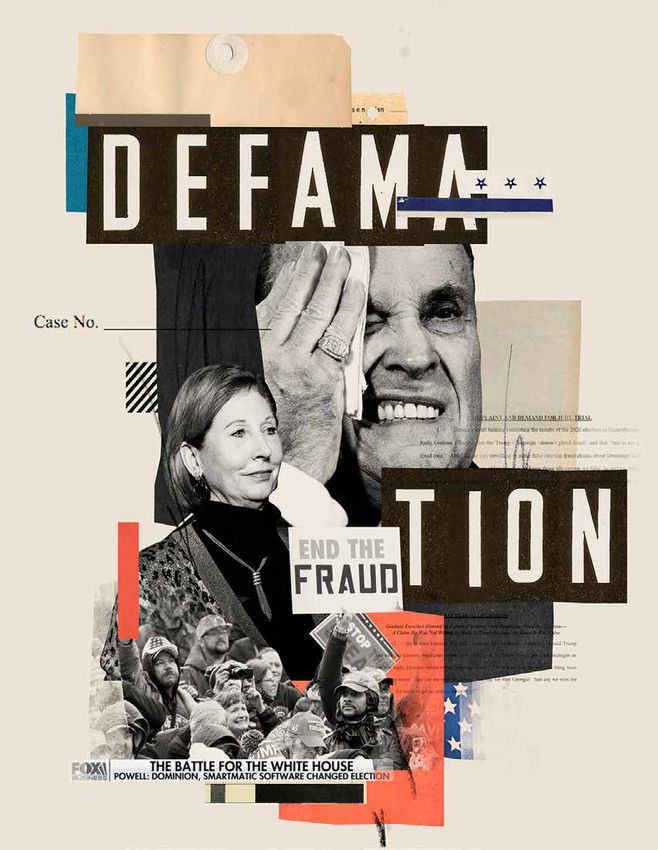
American College of Trial Lawyers

JOURNAL
Chancellor-Founder
Hon. Emil Gumpert
(1895-1982)

OFFICERS
RODNEY ACKER President
MICHAEL L. O’DONNELL President-Elect
SUSAN J. HARRIMAN Treasurer
WILLIAM J. MURPHY Secretary                                               FEATURES
DOUGLAS R. YOUNG Immediate Past President

BOARD OF REGENTS
RODNEY ACKER
Dallas, Texas
                                             DAN S. FOLLUO
                                             Tulsa, Oklahoma
                                                                                02                     05                      11                         15
                                                                                                                                                        The College
                                                                          Letter from the Editor      President’s          Gumpert Award                Lincoln and the
PETER AKMAJIAN                               LARRY H. KRANTZ                                          Perspective          Winner - Arizona           Welcomes
                                                                                                                                                     Modern       New
                                                                                                                                                            Practice of Law
Tucson, Arizona                              New York, New York                                                            Justice Project           Officers & Regents
SUSAN S. BREWER                              MARTIN F. MURPHY
Morgantown, West Virginia                    Boston, Massachusetts
JOE R. CALDWELL, JR.
Washington, D.C.
                                             WILLIAM J. MURPHY
                                             Baltimore, Maryland                23                     31                      35                         25
                                                                                                                                                     Lincoln and the
JOHN A. DAY                                  MICHAEL L. O’DONNELL            Free Speech or           Meet our New         Artists Among Us
Brentwood, Tennessee                         Denver, Colorado                 Defamation?              President                                    Modern Practice of
RICHARD H. DEANE, JR.                        LYN P. PRUITT                                                                                                 Law
Atlanta, Georgia                             Little Rock, Arkansas
MONA T. DUCKETT, Q.C.                        JEFFREY E. STONE
Edmonton, Alberta                            Chicago, Illinois
GREGORY M. LEDERER                           MICHAEL J. SHEPARD
Cedar Rapids, Iowa
SANDRA A. FORBES
                                             San Francisco, California
                                             CATHERINE RECKER
                                                                           FELLOWS IN ACTION
Toronto, Ontario                             Philadelphia, Pennsylvania
SUSAN J. HARRIMAN                            DOUGLAS R. YOUNG

                                                                                46                     54                      41                         47
San Francisco, California                    San Francisco, California

EDITORIAL BOARD
Robert L. Byman (Editor) Chicago, Illinois                                  Awards and Honors          Fellows to          A Conversation With    Never Out Of The Fight —
Elizabeth K. Ainslie Philadelphia, Pennsylvania                                                        the Bench          the Former President      the Eddie Gallagher
Lisa G. Arrowood Boston, Massachusetts                                                                                     of the United States        Court Martial
Carol Elder Bruce Washington, District of Columbia
Brian J. Gover Toronto, Ontario
Christina M. Habas Denver, Colorado
David G. Hanrahan Boston, Massachusetts

                                                                           IN (ALMOST) EVERY ISSUE
Lynne D. Kassie, Ad. E. Montréal, Québec
David N. Kitner Dallas, Texas
Kevin J. Kuhn Denver, Colorado
Carey E. Matovich Billings, Montana
Lorna S. McClusky Memphis, Tennessee

                                                                                39                     43                      47                         51
Clarence L. Pozza, Jr. Detroit, Michigan
Paul Mark Sandler Baltimore, Maryland
Stephen G. Schwarz Rochester, New York
J. Walter Sinclair Boise, Idaho                                             Heroes Among Us         All In The Family      Heritage Profiles             War Stories
Dennis R. Suplee Philadelphia, Pennsylvania                                                                                                             From Fellows
Mark C. Surprenant New Orleans, Louisiana
Chilton Davis Varner Atlanta, Georgia
David J. Wachowich, Q.C. Calgary, Alberta
Sylvia H. Walbolt Tampa, Florida
E. Osborne Ayscue, Jr. (Editor Emeritus) Chapel Hill, North Carolina

MANAGING EDITOR
                                                                               55                     57                      41                        47
                                                                          Foundation Update          In Memoriam          A Conversation With     Never Out Of The Fight —
Sarah Stokes                                                                                                             the Former President       the Eddie Gallagher
                                                                                                                          of the United States         Court Martial
ASSOCIATE EDITOR
Amy Mrugalski, CAE

For comments, inquiries, and submissions,

                                                                           ANNOUNCEMENTS
please email the National Office at ACTLJournal@gmail.com
Liz Doten Design Director
Ben Majors Photographer, EventWorks

Dennis J. Maggi, CAE, Executive Director

                                                                                   4                    42                      53                         70
American College of Trial Lawyers
1300 Dove Street, Suite 150
Newport Beach, California 92660
949.752.1801                                                               2022 Spring Meeting     2022 Annual Meeting        Foundation Ad                 Calendar
www.actl.com                                                                 Announcement             Announcement

     1       JOURNAL
Copyright ©2021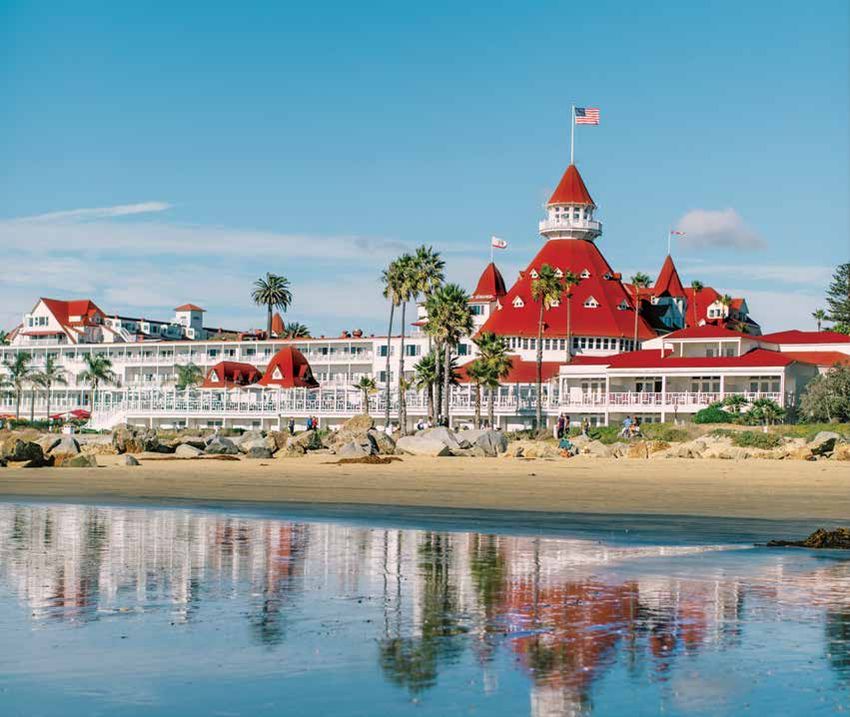
PLEASE SEND CONTRIBUTIONS OR SUGGESTIONS TO ACTLJOURNAL@GMAIL.COM

 DARROW ARGUED THAT THE LAW WAS OBTUSE, IMPENETRABLE, IMPOSSIBLE TO UNDERSTAND. “ARE YOU SUGGESTING, MR. DARROW,”
 QUERIED THE JUDGE, “THAT IGNORANCE OF THE LAW IS A DEFENSE?” “WHY NO,” DARROW REPLIED, “ALL MEN ARE PRESUMED TO
 KNOW THE LAW. THE TINKER, THE TAILOR, THE CANDLESTICK MAKER – ALL MEN ARE PRESUMED TO KNOW THE LAW. EXCEPT, OF
 COURSE, TRIAL JUDGES LIKE YOURSELF – FOR WHOM WE HAVE WISELY PROVIDED COURTS OF APPEAL.”

We are lawyers. We are presumed to know the law. To get our          Of course they can’t. How could any lawyer suggest such a
licenses to practice law, we are required to demonstrate char-       thing? But Meadows’ initial reaction notwithstanding, “Just
acter and fitness.                                                   say we won” is exactly what happened. President Trump,
                                                                     and people allied with him, simply declared, without actual
The College does not take political positions. The Journal, as
                                                                     evidence, that he won the election. In a December 2020
the official publication of the College, does not take political
                                                                     interview with Fox News, Trump said “We keep going, and
positions. So I have, but will not express, my own opinions on
                                                                     we’re going to continue to go forward. . . . We’re, you know, in
political issues. Pshaw. You didn’t roll off a radish truck. You
                                                                     some of the states that got rigged and robbed from us. We won
will be easily able to infer my political point of view, expressed
                                                                     every one of them. We won Pennsylvania. We won Michigan.
or not. But I’m really trying here not to be political, so give
                                                                     We won Georgia by a lot.”
me a break. The College doesn’t take political positions, but
it does advocate in furtherance of its mission: “The College          So, here’s my point. It’s okay that Trump said that. Right
maintains and seeks to improve the standards of trial practice,       or wrong, he has the right to say it. But Rudy Giuliani, as
professionalism, ethics, and the administration of justice . . .”     Trump’s lawyer, does not have the right to say it – unless he
So I want to take a stance – a purely personal stance – not on        can back it up. And given the chance, he could not. On June
a political issue but on an issue of professionalism, ethics and      24, 2021, a New York court took the extraordinary step of
the administration of justice.                                        issuing an interim suspension of Rudy Giuliani’s right to prac-
 The recently released book, I Alone Can Fix It, recounts that on tice law, finding that “The seriousness of [his] uncontroverted
 November 3, 2020, as election returns began to roll in, Presi- misconduct cannot be overstated.”
 dent Trump’s personal lawyer, Rudolph Giuliani, announced
                                                                      In the weeks and months following the election, Giuliani
 that he had come up with a strategy he needed to relate to
                                                                      claimed that more than 600,000 mail-in ballots were returned
 the President. A group of Trump advisors, including White
                                                                      in Pennsylvania than were mailed out; he claimed that as
 House Chief of Staff Mark Meadows, heard him out. “What’s
                                                                      many as 30,000 dead people, including former heavyweight
 happening in Michigan?” Giuliani asked. Someone responded
                                                                      champ Joe Frazier, voted in Philadelphia; he claimed that
 that it was too early to tell, votes were still being counted. “Just
                                                                      Dominion voting machines were manipulated to mis-count
 say we won,” Giuliani told them. Same thing in Pennsylvania.
“Just say we won Pennsylvania,” Giuliani said.                        Georgia votes (see article at p. 23, infra); he claimed that as
                                                                      many as 165,000 underage persons, as many as 10,000 dead
“We can’t do that,” Meadows reportedly said, raising his voice. persons, and as many as 2,500 disenfranchised felons voted in
“We can’t.”                                                           Georgia; and he claimed that as many as 250,000 illegal aliens

                                                                                                       FALL 2021        JOURNAL         2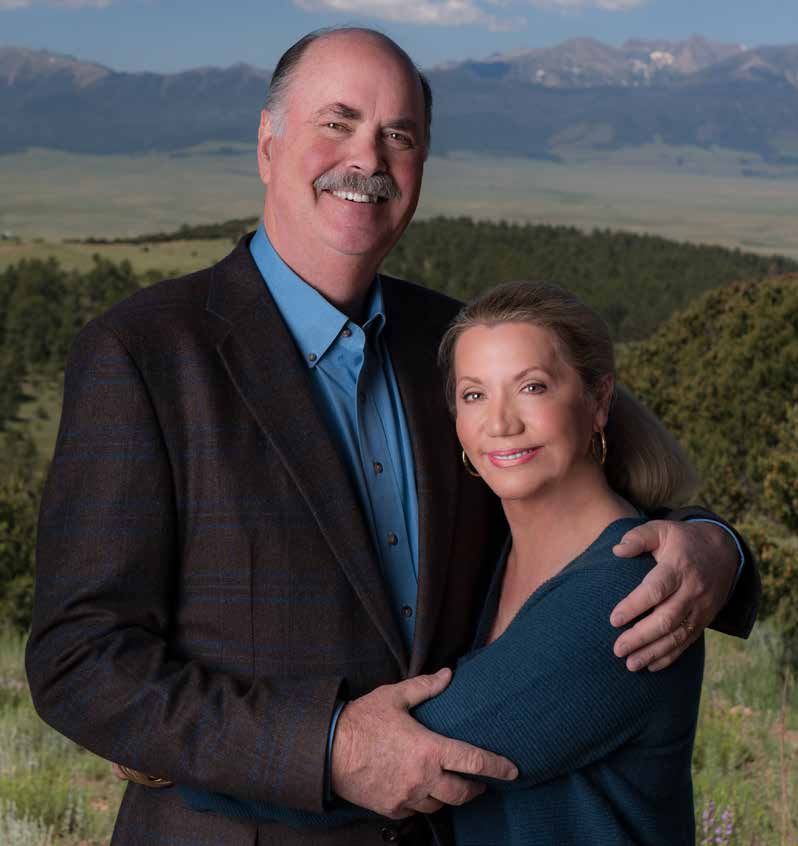
voted in Arizona. The court found that not one of these claims    lican Presidential debates, candidate Trump said “If I become
    was true. Not remotely true. Joe Frazier did not vote from the    President, we will win on everything we do.” Winning is hard-
    grave nor did anyone else. Hand counts in each state verified     wired in him; so him saying he won, whether or not he did, is
    the official results. Giuliani was given ample opportunity to     all but expected. But Giuliani – if he wants to regain his law
    offer evidence to support his claims, and he could not.           license – has to meet a higher standard.

    Politicians can and more often than not lie to us. Car salesmen On June 5, 1944, General Dwight Eisenhower composed this
    can and do puff. And that’s okay. The First Amendment has speech:
    limits – you can’t yell “Fire!” in a crowded theater, you can’t
    defame someone – but within those limits, most people can “Our landings in the Cherbourg-Havre area have failed to gain
    say pretty much whatever they want, true or not. But not us. a satisfactory foothold and I have withdrawn the troops. My
    We are lawyers. We are, we should be, held to a higher stan- decision to attack at this time and place was based on the best
    dard. Justice cannot be fairly administered if its stewards are information available. The troops, the air and the Navy did all
    allowed to ignore, misstate or mangle the truth.                   that Bravery and devotion to duty could do. If any blame or
                                                                       fault attaches to the attempt it is mine alone.”
    It is long recognized that “speech by an attorney is sub-
    ject to greater regulation than speech by others.” Gentile v. He did not, of course, have to deliver that speech. The D-Day
    State Bar of Nevada, 501 U.S. 1030, 1051, 111 S.Ct. 2720 landing was successful. But Eisenhower saw that failure was
    (1991). Lawyers have professional and ethical responsibili- possible; he planned for the possibility; and he was fully pre-
    ties to speak the truth.                                           pared to shoulder the consequence. A lawyer has to demon-
                                                                       strate character and fitness. And if you want to understand the
    Okay, as defense lawyers, we are not required, we are not
                                                                       very essence of character, simply compare “Just say we won”
    allowed, to blurt out that our client is guilty of the crime
                                                                       with “If any blame or fault attaches it is mine alone.”
    charged even if we know that to be the truth; we are allowed,
    we are obliged, to sit silent and put the prosecution to its                                ***************
    burden. But we can’t allow our client – if we know she com-
    mitted the crime – to take the stand and deny the truth. We We have a great issue for you. Former Regents Steve
    don’t always have to tell the whole truth – but we can never Schwarz and Ritchie Berger discuss the status and import
    stand up and lie.                                                  of the Dominion and Smartmatic defamation cases. We get a
                                                                       Canadian homage to an American President, in Guy Pratte’s
    Whether you believe the election was stolen or that the claim article on Lincoln. We spotlight, as part of our continuing
    of a steal is a big lie, Trump has the right, without consequence, record on the Heritage of the College, a Fellow who started his
    to claim “I won.” His lawyer does not. He can’t ethically make career representing Lt. William Calley in the My Lai massacre
    that claim without a good-faith basis in fact.                     prosecution; we honor another Fellow who served with honor
                                                                       and heroism in that same war. And more. I hope you enjoy.
    Trump can be excused. Trump expects to win; he doesn’t plan
    for and doesn’t accept anything else. During the 2016 Repub- Bob Byman

3     JOURNAL
LANCE ARMSTRONG                                                                               JAY KUO, J.D.
     Survivor, Author,
                          Accomplished speakers, unique experiences and an                Attorney, Tony-winning Broadway
  World Class Sportsman    expert panel discussing Violence Against Judges.                    producer and composer

FEB 24-FEB 27 2022 SPRING MEETING                                                           Hotel del Coronado
                                                                                            Coronado, California

  Save The Date
                                                                              FALL 2021         JOURNAL           4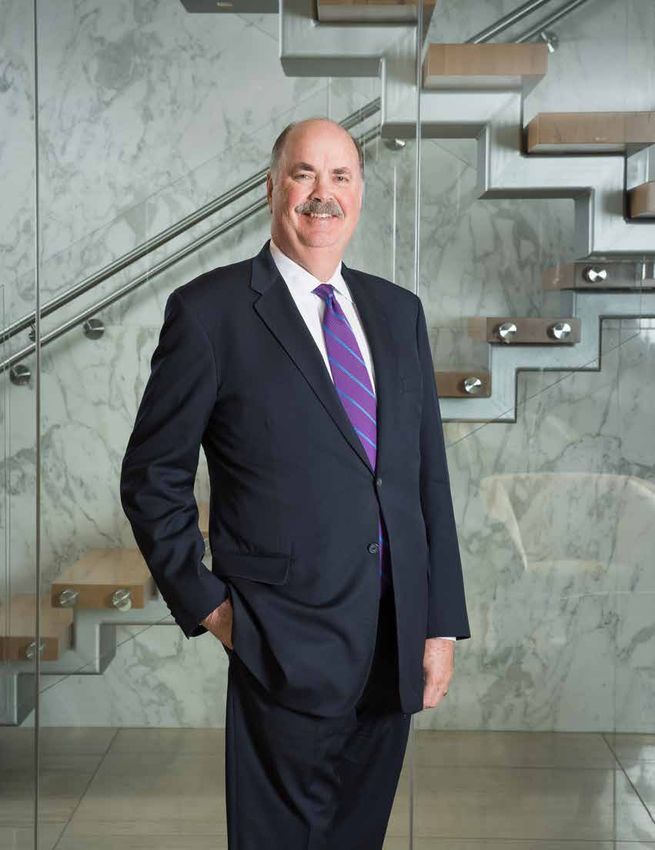
PRESIDENT’S REPORT –
                RODNEY ACKER,
                PRESIDENT 2020-2021
    THE COLLEGE IS IN GREAT SHAPE. THE COLLEGE’S COMMITTEES AND
    TASK FORCES HAVE ADJUSTED TO THE LIMITATIONS CREATED BY THE
    PANDEMIC AND ARE FULLY ENGAGED IN FULFILLING THE COLLEGE’S
    MISSION AND THEIR COMMITTEE MANDATES. REDUCED TRAVEL AND
    OTHER EXPENSES COUPLED WITH A GOOD STOCK MARKET HAVE PUT US
    IN AN EXCELLENT FINANCIAL POSITION. NONE OF THIS WAS BY ACCI-
    DENT, AND IT HAS NOT BEEN WITHOUT ITS CHALLENGES. THE COLLEGE
    CONSISTS OF SOME VERY REMARKABLE PEOPLE, BOTH FELLOWS AND
    OUR STAFF. OVER THE LAST YEAR, THOSE PEOPLE HAVE COME TOGETHER
    TO FURTHER THE MISSIONS OF THE COLLEGE. IT HAS BEEN A PRIVILEGE
    TO WORK WITH EACH OF THEM, AND I AM GRATEFUL TO ALL OF THEM.

    Of course, my gratitude starts with my wife Judy. No one could
    have asked for a better partner and a more calming influence.
    A very funny former First Lady was once asked, what was the
    hardest thing about being First Lady? Without hesitation she
    quipped — spending 200 nights in a hotel room with my
    husband. Well, Judy went her one better — 365 days (almost)
    at home with me with (almost) no complaints. Shortly before
    this Journal is published, we will have celebrated our 49th
    Wedding Anniversary. Who’d have thunk it in 1972.

    I was also truly blessed to have a remarkable Executive Com-
    mittee. One of the most rewarding aspects of being on the
    Executive Committee for the last four years has been to
    spend in-person time with four talented and interesting
    people and their significant others. While we had no in per-
    son gatherings for almost fifteen months, regular Zoom calls

5     JOURNAL
created the opportunity to develop strong bonds. Finally, we ones, the silver lining was spending additional time with my
had in-person meetings in May and then again in June. I felt wife. Travel is beginning to resume. There are approximately
as though we had not missed a beat through the months of five in-person events scheduled between the last week in June
physical separation. For my four years on the Executive Com- and the Annual Meeting in Chicago, including one region-
mittee, I can’t recall a single instance where the Executive al meeting. From my conversations with Fellows across both
Committee took any action (or declined to take any action) countries and the results of a survey about attending in-person
without unanimous consent. That tradition continued this meetings, it is obvious Fellows are looking forward to gather-
year. The College could not be in better hands for the com- ing both locally and nationally. We remain confident that the
ing year than it will be with President-Elect Mike O’Donnell. Annual Meeting in Chicago will be in-person (with a virtual
                                                                 component for those who don’t yet feel safe traveling). Presi-
The broader leadership of the College is housed in the Board of
                                                                 dent–Elect Mike O’Donnell has recruited some great speakers,
Regents, the Past Presidents, and the Committees. While you
                                                                 and we expect a big crowd.
might expect Board Meetings lasting six hours on Zoom with
30+ lawyers would be challenging, the Board maintained both The fact that there were few in-person meetings did not stop
focus and collegiality in continuing the College’s work. Zoom the Fellows from gathering virtually. The first two virtual na-
calls also allowed for more and closer work with the Commit- tional meetings of the College drew the highest Fellow registra-
tees. Although anxious to be back to in-person meetings, the tions in College history. The success of those virtual meetings
technology allowed the Committees to meet more effectively has resulted in the decision to include a virtual component in
and more often, and we will see that continue.                   future national meetings even when we are back to unrestrict-
                                                                 ed, in-person attendance. State and province committees were
THE RETURN TO IN-PERSON
                                                                 also adept at making the most of a bad situation by holding
GATHERINGS (HOPE FOR WHAT’S COMING)
                                                                 virtual cocktail, lunch and dinner calls in addition to state and
Missing from the last fourteen months has been the in-person province committee meetings. Some events were very creative
Fellowship that is the essence of the College. Like the Presi- such as the Alberta Fellows virtual bar crawl. Even the College
dents and their spouses before us, Judy and I were excited about sponsored competitions adjusted and were all held virtually for
carrying the College flag on our visits to the states and prov- the first time ever and went off without a hitch. Judging the law
inces in both countries. The pandemic restricted all trips from students in these competitions is always a highlight for every
the Spring 2020 Meeting until the Kentucky Fellows held the president of the College. The students are talented, well pre-
first in-person gathering in May 2021. While Judy and I were pared, well coached, and the future of trial practice. Typically,
disappointed not to travel and see old friends and make new there is an opportunity to visit with the competitors after the

                                                                                                    FALL 2021        JOURNAL         6
competition, but even when that is missing, the competitions         rapid response team, to respond on either a local or national
    are still fun for both the competitors and the Fellows who judge.    level. These statements are well documented and can be seen
                                                                         on the website. Although we expected that the assaults would
    College sponsored competitions:                                      have subsided following the inauguration, we were wrong. In
                                                                         June, the College again spoke out on personal attacks against a
     COMPETITION                    WINNER
                                                                         Southern California federal judge after his ruling on an assault
     Gale Cup                       Univesité Laval                      weapons statute. The nature of both verbal and physical attacks
                                                                         against judges was the subject of a 60 Minutes article. According
     Sopinka Cup                    Univesité d’Ottawa
                                                                         to 60 Minutes, there were 4000 verbal or physical attacks threat-
     National Moot Court            Loyola Law School, Los Angeles       ened against federal judges last year, up more than 400% from
     Competition                                                         five years ago. The Federal Judges Association asked the College
     National Trial Competition     Loyola Law School, Los Angeles       to participate in a forum hosted by Duke Law School and ad-
                                                                         dress how the organized bar can assist in curbing this trend. I
                                                                         was honored to participate and explain what the College is do-
    JUDICIAL INDEPENDENCE AND PUBLIC STATEMENTS:
                                                                         ing through its Judicial Independence Committee. John Wester
    As our politics have become more rancorous, attacks on poli-         has participated in similar presentations.
    ticians and the judiciary are more prevalent. Over the last few
                                                                         Second, to advance the College’s commitment to supporting
    years, the College made statements when these attacks were
                                                                         the Judiciary, the College authorized the Judicial Indepen-
    a threat to our mission to protect the rule of law and the in-
                                                                         dence Committee to engage with the National Association
    dependence of the judiciary. In the months leading up to the
                                                                         of Women Judges in a two-year pilot project to educate the
    presidential election and continuing until the inauguration,
                                                                         adult public about the meaning and importance of judicial in-
    these attacks increased exponentially and the College could
                                                                         dependence. In collaboration with the NAWJ, the committee,
    have released statements almost daily. Indeed, Fellows contact-
                                                                         under the leadership of Virginia (Ginny) Nelson, Kathleen
    ed the National Office frequently requesting that the College
                                                                         Trafford and Natalie Tarantino, produced a PowerPoint pre-
    condemn politicians on both sides of the aisle for their actions,
                                                                         sentation and supporting materials to be used by Fellows and
    statements and attacks on judges.
                                                                         NAWJ member judges to speak to civic groups and other adult
    The College did speak, including an op-ed in Bloomberg Law           audiences about the judiciary and the rule of law.
    condemning the numerous attacks and threats against the jus-
                                                                         Despite the logistic challenges due to pandemic restrictions,
    tices on the Wisconsin Supreme Court. For many, these state-
                                                                         six presentations were given in multiple states last Fall or this
    ments were not enough. As I explained to many of the Fellows
                                                                         past Spring. Another five presentations were confirmed for late
    with whom I spoke individually, the College includes many
                                                                         Summer and Fall 2021, and several more are in the planning
    passionate Fellows in each party who have conflicting views on
                                                                         stages at the time of this writing for Fall 2021. Many thanks
    when and what should be said. The College, however, attempts
                                                                         to the Fellows who participated in the pilot project and gave a
    to remain non-political. Although it is important for our voice to
                                                                         presentation to an audience in their local area. You performed
    be heard on issues involving our mission, the College’s policy on
                                                                         a valuable service to the College in its effort to support the
    public statements cautions restraint when making any statement
                                                                         Judiciary and educate the public.
    that could affect the collegiality of the College.
                                                                         At the end of the year, the committee will prepare a report
        “Although not included among our core missions, collegiality
                                                                         for the Board of Regents in which it will evaluate the project
         is as important as any of those missions, and no statements     and the Fellows’ receptiveness to this important work. It will
         should be made which unduly threaten our collegiality by        make recommendations as to whether the project should be
         taking a position on one side of a matter of genuine and        continued and in what manner or format. It is unlikely that
         divisive controversy.” ACTL Guidelines for Public Statements    the need for the College to actively support judicial inde-
    Defending judicial independence has long been a core mission         pendence and the protection it affords the rule of law will
    of the College. Historically, a number of committees worked          diminish in the short-term.
    on judicial independence issues. However, the College stepped        FELLOW ENGAGEMENT:
    up its efforts to defend judicial independence with the creation
    of the Judicial Independence Committee in 2019. Headed by            In 2020, the College contracted with McKinley Advisors to as-
    Chair John Wester, the committee focuses on two separate but         sist with a new Fellow Engagement project. The goal is to have
    equally important functions. First, the committee is vigilant        more involvement by Fellows generally and particularly newly
    to identify attacks on the judiciary and prepared, through its       inducted Fellows. McKinley Advisors conducted surveys of the

7     JOURNAL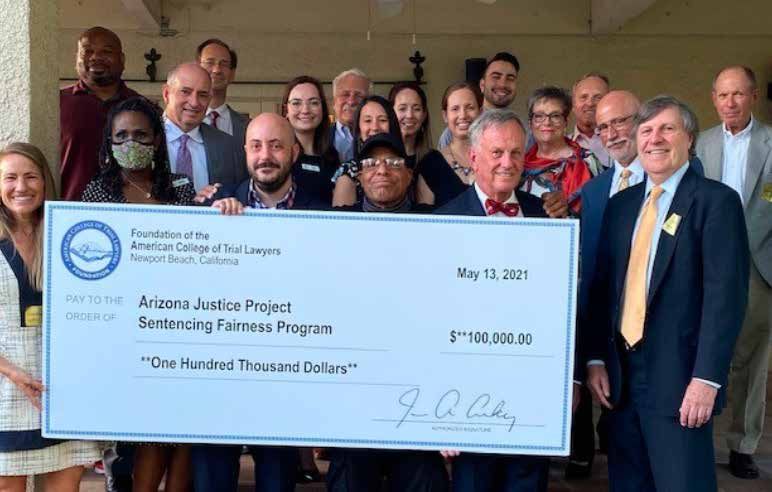
College to identify any barriers to participation and modify our noted: “Indeed, the need for young trial lawyers to be able to
existing structure in a way that would allow more Fellows to learn trial skills and the importance of civility in trial practice
participate. McKinley’s report was delivered to the Executive has become even more acute with the lack of face to face con-
Committee in June of 2020. The Executive Committee created tact necessitated by the social distancing of the Pandemic.”
a Task Force to work with McKinley to implement its findings
                                                                  I asked Past President Leon and former Regent Christy Jones
and recommendations. To date, the Task Force has completed
                                                                  to consider the next steps in the College’s mentoring efforts.
the first two recommendations (rethinking expectations of vol-
                                                                  After meeting virtually with the Chairs of several committees
unteers and documenting their responsibilities) and has moved
                                                                  and considering many suggestions and options, Jeff and Chris-
considerably through the third recommendation (centralizing
                                                                  ty submitted their report and six recommendations on Febru-
resources into a volunteer portal). In the near future, the Task ary 10, 2021. Their recommendations included (1) organiz-
Force will move into the fourth recommendation (increasing ing a library and making accessible teaching materials already
communication effectiveness). For this portion of the effort, in existence at the College to help younger lawyers in need of
the Task Force will design and implement a mentorship pro- mentoring; (2) developing a program for contacting corporate
gram for new Fellows to actively and engage them in College counsel for assistance in providing in-court opportunities for
activities from the beginning of their Fellowship.                junior trial lawyers; (3) organizing and making accessible to the
                                                                  judiciary a catalogue of initiatives undertaken by various courts
The Task Force consists of Cal Mayo (Oxford, MS) (chair),
                                                                  that offer increased opportunities for young lawyers to appear
Michelle Awad (Halifax, NS), Renee Rothauge (Portland,
                                                                  in court; (4) promoting wide circulation of the papers produced
OR), Felix Luna (Seattle, WA), and Khaldoun Baghdadi
                                                                  by the College’s Task Force on Advocacy in the 21st Century,
(San Francisco, CA). We expect the Task Force to have sub-
                                                                  particularly to provide direction on effective advocacy in virtual
stantially completed its work and present the results to the
                                                                  hearings; (5) encouraging pro bono work as a means to obtain
Board at the Annual Meeting.
                                                                  trial experience; and (6) issuing a “Mentoring Challenge” to
MENTORING:                                                        state and province committees. The Mentoring Task Force has
                                                                  now become a permanent Mentoring Committee. On June 3,
Mentoring young lawyers has long been a focus of the College I wrote the state and province chairs asking them to appoint
and has been viewed as essential to developing the next gen- a mentoring liaison to begin working with and as part of the
erations of trial lawyers. In 2019, the Mentoring Task Force Mentoring Committee. The Mentoring Committee is chaired
issued its report titled: “Mentoring the Next Generation of trial by former Regent John Siffert and, like the Fellows serving as
Lawyers—Developing Excellent Trial Lawyers in an era of Di- Diversity Liaisons, the Committee and the Mentoring Liaisons
minishing Trials.” That report provided a blueprint for men- will have periodic calls with the President. Mentoring is partic-
toring through Law Firm/In-House Trial Training Programs, ularly localized by its nature and we are hopeful that the new
Bar Associations, the Judiciary, Corporate Counsel and the Col- initiative will develop robust mentoring programs in each state
lege itself. When the pandemic hit, Past President Jeff Leon and province. The committee is off to a good start, partnering

                                                                                                      FALL 2021        JOURNAL         8
with Just the Beginning — A Pipeline Organization to         Honorable Lord Hodge (Deputy President of the Su-
              create an ACTL Summer Judicial Internship program.           preme Court of the UK); The Right Honorable Lady
              Funded by a grant from the Foundation, the program           Arden (Justice of the Supreme Court of the UK); The
              will provide stipends to law students who could not          Right Honorable Lord Mance (Deputy President (ret)
              otherwise avail themselves of the opportunity to work        of the Supreme Court of the UK); The Right Honor-
              in the chambers of state and federal judges. The new         able Lady Dorian; The Right Honorable Sir Declan
              ACTL SJI program is national in scope. We hope that          Morgan (Lord Chief Justice of Northern Ireland); The
              Judicial Fellows around the country will volunteer to        Right Honorable Sir Geoffrey Vos (Master of the Rolls);
              participate by hiring these interns, and that Fellows        The Right Honorable Lord Justice Flaux (Chancellor
              throughout the country will organize mentoring events        of the High Court); Dame Karen Steyn DBE (Judge of
              for the ACTL SJI’s. We believe this new program has          the High Court of England and Wales, Queen’s Bench
              the potential to become a recurring opportunity to           Division); The Honorable Dame Justine Thornton
              mentor aspiring lawyers, to involve Judicial Fellows in      DBE (Judge of the High Court of England and Wales,
              College activities and to increase the visibility of the     Queen’s Bench Division), and two Barristers: Sir James
              College among the interns and judges who participate.        Eadie QC and Helen Davies QC. In addition to Doug
                                                                           Young, the US Delegates include Regents John Day,
              MARSHALL SCHOLARS FORUM ON THE                               Rick Deane, Susan Brewer, Fellows Andrea La’Verne
              RULE OF LAW: LEGAL ISSUES IN A POST                          Edney, Ashok Ramani, Adam K. Peck and Judicial
              PANDEMIC SOCIETY FROM A CULTURAL                             Fellows USCA (1st Circuit) The Honorable William J.
              AND SOCIAL VIEWPOINT                                         Kayatta and USDJ (NDTX) The Honorable Barbara
                                                                           M. G. Lynn, as well as The Honorable Martin Jenkens
              The Marshall Scholarship program was created in 1953 (Associate Justice of the California Supreme Court),
              shortly after World War II by the British government and USDJ (DAZ) The Honorable Diane Humetewa.
              at the proposal of Sir Roger Mellor Makins, Deputy Topics for the program will include Covid and the
              Undersecretary of State. The program is named after Courts, Free Speech and the Internet, The Rule of Law
              General George C. Marshall (“the Marshall Plan”). The and an Independent Judiciary, Copyright and Technol-
              scholarships provide for post graduate study in England ogies of the Future, Separation of Powers and National/
              by US students in a wide range of fields. The number of International Security and the Law. The program will
              scholarships has increased over the years, and forty-eight be held at the Supreme Court building. There will be
              scholarships were awarded in 2019. The list of the 2000+ dinners at the USSC and the British Embassy. It ap-
              alumni of the Marshall Scholars program is truly im- pears that the Marshall Scholars Program is the start
              pressive, and includes a Nobel Prize winner in chemistry, of a project that will benefit the College much the
              holders of more than fifty patents, financiers with more same as our Legal Exchanges with the UK and Canada.
              than $44 Billion in assets, ten university presidents, thir-
              ty-eight members of the American Academy of Arts & BOOT CAMP:
              Sciences, and six Pulitzer Prize winners.
                                                                           One of the successful programs undertaken in recent
              Earlier this year, the College was approached by Nell years includes the one-day Boot Camp Trial Training
              Breyer, Justice Stephen Breyer’s daughter and Execu- Program for Young Lawyers, headed by Paul Mark San-
              tive Director of the Association of Marshall Scholars, dler and a team of enthusiastic Committee members.
              about creating a program in connection with the Asso- These one day, in-person programs use an historic case
              ciation of Marshall Scholars. The Executive Commit- for the day tailored to the programs’ lectures, demon-
              tee quickly approved the project and Past President strations, and panel discussions. While more than six
              Doug Young is leading this effort by the College. The programs were conducted in person before the pandem-
              program, which was originally planned for September, ic, the committee successfully transitioned to a Zoom
              will be presented next Spring over three days in Wash- format presenting a program in Salt Lake City under the
              ington D.C. Anticipated participants include Justices leadership of Andrew Morse (over 250 young lawyers
              Gorsuch, Breyer, Alito, and Sotomayor and possibly attended), and in Cincinnati under the leadership of
              several other justices who are still considering their John Gilligan. With the return of in-person meetings,
              participation. It is anticipated that Chief Justice Rob- the committee will be scheduling fourteen boot camps
              erts will welcome the delegates at the opening dinner. for this fall and 2022, beginning with Oklahoma on Au-
              The UK delegation tentatively includes: The Right gust 6. The key to successful programs is the enthusiasm

9   JOURNAL
of Fellows in jurisdictions around the country forming accessible and affordable while actively promoting the
“local teams” to help organize and join the boot camp traditions of in-person advocacy in a public courtroom.
faculty of twenty-three judges and lawyers.
The committee is now poised to explore additional
ADVOCACY IN THE 21ST CENTURY: issues concerning advocacy in the 21st century. It is
expected the committee will identify issues that would
The Advocacy in the 21st Century Committee (“A21C benefit from the experience and expertise of the Fellows
Committee”) arose from a task force of the same name of the College, and then work with other College com-
launched by Past President Doug Young in the Spring of mittees and outside groups to lend the College’s voice
2020. As Covid-19 began to wreak havoc on the court to the discussion of those issues.
systems of Canada and the United States, it was obvi-
ous that the response to the pandemic was going to im- The A21C Committee and its predecessor are shining
pact the administration of justice long after society was examples of how the College can use the leadership and
able to medically manage the Covid-19 threat. Doug experience of its Fellows to assist the Bench and Bar in
and the Executive Committee determined that the our two nations.
College needed to lend its experience and voice on the
use of technology and other administration of justice AWARDS
issues brought quickly to the forefront by the pandemic.
The Board of Regents approved three awards this year:
Regent John Day of Nashville was appointed to lead
the task force, comprised of judges and lawyers from The 2021 Emil Gumpert Award was given to The Ari-
across the US and Canada. The group quickly sprang zona Justice Project to support and fund its program to
into action, meeting frequently via Zoom. In just over address inequities resulting from conflicting interpre-
two months, it created a series of white papers on the tations of The Arizona 1993 Truth in Sentencing Act.
use of remote video in depositions, examinations for The AJP, and several Fellows who work closely with the
discovery, hearings, non-jury trials, and appellate ar- AJP, were involved in appealing Chaparro v. Shinn in
guments, as well an extensive paper titled “Issues to which the Arizona Supreme Court unanimously per-
be Considered When Preparing for and Conducting a mitted parole eligibility for convicts in cases where
Civil Jury Trial During the Pandemic.” Shortly there- judges imposed sentences that specifically stated that
after, the task force released a thorough examination parole was a possibility.
of the constitutional issues that arose in US courts in
The Griffin Bell Award will be presented to John
their efforts to manage a criminal docket in an era of
Rosenberg, founder of the Appalachian Citizens Law
mask-wearing and social distancing. Then, in Septem-
Center, a nonprofit law firm in Whitesburg Kentucky,
ber, the Board approved the Committee’s “Overarch-
that has helped thousands of former coal miners and
ing Principles Applicable to Civil Trials,” a major pol-
their widows seeking black lung benefits.
icy statement setting forth the College’s position on
the preference for in-person court proceedings, while The first Thurgood Marshall Award for Equality and
also recognizing how technology can play a role in the Justice will be presented posthumously to the family
delivery of justice. of Congressman John Lewis and will be accepted by
his son, John Miles Lewis. Congressman Lewis led the
In September, the Board of Regents converted the task
charge for civil rights dating back to before his partici-
force into a general committee, retaining John Day as
pation in the march at Selma Alabama.
Chair, selecting Fellow Roslyn Levine of Toronto as
Vice-Chair, and expanding the group. The A21C Com-
CONCLUSION:
mittee immediately went to work on reviewing and up-
dating its earlier papers, presenting them to Executive To finish where I started, the College is well positioned
Committee and Board for approval at the Spring Meet- to move forward. It has been a challenging year for both
ing. The committee then undertook an effort to reach the legal profession and the College. The College has
out to several other organizations, offering to assist remained focused on its mission to further the adminis-
them in their efforts to take what was learned during tration of justice despite those challenges.
the pandemic and see what changes can be made to the
court systems in both countries to make justice more Rodney Acker
FALL 2021 JOURNAL 10ARIZONA JUSTICE PROJECT TO
RECEIVE 2021 EMIL GUMPERT AWARD
11 JOURNALTHE GENEROSITY OF THE AMERICAN COLLEGE OF TRIAL LAWYERS WILL GIVE THE ARIZONA JUSTICE PROJECT
THE ABILITY TO MAKE A MEANINGFUL DIFFERENCE IN THE LIVES OF A GROUP OF PRISONERS IN ARIZONA,
WHO HAVE ALL SERVED SIGNIFICANT TIME AND ARE ENTITLED TO BE CONSIDERED FOR PAROLE, BUT DO NOT
KNOW THEIR RIGHTS OR HAVE THE RESOURCES TO PURSUE THEM.
— LEE STEIN, CHAIR OF THE BOARD OF THE ARIZONA JUSTICE PROJECT
The Emil Gumpert Award is the highest honor conferred annually by the College. The $100,000
Award, funded by the ACTL Foundation, is granted to an organization whose principal purpose
is to maintain and improve the administration of justice – an organization to which the monetary
award will make a real difference to the organization and its goals. The Award “is the crown jewel
of our beloved College,” says Joan Lukey, President of the ACTL Foundation.
The recipient of the 2021 Award is the Arizona Justice Project (“AJP”) and, in particular, its Sentenc-
ing Fairness Program: A Legal Right to a Second Chance. “This Award, which we are thrilled to receive,
will allow us to expand our reach in creating a meaningful opportunity at release for hundreds of
individuals who would otherwise languish in prison, help people prepare for a parole hearing, and
plan for re-entry into society. We want to be able to aid more worthy individuals and, under this
grant Program, we will create materials that could be used all over the country for lawyers, commu-
nity volunteers, and prisoners themselves with guidance on how to prepare for a parole hearing and
how to plan for re-entry,” said Lindsay Herf, AJP’s Executive Director.
The late Larry Hammond, one of the ACTL’s Access to Justice Distinguished Pro Bono Fellows,
founded the AJP in 1998. The AJP’s mission is to “represent indigent Arizona inmates whose
claims of innocence or manifest injustice have gone unheeded.” Over the years, in addition to Lar-
FALL 2021 JOURNAL 12ry Hammond, many Fellows have been actively The AJP, in conjunction with a pro bono legal
involved in the work of the AJP: Distinguished team led by ACTL Distinguished Pro Bono
Pro Bono Fellow Howard Cabot, Regent Peter Fellow Howard Cabot, successfully challenged
Akmajian (who will present the Emil Gumpert the ADOC’s decision before the Arizona Su-
Award to the AJP at the College’s Annual Meet- preme Court in Chaparro v. Shinn, holding that
ing), Randy Papetti, Michael Piccarreta, Jor- Chaparro was eligible for parole after serving 25
years pursuant to his original sentence. That land-
dan Green, and Jeffrey Willis. Since 2018,
mark decision became the driving force behind
the AJP has been one of the College’s recog-
the AJP’s development of its Sentencing Fairness
nized Access to Justice Distinguished Partners.
Program: A Legal Right to a Second Chance.
In 1993, the Arizona legislature enacted a
The Emil Gumpert Award grant will allow
“Truth in Sentencing” law that abolished pa- the AJP to hire much needed additional staff
role for any convictions occurring on or af- to help initiate and coordinate parole hearings
ter January 1, 1994. But, because the statute to which several hundred eligible prisoners in
did not expressly refer to the state’s Criminal Arizona are now entitled because of the Chap-
Code and criminal court proceedings, lawyers arro decision. The AJP’s work in this area will
continued to recommend to their clients and be supported by the pro bono service of many
courts continued to enter sentences of “life dedicated ACTL Fellows and other lawyers
without possibility of parole for 25 years,” throughout Arizona. “The Emil Gumpert
mistakenly believing that parole remained Award allows the Arizona Justice Project to help
a real possibility. One such person was Abe- many individuals who have rehabilitated them-
lardo Chaparro, who had served more than selves to emerge from the penal system and re-
twenty years by 2017 when the Arizona De- alize their potential as productive citizens. This
Award gives much needed hope to those who
partment of Corrections (“ADOC”) informed
have paid their debt to society and earned the
him that he would not be parole eligible af-
right to a second chance,” says Howard Cabot.
ter serving twenty-five years or, for that mat-
ter, ever. Based upon the 1993 statute, the Lee Stein, current Chair of the Board of the AJP,
ADOC belatedly determined to write out of emphasizes: “Following the Justice Project’s suc-
Chaparro’s sentence the words “for 25 years,” cessful challenge in the Arizona Supreme Court
thereby converting the sentence to “life with- in 2020, we have been inundated with requests
out possibility of parole.” Hundreds of simi- for assistance by individuals with compelling
larly situated prisoners faced an identical fate. cases. The Emil Gumpert Award gives us the
13 JOURNALopportunity to meet that need. Without this funding, nobody would do
this work. We are extremely grateful to the College for recognizing the EDITOR’S NOTE
importance of this project.”
The Gumpert Committee is one of the
Because of the AJP, many individuals will receive their legally entitled hardest working groups in the College.
right to a second chance to lead a productive and fulfilling life. “Without
In any given year, it reviews dozens of
applications in weekly meetings over
a doubt, the Arizona Justice Project has changed my life. In prison, you
many months, winnowing the candidates
just exist. You are not living. I can finally start living again, and I couldn’t
to three finalists, for which teams of
be happier,” stresses Nevada Freeman. For Carlos Ybarra, the AJP has
Committee members are dispatched to
allowed his dreams of a new life to become a reality: “You know for a
make site visits and detailed reports.
long time I was invisible because I was in prison. We weren’t treated as I know first-hand how dedicated and
humans, just laborers or trash. After a long time of being treated like that, hard working the Committee Chair, Mark
you begin to believe it is true. The Arizona Justice Project saw me as a Surprenant, has been. And typical of Mark,
man and treated me like a person. I feel like I owe a lot to them because he insisted, as the price of authoring
they helped me when I needed it the most. Lindsay Herf [AJP’s Executive this article, that this note be added:
Director] is a great attorney, really smart and kind. Tansha Harrell [AJP’s “As Chair of the Gumpert Committee, I
Social Work Director] is not just a social worker, but a woman who cares thank all Committee members for their hard
and always reminds me that I have something to offer the world. The Ar- work, dedication, and conscientiousness:
izona Justice Project has given me a chance to reconnect with my family Kathryn Snapka (Vice Chair), Judy
and friends. They have given me a new outlook on life. They have helped Barrasso, Eugene Brown, Jr., Robert Byman
me see where I want to better myself and made me want to help others (Foundation representative), Howard
in need. Tansha taught me that it is ok to have dreams and to follow Cabot, Nancy Gellman, John Houlihan,
them. When I was in prison, not knowing if I would ever get out, I was Jr., David Indiano, Michael Kinney, Gerald
scared to admit I had dreams of a new life. The Arizona Justice Project Kowalski, Mark Lavoie, Charles Moody,
has helped that secret dream become a reality, I wish I knew how to tell Jr., James Murray, Jr., Christine O’Hearn,
them how thankful I am for all of their help. I just want to thank them Jennifer Parent, Rebecca Ringer, Nancy
for everything they do for everyone, not just me.” Rubin, Saul Simmonds, Paula Sweeney,
Frank Walwyn, Donald Wolfe, Jr., Martin
On May 13, 2021, ACTL President Rodney Acker presented the AJP Murphy (Board of Regents representative),
with the $100,000 Emil Gumpert Award grant before a large, enthusiastic and Amy Mrugalski (ACTL staff liaison).”
audience in Phoenix, stating “I am honored to present our Emil Gumpert
Award grant to a program that has touched so many lives. By providing ac-
cess to justice for incarcerated individuals through integrity and sentencing
fairness, the AJP is actively upholding the mission of the Emil Gumpert
Award. The $100,000 grant provided by our Foundation will help the AJP
expand its capacity to provide important services and access to counsel for
individuals denied parole hearings due to contradictory ‘Truth in Sentenc-
ing’ legislation in Arizona’s criminal justice system. The College is proud
to support such a worthy project.” Following the event, President Acker
added, “Meeting the AJP team in person and seeing first-hand their emo-
tional response to receiving the Award and the good that it is doing was
truly heartwarming and was one of the highlights of my term as President.”
Mark Surprenant
New Orleans, LA
FALL 2021 JOURNAL 14LINCOLN AND THE MODERN
PRACTICE OF LAW
GIVEN THAT ABRAHAM LINCOLN WAS BORN MORE THAN 200 YEARS AGO IN THE BACKWOODS OF KENTUCKY, IT MAY SEEM FANCIFUL TO
BELIEVE THAT HE COULD HAVE ANY RELEVANCE TO LAWYERS IN THE 21ST-CENTURY.
What can Lincoln – who carried his mail in his ubiquitous top His law partner William Herndon would tire of listening to
hat instead of a smartphone, who used a horse instead of vir- Lincoln read aloud in the office, but Lincoln explained “When
tual reality software to ride the judicial circuit, and whose ex- I read aloud, two senses catch the idea: First, I see what I read;
traordinarily succinct 278-word Gettysburg Address would second, I hear it, and therefore I remember it better.”
be ten times too long to tweet – teach us today?
From youth, Lincoln was melancholy; he suffered from depres-
Well, true wisdom is neither fleeting nor ephemeral, and the
sion. Yet there was also a very jovial side to Lincoln’s personality.
voices of great men and women speaking to what is right and
A master storyteller, he was, while on the judicial circuit, known
just in their time can and should have echoes in our own. Lin-
to regale fellow lawyers (and judges) with a variety of stories he
coln’s voice deserves to be heard and heeded not just by politi-
had picked up along the way. William Herndon wrote:
cians, but especially by lawyers.
LINCOLN THE MAN In the role of storyteller I regard Mr. Lincoln as with-
out equal. His power of mimicry and his manner of re-
Abraham Lincoln was born on February 12, 1809, near the cital were unique. His countenance and all his features
hamlet of Hodgenville in rural Kentucky, in a tiny log cabin
seemed to take part in the performance. As he neared
with a dirt floor. His father – an illiterate farmer – moved
the pith or point of the story every vestige of serious-
frequently, taking the family to Indiana and later to Illinois,
ness disappeared from his face. His gray eyes sparkled;
each time looking for more fertile land or to escape creditors
a smile seemed to gather up, curtain-like, the corners
and land title disputes. As a result, Lincoln had very little
of his mouth; his frame quivered with suppressed ex-
formal education, attending some form of school for a total
citement; and when the nub of the story – as he called
of only one year!
it – came, no one’s laugh was heartier than his.
By all accounts, Lincoln intensely disliked farm work. He
had a natural penchant for the few books he could get his While Lincoln clearly used humour to entertain and, as he
hands on, and he learned the Bible by heart as well as many admitted, to stave off his depression, he also used it as a key
excerpts from Shakespeare. part of his advocacy. One of his colleagues observed:
15 JOURNALFALL 2021 JOURNAL 16
Nothing could be more absurd than to pic- It is not at all clear what prompted Lincoln to
                    ture Lincoln as a combination of buffoon become a lawyer, but we may reasonably spec-
                    and drummer. He was frequently the life ulate that, as an ambitious young politician –
                    of our little company, keeping us good-na- he first ran for the state legislature of Illinois at
                    tured, making us see the funny side of the age of 23 – he concluded that the law was
                    things and generally entertaining us; but to the best path to elected office. Lincoln stud-
                                                                     ied the few law books he could get his hands
                    create the impression that the circuit was
                                                                     on, including Blackstone’s Commentaries on the
                    a circus of which Lincoln was the clown is
                                                                     Laws of England, which – legend has it – he had
                    ridiculous. . . . In all my experience I never found at the bottom of a barrel full of junk.
                    heard Lincoln tell a story for its own sake or Lincoln advised the young men who frequent-
                    simply to raise a laugh. He used stories to ly solicited his opinion on advancing their ca-
                    illustrate a point.                              reer prospects to “get the books, and read and
                                                                     study them till you understand them in their
               Lincoln’s utilitarian use of humour was demon- principal features; and that is the main thing.
               strated when an adversary tried to convince a It is of no consequence to be in a large town
               jury that precedent was superior to law, and that while you are reading. I read at New Salem,
               custom made things legal in all cases. Lincoln which never had three hundred people living
               dismissed the argument by showing its absurdity: in it. The books, and your capacity for under-
                                                                     standing them, are just the same in all places.”
                    Old Squire Bagley . . . came into my of-
                    fice and said, “Lincoln, I want your advice Lincoln was certified as a person of “good moral
                    as a lawyer. Has a man what’s been elected character” and became a lawyer on March 1, 1837,
                    Justice of the Peace the right to issue a mar- at the age of 28. Lincoln practised for a few years
                                                                     with two prominent and more senior Springfield
                    riage license?” I told him he had not. Then
                                                                     lawyers before striking out on his own with the
                    the old squire . . . said very indignantly:
                                                                     younger William Herndon in 1844. That part-
                   “Lincoln, I thought you was a lawyer . . .
                                                                     nership was dissolved only by Lincoln’s death in
                    but if this is your opinion I don’t want it, April 1865. The arrangement between Lincoln
                    for I know . . . better. I been squire now and Herndon was, financially at least, simple: all
                    eight years and have done it all the time.”      fees earned by the partnership were split 50/50.
                                                                     For those involved in the compensation pro-
               On the other hand, Lincoln demonstrated re- cess common in modern law firms, such sim-
               peatedly that he could curb his humorous in- plicity might evoke yearning for an earlier time.
               stinct and deliver uncannily somber and elegant
               speeches, like his famous Gettysburg Address. In Lincoln was a trial lawyer, literally trying thou-
               that very short speech, we see the culmination sands of cases (including a claim for three dollars
               of the art of public speaking that Lincoln had for conversion of a pig!) and arguing hundreds of
               honed as a lawyer. Lincoln had been preceded to appeals. His practice covered every subject the law
               the podium by Edward Everett, former president touched, from criminal to patent law, and from
                                                                     bankruptcy to matrimonial disputes. Twice a year,
               of Harvard University and probably the most
                                                                     Lincoln would go on the circuit for two or three
               famous orator of his time, at the dedication of
                                                                     months at a time, trying dozens if not hundreds
               the cemetery where thousands of soldiers had lost of cases in neighbouring counties. He would
               their lives at the famous battle. Everett later wrote travel on horseback and, occasionally, in a car-
               to Lincoln: “I should be glad, if I could flatter riage with fellow lawyers and often the presiding
               myself, that I came as near the central idea of the judge. Some speculate that he enjoyed the circuit
               occasion in two hours as you did in two minutes.” so much because it offered relief from a challeng-
                                                                     ing matrimonial life. Lincoln traveled with only
               Not surprising then that, after listening to a a few necessities, filling his saddlebags with spare
               long speech on another occasion, Lincoln is clothing, paperwork, and a book or two. Lin-
               said to have remarked: “I never saw so many coln practised law this way until his election as
               words compressed into so small an idea.”              President of the United States in the fall of 1860.

17   JOURNAL
LINCOLN AS LAWYER Lincoln was nothing if not consistent Lincoln is reported to have responded:
about what was required to succeed in
In his Notes on the Practice of Law, Lin- the legal profession. To another young That money comes out of the
coln writes: “The leading rule for the man who asked how to obtain a thor- pocket of a poor demented girl and
lawyer . . . is diligence. Leave nothing ough knowledge of the law, Lincoln I would rather starve than swindle
for tomorrow, which can be done to- responded: “The mode is very simple, her in this manner.
day. Never let your correspondence though laborious, and tedious. It is
only to get the books, and read, and But Lincoln was not above aggressive
fall behind.” Lincoln did not always
study them carefully. . . . Work, work, marketing. In 1852, Lincoln learned
follow his own advice. He once had to work, is the main thing.”
that McLean County – which he had
apologize to a client for not respond-
represented in the past – intended to
ing earlier to a letter, explaining that This last injunction may not sound
assess land owned by the Illinois Cen-
he had misplaced the correspondence very different from what you are used
tral Railroad, which had approached
as a result of purchasing a new top hat to hearing from your managing partner.
Lincoln to represent it. So he wrote the
and forgetting that he had stored the But, for Lincoln, hard work was not county: “Feeling that you have the pri-
justified by financial considerations. In
client’s letter in the old one. or right to my services, if you choose to
a case where Lincoln was retained to
protect the estate of a feeble-minded secure me a fee something near as much
Lincoln also stressed the importance of
girl against the designs of a would-be as I can from the other side [I will act
public speaking and hard work:
suitor, Lincoln decided to return half for you].” Receiving no reply from the
the agreed-upon fee even though he county, he confirmed his availability to
Extemporaneous speaking should
was successful. His colleagues at the the railroad.” Now that is behaviour
be practiced and cultivated. It is
bar dragged him before a moot tribu- a managing partner would applaud!
the lawyer’s avenue to the pub- nal they called the Organamathorical
lic. However able and faithful he Court, where the presiding officer is Lincoln was successful in having the
may be in other respects, people said to have remonstrated: county’s taxation ordinance declared
are slow to bring him business if unconstitutional, saving the railroad
he cannot make a speech, and yet Lincoln ... you are impoverishing
this bar by your picayune charges hundreds of thousands of dollars. He
there is no more fatal error to young charged it $5,000 – his largest fee ever.
of fees, and the lawyers have rea-
lawyers than relying too much on But when the railroad refused to pay, he
son to complain of you. You are
speech-making. If anyone, upon his now almost as poor as Lazarus, and had to sue for payment. He was success-
rare powers of speaking, shall claim if you don’t make people pay you ful. About now, the managing partner is
exception from the drudgery of law, more for your services you will die ready to have a statue of Lincoln erected
his case is a failure in advance. as poor as Job’s turkey! in the firm’s lavish lobby . . .
He once had to apologize to a client
for not responding earlier to a letter,
explaining that he had misplaced the
correspondence as a result of purchasing
a new top hat and forgetting that he had
stored the client’s letter in the old one.
FALL 2021 JOURNAL 18Anyone who knows anything about Lincoln
knows that he did not practise law to make
money, nor was his insatiable political ambi-
tion fueled by the prospect of monetizing any
fame he might achieve. Lincoln’s commitment
to work was a matter of professional ethics, of
unremitting devotion to the cases he was called
upon to argue, especially when these engaged
his passion for “Justice,” writ large. Lincoln was
partly driven by ambition but was mainly driv-
en by the creed that human beings are perfect-
ible. He worked hard to improve himself as a
lawyer, as a politician and as a person.
We advocates carry our clients’ dreams of justice
upon the sound of our voice and the meaning of
the words marshalled on their behalf as we repre-
sent them in court. Such a trust is deserved only
if it is earned by a corresponding commitment
to excellence. Whether we practise in the 19th
or the 21st century, such excellence only comes
– if ever – at the cost of unremitting toil. That is
what Lincoln believed.
LINCOLN AS AN ADVOCATE
Lincoln was legendary for focusing on the real
issue. Leonard Swett, a lawyer who had many
cases against Lincoln, described a standard Lin-
coln technique:
As he entered trial, where most lawyers
would object, he would say he “reckoned” it
would be fair to let this in or that; and some-
times when his adversary could not prove
what Lincoln knew to be the truth, he would
say he “reckoned” it would be fair to admit
the truth to be so & so. When he did object
to the court, after he heard his objection an-
swered he would often say, “Well I reckon
I must be wrong.” Now about the time he
had practiced this ¾ through the case, if his
adversary didnʼt understand him, he would
wake up in a few minutes finding that he
feared the Greeks too late (an allusion to
the Greek assault on Troy using the Trojan
Horse) and woke up to find himself beat.
This is a lesson still worth teaching and learning,
but it takes some courage to apply. It requires
daring to discard the marginal and the trivial,
and to concentrate instead on the essential, for
it is not always clear which is which. Yet such an
19 JOURNALapproach to advocacy not only assists a court that to establish Lincoln as a viable presidential
wants to get to the nub of a question, but also candidate in the eastern United States, where
enhances the advocate’s credibility. he was not nearly as well-known as his great
rival William Seward. The overarching object
Another colleague had this to say about Lincoln’s of Lincoln’s “lecture,” as he called it, was to
advocacy: show that the federal government had the legal
authority to ban the expansion of slavery into
On the whole, Lincoln was the strongest jury
the new territories, a doctrine opposed by the
lawyer we ever had in Illinois . . . He excelled
main presidential candidate of the Democratic
all in the statement of his case. However
Party, Stephen Douglas. Douglas insisted that
complicated, he would disentangle it and
it was up to the residents of each territory to
present the turning-point in a way so simple
decide whether they wanted slavery or not.
and clear that all could understand . . . He
had to the highest possible degree the art of Cleverly, Lincoln began by agreeing with the key
persuasion and the power of conviction. premise of Douglas’ argument – he agreed that
the Founding Fathers well understood the issue
Lincoln represented the widow of a Revolution- of slavery. The question, Lincoln continued, was
ary War veteran who had been entitled to a $500 the future of slavery in the new territories, and by
pension and had retained a claim agent to col- extension, in the United States generally. On that
lect it. The agent did collect, but took half as his point, Douglas subscribed to what we would now
fee. Lincoln sued the claim agent, charging that refer to as the “original intent” school of constitu-
the fee was excessive. Lincoln’s handwritten notes tional interpretation and, based on that view, he
for argument: contended that the Founding Fathers never con-
sidered that blacks were equal to whites, nor that
No contract. Not professional services.
there was any power in the federal Constitution
Unreasonable charge. Money retained by allowing the national government to constrain
defendant - not given to plaintiff the expansion of slavery anywhere.
Revolutionary War. Describe Valley Forge But Lincoln went back to the original founding
privation. Ice. Soldiers’ bleeding feet. documents and painstakingly examined the vot-
ing records of the 39 delegates who had signed
Plaintiffs husband. Soldier leaving home the Constitution. He showed that a clear majori-
for army. ty of them had consistently voted to preclude any
SKIN DEFENDANT. expansion of slavery in any new territory. From
this, Lincoln argued that the Fathers, while rec-
Close.
Lincoln began with the technical point that there
was “no contract.” But Lincoln did not stop
with what the jury had to decide. He went on
to stir basic impulses of fairness, morality, and
justice. This uncanny marriage of succinctness,
logic and equity are found in Lincoln’s polit-
ical pronouncements, where the skills he had
honed as a lawyer were harnessed in his po-
litical quest for the preservation of the Union.
Lincoln delivered a speech in 1860 at Cooper
Union in New York City, when he was vying
for the nomination of the recently formed Re-
publican Party for the presidency of the United
States. The speech had a clear political purpose:
FALL 2021 JOURNAL 20You can also read


