2021 Student Catalog - Universal Training Institute
←
→
Page content transcription
If your browser does not render page correctly, please read the page content below
Universal
Training
Institute

  Student Catalog
            2021
                  174 Jefferson Street
            Perth Amboy, New Jersey 08861
                    (732) 826-0155
                 www.universaluti.edu

Volume 23                                   07/2021

                         1
TABLE OF CONTENTS
                                                           PAGE NUMBER
President’s Welcome Address                                    4
Mission and Vision Statements                                  5
Institutional Objectives                                       6
UTI Philosophy of Nurse Education                              7
Organizing Framework                                           7
Institutional Profile                                          8
Licensure, Approvals                                           9
Accreditations                                                 10
General Admission Policy                                       11
Criminal Background Policy                                     12
Students With Disabilities Policy                              12
Equal Opportunity Policy                                       13
Transfer of Credit Policy                                      14
Transferability of Clock Hours                                 15
Post-Admissions Health Requirements                            15
Malpractice Insurance                                          15
Readmission Policy                                             15
Non-Discrimination Policy                                      16
Federal Student Financial Aid                                  17
Types of Financial Aid                                         18
Eligibility for Title IV Financial Aid                         18
Cost of Attendance                                             22
Student Payment Plans                                          24
Payment Schedule & Billing Period                              24
Delinquent Tuition Payments                                    24
Financial Aid Prior to Attending UTI                           24
Requirements for Verification of Permanent Residency           25
Requirements for Financial Aid Verification                    25
Correction of Information                                      25
Renewal Application                                            25
Loan Default Prevention                                        25
Financial Aid Ombudsman                                        26
New Jersey Class Loan                                          27
New Jersey Department of Labor & Workforce Grant               27
Satisfactory Academic Progress (SAP) Policy                    28
Appeals                                                        32
Academic Unit of Measurement                                   33
Course Code and Numbering System                               33
Grading System/ Drops                                          34
Calculation of Cumulative Grade Point Average CGPA             35
Course Failure                                                 35
Course Incomplete                                              35
Withdrawal from Course                                         35
Repeating and Progression in a Course                          35

                                                       2
Grading Definitions 36
Academic Dismissal 37
Behavioral Dismissal 37
Academic Integrity 37
Attendance Policy 38
Punctuality Policy 39
Excused Absences 39
Make –Up Policy 39
Leave of Absence Policy 40
Withdrawals 41
Cancellation & Refund Policies (ACCET) 42
Return to Title IV Calculations 44
Institutional Loans and Scholarships 49
Student Services 49
Career Services 49
Copyright Policy 50
Facilities and Equipment 51
FERPA Policy 52
Maintenance of Student Records 59
Course and Program Audit 59
Grievance Policy 60
ACCET Complaint 61
Code of Conduct Policy 62
Food and Beverages in Classrooms / Laboratories 63
Smoking 63
Campus Security 63
Drug & Alcohol Free Campus & Workplace 63
Classroom and Clinical Dress Requirements 65
New Student Orientation 68
Graduation Requirements 68
Commencement & Pinning Ceremony 69
Hours of Operation 69
Statement of Legal Control 69
Members of Universal Training Institute Advisory Board of Directors 69
Administrative Staff 70
Faculty 70
Tuition and Fees 71
School Calendar 71
Scheduled New Class Start 71
Annual Student Performance Report 72
Academic Program 73
Covid-19 Pandemic Policies and Procedures 82-87
UNIVERSAL TRAINING INSTITUTE reserves the right to make changes to the contents of this catalog, to make changes in its programs of study and to its
schedule of classes and hours of operation, provided that students are given advanced notice. Important information regarding the policies of UTI and its
educational program is included in this catalog; students are encouraged to read it carefully.
3PRESIDENT’S WELCOME ADDRESS
As a registered nurse for over 37 years, I know the personal satisfaction and sense
of worth that comes from sharing my nursing skills with patients who need and
appreciate the kind of medical care and personalized attention that nurses can
provide. It has been my, and the faculty here at Universal Training Institute (UTI),
desire to share our knowledge and expertise with students who share our passion
and commitment to helping others.
As you undertake your studies at UTI, know that I, my staff, and every instructor
here is willing and eager to help you with your educational pursuit and will provide
all the resources at our disposal to contribute to the successful completion of your
chosen academic program.
The curriculum in our Practical Nurse Program is challenging but comprehensive
to ensure that the knowledge and skills you will need to enter the nursing profession
are provided.
UTI is located at the heart of historical city of Perth Amboy, New Jersey. This
location and the surrounding areas provide a culturally diverse population and a
professional work environment. The School is conveniently located near NJ
Garden State parkway, NJ Turnpike, Route 287 Highway 440, and the Staten Island
Outer Bridge; and less than one hour away from New Brunswick, Newark in New
Jersey and New York City. The location of UTI provides the students with access
to diverse cultural interest including, but not limited to a variety of fine restaurants,
the library, post office and other places of interest.
It is with great pride that I welcome you to the Universal Training Institute. I
congratulate you on your choice of schools and wish you success during your time
with us.
Sincerely,
Claudia Houston RN, BSN, MSA
President / CEO
4MISSION STATEMENT
The Mission of Universal Training Institute is to provide educational training
opportunities for individuals to learn and develop the necessary skill that will
allow them to become valued members of the healthcare profession.
VISION STATEMENT
Our Vision is to create a healthcare training system that selects and trains
individuals to provide support services to hospitals, clinics, nursing homes,
home care facilities and individual practitioners who have committed their
lives to assisting others improve their health and wellness in the
communities they serve.
5INSTITUTIONAL OBJECTIVES
To achieve its mission, the college has established the following institutional objectives:
1. Retain highly qualified professionals to provide superior instruction in the Practical Nurse
Program offered by UTI;
2. Equip students with the skills, knowledge, and abilities necessary to sit for any state required
licensing examination or certifications that may be required to obtain entry-level employment
in the field of nursing;
3. Promote a sense of cooperation and teambuilding as an essential aspect of the medical and
health professions;
4. Foster and maintain relationships with potential employers and professionals to create more
employment opportunities for UTI graduates; and,
5. Encourage and instill in students the importance of continuing education for professional
development and career advancement.
6. Encourage managed growth of the institution through the ethical recruitment of qualified
students who can benefit from the education and training offered and to ensure the institution’s
future financial viability and sustained growth;
7. Manage institutional revenues in a conscientious manner that ensures the ongoing availability
of instructional and administrative resources necessary to provide quality academic programs
and student support services that enhance student success and program completion;
8. Ensure the ongoing effectiveness of institutional operations by supporting and developing a
systematic process for planning, implementing and evaluating professional development
opportunities for all faculty and administrative staff, by keeping abreast of technological
advances that will maximize operational efficiencies, and by assessing outcomes for continual
improvement;
9. Commit to being of service to the community through active participation and engagement with
local organizations in volunteer activities and outreach efforts and encourage students to join
in those efforts.
6UTI PHILOSOPHY OF NURSE EDUCATION
The philosophy of the Practical Nurse education program flows from the mission of the institution to
provide the opportunity for individuals to learn and use nursing knowledge and skills which allows
them to become valued licensed members of the healthcare team. The curriculum is designed to
integrate the art and science of nursing as practical nurses assist individuals to attain, maintain and
retain wellness. Inherent in this belief are the following concepts
Humans are individuals who exist in society and are diverse, complex beings, each having
physiological, psychological, socio-cultural and spiritual needs.
Environment is comprised of dynamic ever-changing surroundings in which humans exist. This
environment consists of family, social and work groups as well as members of the global community.
The environment includes those forces (internal and external) which may have a positive or negative
influence on individuals and their state of health.
Health is a dynamic state of being viewed holistically and promoted through understanding, caring,
adaptive coping, and appropriate system/illness management.
Nursing is an art and science requiring the treatment of human response to actual or potential health
problems. Nursing involves a holistic, goal-oriented approach by responding to economic, social and
other environmental influences. The practical nurse performs tasks and responsibilities within the
framework of case finding, reinforcing patient/family teaching, implementation and evaluation of
caring interventions as well as assisting in the collection of data used in formulating plans of care under
the supervision of the registered nurse or licensed physician.
Teaching/Learning is a planned process of interaction that promotes behavioral change and facilities
growth. A variety of teaching strategies are employed to maximize learning as contemporary
technology is incorporated.
Organizing Framework:
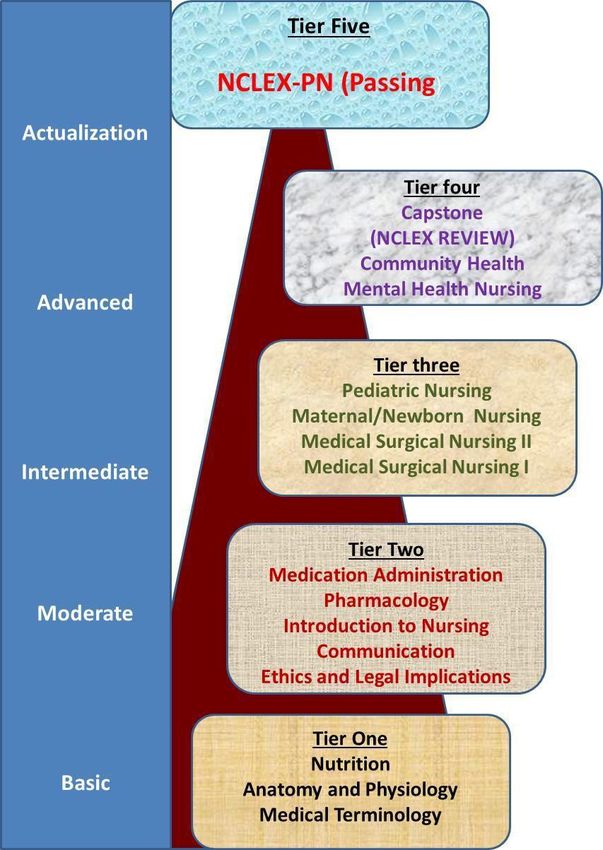
Maslow’s Hierarchy of Basic Needs serves as the basis for the organizing framework as the faculty
believes that health occurs on a continuum from wellness to illness with humans constantly striving to
attain and maintain health. The curriculum design progresses from basic to complex and guides the
learner to build on prior course, material, skills and experience. This framework provides the
foundation upon which students will care for individuals of all ages, in a variety of settings, across the
lifespan.
7INSTITUTIONAL PROFILE
Universal Training Institute (UTI) is a postsecondary institution established in 2006 and located in
Perth Amboy, New Jersey. It began offering Licensed Practical Nursing classes in October 2007. With
the support of a dedicated, highly qualified and experienced faculty team, UTI trains its students for
entry-level employment in practical nursing.
UTI’s program is centered on the development of the total student including the social, emotional,
intellectual aspects of human life. UTI’s program has been carefully developed to provide students
with the knowledge and skills required to function efficiently and effectively as crucial and contributing
members of a healthcare team.
UTI provides education and training to a cultural and ethnic diversity of students who, upon successful
completion of their studies, will contribute to the improvement of the health and wellness of their
communities.
While student success is at the core of its mission, UTI recognizes that, ultimately, students must
assume responsibility for their own learning and that the role of instructors is to facilitate that learning.
To this end, it is the responsibility of both the faculty and the institution to provide an environment in
which students’ critical thinking skills are stimulated and honed to maximize their learning potentials,
and thrive intellectually through the exchange of ideas and interaction with other students and faculty.
It is a goal of UTI and its faculty to help students develop an unwavering commitment to the ethics of
the profession and to embrace the necessity of and desire for lifelong learning.
8LICENSURE, APPROVALS AND ACCREDITATION
Department of Labor and Workforce Development
Universal Training Institute is licensed as a Private Career School by the New Jersey Department of
Education and the Department of Labor and Workforce Development. The Department is located at
the following address, directed to either listed office:
(COEI), New Jersey Department of Labor and Workforce Development
John Fitch Way, 5th Floor PO Box 057
Trenton, NJ 08625-0057
(609) 341-2031
“In the event of an unannounced school closure, students enrolled at the time of the closure must
contact the Department of Labor and Workforce Development’s Training Evaluation Unit within
ninety (90) calendar days of the closure. Failure to do so within the ninety (90) days may exclude the
student from any available form of assistance. The contact number to call is (609) 292-4287 or email
at trainingevaluationunit@dol.nj.gov. ”
State of New Jersey Department of Education
Office of Career and Technical Education
P. O. Box 500
Trenton, New Jersey 08625-0500
privatecareerschools@doe.state.nj.us
New Jersey Board of Nursing
The Practical Nurse Program of Universal Training Institute is approved by the New Jersey Board of
Nursing. The Board is located at the following address:
Executive Director
New Jersey Board of Nursing
PO Box 45010
Newark, NJ 07101
(973) 504-6430
http://www.njconsumeraffairs.gov/nursing/
United States Department of Education
Universal Training Institute is approved by the U.S. Department of Education as an eligible institution
to participate in Student Financial Assistance Programs authorized under Title IV of the Higher
Education Act of 1965, as amended. They are located at the following address:
U. S. Department of Education
400 Maryland Avenue, SW
Washington, DC 20202
Tel: 202-401-2000
9ACCREDITATION
Accreditation is the process by which an accrediting agency, using peer-review evaluations, determines
whether an educational institution meets standards or criteria the agency has established for acceptable
levels of quality in the institution’s academic and/or training programs, student services, administrative
operations, and fiscal capability. The U.S. Department of Education (USDE) defines the goal of
accreditation to be “to ensure that institutions of higher education meet acceptable levels of quality.”
The USDE has established regulations to “recognize” those accrediting agencies (“accreditors”) which
satisfy the federal regulations. Recognition means that the USDE accepts the accreditor as a reliable
authority to evaluate the quality of academic programs and operations of institutions of higher
education.
ACCREDITATION:
The CEO/President and the Board of Directors of Universal Training Institute are pleased to announce
that, effective December 13, 2018, UTI has been awarded initial accreditation by the Accrediting
Council for Continuing Education & Training (ACCET) for a period of three years, from
December 13, 2018 through December 30, 2021. ACCET is listed by the U.S. Department of
Education as a nationally recognized accrediting agency.
Accrediting Council for Continuing Education & Training (ACCET)
1722 N Street, NW
Washington, DC 20036
Telephone: 202-955-1113
www.accet.org
Initial Accreditation: December 13, 2018
Accreditation Expires: December 30, 2021
Accreditation can be renewed provided that an institution continually complies with the accreditation
standards or criteria of the accreditor(s) and fully satisfies the criteria or standards in effect at the time
of application for accreditation renewal.
10GENERAL ADMISSIONS REQUIREMENT
Universal Training Institute is an equal opportunity institution and accepts students without regard to
race, origin, marital status, religion, age, sex, sexual orientation, or disability. UTI upholds the highest
standards to maintain the integrity and long term viability of the school by recruiting the prospective
students who demonstrate academic aptitude and proficiency to achieve the learning outcomes of a
Licensed Practical Nurse.
Admission Requirements
All prospective candidates are expected to meet and follow UTI’s guidelines before being accepted into
the LPN program. The minimum requirement for admission include, but are not limited to:
Make an appointment with the Admissions Director, or designee, for an initial interview. The
candidate will be informed about the required documents needed for admission into the program as
well as those documents required for financial aid to include, but are not limited to:
Be at least 18 years of age.
Provide proof of U.S. citizenship, permanent residency, or U.S. national status. You are a
U.S. citizen if you were born anywhere in the United States or any of its territories, including Puerto
Rico, Guam, or the U.S. Virgin Islands. You are a U.S. national if you were born in American Samoa
or in Swains Island.
Provide a valid government-issued ID or other official ID with photo.
Complete an interview with the Director of Admissions, or his/her designee.
Take and pass the admissions examination (TEAS). If an applicant does not achieve the minimum
acceptable score of on the first attempt, the following re-test requirements apply:
a. Re-test within two weeks following the first attempt.
b. Wait a period of 21 – 30 days before a third attempt, if needed.
c. Wait a minimum of 6 months before making a final re-take attempt.
Write an admissions essay.
Be able to speak, read, and write fluently in English (as determined during the admissions interview,
the taking of the TEAS exam, and the written essay).
Provide a verifiable social security card (required for criminal background check and for applicants
who intend to apply for financial aid).
Provide acceptable documentation of completion of high school or its recognized equivalent. Any one
of the following is acceptable:
1) High school diploma, GED or college degree;
2) Provide a high school transcript from a foreign institution that has been evaluated as equivalent to a
U.S. high school diploma. The evaluating agency must be a member of the National Association of
Credential Evaluation Services (NACES); the Association of International Credential Evaluators
(AICE); or, the American Association of Collegiate Registrars and Admissions Officers (AACRAO).
Take and pass a criminal background check.
Meet with a financial aid representative and prove ability to pay tuition or to qualify for financial aid.
Pay the required registration fee.
Submit all required admissions documentation.
11 All newly-admitted students are required to attend an orientation session before they will be allowed
to begin classes.
All successful applicants will be issued an official offer of admission
Acceptance is only confirmed with an initial down payment
The candidate who meets all of the requirements for admission will sign an Enrollment Agreement.
To Be Eligible for Financial Aid these Additional Admission Documents Are Required
1A. Complete Online FAFSA Application.
2B. Submit copy of his/ her most recently filed Federal Tax return (if a dependent student, a copy of the
parent’s most recently filed Federal Income Tax Return.
3C. If male, between the ages of 18 to 25 years, must be registered with Selective Service in order to
apply for any of the federal programs.
4D. Not be in default of a student loan, or owe a refund on any federal grant as stated in the National
Student Loan Data System (NSLDS).
5E. A student eligible for financial Aid via loans, must sign promissory note and complete the entrance
counselling.
6F. The student completes the entrance counselling which becomes part of permanent file.
Criminal Background Screening:
Applicants must undergo a criminal background check before being admitted into the LPN Program.
New Jersey and all states require a clear, acceptable criminal background check as one condition of
licensure to work as a licensed practical nurse (LPN). Each state’s Board of Nursing makes the final
determination as to whether the background check is acceptable for the position of LPN in that state.
Any questions regarding whether the background check will be acceptable in the state where a Practical
Nurse graduate wants to practice should be directed to that state’s Board of Nursing.
Universal Training Institute cannot and does not guarantee that a student will be able to take the
licensing exam, obtain a license as a Practical Nurse, or to obtain employment following successful
completion of the program in New Jersey or any other state. Crimes and offenses while in the program
could possibly jeopardize a student’s eligibility to take the licensing examination (NCLEX) and find
employment as a Licensed Practical Nurse.
Students with Disabilities:
Universal Training Institute complies with applicable provisions of the Americans with Disabilities
Act of 1990 and its premises on the second floor are wheelchair accessible by elevator. It is, however,
UTI’s responsibility to determine, to the extent possible, that every admitted student has the ability to
benefit from the training he or she will receive in the Practical Nurse Program.
12Any potential applicant who has a physical disability or learning disability will be considered for
admission provided that UTI is reasonably able to provide accommodations the applicant would
require. In the case of a physical disability that, in the determination of UTI, might impact the
applicant’s ability to successfully complete the Practical Nurse Program, the potential applicant must
provide a certification from a licensed physician that the applicant is physically capable of pursuing
the program of study and the physical rigors it requires to be admitted into the program. Additionally,
it is importance for the candidate to understand that the rigors of the job may impede them from
being able to be hired as a Licensed Practical Nurse hands –on provider. In cases of learning
disabilities, UTI provides additional time for testing as well as private testing areas. All such
disability cases, must be supported with certified documentation.
Equal Opportunity Policy
Universal Institute values diversity and seeks talented students and staff from diverse backgrounds.
The school does not discriminate on the basis of race, color, sex, sexual orientation, religion, national
or ethnic origin, age or status as a veteran in the administration of its educational policies, programs,
activities, admissions policies, financial aid and loan programs, employment or other school
administered programs.
It is against the law to discriminate against any beneficiary of a program financially assisted by Title
I of the Workforce Investment Act of 1998 (WIA), on the basis of the individual’s status as a lawfully
admitted immigrant or as a participant in a WIA program.
Individuals believing that they have been subjected to discrimination in relation to a WIA Title I
assisted activity may file a complaint with the Director of Nursing, or the United States Department
of Labor Civil Rights Center, 200 Constitution Avenue NW, Rm. N-4123, Washington, DC 20210.
13TRANSFER OF CREDIT POLICY
Universal Training Institute is committed to assisting students successfully navigate through the
Licensed Practical Nurse Program as quickly and efficiently as possible. If a candidate was previously
in another accredited nursing program recognized by the New Jersey Board of Nursing, Council on
Higher Education Accreditation or the National League of Nursing (NLN), and would like to transfer to
UTI, all measures will be taken to ensure a smooth transition. UTI will consider accepting transfer
credits or clock hours earned at another provided certain criteria are met. The purpose would be to
lessen the amount of time and resources previously spent at another postsecondary to expedite the
candidate’s completion of the program.
1. Only the School Administrator or Director of Nursing will make the determination as to whether
the course or courses requested for transfer credit satisfy all of UTI’s criteria. The Director’s
decision is final and not appealable.
2. The postsecondary institution is accredited by an agency recognized by either the U.S. Department
of Education, Council on Higher Education Accreditation.
3. The course or courses being transferred are a part of a Practical Nursing or Registered Nurse
program / curriculum that has been accredited by the New Jersey Board of Nursing and /or the
National League of Nursing.
4. The course or courses are determined to be comparable in both content and duration to a course or
courses offered by UTI.
5. The course or courses were completed within two years of the date that the student is applying for
admission into UTI.
6. The grade earned is a “B”, or higher.
An “Official” transcript must be sent directly to UTI from the postsecondary institution that the
transferring student attended and must be received prior to the student beginning his or her studies at
UTI.
If course(s) are accepted on transfer, the tuition and any fees for those courses will be deducted from
the total tuition and the student will be responsible only for the remainder of the tuition and fees.
Transfer credit is limited to a maximum of 21.73% of the total clock hours for the program and will
only be accepted for the following courses.
Medical Terminology
Anatomy and Physiology
Nutrition
Communications
Ethics and Legal Implications
As indicated in the Satisfactory Academic Progress Policy section of this catalog, although grades
earned for transfer courses will not be included in a calculation of a student’s cumulative grade point
average (CGPA), the clock hours (or converted credits) will be included in a calculation of total clock
hours attempted and total clock hours successful completed.
14Transferability of UTI Clock Hours
The decision to accept transfer credits or clock hours is at the discretion of the institution to which the
student is applying for acceptance. Although UTI is an accredited institution and its Practical Nurse
Program is approved by the New Jersey Board of Nursing and properly licensed by the New Jersey
Department of Labor and Workforce Development, it is not likely that successful completion of UTI
clock hours will transfer to other postsecondary institutions.
If a student advises UTI that he or she is planning to try to transfer clock hours to another institution,
UTI will send an official transcript to the institution and, if requested, copies of syllabi or a catalog.
Post- Admissions Health Requirements:
1. Every student will be required to have a tuberculin skin test (PPD/TST test) within 30 days of
enrollment. If a student has a positive test result, a chest x-ray report or QuantiFeron Gold test
indicating absence of active disease is required. The PPD/TST test must be completed
regardless of the student’s Bacillus Calmette-Guerin (BCG) vaccine history.
Note: Taking the Hepatitis B vaccine series is recommended but not required.
2. Students must complete certain health requirements prior to beginning the clinical practice
portion of their academic program. Those requirements include the following:
a. Submission of a completed health examination form to the Director of Nursing. This
health examination must be valid for the length of time the student is in the Practical
Nurse Program.
b. Documentation of immunity (with lab titers) to measles, mumps and rubella (MMR
immunity), Varicella, and, if born on or after 1/1/ 1957, Rubeola.
c. To support a claim of immunization, a student must provide acceptable records showing
that vaccination occurred or that the disease was experienced. This documentation is
required by the New Jersey Department of Health and may include official
immunization records from an American school and/or official records signed by a
licensed physician or licensed nurse practitioner.
Malpractice Insurance
Universal Training Institute provides malpractice insurance for all of its active Practical Nurse students,
effective from the students’ first day of laboratory section and covers the clinical practice as well. The
policy covers one million dollars per claim and five million dollars in the aggregate.
Readmission Policy
Students who have left or been withdrawn from an academic program for any reason must submit a
request in writing to UTI’s Director of Nursing, asking to be readmitted. Any student who has been
out of the program in excess of six months, unless otherwise deemed appropriate by UTI, must restart
15the program from the beginning. Students who were dismissed for violation of any of the Codes of
Student Conduct are not eligible for readmission. A student can be readmitted only once and based
on space availability. Before readmission, a student must pay any and all outstanding tuition that was
due at the time of his or her dismissal or withdrawal. Students will receive academic credit for all
courses previously successfully completed. Students readmitted into a program must complete that
program within the maximum time frame as described in the Satisfactory Academic Progress Policy
section of this catalog.
NON-DISCRIMINATION POLICY
As mandated by Title IX of the Educational Amendments of 1972, 20 U.S.C. 1681 et seq., and its
implementing regulations, 34 C.F.R. Part 106, the School does not discriminate on the basis of sex,
race, ethnic origin or religion in its admission process to the school or employment in its
educational programs or activities.
Inquiries concerning the application of Title IX and its implementing regulations by the School may
be referred to the Director of Nursing or the Office of Civil Rights of the United States Department of
Education. Universal Training Institute is committed to achieving a prompt and equitable resolution
of any student or employee complaints under Title IX. Any individual alleging noncompliance with
Title IX should file a written complaint with the Director of Nursing who will proceed to investigate
the matter. Either the complaining party or Director of Nursing can demand a forum to address the
matter. The complaining party will be given a copy of the written findings of the Director of Nursing as
promptly as possible after the investigation has taken place. These findings will include the Director of
Nursing conclusion as to whether a violation of Title IX has taken place and, if so, the remedial actions to be
taken by the Institution.
16FEDERAL STUDENT FINANCIAL ASSISTANCE PROGRAMS
(TITLE IV, NJCLASS, NJ WORKFORCE)
Universal Training Institute has been designated by the U. S. Department of Education (DOE) as an
eligible institution so that its students may apply to DOE to receive financial aid that is authorized
under Title IV of the Higher Education Act of 1965, as amended. As an eligible institution, UTI is
required by DOE to disclose all aspects related to students’ applying for and receiving Title IV financial
aid and other disclosures related to the institution.
These full disclosures are provided in electronic format to all new students during their new-student
orientation sessions and are distributed to all students once a year. Additional copies of these
disclosures are available in the Office of Financial Aid and the UTI website at
www.universaluti.com/additional-information.
Students must meet very specific requirements, complete an online Federal application form called the
Free Application for Federal Student Aid (or FAFSA), and provide all the supporting documentation
required for the government to make the determination whether a student is qualified (eligible) to
receive any form of Title IV financial aid.
Financial Aid can be in the form of grants, which are financial assistance that the student does not have
to repay, and loans, that must be repaid by the student or, if the loan was taken out by the student’s
parent(s) on his or her behalf, the loan must be repaid by the parent(s). The most common form of grant
is the Pell Grant and the most common loan is the Direct Loan.
Details on the very specific requirements are available from UTI’s Office of Financial Aid, UTI’s
“Student Financial Aid Information” Catalog. Financial Aid office staff is available to explain the
application process and to assist students in applying for aid and in understanding their obligations and
responsibilities related to paying back Title IV loans.
The contact information for the Office of Financial Aid appears at the end of this section but generally,
a student must be enrolled in the Practical Nurse Program as a regular student, must be a U.S. citizen
or national or a permanent resident, and cannot be in default on any Title IV loan that he or she may
have received previously. A regular student is one who has enrolled in the Practical Nurse Program for
the purpose of completing the program, earning a diploma, sitting for the required state licensure exam,
and working as a licensed practical nurse (LPN). Once qualified to receive financial aid, a student
must maintain Satisfactory Academic Progress in order to remain qualified for that aid.
UTI Financial Aid and Disclosures Contact Information
Ms. Iren Brodskiy, Financial Aid Officer
174 Jefferson Street, Perth Amboy, NJ 08861
(732) 826-0155; email: financialaid@universaluti.com
17Types of Title IV Student Financial Aid Programs
Federal Pell Grants:
Pell Grants are awarded to eligible students who have not earned a bachelor’s degree. To determine
eligibility, the U. S. Department of Education uses a standard formula to evaluate financial need.
Unlike loans, grants do not have to be repaid.
Federal Direct Loans:
Subsidized
Students may be eligible based on need. The subsidized has a fixed interest rate. The federal
government pays the interest on the loan while the student is in attendance at least halftime.
Repayment begins six (6) months after the last day of attendance or once the student falls below
half-time status.
Unsubsidized:
Available to dependent and independent students who need additional assistance to help pay
their educational cost. The student is responsible for the interest payments on the loan while in
school. The interest rate is fixed and repayment begins six (6) months after the last day of
attendance or once the student falls below half-time status.
Federal Parent Plus Loans:
Federal loans are available to parents of dependent students. Parents can borrow up to the cost
of attendance, less other financial aid received. Approval is based on the parent(s) credit history
and repayment begins sixty (60) days from the last date disbursement of the loan.
ELIGIBILITY FOR TITLE IV AID PROGRAMS
This section spells out the general eligibility requirements for Title IV programs by the U.S.
Department of Education (US DOE) for post-secondary school students who desire to utilize grants
and/or loans offered by US DOE as part of their education funding.
To receive Federal, Title IV Student Financial Aid (SFA) from Universal Training Institute, you will
need to:
1. Satisfy all Admission Requirements and be accepted into one of UTI’s approved Title IV
programs.
2. Sign a statement of Educational Purpose and a certification statement on overpayment and
default (found on the FAFSA).
3. Complete all verification and federal reject codes requirements. Students may be selected for
verification or clarification of application information. No aid eligibility can be processed
until the student provides required information. If provided information varies from the
application information, the student's record may have to be submitted to the Federal Central
Processor for corrections before any aid is processed.
4. Not have borrowed in excess of Federal aggregate loan limits
5. Sign an Enrollment Agreement;
186. Be enrolled at least halftime to receive assistance from the Direct Loan Programs.
7. Be enrolled in a program that leads to a Diploma or Certificate.
8. Be registered with Selective Service, if you are a male (you must register between the ages of
18 and 25). Men exempted from the requirement to register include:
Males currently in the armed services and on active duty (this exception does not apply to
members of the Reserve and National Guard who are not on active duty);
Males who are not yet 18 at the time that they complete their application (an update is not required during
the year, even if a student turns 18 after completing the application);
Males born before 1960;
Citizens of the Republic of Palau, the Republic of the Marshall Islands, or the Federated States
of Micronesia; and,
Non-citizens who first entered the U.S. as lawful non-immigrants on a valid visa and
remained in the U.S. on the terms of that visa until after they turned 26.
9. Have a valid Social Security number, unless you are from the Republic of the Marshall
Islands, Federated States of Micronesia, or the Republic of Palau.
10. Have a High School Diploma or General Equivalency Diploma. Effective July 2012 federal
regulations no longer allow new students to be eligible under ability to benefit standards.
Students who have previously enrolled as Federal Ability to Benefit students prior to July 2012
will be able to continue to be eligible for Federal Title IV Aid.
11. Complete a Free Application for Federal Student Aid (FAFSA);
12. Sign certifying statements on the FAFSA stating that:
You are not in default on a federal student loan under Title IV.
You do not owe a refund on a federal grant under the Title IV program.
You will use federal student aid only for educational purposes.
13. Maintain Satisfactory Academic Progress (SAP) while you are attending UTI.
14. Demonstrate financial need as determined by the appropriate agency offering the financial
assistance.
15. The Pell Grant program does not require half time enrollment, but the student enrollment status
does affect the amount of Pell a student may receive. A student may receive Pell for a total of
12 payment periods or 600%. Once the student has reached this limit, no further Pell may be
received.
In addition, you must meet one of the following classifications:
1. Be a U.S. CITIZEN or U.S. NATIONAL.
You are a U.S. citizen if you were born in the United States or certain U.S. territories, if you were
born abroad to parents who are U.S. citizens, or if you have obtained citizenship status through
naturalization. If you were born in American Samoa or Swains Island, then you are a U.S. national.
192. Be a PERMANENT RESIDENT.
If you have a Form I-551, I-151, or I-551C, also known as a Green Card, you are a U.S.
permanent resident.
3. Have a qualifying ARRIVAL-DEPARTURE RECORD.
Your Arrival-Departure Record (I-94) from U.S. Citizenship and Immigration Services
(USCIS) must show that you have status in one of the following categories:
Refugee
Asylum Granted
Cuban-Haitian Entrant (Status Pending)
Conditional Entrant (valid only if issued before April 1, 1980)
Parole
4. Have BATTERED IMMIGRANT STATUS
You have been designated by USCIS as a “battered immigrant-qualified alien” because you are
a victim of abuse by your U. S. citizen or permanent resident spouse, or because you are the child
of a person designated as such under the Violence Against Women Act.
5. Have a T-VISA. You are eligible if you have a T-visa or a parent with a T-1 visa.
Terms and Conditions of Title IV, HEA Loans
Your loan eligibility is directly correlated to your classification as either Dependent or Independent.
Here below are the criteria for both classifications: Independent: For the purposes of federal aid, a
student is considered independent if he or she meets one or more of the following criteria:
If ANY of the following circumstances apply to you, you are an independent student; you will not have
to provide parental information. If NONE of the following circumstances apply to you, you will be
asked to provide parental information and you are considered a dependent student unless the financial
aid administrator determines that the student is independent on the basis of special circumstances and
performs a dependency override.
• You are 24 years or older or will be by December 31st of the award year
• You are married
• You will be working on a Master’s Degree
• You are serving on active duty in the U.S. Armed Forces
• You are a veteran of the U.S. Armed Forces
• You have children, and you provide more than half of their support
• After you turned age 13, both of your parents were deceased
• You have dependents (other than children or your spouse) who live with you, and you provide
more than half of their support at the time the FAFSA is completed and through June 30 of the
award year.
• You were in foster care since turning age 13 until you reached age 18
• You were a dependent or ward of the court since turning age 13 until you reached age 18
• You are currently or you were in legal guardianship
• You are currently or were an emancipated minor;
• You are homeless or you are at risk of being homeless
20Students who claim to be independent may be asked to provide documentation to verify their
dependency status prior to receiving financial aid. Students who want to be considered independent
due to circumstances other than those listed should contact a financial aid officer prior to completing
the FAFSA
Incarcerated Applicants
A student is considered to be incarcerated if she/he is serving a criminal sentence in a federal,
state, or local penitentiary, prison, jail, reformatory, work farm, or similar correctional
institution (whether it is operated by the government or a contractor). Our attendance policy
specifies that all classed and practical studies are done at the school’s physical location;
therefore, incarcerated students are not eligible for admissions.
For UTI’s purposes, a student is not considered to be incarcerated if she/he is in a halfway
house or home detention or is sentenced to serve only weekends.
Conviction for Possession or Sale of Illegal Drugs
A Federal or state drug conviction can disqualify a student for Federal student financial aid
(SFA). The student self-certifies in applying for SFA that he or she does not have a
drug conviction. UTI is not required to confirm this unless there is evidence of conflicting
information.
The chart below illustrates the period of ineligibility for SFA, depending on whether the
conviction was for sale or possession and whether the student had previous offenses. (A
conviction for the sale of drugs includes conviction for conspiring to sell drugs.)
Possession of illegal drugs Sale of illegal drug
1st Offense 1 year from date of conviction 2 year from date of conviction
2nd Offense 2 years from date of Indefinite period
conviction
3+ Offense Indefinite period
If a student was convicted of both possessing and selling illegal drugs and the periods of
ineligibility are different, the student will be ineligible for the longer period
A student regains eligibility the day after the period of ineligibility ends or when he or she
successfully completes a qualified drug rehabilitation program. Further drug conviction will make the
student ineligible again.
When a student regains eligibility during the award year, UTI may award Pell and/or loans for the
current payment period. A qualified drug rehabilitation program must include at least two unannounced
drug tests and must satisfy at least one of the following requirements:
o Be qualified to receive funds directly or indirectly from a federal, state or local
government program.
o Be qualified to receive payment directly or indirectly from a federally or state-licensed insurance
company.
21o Be administered or recognized by federal, state or local government agency or court.
o Be administered or recognized by a federally or state-licensed hospital, health clinic or medical
doctor.
Definition of Financial Need:
Financial need is defined as the difference between the cost of attending school and the student’s or
families’ expected contribution (EFC). A central processor to whom the student’s Free Application for
Federal Student Aid (FAFSA) is submitted conducts determination of the EFC, based on federal
guidelines. The School’s Financial Aid Officer then determines the student’s Cost of Attendance using
nationally-approved living expense guidelines.
COST OF ATTENDANCE
Universal Training Institute sets tuition based on the cost of providing education and training to its
students. UTI strives to maintain excellence within its academic programs and to provide abundant
instructional resources to guarantee high-quality education and resources.
The U. S. Department of Education allows certain educational expenses to be used when determining
a school’s Cost of Attendance (COA). The COA is the cornerstone of establishing a student’s financial
need, as it sets limits on the total financial aid that a student may receive to attend UTI.
The U. S. Department of Education directs UTI to determine costs associated with attending the school
in order to determine the amount of financial aid for which a student may be eligible. The COA for a
student estimates the total educational and living expenses for a period of academic enrollment.
UTI’s Third Party Servicer (ECM) reviews, and if necessary, updates each component annually in
adherence with the U.S. Department of Education’s standards.
Components of COA: The Higher Education Act of 1965, as amended, define COA
components and is calculated based on rules established by the U.S. Congress. The COA
includes tuition and fees, allowances for room and board, books, supplies, transportation, loan
fees, purchase or lease of a computer, dependent care costs, costs related to disability and
miscellaneous expenses.
Financial Aid used to meet COA: all Federal Student Aid Programs (FSA): Federal Pell Grant
Program, Federal Direct subsidized Loan, Federal Direct Unsubsidized Loan, Federal Direct
PLUS Loan.
Note that students must supply documentation of computer costs, dependent care costs, and
costs related to disability to have these included in the COA. This is required as expenses for
these areas do not apply to all students and may vary significantly from student to student. For
students who attend less than six program hours each program, the COA includes only tuition
and fees and an allowance for books, supplies, and transportation.
Students with unusual expenses may request an evaluation of their COA by submitting a letter
to the Financial Aid Office detailing the circumstances, amount of expenses involved, and
providing documentation of the expenses. The COA determines a student's estimated costs
related to attendance at college. It is not intended to reflect full support requirements. Financial
22Aid provides assistance for educational expenses, not full support. Students should be aware
that requests for adjustments to the COA do not, in any way, indicate that there is financial aid
available to cover such adjustments.
If a student has questions regarding the COA or their Financial Aid award year, they are to contact the
Financial Aid Office at financialaid@universaluti.com or (732) 826-0155.
Cost & Expenses
On- Off-Campus Off-Campus
Campus (Away from Home) (with Family)
Tuition & Fees $21,500 $21,500 $21,500
Books & Supplies $1,500 $1,500 $1,500
Room & Board $15,210
Personal Expenses $6,435 $6,435
Registration Fee $100 $100 $100
Criminal Background $30 $30 $30
Check
Total Cost of Attendance $23,130 $44,775 $29,565
This is the amount that the Financial Aid Office estimates it will cost student to attend a program
at UTI.
The COA is calculated based on rules established by the U.S. Congress. The COA includes
tuition and fees, allowances for room and board, books, supplies, transportation, loan fees,
purchase or lease of a computer, dependent care costs, costs related to disability and
miscellaneous expenses.
Note that students must supply documentation of computer costs, dependent care costs, and
costs related to disability to have these included in the COA. This is required as expenses for
these areas do not apply to all students and may vary significantly from student to student. For
students who attend less than six program hours each program, the COA includes only tuition
and fees and an allowance for books, supplies, and transportation.
Students with unusual expenses may request an evaluation of their COA by submitting a letter
to the Financial Aid Office detailing the circumstances, amount of expenses involved, and
providing documentation of the expenses. The COA determines a student's estimated costs
related to attendance at college. It is not intended to reflect full support requirements. Financial
Aid provides assistance for educational expenses, not full support. Students should be aware
that requests for adjustments to the COA do not, in any way, indicate that there is financial aid
available to cover such adjustments.
The type of aid awarded depends upon the student's financial need and eligibility and may include a
combination of gift and self-help assistance. UTI’s eligibility as a private for-profit institution, has been
authorized by the United States Secretary of Education to participate in financial aid programs
authorized by Title IV of the Higher Education Act of 1962 as amended. UTI’s Program Participation
covers the following federal programs:
23 Federal Pell Grant Program.
Federal Family Educational Loan Program (including the Stafford Loan Program, the
Unsubsidized Stafford Loan Program, and the Parent Loan for Undergraduate Students
Program).
The Financial Aid Office applies for funds annually through the Fiscal Operation Report and
Application to Participate (FISAP).
The Federal Pell Grant is an entitlement program. Students must demonstrate financial need to
qualify. Disbursement occurs only when the enrollment matches the appropriate Pell award.
Pell awards are recalculated when there is a change in the EFC, when the enrollment status
changes between terms within the same award year, and when the cost of attendance changes.
Students must submit the FAFSA and have electronic data submitted by May 1st of each
academic year in order to allow time to process the award.
In the event of an over award, the student's account is placed on hold until such time that the
overpayment is rectified. In addition, the Pell Grant is awarded only to first-time
undergraduates. Student eligibility is determined only through the Central Processing System
of the Department of Education using the Federal Methodology need analysis formula.
Student Payment Plans:
A student payment plan option is provided for students who have balances remaining after all other
financial aid options have been exhausted. Approval for payment plans are made by the financial aid
officer and are made on an individual basis. Students making cash payments can arrange for a
convenient payment plan over the course of their enrollment. Minimum payment requirements are
required and all education costs must be paid in full prior to graduation. UTI accepts cash, money
orders and most credit cards: Visa, Master Card, Discover and Debit.
Payment & Billing Schedule:
Tuition and fees are assessed to coincide with the Title IV billing cycles in each academic year. An academic
year is defined as 900 clock hours and billing is at the beginning of every 450 clock hours. The remaining 296
clock hours are billed at the beginning of the second academic year after successful completion of 900 clock
hours. Students are only financially responsible for the period(s) of enrollment they attend. The School’s
Cancellation and Refund policies apply as published, whether the student is enrolled in the Day or Evening
session.
Delinquent Tuition Payments:
Students are expected to make payments, required by their individual payment plan, on a monthly
basis. This is usually due on the 15th of every month. Students who fall behind in tuition payments are
contacted by the financial aid office and attempts are made to collect current and past due balances.
When a student continues to be delinquent, they may be suspended from class in an effort to give them
time to resolve their financial challenges. Upon successful resolution students are able to return to
their studies. When a student graduates or withdraws from enrollment, a final billing statement is sent
to the student.
Financial Aid Received Prior to Attending Universal Training Institute:
Federal regulations require an institution to determine all previous Federal Title IV aid received by the
student prior to disbursement of funds. Therefore, UTI will review all financial aid disbursed by each
school at which a student was previously enrolled. Financial aid awarded at other schools could limit
available eligibility at UTI.
24Requirements for Verification of Permanent Residency:
If a student is an eligible non-citizen for Federal Title IV aid purposes, a database match will be
conducted to determine the student’s eligibility status with the Department of Homeland Security
(DHS). If DHS is unable to complete the match, i.e., social security number, name, and birth date, the
student will be asked to submit additional documentation. Students are not eligible for financial aid
until verification of permanent residency has been completed.
Requirements for Financial Verification:
A percentage of all students applying for Federal Financial Aid are selected for a process called
Verification. UTI will notify you if your application is selected for Verification. If you are notified,
please submit the Verification documentation requested by UTI’s Financial Aid Office as soon as
practicable, but no later than 14 days from the date of notification. Applicants may be required to
submit copies of their tax transcripts and, for those who are under the age of 24, their parents’ tax
transcripts. Failure to submit the requested documentation will jeopardize your Financial Aid. A
student’s anticipated financial award may be adjusted as determined by the Verification results.
Correction of Information:
If it becomes necessary to correct any of the information on an ISIR as the result of verification or
another documentation process, the Financial Aid Department will note the corrections on the current
ISIR and submit the corrections electronically to the U. S. Department of Education. A new ISIR
showing the corrected information is then generated. Applicants may be required to verify correctness
and sign the revised ISIR. If the applicant becomes ineligible for a Federal PELL Grant or other Federal
Title IV aid as a result of the corrections in his/her information, the applicant will be notified by the
Financial Aid Department. If corrections result in a change in eligibility, the applicant will be so
advised and a revised Financial Plan will be developed for the applicant’s review and approval.
Renewal Applications:
Students applying for a second academic year of financial aid must complete all required applications
and submit additional paperwork, as necessary, when requested by the Financial Aid Department.
Failure to do so could result in the student being required to make cash payments to the School or may
result in the student being dismissed from UTI.
Note: The entire financial aid application process and verification process, if applicable, must be
completed for each academic year.
Loan Default Prevention:
Students are responsible to repay, in full, all loans used to pay for their education. Repayment of student
loans helps ensure the availability of loan funds for the future. Borrowers are encouraged to take the
responsibility of loan repayment seriously. Some helpful hints on avoiding delinquency are as follows:
Send in your payment each month even if you haven’t received a bill.
Send in larger or additional payments to reduce the amount of interest you pay on the loan. Be
sure to indicate if you want the extra amount applied to the principal or used as a future payment.
Remember that overpaying one month does not mean that you can skip or reduce next month’s
payment.
Call your lender/servicer immediately if you are unable to make a payment on time or if you
have a financial hardship. The lender/servicer may be able to work out an alternative plan.
Know your deferment rights. After sending in the necessary forms, follow up with your
lender/servicer to confirm that your loan(s) has been deferred.
25 Understand your rights and responsibilities under each loan program. Keep all paper work such
as promissory notes, lender correspondence, cancelled checks, etc.
Always call to resolve a discrepancy. Never ignore correspondence or requests for payment
from your lender/servicer.
If you do default on your loan(s) in spite of all the arrangements available to prevent this from
happening, you can expect all or some of the following repercussions:
Your status may be reported to a national credit bureau and have a negative effect on your credit
rating for seven years.
You may lose deferment possibilities.
Your wages may be garnished.
Your federal and state income tax refunds may be withheld.
You may be ineligible to receive any further federal or state financial aid funds.
The entire unpaid amount of your loan, including interest and cost of collection, may become
due and payable immediately.
Students may obtain additional information about loan repayment and default prevention guidance
from the Financial Aid Office.
*Please be advised that all students receiving federal loans must complete both an Entrance and
Exit counselling.
Financial Aid Ombudsman:
A UTI financial aid officer reviews with student borrowers the availability of the Department of
Education’s Office of the Ombudsman during exit advising. Borrowers are advised that if they have a
dispute regarding a student loan that cannot be resolved through normal communication channels with
their loan servicer, they may contact:
U. S. Department of Education
FSA Ombudsman Group
830 First Street, N. E., Mail Stop 5144
Washington, D.C. 20202-5144
Via on-line assistance: http://studentaid.gov/repayloans/disputes/prepare
Via telephone: (877)557-2575 Via fax: (202)275-0549
26You can also read


