The Red Pages orientation 2020-2021 - louisiana.edu - University of ...
←
→
Page content transcription
If your browser does not render page correctly, please read the page content below
The Red Pages   orientation
                2020-2021

                  louisiana.edu
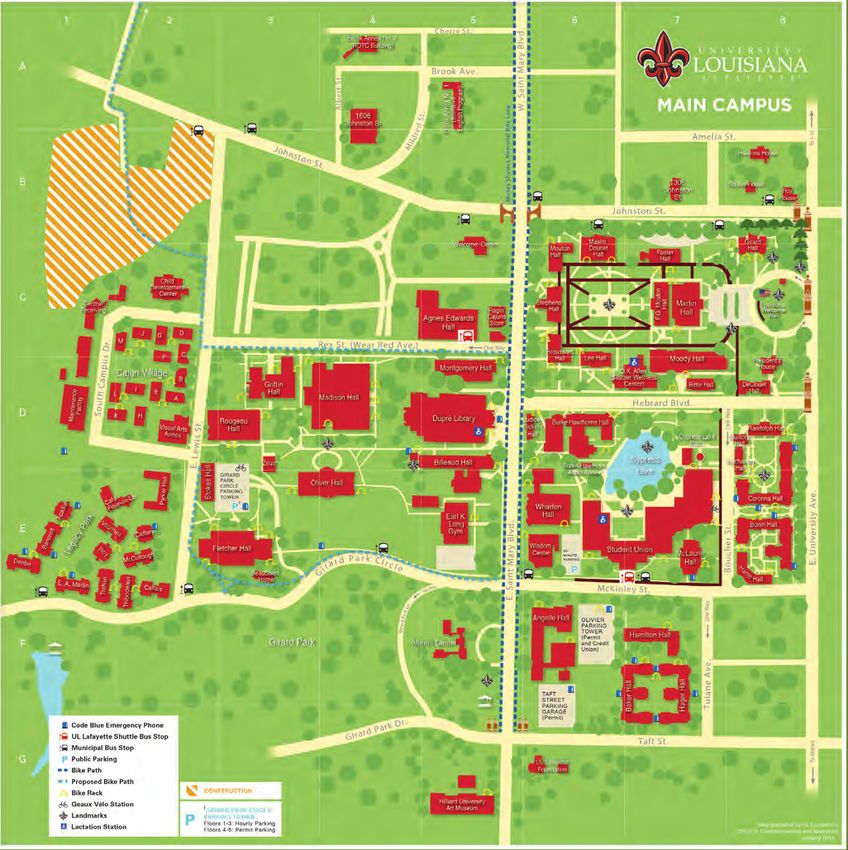
ACADEMIC BUILDINGS                                          NON-ACADEMIC BUILDINGS                                   RESIDENCES
ANG     Robert J. Angelle Hall                         F6   CONF    Agnes Edwards Hall        		                C5   CONF    Agnes Edwards Hall 		                           C5
BLD     Billeaud Hall                                  D5   ALCT    Alumni Center                               F5   BKA     Baker Hall                                       F7
BSX2    Brook Annex No. 2-ROTC Building                A4   BSH     BeauSoleil Home                             E3   BNA     Bonin Hall                                       E8
BSX1    Brook Annex No. 1-Intensive English Program A5      UPO     Bittle Hall                                 D7           Cajun Village                                    C2
BRS     Broussard Hall                                 C6   BUCH    Buchanan Hall                               D8   CRA     Coronna Hall                                     E8
B       Burke-Hawthorne Hall                           D6   FLDL    Cafe Fleur-de-Lis                       E1, E2   HARR    Harris Hall                                      E8
CLR     Clyde L. Rougeou Hall                          D3   CNRC    Central Receiving                           C1   HGR     Huger Hall                                       F7
DECL    DeClouet Hall                                  D8   DAYC    Child Development Center                    C2   LP      Legacy Park                                  E1, E2
                                                            EKLG    Earl K. Long Gym                            E5
D       Edith Garland Dupré Library                    D5
FGM     F. G. Mouton Hall                              C7
                                                            F       Foster Hall                                 C7
                                                                                                                     LANDMARKS
                                                                    Guillory Hall                               D8
G       Girard Hall                               B8, C8                                                                     9/11 Memorial                                     F5
                                                            0011A   Hawkins House                               B8
HLG     H. L. Griffin Hall                             D3                                                                    Babin Memorial Gateway                            C8
                                                            BSX1    International Student Center                A5
HH      Hamilton Hall                                  F7                                                                    Cypress Lake/Park                             D7, E7
                                                            0060    Maintenance Facility                        D1
JLF     Joel L. Fletcher Hall                          E3                                                                    Mary Olive McPhaul Rose Garden                    D8
                                                            MA      Martin Hall                                 C7
JUDI    Judice-Rickels Hall                            D6                                                                    McNaspy Stadium Memorial                          D4
                                                            OKA     O. K. Allen (Saucier Wellness Center)       D7
LEE     Lee Hall                                  C6, D6    OLVT    Olivier Parking Tower                       F6   STUN    “The Porch” of former Student Union           E6, E7
MCLG    McLaurin Gym                                   E7           Our Lady of Wisdom Catholic Center          E6           Dr. Edwin L. Stephens Statue/Century Oaks         C8
MDSN    Madison Hall                                   D4   PRKR    Parker Hall                                 E2           Louisiana Welcome Wall                            C8
MDD     Maxim D. Doucet Hall                           C6   UAM2    Hilliard University Art Museum              G5           Montezuma Bald Cypress                            D4
MO      Mouton Hall                                    C6   0001    President’s House                           D8           Quadrangle “The Quad”                             C6
MX      Moody Hall                                     D7           Ragin’ Cajuns Store                         B2           Walk of Honor                     C6, C7, D7. D8, E7
MY      Montgomery Hall                                D5   RAND    Randolph Hall                               D8           World War I Memorial                              C8
OLVR    James R. Oliver Hall                       E3, E4   0011    Roy House                                   B8
VLW     V. L. Wharton Hall                             E6   0011B   Soulier House                               B8
VAA     Visual Arts Annex                              D2   SMH     Stephens Memorial Hall                      C6
                                                            STUN    Student Union “The U”                   E6, E7
                                                            TSCG    Taft Street Parking Garage              F6, G6
                                                            UFC     UL Lafayette Foundation                     G6
                                                            MAF     Welcome Center (French House)           B5, C5
                                                                    Zeus Fresh Food On the Go                   D3
The Red Pages                 2020-2021

Contents         Welcome
                 Academic Engagement
                   2020-2021 Academic Calendar
                                                                02
                                                                04
                                                                04
                   Requirements for a Bachelor’s Degree         04
                   General Education                            05
                   Credits Already Earned - Freshmen            06
                   Credits Already Earned - Transfer Students 07
                   Advising                                     08
                   Academic Expectations & Procedures           09
                   Academic Resources                           10
                   Academic Terminology                          12
                   Tips for Success                              13
                 Academic Lagniappe                             14
                   Honors Program                                15
                 Academic Colleges                           16-29
                 Campus Involvement                             30
                   Student Organizations                        30
                   University Program Council                    31
                   Campus Traditions                            32
                   Ragin’ Cajuns Athletics                      33
                 Campus Services                                34
                 Student Health and Wellness                    37
                 Financial Aid & Scholarships                   40
                   Veteran Services                             41
                   Scholarships                                 41
                 Cajun Card Services                            42
                 Campus Dining                                  43
                 Transportation Services                        44
                 Technology 101                                 45
                 Public Safety                                  48

                Office of Orientation
                    337-482-1391
             orientation@louisiana.edu
              orientation.louisiana.edu
The Red Pages                          2020-2021

Orientation from the Inside
            On behalf of the Student Orientation Staff, I welcome you to Orientation!

            We are excited that you have chosen to embark on your educational journey
            at the University of Louisiana at Lafayette, a national research institution and
            a University of choice for many top scholars. As an alumna of the University,
            I speak from experience when I say that your college years will be all that you
            have imagined, but it is up to you to make the most of them. I encourage you
            to become engaged in the classroom, join a student organization or two, and
            experience all that the University has to offer.

            Your orientation experience is designed to show you the ways the University
            can help you be successful. A few benefits of attending Orientation include:
            meeting with directors of many of the support services across campus; hearing
            from students who will give you honest feedback on how to succeed as a Ragin’
            Cajun; discovering ways to get connected to campus life; and getting to know
            the Student Orientation Staff. SOS is an award-winning group of current UL
            Lafayette students with a thorough knowledge of the University. These students
            are specially trained to answer your questions and help you throughout your
            University experience. At Orientation and during your time on campus, look to
            them as mentors and reach out to them for assistance.

            Your success at Orientation is directly related to the investment you make. While
            at Orientation, ask questions, learn our traditions and school history, locate your
            classes, and make a few friends; they may remain with you throughout your
            college years and beyond. I challenge you to step out of your comfort zone, learn
            something new, and make the most of your Orientation experience.

            I look forward to meeting with you and watching as you make your mark on the
            University of Louisiana at Lafayette!

            Sincerely,

            Lauren L. Sarver
            Director of Orientation

02
The Red Pages                                  2020-2021

                   Welcome to UL Lafayette
Welcome to the University of Louisiana at Lafayette, home of the Louisiana
Ragin’ Cajuns and your home for your college years.

Today you embark on an exciting journey that will transform you, as it has
transformed those who came before you. Embrace the entirety of the experience
– the academic challenges of classrooms, labs, service-learning projects, and
internships, as well as opportunities to grow as an individual and a global
citizen.

You can take pride in the fact that you’re a member of one of the most
academically prepared classes in the University’s history. We’re glad you’re here,
because we believe you have much to contribute to us and to each other: new
ideas, fresh perspectives and questions that will challenge us all.

We want you to succeed academically, but the benefits of attending a university
extend far beyond the classroom. Here you’ll have opportunities to build
relationships with people from different countries, cultures and backgrounds.
And some of the friends you make here, through shared experiences, will remain
your friends for life.

Take advantage of everything the University has to offer. Reside in one of our
Living Learning Communities. Get involved in campus activities.

Join a student organization. There are 200 of them, ranging from AmeriCorps,
a community service group, to the Student Government Association. Attend a
theatrical performance at Burke-Hawthorne Hall Auditorium or a concert at
Angelle Hall.

Cheer for your Ragin’ Cajuns athletics teams. Visit the Paul and Lulu Hilliard
University Art Museum, where you can see some of the finest art exhibits the
world has to offer.

Head to Bourgeois Hall regularly. There, you’ll find workout equipment, an
indoor track, indoor basketball courts, outdoor tennis courts, aerobics classes,
a rock climbing wall, and racquetball courts. The Student Aquatics Center at
Bourgeois Hall houses two swimming pools, a lazy river, a 20-person whirlpool
and a sand volleyball court.

To a great extent, your college experience at UL Lafayette will be what you make
it. So make the most of it!

Sincerely,

E. Joseph Savoie
President

                                                                                       03
The Red Pages 2020-2021
Academic Engagement
Helping you understand your degree and succeed academically
The University of Louisiana at Lafayette offers more than 100 undergraduate degree programs and specialized concentrations.
Faculty and staff on our campus are committed to ensuring you are successful.
2020-2021 academic calendar
(Subject to change)
Summer Session 2020 Fall Semester 2020 Spring Semester 2021 (Estimated)
Tuition & Fees Payment Deadline Tuition & Fees Payment Deadline Tuition & Fees Payment Deadline
Wednesday, May 27, 2020 Wednesday, August 12, 2020 Monday, January 4, 2021
First Day of Classes First Day of Classes First Day of Classes
Monday, June 8, 2020 Thursday, August 20, 2020 Wednesday, January 13, 2021
(First-time freshman)
Last Day of Classes Monday, August 24, 2020 Last Day of Classes
Wednesday, July 29, 2020 (All other students) Friday, April 30, 2021
Final Exams Last Day of Classes Final Exams
Thursday, July 30 – Friday, December 4, 2020 Monday, May 3 –
Friday, July 31, 2020 Friday, May 7, 2021
Final Exams
Monday, December 7 –
Friday, December 11, 2020
REQUIREMENTS FOR A BACHELOR’'S DEGREE
Every student who comes to the University of Louisiana at will come later in the major. Your choice of major should be
Lafayette as an undergraduate student seeks to earn a “bachelor’s based on an understanding of your interests, aptitudes and careful
degree” (from the Latin baccalaureate, roughly translated as junior thought about your career goals. Ideally, you will find a major that
degree). No matter the kind of degree you are seeking here at UL perfectly captures the intersection of your own talents and future
Lafayette, you must earn a minimum of 120 credit hours (which dreams. If you are unsure what major or minor best fits your
may include credit hours from courses you have already taken interests and academic talents, UL Lafayette’s Major & Career
elsewhere, earned as Advanced Placement (AP) credit, and dual Exploration Center can help. See page 14 for more information
enrollment credit). The 120 credit hours required for your degree about the services they offer.
may include four components:
3. Minors: Minors are 18 credit hours in a specified group of
1. General Education courses (or “core curriculum”): courses within a particular discipline or field and are meant to
Every student at UL Lafayette must complete 42 credit hours complement your major. Some majors require a minor to fulfill
of “Gen Ed” coursework. General Education courses aim to degree requirements. Be sure to discuss minor requirements with
ensure that every UL Lafayette graduate has basic knowledge and your advisor.
skills that prepare them for both a career and life as an educated
member of society. See below for more information about the 4. Electives: In some majors, you will be asked to choose
Gen Ed curriculum. additional courses (electives) that interest you and complement
your major studies. Keep this in mind as you schedule courses
2. Major courses: The “major” is the field of study (chosen by each semester, and be sure to discuss your elective requirements
the student) in which a student intends to specialize. The major with your advisor. Some majors may require you to choose
coursework will begin with foundational courses – often in related electives from an approved list.
fields – that are required to understand the specialized work that
04The Red Pages 2020-2021
Be sure to review your degree program (a list of all required courses for the bachelor’s degree)
so that you understand what courses are required for your major, including General Education
core courses and elective coursework.
General Education
We live in a dynamic global society in which technological advances move swiftly and
geopolitical alliances seem to shift constantly. It is increasingly important that our students
not only understand what we know today, but acquire the skills necessary to learn what they
will need to know tomorrow. This is what the “Gen Ed” curriculum is all about – helping
you evolve into lifelong thinkers who can make critical decisions, evaluate and respond to
societal challenges, communicate with those like and unlike you, and appreciate the beauty
around you. Gen Ed, in short, provides a foundation for success not just in college, but also
in life.
Gen Ed is also what distinguishes a university education from that of a technical school.
So your choices about which specific classes to take should be made thoughtfully and
strategically – based on interests, career aspirations, passions, and future plans.
Each UL Lafayette student, regardless of major, will take 42 hours (or 14 courses) to
complete the Gen Ed requirement. These courses include:
First-Year Seminar.. . . . . . . . . . . . . . 3 credit hours UNIV 100
ENGLISH COMPOSITION.. . . . . . . . . . . 6 credit hours ENGL 101-102 or the equivalent
MATHEMATICS. . . . . . . . . . . . . . . . . . . . . . . . 6 credit hours Course requirements vary widely by major and
ACT/SAT score; for some degree programs, 3 credit
hours may be statistics (STAT)
...............................................................
FINE ARTS. . . . . . . . . . . . . . . . . . . . . . . . . . . . . 3 credit hours Approved courses from dance, design, music,
theater, and visual arts
BEHAVIORAL SCIENCE. . . . . . . . . . . . . 6 credit hours Anthropology, criminal justice, geography, political
............................................................... science, psychology, sociology, with 3 credit hours
at the 200-level or higher
Humanities.. . . . . . . . . . . . . . . . . . . . . . . . . . 9 credit hours 3 credit hours from approved English, foreign
language, or humanities literature; 3 credit hours
from recommended history or philosophy; and 3
credit hours from recommended communication
or foreign language courses
...............................................................
NATURAL SCIENCES. . . . . . . . . . . . . . . . 9 credit hours Biology, chemistry, environmental science,
geology, physical science, or physics; all students
must take both biological science and physical
science, with 6 credit hours in one science
TOTAL 42 credit hours
At UL Lafayette, we hope you will take away specific learning experiences from your Gen Ed courses, no matter which classes you
choose to satisfy these requirements.
As you plan your educational journey here at UL Lafayette, remember that the Gen Ed courses are designed and intended to
help you master information in your major more effectively. As such, please take your Gen Ed classes as early as possible in your
academic career. That is, please stick to your curriculum and don’t be tempted to put these off. The earlier you complete your Gen
Ed requirements, the quicker you will transition into your major courses.
For more information on General Education visit:
catalog.louisiana.edu
and click on General Education Courses on the left side of the page
05The Red Pages 2020-2021
Credits already earned - freshmen
Many of our freshmen enter the University with credits they have already earned through courses they took in high school,
exams they have taken, or courses they have completed at another college or university. These credits will apply toward your
degree at UL Lafayette. You should make sure to discuss with your advisor at Orientation what credits you believe you have
earned, so they can use that information to best determine your class schedule for the fall.
Course Placement
English Course Placement
ACT English New SAT Accuplacer Writing Course Placement
≤ 17 ≤ 480 ≤ 249 Cannot schedule a UL Lafayette English course.
Please schedule the Accuplacer Writing exam.
For information about scheduling and taking the exam
email accuplacer@louisiana.edu.
18-27 500-630 250 + ENGL 101 - Introduction to Academic Writing
28 640 Students receive Credit for ENGL 101
28 + 640 + ENGL 102 or ENGL 115 (Honors English)
Math Course Placement Note: required course depends on major
ACT English New SAT Accuplacer Writing Course Placement
≤ 18 ≤ 500 ≤ 249 To register for a mathematics course at UL Lafayette you
must either:
1. Successfully pass an Intermediate Algebra course at a
community college OR
2. Successfully pass the ACCUPLACER QAS Math Placement
Exam.
For information about scheduling and taking the exam
email accuplacer@louisiana.edu.
19 - 20 510-520 250-262 MATH 102 - Quantitative Reasoning (for students whose
majors do not require pre-calculus, business calculus or
calculus) OR
MATH 103 & 104 - Applied College Algebra Fundamentals
and Practicum OR
MATH 117 Number Sense for P-K Teachers
(Elementary Education majors only)
21-22 530-540 263 MATH 105 - Applied College Algebra
23 + 560 + MATH 109 - Pre-Calculus Algebra
24-25 580-590 MATH 109 & MATH 110 - Pre-Calculus Algebra & Trigonometry
and Function Theory (students with a 24 or 25 can take Math
109 & 110 in the same semester)
26 + 610 + MATH 143 - Pre-Calculus Algebra and Trigonometry
(Equivalent of Math 109 & 110 together)
28 + 660 + MATH 270 - Calculus I
Note: Pre-calculus trigonometry is an essential part of Math 270. Students with an ACT math score of 28 who have not had pre-calculus
trigonometry are strongly encouraged to enroll in Math 110.
Credit in Mathematics based on ACT/SAT Math Scores:
ACT Math New SAT Course Placement
25-27 590-640 Credit in MATH 105 - Applied College Algebra
28 + 660 + Credit in MATH 109 - Pre-Calculus Algebra
30 + 700 + Credit in MATH 109 & 110 - Pre-Calculus Algebra
& Pre-Calculus Trigonometry and Function Theory
Math Placement All mathematics courses have prerequisites. The math
Placement in a math class is slightly tricky, as there department uses either your ACT mathematics score,
are many different sequences and levels of math that a SAT mathematics score, ACCUPLACER QAS score,
student might be eligible for. It is useful to define the term or any college level mathematics courses (including dual
placement. Placement into a course means permission to enrollment) you have taken to assess your preparedness for
enroll in that course. Note: Just because you place into a a particular course.
particular course does not necessarily mean that it is the
course you should enroll in. Consult with your academic The Office of Admissions schedules and administers
advisor and be sure to consider what you plan to take after the ACCUPLACER QAS exam for UL Lafayette. For
this course and any restrictions imposed by your major. information about scheduling and taking the exam, please
contact the Office of Admissions.
06The Red Pages 2020-2021
Dual Enrollment, Advanced Placement, With dual enrollment, AP, and CLEP credits, students
and CLEP Credit should make sure to articulate to their advisor at Orientation
We accept dual enrollment credits from any regionally exactly which courses they believe they have earned credit
accredited college or university. Make sure that you have the for. Advisors may not yet have access to a student’s scores
college that has offered you dual enrollment credit submit or transcripts, and may schedule a student for a course they
your transcripts to us because your grades in those courses already have earned credit for. Credit that is accepted by
will be included in your college cumulative GPA. UL will not necessarily count toward requirements for your
major. It is important to check with your academic advisor
We offer college credit for scores of at least a 3 on most AP to see which credits your department and college will count
exams. Have the College Board send a copy of your scores to toward major requirements.
the Office of Admissions and Recruitment. Check out the
“Credit by Other Means” section of the University Catalog Advance Credit Exams
for details about which credits are offered for which exams. The UL Lafayette Advance Credit Exam program offers
high-achieving students an opportunity to earn course credit
Students who have taken College Level Examination Program before they begin their first semester. Students are required
(CLEP) exams or other recognized advanced placement to meet specific eligibility requirements to attempt one or
programs are invited to submit transcripts of those more of the Advance Credit Exams. Each exam may only
examinations to the Office of Admissions and Recruitment be attempted once. Reservations for these test dates are
for evaluation and possible credit. However, students may accepted by phone (where applicable) and are managed by
not earn credit through these programs for courses they have academic departments.
been registered for, audited, or failed at the college level.
Credit will also not be offered through CLEP exams for To view a full list of exams, qualifications, dates and
courses which are prerequisites for a more advanced course reservation information, please visit the orientation website:
for which they have already received credit. orientation.louisiana.edu/resource-center/placement-testing/
advance-credit-exams.
Credits Already Earned - Transfer Students
Will all my credit hours transfer? Will my transfer hours count toward my GPA?
All college level courses are transferable to the University from At UL Lafayette, all college level courses that you complete will
regionally accredited institutions. The Transfer Evaluation transfer to the University and will be calculated into the UL
System (TES) and Transferology will assist you in reviewing Lafayette cumulative GPA.
what transfer work the University will accept. To access TES and
Transferology: studentsuccess.louisiana.edu/content/transfers/ Is there a limited amount of course credits that
will-my-credits-transfer. can be applied to a UL Lafayette degree from a
community college?
Who is my academic advisor? UL Lafayette may apply up to 60 transferable hours from an
Transfer students are advised by the transfer advisor in the accredited community college toward a baccalaureate degree.
academic college for the first semester of enrollment. Transfer
students are usually assigned a faculty advisor in the academic How many hours must I take at UL Lafayette to
department after the start of the first semester. graduate?
To graduate with a bachelor’s degree, 25 percent of the required
Does UL Lafayette accept CLEP, AP or credit credit hours and the last 30 hours must be taken in residence at
by exam? UL Lafayette. A minimum 2.0 GPA is required by the University
Subject to limitations, UL Lafayette does accept credit earned to graduate. Some departments may require a higher minimum
through CLEP subject examinations, and College Board GPA and additional courses to be completed at UL Lafayette.
Advanced Placement (AP).
Can I make a fresh start at UL Lafayette?
A student who has not been enrolled in any college or university
Will my military credit transfer?
for a minimum of three complete years may apply for academic
UL Lafayette follows the recommendations of the American
amnesty upon admission to UL Lafayette. Academic amnesty
Council on Education’s Guide to the Evaluation of Educational
does not apply to individual courses. Academic amnesty must
Experiences in the Armed Services and will grant credit for
be requested for all previous college/university courses. Request
certain military schools, subject to the approval of the director
for amnesty can be made by submitting a request to the
of admissions and the student’s academic dean.
Undergraduate Admissions Committee and/or speaking to the
academic dean.
07The Red Pages 2020-2021
Advising is a crucial component of helping you navigate
advising
After meeting with your advisor, you will proceed to a
your time at the University and keeping you on track to computer lab on campus where the Student Orientation
graduation. Advisors help you select courses each semester, Staff will help you register for and schedule your classes.
and offer guidance about your major, career planning,
academic progress and more. Each semester, an advising Remember, once you have attended Orientation, you can
hold will be placed on your account prior to registration, and make changes to your schedule anytime through ULink.
you must meet with an advisor to have that hold removed so The schedule adjustment period ends after the fifth day of
that you can schedule classes. This ensures that you and your classes, so make sure you are satisfied with your schedule
advisor will stay in regular contact. before that time.
ADVISING AT ORIENTATION The Course Scheduling Guide
Your first experience with advising at UL Lafayette will be At Orientation, you will receive a course scheduling guide
different than in subsequent semesters. During Orientation, that takes into account your major and your test scores
you will meet with an advisor from your college or a (ACT, SAT, etc.) to suggest courses you might be eligible
professional advisor. Advising may be completed individually for. Use this guide with your advisor to select courses that
or in small groups. The person you meet with will not you are eligible for and that meet your general education or
necessarily be your permanent advisor. The primary goal major requirements. This scheduling guide will only be used
of this session is to help you select the courses you need to at Orientation — in subsequent meetings, you and your
register for in your first semester. advisor will work from the catalog or curriculum sheets from
your department. If you earned college credit in high school,
your suggested courses may change.
The University of Louisiana at Lafayette
First-Time Freshman 1st Semester Course Scheduling Guide
ULID: C00000000 TEST SCORES:
Name: Pepper Cayenne Subject: Test Type/Score: ACT Equivalent:
English ACT 0023 23
Major Code: BSBA_MGMT Math ACT 0023 23
Major: Management Composite ACT 0023 23
Classes you should schedule first: Credit Hours:
ENGL 101 . . . . . . . . . . . . . . . . . . . . . . . . . . . . . . . . . . . . . . . . . . . . . . . . . . . . . . . . . 3
MATH 105 . . . . . . . . . . . . . . . . . . . . . . . . . . . . . . . . . . . . . . . . . . . . . . . . . . . . . . . . 3
UNIV 100 . . . . . . . . . . . . . . . . . . . . . . . . . . . . . . . . . . . . . . . . . . . . . . . . . . . . . . . . . 3
Choose remaining courses from the approved list below. It is recommended that first-time freshmen
take a maximum of (1) math and (1) science per semester. If working 15 or fewer hours per week,
students are urged to schedule 15 credit hours. Those working 20 or more hours per week are
encouraged to schedule no more than 12 credit hours.
CMCN 100 (3 credits) SOCI 100 (3 credits)
ECON 201 or 202 (3 credits) History Elective (HIST): MAY SELECT ONE
PSYC 110 (3 credits) HIST 101, 102, 110, 221, 222, 355 (3 credits)
Art Elective (ARTS): MAY SELECT ONE Science Elective (SCI): MAY SELECT ONE
DANC 101 or 102 (3 credits) CHEM 101 (3 credits)
MUS 104, 105, 106, 108, 109, 260, 362, 364 (3 credits) GEOL 105 (3 credits)
THEA 161 or 261 (3 credits) PHYS 160 or 170 (3 credits)
VIAR 120 (3 credits) ENVS 150 3(credits)
Behavioral Science Elective (BHSC): MAY SELECT ONE
ANTH 201 (3 credits)
POLS 220 (3 credits) Advanced Placement
Total Credit Hours:______________
08The Red Pages 2020-2021
ADVISING FOR CONTINUING During Advising
STUDENTS You and your advisor will fill out the blue advising form
Advising after Orientation takes place during a designated together — put together a list of first choice classes, and
advising period during each fall and spring semester. You’ll make sure you have some alternatives in place, because
meet with your advisor in late fall to discuss courses for classes may fill or not fit into your schedule. Ask your
the spring semester, and in the spring to discuss courses advisor questions about what he or she is suggesting you
for the summer and fall semesters. You will be assigned take and why — make sure you understand their long-
an advisor and you will schedule an appointment with term plan for you, and do not be afraid to advocate for
them according to their policies. Be sure to contact yourself if you have a different idea.
your department to see if there are any special advising
procedures they have in place. For more information Also, your advising appointment is a good time to talk
on advising and how to prepare for your advising about any academic difficulties you’re having (study
appointment, you may visit the Academic Success Center’s skills, certain subjects, time management) or long-term
website, studentsuccess.louisiana.edu/advising/students. planning questions. If you’re curious about career paths
in your field, or internship opportunities, or graduate
Before Advising school, or even just declaring a minor, your advising
Before meeting with your advisor, you will need to learn appointment is the perfect time to bring that up.
your advisor’s or the department’s policies and procedures
for scheduling an appointment. Some advisors set up Registering for the Following Semester
appointments by email, while others like to post a sign-up Unlike at Orientation, you may not be able to register
sheet on their door. Some departments advise in a group for classes immediately. Each student is assigned a
setting. Make sure you schedule a meeting early — your registration time (you can check yours through ULink),
advisor’s time will get booked up pretty quickly. A blue which allows for staggered access to the registration
advising form will also be used during the advising process system. When your appointment arrives, you will be able
(unless your advisor has specified a different procedure). to access the course registration system through ULink
Contact your advisor to determine if you need to bring the and schedule your classes from anywhere you have
form with you. internet access. Be sure to clear any holds which may
affect you registration.
Take a look at the degree plan online (catalog.louisiana.
edu) or curriculum sheet for your major and begin to While you’re waiting for your registration appointment,
formulate a list of what classes (5-7) you are thinking it is a good time to map out your schedule. Use the blue
about taking; this helps make the appointment go more sheet from your advising appointment as a guide when
smoothly. Do some research, too, on what General planning class times and creating a semester schedule.
Education courses you’d like to take. You have some You should be ready to register for classes as soon as
freedom there, so think about what subjects and topics you are allowed into the system, if all holds affecting
you would like to explore. catalog.louisiana.edu/ registration have been cleared. Courses fill up quickly, so
don’t wait.
ACADEMIC EXPECTATIONS AND PROCEDURES
EXPECTATIONS PROCEDURES
• Check University email account daily Changing Your Major
• Learn the requirements of the declared major and be It is not uncommon for students to realize during
familiar with previously earned college credits their freshmen year that they are in the wrong major.
• Understand the University General Education Freshmen may change their majors in the Academic
requirements and monitor progress to ensure timely Success Center (ASC) in Lee Hall 115. Even if you’re
degree completion unsure, you can meet with an advisor to discuss your
• Schedule and attend academic advising appointments best options.
each semester and be prepared with questions
• Know and abide by the academic and disciplinary Changing Your Classes: Dropping with a
policies of the University found in the Code of “W” vs. Schedule Adjustment Period
Conduct Students may adjust their schedules by dropping or
• Maintain a minimum 2.0 GPA each semester of adding classes online until the 5th day of the fall and
enrollment spring semesters (3rd day of the Summer semester). After
this date, students are no longer able to make changes
through ULink.
09The Red Pages 2020-2021
If you find later in the semester that you need to drop a Resigning: Dropping All of Your Classes
class, you will earn a “W” (withdraw) on your transcript In extreme circumstances, a student may be unable to
for the course. The “W” will not be calculated into your complete courses in a given semester. The best thing
GPA. You will need to come to the Academic Success to do in this scenario is to go to the Academic Success
Center (ASC) to drop the class, at which time, you may Center (ASC) in Lee Hall 115 and meet with an advisor
also discuss any possible consequences of doing so. The to discuss the situation and then schedule a meeting with
last day to drop is mid-semester. Please see the academic a financial aid counselor. A student may resign from
calendar for the exact day: registrar.louisiana.edu/ the University by dropping all registered credits. At this
registration/academic-calendar. time, the student is no longer considered enrolled at
UL Lafayette and will need to re-apply in order to return
at a later date. Resigning from the University may have
implications for financial aid, housing, athletic eligibility,
and more. Make sure to carefully discuss resigning with
an advisor.
ACADEMIC RESOURCES
THE ACADEMIC SUCCESS CENTER Academic Success Workshops
To meet with an academic advisor year-round, or when Academic advisors in the Academic Success Center offer
your advisor is not otherwise available, come to the a series of workshops on a variety of topics that will help
Academic Success Center (ASC) in Lee Hall 115. ASC you be more successful in college. These topics range
advisors can answer questions about academic issues from the detail-oriented, “Top 5 Ways to Master Your
or provide guidance about processes like changing Time,” to the bigger picture, “What Happens if I Fail a
your major or dropping a class. Class?” A workshop schedule is available at
studentsuccess.louisiana.edu/services/success-workshops.
Grade Checks
The Academic Success Center administers regular grade Transfer Students
checks throughout the semester. Professors of select Transfer Students are students admitted to UL Lafayette
courses will be prompted to report on students’ progress after attending another college or university beyond
throughout the semester. If you are marked “At Risk of high school dual enrollment programs. For questions
Failing,” you will receive an email. Make sure you take regarding transfer credit, please contact the university
action upon seeing the email. You should first meet with transfer coordinator by calling 337-482-2059 or
your professor to discuss your problems in the course. emailing transfer@louisiana.edu.
If you need further help, it might be time to meet with
an academic advisor or visit The Learning Center to talk Contact Information
about tutoring, study skills, and time management. Academic Success Center
Lee Hall 115
337-482-6818
asc@louisiana.edu
studentsuccess.louisiana.edu
10The Red Pages 2020-2021
Office of First-Year Experience The Learning Center
Attending college is a big change. As with any of the The Learning Center is the place to visit when you need
other big changes you encounter in life, college can help with an academic subject. Its main goal is to assist you
be both exciting and stressful. The Office of First-Year in achieving academic success.
Experience helps you manage this transition. OFYE has Services of The Learning Center include free one-on-one
created programs and services to assist students and their tutoring, study group tutoring, Supplemental Instruction
families throughout the process of joining the UL Lafayette
(SI), online tutoring (for students enrolled in online
community. These include:
courses), a STEP computer lab, and other online
Cajun Connection is a required introduction to resources. These services are available to all enrolled
UL Lafayette and to university life and academic work. students. Tutors are available at The Learning Center for
This fun-filled series of events will prepare you for your almost all 100- and 200-level math and science courses
courses and get the academic year off to a great start. as well as accounting, economics, engineering, languages,
Topics covered during Cajun Connection include time psychology, and statistics.
management, study skills and strategies, major and career
choices, identifying and utilizing campus resources, Students can walk in or call 337-482-6583 for a one-on-one
encouraging students to become active participants in their appointment. Study/SI groups do not require an
learning and to engage fully in university life. appointment. The complete subjects-tutored list and study
group/SI schedules can be found on the TLC website or on
UNIV 100: First-Year Seminar is a course Facebook at facebook.com/TheLearningCenter.
specifically designed to assist first-year students with a
successful transition into college-level work. You will work Contact Information
with a faculty member and a peer mentor on theme- The Learning Center
based activities that sharpen your critical thinking and 337-482-6583
tlc@louisiana.edu
problem-solving skills and develop your written and oral
studentsuccess.louisiana.edu/tutoring
communication skills.
Programs for First-Year Students include THE WRITING CENTER
educational and social events throughout the year. Annual The Writing Center is a community of students, tutors, and
events include a day of community service called The Big teachers who are focused on writing. Together, they create
Event and the Freshman Red Run, where the incoming a comfortable and relaxed atmosphere in which writers
class runs en masse onto Cajun Field to kick off the first work with other writers. Students visiting the center are
home football game. Make sure to learn about getting encouraged to discuss their writing projects and writing in
involved in all campus activities including Get on Board general.
Day and the Emerging Leaders Summit.
The center is staffed by tutors who assist students at any
Living Learning Communities offer enrichment stage of the writing process to help them become better
experiences to first-year residential students who share writers. Services include:
the same academic or personal interests. Students selected
to participate live together in a residence hall and attend • Focusing on the writing process and the value of
special events together. Benefits of participating in a Living creating multiple drafts
Learning Community include meeting people who have • Helping students see strengths and problems in their
a common goal, increasing interpersonal skills, growing writing
in autonomy and independence, and enhancing academic • Helping students learn to proofread their writing
performance. • Empowering students to write in their own voices
Parent and Family Newsletter is emailed to the If you are interested in learning more about the UL
families of first-year students. Parents can sign up for the Lafayette Writing Center and its services, visit Griffin Hall
newsletter on the Office of First-Year Experience website at room 107, call 337-482-5224 for an appointment, or visit
firstyear.louisiana.edu. its website.
Contact Information Contact Information
Office of First-Year Experience The Writing Center
337-482-6599 337-482-5224
ofye@louisiana.edu denise.rogers@louisiana.edu
firstyear.louisiana.edu english.louisiana.edu/writing-center
11The Red Pages 2020-2021
Academic Terminology
Catalog Grade Checks
The catalog includes important information such as Grade checks enable faculty to report class progress,
course descriptions, academic minors, admissions absences, grades, and other useful feedback to students.
policies, courses needed for each major and degree Grade checks for freshmen and sophomores occur two to
program, and a listing of course offerings. It can be three times throughout the semester. Students who are
viewed online at catalog.louisiana.edu. identified as “at-risk” of not succeeding in a class by their
Classification professors will be sent an email alerting them of their
Classification is a term applied to students and is standing and information on campus resources. Students
determined by the number of credit hours a student has access grade checks through their ULink accounts.
earned. Classification is determined strictly by credit Grade Point Average/GPA
hours earned, not by semesters spent taking classes. A Grade point average is calculated every semester/term as
student’s classification is determined accordingly: well as cumulatively. To calculate semester or cumulative
Freshman: A student who has not yet earned 30 semester GPA, first assign quality points to the course grade, and
hours of college credit. then multiply the total quality points by the total credits.
Sophomore: A student who has earned at least 30, but Divide the new total by the total number of credits.
fewer than 60 semester hours of college credit. Quality points are assigned to grades as follows:
Junior: A student who has earned at least 60, but fewer A = 4, B = 3, C = 2, D = 1, F = 0.
than 90 semester hours of college credit. Course Grade Hours Qual. Points
Senior: A student who has earned a minimum of 90 UNIV 100 A 3 12
semester hours of college credit. ENGL 101 B 3 9
ULID (Username) HIST 101 A 3 12
The ULID is a student’s university identification number. MATH 105 C 3 6
The ULID is also used as the username to access ULink, 12 39
Moodle, email, financial aid, and many other online Calculate Semester GPA average — 39/12 = 3.25
resources. Students should memorize their ULID as soon
as possible. Moodle
Moodle is the University’s course management system.
Corequisite
It facilitates learning outside the classroom. Faculty
A corequisite is a course required to be taken
frequently use Moodle to post the class syllabus, reading
simultaneously with another course. Corequisites are
and writing assignments, class announcements, quizzes,
listed in the Undergraduate Catalog under course
exams, and grades. It is very important that students log
descriptions.
in to check Moodle frequently to stay informed about
Credit Hour their classes.
A credit hour is a measurement of course work completed
Prerequisite
satisfactorily, usually given for one hour of class
A prerequisite is a specific course that is required to
attendance per week per semester. Laboratory classes may
be completed before another course may be taken.
require two to three “clock hours” to earn one semester
Prerequisites are listed in the Undergraduate Catalog
credit. Typically, a 3 credit-hour lecture course will be
under course descriptions.
offered 50 minutes 3 times/week, 75 minutes 2 times/
week, or 150 minutes 1 time/week. Schedule Adjustment Period
The Schedule Adjustment Period allows students to add
Full-Time Status
and drop classes on their class schedule through the 5th
Full-time status in fall/spring semester means
day of class (3rd day for summer session). After that time,
maintaining 12 or more hours. Full-time status in a
students may not drop or add classes through ULink.
summer session means maintaining 6 or more hours.
Final tuition and fees owed will be based on the number
Maintaining full-time status is important to students
of credits listed at the end of the Schedule Adjustment
receiving financial aid, UL Lafayette scholarships, and/
Period. Students are responsible for the eligibility
or TOPS. Students who have TOPS must keep 12
requirements for their classes. Refer to the course
hours through the 15th class day during the fall/spring
descriptions section of the catalog.
semesters.
12The Red Pages 2020-2021
Schedule of Classes and meal plans, and other charges. The Student Cashier
The Schedule of Classes lists all classes being offered Center is located in the Student Union Room 135.
in a particular semester/term. The Schedule of Classes Students may make payments on their accounts with cash
contains course offerings and availability, building or check only at the Student Cashier Center. Students
abbreviations, classroom numbers, and instructor names can make payments via credit or debit card in ULink.
(when available). Remember to check the Schedule of ULink
Classes often before the registration period begins, as the ULink is the University’s web portal where students can
listings may change as courses are added, removed, or register for classes, access Moodle, email, and other helpful
edited. To view the Schedule of Classes visit: links, and view other student account information. Fees
registrar.louisiana.edu/registration/schedule-classes. may also be paid through ULink. Students access ULink
Student Cashier Center/Bursar using their ULID and password.
The Student Cashier Center is where students may go
to make payments on their tuition and fees, housing
TIPS FOR SUCCESS
How many credit hours should I How many hours a week should I be
schedule? studying?
A first-time freshman should schedule 12-15 hours in the In general, students should be studying 2 hours outside of
first semester, which is a reasonable load for a first-year class for each credit hour they take during a semester. This
student. Whether or not you are employed should also be means that if a student is enrolled in 15 credit hours, he or
taken into consideration when making this decision. Note she should be spending about 30 hours outside class per
that if you schedule fewer hours in any semester than are week studying and preparing for class.
listed in your curriculum, you may not graduate at the end I have to work to pay for school. How
of eight semesters (four years) unless those hours are made many hours should I work per week?
up in another semester or summer session. The ideal maximum load for outside employment is
How important is class attendance? around 15-20 hours per week. Working more than
Class attendance is incredibly important! Attending 20 hours per week can hurt a student’s ability to have
class regularly is the easiest thing students can do to adequate time to study as well as time for outside interests
ensure a higher class grade. Coupled with an adequate or obligations. Students who are interested in working
study schedule, students who attend class do better on campus can inquire about work-study eligibility and/
academically than students who skip class. Specific class or availability at the College Work-Study Office in Foster
attendance policies are dictated on course syllabi and are Hall 221 or inquire about other (non-federal work-study)
at the discretion of faculty members teaching courses. on-campus jobs at the Office of Career Services in Agnes
Extenuating circumstances (extreme illness, family death, Edwards Hall 104.
etc.) may cause students to miss class for extended What do I need to do to maintain my
periods of time. In these cases, students should contact TOPS eligibility?
the Dean of Students Office at (337) 482-6272 or Students who receive Louisiana TOPS must complete
deanofstudents@louisiana.edu to get an extended absence 24 credit hours in the academic year. Students must be
excuse. registered for 12 or more credit hours on the 14th class day
How important is it that I get the in order to receive TOPS in any given semester. The total
textbooks for my classes right away? of 24 semester hours for TOPS eligibility can be earned
It is very important to get the required textbooks for each over the course of the fall semester, winter intersession,
of your classes as soon as possible. Professors frequently spring semester, May intersession, and summer terms.
assign readings and activities from textbooks early in Students receiving TOPS must also maintain a minimum
the semester and waiting to get your textbooks can put 2.0 cumulative GPA after the fall semester and a minimum
you behind in your classes. Textbooks can be purchased 2.3 cumulative GPA at the end of their first spring
new or used from the campus bookstore or online. Some semester. A minimum 2.5 cumulative GPA is required at
textbooks are also available for rental and in e-book the end of your next academic year. TOPS Performance
format. Keep in mind the cost of college textbooks and try and Honors require at least a 3.0 GPA at all times.
to budget accordingly.
13The Red Pages 2020-2021
Academic Lagniappe
Major & Career Exploration Center Academic Honors & Awards
Career Services, Agnes Edwards Hall 104 Semester Honors: Students who do exceptionally
Lauren Fontenot Landry well in their studies at UL Lafayette receive special
337-482-1444 recognition. At the end of each regular semester, students
findyourmajor.louisiana.edu will receive notification of semester honors for the
explore@louisiana.edu following two areas:
Undecided? Unsure? The Major & Career Exploration
Dean’s List: Semester GPA of 3.5
Center can guide you on your career exploration and
President’s List: Semester GPA of 3.8
planning journey toward declaring a college major.
You can visit our career computer lab to examine your
Honors Convocation: The special event held each
interests, values, skills and personality characteristics by
spring recognizes sophomores, juniors and seniors who
participating in career testing and gathering information
have maintained a cumulative GPA of at least 3.50 on all
about major and career options. Major and career
college work pursued.
counseling is also available to you to learn more about
occupations and areas of study.
Honors At Graduation: To earn a degree with honors,
students must demonstrate exceptional scholarship.
Visit the Major & Career Exploration Center to find your
Students can receive three different levels of Honors at
“best fit” major.
Commencement:
• Career Testing
Summa Cum Laude: 3.9 cumulative GPA
• Major & Career Counseling
Magna Cum Laude: 3.7 cumulative GPA
• Career Classes and Workshops
Cum Laude: 3.5 cumulative GPA
• Majors Fair event
Students who complete certain extra requirements
through the University Honors Program will be eligible to
Taking Major Steps
receive an Honors Baccalaureate Degree.
on your Career Path
14The Red Pages 2020-2021
University Honors Program
Dr. Julia Frederick, Director Qualifications
Judice-Rickels Hall 208 First-time freshman qualify for the Honors Program with
337-482-6700 an ACT composite of 26 (SAT 1260) or higher. Students
honors.louisiana.edu must apply to the program by attending the Honors
honors@louisiana.edu Program meeting during the Orientation. Students
may also apply to the program at any point in their
The University Honors Program provides highly undergraduate careers if they have at least a 3.2 GPA.
motivated students with a set of unique intellectual and
educational opportunities designed to help them reach Program Requirements
their potential. To remain in the Honors Program, students must
complete the following requirements:
Students in the Honors Program benefit from the • Maintain a 3.0 GPA as a freshman and 3.2 GPA
following opportunities and resources: during sophomore, junior and senior years
• Smaller class sizes and contracts to personalize • Complete 18 credit hours of Honors courses
their education during their undergraduate careers
• An opportunity to complete an undergraduate • Enroll in and attend an Honors Seminar for 6
thesis and have it published consecutive semesters
• Early registration • Complete a research project
• Research opportunities
• Honors Seminar
• Honors scholarship opportunities
• Honors events & expense paid Honors trips
• Honors residence halls
• In-house computer lab and services in Judice-
Rickels Hall
15The Red Pages 2020-2021
College of the Arts
The College of the Arts understand the form and aesthetics of products that
has the right programs respond to human needs and manufacturing processes.
and resources to prepare
you to succeed and Interior Design
thrive in your profession The Interior Design major is accredited by the Council
after graduation. It has for Interior Design Accreditation, as well as the National
fully equipped performance venues, studios and Association of Schools of Art and Design. The program
laboratories. Angelle Hall is home to an 800-plus seat investigates spatial concepts informed by experience
performance hall, classrooms, studios and laboratories and examination, working to enhance the function and
to support academic concentrations like performance, quality of interior spaces for the purpose of improving
piano pedagogy, digital music and media, and music quality of life for its inhabitants.
education. Burke-Hawthorne Hall is home to the
200-plus seat Burke Theatre, with teaching spaces Music & Performing Arts
for costume design, set design and technical theatre. As a vibrant community of artists and scholars, the
McLaurin Hall houses dance and theatre teaching School of Music & Performing Arts exists to provide
studios and rehearsal rooms. Fletcher Hall and the rigorous professional training within the context of a
Visual Arts Annex include a 130-plus seat multimedia comprehensive liberal arts education.
classroom/performance venue. It also houses design
and art studios plus three computer classrooms in its Music
well-equipped Digital Media Resource Center for Graduates who earn music degrees go on to work
computer art, animation and media, plus a “Digi-Fab” as performers, teachers, audio engineers, composers,
lab, along with well-resourced shops for wood, metals, songwriters, arts administrators, promotors, agents,
and each of the concentrations. and managers. While we offer several concentrations
at the bachelor’s and master’s levels, students in all
Design Programs concentrations gain the skills to excel in several of these
These programs are anchored in the conviction that endeavors after they graduate, usually as self-employed
the education of creative, responsive and resourceful entrepreneurs or full-time teachers. The bachelor
designers best occurs in an environment that enables of music degree requires an audition as a vocalist or
students to search for their own approach to design. instrumentalist and study of that instrument for four
years; concentrations include performance, music
Architecture media (music technology, recording, and film scoring),
The Architecture program consists of a four-year, theory/composition, piano pedagogy (for future piano
preprofessional bachelor of science degree in teachers), and jazz studies. The bachelor of arts (BA) in
traditional music involves the study of roots music styles
Architectural Studies. This degree prepares students
learned by ear (such as Cajun music, zydeco, blues and
to enter fields related to architecture. The degree
bluegrass) and also requires an audition. The BA in
also partially fulfills the requirements to enter the
music business includes coursework in communication,
professional graduate degree program. The professional
business, and the music industry; it requires no audition
masters of architecture degree is required to become a
but some study of music theory and performance. The
licensed architect. The program is accredited through
BA with concentrations in instrumental or vocal music
the National Architecture Accrediting Board. education is offered in conjunction with the College
of Education; it prepares students to teach music at
Industrial Design
the elementary and secondary levels. Masters students
The Industrial Design program is the only such program
in music specialize in performance, music education,
in Louisiana. It grants the bachelor of industrial design theory/composition, conducting, or pedagogy.
degree. This National Association of Schools of Art
and Design-accredited program prepares students to
16The Red Pages 2020-2021
Dance
Students majoring in performing arts with a concentration computer art and animation, ceramics, graphic design,
in dance pursue a bachelors of fine arts degree. Physical metalwork and jewelry, new media & digital arts, painting,
training is balanced with theory, lecture and detailed photography, printmaking, and sculpture, as well as a
study of the art form and rounded out with performance bachelors of art in art with a concentration in art education
opportunities that put studio training into practice. With K-12 coordinated with the College of Education.
an abundance of choreographic and production
opportunities throughout their undergraduate training, The goal of the Department of Visual Arts is preparing
students gain vital experience as performing artists and students for a wide range of professional careers. Our
hone the skills needed to navigate a working artist’s life. graduates go on to become successful artists, art educators,
Grounded in their craft and in command of their creative animators, filmmakers, designers, curators and community
vision, graduates in performing arts dance concentration leaders. Some graduates continue their education into
are well-rounded, socially aware, entrepreneurial individuals top graduate programs in the country. We are committed
who possess the skills and dispositions needed to compete to the concept that new directions in art and media are
successfully in the professional arena or continued graduate informed with the traditions of the past and nurtured by
study. a foundation of art fundamentals. The practice of basic
drawing principles are fundamental to each student’s
Theatre personal artistic growth and development. Our foundations
Students majoring in performing arts with a concentration include drawing, 2-D and 3-D design, and art history
in theatre pursue a bachelors of fine arts degree, with with a dialogue in contemporary criticism. Concentrations
options to take a balanced approach to all areas of the include in-depth study in first-rate facilities with a dedicated
theatre or to focus on acting, theatre design/technology, faculty of professional artists and art historians working
or directing. Grounded in intensive theatre training and with students toward their senior capstone project, a
broad experiences in the liberal arts, students undertake two-semester studio sequence during their senior
coursework designed to build, strengthen, and solidify an years, culminating in the BFA Senior Thesis
understanding of technique and individual artistic vision. Exhibition.
The study of theatre at UL Lafayette is unique because
of the emphasis on pre-professional training within the Our students’ experiences are also
context of a comprehensive liberal arts course of study. supplemented by rotating exhibitions
Students will focus on rigorous and active training in and functions connecting our studio-
theatrical coursework in alignment with their area of focus, centered concentrations with the
along with the opportunity to be a part of six or more Hilliard University Art
productions per year. The NAST-accredited curriculum Museum, the Fletcher
explores the process, complexity and richness of theatrical Hall Gallery and trips to
production while challenging students with the intellectual regional museums and
discipline necessary for the theatre. galleries. Our students
are also involved in
Visual Arts Programs departmental student clubs and
The NASAD-accredited Department of Visual Arts is the groups, the Marais Press, and
largest visual arts program offering the professional bachelor workshops with nationally recognized
of fine arts degree in Louisiana. We have concentrations in visiting artists, critics and lecturers.
Contact Information
H. Gordon Brooks II, Assistant Dean, Music and
FAIA, Dean Lori D. Crain Performing Arts,
337-482-6224 337-482-1426 Dr. Jonathan Kulp
gbrooks@louisiana.edu lorid@louisiana.edu 337-482-6016
kulp@louisiana.edu
Associate Dean, Architecture and Design,
Michael McClure Kari Smith Visual Arts,
337-482-1425 337-482-6225 Kevin Hagan
mcclure@louisiana.edu kari.smith@louisiana.edu 337-482-6056
kevin.hagan@louisiana.edu
17You can also read


