A Prevention Strategy for Swansea 2018-2021 - Swansea Council
←
→
Page content transcription
If your browser does not render page correctly, please read the page content below
Appendix B

A Prevention Strategy for Swansea

2018-2021

1|Page                     Swansea Council
2|Page Swansea Council
CONTENTS

1   Executive Summary ..................................................................................................................3
2   Strategic Context......................................................................................................................4
3   Why intervene? .........................................................................................................................7
4   Evidence base...........................................................................................................................9
5   Our approach ..........................................................................................................................13
6   Outcomes for the strategy (e.g. how this adds value)..............................................................24
7   Governance ............................................................................................................................26
8   Delivery plan...........................................................................................................................26
Appendix A ………………………………………………………………………………………………………………….. 27

3|Page                                                                                                 Swansea Council
1. Executive Summary Steeped in the principles of Sustainable Swansea, this strategy is about delivering more sustainable services that meet people’s needs and deliver better outcomes. It is about supporting the development of a community and urban fabric, which has future resilience and independence in both the medium and long term. Our citizens are central to our future and delivery, and as such, are the focus of our developments, driving cross cutting working across Council Departments and with partners. Consequently, this strategy forms a key part of our corporate transformation programme and the way we will continue to develop our services with our partners. Our work particularly with and through Swansea’s Public Services Board is essential to future delivery here. The Council faces unprecedented challenges. Rising demand, changing demographics, public expectations and increasing pressure on budgets mean that the choice for local authorities and public service providers is a difficult one. We must also ensure we continue supporting people to become resilient and achieve outcomes that they want to see in their own lives, which will in turn reduce demand on services. Unless we reduce demand and prevent need escalating, service provision in its current form will become unsustainable. It is not however, simply about reducing demand on services. Swansea Council has always taken a prevention approach. This was borne from a longstanding recognition that prevention activity is better, less time consuming and ultimately less costly and damaging to individuals and organisations than cure. This strategy presents a more ambitious direction, building upon previous work and recognising that all, including key partners and stakeholders, have a role in the prevention agenda. Two key aims are driving this strategy: A desire for increased organisational and personal resilience; Sustainable services. In order to make this work, we will have to continue and enhance the cultural changes that began with the acceleration of the prevention approach three years ago, supporting Swansea’s transformational change agenda. We will have to think differently, encouraging innovative solutions to existing problems and those that arise. We also have to be clear that savings do not drive our agenda – better, more personalised and joined up services do. This strategy sets out our overarching corporate and partnership approach to prevention, as well as outlining our key activities and expected outcomes. It starts setting out our rationale and how this supports national, regional and local policy, including our plan for a Sustainable Swansea. We then provide evidence, further justifying need, our reasons for 4|Page Swansea Council
intervention and our approach. We have highlighted our delivery history in this area and
early successes, giving a flavour of what prevention activity can achieve. Our strategy then
goes on to describe our need and desire to reduce the demand for intensive intervention
services, before describing the optimum prevention model. Lastly we provide governance
information to demonstrate how we will deliver and a time bound action plan describing
our activities in more detail, who is accountable for their delivery and when we intend to
achieve them. Ultimately, the Prevention Strategy and its application have to advance and
progress the culture of prevention and early intervention across the Council.

The Council is committing to an invest to save approach over a period of twenty years.
Where we recognise need, individual business cases for proposed intervention will be
brought forward, resulting in an informed, evidenced action and investment plan to deliver
this strategy.

We hope you enjoy reading this strategy. Moreover, we look forward to working with local
people and partners in the public, private and third sectors in delivery, making a positive
difference to the lives of local people, improving their quality of life and contributing to a
‘Sustainable Swansea’.

2. Strategic Context
The Public Services Board Well-being assessment
The Public Services Board Well-being Assessment was produced by Swansea’s Public Services
Board (PSB). Swansea’s PSB is the overarching partnership group for public service providers in
Swansea. It highlights that in working as Team Swansea ‘partnership working has never been more
important.’1 The increasingly difficult social, economic and environmental pressures on public
services, coupled with the substantial reductions in public funding, mean that service providers have
to work together in more innovative ways than ever before to increase efficiency, effectiveness and
reduce the reliance upon intensive and more costly interventions.

The Swansea Public Services Board Well-being assessment outlines six outcomes
namely:
   Children have a good start in life
      People learn successfully
      Young people and adults have good jobs
      People have a decent standard of living
      People are healthy, safe and independent

1   P16 One Swansea Plan
5|Page                                                                    Swansea Council
People have good places to live and work Placing this strategy in a PSB Well-being assessment context, we have aligned our outcomes as six headings for actions. These are referred to later in this strategy and with the associated Delivery Plan. The PSB’s ‘Wellbeing Plan’, due for publication in May 2018, will supersede this we will review our delivery plan to ensure continued relevance. Sustainable Swansea Programme Sustainable Swansea – fit for the future, is our long-term plan for change. Financial, demographic and social challenges facing Swansea require a radical approach. Sustainable Swansea is a programme of activity, tools and techniques that will help us to take a managed approach to the changes that the Council faces as an organisation. The objectives are: to transform services; deliver better outcomes for residents; achieve financial sustainability. A whole council approach is far more likely to maximise impact than if we all acted alone. It contains four priorities for a sustainable Council, one of which is prevention. Core future purpose of the Council Transformation of services and the model of delivery Greater collaboration with others, including residents And sustainable solutions, with prevention at its heart The approach described in this Prevention Strategy therefore, is wholly supportive of our wider transformation agenda, promoting greater resilience in residents which in turn delivers better and more sustainable outcomes for individuals. At the same time the reliance upon costlier services is reduced. Corporate Plan Swansea’s Corporate Plan Five Well-being objectives outline our ambitions and commitments to residents, and how we will work to meet present and future challenges: Safeguarding people from harm Improving Education and Skill Transforming our Economy and Infrastructure Tackling Poverty Transformation and Future Council development Prevention is an underpinning principle of these Well-being objectives. Welsh Government Welsh Government has a national picture and approach to prevention through new legislation within the Well-being of Future Generations (Wales) Act 2015 and the Social 6|Page Swansea Council
Services and Well-being Act 2014. The idea of embedding prevention within the Council’s
work builds not only upon national requirements, but also emphasises a Swansea
approach to its delivery. In addition, it is essential that our preventative approach aligns
with the wider direction of Welsh Government, implemented locally through the Council
and the PSB. The wider strategic context is shown below:
Well-being of Future Generations Act
(1) Council services must take account of
the long-term, integration, involvement,
collaboration and prevention elements of the
sustainable development principle.
(2) Prevention specifically states
‘Deploying resources to prevent problems
reoccurring or getting worse to meet the
Council or other organisation’s well-being
objectives.’
Social Services and Wellbeing Act
The Act has a wide remit that impacts not
only upon Social Services as the name implies, but on the work of a range of Local
Authority services such as housing, education, leisure, regeneration, poverty and
prevention and those of our partners particularly, the Local Health Board and third and
private sector providers. In some instances, services are provided via Western Bay Health
and Social Care Programme2 on a regional footprint. Under Part 2 of the Act, General
Functions, there is a duty to:
Promote well-being;
Provide preventative services;
Promote social enterprises, co-operatives, user led services and third sector;
Provide Information, Advice and Assistance (IAA).
The Council’s delivery of the Prevention Strategy has to take into account the requirements
of both Acts, along with additional legislation, such as the Housing (Wales) Act 2014 and
the Environment (Wales) Act 2016. We are also working closely with Western Bay to ensure
that the Western Bay Principles of Prevention Framework and the Swansea Council’s
Prevention Strategy is delivering our priorities for prevention and early intervention
services for people in Swansea. A fundamental principle in the Western Bay Framework
highlights the importance of a long term plan for prevention services, which further
supports this Prevention Strategy.
2 http://www.westernbay.org.uk/
7|Page Swansea Council3. Why intervene?
In Swansea, we have been asking difficult questions about established ways of working and
drawing upon years of experience of delivering better outcomes with less money. The
graph below clearly demonstrates why we need to use preventative approaches to reduce
the demand on services and reduce costs. The graph shows the estimated projected spend
on Social Services and Education alone, up until 2030, plotted against the estimated total
resource available over the same period. It demonstrates that without earlier intervention
to reduce demand on statutory services, by 2024 the total spend in these two areas alone
would exceed the total Council budget.
500
480
460
440
420
400
TOTAL RESOURCE (C Tax and Grant)
380 SPEND (ONLY Ed, SS, capital, levies)
360
340
320
300
20 -17
20 -18
20 -19
20 -20
20 -21
20 -22
20 -23
20 -24
20 -25
20 -26
20 -27
20 -28
20 -29
0
-3
16
17
18
19
20
21
22
23
24
25
26
27
28
29
20
We cannot therefore stand still. This Prevention Strategy outlines an approach to
reducing, de-escalating and delaying demand and therefore overall expenditure, now and
in the future. This strategy applies to all of the Council’s five well-being objectives3, which,
unless we change how we operate, we will not be able to deliver into the future.
Swansea has and will continue to explore all options available regarding demand
management and cost savings. The actions we will take include:
Integration with other councils or partners such as our Local Health Board;
3 Safeguarding people from harm, Improving Education and Skills, Transforming our Economy and
Infrastructure, Tackling Poverty and Transformation and Future Council development.
8|Page Swansea Council Channel shift4 and digitisation;
Pathway and business process redesign;
Promoting and supporting resilience and independence within Swansea’s
communities.
Prevention has to be at the heart of the Council’s delivery in order to achieve a sustainable
approach to managing the budget and service delivery. By delivering a preventative
approach across key priority areas, the Council can manage spend. The graph below
illustrates the shift needed to make expenditure sustainable. If we start to implement our
preventative approach now, by 2020 we will start to extend the time that resources
available will be able to meet spend, whilst starting to reduce demand to turn the curve.
500
480
460
440
420
400
380 TOTAL RESOURCE (C Tax and
Grant)
360
SPEND (ONLY Ed, SS, capital,
340 levies)
320
300
7
8
9
0
1
2
3
4
5
6
7
8
-1
-1
-1
-2
-2
-2
-2
-2
-2
-2
-2
-2
16
17
18
19
20
21
22
23
24
25
26
27
20
20
20
20
20
20
20
20
20
20
20
20
So the question really is, why ever would we not take a prevention approach. Prevention
activity is imperative to our continued delivery of essential services as well as improving
the life chances of Swansea citizens. Activities to prevent expensive interventions are
essential just to stand still, before looking at ways that we can reduce the reliance upon
costly services into the longer term. The following section focuses upon the improvement
in outcomes that this approach can bring.
4 Channel shift – citizens changing the way they interact with the Council, increasing digital interactions whilst
increasing customer satisfaction and reducing costs.
9|Page Swansea Council4. Evidence base We have researched prevention approaches taken elsewhere in the UK and wider to demonstrate the potential value of such an approach. Below are a number of case studies reported by the Local Government Association, Bangor University and Public Health Wales, demonstrating varying approaches, supporting a number of interventions in the UK to promote better health, increased wealth, greater resilience and independence of residents. They demonstrate (where available) the cost benefit ratio of investment (per £1) along with the timeframes for both investment and return on investment. They give a real sense of the benefits and cost reductions we can achieve through prevention activity. There is a strong evidence base and justification for investment in preventative services. Evidence clearly shows impact over a number of years, to the medium and long-term effects of early interventions. We will draw upon such evidence in developing specific proposals for investment, using innovation and exploration to improve people’s outcomes. Some examples of the impact of early interventions, as well as the impact of non- intervention are given below. Many are from the health field, but the impact upon public service delivery and expenditure in general terms are evident. The clear and overriding message from research, Welsh and UK Government, think tanks and emerging policy is however fairly clear – prevention is better, more person centred and more cost effective than cure. The Marmot Review and Report5 This review examined the impact of health inequalities upon life chances and expectancies in England. There are many parallels in Wales. Its findings and recommendations have been very influential in directing policy – indeed the recommendations of the report reflect the six outcomes of the Well-Being Assessment. A key highlight of the report was that ‘in England, the many people who are currently dying prematurely each year as a result of health inequalities would otherwise have enjoyed, in total, between 1.3 and 2.5 million extra years of life’. The Review stated that if the conditions in which people are born, grow, live, work, and age are favourable and more equitably distributed, then they will have more control over their lives, influencing their own health and health behaviours, and those of their families. 5Marmot 2010. ‘Fair Society, Healthy Lives – The Marmot Review’. Strategic Review of Health Inequalities in England Post 2010. 10 | P a g e Swansea Council
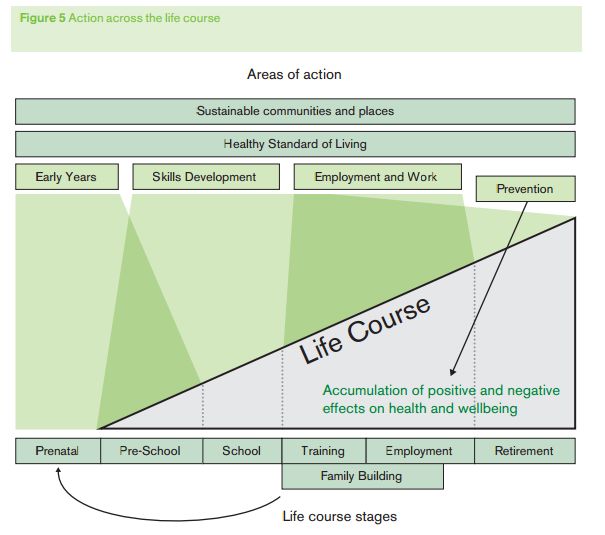
‘Action across the life course’ was central to the Marmot review. It argues that disadvantage
starts before birth and accumulates throughout life, as shown in below in Figure 5. It shows
that that action to reduce health inequalities must start before birth and follow the life of
the child, to break the close links between early disadvantage and poor outcomes
throughout life. For this reason, giving every child the best start in life, (Policy objective A)
was their highest priority recommendation.

Marmot Review Policy Objectives
A - Give every child the best start in life.

B - Enable children, young people and adults to maximise their capabilities and have control over their lives.

C – Create fair employment and good work for all.

D – Ensure a healthy standard of living for all.

E – Create and develop healthy and sustainable places and communities.

F – Strengthen the role and impact of ill health prevention.

‘Action to reduce health inequalities must start before birth and be followed through the
life of the child. Only then can the close links between early disadvantage and poor
outcomes throughout life be broken.’6

6Marmot 2010. ‘Fair Society, Healthy Lives – The Marmot Review’. Strategic Review of Health Inequalities in
England Post 2010. P.20
11 | P a g e                                                                      Swansea Council
Adverse Childhood Experiences (ACE) Study7
This study identified that adverse childhood experiences (ACEs) have a major impact on the
development of health harming behaviours in Wales and the prevention of ACEs is likely
not only to improve the early years’ experiences of children born in Wales but also reduce
levels of health harming behaviours such as problem alcohol use, smoking, poor diets and
violent behaviour. All of these come at great last personal and financial cost to individuals
and society.

Transforming Young Lives across Wales8
This report reflects upon the recognition within the Future Generation (Wales) Act of the
intergenerational relationship between poverty, health and lifetime opportunities,
presenting an economic case for investment of scarce public resources in the first 1000 days
of life, from conception to school readiness. It concludes that international evidence shows
that investment, focussed upon the first few years of life produces returns over and above
other forms of financial investment and/or investment at other times in the life course. This
therefore offers the most efficient use of public resources.

Prevention: A Shared Commitment9
This Local Government Association (LGS) report highlights the unsustainable nature of
curative approaches to social care and health services. It highlights the need for
preventative strategies that mitigate or defer the need for costly interventions and at the
same time deliver better outcomes for individuals. Their rationale is that the delivery of
local upfront prevention services stops problems arising in the first instance and reduces
escalation of problems, which are more complicated, lengthy and costly to address. We
present a number of the case studies demonstrating this below.

The LGA highlight that service delivery and transformation is difficult and that doing it well
requires careful planning, skilled workforces, good management, leadership and delivery.
They recognise that local government has a strong track record in this area and that we are
well placed to lead public services collectively to take a preventative approach. They also
recommend the use of proper evaluation techniques to ensure that costs, benefits and
savings are fully tracked and the learning shared widely.

7 Public Health Wales 2015 ‘Adverse Childhood Experiences and their impact on health-harming behaviours in
the Welsh adult population’.
8 CHEME ‘Transforming Young Lives across Wales: The Economic Argument for Investing in Early Years’.
9 Local Government Association – 2015 - ‘Prevention – A Shared Commitment – Making the case for a

prevention Transformation Fund’.

12 | P a g e                                                                 Swansea Council
Case Studies

                           Bury Metropolitan Borough Council

 To illustrate the costs and benefits of public health interventions, NICE ran an analysis
 with Bury MBC to assist its range of smoking interventions using a tobacco return on
 investment tool.
 Smoking rates in Bury are slightly above the national average at 23% with estimate
 costs of £10.7 million per year once the cost to the local economy and NHS are
 considered
 The analysis showed that investment of just over £750,000 in smoking interventions
 for one year lead to a return of £472,500 over two years, £1,085,000 over five,
 £2,115,000 over ten years and £7,012,500 over a lifetime.

                                 Birmingham City Council

 Be Active is Birmingham CC’s scheme to provide free leisure services to its residents.
 Once registered participants have a card allowing them to use a range of leisure
 facilities free at certain times. A third of the local population has got involved since
 2008.
 Evaluation by Birmingham University showed that 75% of users were not using a gym,
 leisure centre or swimming pool previously and half were overweight or obese.
 For every £1 spent on the scheme, approximately £20.69 was saved in health benefits.
 This has helped the team behind the project build a case for continued funding.

13 | P a g e                                                           Swansea Council
5. Our approach 5.1 Our history and successes Swansea has a long and proud history of supporting our citizens through the delivery of statutory services. We have a key role in the delivery of public services for Swansea and as such services such as public protection, health and safety and accident prevention are at our core in service delivery, as is the Safe Looked-After Children Reduction Strategy. This has resulted in a significant reduction year on year (for the last six years) in the numbers of children needing recourse to care. The increased recognition of the value of prevention activity led to an acceleration in our prevention approach to improve the well-being of people in Swansea, driven by the Council’s commitment to providing £1 million for pilot prevention projects in 2014. Here, pilot preventative approaches were delivered that sought to address gaps in services working with children, young people and adults. The proposals were based upon an ‘invest to save’ approach aimed to change behaviours and prevent the need for involvement in costly specialist services, often followed by a long-term support programme. Some pilots, because of their success in demonstrating new delivery methods, namely Local Area Co-ordination and Tackling Domestic Abuse (via the DV Hub) will continue having proved their effectiveness. Others demonstrating better ways of working have been embedded in service delivery, becoming ‘business as usual’. All Council Departments have a role in prevention. The Prevention Strategy brings greater emphasis to prevention activity being everybody’s business and so we cite here some of the corporate activities which contribute positively to this agenda, as well as those early pilot activities funded through the Prevention budget, demonstrating our wider commitment and recognition that further investment is required in this area. We have linked these under the One Swansea Outcomes. The range of prevention activities delivered clearly demonstrates that prevention is everyone’s business! They also reflect the required culture change within the Council to reflect that every contact counts. That is, what services would be like if every employee of the Council worked to the same set of principles around encouraging self-reliance, promoting individual independence and safeguarding the safety of our citizens. 14 | P a g e Swansea Council
A number of activities are already taking place and are aligned under the required
outcomes of the Public Services Board Well-being assessment:
Children have a good start in life
Continuing the success in Child and Family services, of the effective approach to safe
reduction in numbers of ‘looked after children’.
Further success resulting from the reviewed contracting arrangements for children in
need of care places to ensure that they are cared for either within the Swansea Council
or nearby.
Delivery of the Family Support Continuum, using existing resources and spend across a
continuum within Child and Family, Poverty and Prevention, Education and Health.
Delivery of Team around the Family (TAF) in schools, which now supports 52 primary
settings throughout Swansea. This enables schools to identify families’ needs on one
part of the continuum and ensure the delivery of appropriate support at the earliest
opportunity.
The Flying Start programme, which provides over 3,000 young children and their
families (annually) with coordinated, evidence based packages of services and
interventions within their local community to support the child’s development and the
family’s well-being.
The Teenstart pilot, which has provided a multi-disciplinary and multi-agency team of
midwives, family facilitators, NNEBs and Language Development practitioners to
support parents under the age of 25 via a pathway of support with clear focus on early
attachment and better parental infant relationships.
People learn successfully
Contribution at post 16 to continued NEET reduction and improved young person and
family well-being through the NEETS reduction strategy, engagement and progression
framework and delivery of EU funded projects such as Cynydd (working with young
people in school at risk of becoming NEET) and Cam Nesa (working with young people
aged 16-18 who are NEET).
Contribution at pre 16 to improved school attendance, through ‘Education other than at
school’ (EOTAS) reduction, reduction in the number of children who are looked after
(because of reduced need) and improved young person and family well-being.
15 | P a g e Swansea CouncilYoung people and adults have good jobs
Swansea’s ‘Beyond Bricks and Mortar’ policy has embedded community benefit
(targeted recruitment and training) in construction contracts. This is being extended
across our procurement processes to bring local benefit from other contracted works
(construction and service contracts).
Communities for Work and Workways help local people, particularly in our more
deprived areas to develop skills and access job opportunities.
Our Council wide apprentice and trainee strategy develops training and employment
opportunities for young people, targeting those in greatest need.
People have a decent standard of living
Coordination of activity through the Council’s Poverty Forum and partner activity
through the Poverty Partnership Forum10.
Delivery of advice services for council tax and housing benefit entitlements.
Support in the resolution of benefit disputes through our Welfare Rights Service.
People are healthy, safe and independent
Successful approaches to tackling domestic violence, continuing to coordinate activity
through the Domestic Abuse Hub.
The success of the Local Area Coordination (LAC) pilot has led to better service
coordination with, for example, health colleagues. These have demonstrated how we
can develop and build capacity to provide natural support services, building community
resilience. Our intention is to seek further investment in this area to roll out the
approach.
Reducing the risk of disease and illness through our public protection services of food
safety and vermin control.
Delivery of leisure and sports development services, encouraging more active and
healthier lifestyles.
Delivery of CCTV services throughout the city increasing successful crime reporting and
levels of security.
Working to improve the well-being of Council staff and reduce sickness levels.
People have good places to live and work
10 See appendix A
16 | P a g e Swansea Council Significant investment is taking place in Swansea and across the City Region presenting
extensive opportunities through developments such as City Deal and the proposed
Swansea Bay Tidal Lagoon.
Delivery of a range of prevention activities across core Council services including the
provision of culture, leisure, community centres and libraries.
Delivery of leisure activities across Swansea, impacting positively upon the health and
well-being of citizens through encouraging more active lives.
The provision of parks and open spaces for recreation and exercise, encouraging more
active lives.
Alignment of cleansing services and the prevention of waste across our communities
through our waste management and recycling strategy.
Preventative works to highways and buildings assets infrastructure to prevent
deterioration and mitigate larger unplanned failures affecting future delivery.
Investment in achieving Wales Housing Quality Standard in our council housing to
improve the accommodation and well-being of our citizens.
The landscape of our city is continually maintained and refreshed, bringing benefits to
local communities.
In addition to the positive prevention work being undertaken, it is clear that further
opportunities exist as well as further work being required. A key strand of our
commissioning reviews within Swansea will be to assess and evaluate the opportunities for
further prevention activities. This will support and allow directorates and services to
improve outcomes and mitigate against future demand.
5.2 Vision
Our vision is to…
‘Secure better outcomes and better manage demand through
preventative approaches’.
5.3 Demand management
Demand arises from many places. Everything the council does either creates demand or
responds to it.
For example: Residents depend on the council to fulfil specific needs which could be
something simple such as reporting a pot hole or fly tipping, paying a council tax bill or
making an application for a Blue Badge.
17 | P a g e Swansea CouncilDemand can however also be complex and require long-term, costly resources, such as the need for residential care following a hospital admission, or long term domiciliary care to support a person with personal care. Different types of demand can be managed in different ways: Failure demand This is demand, which can be caused by poor service design and/or previous failure by a service to adequately resolve an issue. This can include unnecessary referrals or hand-offs by front-line staff, multiple assessments by numerous support services and external agencies, or the failure to get things right the first time. Demand which is avoidable Avoiding the demand for services arising in the first instance will result in the reduction in provision of costly or unnecessary services. For example, offering an app, which enables residents to easily report broken street lights via their smartphone rather than having to call or email the council. The council receives richer information and residents are able to report issues at a time that is convenient to them. Both parties save time and avoid duplication of tasks. Demand which is preventable This is when actions should happen earlier, which would have prevented the need arising in the first place. Here we may be providing more than is needed. For instance, with care for older people, when the right actions are taken early - such as fixing trip and slip risks around the home - this can help prevent falls and preserve mobility and independence for longer. This reduces the need for hospital admission and re-enablement services. Excess/ co-dependent demand This is when the council deliver more than is required or creates demand through dependency. To avoid the unnecessary over provision or insufficient targeting of services, we need to understand demand needs. Services can then be redesigned to move away from delivering services based on perceived need and expectation to delivering services, which are built on the needs of citizens and the community. This makes services more innovative, efficient, person centred and enables co-production. Creating productive demand in services The Council can be more commercially aware by offering additional services at competitive prices thus increasing Council income. An example here would be using the expertise the Council has developed in treating Japanese knotweed and charging for this service externally. 18 | P a g e Swansea Council
5.4 Good Customer Services
The heart of demand management is about good customer services and delivers the
following benefits:
1. Delivering better outcomes to residents and communities by:
Developing residents' independence and community resilience;
Better targeting support and services to where they are most needed;
Delivering better quality services, which target root causes rather than the effect of
problems.
2. Saving money through achieving operational and financial efficiencies by:
Removing duplication and waste;
Enabling customers to serve themselves;
Targeting resources, and aligning supply more closely to demand;
Introducing modern ways of working ensuring we are up to date with technology.
In all of these cases, managing demand begins by understanding what drives demand -
what are the root causes. Any attempt to manage demand, while also seeking to improve
outcomes, should be based on an understanding of how people, both those using and
delivering services behave, and what they want versus what they need. The behaviours,
expectations and default actions of both residents and service providers can magnify and
multiply demand.
Ultimately demand management is about ensuring the right services reach the right
residents when and where they need it, at the lowest possible cost. This will not only
improve the resident experience, ensuring they are receiving what they need in the most
efficient, timely way, but will also reduce duplication and waste which will save unnecessary
costs.
5.5 Managing the cycle of customer behaviour
Demand management will be delivered across three interconnected themes, which have
been designed to complement the work already being achieved across the organisation.
We will seek to manage our demand via new and innovative approaches in service delivery.
By understanding the continuing cycle of
customer behaviour, Council demand on
services, the standard practice of service
provision, looking at this differently and Understand
Customer & Shape
developing our demand management skills, it Behaviour Council
Demand
19 | P a g e Swansea Council
Develop Demand
Management Skillswill enable us to do different things rather than doing traditional things differently.
We need to recognise that those with greatest need for support from Council Services are
likely to place high demand on other local services and may require shared solutions with
our Public Service Board partners.
Some examples of current programmes assisting in demand management are:
Delivery of high quality and efficient Customer Relationship Management (CRM)
Services for Swansea.
Leading the Swansea Council’s transformation approach, supporting not only better
cost effectiveness but also a truly sustainable Swansea.
Delivering customer contact and self-service which is playing a key role in
prevention, particularly through the provision of information advice and assistance
(IAA).
5.6 Early intervention and prevention
The Council interacts with citizens depending on their need for more complex and
individual services. These can be broken down into distinct tiers as a continuum of need
from universal services through to specialist complex targeted services (see diagram
below).
The right approach should be proportionate to need ensuring whole population
interventions, such as public health campaigns or changes to waste collections, with
interventions adjusted and support enhanced according to the needs of groups and
individuals. This approach ensures a proper process, which both de-escalates and delays
need.
When providing support services to people, the need for tailored responses to reflect
varying complexity makes service delivery more challenging, and even more important that
we get it right. It is also more difficult to track the impact of interventions as often the
outcomes and specific cost savings are long term and consequently difficult to quantify.
20 | P a g e Swansea Council5.7 The Need Continuum
Within the context of the Social Services and Well-being Act, prevention is illustrated
through the image of a windscreen. The illustration above is an example. This model
demonstrates the importance of developing sustainable solutions which allow people to
look after themselves as far as possible. For those who require Tier 3 or 4 services there
should be an emphasis on supporting them in order to de-escalate the level of need and
therefore the complexity of services they require. People are not constrained by this
model. They can benefit from one or more tier of the services at the same time.
TIER 0
Supporting
TIER 1
Individual
Community & Universal
Family Resilience Access to TIER 2
support for TIER 3
Wellbeing Early
Intervention Identified TIER 4
Need
Higher Level Needs
Being Case
Specialist
Managed Support
21 | P a g e Swansea CouncilThe above diagram outlines the continuum of need in each tier, which can be applied across
all services. It is a representation of the different types of support available to people.
Explanation: At every tier, the Council and its delivery partners need to understand present
and future demand, considering previous trends to predict future need. Each area of the
Council’s business will consider the tiered model and what services are currently provided
along with existing demand and future demand. We will then consider the potential
options for reducing or delaying demand and de-escalating needs.
Tier zero is often referred to in health and social care. This level is prior to universal
services in tier one and is about individuals relying on their own personal resilience and
ability to have strong supportive relationships within their families and communities. This
is evident when people or an area has a high level of social capital. The Third Sector and
Voluntary Sector play an important role within tier zero and the Council continue to
support the sector through our Change Fund. Our aim is to support citizens to achieve the
highest level of independence that they are able to.
It is vital to consider the whole system, as investment and growth in one area can
potentially increase demand elsewhere. Investment in one tier alone is not sufficient to
reduce demand in all areas. A holistic application to prevention throughout all tiers is
necessary to support people to achieve the outcomes they want in their lives.
Case Studies
The Family Support Continuum
A child was identified to have high levels of difficulty in speech and language and was
referred to the speech and language team within Early Years. Home visits showed that
he was looked after by his grandmother while mum and dad worked, spending most of
his time in a play pen. His play skills were limited so the Early Language Development
Team (ELDT) initially worked on these skills. At the same time the family, including the
grandmother, was encouraged to come to parent and toddler group and song and rhyme
sessions at the library. They were also encouraged to access further support. The child
and his family, once ready, were helped by the speech and language (SALT) team. This
involved early language groups and 121 sessions. He has now moved on to nursery and
his speech and language skills are on par with other children in his class.
22 | P a g e Swansea CouncilLocal Area Coordination (LAC)
A gentleman was in rent arrears and at risk of potential eviction. He was also out of
work. He was at high risk of fire at home due to alcohol and other factors. In addition,
he was at risk of his health deteriorating and admission to hospital for physical and
mental health reasons.
LAC support resulted in the following service cost reductions (based on researched
average annual costs):
Reduced demand on mental health services (£956 for an adult with anxiety and
depression.
£1962 cost to the NHS of alcohol dependency.
Reduced cost to housing of £733 based on simple housing repossession;
Reduced benefits costs of £7,744 as he is now in paid employment
Fire prevention resulting in reduced cost of £3568 – the average cost of a fire
callout
Total cost reduction (first year only): £14,963
Domestic Violence Hub (DV Hub)
A mother reported a violent incident with her partner which occurred while their three
children were present. This was not the first time an incident had happened however
this was the first time she had reported one. At the first visit to the Hub, the mother
scored her safety (from further incidents of domestic abuse) at a 2 (1 is high risk, 10 is
low).
The DV Hub lead worker mediated between the parents in relation to the immediate
issues of payment of rent, transfer of tenancy and child contact, which prevented the
requirement for any contact between them and possible escalation of incidents. The
outcome of direct work with the children was shared, which enabled the father to
consider the impact of his behaviour on the children and act in accordance with their
wishes and feelings regarding contact. Over the following weeks mediation in relation to
child contact continued and this progressed to contact between the children and their
father being supervised by a family member and eventually, when they felt ready, to
unsupervised in the community.
Support was provided to the mother to make a priority application to the Local Authority
for housing and benefits for her and the children. The mother scored her and the
children’s safety (from further incidents of domestic abuse) at a six.
The case was closed when mother scored hers and the children’s safety (from further
incidents of domestic abuse) at nine and agreed that all identified needs had been met.
23 | P a g e Swansea CouncilThis prevention approach even at a high level of need can be applied to other areas of the
Council or to partner’s delivery.
We are seeking to ensure that people get good quality and appropriate services, meeting
their needs within the right tier of support. Early intervention will ensure that we meet
people’s needs at the lowest appropriate tier. This approach will result in a reduction in
demand for the costlier interventions delivered within tiers 3 and 4 and focus at every point
of de-escalating need.
5.8 The Prevention Optimum Model
The optimum model sets out what we would be doing if we get our Prevention Strategy
approach right. It is important that we work to ensure that this approach is understood
corporately and with our partners in order to embed prevention principles and delivery
mechanisms.
The principles we will work towards as Swansea’s Prevention Optimum Model are;
A whole Public Services Board and whole Council approach;
Making every conversation count;
Holistic universal and early intervention services;
A culture where all services are acting at every point to de-escalate need and build
on strengths;
Adopting strength based approaches using the strengths of individuals, families and
communities;
Supporting independence at all stages, with different levels of interventions offered;
Building resilience, social capital11 and social networks;
Delivery partners have confidence in the approach;
Making evidence based investment decisions of what reduces demand;
Learning about ‘what works’ is fundamental to future delivery.
The Prevention Optimum Model would encompass the following elements:
Needs assessment providing trend data for each tier and future predictions;
Services map activities onto the continuum of need to see what is in place/its cost;
Gap analysis across the tiers to establish over/under provision based on outcomes;
Clear unit costs and budget;
Staff/member training to reinforce importance of and their role in prevention;
Engaging people in design and delivery of services through co-production;
Working in partnership with other agencies, voluntary and community sector;
Strong and effectively managed commissioning of services across all tiers.
11 Social Capital – The networks of social connections between people and their shared values and benefits.
24 | P a g e Swansea Council5.9 The importance of partnerships In this strategy we have chosen to include all of our prevention activity as a Council that helps to sustain quality of life and encourages resilience and independence. We recognise that prevention is everyone’s business within the Council and is therefore our corporate approach. These key priorities can only be achieved through corporate and partnership approaches to prevention and wellbeing for Swansea, including through the PSB and Western Bay. The issues we face can only be tackled through new ways of working, including joined up partnerships, around shared issues, which build individuals, families and communities resilience and support people to achieve outcomes for themselves. The overriding message is prevention is everyone’s business – all Council staff, directorates, our partners and stakeholders – to encourage the increasing partnership with and resilience of the communities we serve. 6. Outcomes for the strategy Our Approach We will judge outcomes of the model and this strategy in line with achievements towards the expected outcomes of the Public Services Board Well-being assessment. In this way, as we further develop activities with our PSB partners, we can add them in to our dynamic Delivery Plan. In order to continue to reduce the expenditure and the demand in each of the key priority areas we need to look to an evidence base of what works. Many of these initiatives will need pump priming, acting as a catalyst for wider change, with the majority refocusing existing spend, whether that is grant funding or core budget. The Council is committing to an invest to save approach over a period of twenty years. Where we recognise need, individual business cases for proposed intervention will be brought forward, resulting in an informed, evidenced action and investment plan to deliver this strategy. The attached action plan outlines our more detailed activity – below are some overarching actions, which will increase commitment and demonstrate effectiveness. The action plan supports their delivery. Some early and overarching actions: 1. Working with Swansea’s Public Services Board, seeking targeted commitments from PSB partners; 2. Preparing business cases for preventative action and identifying funding sources as appropriate; 25 | P a g e Swansea Council
3. Develop an Adult Support Continuum, learning from the successes of the Local Area
Coordination (LAC) approach;
4. Making culture changes to make every contact count;
5. Giving preventative messages through information advice and assistance (IAA);
6. Embedding the prevention approach in the commissioning review process;
7. Delivery of staff and member training around the prevention agenda;
8. Working with Swansea’s voluntary and community sector to support their preventative
approach and help develop their role;
9. Maximising employment and training opportunities created through Council, partner
and private sector investment in the Swansea region, targeting these opportunities at
local people to increase personal wealth.
How will we know if we have been successful?
We will know that we have been successful when we see the following types of outcomes
(these are not exhaustive):
Key progress is made against the Key Performance Indicators associated with our
six population outcomes;
We identify reductions in need for costly services and complex interventions;
Prevention activity is embedded across Council Services and across the services of
our PSB partners;
We can evidence the avoidance of unnecessary expenditure;
We are confident that costly interventions were appropriate, necessary and could
not have been avoided.
26 | P a g e Swansea Council7. Governance
The diagram below shows how the Prevention Strategy will be managed within Swansea
Council. This needs to be considered in the wider strategic context of the Swansea’s Public
Services Board via Cabinet Members and senior officers.
Swa
nse
a
Cabi
Corporate
net
Management
Team
Directorate Performance
Management
Explanation
Corporate Directors take responsibility for work and actions in their area and manage these
through regular performance and financial monitoring meetings and reporting
mechanisms. Progress is reported through Corporate Management Team and on to
Swansea’s Cabinet. Decision-making is regulated through Swansea’s scheme of delegation
and standing orders. This plan will undergo a mid-term review in 2019.
8. Delivery Plan
The Delivery Plan outlining key activities and outcomes is attached to this document. The
Delivery Plan is designed to be dynamic. For consistency, actions are grouped under the
key outcomes of the Public Services Board Well-being assessment.
27 | P a g e Swansea CouncilAppendix A Swansea Council Poverty Forum The Chief Executive chairs the Swansea Council Poverty Forum and membership comprises of operational and senior managerial representatives from across the Council and health. The operational staff act as departmental poverty champions, with backing from their senior managerial representative. The forum is the leading group bringing together all Council departments into a one Council tackling poverty approach, prioritising resources to tackle and alleviate poverty within and between departments. The forum champion and track delivery progress of the Tackling Poverty Strategy and Delivery Plan on behalf of Swansea Council. Swansea Poverty Partnership Forum The Swansea Partnership Poverty Forum membership comprises of senior representatives from PSB member organisations and wider partners to lead and co-ordinate action to tackle poverty in Swansea. The membership includes representatives from South Wales Police, the Health Board, SCVS, Housing Associations, Credit Unions, Department of Work and Pensions and charities including Crisis, YMCA and Citizen’s Advice. The partnership supports the development of new initiatives and programmes to tackle poverty throughout the county, and shares good practice. It develops processes and policies to focus resources, to generate new resources and align existing resources to tackle poverty. 28 | P a g e Swansea Council
You can also read


