Missouri Heart Disease and Stroke Plan 2012 2018
←
→
Page content transcription
If your browser does not render page correctly, please read the page content below
Missouri Heart Disease
                           and Stroke Plan
                             2012 – 2018
Development of this plan was facilitated by the Missouri Heart Disease and Stroke Program at the
Missouri Department of Health and Senior Services (DHSS) along with the Heart Disease and Stroke
Partnership* and its workgroups including the Steering Committee, the Quality Health Care
Workgroup, the Worksite Partner Collaboration Workgroup and the Sodium Knowledge in Practice
Workgroup as well as representatives from the Missouri Million Hearts Collaboration. In addition, the
framework of this plan was developed by a Chronic Disease State Plan Workgroup consisting of key
internal and external partners. See Acknowledgments for a full listing of these memberships.

Financial support was provided through a Cooperative Agreement (3U50DP00075005S1) with the
Division for Heart Disease and Stroke Prevention of the Centers for Disease Control and Prevention
(CDC).

The Heart Disease and Stroke Partnership* is a group of statewide stakeholders who assist the heart
disease and stroke prevention and control initiatives (Missouri Heart Disease and Stroke Program and
Missouri WISEWOMAN Program) funded through the Centers for Disease Control and Prevention
Division of Heart Disease and Stroke Prevention grants awarded to DHSS with statewide planning,
implementing interventions and leveraging resources to increase efficiency of program and partner
efforts.

For more information, contact:

Missouri Heart Disease and Stroke Program
Missouri Department of Health and Senior Services
P.O. Box 570
920 Wildwood Drive
Jefferson City, Missouri 65109
Telephone 573-522-2896

                                                                                                        1
Table of Contents
Introduction
Chronic Disease Integration in Missouri
Burden of Heart Disease and Stroke in Missouri
Chapter 1: Planning
Chapter 2: Environmental Approaches
Chapter 3: Health System Interventions
Chapter 4: Community-Clinical Linkages
Chapter 5: Epidemiology and Surveillance
Acknowledgments
References and Resources
2Introduction
Vision: Healthy Hearts – Stroke Smart Missourians
Mission: To promote leadership and foster collaboration to prevent and reduce the effects of heart
disease and stroke among all Missourians.
Overall Goal: To reduce heart attacks and strokes in
Missourians in alignment with the national Million The Million Hearts™ initiative* is a
HeartsTM initiative*. national initiative to prevent one
million heart attacks and strokes
Heart disease is the number one killer in Missouri and over five years. Million Hearts™
brings together communities, health
in the Unites States (US). Missouri’s age-adjusted
systems, nonprofit organizations,
death rate is significantly higher than the national federal agencies and private-sector
rate. African-Americans have a significantly higher partners from across the country to
heart disease mortality rate than whites. Stroke is the fight heart disease and stroke.
fourth leading killer in the state and Missouri’s stroke http://millionhearts.hhs.gov/index.html
age-adjusted death rate is also significantly higher
than the national rate. High blood pressure is the
main risk factor for stroke and one of the major risk factors for heart disease. In the past ten years, the
prevalence of high blood pressure increased significantly in Missouri. The racial disparity between
African-Americans and whites has also increased. A more comprehensive burden overview can be
found in Burden of Heart Disease and Stroke in Missouri commencing on page seven.
What is being done to address this problem? In 1996, state general revenue dollars were made
available to address the cardiovascular health disparities for minorities living in Kansas City, St. Louis
City and the Bootheel region of the state. In 1998, the US Congress provided funding for the CDC to
initiate a national, state-based cardiovascular health program with funding for eight states. Missouri
received capacity building grant funds in October 1998. In October 2000, Missouri became just one of
four states to receive funding at the Basic Implementation level. The Cardiovascular Health Program
focused on health promotion, primary and secondary prevention of heart disease and stroke in regard
to the risk factors of high blood pressure, high blood cholesterol, diabetes, tobacco use, physical
inactivity, poor nutrition and overweight/obesity.
3In 2002, the emphasis of the CDC grant moved to the prevention of initial and recurrent events,
knowledge of the signs and symptoms of heart attack and stroke and the control of high blood
pressure and cholesterol. This focus continued into the 2008 cooperative agreement although blood
pressure and cholesterol control came into sharper focus during that grant cycle and the ABCS of Heart
Disease and Stroke Prevention (see next page) were introduced.
The current program focus at the national level is to address the ABCS of Heart Disease and Stroke
Prevention (see below), with the main focus on preventing and controlling high blood pressure and
reducing sodium intake. Efforts to address the ABCS include:
• Aspirin: Increase low dose aspirin therapy according to recognized prevention guidelines.
• Blood pressure: Prevent and control high blood pressure; reduce sodium intake.
• Cholesterol: Prevent and control high blood cholesterol.
• Smoking: Increase the number of smokers counseled to quit and referred to State quit lines;
increase availability of no or low-cost cessation products.
The Missouri Heart Disease and Stroke Program is addressing the national priorities, conducting
program evaluation and using those results to guide planning efforts. This plan expands that work,
leveraging the progress made with the most recent Heart Disease and Stroke Program’s grant award
that covered fiscal years 2008 through 2013. The following Missouri Heart Disease and Stroke Plan was
developed with input from over 50 external partners, numerous internal partners and describes
strategies throughout the State involving the Program and its partners to address the ABCS of Heart
Disease and Stroke Prevention. The success of the plan depends on partners from a wide range of
organizations working together to implement various aspects of the plan. These partners are
identified throughout the plan.
This plan uses goals, objectives, strategies and action steps which are time-driven as follows:
• Short-term – years 2012 through 2014
• Mid-term – years 2015 through 2016
• Long-term – years 2017 through 2018
The intended audiences for this plan are public health and health care professionals in the
cardiovascular and primary care fields, policy-makers and all other stakeholders who can help design
implement and sustain initiatives of the plan.
4Chronic Disease Integration in Missouri
Organizational Structure
Within the DHSS, the Section for Community Health and Chronic Disease Prevention (CHCDP) consists
of two Bureaus and several programs and initiatives:
Bureau of Cancer and Chronic Disease Control (CCDC):
• Arthritis and Osteoporosis
• Asthma Prevention and Control
• Diabetes Prevention and Control
• Heart Disease and Stroke
• Organ and Tissue Donation
• Show-Me Healthy Women (Breast and Cervical Cancer Control)
• WISEWOMAN
• Comprehensive Cancer Control
• School Health
Bureau of Community Health and Wellness:
• Obesity Initiative
• Comprehensive Tobacco Control
• Healthy Communities
• Team Nutrition
• Adolescent Health
• Injury / Violence Prevention
• Safe Kids Coalition
Missouri Coordinated Chronic Disease Plan
In January 2012, the DHSS launched a planning process to enhance coordination of chronic disease
prevention and health promotion activities statewide. Members of the multi-stakeholder Chronic
Disease State Plan Workgroup participated in multiple discussions to recommend strategies that could
build a statewide infrastructure for interventions and policies to achieve measureable improvements
across the leading chronic diseases – arthritis, asthma, cancer, diabetes, heart disease and stroke.
Aligned with analysis from the Institute of Medicine and advice from the CDC, the Workgroup was
guided by two simple principles – (1) support people to live well, regardless of their chronic illness or
current state of health and (2) dissolve boundaries between categorical (aka, condition-specific)
program activities. Informed by surveillance data, the Workgroup built this plan from a foundation of
prior work led by DHSS over the past three years, including the Integrated Chronic Disease Prevention
& Management: Framework for Strategic Planning.
5Strategies were developed within five broad domain areas: (1) planning, (2) environmental
approaches, (3) health system interventions, (4) community-clinical linkages and (5) epidemiology and
surveillance. The Workgroup ultimately selected Action Steps under each strategy to guide statewide
activity. The actions are specific, measureable items that, when accomplished, would advance
Missouri’s capabilities to implement an efficient, coordinated, public health approach to chronic
disease. The resulting product is called, On Common Ground for Health, Our Coordinated Efforts to
Prevent and Manage Chronic Disease in Missouri.
Five Strategy Areas for Missouri Chronic Disease Coordination
(1) planning
(2) environmental approaches
(3) health system interventions
(4) community-clinical linkages
(5) epidemiology and surveillance
Heart Disease and Stroke Plan
The Heart Disease and Stroke Plan begins with and builds upon this coordinated plan. Each domain
from the coordinated plan aligns with a chapter in this plan. The strategies aligning with the
coordinated plan are the starting point for each chapter and are each designated as a Coordinated
Chronic Disease Strategy. The Heart Disease and Stroke Plan then adds additional strategies specific to
the ABCS of Heart Disease and Stroke Prevention which are each designated as an ABCS Strategy.
There is also explicit alignment between this plan and other Missouri chronic disease management and
prevention state plans such as diabetes, obesity, tobacco and cancer programs.
Achieving Health Equity
Achieving health equity results in enhanced quality of care and reduced costs due to improved
communication between providers and patients. Enhanced communication improves patient
adherence to prescribed diagnostics and therapy and fosters self-management of chronic conditions.
Health system performance and efficiency is improved due to a reduction in medical errors and
improved use of costly technology and resources. Achieving health equity improves health literacy
ensuring that all patients have the skills to make optimal health decisions on their own behalf. Finally,
efforts to achieve health equity impact the economy. Achieving health equity will result in a healthier
workforce thereby improving productivity and reducing absenteeism in the workforce. Over the
course of the next year and beyond, DHSS intends to utilize the Organizational Self-Assessment for
Addressing Health Inequities Toolkit which provides public health leaders with tools and guidelines that
help identify the skills, organizational practices and infrastructure needed to address health equity and
provide insights into the steps which can be taken to ensure DHSS can have an impact on the issue of
health equity.
6Burden of Heart Disease and Stroke in Missouri
Summary
The health and economic costs of heart disease and stroke in Missouri are tremendous. Heart disease
was the first, and stroke, the fourth leading causes of death in Missouri in 2010. Missouri has a higher
burden of heart disease and stroke, as demonstrated by higher morbidity and mortality rates than the
nation. The burden of these two categories of diseases is likely to grow as Missouri’s population ages
and also because of the increasing prevalence of risk behaviors and chronic diseases/conditions that
increase the risk of heart disease and stroke. According to the 2010 Census, about 14 percent of
Missouri’s population were 65 years of age or older, compared to 13 percent in the US. In addition,
Missouri’s prevalence of smoking, physical inactivity, obesity, hypertension, high cholesterol and
diabetes are all higher than that in the US. Furthermore, the prevalence of obesity, hypertension and
diabetes are increasing significantly over time in Missouri, and at a faster pace than the US. While
health data is available for the two largest racial groups, African American and whites, this data for
other racial/ethnic populations is limited in Missouri.
Heart Disease and Stroke Mortality
Heart disease and stroke were the first and fourth leading causes of death in Missouri in 2010,
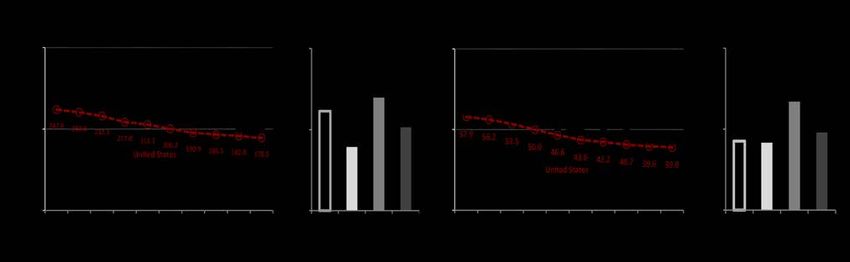
accounting for 31.2 percent of total deaths. Parallel to the US, the age-adjusted death rate for heart
disease has decreased significantly in Missouri in the last decade. However, Missouri’s rates have been
consistently higher than the US rates (see fig. 1a). In Missouri, African-American men had a higher
death rate than other racial and gender groups in 2010 (see fig. 2b). From 1999 to 2009, Washington
County had the highest heart disease death rate (381.6 per 100,000 population) among 114 counties
and the City of St. Louis, followed by Mississippi County (363.8 per 100,000 population) and Pemiscot
County (361.0 per 100,000 population).
7The age-adjusted death rate for stroke also decreased significantly in Missouri in the last decade;
however, Missouri’s rates have again been consistently higher than the US rates (see fig. 1c). In
Missouri, African-American men had a higher death rate from stroke than other racial and gender
groups in 2010 (see fig. 1d). From 1999 to 2009, Dunklin County had the highest death rate (85.9 per
100,000 population) among all counties, followed by Henry County (79.8 per 100,000 population) and
Lawrence County (79.7 per 100,000 population).
Heart Disease and Stroke Emergency Room Visit and Hospitalization Rates
In 2010, the age-adjusted emergency room visit rate for heart disease was 14.6 per 1,000 population in
Missouri, which increased significantly from 12.2 per 1,000 population in 2000. African-American
women had a higher rate than other racial and gender groups. The age-adjusted hospitalization rate
for heart disease was 132.7 per 10,000 population in 2010, a significant decrease from 168.3 per
10,000 population in 2000. Among all racial and gender groups, African-American men had the highest
hospitalization rate. In 2010, heart disease led to $3.2 billion in hospital charges (see Table 1),
including $2 billion in charges to Medicare and $253 million in charges to Medicaid.
Table 1. Emergency room visits, inpatient hospitalization, death and hospital charges
of heart disease and stroke, Missouri, 2010
Rate a
Disease Burden Number
Missouri White men White women AA men b AA women b
Heart Emergency room visits c 89,673 14.6 12.7 13.4 22.2 27.2
disease Inpatient hospitalization c 89,061 132.7 147.3 104.2 205.7 185.2
Death c 13,741 200.3 245.4 157.3 278.7 206.0
Hospital charge (dollars) c 3.2 billion (all), 2 billion (Medicare), 253.0 million (Medicaid )
Stroke Emergency room visits c 5,135 0.8 0.8 0.7 0.8 0.7
Hospitalization c 20,104 29.7 29.7 25.6 49.3 44.2
Death c 2,979 43.6 42.6 41.6 66.9 47.9
Hospital charge (dollars) c 647.3 million (all), 404.5 million (Medicare), 64.1 million (Medicaid)
a
Emergency room visits, per 1,000 population; inpatient hospitalization, per 10,000; death, per 100,000.
b AA, African-American.
c
Source: Missouri Information for Community Assessment (http://health.mo.gov/data/mica/MICA/).
In Missouri, the age-adjusted emergency room visit rate for stroke remained at 0.8 per 1,000
population from 2000 to 2010. The rate was not significantly different among racial and gender
groups. In addition, the age-adjusted hospitalization rate for stroke also decreased significantly from
35.7 per 10,000 population in 2000 to 29.7 per 10,000 in 2010. African-American men had the highest
hospitalization among the four racial and gender groups. In 2010, stroke incurred $647.3 million in
hospital charges (see Table 1), $404.5 million to Medicare and $64.1 million to Medicaid.
8Prevalence of Heart Attack and Stroke Survivors
In 2010, the prevalence of heart attack survivors was 4.6 percent in Missouri, an increase from 4.1
percent in 2001. Missouri’s prevalence has been higher than the US prevalence since 2005 (see fig.
2a). In Missouri, the prevalence was higher among African-American men than among other racial and
gender groups. The prevalence increases with age and decreases as education or household income
level increases. The southeast region had the highest prevalence among all regions in Missouri (see
Table 2).
Table 2. Prevalence of adults with heart attack or stroke, Missouri, 2010
Heart attack Stroke Heart attack Stroke
(%) (%) (%) (%)
Race and gender Income ($)
White men 6.1 3.3 14,999 or less 11.9 10.6
White women 2.8 4.3 15,000-25,000 8.9 8.0
African-American men 7.4 2.0 25,000-50,000 4.2 2.5
African-American women 3.1 4.4 50,000+ 1.9 2.1
Age (year) Region
18-44 0.5 0.8 Central 3.6 4.3
45-54 3.9 4.1 Kansas City 4.3 3.0
55-64 7.5 5.4 Northeast 5.8 4.6
65+ 13.4 10.3 Northwest 4.9 4.7
Education Southeast 8.6 5.7
Less than high school 9.8 7.1 Southwest 5.0 4.9
High school 6.2 4.8 St. Louis 3.5 3.0
Some post-high school 3.5 3.6
College graduate 2.2 1.9
Source: Behavioral Risk Factor Surveillance System (http://www.cdc.gov/brfss/technical_infodata/surveydata.htm).
9In 2010, the prevalence of stroke survivors in Missouri was 3.9 percent, which increased from 2.5
percent in 2001. Missouri’s stroke survivor prevalence has also been higher than the US since 2005
(see fig. 2b). In Missouri, African-American women had the highest prevalence among all racial and
gender groups. Similar to heart disease, the prevalence increases with age and decreases as education
and income levels increase. Again, the prevalence was highest in the southeast region of the state (see
Table 2).
Risk factors
Major risk factors for cardiovascular diseases include diseases/conditions (obesity, high blood pressure,
high blood cholesterol and diabetes), modifiable risk behaviors (smoking, physical inactivity and
unhealthy diet) and non-modifiable risk factors (age, sex, race and family history). Controlling the
modifiable risk factors and being aware of the non-modifiable risk factors could substantially reduce
the risk of heart disease and stroke.
From 2001 to 2010, the prevalence of obesity has increased significantly from 23.4 percent to 31.4
percent in Missouri, or about 0.8 percentage points per year. During this period, the prevalence of
hypertension and diabetes also increased significantly at about 0.5 and 0.3 percentage points per year,
respectively, in Missouri. Meanwhile, the prevalence of current smoking decreased significantly from
25.9 percent in 2001 to 21.1 percent in 2010, about 0.5 percentage points per year. The prevalence of
low fruit-and-vegetable intake, heavy drinking and physical inactivity did not change significantly
during this period. The prevalence of obesity, high blood pressure, high blood cholesterol, current
smoking and physical inactivity has been consistently higher in Missouri than in the US in the last
decade (Figure 3).
10In 2011, 34.3 percent of adult Missourians had hypertension; 10.7 percent had diabetes; 30.2 percent
were obese; 40.4 percent had high blood cholesterol; and 80.1 percent ate fruit-and-vegetable less
than 5 times per day (2009). The prevalence of these risk factors were higher in Missouri than in the
US. Among race and gender groups in Missouri, African-American men had the highest prevalence of
diabetes, current smoking and heavy drinking, while African-American women had the highest
prevalence of hypertension, obesity and physical inactivity. White men had the highest prevalence of
low fruit-and-vegetable intake and White women had the highest prevalence of high blood cholesterol
(see fig. 4).
Among age groups, people age 65 years and older had the highest prevalence of hypertension,
diabetes, high blood cholesterol and physical inactivity, while people age 18-44 years had the highest
prevalence of current smoking, low fruit-and-vegetable intake and heavy drinking. The prevalence of
obesity was highest in the age group 55-65 (see fig. 5).
The prevalence of hypertension, diabetes, high blood cholesterol, current smoking, low fruit-and-
vegetable intake and physical inactivity decreased as the education level increased. Adults with less
than a high school education had the highest prevalence of all the risk factors, except for heavy
drinking, which was highest among those with some post-high school education (see fig. 6).
11The prevalence of high blood cholesterol, diabetes, current smoking and physical inactivity decreased
as the household income level increased. Adults with a household income of $14,999 or less had the
highest prevalence of diabetes, high cholesterol, current smoking, heavy drinking and physical
inactivity. The prevalence of low fruit-and-vegetable intake varied little as the household income level
increased (see fig. 7).
Populations with higher burden of cardiovascular diseases and risk factors
Morbidity and mortality data indicate the populations with highest burden of cardiovascular diseases
in Missouri are 1) African-Americans, 2) seniors age 65 years and older, 3) adults with less than a high
school education or household income lower than $15,000, 4) adults in Mississippi County for heart
disease, Dunklin County for stroke and the Bootheel area overall for both diseases. Data from the risk
factors demonstrate that the highest prevalence of the risk factors also occurs mainly in these
subpopulations, except for smoking and heavy drinking, which are more prevalent among younger
adults (see Table 3).
12Table 3. Population with the highest burden of heart disease and stroke, Missouri, 2010-2011
Population with highest burden
Heart disease Stroke
AA men b, ≥65 years, < high school education, AA women, ≥65 years, < high school education ,
Prevalence a (2010)Chapter 1
• Bureau of Cancer and Chronic Disease
Control
• Bureau of Community Health and
Strategy Area #1 Wellness
Planning Coordinated Chronic Disease
Strategy 1.1.2 – Leadership
Goal – Priorities for population–based Establish a coordinating council, drawn from
health improvement are focused on existing partnerships, to inform and guide
equity among diverse socio-economic evidence-based planning for chronic disease
groups. prevention and management.
Action Steps
Objective 1.1
Assure priorities for population-based health improvement are focused on equity among diverse socio-economic groups.
• Establish a chronic disease coordinating
By 2014, build infrastructure to address
council drawn from existing
population–based health improvement
focused on equity among diverse socio- partnerships (short-term).
economic groups. • Develop and implement method for
routine collection of input from diverse
Coordinated Chronic Disease people with chronic disease to inform
Strategy 1.1.1 – community health improvement efforts
(short-term).
Communication • Publish menu of evidence-based
Establish a centralized communication
interventions for communities to use for
channel for information about chronic disease
prevention and management among local planning (short-term).
stakeholders statewide.
Partners
Action Steps • Section for Community Health and
• Develop common contact database of Chronic Disease Prevention – Lead
stakeholders from categorical • Bureau of Cancer and Chronic Disease
programs (short-term). Control
• Develop and begin implementation of • Bureau of Community Health and
social networking strategy to link Wellness
stake-holders (short-term).
• Increase number of stakeholders Objective 1.2
linked through social network tools Through 2018, continue to work with and
(short-term). through partnerships to plan, implement and
evaluate heart disease and stroke initiatives
focused on equity among diverse socio-
Partners
economic groups.
• Section for Community Health and
Chronic Disease Prevention – Lead
14ABCS Strategy 1.2.1 –
Partnership
Enhance Heart Disease and Stroke Program
effectiveness, foster collaboration and align
resources through strong statewide
partnerships.
Action Steps
• Continue to recruit new partners to
the Heart Disease and Stroke
Partnership and the Missouri Million
Hearts Collaboration (ongoing).
• Provide training of partners (ongoing).
• Conduct strategic communications
with partners (ongoing).
Partners
• Heart Disease and Stroke Program
• Missouri WISEWOMAN Program
• Heart Disease and Stroke Partnership
15Chapter 2
professionals to use for wellness
program development and
implementation (short-term).
Strategy Area #2 • Offer training program for employers
that are increasing investment in
Environmental
worksite wellness programs (short-
term).
Approaches Partners
• Bureau of Community Health and
Goal – Environmental and social factors Wellness – Lead
support individuals engaging in healthy
• Bureau of Cancer and Chronic Disease
living.
Control
• Section for Community Health and
Objective 2.1
Promote physical activity, healthy eating, and tobacco free living by modifying influential environmental factors.
Chronic Disease Prevention
By 2014, increase from baseline Missourians’
healthy behaviors related to physical activity,
fruit-and-vegetable intake and smoking by Coordinated Chronic Disease
two percent. Strategy 2.1.2 – Activate
Baseline – 2011 BRFSS: (physical inactivity: 28.4
percent; five or more daily servings of fruits-and-
Change Agents
vegetables: 14.1 percent; current smoking: 25 percent) Activate individuals and organizations to
change environmental factors associated with
Coordinated Chronic Disease physical activity, healthy eating and tobacco
free living.
Strategy 2.1.1 – Worksite
Wellness Action Steps
Build capacity among employers to adopt • Increase use of key messages and
wellness programs targeting physical activity, materials that inform the public about
healthy eating and tobacco free living. the association between environmental
factors and physical activity, healthy
Action Steps eating and tobacco free living (short-
• Assemble stakeholders from at least term).
three categorical programs to develop • Increase number of municipalities
coordinated worksite strategy (short- adopting comprehensive smoke-free
term). ordinances (short-term).
• Complete baseline assessment of • Increase number of communities in the
wellness programs offered by state that adopt ordinances or policies
representative sample of employers in for safe alternate transportation modes
the state (short-term). (short-term).
• Launch website with health education • Increase the percentage of adults who
and other tools for human resource report healthy foods are easy to
16purchase in their neighborhood (short-
term).
Tobacco Free Missouri (TFM) is a
statewide group of concerned
Partners
individuals and organizations from
• Bureau of Community Health and all backgrounds and walks of life.
Wellness – Lead Some are former smokers and some
• Bureau of Cancer and Chronic Disease are working to help friends and
Control loved ones quit. The group is
• Section for Community Health and working to improve clean air access
for everyone and reduce tobacco
Chronic Disease Prevention
use and second hand smoke. Since
• Missouri Council for Activity and 2007, TFM has been working with
Nutrition (MOCAN) partners across the state to support
communities and individuals
ABCS Strategy 2.1.3 – Second- working on cessation and other
tobacco control policy efforts.
hand Smoke
Advance policies that reduce exposure to
environmental tobacco smoke. Goal – Environmental and social factors
support individuals in controlling high
Action Steps blood pressure.
• Advocate for legislation for a tobacco-
free Missouri (short-term). Objective 2.2
• Increase the number of Missouri By 2018, increase the percentage of
communities that implement Missourians who have achieved blood pressure
comprehensive smoke free policies for control from 60.29 percent to 65 percent.
all workplaces, including restaurants and Baseline – 2010 Healthcare Effectiveness Data and
Information Set (HEDIS)
bars (short-term).
• Increase awareness among community
ABCS Strategy 2.2.1 – Heart
officials of the benefits of creating
tobacco-free environments (short-term). Healthy Worksites
Develop and implement Healthy Hearts at
Partners Work initiative that coordinates wellness
• Tobacco Free Missouri – Lead programs, benefit design and corporate policies
• Comprehensive Tobacco Control to promote high blood pressure control.
Program
Action Steps
• Heart Disease and Stroke Program
• Enroll 30 worksites representing
• American Heart Association
residents of St. Louis City into the
• American Cancer Society
Healthy Hearts at Work initiative (short-
• American Lung Association
term).
• Missouri Local Public Health
• Assess Healthy Hearts at Work
Association
employers’ current high blood pressure
17health care provider benefit design • Work with corner stores to increase
and communicate them to employees knowledge of sodium and intent to offer
(short-term). lower sodium foods (short-term).
• Implement new environmental • Provide incentives for corner stores to
supports in participating worksites that carry healthy foods choices (short-
support employee blood pressure and term).
cholesterol management and control • Coordinate activities with Community
(short-term). Transformation Grant grantee in that
• Provide technical assistance for area to augment and not duplicate
employers in the Healthy Hearts at efforts (short-term).
Work initiative in implementing • Implement strategic communication
policies and environmental supports plan for targeted area to complement
(short-term). activities (short-term).
• Implement a communication method • Evaluate and if feasible, expand the
that provides a link between initiative to additional communities
employers, employees and health (mid-term).
plans, promotes information exchange
on high blood pressure management Partners
and assists employees to self-manage • Sodium Knowledge in Practice
their high blood pressure (short term). Workgroup – Lead
• Evaluate and if feasible, expand the • Kansas City Health Department
initiative to additional worksites (mid- • American Heart Association
term). • Black Health Care Coalition
• Diabetes Prevention and Control
Partners Program
• Heart Disease and Stroke Program – • Missouri WISEWOMAN Program
Lead • MOCAN
• Open Health, LLC
• St. Louis Area Business Coalition ABCS Strategy 2.2.3 – Food
• Visiting Nurses Association, St. Louis
Environment
• Bureau of Community Health and (under development 2012)
Wellness By 2018, increase from baseline Missourians’
healthy behaviors related to sodium intake by
ABCS Strategy 2.2.2 – Low ten percent.
Baseline – to be established using 2012 Behavioral Risk
Sodium Options Factor Surveillance System (BRFSS) data
Increase demand for and availability of low-
sodium food options at corner stores within Action Steps
designated areas of metropolitan Kansas City.
• Support the most current
Action Steps implementation strategies of the
Institute of Medicine’s Strategies to
18Reduce Sodium Intake in the United
States (ongoing).
• Advocate for a resolution to create
awareness of the benefits of reducing
dietary sodium intake (short-term).
• Use media including earned media to
educate the public and decision
makers about the relationships of high
salt intake and high blood pressure
(short-tem).
• Partner with MOCAN to develop an
action plan to improve the food
environment in Missouri (mid-term).
Partners
• Sodium Knowledge in Practice
Workgroup – Lead
• Diabetes Prevention and Control
Program
• Missouri WISEWOMAN Program
• Bureau of Community Health and
Wellness
• MOCAN
19Chapter 3
• Form team and provide technical
assistance to support health care
provider quality improvement efforts
Strategy Area #3 (short-term).
Partners
Health System • Section for Community Health and
Chronic Disease Prevention – Lead
Interventions
• Bureau of Cancer and Chronic Disease
Control
• Bureau of Community Health and
Goal – Health care systems deliver
Wellness
evidence-based, coordinated, proactive
and equitable services to prevent,
Enhance health care system capacity to deliver coordinated, proactive, and equitable services for people with chronic conditions.
Coordinated Chronic Disease
detect and control chronic diseases.
Strategy 3.1.2 – Understanding
Objective 3.1 Quality Metrics
By 2014, enhance capacity of the health care Inform public about quality performance
system to deliver coordinated, proactive and metrics of health care providers in chronic
equitable services for people with chronic disease management, including patient-
conditions. centered models of care.
Coordinated Chronic Disease Action Steps
• Release publication (e.g., brochure,
Strategy 3.1.1 – Enhancing
website) to educate the public about
EMR Usability attributes and benefits of patient-
Increase the use of quality improvement centered models of care (short-term).
methodologies and population management
• Create inventory of quality assessment
functions (e.g., registries) available though
electronic medical record (EMR) systems. and measurement projects underway in
the state (short-term).
Action Steps • Develop system for directing consumers
• Develop and begin implementation of to public information about health care
an annual assessment of leading provider quality (short-term).
health care providers’ use of electronic
Partners
population health management tools
• Section for Community Health and
for improving chronic care (short-
Chronic Disease Prevention – Lead
term).
• Bureau of Community Health and
• Develop and publish analysis of payer
Wellness
policies for chronic disease prevention
• Bureau of Cancer and Chronic Disease
and management services (short-
Control
term).
20Goal – Disparities in blood pressure and • Expand the initiative to additional
cholesterol control in priority hospitals and/or risk factors (mid-term).
populations are addressed.
Partners
Objective 3.2 • Heart Disease and Stroke Program –
By 2015, increase the number of rural Lead
hospitals providing enhanced discharge • Office of Primary Care and Rural Health
services for elevated blood pressure and • Critical Access Hospitals
cholesterol levels from three to ten. • Missouri Association of Free Clinics
Baseline – Three hospitals participated in pilot project
ABCS Strategy 3.2.1 –
Objective 3.3
By 2017, decrease the number of heart attacks
Discharge Planning and stroke among Missourians by 20,000.
(a pilot project in 2012) TM
Baseline – National Million Hearts Goal; Missouri’s
Establish enhanced rural hospital discharge portion of one million calculated by 2009 population
services related to elevated blood pressure estimates
and cholesterol in Missouri regions with
provider access shortages. ABCS Strategy 3.3.1
Enhance Missouri Millions Hearts strategic
Action Steps partnership to align resources to prevent heart
• Develop a detailed plan for project disease and stroke.
expansion and identify participating
rural hospitals (short-term). Action Steps
• Establish system linkages with rural • Develop outreach plan for physicians,
hospitals that express interest in nurse practitioners and other health
enhancing discharge planning services care providers (short-term).
to include elevated blood pressure and • Recruit and train physician champions
cholesterol levels (short-term). to promote Missouri Million Hearts
• Provide project-related technical initiatives related to the ABCS (short-
assistance for participating hospitals term).
(ongoing). • Sponsor provider educational session,
• Facilitate collaboration among the “ABCS of Heart Disease and Stroke
participating hospitals fostering best Prevention” for primary care providers
practice identification (ongoing). (short-term).
• Collect and monitor project data to • Develop and conduct ABCS initiatives
confirm that hospital policies and among Missouri Million Hearts partners
processes are in place (ongoing). (mid-term).
• Solicit recommendations from
hospitals and partners for continuous
Partners
• Heart Disease and Stroke Program –
project improvement (mid-term).
Lead
• Missouri WISEWOMAN Program
21• Comprehensive Tobacco Control Partners
Program • Heart Disease and Stroke Program –
• Diabetes Prevention and Control
Lead
Program
• Missouri Primary Care Association • Missouri Primary Care Association
(MPCA) • Community Health Centers
• Primaris • University of Missouri Health Care,
• Missouri Pharmacy Association Department of Neurology
Objective 3.4 United States Preventive Services
By 2013, increase from baseline the number Task Force (USPSTF) aspirin
of eligible patients in Community Health recommendations for the primary
Centers (CHC) who receive low-dose aspirin prevention of cardiovascular disease:
therapy utilizing the United States Preventive
Services Task Force (USPSTF) aspirin • Encourage men age 45 to 79
recommendations for the primary prevention years to use aspirin when the
of cardiovascular disease by ten percent. potential benefit of a reduction
in myocardial infarctions
Baseline – To be established in 2012 through MPCA
Reports from CHC data
outweighs the potential harm of
an increase in gastrointestinal
hemorrhage. (USPSTF “A”
ABCS Strategy 3.4.1 – Low- recommendation).
dose Aspirin Therapy • Encourage women age 55 to 79
Implement change in CHC clinic practices years to use aspirin when the
related to low-dose aspirin therapy using potential benefit of reduction in
USPSTF evidence-based recommendations. ischemic strokes outweighs the
potential harm of an increase in
Action Steps gastrointestinal hemorrhage.
• Sponsor provider educational session, (USPSTF “A” recommendation).
the “ABCS of Heart Disease and Stroke
Prevention” for CHC and other primary
care providers (short-term). Goal – Quality improvement initiatives
• Develop and promote webinar on the are implemented in health care settings
“ABCS of Heart Disease and Stroke serving disparate populations.
Prevention” for providers in CHCs
(short-term). Objective 3.5
• Incentivize CHCs who utilize aspirin By 2014, increase the number of CHCs that
prompts in clinical practice (short- become a National Committee for Quality
term). Assurance (NCQA) 2011 Patient Centered
• Distribute current aspirin guidelines to Medical Home (PCMH) from seven to 18.
primary care providers (mid-term). Baseline – Seven CHCs NCQA 2008 PCMH Recognized –
2013 MPCA data
22ABCS Strategy 3.5.1 – Medical • Introduce Care Teams to specific
interventions and how to evaluate
Home impact (short-term).
Support CHCs to become Patient Centered
• Link training materials to patient
Medical Homes (PCMHs).
engagement (short-term).
Action Steps • Conduct training and provide technical
• Partner with the Missouri Primary Care assistance (mid-term).
Association to expand number of • Identify and provide resources that
participating CHCs that are a PCMH physicians and other health care
(short-term). providers could use on their patient
• Ensure that each participating CHC portals (mid-term).
adopts at least two of the eight • Evaluate impact and develop future
components of Patient-Centered plans (long-term).
Medical Home Assessment (PCMH-A)
Partners
(short-term).
• Heart Disease and Stroke Program–
Partners Lead
• Heart Disease and Stroke Program– • Missouri Primary Care Association
Lead • Primaris
• Diabetes Prevention and Control • Health Literacy Missouri
Program – Co-lead • Prevention Research Center-St. Louis
• Missouri Primary Care Association • Primary Care Clinics
• Community Health Centers
• Primaris Objective 3.6
By 2016, increase the percentage of
ABCS Strategy 3.5.2 – Care hypertensive patients in CHCs with LDL
cholesterolwith chronic diseases, focusing on
cardiovascular disease and diabetes
(ongoing).
• Monitor dashboard reports from the
MOQuIN data warehouse and
reporting system on leading ABCS
indicators aligned with Million
HeartsTM measures (ongoing).
• Promote use of decision support and
electronic reminders for CHCs in use of
their EMRs (short-term).
• Monitor quality improvement (QI)
plans prepared to address gaps and
opportunities for quality improvement
and chronic disease management
focusing on cardiovascular disease and
diabetes within each CHC as well as
with partnerships made in the
community (ongoing).
Partners
• Heart Disease and Stroke Program –
Lead
• Diabetes Prevention and Control
Program – Co-lead
• Missouri Primary Care Association
• Community Health Centers
24Chapter 4
• Bureau of Cancer and Chronic Disease
Control
• Section for Community Health and
Strategy Area #4 Chronic Disease Prevention
Coordinated Chronic Disease
Community- Strategy 4.1.2 – Resource
Awareness
Clinical Linkages Provide public access to tailored information
Goal – Individuals are linked to about community-based resources for
prevention and self-management education.
evidence-based community resources
that support their personal efforts to Action Steps
reach optimal health.
• Identify organizations in all counties
that can serve as a key contact for
Objective 4.1 community-based resources for
By 2014, build the capacity to link individuals
Link individuals to community resources that support their personal efforts to reach optimal health.
prevention and self-management
to community resources that support their
personal efforts to reach optimal health. education (short-term).
• Develop framework and manual for
Coordinated Chronic Disease local public health agencies to
inventory, categorize and promote
Strategy 4.1.1 – Referral community-based resources for
Implement systems to drive referrals into
chronic disease prevention and management prevention and self-management
interventions. education (short-term).
• Convene task force of stakeholders to
Action Steps create conceptual design and basic
• Increase referrals from medical care specifications for web-based tool for
providers to behavioral support accessing community-specific resources
programs for chronic disease self- (short-term).
management, weight reduction and
tobacco use cessation (short-term).
Partners
• Increase number of evidence-based • Section for Community Health and
chronic disease prevention and Chronic Disease Prevention – Lead
management services available at the • Bureau of Cancer and Chronic Disease
community level (short-term). Control
• Bureau of Community Health and
Partners Wellness
• Bureau of Community Health and
Wellness – Lead
25Goal – Community health care services health systems to additional
deliver team-based coordinated, communities (short-term).
proactive care for people with chronic
conditions. Partners
• Missouri Heart Disease and Stroke
Objective 4.2 Program – Lead
By 2018, increase the number of community • Heart Disease and Stroke Partnership
sustainability plans for the control high blood • Missouri WISEWOMAN Program
pressure from five to 25. • Comprehensive Tobacco Control
Baseline – High Blood Pressure contractors in five areas Program
of Missouri in FY2013. • Health Literacy Missouri
• Missouri Primary Care Association
ABCS Strategy 4.2.1 – Linkages • Prevention Research Center
• Primaris
in Communities • Social Welfare Board
Establish linkages between community-based
• Community-based organizations
organizations, health care and public health
systems to support patients in managing their • Local Public Health Agencies
high blood pressure. • Center for Local Public Health
• Community Health Centers and other
Action Steps primary care clinics
• Work with CHCs to refer patients who
smoke and who have cardiovascular ABCS Strategy 4.2.2 – Expand
disease and/or diabetes to the Role of Pharmacists
Missouri Tobacco Quitline for services (under development 2012)
(short-term). Leverage use of Missouri pharmacists in team-
• Support CHCs to provide and based care to improve control of blood
document self-management education pressure, cholesterol and/or glucose.
(short-term).
Action Steps
• Increase the number of formal
• Establish and strengthen partnerships
agreements between community-
with key pharmacy associations and
based organizations, providers and
organizations to leverage and support
Local Public Health Agencies to
the pharmacist’s role in patient care
support blood pressure control (short-
management (ongoing).
term).
• Determine existing medication therapy
• Increase the number of community
management (MTM) projects or other
sustainability plans for the control of
pharmacist projects currently under way
high blood pressure (short-term).
in Missouri that are suitable for
• Expand initiatives to develop linkages
collaboration (short-term).
between community-based
• Explore potential barriers and action
organizations, health care and public
pathways (short-term).
26• Design plan with partners (short-term).
• Implement the plan (mid-term).
• Evaluate and if feasible, expand the
pharmacy initiative to additional
communities (long-term).
Partners
• Heart Disease and Stroke Program –
Lead
• Diabetes Prevention and Control
Program – co-lead
• Missouri WISEWOMAN Program
• University of Missouri Kansas School of
Pharmacy
• Missouri Pharmacy Association
• Missouri Medicaid
A Program Guide for Public Health – Partnering with Pharmacists
in the Prevention and Control of Chronic Disease states that Heart
Disease and Stroke and Diabetes Prevention and Control
Programs both have a focus on enhancing the role of community
pharmacists in team-based care:
• HDSP Programs Strategies for States to Address the
ABCS of Heart Disease and Stroke Prevention: “Promote
use of pharmacists as health care extenders to promote
control of hypertension and high blood cholesterol.”
• DPCP Core Diabetes Interventions and Strategies:
“Expand the role of allied health professionals by
replicating and scaling evidence-based programs
founded on the principles of the Ashville Project and
the Diabetes Ten-City Challenge.
27Chapter 5
• Bureau of Cancer and Chronic Disease
Control
• Bureau of Community Health and
Strategy Area #5 Wellness
Coordinated Chronic Disease
Epidemiology and Strategy 5.2 – Dissemination
Surveillance Enhance avenues for making chronic disease
and health promotion data available for diverse
audiences through multiple mediums.
Enhance use of surveillance data for guiding chronic disease and health promotion program planning and evaluation among state and local partners.
Goal – Missouri has surveillance and
epidemiological capacity to support Action Steps
programs and interventions that • Assess current DHSS data dissemination
promote healthy living. systems (e.g., MICA, Profiles) for
effectiveness of access and utilization by
Objective 5.1 end users (short-term).
By 2014, build infrastructure to interpret and • Propose improvements to current DHSS
utilize data in program planning and data dissemination systems (short-
evaluation. term).
• Explore the potential of making data
Coordinated Chronic Disease available through new avenues such as
Strategy 5.1 – Reporting social media (short-term).
Document the burden of chronic disease
across the state. Partners
• Section for Community Health and
Action Steps Chronic Disease Prevention – Lead
• Disseminate the comprehensive • Bureau of Health Information – Co-Lead
chronic disease burden report • Office of Epidemiology – Co-Lead
documenting trends and disparities in • Bureau of Cancer and Chronic Disease
diseases, conditions, risk behaviors, Control
treatment and self-management • Bureau of Community Health and
(short-term). Wellness
• Disseminate a report documenting
people living with multiple chronic Coordinated Chronic Disease
diseases, having shared risk factors
and related disparities (short-term).
Strategy 5.3 – Training
Provide training and technical assistance for
Partners interpretation and utilization of data in
program planning and evaluation.
• Section for Community Health and
Chronic Disease Prevention – Lead
• Office of Epidemiology – Co-Lead
28Action Steps Progress in accomplishing the actions will be
tracked annually, at a minimum, through
• Conduct hands-on training for state
designated mechanisms or surveillance
and local partners to increase systems. Heart Disease and Stroke Program
utilization of DHSS data dissemination staff will determine the updates needed in the
systems (short-term). implementation and evaluation plan with input
• Conduct training programs for state from key partners.
and local partners in data The Heart Disease and Stroke Partnership
will be provided with annual progress updates
interpretation and utilization to
and the difficulties encountered in plan
improve program planning and implementation. The Partnership will consult
evaluation (short-term). on any revisions to the plan on an annual basis.
Partners
• Section for Community Health and
Chronic Disease Prevention – Lead
• Bureau of Health Information – Co-
Lead
• Office of Epidemiology – Co-Lead
• Bureau of Cancer and Chronic Disease
Control
• Bureau of Community Health and
Wellness
ABCS Strategy 5.4 – Evaluate
Evaluate the quality of major program
components and use evaluation findings as
the foundation for program planning,
monitoring and improvement.
Evaluation Plan
To accomplish the actions stated in the
plan, a work plan will be developed based on
identified priorities, feasibility and impact.
The work plans will identify detailed steps,
time frames, organizational responsibilities
and who will be responsible for assuring
completion of the work. The evaluation of the
plan will build capacity for data analysis of the
outcomes.
The implementation and evaluation plan
will be reviewed semiannually to determine
progress and modify work as necessary.
29Acknowledgments
Heart Disease and Stroke Partnership
Steering Committee
Eric Armbrecht, PhD, Open Health, LLC
Kathy Davenport, RN, QI and Risk Management Program Manager, Missouri Primary Care Association
Lane DePrima Jacobs, MPA, Program Manager, Missouri Primary Care Association
Katie Duggan, RD, MPH, Manager, Prevention Research Center-St. Louis
Maude Harris, Nutrition/Health Specialist, University of Missouri Outreach and Extension
Linda Judah, Executive Director, Social Welfare Board, St. Joseph
Joe Palm, MPH, Chief, Office of Minority Health
Jace Smith, Missouri Government Relations Director, American Heart Association
Missouri Department of Health and Senior Services
Anita Berwanger, MA, RD, Manager, Heart Disease and Stroke Program
Rita Reeder, MS, RD, LD, Manager, Missouri WISEWOMAN Program
Quality Health Care Workgroup
Helen Feldker, APRN, BC, FNP, Missouri Nurses Association
Angela Herman, Clinical Programs Manager, Missouri Primary Care Association
Leanne Peace, MSW, MHA, Director, Missouri Kidney Program
Loah Stallard, Social Welfare Board, St. Joseph
Consultants
Andrew Kates, MD, Associate Professor of Medicine, Washington University School of Medicine
Jerry Kennett, MD, FACC, Missouri Medical Association
Dan Pierce, MD, FACC, Missouri Heart Center
Missouri Department of Health and Senior Services
Anita Berwanger, MA, RD, Manager, Heart Disease and Stroke Program
Ellen Ehrhardt, MA, Evaluator, Office of Epidemiology
Rita Reeder, MS, RD, LD, Manager, Missouri WISEWOMAN Program
Sodium Knowledge in Practice Workgroup (SKIP)
Katie Duggan, MPH, RD, Center Manager, Prevention Research Center – St. Louis
Mary Heet, RN, State Wellness Ambassador, Mo HealthNet, Department of Social Services
Leanne Peace, MSW, MHA, Director, Missouri, Kidney Program
Abhi Ray, MHA, MS, MBA, Program Manager, Electronic Health Records, Primaris
Christine Riederer, Ph.D., Manager, Community Health Education and Health Communication, Kansas City
Health Department
Melissa Robinson, President/CEO, Black Health Care Coalition, Kansas City
Tru-Kechia Smith, Regional Health Equity Director, American Heart Association, Kansas City
Jon Stemmle, Director, Health Communication Research Center, University of Missouri School of Journalism
30Sarah Worthington, RD, LD, Registered Dietitian, Kansas City Health Department
Missouri Department of Health and Senior Services
Anita Berwanger, MA, RD, Manager, Heart Disease and Stroke Program
Dorothy Dolson, Senior Office Support Assistant, Heart Disease and Stroke Program
Kris Kummerfeld, MHA, Planner, Heart Disease and Stroke Program
Sam Pherigo, Health Program Representative, Diabetes Prevention and Control Program
Rita Reeder, MS, RD, LD, Manager, Missouri WISEWOMAN Program
Worksite Partner Collaboration Workgroup
Eric Armbrecht, PhD, Open Health, LLC
Melissa Hogan-Watts, Director of Health Improvement, St. Louis Business Health Coalition
Becky James, Health Educator, St. Louis Business Health Coalition
Lisa Banotai, St. Louis Business Health Coalition
Missouri Department of Health and Senior Services
Anita Berwanger, MA, RD, Manager, Heart Disease and Stroke Program
Lisa Britt, Health Educator, Missouri WISEWOMAN Program
Barbara Brendel, Health Program Representative, Heart Disease and Stroke Program
Jiaqing Li, MD, PhD, Research Analyst, Office of Epidemiology
Brenda Maley, Manager, Healthy Communities Program
Missouri Million Hearts Collaboration
American Heart Association
Madelyn Alexander, Communications Director, St Louis
Cherrie Boxberger, Director, Quality Improvement, Kansas City
Stephen Hall, Communications Director, Columbia
Robin Hamann, RN, BS, Director of Quality and Systems Improvement, St. Louis
Ciara O'Brien Murray, Communications Director, Kansas City
Jace Smith, Missouri Government Relations Director, American Heart Association
Missouri Pharmacy Association
Sarah Luebbert, Director of Communications
Missouri Primary Care Association
Kathy Davenport, RN, QI and Risk Management Program Manager
Ryan Krull, MPH, MOQuIN Project Coordinator
Noelle Parker, MBA, MOQuIN Team Manager
Primaris – Missouri’s Quality Improvement Organization (QIO)
Dorothy Andrae, MHA, BSN, RN, CPHQ, Director, Clinical Review and Patient Safety, Hospital
Kristen Bird, M.Ed., Program Coordinator
Deborah Finley, MPA, CPHQ, LNHA, Director Physician Offices and Nursing Homes
Sandy Pogones, BS, MPA, Practice Facilitator for Meaningful Use, PQRS, Patient Medical Homes and EHR
Optimization in Physician Offices
Abhi Ray, MHA, MS, MBA, Program Manager, Electronic Health Records
Revee White, BJ, Program Coordinator, Communications
Missouri Department of Health and Senior Services
31Anita Berwanger, MA, RD, Manager, Heart Disease and Stroke Program
Barbara Brendel, Health Program Representative, Heart Disease and Stroke Program
Karen Connell, Health Program Representative, Heart Disease and Stroke Program
Kris Kummerfeld, MHA, Planner, Heart Disease and Stroke Program
Jiaqing Li, MD, PhD, Research Analyst, Office of Epidemiology
Sam Pherigo, Health Program Representative, Diabetes Prevention and Control Program
Rita Reeder, MS, RD, LD, Manager, Missouri WISEWOMAN Program
Victoria Fehrmann Warren, MS, Manager, Comprehensive Tobacco Control Program
Chronic Disease State Plan Workgroup Members
Dorothy Andrae, MHA, BSN, RN, CPHQ, Director, Clinical Review and Patient Safety, Hospital, Primaris
Colleen Beckwith, MPH, Missouri Foundation for Health
Maryann Coletti, BS, RN, Siteman Cancer Center
Donna Mehrle, MPH, RD, LD, Missouri Council for Activity and Nutrition
Marian Minor, PT, MSPH, PhD, University of Missouri
Nancy Mueller, MPH, Washington University in St. Louis
Beth Richards, CTRS, Manager, Missouri Arthritis Program, University of Missouri
Eduardo Simoes, MD, MSc, DLSHTM, MPH, University of Missouri
John E. Valenti, Sanofi US
Missouri Department of Health and Senior Services
Anita Berwanger, MA, RD, Manager, Heart Disease and Stroke Program
Mark Buxton, MA, Manager, Comprehensive Cancer Program
Ben Harvey, Director, Office of Primary Care and Rural Health
Belinda Heimericks, MS(N), RN, Administrator, Section for Community Health and Chronic Disease Prevention
Sherri Homan, RN, FNP, PhD, Senior Epidemiologist
Noaman Kayani, PhD, Research Analyst, Comprehensive Tobacco Control Program
Kris Kummerfeld, MHA, Planner, Heart Disease and Stroke Program
Melinda Laughlin, BSN, RN, Chief, Bureau of Cancer and Chronic Disease Control
Brenda Maley, Manager, Healthy Communities Program
Joseph Palm, MPH, Chief, Office of Minority Health
Jim Pruitt, Operations Manager, Bureau of Cancer and Chronic Disease Prevention
Rita Reeder, MS, RD, LD, Manager, Missouri WISEWOMAN Program
Pat Simmons, MS, RD, LD, Manager, Obesity Initiative
Dennis Spurling, Chief, Bureau of Community Health and Wellness
Glenn Studebaker, Manager, Diabetes Prevention and Control Program
Victoria Fehrmann Warren, MS, Manager, Comprehensive Tobacco Control Program
Janet Wilson, MEd, MPA, Data Manager, Office of Epidemiology
Shumei Yun, MD, PhD, Senior Epidemiologist
Sidney Wilde, RN, Manager, Show-Me Healthy Women Program
Health Literacy Consultant
Pamela Kelly, Director of Partnerships and Initiatives, Health Literacy Missouri
32You can also read


