Abercromby Primary School Handbook 2020 2021
←
→
Page content transcription
If your browser does not render page correctly, please read the page content below
Abercromby Primary
 School Handbook
   2020 - 2021
Contents

                             Contents          Page
Chief Education Officer’s Foreward             2
Welcome from the Headteacher                   3
School Context                                 4
School Information
School Contact Details
School Staff
The School Day
Formation of Classes                           5-6
School Vision, Values and Aims                 7
Ethos
Buddies
House Teams
Positive Behaviour Approaches
Nurturing Approaches
Meeting Learners’ Needs
                                               8-10
GIRFEC
Curriculum                                     11-13
Learning and Teaching                          14
Assessment                                     15
Homework                                       15
Partnership with Parents                       16
Parent Council                                 16
Communication                                  17
Crisis Management                              19
School Improvement Plan                        19
Pupil Equity Fund                              19
School Enrolment                               19
Absence from School                            20
Unexpected Closures                            20
Wet Weather Arrangements                       20
Administration of Medicine                     20
School Uniform                                 20
Physical Education Clothing and Footwear       20

                                           1
Chie Education Officer’s Foreword

Clackmannanshire Council Education Service
The Education Service provides a wide range of services for children, young people, families and
communities and is committed to lifelong learning, giving children the best possible start in life as they
progress from nursery to school and beyond.

Our mission is to educate, protect, support and promote the achievements, health and wellbeing of every
child and young person. Much of our work is undertaken in partnership with other services, agencies,
communities, children, young people and their families. Improvement will be supported by collaboration
across educational establishments, services and with other regional partners.

With the full support of our Headteachers, Elected Members, Chief Executive, our corporate colleagues
and partners, we are committed to achieving Excellence and Equity - raising attainment, tackling inequity
and ensuring that high aspirations and positive outcomes are the expected norm for every child in
Clackmannanshire.

We are committed to ensuring that the views of our children, families, communities and partners are
taken into account when planning and delivering our services. Shared ownership and awareness of the
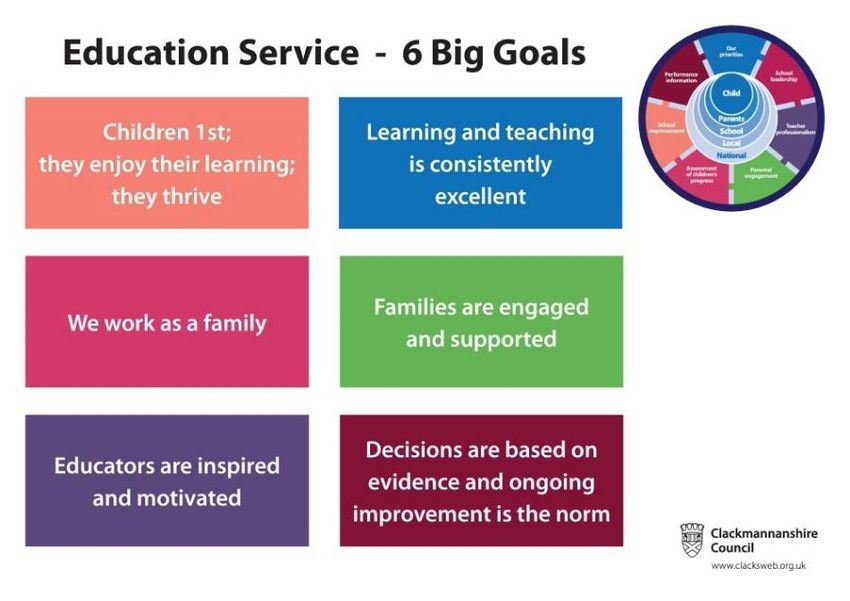
education “big goals” is key.

It is clear that the needs of our children and young people are best met by working effectively with
parents and carers. I believe we need to strengthen parental involvement in education and to provide
flexible systems to enable parental engagement and representation.

The school your child attends is where it all happens and I encourage you to get involved in whatever way
you can, be that via Twitter, Class Dojo, giving a helping hand, taking an interest in your child’s learning or
buying a ticket for a concert!

Read with your child every day! Ask them what they have learned that day and get them to show you!
Look out for opportunities to learn together as a family!

It is our intention to ensure that our relationships are characterised by mutual trust and respect, there is
transparency and equity in the use of our resources and we are all ambitious for our children and young
people.

Lorraine Sanda
Acting Chief Education Officer
Clackmannanshire Council

                                                      2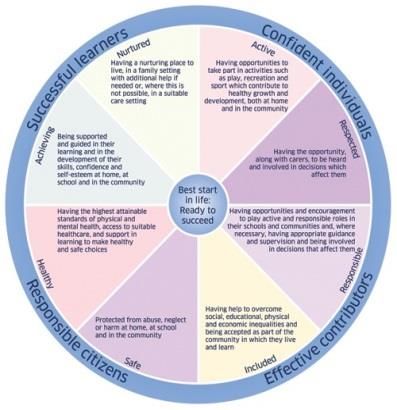
Welcome From The Headteacher

A very warm welcome to you and your child from everyone at Abercromby Primary School.

At Abercromby Primary we pride ourselves on being a welcoming, vibrant and nurturing school,
where staff, pupils and parents work in partnership and everyone is valued. Our school has a positive
and inclusive ethos. A strong emphasis is put on celebrating success, raising attainment and on
personal improvement and self-belief.

Our expectations are high and we aim to provide the best possible broad education for all of our
pupils in an active, innovative and stimulating environment, where every child is motivated and
challenged to reach their full potential. Our dedicated staff team is committed to ensuring that
learning is relevant, engaging and fun.

We want the very best for your child and firmly believe that education is most effective when there
are strong partnerships between home and school. We regularly invite parents to come into school
to participate in Family Learning and other numerous events throughout the year. We also
encourage parents and friends in the community to share their skills and expertise with our learners.
We look forward to working in partnership with you to ensure that our school is at the heart of the
community.

If you have any questions or concerns, the Senior Management Team will make every effort to be
available to meet with you promptly. If you wish to meet with the class teacher please, they are
usually available at the end of the school day. On occasion, you may have to contact the school
office and an appointment will be made for you.

This handbook is designed to help your child settle into our school and to provide you with useful
information about the school. I hope you will find it helpful.

I look forward to working with you and your child during their learning journey at Abercromby
Primary.

Aileen Ferguson
Headteacher

                                                  3
The School Context

Abercromby Primary is a non-denominational school serving the catchment area to the south of
Tullibody. The school is part of the Lornshill Cluster and most of our pupils transfer to Lornshill
Academy at the end of Primary 7, although some pupils go on to St Modan’s High as a matter of
choice. Abercromby currently has a roll of 344 pupils.
The school is located within Tullibody South Campus and is shared with St Bernadette’s Primary,
Tulach Nursery and a Community Library. Tullibody South Campus was officially opened by Keith
Brown MSP on Friday 11th October 2019, however the building has been occupied since August
2019. This is an exciting time for our school and local community and we are making the most of all
the opportunities afforded to us by working in close partnership with the other establishments in
the campus and the excellent state of the art facilities.
The campus is light and airy and influenced by biophilic design. This incorporates nature in the
interior and architectural design bringing the outdoors inside. There are numerous floor to ceiling
windows throughout the campus which let in an abundance of light. Furniture in the campus is in
keeping with this theme in its colour and design. There are currently 14 classrooms over 2 floors
with flexible learning areas for each stage.
We share some of the areas in the campus with the other establishments. Children can enjoy lunch
in the spacious dining hall, with its choice of different styles of tables, including café style booths.
We have a fabulous, well equipped and spacious 4 court gym hall which doubles up as an Assembly
Hall and is a super space for performing and holding other events. There is also another smaller hall
upstairs which is also used for PE.
We are the first campus in Scotland to have an Immersive classroom. This classroom offers a full 360
degree floor to ceiling immersive experience for a whole class. There is a vast range of interactive
experiences which support all areas of our curriculum.
We also have access to 3 GP rooms in the campus which are used for many different purposes.
Our experienced staff team are committed to taking the school forward on a journey of continuous
improvement through critical reflection, and rigorous evaluation of our work, ensuring best practice.
There is a strong commitment to professional learning across the school, with all teachers currently
participating in Tapestry Masterclass and the Equitable Literacy Programme. Quite a few teachers
have undertaken learning at Masters Level at Stirling University.

                                                   4
School Information
School Address                 Abercromby Primary School
                               Tullibody South Campus
                               The Orchard
                               Tullibody
                               FK10 25D

Telephone Number               01259 722972

E-mail                         abercrombyps@clacks.gov.uk

                               Follow us on twitter @abercrombyps
                               Sign up to Class Dojo

                               Follow us on Facebook: Abercromby Primary School

                               School Website:
                               https://blogs.glowscotland.org.uk/cl/abercrombyprimary

School Roll                    344

School Staff
Headteacher                    Mrs Aileen Ferguson

Depute Headteacher             Mrs Louise Thomas

Principal Teachers             Miss Deborah Hamill
                               Miss Erin McDaid
                               Mrs E McLaren
                               Miss E Craig (Acting )

Class Teachers                 Miss Lauren Davis
                               Mrs Dianne Hemming
                               Miss Stacey Paterson
                               Mrs Mhairi Griffiths
                               Ms Lissa Lorenzo
                               Mrs Katie Donnelly
                               Miss Linzi Stark
                               Miss Jen Sneddon
                               Miss Laura Powell
                               Miss Gillian McBride
                               Ms Fiona Delaney
                               Miss Kathryn MacLean
                               Ms Yvonne Wilson     0.8
                               Miss Denise Brown    0.6

Support for Learning Teacher   Mrs Meg Scott 0.8

                                5
Support Worker                                    Miss Caitlin Burns

Early Intervention Worker                         Mrs Michelle Mackie (funded through SAC)

Support for Learning Assistants                   Mrs Irene Barclay
                                                  Mrs Christine Brophy
                                                  Mrs Linda Ross
                                                  Mrs Aileen Terras
                                                  Mrs Lesley McIntyre
                                                  Mrs Catrina Morgan
                                                  Mrs Kirsty Farrell
                                                  Mr Nick Strong

PE Specialists                                    Mr Gareth Roberts
                                                  Mrs Laura Conlon 0.4

Art Specialist                                    Mr Simon Gough 0.4

Administrative Assistant                          Mrs McMorran

Administrative Support Assistant                  Mrs Kay Faichney

Assistant Facilities Officers                     Ms Sandra Dornan
                                                  Mr Scott McLellan

School Chaplain                                   Rev Drew Barrie

The School Day

Breakfast Club                           8.30am – 8.55am

Morning Session                          9.00am – 12.15pm

Afternoon Session                        1.00pm – 3.00pm

Formation Of Classes

Our school currently has 14 classes from P1 – P7. There are times when the distribution
of children over various stages of the school necessitates the formation of composite
classes. This is where children from two stages in a school become one class. Primary
teachers are trained to teach in differentiated groups. Consequently, composite classes,
organised in flexible teaching and learning groups, operate in the same way as a single
stage class, allowing pupils to learn at their own level and pace. A composite class will not
exceed 25 in number, unlike single stage classes that may have up to 33 pupils.

                                                   6
Our Vision, Values and Aims
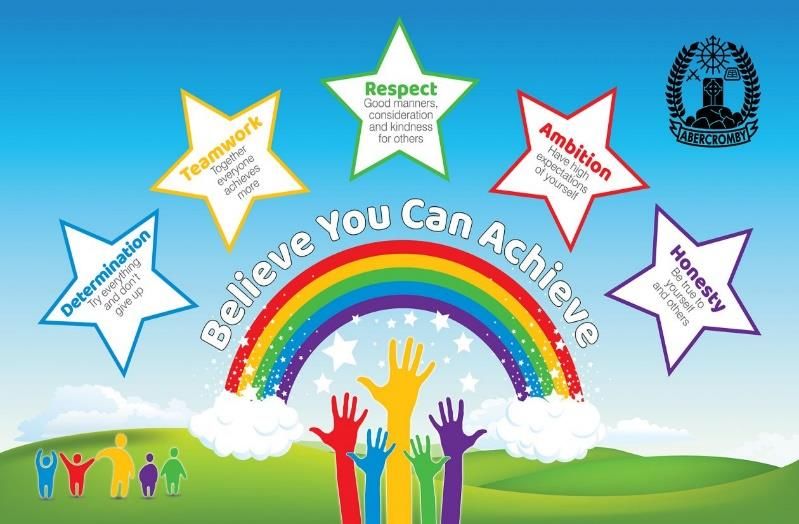
‘Believe You Can Achieve’
At Abercromby Primary School and Nursery we have high aspirations for all of our learners. Staff,
pupils and parents were all involved in an extensive and highly successful consultation process to
decide upon our vision and set of values, which we all agreed encapsulated our school. Our shared
Vision and Values underpin all that we do and have a high profile within our whole school
community.
We work in an inclusive way and believe in promoting positive life chances for all. In putting children
first, we aim to meet the needs of the children in our care in a holistic and nurturing way. We
actively seek to be innovative in our approach to providing the best educational experience for our
pupils in an active and stimulating environment, where children are motivated and challenged to
reach their full potential. We aim to ensure that learning is relevant, engaging and fun.
We continually promote and uphold our school values of:
Ambition have high expectations of yourself
Respect good manners, consideration and kindness for others
Determination try everything and don’t give up
Teamwork together everyone achieves more
Honesty be true to yourself and others
In carrying out all aspects of our work, we aim to:
provide a supportive, reflective and developing environment to ensure that each child has
the opportunity to reach his or her potential through the provision of high quality learning
and teaching.
ensure there is a positive welcoming and inclusive ethos where everyone in the school
community is valued and has a voice.
build nurturing relationships with the children and work effectively in partnership with
parents/carers, outside agencies and the wider community to ensure we get it right for
every child.
improve our children’s health and wellbeing by building their confidence and self-esteem,
promoting healthy lifestyles and by developing in them consideration and respect for others,
tolerance and resilience
equip our children with the skills, knowledge and attitudes they need to build a successful
future for themselves and make a positive contribution to society.
We believe that by fostering these principles, we can improve our service and provide the
best possible experiences for our children.
7Ethos
Abercromby Primary has a strong, positive and inclusive ethos, which promotes good behaviour,
courtesy and effort. These qualities are regularly rewarded by the presentation of certificates,
badges and other awards. Strong emphasis is put on celebrating success, recognising wider
achievement, raising attainment and on personal improvement and self-belief. We encourage our
learners to aim high, set standards for themselves and be ambitious about their future. Individual
teachers run a variety of incentive or merit schemes in their classes in which children can gain
rewards.
Pupil and staff achievements are regularly celebrated at our monthly ‘Superstar Assemblies’,
attended by parents, friends and of local partners. At the end of the academic year, we have a
Special Celebration Assembly where a wide range of individual and group achievements are
recognised and celebrated.
Celebration of our learning and achievement is shared regularly on Twitter, Facebook and
Class Dojo.
We pride ourselves on being a welcoming and nurturing school, where staff, pupils and parents work
in partnership together and everyone is valued.
We have developed a culture where a collective vision for development and improvement is shared
and understood by all members of the school community, and where there are opportunities for
leadership at all levels. Individual, teams and RACI groups have driven forward initiatives and
developments which have had a positive impact on learners’ progress and achievement.
Pupils are given many opportunities to contribute effectively to the life of the school and the wider
community in a variety of ways. There are increasing opportunities for learners to take on leadership
roles and to be innovative and creative. Our learners have opportunities to take on responsibilities
such as Pupil Council, Prefects, House Captains, Sports Leaders, School Bank Team, Buddies to
younger children, Curriculum Buddies and WOW, Eco Team.
The positive ethos and learning culture we have created has a positive impact on pupils’ overall
achievement.
Buddies
Our P6 Buddies participate in Buddy Training in January. This training takes place both in school and
in the nursery. ‘Big Buddies’ are allocated to ‘Wee Buddies’ from the nursery. From January to June
positive relationships are formed as both groups of children work together on various projects in a
structured and supportive environment. This Buddy Programme has been highly effective in
achieving its aim, ensuring a smooth transition for our young children starting school. Buddies
continue to support P1 pupils effectively when they start school, in the playground and in the school
throughout the session.
8School House Teams
Wallace Mar Delph Ochil
Pupils and staff are allocated to a house team, and work towards winning points for their team for
demonstrating a good work ethic, good behaviour and a positive attitude to all aspects of school life.
The houses are, Wallace, Mar, Delph and Ochil. They are led by House Captains who encourage their
team to work hard and earn points for their house. House Captains play a major role during weekly
assemblies, and organise house events and house challenges, throughout the year. Each house has
their own ‘chant’, which is often heard at assemblies and during house challenges and sporting
events.
There are also termly treats for the house who has earned the most points during the term. Termly
treats are planned in advance with the House Captains and the Principal Teacher responsible for
houses. At the end of session, a cup is awarded to the house which has earned the most house
points over the year and a cup is presented to the overall winning house from Sports Day.
Pupils are proud of their own house and are motivated to earn points for being, successful learners,
effective contributors, confident individuals and responsible citizens.
Positive Behaviour Approaches
A strong emphasis is put on good relationships and positive behaviour. We recognise the link
between positive relationships and behaviour and the provision of high quality learning and
teaching. We understand that children bring with them to school different abilities, experiences and
home circumstances, and that creating a safe, nurturing, inclusive environment and positive ethos
will foster good relationships and behaviour within our school. The restorative approach is
something we value as an effective way of moving forward and restorative conversations take place
as a matter of course.
Following a review and consultation with staff, pupils and parents we are implementing our new
Positive Behaviour Policy this session. Our new agreed School Rules are SAFE – RESPECTFUL –
READY.
All staff and pupils have a clear understanding of the policy which will ensure a more consistent
approach to positive behaviour management throughout the school.
Pupils from St Bernadette’s Primary and Abercromby Primary agreed campus rules prior to moving
to the new school, RESPECTFUL – SAFE
We have currently reviewing our Anti-Bullying Policy to reflect recent changes in practice at school
and authority level. To support us in achieving this aim, we are consulting with pupils, parents and
staff.
9Bullying behaviour will not be tolerated in Abercromby Primary. All pupils are entitled to work and
play in a learning environment where they feel valued, respected, safe, and are free from all forms
of abuse, bullying and discrimination. Pupils can tell any member of staff if they are unhappy in the
way they are being treated by others. They will be listened to and any reported incidents of bullying
are dealt with immediately.
Nurturing Approaches
We believe that all children benefit from being educated in a climate that supports the nurturing
principles.
These principles are as follows:
• Children’s learning is understood developmentally.
• Nurture is important for the development of self-esteem.
• Language is understood as a vital means for communication.
• All behaviour is communication.
• The classroom offers a safe base.
• Transitions are significant in the lives of children.
All staff have undertaken nurture training and R4L (Readiness for Learning). This approach is having a
positive impact on children’s learning and achievement.
Meeting Learner’s Needs
We recognise the value of early identification when it comes to removing barriers to learning and we
continually strive to ensure that all pupils are supported appropriately and effectively. This is with a
view to making sure that each child in our care reaches their full potential. GIRFEC (Getting It Right
for Every Child) is firmly embedded in our practice. Staff consider all aspects of children’s wellbeing
and development and are familiar with thinking about their pupils in terms of the wellbeing
indicators, (safe, healthy, achieving, nurtured, active, respected, responsible, included). These
indicators help us in our identification of learners’ needs in the widest possible sense and from this
we focus on specific outcomes for children with a view to improving outcomes for all pupils in our
care. Through our robust Staged Intervention process in school, pupils’ additional support needs are
identified quickly and relevant supports are accessed. This process sits within GIRFEC. We value the
role parents have to play in supporting their children to become successful learners.
10Curriculum
Our curriculum is firmly based on the experiences and outcomes and design principles of Curriculum
for Excellence.
The ‘Curriculum for Excellence’ framework consists of the following areas:
Languages
Numeracy/Mathematics
Health and Wellbeing
Social Studies
Sciences
Technologies
Expressive Arts
Religious and Moral Education
Within this framework your child will progress through a national framework of levels. The broad
expectations in primary are:
Early – pre-school years, P1 or later for some.
First – to the end of P4, but earlier or later for some.
Second – to the end of P7, but earlier or later for some.
Each level offers opportunities for challenge and depth. We plan learning experiences in order to
ensure, ‘how much’ and ‘how well’ pupils have learned and developed.
The 3-18 Curriculum aims to raise standards, prepare our pupils for the future and equip them with
the relevant skills and knowledge essential for employment in a fast and changing world.
Languages
Literacy and English
Literacy permeates every area of the curriculum. The Literacy and English framework
promotes the development of critical and creative thinking as well as competence in
listening and talking, reading, writing and personal, interpersonal and team-working skills. In
line with a whole authority approach to reading, we are currently implementing the
Equitable Reading Programme across the school. We are implementing new strategies to
support children and raise attainment in reading. We have developed ‘literacy rich
environments’ in classrooms and class libraries are stocked with a wide range of books to
suit all tastes. We have also introduced banded books. Time is set aside for the enjoyment
of books and reading. There are many opportunities for pupils from different stages to share
reading with each other. Engaging with the Reading Programme has had a positive impact
on attainment in reading across the school.
Writing is the ability to effectively communicate ideas, information and opinions through the
written word in a range of contexts. Writing is most effective when there is something
relevant to write about and there is a definite purpose or audience for the writing.
11Modern Languages
At Abercromby Primary we recognise the importance and value of giving pupils the opportunity to
learn another language. As part of the ‘Language Learning in Scotland 1+2 approach’, children begin
their first additional language, L2 (French) from P1. This enables our children to learn about and
foster an interest in, another language and culture, other than their own. We believe that learning
another language stimulates children’s creativity and enables them to develop personal qualities,
skills, knowledge and understanding.
A good number of our staff are proficient in a modern language with most having attended
professional learning. We are currently using Power Languages as a resource.
Our Framework, which is motivating, relevant, coherent and active , sits in line with Curriculum for
Excellence and recommendations in the Scottish Government, Language Learning in Scotland. Pupils
from P1 – P7 enjoy and participate enthusiastically in a variety of French activities in an active
learning environment. Pupils learn and extend their knowledge of the French language through
listening, responding, talking, singing, and in some classes, reading.
Numeracy/Mathematics
Our Numeracy and Maths programme sits in line with the Curriculum for Excellence. Although
textbooks are still used, pupils also learn mathematical concepts through active learning. Pupils are
encouraged to explore and apply mathematical concepts to understand and solve problems,
explaining their thinking and presenting their solutions in a variety of ways. Pupils are encouraged to
work collaboratively, with a partner or in teams. Maths is also taught in context which makes it more
relevant and meaningful for pupils as it models real life situations (inside and outside the classroom).
The Interactive Whiteboard is an excellent resource for the teaching of numeracy and mathematics.
We recognise the value of outdoor learning and teachers regularly use the outdoors to support and
enhance the numeracy and mathematics curriculum. Pupil Equity Funding has been used to recruit
an additional fulltime Learning Assistant who has provided small group targeted support with a
particular focus on closing the equity gap and raising attainment in numeracy. Attainment data from
assessments show that children in these groups are making significant progress, with the majority
reaching expected milestones in their learning.
Our numeracy and mathematics curriculum is well resourced.
Health and Wellbeing
Health and Wellbeing permeates the curriculum. Learning in Health and Wellbeing ensures that
children develop the knowledge and understanding, skills, capabilities and attributes which they
need for mental, emotional, social and physical wellbeing. The develop lines are mental, emotional,
social and physical wellbeing, planning for choices and changes, physical education, physical activity
and sport, food and health, substance misuse, relationships and sexual health. Careful planning
ensures that pupils will be active, respected, responsible, included, nurtured, safe, healthy and
achieving.
Bounceback, a programme to support mental and emotional wellbeing is used across the school.
This programme familiarises children with everyday situations that may occur and develops their
awareness of who can help them.
We have a whole school health focus in the summer term, this is widely supported by parents and
other partners and usually culminates in a large event.
Sporting achievement is a strength in the school. Pupils across the school regularly participate in
12sporting events and achieve success. We have been awarded the, sportsscotland’, Gold School
Sport Award in recognition of our Sporting Success.
Social Studies
Our ‘Contexts for Learning’ Programme is an interdisciplinary approach to learning, (IDL). This
incorporates the principles of curriculum design and supports staff and pupils in planning innovative,
engaging and enjoyable learning experiences. This method of learning in context provides a
meaningful and motivating experience for pupils. Pupils are actively involved in making decisions
about how and what they learn, by asking ‘Big Questions’ and sharing learning with their peers and
parents.
Wherever possible pupils will take their learning outside, in the playground, local area and further
afield. We also involve partners and parents to share their expertise and support learning. This
greatly enhances the learning experience for children.
Sciences
Through learning in sciences, pupils develop their interest in and understanding of, the living,
material and physical world. Through the science experiences and outcomes, pupils develop skills of
scientific enquiry and investigation using practical techniques in the classroom, playground and
wider environment.
There is a strong focus on STEM subjects across the school. Maker Spaces are being developed in all
open areas for pupils to access.
Technologies
ICT is a term used to include a wide range of technologies involved in information handling and
processing. ICT is embedded across all curricular areas. All children have access to a safe
environment within the internet. There is an interactive whiteboard in each classroom. We have
invested in new technology, including ipads and are developing digital literacy, especially as we are
now in our new school. We want our children to be digitally aware and confident in using digital
technology.
Expressive Arts
The development lines are: Art and Design, Dance, Drama and Music. Our Expressive Arts
Programme is supported by the PE Specialists, Art Specialist and Music Tutors. There are often
opportunities for classes to be involved in music projects, supported by partners. Last session all
children in P4 and P5 were involved in a Scots Song and Language Music Project supported through
the Scottish Attainment Challenge. We have also worked with ABC Music. Children across the school
have frequent opportunities to perform to a wider audience through presenting class assemblies,
the nativity, plays, and other performances. P7 pupils perform their annual pantomime in December.
Religious and Moral Education
The development lines are Christianity, Other World Religions and the Development of Beliefs and
Values. Throughout their time at Abercromby Primary, pupils will learn about the beliefs, values,
practices and traditions of different world religions.
School Assemblies are held on a weekly basis and may be led by members of staff, pupils, the School
Minister and other visitors. Each class presents their own class assembly at some time during the
session. Pupils share their learning with their parents and the rest of the school.
13At the end of winter and spring terms, pupils, staff and parents join together for a service in St Serf’s
Church. Pupils generally lead services, supported by Rev Drew Barrie.
Developing Young Workforce
Our aspiration at Abercromby Primary School is to prepare and support each young person for a
stretching and rewarding career pathway, by nurturing and building on their skills for learning, life
and work from an early stage. Our Skills Academy provides a structure for these exciting and
confidence-building learning opportunities for all pupils. It also offers children the opportunity to
use their knowledge and skills in a variety of relevant, real life contexts. This will prepare them for
transferring skills to high school and then further education.
Currently all stages across the school participate in our Skills Academy.
Our DYW Curriculum was recognised as very good practice by the Royal Society of Edinburgh in
January 2019. Mrs Ferguson was proud to showcase our good work in this area at an
Interdisciplinary Learning: Creative Thinking for a Complex World National Conference held at the
Royal Society of Edinburgh. Our work was well received by educational practitioners across Scotland,
Education Scotland and the Further Education Sector.
We were finalists in the Scottish Education Awards 2019 in the Employability & Creativity Skills
Across Learning Award. This was a major achievement for our school community.
We are proud of the strong relationship we have developed with Forth Valley College, local
businesses and employers, including Diageo. Scientists from Diageo have supported DYW by leading
science learning in a creative and engaging way with our learners. Other partners, including parents
continue to support DYW.
We have made the most of all the opportunities afforded by Robertson Construction being on Site
building our new school within the Tullibody South Campus,with our Young Reporters keeping
everyone updated with progress.
We were nominated for a Clackmannanshire Education Service
Towards Excellence Award for DYW Developing Young Workforce in June 2019.
Learning and Teaching
Learning and teaching within Abercromby Primary and Nursery follows National and Local Guidance
and Policy to ensure we provide our learners with the skills, knowledge and understanding and
attributes, which will provide the foundation on which they can build a successful future for
themselves, and make a positive contribution to society. We aim to achieve this by providing the
highest quality learning and teaching within a nurturing, supportive, motivating and challenging
learning environment, to ensure our pupils become:
Successful learners
Confident Individuals
Responsible Citizens
Effective Contributors
We are committed to achieving excellence and equity- raising attainment, tackling inequity and
ensuring that high aspirations and positive outcomes are the expected norm for all learners.
14Pupils take responsibility for their own learning, lead learning and make decisions about what they
want to learn and how their learning will develop. Teachers enhance learning experiences by
creating opportunities to take learning outside as much as possible, in the local environment and
further afield.
Assessment
Assessment is a continuous process integral to learning and teaching which begins at the planning
stage of any learning experience and takes a holistic view of the child. It lies at the heart of the
process of promoting children’s learning and provides a framework within which educational
objectives may be set and pupil progress measured and monitored. It is how pupils and teachers
gain knowledge of development needs, achievements and abilities, enabling planning and delivery to
be more effective, thereby raising standards of achievement for every child. Assessment is an
important part of how teachers know what progress is being made. In every class teachers make
ongoing and informed assessments about pupils using a range of assessment approaches, e.g.
questioning, listening, talking, observing etc. Pupils confidently engage in self and peer assessment
to inform next steps in learning. Teachers also use Standardised Assessments. These help to build
upon the evidence of achievement of a level for your child. Standardised Assessments currently used
in school are the SNSA in primaries 1, 4 and 7 and the NGRT in primaries 2 – 7.
Assessment is for Learning ensures that assessment is an integral part of day to day learning
and teaching. Learners learn best when:
They understand clearly what they are trying to learn and what is expected of them.
They take ownership of their learning and are actively involved in the learning and teaching
process.
They are able to set their own personal targets and are aware what they must do to improve
their work.
They are given feedback about the quality of their work.
They are fully involved in deciding what needs to be done next and who can give then help if
they need it.
They confidently use ‘I can’ statements when evaluating their own learning
End of Year Reports are issued to parents in June of each year. This report outlines the progress a
child has made during the academic session. At the end of last session we issued a revised report
which had been agreed upon in consultation with staff, pupils and parents.
Homework
Following an extensive consultation all classes have Homework Grids, (Home Learning). These grids
are updated regularly and shared with pupils and parents.
15Partnerships with Parents
We value parents as partners and welcome them into our school at every opportunity. We are keen
to work with you to help give your child the best education we can provide. We offer a variety of
opportunities throughout the year for parents to be involved in their child’s learning and the life and
work of the school:
P1 Induction Meeting
Meet The Teacher Event
Curriculum Afternoons
Curriculum Learning Cafes
Sharing Learning Events
Family Learning Events
Special sessions organised by individual class teachers to involve parents in their child’s
learning.
Parents supporting learning by sharing their expertise
Family Challenges and home learning
Class Assemblies
Supporting the life of the school – parents are actively encouraged to help at events.
Class Assemblies
Christmas Fayre
Parents Evenings
Staged Intervention Meetings
Parental Surveys and Questionnaires to seek your views to inform our curriculum and School
Improvements.
Parents welcome the opportunity to come along to our evening Family Learning Events. These
regular events have been extremely successful and very well attended. Some of our Family Learning
Events have included, STEAM Event (Creative STEM/ART challenges for all the family), Scots Supper
and Story, Clubbercise (exercise fund for all the family), Family Sports Event Health supported by
Active Schools, Family Quiz Night and Family Picnic.
The Link at Abercromby (Family Room) was established in August 2018. Our Values are: Family – Safe –
Respect – Trust – Community. We aim to provide our families with a calm and supportive environment where
they can come and spend 1:1 time together within a friendly, welcoming and inclusive group.
Our ‘Family Fun’ groups run once a week, where invited parents can join the team for tea and toast for a
blether and catch up before children come along and join the group. The groups are designed to be fun and
active, giving children the opportunity to spend some quality time with their families in school.
We have welcomed a range of partners along to support parent only sessions.
The Link Team are Miss Emma Craig PT, Caitlin Burns Support Worker and Mrs Mackie EIW.
Team Abercromby (formerly the Parent Council), is an active group of parents who are very much
involved in the life and the work of the school. Sharon Nicol our Chairperson is always looking for
new members and new ideas. ‘Everyone is welcome, we would encourage you to come along and
get more involved in the life of the school’ says Sharon.
16As a parent of a child who attends Abercromby Primary, you are automatically part of what is called
the Parent Forum for the school. As a member of the Forum:
You can ask the school for advice and information on your child’s education and how you
can support this.
You will have the opportunity to come along to meetings and to feed in your ideas in other
ways.
You can, at the AGM in June, also help choose the Parent Council for your child’s school –
this is a group of parents who represent the views of all parents in the school. There are lots
of different ways of getting involved in education and in your child’s learning. Just enjoying
being in the school is important. What you do matters, and can make a real difference to
your child’s education and achievement.
Communication
We place a great deal of importance on communicating effectively with our families about learning,
and the life and work of the school. It is important that everyone is kept informed. An Annual
Calendar of Events is distributed to families in August. Reminders of dates are sent out throughout
the term.
We communicate effectively through ‘twitter’, ‘facebook’ and ‘class dojo’.
We also keep parents informed through group texts sent through the Expressions App.
General letters, ‘Information Updates’ and ‘Newsletters’ are sent out regularly to keep parents
informed.
Class teachers will also issue letters and message via Class Dojo to parents, generally about future
sharing learning events.
We have a text alert messaging system in place which enables us to contact parents regarding,
absence from school, unforeseen emergencies, reminder of meetings and special events.
Information relating to the school is also on our school website:
blogs.glowscotland.org.uk/cl/abercrombyprimary
Follow us on twitter @abercrombyps
Parents should contact the Headteacher at the earliest opportunity if they have any queries,
concerns or complaints. We pride ourselves in having a very positive relationship with our
parents/carers and will always take time to listen and talk and try to resolve any issues which may
occur. However, if a parent has a complaint about any aspect of school life, they should always
contact the Headteacher or other member of the school management team, in the first instance.
Parental Complaints
Complaints are dealt with in line with Clackmannanshire Council Policy
You can complain in person, by phone, email or by letter. We regard a complaint as any expression
or dissatisfaction about our action or lack of action, or about the standard of service provided by us
or on our behalf.
Who Can Complain ?
Anyone can complain who is the parent or legal guardian of a child or a person authorised to
complain on his/her behalf. For example, a child’s grandparent who is not the legal guardian needs
17authority from the child’s parent or guardian. This would normally mean a note to show that the
person responsible for the child had agreed.
What can’t I complain about?
Here are some things we can’t deal with through our complaints procedure:
A routine first time request for a service or action – e.g. informing the school that your child
told you she is being bullied and asking them to resolve this.
Requests for compensation from the Council.
Things that are covered by a right of appeal, e.g. Exclusion from school which has its own
statutory process. In these cases we will give you information and advice to help you.
We have a 2 stage complaints procedure.
Stage One - Frontline resolution
In the first instance please complain to your child’s school or nursery, telling them as much as you can
about the complaint, what has gone wrong and what you want them to do to resolve the matter. A
senior member of staff, either the headteacher or depute head, will be responsible for looking into
complaints. Heads are senior managers with a high level of responsibility for your child’s learning and
welfare and able to look into most matters. However, the headteacher may refer the Stage One
complaint to Education Services centrally, e.g. if it is about the conduct of the headteacher or too
complex to be dealt with at front-line service level.
The school or nursery will give you our decision at Stage One within 5 working days or fewer unless
there are exceptional circumstances. If we need further time we will ask you to agree an extension of
up to 5 further days. If the Stage One complaint has been referred to Education centrally your
response will come from there.
Stage Two – Investigation
If you are dissatisfied with your Stage One response you can move to Stage Two. Stage Two deals with
2 types of complaints: those not resolved at Stage One and those not appropriate for Stage One, for
example the conduct of a headteacher or too complex for a headteacher to deal with.
To move to Stage Two, you should contact the Chief Education Officer and ask for a formal
investigation under Stage Two. You can do this by contacting the education service at Kilncraigs 4 th
floor, Alloa
When using Stage Two:
We will acknowledge your complaint within 3 workings days.
You will be contacted by the Investigating Officer for your complaint, who will usually meet
you to confirm: the detail of your complaint, what you want to achieve, and if your
expectations are achievable. In some cases, e.g. your complaint has been made in writing and
is clear, there may be no need to meet. It is helpful if you present any evidence that you can
offer in support of your complaint, e.g. contact details for witnesses, reports from other
professionals etc. if appropriate.
18 We will write to you confirming the details of your complaint, what you want to achieve, and
what the investigation can cover.
We will give you a full, written response to the complaint as soon as possible and within 20
working days. If our investigation takes longer than 20 working days we will agree revised time
limits with you and keep you updated on progress.
After we have fully investigated your Stage Two complaint, if you are still dissatisfied with our decision
or the way we dealt with your complaint you can ask the Scottish Public Services Obudsman (SPSO) to
look at it.
The SPSO cannot normally look at:
A complaint that has not completed our complaints procedure.
Events that happened or you became aware of, more than a year ago.
Crisis Management
The school has a crisis management plan and critical incident plans for dealing with any emergency
situations. These plans are regularly reviewed and updated as appropriate.
School Improvement Plan
Every school has a School Improvement Plan, (SIP) which sets out their priorities and targets for the
year. Each year the SIP is audited against set performance criteria to check that targets have been
met and to determine the way forward for the school.
The school promotes a collective vision for development, and improvement is shared and
understood by all members of the school community. We use a variety of methods to collect
information about our school and use this to inform our actions and next steps in our School
Improvement Plan.
Each year we publish a Standards and Quality Report, which reports on our progress in meeting our
targets over the session. This document is available on our school website. A paper copy can be
requested from the school office if you are unable to access the internet.
PEF
In 2018/2019 £120m of Pupil Equity Funding was allocated directly to schools and targeted at closing
the poverty related attainment gap. Every council area is benefitting from Pupil Equity Funding and
95% of schools in Scotland have been allocated funding for pupils in P1-S3 known to be eligible for
free school meals. This funding is to be spent at the discretion of Headteachers working in
partnership with each other and their local authority. Pupil Equity Funding is being provided as part
of the £750m Attainment Scotland Fund which will be invested over the current Parliamentary term
to tackle the poverty related attainment gap. Abercromby Primary School has been allocated PEF
Funding over the last 3 years. Details of how we spend this money can be found on our website.
School Enrolment
There is only one admission date for the children starting school for the first time, which is in August
after the summer holidays. Enrolment takes place in January. Parents are required to bring their
child’s birth certificate and proof of address to the school when they are enrolling their child.
Parents who wish to arrange a visit to the school should contact the Headteacher.
Of course, we welcome new pupils to our school at any time during the school year. The
19Headteacher or a member of the Senior Management Team will always take time to meet with
parents and new pupils prior to them starting officially, to talk about the school and answer any
questions they may have. This is followed by a tour of the school and a visit to their new class to
meet their teacher and pupils.
We find that this is reassuring for both parent and child and reduces any anxiety.
Absence from School
If your child is going to be absent from school due to illness we ask that you call the school to report
this. If you are unable to talk to a member of staff, please leave a message. Parents and carers
should indicate why their child is absent from school. If pupils are going to be absent from school
due to appointments or other circumstances we ask that parents write a note to the class teacher.
Unexpected Closures
Any departure from the normal arrangements will be notified to you in writing, but there are
occasions when children may be dismissed early without warning, eg in the case of power cuts,
heavy snow, or any other unforeseen circumstances. In the event of this happening we will make
every effort to contact you through the usual channels, but would be grateful if you could make sure
your child knows where to go if you are not usually home during the day.
Wet Weather Arrangements
There is no staff supervision before 9.00am, unless your child attends Breakfast Club. Pupils will
remain indoors during wet intervals. At lunchtime, pupils taking school meals and packed lunches
will be supervised in the dining hall and then supervised in classrooms by Learning Assistants and
senior monitors.
Administration of Medicine
From time to time there may be a need for your child to receive medicine during the school day.
School staff are not permitted to give any commercial medicine, eg. aspirin or calpol. We are
however, permitted to administer prescribed medicine by a GP.
All prescribed medicine should be brought to school by the parent/carer and given to the designated
member of staff. Normally, this is the office staff.
Parents/carers should complete the relevant paperwork giving permission for medicine to be
administered. All medicine will be kept in a locked cabinet.
When there is any change to a child’s medication (eg, children who get medicine on a regular basis)
then updated instructions should be given to the school.
We have two qualified First Aiders in school and two in the nursery.
School Uniform
Parents are asked to support the school by ensuring that children wear the school uniform.
It fosters equality
It is aesthetically pleasing
It promotes and encourages a corporate school spirit
Our Uniform consists of:
Black or Grey sweatshirts with the school badge on them
White polo shirt with or without the school badge
20You can also wear a shirt and Abercromby tie if you wish.
You should wear black or grey trousers or skirt.
Some pupils wear a school blazer as a matter of choice.
Pupils can order polo shirts in the colour of their house with their house badge. These are normally
worn for PE, School Sports Day, or other events.
Physical Education Clothing and Footwear
For health and safety reasons, pupils should come to school with the following clothing for gym.
1. T-shirt
2. Shorts
3. Gym shoes
All items of clothing should be clearly marked with the child’s name. Any misplaced items of clothing
will be placed in lost property. At the end of each term unclaimed items of clothing are recycled.
There may be occasions when your child may need to wear additional items of clothing for certain
sporting activities. The pupils will be advised of this by the PE teacher or their class teacher.
No jewellery at all, may be worn during PE lessons. If children have just had their ears pierced and
have to wear stud earrings, then they must be covered in elastoplast.
In the interests of health and safety, pupils should not wear hooped earrings or excessive jewellery
in school at any time.
Transitions
Transitions are the moves children and young people make from home to an early learning and
childcare (ELC) setting, from there to primary, from stage to stage, from primary to secondary to
further education and beyond. Transitions and changes are part of everyone’s life. The vast majority
of children look forward to moving on. However, transitions can be challenging and support from
staff and parents can help transitions go more smoothly. There may be times when a pupil may
benefit from and ‘enhanced transition’. This is when a special plan is put in place in consultation with
the child and parent for additional visits to the new class or school.
This often alleviates any anxieties a child may have.
We have procedures in school in place to support children’s transition from nursery to primary one,
stage to stage and from primary seven to high school. At each stage we involve and inform parents.
You will be kept informed of transition arrangements and what you can do to support your child.
Where children have additional support needs we work closely with families and professionals to
support the transition.
It helps children and young people at all transitions if parents:
Talk with them about what is going to happen.
Encourage them to ask questions
Encourage them to talk about any concerns they may have
Listen carefully to their concerns and consider sharing them with other relevant people
21 Help them to become familiar with the new school or setting and what will be expected of them.
As part of their Transition Programme, P7 Pupils attend the Lornshill Cluster Residential experience
at Dalguise. This gives children the opportunity to meet children from the other schools in the
cluster and start to form relationships.
Secondary School
At the end of P7 pupils normally transfer to:
Lornshill Academy
Tullibody Road
Alloa
FK10 2ES
01259 214331
Extra Curricular Clubs
There are various sports clubs before the start of the school day, lunchtime and after school. Trained
coaches support these clubs.
We also run the following clubs:
Basketball
STEM Club
Coding Club
Various sports clubs
Reading Club
Some of these clubs do not run throughout the year and are in blocks. Teacher will give pupils
advance notice of these clubs.
Equalities
Clackmannanshire Council has developed Council-wide policies for diversity, race, disability and
gender equality, which aim to ensure that all Council employees are aware of their responsibilities to
ensure that no child or young person will receive a less effective service on grounds of ethnicity,
disability, or sexual orientation. The council is a signatory to the Multi-Agency Hate Response
Strategy (MAHRS) Racial Attacks and Harassment Multi-Agency Strategy with Central Scotland
Police. Forth Valley NHS, the Central Scotland Racial Equality Council and Stirling and Falkirk
Councils. Schools and other council services use this strategy to respond to any allegations of racial
incidents or abuse. Allegations of other forms of harassment or discrimination are followed up
through the regular complaints procedure. Schools are well placed to actively promote equality
through the curriculum and through other aspects of their life and work. The quality of this work is
also monitored through Standards and Quality procedures.
Equal Opportunities and Social Inclusion
Abercromby Primary is firmly committed to equal opportunities and social inclusion. Every member
of the school community is valued as an individual who has a contribution to make to the life of the
school. The school encourages all staff and children to work together to create an atmosphere of
22tolerance and respect for each other. Equal opportunities are reinforced throughout the school
curriculum and we aim to ensure that no materials or books are used which reflects prejudice of any
sort. We try to manner, in an attempt to allow each child to appreciate that every human being has
similar needs and emotions. Through this approach we aim to help children develop an
understanding of, and respect for, all fellow human beings. A priority for our school is to develop
positive links between home and school and our school and other agencies. The Head Teacher has
the responsibility of developing such links. Should any parent require further information please
contact the Head Teacher at the school.
Inclusion
The Education (Additional Support for Learning) (Scotland) Act 2004 was amended in 2009. The 2009
Act strengthens the duties placed on Clackmannanshire Education Service to identify and meet the
additional support needs of children and young people. We continue to do this through the Staged
Intervention process. The 2009 Act clarifies the definition of additional support needs and increases
the rights of parents and young people in respect of requesting assessments, making placing
requests as well as access to the Additional Support Needs Tribunal for Scotland (ASNTS). The Act
also places a duty on Clackmannanshire Council to provide access to mediation and dispute
resolution services free of charge to parents who have made a successful placing request from
another Authority. The Act now deems all Looked After children to have additional support needs
unless the education authority determines otherwise. Clackmannanshire Council has procedures in
place to assess these needs through the Staged Intervention process, as with all children and young
people who may require additional support. Information and leaflets for parents, carers and young
people can be found on the Council’s website: http://www.clacksweb.org/learning/asl/
Information and leaflets for parents, carers and young people can be found on the Council’s website
http://www.clacksweb.org.uk/learning/asl/ Leaflets include
Additional Support for Learning – a Guide for Parents
Additional Support for Learning – Resolving Differences More information on The Education
(Additional Support for Learning) (Scotland) Act 2009 is provided by Enquire – the Scottish advice
service for additional support for learning. Operated by Children in Scotland, Enquire offers
independent, confidential advice and information on additional support for learning through:
A telephone helpline – 0845 1232303
An email enquiry service – info@enquire.org.uk
Two websites - www.enquire.org.uk (for parents/carers and practitioners) www.enquire.org.uk/yp
(for children and young people) Enquire also provide a range of clear and easy to read guides and
factsheets explaining everything from ‘additional support in the early years’ to ‘what planning
should take place for moving on from school’. The Scottish Government have a duty to provide an
advocacy service to parents and young people following a reference being made to the Additional
Support Needs Tribunal for Scotland (ASNTS). Ministers have also agreed that the advocacy service
should also provide support for parents and young people from the time they have grounds to make
a reference to the ASNTS. It will be a national service and available to parents and young people on
request and free of charge.
This service will be provided through a partnership between Kindred Advocacy Service and the
Scottish Child Law Centre, known as “Let’s Talk”. The two organisations will work together to deliver
23lay and legal advocacy for parents and young people. The service will focus on non legal
representation, but where appropriate in complex cases, legal representation will be available. For
further information on this National Advocacy service please contact the Scottish Child Law Centre:
Telephone: 0131 6676333
Email: enquiries@sclc.org.uk
Web: www.sclc.org.uk Some literature still refers to the previous partnership between the Scottish
Child Law Centre and Barnado’s and this will be updated shortly. Clackmannanshire Council
Education Service is committed to working in partnership with all parents and carers of children and
young people with additional support needs and seeking their views on all aspects of the support
provided in educational establishments. We encourage parents to contact the school/establishment
in the first instance if there are any queries or concerns, and we will always try to resolve any
difficulties as soon as possible. Further information on how support for learning is organised in
Clackmannanshire is available by contacting either the school, or the ASN team at Kilncraigs:
telephone 01259 452441 or e-mail
School Health Service
School Health Service NHS Forth Valley fulfils a statutory obligation to provide a health service for all
school age children in Clackmannanshire. The aim of the service is to make sure that all children are
in the best possible health to benefit from their education and to provide the Education Authority
with advice about the spread of infections and the promotion of good health. This service is
provided by staff from NHS Forth Valley. During P1 parents will be asked to complete a health
questionnaire and will be given the opportunity to ask to meet the named nurse for the school.
Vision Screening is carried out at pre-school by a specialist service. Hearing is no longer screened in
school but any concerns about your child’s hearing should be discussed with the school doctor who
can arrange a fast track referral to the audiology department. During their time at school, children
are offered various immunisations and parents are asked for written consent for these. Parents and
school staff, with parental consent, can request a consultation with the school doctor at any time
School Dental Inspections
The NHS in Scotland runs a programme of dental inspections of children in Primary 1 and Primary 7.
The aims of the National Dental Inspection Programme (NDIP) are:
To inform individual parents / carers of the dental health / oral health status of their
children.
To provide Scottish Government and NHS Boards with information on trends in dental
disease in children in order to monitor oral health and plan dental services.
To support dental attendance in those children who are found to have need of dental care.
NHS in Scotland runs a programme of dental inspections of children in Primary 1 and Primary
Clinics
From time to time children may have clinic/GP appointments during school hours. Please let the
school know about these visits and arrange for your child to be collected. For personal safety
reasons, children are not allowed out of school during school hours unless accompanied by a
responsible adult or unless written permission to do so has been given by the parent or carer.
24You can also read


