Active Chats Training Conversation Slides - Connect Well, April 2021 - Think Active
←
→
Page content transcription
If your browser does not render page correctly, please read the page content below
Active Chats Training
 Conversation Slides

Connect Well, April 2021
Did you know…….
                  The least active individuals
                  stand to gain the most from a
                  small increase in physical
                  activity

                  It’s never too late to start

                  Start small and build up
                  gradually, something is better
                  than nothing!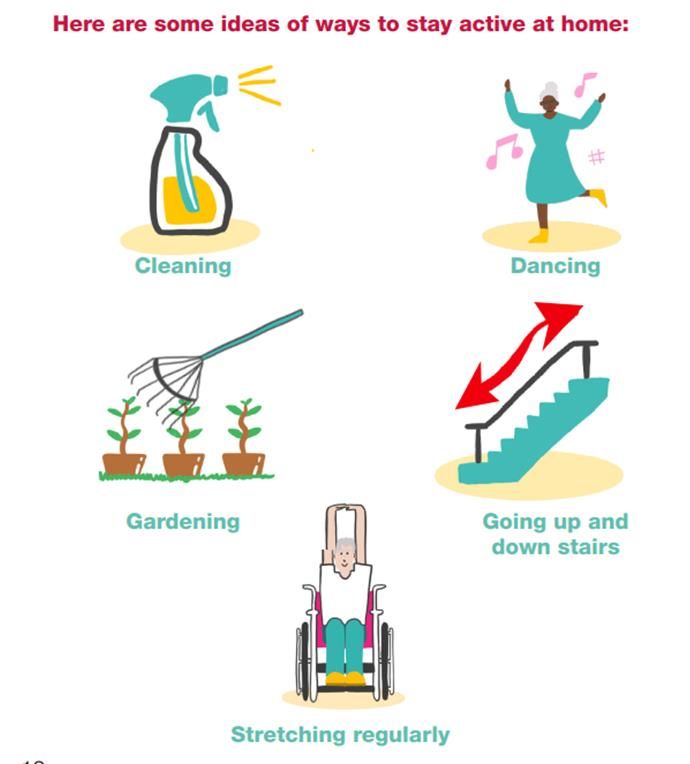
Data Collection – Week 1, 3 & 6
 It is really important that we
 find out how beneficial active
 chats are to the people that       Before we start our exercises
 you are supporting.                   this week do you mind
                                     answering a few questions
 There are some simple               about your wellbeing and
 questions you will need to ask     physical activity levels so we
 during the first active chat and    can see how this improves
 then follow up at week 3 and        whilst you’re on the Active
 week 6.                                 Chats programme?
 It is up to you where best you
 feel they would fit in the
 conversation.
Data Collection – Week 1, 3 & 6
 “I’m just going to read out some statements about feelings and thoughts,
 to find out how frequently you feel this way on a scale from ‘none of the
 time’ to ‘all of the time.’ ”
                                                  WEEK 1 DATA
                                             None of the time Rarely Some of the time Often All of the time
 I feel good about myself
 I feel close to at least one person
 I feel isolated from others
 I feel able to move around at ease
 I have been active in the last seven days
 I feel confident to move around more
 I enjoy being more active

 • There is a data collection sheet for you to record participant responses.
 • Encourage people to share their stories and capture case studies at 6
   weeks where possible.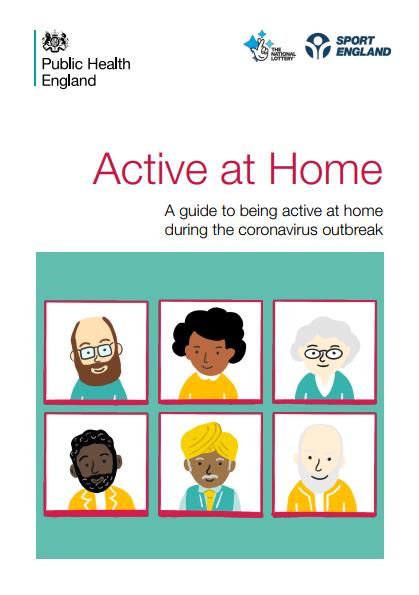
The Active Chat: Sign up
                           Open the conversation

                 Assess the impact of their current situation

                        Explore current activity levels

                      Find out what they already know

                             Share the benefits

                            Encourage reflection

                              Make it personal

                              The key Question

                                 Make a plan

                        Send out introductory letter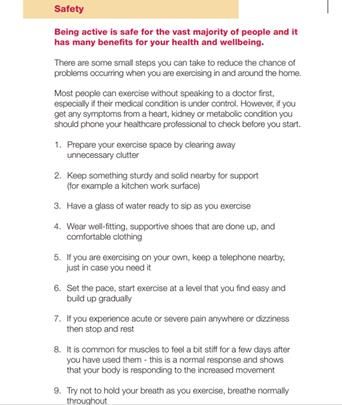
The Active Chat: Hints and Tips
Do:                                             Do not assume they:

✓ Ask permission to open up the conversation    × ought to or want to want to change

✓ Keep the conversation constructive and        × are primarily motivated by their health
  person-centred focusing on behaviour
  change.                                       × either ARE or ARE NOT motivated to increase
                                                  their activity levels
✓ Keep the individual actively engaged in the
  conversation and decision making              × will respond well to a tough approach from
                                                  you
✓ Help the individual to consider and share
  how they think they might benefit from        × must (or will) follow your advice
  being active

✓ Help them to develop these ideas into a
  workable plan that fits into their life.

✓ Try to understand their perspective, agenda
  and priorities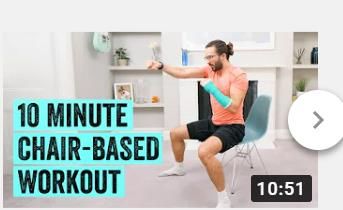
1: Open up the conversation
                          Prompts:

                          • I’d really like to talk about being active
     Would it be Ok to
   spend a few minutes    • Is being active something that you enjoy?

    talking about being   • What type of sports or activities did you use to
     active and how it      do/did you enjoy when you were younger?

     could make a big
     difference to your
  health and wellbeing?
2: Explore how their current situation impacts their
Physical activity levels

                                        LTHC = Long-term
           How has:                     Health Condition
        lockdown/this
     period/your LTHC*,
     affected how active
    you are and the things
          you enjoy?

              *select as appropriate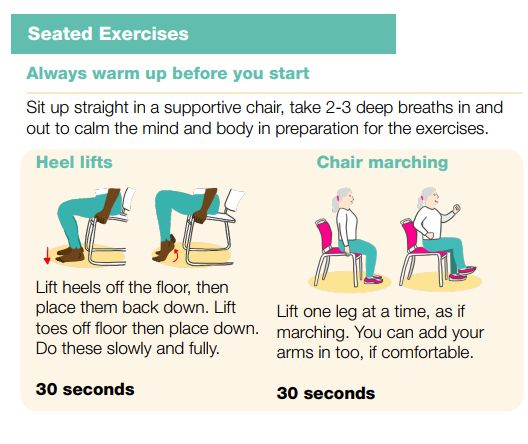
3: Explore current activity levels

                                 Notes:

                                 • Could use questionnaire to assess current
                                   activity levels

    How active are you at
     the moment during
          the day?
                                 Prompts:

                                 • Are you able to get up from your chair to
                                   answer the door?
                                 • Do you do any gardening?
                                 • Do you prepare your own meals?
                                 • Can you get up the stairs?
                                 • Are you able to go outside for a walk?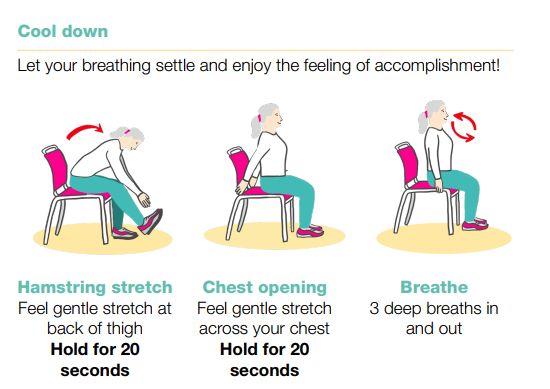
4: Find out what they already know

     What do you know
    about the benefits of
      being physically
           active?
5: Share the benefits
Prompt:
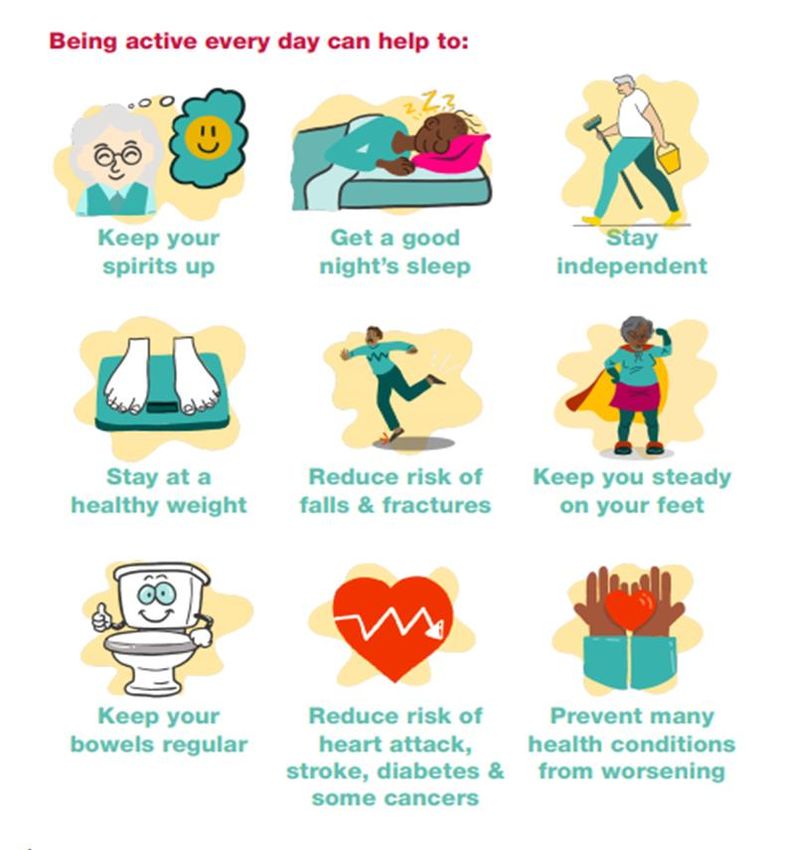
Take a look at Page 4 of the active at home leaflet
Can I share with you
some of the other
things people find
beneficial, see what
you make of them?6: Encourage reflection
Notes:
• Allow some space for people to talk and explore
the information rather than asking ‘do you
understand?’
• Share the experience of other people with similar
concerns
What do you make of • Point to some of the people featured in the We
what we’ve just talked are Undefeatable Campaign
• See common concerns summary sheet
about?
Prompts:
• Do you need anything clarifying?
• Do you have any concerns?
• Other people I’ve worked with that have had
these concerns have tried …..
• Whilst there is a small risk of X when you get
started, this is outweighed by the benefits & risk
reduction you experience once you have started
moving more’7: Make it personal
Prompts:
• Why do you think being active might help you?
What would be the
top 2-3 reasons for
you personally
becoming more active,
if you decided to?8: The key question
Prompts:
Do you think you • They are very simple seated exercises
would like to do some • They should help you with your strength and
balance so if you do them regularly they can help
exercises with me/one you from tripping or falling over.
of our volunteers
• We can go through them together over the phone
together over the
phone? I could arrange • We wont do anything you aren’t comfortable with
for someone to call • You can stop at any time
you next week?
• It should only take us about 15 minutes
• Arrange the time/date of the call11: The follow up
YES NO
That’s great, you will get a That’s fine, if you change
letter through the post with your mind, please get back
more details and a copy of in touch with us. Would
the ‘Active at Home’ leaflet you like me to send youa
This has information about copy of the ‘Active at
the exercise’s we will be Home’ Leaflet which has
dong. Please make sure information about being
you have this to hand for active at home?
the callThe Active Chat: Exercise Calls
Open the conversation
The Activity
Review
Make a plan
Follow Up1: Open the Conversation
Prompts:
My name is ……
• They are very simple seated exercises
I’m calling from …… to
do some exercises with • They should help you with your strength and
balance so if you do them regularly they can help
you over the phone you from tripping or falling over.
which will help you be
more active. • We wont do anything you aren’t comfortable with
• You can stop at any time
Are you still OK for us to
• It should only take us about 15 minutes
do these together
today? • Do you have the letter we sent you with the
Active At Home leaflet to hand for the call?2. The exercise
• Before we get started, there are some tips to
The exercises we are going to use are on
consider on p 5 and 6 of the active at home leaflet
p 7 – 9 of the active at home leaflet
Video clips will all the teaching points
are available online here;
https://www.youtube.com/playlist?list=P
L9f3C4Fbo5T-DOZnPekuR0ZewDYCuf-1b
If they feel unwell advise the patient to
stop exercising immediately and contact a
doctor or call 111, if they do not start to
feel better within 10 minutes. In an
emergency, call 999 if they are seriously ill
or injured or their life is at risk.The exercise: Warm Up
Active at home leaflet, seated warm up page 7
Video clips will all the teaching points
are available online here;
https://www.youtube.com/playlist?list=P
L9f3C4Fbo5T-DOZnPekuR0ZewDYCuf-1b
Heel Lifts Chair Marching
1 30secs or 8-10 Legs on own, arms by
reps, 1 set sides, slow
2 2 sets or 1 set Legs & Arms together,
1min/16-20 reps slow
3 Alternate feet: 1 Legs & Arms together,
heel lift, 1 toe lift faster/lifting higherThe exercise
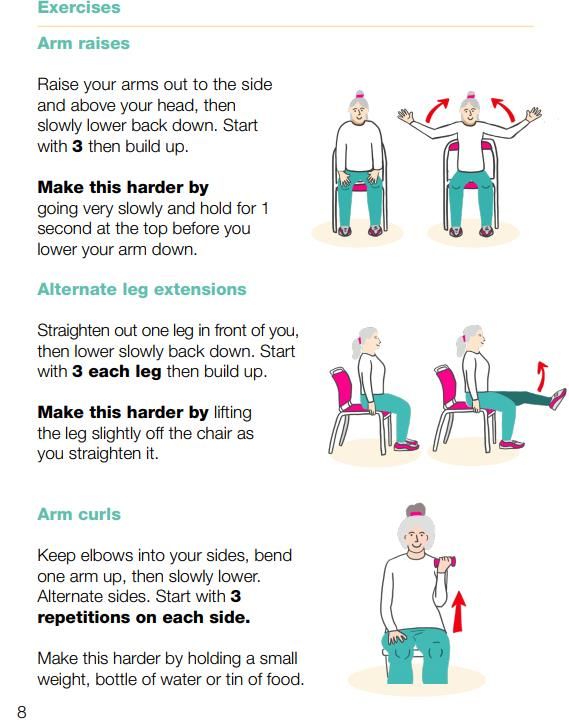
• Active at home leaflet, seated exercises page 8
Arm raises Alt Leg Extension Arm Curls
1 3-6 reps, 1 set 3-6 reps each leg, 3-6 reps, 1 set
1 set alternate
2 7-10 reps, 1 7-10 reps each leg, 7-10 reps, 1 set
set 1 set alternate
3 Add weights or 7-10 reps each leg Add weights or
increase to 2 slower/hold at top of increase to 2 sets,
sets move, &/or same leg &/or both arms
before swapping together
4 Add legs, Add single arm raise Add gentle march
gentle march to front or heel lifts
Remember all these exercises are good for you regardless of
fitness levels, as they work on joint mobility & flexibility, as
well as muscle strength.
This decreases stiffness, increases range of movement at
joints & enables people to do their daily activities more
easily.The exercise: Cool Down
Active at home leaflet, seated cool down pages 9
Hamstring Chest stretch Breathing exercise
stretch
1 Hold 10-20 Hold 10-20 3 deep breaths in &
seconds, 1 set seconds, 1 set out
each leg
2 2 sets or hold 2 sets or hold 3-5 deep breaths in &
20-40 seconds 20-40 seconds out
3 2 sets & hold 2 sets & hold Reach arms above
20-40 seconds 20-40 seconds head on breath in &
lower them on breath
out3: Review
Notes:
• Its Ok to feel a bit out of breath, so long as you
can still talk!
Prompts:
How did you find going
through those • How did you feel when we were dong the
exercises?
exercises?
• Did you enjoy doing the exercises?
• You may feel some discomfort/aches when you
start with something new, as well as after you
have exercised, this is normal and shows your
body is responding to the exercise.4: Make a plan
Prompts:
• Don’t feel you have to perform all exercises in one
go. They can be split into more manageable
sections if needed.
Could you do those • Have you got an e mail, I could e mail you a copy
exercises twice more of the exercises ?
Or
this week? • I could send you a copy of the exercises through
the post
• Is there anything else you
could do to be active this
week?5: The follow up?
Notes:
• Try to make another appointment to call again.
• Reiterate what they have agreed to try and do
How would you feel about before you next call.
having another call next • Encourage people to complete a 6 week
programme with you to help them progress.
week so you can let me • Provide signposting information to
know how you have got on virtual/community activities as appropriate.
and we could perhaps do
the exercise together Prompts:
again? • I would love to hear how you get on doing the
exercise again this week
• Maybe you could put some music on whilst you
are doing them next time?Follow up chats Open the conversation: complete data collection in weeks 3 and 6 Encourage reflection: how have you got on during the week? Make it personal: support and build confident, what's gone well, what did you enjoy? The Activity: repeat last week's exercises, introducing some of the progressions to make the exercises more difficult if appropriate and safe to do so. Review: how did you find it this week, are the exercise getting easier? Make a plan: set a new goal. If they can manage the exercise easily it is time to make it harder (add extra repetitions or sets). Maybe try the standing ones or suggest some of the activities on the next slide or sign post to other activities in the community. Follow Up: Arrange another call to see how they are getting on. Again try to ensure 6 weeks on the programme, to help encourage & maintain behaviour change and help form good habits.
Hints and Tips from Solihull CAB
• It helps if the client can receive a copy of the Active t Home leaflet before the Active Chat so
  both the volunteer and client can refer to it in the conversation

• Speak clearly and slowly.

• Ask family members and carers to support their loved ones if they have dementia. They have
  been happy to support their partners.

• For a visually impaired client, we explain clearly over the phone the exercises and then ask the
  client to repeat back what we have said. It means we can go through the exercises without the
  booklet knowing you understand each other.

• Always make sure the clients are happy with everything.
Exercises: Other ideas
                  10 alternative seated exercises from Love to Move which are particularly useful for those
Seated
                  living with Dementia. https://www.thinkactive.org/health/love-to-move/

Seated &                  Customisable mini workout, choose 5 exercises from the list and do one for 1 minute
Standing                  adding up to a 5 minute workout https://weareundefeatable.co.uk/ways-to-move/five-in-
options                   five. This can be printed off and sent out for those without online access

Seated &          Easy to follow, audio 10-minute daily home workouts to help older people stay active. Available
Standing          on demand through BBC Sounds https://www.bbc.co.uk/sounds/brand/p087wddm
options

Seated &               Bodycoach TV Workouts for Seniors: Short lower intensity home workouts on You Tube. Chair
Standing               based and standing workouts available. https://www.youtube.com/user/thebodycoach1
options

Beginner &               Online Pilates and Yoga workouts from the NHS. Beginner and Intermediate options
Intermediate             which vary in length from 10 – 45 mins. Useful for developing strength and balance.
                         https://www.nhs.uk/conditions/nhs-fitness-studio/yoga-with-lj/
Warwickshire Wellbeing Services Weight Management and Physical Activity • Fitter Futures Warwickshire aims to support people to improve their health. There are two delivery models; 12 week personalised exercise programme for individuals with specific long term health conditions and 12 week free adult weight management support. • Get Set to Go aims to improve the quality of life for anyone with a mental health problem through access to sport and physical activity. Provide taster sessions and 12-week physical activity sessions throughout Warwickshire. Mental Health Services – Adults • There are a range of mental health and wellbeing services and support available across Warwickshire ranging from 24/7 helplines, face to face support, online services, self-help books, out of hours crisis, counselling and bereavement and suicide prevention. For more information, please visit: www.warwickshire.gov.uk/mentalhealth • Dementia Connect can support you if have dementia or are supporting a person with dementia. The service provides a wide range of personalised information and practical and emotional support. For more information about dementia and services and support, please visit Warwickshire’s Living Well with Dementia website: warwickshire.gov.uk/dementia • Dementia Talking Point: Alzheimer’s Society 24/7 online community where people affected by dementia can ask questions or share how they feel. • The Carer Wellbeing Service provides emotional and practical support to help you if you care for someone and also to help you to maintain your own health and wellbeing. Substance Misuse • Adult Drug and Alcohol Treatment Services: A free, confidential substance misuse service for children and young people who need support around their own or another person’s drug or alcohol use. • Stop Smoking: Support is currently online – register here with smokefree NHS for free expert support to help you quit smoking.
Resources & Useful Links
• PHE Active at Home Booklet.
• Common worries handout.
• Top Tips to Prevent Falls and Trips.
• Healthy Ageing Website:
    • Keeping Fit
    • Keeping your Home Accessible
    • Connecting with People
    • Brain Training
    • Food and Drink
    • Alert to Infection
• A comprehensive information pack and Frailty eLearning for staff working in the
  health or care sector. The pack highlights risk identification and the support
  available including how to refer to the local NHS Integrated Single Point of Access
  (iSPA) for customers/or patients you identify as moderate to high risk of falling.
• If any major concerns regarding a participant’s health refer them to their GP.
Final Thoughts
• Practice having the ’Active Chat’ with friends or family a few times before making your first
call
• Before you make your call, ensure you have the following to hand:
• The Active at Home leaflet
• A copy of ‘the chat’ slides to follow
• The ‘Common Worries’ prompt sheet
• The exercises videos to hand to remind you how to explain the exercises
• Monitoring and Evaluation Questions
• Adapt the ‘Active Chat’ so you feel comfortable & confident delivering the key messages &
exercises.
• Remember to complete the Data Sheet at Week 1, 3 and 6
• Take a look through the additional resource slides for other activity ideas and services you
might want to signpost to.
https://www.thinkactive.org/active-chats/Tell us what you think….
We would welcome your feedback on today
session:
https://www.surveymonkey.co.uk/r/23JJ88H
Thank You!You can also read


