Administrative Instructions for 2020 Version 4 - NWSFRA
←
→
Page content transcription
If your browser does not render page correctly, please read the page content below
North West Sydney Football Referees Association Incorporated

                                            Administrative Instructions for 2020
                                                         Version 4

NWSFRA Contact Details                                                                                  2
Main Changes to the Laws of the Game in 2020                                                            3
Communication                                                                                           5
COVID 19                                                                                                6
Unavailability                                                                                          8
Appointments                                                                                            9
Withdrawing from Appointments                                                                           9
Before the Game                                                                                        10
After the Game                                                                                         11
Referee ID                                                                                             12
Caution, Send Off and Incident Reports                                                                 23
Referee Suspended as a Player or Team Official                                                         15
Weather                                                                                                16
Air Quality                                                                                            17
Problems at the Ground                                                                                 18
General Rules for all NWSF Grades                                                                      19
Mini Roos                                                                                              20
Additional Information for NWSF Mini Roos                                                              21
Special Rules for Under 12 and Under 13 games                                                          21
Competitive Games Under 12 and Up                                                                      22
Refereeing School Games                                                                                23
Temporary Dismissals                                                                                   24
Walking Football                                                                                       26
Masters Football                                                                                       27
Refereeing Football NSW Games                                                                          28
Digital Team Sheets (CompMan)                                                                          29
Referee Fees, Payments and Fines                                                                       34
Referees Equipment                                                                                     35
Ground Directory                                                                                       36
Strip Clashes                                                                                          37
Quick Reference Guide                                                                                  38

                                                                                                   1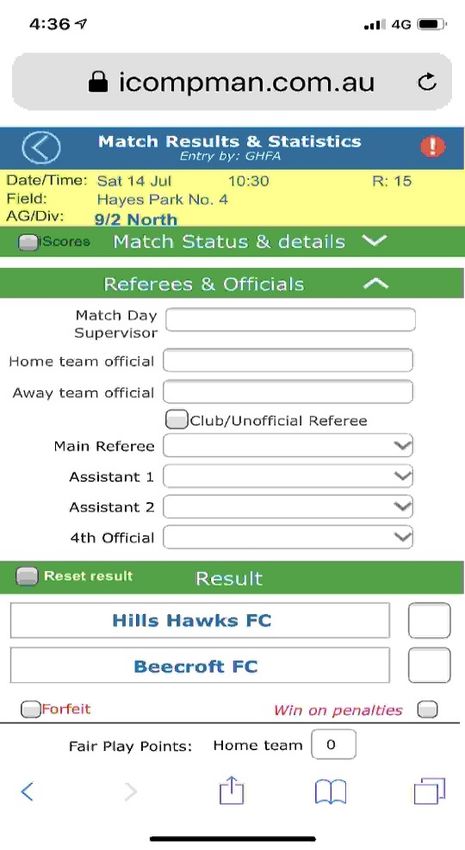
NWSFRA Contact Details
Website                  www.nwsfra.com.au
Mailing address          NWSFRA INC.
                         Christie Park Christie Road
                         Macquarie Park NSW 2113

COMMITTEE/ROLE                     NAME                 PHONE           EMAIL
Mgt. Committee (Executive)
President                          Tom Emeleus           0417 242 893   president@nwsfra.com.au
Secretary                          John Lennon          0409 806 632    secretary@nwsfra.com.au
Treasurer                          Scott McGilvery      0430 175 999    treasurer@nwsfra.com.au
Senior Vice President              Grant Reid           0409 776 443 svp@nwsfra.com.au
Junior Vice President              Chris Quilter        0414 943 952    jvp@nwsfra.com.au
Mgt. Committee (Non-Executive)
Junior Vice President (Under 21) Nick Lawrence          0401 425 881     jvp21@nwsfra.com.au
Assistant Treasurer                                                      assttreasurer@nwsfra.com.au
Assistant Secretary              Tony D’Andreti                          asstsecretary@nwsfra.com.au
Equipment Officer                Craig Black                            equipment@nwsfra.com.au
Branch Coach                                                            coach@nwsfra.com.au
Technical Committee
Chairman                         David Anderson         0435 721 231    technical@nwsfra.com.au
Appointments Committee
Chairman                         Paul Parks                             appointments@nwsfra.com.au
Administration Assistant         Nicholas Lawrence      0434 537 900
Registrar                        Paul Parks                             registrar@nwsfra.com.au
Web Master                         David Saba                           webmaster@nwsfra.com.au
Social Committee Chairperson       Bella Nimmo                          social@nwsfra.com.au
Other Officials
Member Protection Information      Karen McGregor                       mpio@nwsfra.com.au
Officer

Who to contact?
Anything about the Laws of the Games and refereeing technique           Technical (email preferred)
Anything about your grading                                             Technical (email preferred)
Anything about games                                                    Appointments (email preferred)
Anything about your registration with NWSFRA                            Registrar (email preferred)
Anything about using the NWSFRA website                                 Webmaster (email preferred)
Anything about your refereeing gear or replacing gear                   Equipment (email preferred)
Anything about referee payments                                         Treasurer (email preferred)
Issues with teams, team officials or red card and incident reports      Senior Vice President
General issues with NWSFRA (positives, complaints, suggestions etc.)    President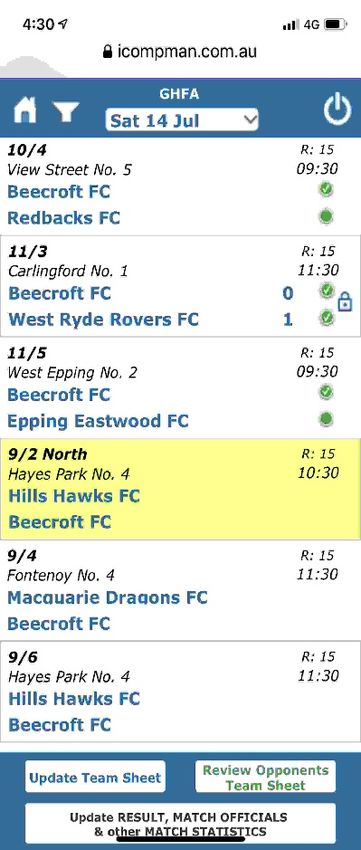
2020 Law Changes

Kick-Off - Law 8
    • The team that wins the toss can now choose to take the kick-off or which goal to attack (previously
       they only had the choice of which goal to attack)

Goal Kick - Law 16
   • The ball is in play once the kick is taken; it can be played before leaving the penalty area
   • Attackers need to be outside the penalty area when the kick is taken. If not, and they get involved,
       then the goal kick is re-taken.

Free Kicks - Law 13
   • When a defensive wall is formed – defined as three or more defenders – the attackers must remain
        1m away from the wall. If they are within this when the kick is taken, they’ll be penalised with an
        indirect free kick.
   • Free kicks in the penalty area are now in play once the kick is taken (same as goal kicks)

Substitutes / Interchange - Law 3
   • A player who is being substituted must leave the field by the nearest point on the touchline/goal line
       (unless the referee indicates the player can leave quickly/immediately at the halfway line or a
       different point because of safety, injury etc.)
   • The player coming on must still be at halfway and must not enter the field until the substituted player
       has left.

Team Officials - Laws 5 & 12
   • A team official guilty of misconduct will be shown a YC (caution) or RC (sending-off); if the offender
      cannot be identified, the senior coach who is in the technical area at the time will receive the YC/RC

Dropped ball - Laws 8 & 9
   • A dropped ball restart will still occur if play is stopped without a foul occurring while the ball is in play.
   • A dropped ball restart will now also take place if the ball hits the referee and:
          • Team possession changes; or
          • A goal is scored; or
          • A promising attack starts
   • The ball is now dropped to the team that had possession, or if it’s in the penalty area, it is dropped to
      the goal keeper. Dropped balls are no longer contested

Handball - Law 12
   • Deliberate handball remains an offence
   • The following ‘handball’ situations, even if accidental, will be a free kick:
           • The ball goes into the goal after touching an attacking player’s hand/arm
           • A player gains control/possession of the ball after it has touches their hand/arm and then
               scores, or creates a goal-scoring opportunity
           • The ball touches a player’s hand/arm which has made their body unnaturally bigger

                                                                                                                  3
•   The ball touches a player’s hand/arm when it is above their shoulder (unless the player has
               deliberately played the ball which then touches their hand/arm)

   •   The following will not usually be a free kick, unless they are one of the above situations:
          • The ball touches a player’s hand/arm directly from their own head/body/foot or the
               head/body/foot of another player who is close/near
          • The ball touches a player’s hand/arm which is close to their body and has not made their body
               unnaturally bigger
          • If a player is falling and the ball touches their hand/arm when it is between their body and the
               ground to support the body (but not extended to make the body bigger)
          • If the goalkeeper attempts to ‘clear’ (release into play) a throw-in or deliberate kick from a
               team-mate but the ‘clearance’ fails, the goalkeeper can then handle the ball

More detail, some other minor changes, and explanation on the thinking behind each change can be found at
https://www.the-ra.org/news/ifab-law-changes-2019-2020

                                                                                                             4
Communication
How does NWSFRA communicate with me?
    1. The NWSFRA website is the main method of communication. We suggest you check the website on
       Monday night after 7:30pm and Friday night as a minimum.
                                      www.nwsfra.com.au
    2. Facebook and Twitter are used to send alerts. If you receive an alert, please check the website. Our
       Facebook is a closed group and you will have to be a registered referee to be accepted.

                      m.twitter.com/NWSFRA                                   NWSFRA

    3. Email is used when the message is for an individual. Please check your email several times during the
       week. Ensure you have notifications turned on, so you do not miss an email from us.
    4. On weekends, we will text you if there are changes to your games. Make sure you keep your phone
       with you and turned on.
    5. NWSFRA meetings are held on the second Monday of the month from April to August via video
       conference or Facebook. The Annual General Meeting held in November. The meeting dates for 2020
       are:
                Monday 13 April 2020                      (Technical session at 7pm General meeting at 7:50pm)
                Monday 11 May 2020                        (Technical session at 7pm General meeting at 7:50pm)
                Monday 15 June 2020                       (Technical session at 7pm General meeting at 7:50pm)
                Monday 13 July 2020                       (Technical session at 7pm General meeting at 7:50pm)
                Monday 10 August 2020                     (Technical session at 7pm General meeting at 7:50pm)
                Monday November 2020                      Annual General Meeting 7:30pm
It is appreciated that some junior members may only be able to participate in the technical session because of
studies, etc.
How do you communicate with NWSFRA?
Email is the best way to contact Appointments, the Technical Committee or the Management Committee. Make
sure you always provide your first name, last name and referee ID number on all emails or texts.

If you have a problem at a game or with a club official or need assistance writing a report call Grant Reid, our
Senior Vice President on 0409 776 443

If you are sent a text about changes to your appointments, please reply to confirm that you received the text.

Why are accurate contact details very important?

    •   NWSFRA must have a valid mobile phone number and an email address for you.
    •   These must be the number and email address that you use.

If any of your contact details change after registration or during the season, you must update them by emailing
appointments@nwsfra.com.au .

                                                                                                                   5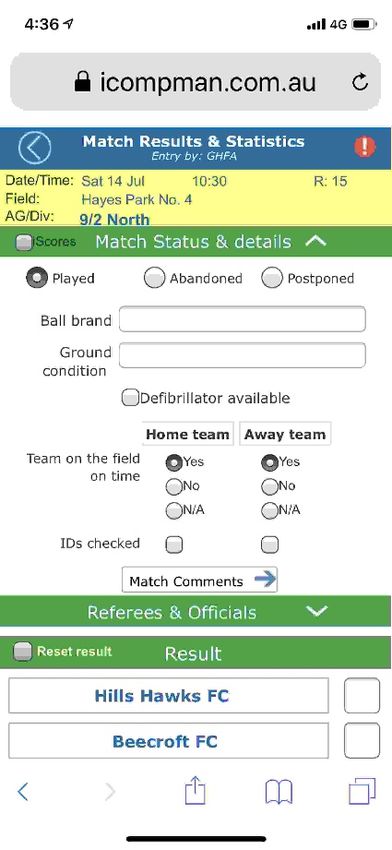
North West Sydney Football Referees Association
                        COVID 19 Protocol
                  Guidelines for Match Officials
                            June 2020

The priority of NWSFRA is to safeguard the health and wellbeing of our referees and the community and to
undertake the social responsibility to reduce the spread of COVID-19.
Referees are encouraged to download the COVID Safe App.
Participation
Referees should not participate in matches, training, meetings or any other football activities if they:
          •   are displaying cold/flu like symptoms
          •   have been in close contact with a confirmed case of COVID-19 in the last 14 days
          •   awaiting results of a COVID 19 test.
In the event of a referee testing positive for COVID-19, they must contact the Appointments Chairperson
immediately on 0422 000 580.
Responsibilities
Referees should contact Appointments as early as possible if they are unable to fulfil their appointment(s). Refer
to the NSWFRA Administration Instructions for contact details.

Referees and Assistant referees are to advise Appointments via an incident report if an appointed referee and/or
assistant referee does not turn up for the game.
Individual referees are responsible for ensuring that their Match History maintained on the NWSFRA website is up
to date and accurate.

Training
Return to training guidelines are available on the Football NSW Return to Training website. Match Officials will be
considered ‘players’ in this context and attendance at training must be recorded and filed.

Preparation for Matches
In addition to the traditional items in your kit bag, the ‘Referees Kit’ should now include:
         • Download the COVID Safe App
         • Soap and / or sanitiser
         • Antibacterial wipes and or sprays (e.g. Glen 20)
         • Paper towels
         • Bring your own drink bottle – clearly labelled with your name

Before Leaving Home
        • Double check your kit bag to ensure you have all your gear … no sharing of equipment.
        • Ensure you have all 3 shirts …. black, blue and yellow.
        • Sanitise your equipment

Arrival
          •   Arrive dressed in your referee uniform.
          •   Arrive 15 - 30 minutes prior to play to inspect fields/warm-up/complete administration.
          •   Maintain the 1.5 metre physical distancing protocol with all people.

These guidelines accompany Football NSW ‘Return to Play Guidelines’, New South Wales Government and Federal
Government COVID-19 plans and directives; and any other directive from Football NSW or FFA specific to COVID-19.
                                                                                                                      6
Pre-Match
       •    Maintain physical distancing of 1.5 m, including the issuing of referee’s instructions.
       •    Sanitise regularly.
       •    Physical contact such as shaking hands is not allowed
       •    Do not share clothing. If this means referee teams are wearing different colours, so be it.
       •    Do not share equipment, including stationery and pens.
       •    Do not share drinks, snacks, lollies etc
       •    Minimise handling of the ball. You can always dribble the ball onto the field.

Change Room (if applicable)
Avoid the use of change rooms. If you decide to use the change room, the following guidelines apply.
        • The only people allowed in the referee change room are: Referees and Referee coach
       • Remember the 1 person per 4 sq metre rule (NSW government is maintaining this rule)
       • Referees are encouraged to keep a record of who enters whilst they are present.
        • On completion of match, officials should leave the change room and take belongings.
If there are multiple ‘teams’ of officials using a change room that is not large enough to allow for physical
distancing measures to be taken, it is the responsibility of the referee team going ON to the next match to be ready
and vacate the change room BEFORE the completion of the previous match.

During the Match
   • Do not touch players for any reason.
   • Referees are to follow the LOTG only. They are not there to police COVID 19 guidelines of players, coaches
        or spectators.
   • Spitting should be discouraged; however, referees should apply the Laws of the Game and sanction a
        player only if they are guilty of spitting at a person.
   • Minimise touching the ball. The only time you should touch the ball is at a drop ball. Players can place the
        ball for place kicks etc under your supervision.
   • Assistant Referees are to use their own flags
   • Assistant Referees are not to touch or collect the ball with their hands when it goes out.
   • Treat injuries as normal by enabling the team officials to deal with players.

Half Time
    • Maintain physical distancing of 1.5 metres between referees and other people
    • Sanitise equipment and hands … you may have touched the ball
    • Do not share drinks, snacks, lollies etc

After the Match
    • Referees should depart in their uniform and shower at home
    • Sanitise all equipment including whistles and flags.

Between Matches
If you are appointed to multiple matches
     • Maintain physical distancing of 1.5 metres between referees and other people
     • Sanitise equipment and hands
     • Do not share drinks, snacks, lollies etc.

Matches without Assistant Referees
If you are uncomfortable with sharing your flags with club lines people, ask a team official to simply use a coloured
jumper to indicate in and out.
If you are willing to share your flags with a club linesperson, the following protocols apply:
     - sanitise the flags before handing them over and after the flags have been used
     - ask the person borrowing them to sanitise their hands before receiving the flag
     - avoid touching your face between taking your flags back and re-sanitising your hands.

                                                                                                                    7
Unavailability
 Why is my unavailability so important?
 • NWSFRA assumes you are available at any time during playing times unless you advise us
    you are unavailable.
 • Playing times are: 6pm – 10pm on every Friday in the season
                        8am – 9pm on every Saturday in the season
                        8am – 7pm on every Sunday in the season
 • If you are unavailable during playing times on any weekend during the season you must advise us that
    you are unavailable by 7pm on the Saturday beforehand.
 • Appointments are based on the information that you have provided.
 • If you do not advise us that you are unavailable, and you are appointed to a game you do not cover, you
    will be fined (see Page 27).

        NWSFRA does not like to fine members, but the work for our volunteers quickly doubles or trebles
       when members do not follow these instructions. Please help us help you and fines won't be needed.

 •   If you play for a team in NWSF competitions, we will know your playing commitments and you DO NOT
     have to advise us of your unavailability. We will appoint you as a match official to games near the
     place and time of your own competition games.

 When can I enter my unavailability?
 You can enter your unavailability for the entire season or individual weekends as long as you meet the
 deadline for the upcoming weekend (7pm on the Saturday before the weekend you are unavailable).

 When is the unavailability deadline?
 The deadline is 7pm on the Saturday before the weekend you are unavailable. It is each Referee’s
 responsibility to enter their information prior to the deadline.
  • At 7pm on every Saturday night during the season, we will ‘lock’ the website so you cannot enter or
     change your availability for the coming weekend.

 How do I enter my unavailability?
  1. Go to www.nwsfra.com.au
  2. Click Ref Sign On
  3. Enter your username and password
  4. Click Sign On
  5. Click Appointments
  6. Click Unavailability (towards the bottom on the left-hand menu)
  7. Enter information using the Add Unavailability box

What happens if I miss the 7pm unavailability deadline on Saturday night for the next weekend?
1. You MUST email appointments@nwsfra.com.au as soon as possible with the details for
   your unavailability including the reason for your unavailability. DO NOT CALL OR SMS!
2. First time offenders may be fined but it depends on individual circumstances.
3. Repeat offenders will be fined unless there are exceptional circumstances.
4. Fines, if applied, are 70% of the match fee for the game to which you were appointed. Fines are
   applied for each match for which you are a late withdrawal.
5. If you do not email you may be fined twice; one fine for not meeting the deadline and the second fine
     for not attending your game.

                                                                                                             8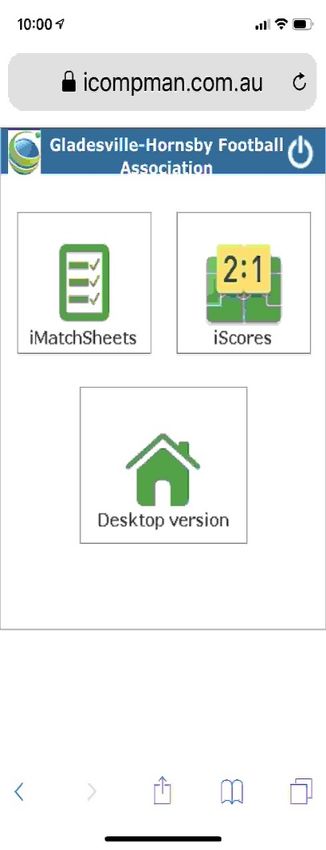
Appointments
When are appointments posted online?
Appointments are posted online on Monday night during the winter season at www.nwsfra.com.au usually
by 8pm. Please read the message on the front page of the website carefully each week as important
information is uploaded when the appointments alert is posted.
How do I view my appointments?
    1. Go to www.nwsfra.com.au                                                        Click on the
    2. Click ‘Ref Sign On’ on the menu bar (left hand side of the page).           ground link with
    3. Log on with your username and password.                                            your
    4. Click ‘Appointments’ on the menu bar.                                       appointments for
    5. Under ‘Appointments’, click ‘My Upcoming’.                                  the exact ground
                                                                                       location
    6. Print or make a note of your appointments.
    7. To sign off click back twice and the click ref sign off.

 What do I do if I did not get any appointments for the weekend?
   1. Check uncovered games and select games you are interested in within your group. This list is updated
       throughout the week.
   2. Email appointments@nwsfra.com.au indicating the games you are interested in. A good way to do this is
       to cut and paste from the uncovered games on the website.
   3. The appointments committee will tell you which games to referee. Do not assume you will referee the
       games just because you email appointments.
 What do I do if I want to referee additional games this weekend?
   1. Check uncovered games and select games you are interested in within your group. This list is updated
       throughout the week.
   2. Email appointments@nwsfra.com.au indicating the games you are interested in. A good way to do this is
       to cut and paste from the website.
   3. The appointments committee will tell you which games to referee. Do not assume you will referee the
       games just because you email appointments.

 What do I do if I referee a game to which I was not appointed?
   1. Email appointments@nwsfra.com.au
   2. The Appointments Committee will update the database and website so you can enter the match score,
       Cautions, Send Offs and Incident Reports as appropriate.
   3. You must enter the match scores by 5pm on the Monday following the game.

               You must NOT referee uncovered games that are at a higher level than games
                             to which you have previously been appointed.
 Withdrawing from Appointments
 What do I do if I have to withdraw from my appointments during the week?
   1. Email appointments@nwsfra.com.au as soon as you know with your details and the reason.
   2. First time offenders may be fined but it depends on individual circumstances.
   3. Repeat offenders will be fined unless there are exceptional circumstances.
   4. Fines, if applied, are 70% of the match fee for the game to which you were appointed. Fines are
       applied for each match for which you are a late withdrawal.

 What do I do if I have to withdraw from my appointments after 5pm on Friday night? (EMERGENCIES)
   1. Call 0434 537 900 …... do not text (if you text you may be fined for not following instructions)
   2. If the call goes to message bank, speak clearly and leave your full name, Referee ID number, the
       game(s) you are unable to attend and the reason for your withdrawal.
   3. Repeat offenders will be fined unless there are exceptional circumstances.
   4. Fines, if applied, are 70% of the match fee for the game to which you were appointed. Fines are
       applied for each match for which you are a late withdrawal.

                                                                                                              9
Before the Game
 How do I find out where the ground is?
 1. Before you leave home or using your smartphone, log into the NWSFRA website, click on Appointments,
    click on “My Upcoming” and click on the ground. The location of the ground and your directions to the ground
    will appear on the map.
 2. If you are appointed to a ground with multiple fields (e.g. Meadowbank or Morrison), make sure you know
    exactly where your field is located. There are maps showing all the fields for Meadowbank and Morrison in
    the “Library” on the NWSFRA website.

         NWSFRA website                   Library                   Information for Referee                 Maps

 When should I arrive at the ground?
 1. Plan to arrive at the ground at least 30 minutes before the scheduled kick-off. The earlier the better.
 2. If you are appointed as AR to an afternoon match, but you are playing or refereeing somewhere else at
    11:00 or 11:30, we understand if you can’t get to your appointment on time.
     TIP: Try to get there as quickly as you can, but make sure you have something to eat and drink before you
     start your afternoon matches and drive safely.
 What do I do when I get to the ground?
 You need this time to:
     •    Get yourself ready for the game                       •    Introduce yourself to team officials
     •    Check the field (nets, flags etc.)                    •    Check players’ equipment
     •    Give instruction to AR’s if appointed and get the     •    NWSF games - confirm e-team sheets
          AR’s ID numbers                                       •    FNSW games - collect paper team sheet.
 How should I be dressed?
 1. You are representing NWSFRA so dress neatly and professionally. Arriving in your uniform is great.
 2. Make sure your uniform is clean and ready for each appointment.
 3. Pack all referee shirts (black, yellow & blue).
 4. Your black referee shirt is the default. Wear your yellow or blue shirt if the black clashes with a team.
 5. If you are an AR on an afternoon match, all referees appointed to that game must wear the same colour
     shirt.
 6. Your referee shirt MUST be tucked into your shorts, and your socks MUST be pulled up.
 7. You can wear a black referee cap if it is sunny or if glare is a problem.
 8. If you are an AR on a cold or wet afternoon, you may wear a black or dark coloured rain-jacket.
 9. Do not wear sunglasses unless you need them for medical reasons. Wear sports sunglasses.
 10. Use a digital watch for keeping time of the match. DO NOT use a mobile phone.

How do I start a game?
When both team managers tell you that they have "confirmed" the opposition team's player list and the teams
have greeted each other, then you are ready to start.

Referees must not get involved in any dispute about player eligibility or identity. If there is a "dispute", referee
the match, submit an incident report and NWSF will review and resolve the dispute after the match has been
played.

  5 minutes prior to the scheduled kick-off call both the teams (including interchange
  players) to the centre circle. Remember, do not shake hands and maintain the correct
                                     social distance.

                                                                                                                       10
After the Game
What do I do after the game?
1. Check your notebook to ensure all details of the match are accurate (score, player numbers for yellow
or red cards, the time cards were issued, correct codes etc.).
2. Log into iCompMan (mobile or desktop app) …. leave some time for managers to update team sheets
3. Enter your name and AR’s name(s) if appointed.
4. Enter score (by 10am Monday deadline).
5. Enter yellow cards and R7 (double yellow) red card if players were cautioned (by 5pm Monday
deadline).
Note: if you want a record of the data you entered, use the print screen function.
6. Log off.
7. Log onto the NWSFRA website.
8. Enter score (by 10am Monday deadline). This is important to ensure correct referee payments.
9. Submit red card details other than R7 or incident report(s) by 5pm Monday deadline. Refer to the
section on Incident Reports (Page 11) for examples of issues which may require an incident report.
10. Log off.
In rare instances, where a paper team sheet has been used for a NWSF game,
a. record the score on the team sheet using words and numbers.
b. record your details and Assistant Referee details on the team sheet.
c. record yellow card / red card codes in the appropriate column against the correct player
d. if you have assistant referees, make sure you agree on the score and they have the accurate
details of any send offs (e.g. player name, shirt number and FFA number)
e. take a photo of the team sheet (front and back if required) using your smartphone so you have all
the details in case you have to refer to them later.
f. Email the photos or a scanned copy of paper team sheet to nikki@nwsf.com.au. The deadline for
receiving a copy of the paper team sheet is 10 am on the Monday following the game.
Alternatively, you can hand deliver the paper team sheet to Christie Park by the deadline.
g. Log on the NWSFRA website.
h. Enter score (by 10 am Monday deadline). This is important to ensure correct referee payments.
i. Submit yellow and red card details or incident report(s) as required. Refer to the section on
Incident Reports (Page 11) for examples of issues which may require an incident report.
j. Log off.
*** AR’s only need to log onto the NWSFRA website and enter the score, red
card details and/or incident reports as required. ***
AR’s who covered a game without an official NWSFRA referee where a digital
team sheet was used, should enter score on the NWSFRA website by 10am
on the Monday following the game and submit an incident report.
School Games (refer to page 21) and Football NSW games (refer to page 26)
How Do I Enter Scores on to NWSFRA Website?
Enter your match scores on-line using the NWSFRA website by 10am on the Monday following the game.
1. Log on using Ref Sign In.
2. Click Appointments on the left-hand menu.
3. Click My History.
4. Select the game.
5. Select Score.
6. Enter the score accurately ensuring the score is correct for each team.
7. Click update.
8. Sign off.
11How Do I Submit cautions, send off and incident reports as required? (See page 11)
What happens if I do not enter my match scores by 10am on the Monday following the game?
1. An email will be sent on Tuesday after the weekend games, reminding referees who have
outstanding scores, to enter them by 5pm Tuesday. You may be fined unless there are exceptional
circumstances.
2. Fines, if applied, are 70% of the match fee for each offence. If you are sent a reminder and you do
not enter the match score by the time requested, the fine is 100% of the match fee for each
offence.
What should I do if I did not referee my appointed game? (No Show)
1. Do not enter any score on either iCompMan or the NWSFRA website.
2. Email Appointments as soon as possible detailing the reasons for not doing the game.
3. Email Appointments if any game you did not referee is still showing in your history.
4. You may be fined or face other disciplinary action unless there are exceptional circumstances.
Fines, if applied, are 100% of the match fee for each match you did not cover without an
acceptable reason.
How do I respond to a team official who requests I enter a comment on iCompMan or sign a comment of
the back of a team sheet?
Do NOT enter a digital comment or sign a team sheet agreeing to anything which is not within your
authority or responsibility, or that you did not witness. You may acknowledge that the team manager has
made a note.
If a team official has requested that you report an issue, submit an incident report on the NWSFRA website
as NWSF will require your report if the team official makes a formal complaint. It is important that in all
circumstances when making a report that you describe the who, when and what YOU witness only.
What fines can be imposed if I do not meet my responsibilities to NWSFRA after the match?
You can be fined for failure to:
• lodge or dispatch the • complete the match report on • submit the match report
team sheet on time; time; on time;
• enter the correct score • enter the correct score on time
on time; after a reminder.
Referee ID
What do I do if I am asked for my name?
1. Provide your referees ID number only
2. Do NOT give your name or any other details.
What do I do if I am asked for my referee ID number?
1. Tell them your number. You are required to supply it.
2. Do not volunteer your name.
12Caution, Send Off and Incident Reports
What do I do if I caution a player?
1. Note the number of the player, the time of the caution and the reason in your notebook.
2. Enter the caution code:
a. Electronic Team sheets … Enter caution code against the player on iCompMan
b. Paper Team sheets (in rare circumstances for FNSW games)
i. Enter the caution code on team sheet next to the players name after the match.
ii. Submit a caution report online by 10am on the Monday following the game.
iii. Take a photo of the team sheet (both sides) and email to appointments@nwsfra.com.au
3. Assistant referees do not report cautions.
Note: If you send off a player for receiving two cautions in the same match, DO NOT submit a caution report for
that player, JUST submit the send-off report - R7 but keep a record of both cautions in your notebook.
? If you need assistance call the Senior Vice President, Grant Reid, on 0409 776 443
Caution (Yellow Card) Codes
Code Offence
Y1 Unsporting behaviour
Y2 Dissent by word or action
Y3 Persistent infringement of the Laws of the Game
Y4 Delaying the restart of play
Failure to respect the required distance when play is restarted with a corner kick, free kick or
Y5 throw-in
Y6 Entering, re-entering or deliberately leaving the field of play without the referee’s permission
What can a substitute or substituted player be cautioned (yellow card) for?
A substitute or substituted player can be cautioned for:
1. Delaying the restart of play.
2. Dissent by word or action.
3. Entering or re-entering the field of play without the referee’s permission.
4. Unsporting behavior.
What do I do if I send off a player?
1. Note the number of the player, the time of the send-off and the reason in your notebook.
2. Write the send-off code on the paper team sheet next to the player’s name after the match.
Note: The manager (and only the manager) of the player you sent off may ask you for the send-off code.
Provide the send-off code if possible, or else ask for the manager’s telephone number and supply
the send -off code and telephone number to the NWSFRA Senior Vice President that evening.
3. Do not give an opinion on the penalty that may be imposed by NWSF.
4. Call the Senior Vice President, Grant Reid, on 0409 776 443 if you want to discuss the send-off.
5. The report must be written clearly and state only the facts.
6. Reports must be written with correct spelling and grammar.
7. If a player is sent off for receiving a second yellow card (R7) and there is no post sanction incident,
do not write anything in the body of the Send Off report.
8. Submit your send-off report online by 5pm on the Monday following the game.
Tip Sign on, click the link, download and read the document, “Send-off report Guidelines” from the
library before you write your report.
9. Assistant referees submit a send-off report except if the send-off is for a second yellow card by 5pm on
t h e Monday following the game.
1310. In any send-off situation, if the player becomes involved in an incident (e.g. referee abuse, threatening
or intimidating behaviour, fighting etc.) after the red card has been shown, this incident
must be fully described in a separate Incident Report. The post sanction section of the Send Off report
must be endorsed “See separate Incident Report”. All match officials (i.e. Referee and Assistant
Referees) must submit Incident Reports for these post sanction incidents.
Note: If there is an offence against a match official any time during or after the match, the referee
MUST contact the NWSFRA Senior Vice President Grant Reid, on 0409 776 443 by 9pm on the day of
the match.
Send Off (Red Card) codes
Code Offence
Serious foul play – a tackle or challenge that endangers the safety of an opponent or uses
R1 excessive force or brutality
R2 Violent Conduct – when a player uses or attempts to use excessive force brutality against an
opponent when not challenging for the ball, or against a team-mate, team official, match official,
spectator or any other person, regardless of whether contact is made.
R3 Biting or spitting at someone
R4 Denying the opposing team a goal or an obvious goal scoring opportunity by deliberately handling the
(except a goalkeeper within their penalty area)
R5 Denying a goal or an obvious goal scoring opportunity to an opponent whose overall movement is
towards the offender’s goal by an offence punishable by a free kick.
R6 Using offensive, insulting or abusive language and/or gestures
R7 Receiving a second caution in the same match
What is an incident Report?
An incident report is a report on any extraordinary event that occurred before, during or after your game.
Examples of extraordinary events include:
• any reportable behavior from a player AFTER he / she has been shown a red card;
• expulsion of a team official from the Technical Area;
• game abandonment (due to extreme weather, light failure, etc.) Enter x – x as the score;
• field invasion;
• serious injury where a player requires an ambulance (play may be suspended and time remaining is run
down, but the game is never abandoned);
• abuse of a referee/assistant referee (excluding abuse by a player where the player was sent off
for the offence and a Send Off report submitted);
• reportable behaviours of supporters;
• a team is not dressed in proper strip;
• managers and / or coaches not identified (neither armband nor photo ID)
• a listed strip clash but the away team did not have an alternative strip;
• the ground is not properly dressed (markings, nets, corner posts and flags);
• a team did not show up;
• a team is late;
• a team had insufficient players;
• a team does not supply a satisfactory ball;
• any other incident witnessed by a match official that warrants a report.
Note: If there is an offence against a match official any time during or after the match, the referee MUST
contact the NWSFRA Senior Vice President Grant Reid, on 0409 776 443 by 9pm on the day of the match.
14IMPORTANT
If you encounter referee abuse or other unacceptable behaviour from a team official (coach/manager) or
supporter, you MUST take some action at the field. If you ignore it and later report it as some form of
"referee abuse" the Competition Authority may find that there is "no jurisdiction" enabling them to hold the
offender to account.
If you do not issue team officials yellow or red cards, the Competition Authority will have no jurisdiction under
which they can initiate disciplinary action.
What do I do if there is an incident to report?
1. Record the important facts in your notebook straight after the game.
2. Call the Senior Vice President, Grant Reid, on 0409 776 443 to discuss the incident before you write the
report.
Tip sign on, click the link, download and read the document, “Send off report Guidelines” from
the library before you write your report.
3. Your Incident Report must provide full details and descriptions of the matter being reported.
4. Reports must be written with correct spelling and grammar.
5. Submit your incident report online by 5pm on the Monday following the game.
6. Assistant Referees must also complete and submit a report of their observations of the incident by
5pm on the Monday following the game.
How do I report cautions, send-offs and incidents?
Cautions (yellow cards) in games using electronic team sheets
1. Log into iCompMan (mobile or desktop app) …. leave some time for managers to update team sheets
2. Enter your referee ID and AR ID’s if appointed.
3. Enter the score (5pm Monday deadline).
4. Enter yellow cards and R7 (double yellow) red card if players were cautioned (5pm Monday deadline).
Note: if you want a record of the data you entered use the print screen function.
All cautions in paper team sheet games and ALL send offs (except for R7 in electronic team sheet games) and
incidents must be reported online using the NWSFRA website.
1. Log on using Ref Sign In.
2. Click appointments on the left-hand menu.
3. Click My History.
4. Select Cards for the game.
5. Choose either Yellow, Red or Incident.
6. Enter the details accurately.
7. Click update.
8. Sign off.
Where do I get help to write send off and incident reports?
1. Sign on and read Send Off Report Guidelines for help with writing red card and send off reports.
2. Call Grant Reid, our Senior Vice President, if you need further help on 0409 776 443.
Referee Suspended as a Player or Team Official
What do I do if I am sent off as a player or expelled from the Technical Area as a team official?
If you are also a player or hold a team official position and you are sent off (while playing) or expelled (from
the Technical Area as a team official) you MUST:
1. complete any appointments that remain in "my upcoming" on the website for that weekend;
2. email Appointments as soon as possible following the game; and
3. advise the Appointments by email of any suspension imposed by the Football Authority
15Weather
What do I do when there is wet weather?
1. Always assume your games are on.
2. Check the NWSFRA website
a. if there’s no message the games are on.
b. If some or all grounds are closed, a message will be on the website.
3. Check the website again for any updates before you leave for your games. Do not call or text!
What do I do if lightning is sighted during a game? FNSW Lightning Policy
LOOK UP LOOK OUT 30 – 30 Rule
1. Count the time until thunder is heard.
2. If that time is 30 seconds or less between lightning and thunder, take appropriate shelter.
3. Suspend the match for a least 30 minutes.
4. All players, referees and spectators should seek safe shelter.
Remain sheltered for 30 minutes after the last thunder is heard.
Can I restart play after suspending a game due to lightning?
1. Play can resume when the ‘30-30’ rule has been satisfied.
2. This is when there has been a lapse of 30 minutes from the last time lightning was seen and thunder
heard within 30 seconds of that flash.
3. There is no stoppage time in NWSF games (except for PLF and SLF).
4. Ensure the game is completed by the scheduled finishing time.
5. If the game cannot be restarted before the scheduled finishing time, make a note on the back of the
team sheet and post an Incident Report online using the NWSFRA website citing extreme weather.
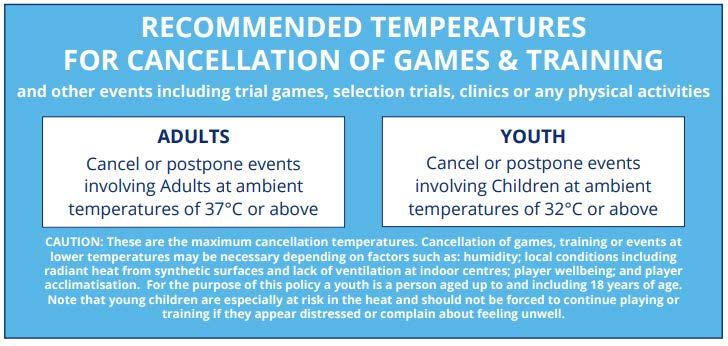
What do I do if it is really hot? FNSW Hot Weather Policy
The FNSW policy is to cancel games if the ambient temperature is 37 degrees for adults and 32 degrees for
Under 18 and below.
If you decide to suspend a game due to extreme weather conditions post an
Incident Report online using the NWSFRA website.
16FNSW Air Quality
The air quality index (AQI) is an index for reporting daily and hourly air quality levels. It is provided by NSW Office
of Environment and Heritage and is an indication of how clean or polluted the air is in areas across NSW.
The AQI provides easy to understand information about:
o Air pollution levels at your nearest suburb or region
o Information for people more at risk from exposure to short-term air pollution
o Steps to take to minimise risk
The AQI website link is: www.dpie.nsw.gov.au/air-quality/current-air-quality
Football Tournaments and Games
To determine if a football game, event or activity should proceed, or if the game or activity should be modified,
the club/association or event organiser is responsible for assessing the air quality by referring to the AQI website
in conjunction with the Action Table.
The AQI website lists the current AQI in a defined region or suburb and is updated on an hourly basis.
In the case of a Football NSW tournament and games, Football NSW will make the determination on whether
specific games will proceed or be postponed, suspended or cancelled due to air quality.
In some cases, Football NSW may also issue an Air Quality Warning notice for the information of all clubs,
associations and participants. These notes are also posted on the FNSW website.
Recommended Actions
When the AQI is ‘fair’ or ‘poor’, it is recommended that consideration be given to modifying the game.
When the AQI level is ‘very poor’ or ‘hazardous’, it is recommended that the event be cancelled or suspended.
17Problems at the Ground
What do I do if I have a problem with the spectators?
1. You should seek assistance from the manager(s) and/or coach(s) who are identified by their armbands
or Photo IDs.
2. If the problem persists, Call Grant Reid, NWSFRA Senior Vice President on 0409 776 443.
What do I do if I want to report a club official?
Call Grant Reid, NWSFRA Senior Vice President on 0409 776 443 and discuss the matter. Grant will advise
what action to take.
If Grant is not available and you consider the issue to be urgent, call Tom Emeleus, NWSFRA President on
0417242893.
What do I do if there a strip clash?
1. The visiting team (as per iCompman) shall be the team to change when a clash of strip occurs.
2. Check the strip clash chart on Page 35 of these instructions.
3. If the strip clash is noted on the chart, inform both team managers that a colour clash problem exists
and that it will be necessary for the visiting team to play in an alternate strip.
4. The use of numbers bibs is acceptable as an away strip.
5. If neither team is able to provide a suitable strip, inform both team managers that you are not
prepared to referee the game and shall report the full details of the matter.
6. Submit an incident report before 5pm on the Monday following the game.
NOTE: Uniquely numbered bibs of an appropriate colour are an acceptable alternative strip.
What do I do if I believe the ground is unplayable?
1. Inform the officials of both teams and request that they rectify the problem.
2. If the problem cannot be rectified, you must contact Call Grant Reid, NWSFRA Senior Vice President
on 0409 776 443.
3. Submit an incident report before 5pm on the Monday after the game.
What do I do if the field has extension posts?
On some fields you will find goalposts with extensions for rugby games. Any ball striking this framework
above the normal crossbar is treated as out of play and the referee shall award a goal-kick or corner- kick
depending on the player who last touched the ball.
What do I do if an ambulance is called to treat an injured player?
1. Allow team officials to support the player on the field.
2. Keep timing the game, indicating to the players when half time and / or full time occurs. Remember,
there is no added time in NWSF (except for PLF and SLF) games.
3. At no time request that the player or ambulance be removed from the field.
4. If the next game, starts late, reduce the time to fit into the schedule ensuring equal halves are played.
5. Submit an incident report before 5pm on the Monday after the game.
What do I do if I am injured during the game and cannot continue refereeing?
1. If you have an assistant referee qualified to referee the game (same group as you or a higher group), ask
that referee to continue the game.
2. If there are other fields at the ground, check to see if there any other referees available who are
qualified to referee the game.
3. If not, advise both managers that you are unable to continue.
4. Submit an incident report with the details of the score and any yellow or red cards issued.
18General Rules for all NWSF Grades
Playing Strip All teams must wear shirts with sleeves with no duplicate numbers within their team,
shorts, socks, shin guards which are covered by socks and footwear. Individually numbered
NWSF Regs bibs are acceptable as an away strip.
6.1 & 9.1.21
Starting the game Referees are to call ALL players of both teams to the centre circle 5 minutes prior to the
scheduled kick off. All players at the ground at this time must present to the centre, not
just the starting 11.
NWSF Reg 9.5.5
NWSF expects that players will line up and greet each other as a mark of respect and
managers will have the opportunity to check photo ID’s against electronic team sheets
and / photo ID cards if they wish to do so
If a team refuses to meet in the middle of the ground or a manager states that there is
a dispute, the referee will note it their notebook and submit an incident report by 5pm
on the Monday following the game.
The match will commence immediately following the greet, or after the completion of any
ID checks. If the match is delayed past the scheduled Kick-off, then the match duration shall
be shortened in accordance with the NWSF By-Laws.
NWSF Reg 9.5.10.1 Once the game has started, the game must not be delayed or stopped for the purpose of
managers disputing player ID.
Players warming up Players for teams participating in the following match, or substitutes/interchange players
warming up for the match should not do so immediately behind the goals as this is an
unacceptable distraction for a goalkeeper.
Temporary Temporary dismissals apply to all NWSF games. Refer to page 22 of the Administration
dismissal instructions.
NWSF Regs 10.2 & 15
Coaches and Team Coach(es) and Manager(s) shall wear a NWSF Photo ID and armband except when
Managers that official is also a player in the match.
Photo ID
If the coach or manager is also a player in the match, then they shall inform the Referee
NWSF Regs 4.5 before the match. They must not wear a Photo ID or armband whilst on the field of play.
If the coach or manager does not wear photo ID and / or armband, referees are to put in
an incident report
Spectators Where ropes are provided, all spectators must be behind them.
NWSF Regs 7.2.2
Spectators are NOT permitted along the goal lines.
No spectators, team officials or players shall be allowed in the immediate vicinity of the
goals and at no time shall provide instructions to goalkeepers from such positions.
Some grounds have pedestrian access immediately to the rear of goals as part of ingress
and egress to the football park. Referees are requested to use common sense when
dealing with spectators, team officials and players in these circumstances, e.g. it is
acceptable for people to transit behind the goals for the purpose of egress and ingress,
but not to stop or delay for the purpose of spectating, coaching or distraction.
1920
Additional information for NWSF MiniRoos
MiniRoos non-competitive football games shall be played in accordance with FFA MiniRoos Match Rules
(NWSF reg 8.1)
                    Unlimited player interchange subject to the authority of the referee.

                    Interchanges to occur whilst the ball is in play. Referees should discuss with team
Interchange         managers before the game how, and when, you will allow interchanges. At all times the
NWSF Reg 8.16       referee must be made aware of interchanges occurring.

                    No more than fourteen (14) players may participate in any match for any one team.
                    There is no minimum number of players.
Minimum number      The emphasis is on fun and safety. The referee should apply common sense and work
of players          with the managers of both teams to ensure the players can play football in a safe and fun
NWSF Reg 8.15       environment.

                    The offside rule does not apply. Goals can be scored from an offside position.
Offside
                    Referees should direct players standing in blatant offside positions to move into onside
NWSF Reg 8.17
                    positions
Shin Guards
                    Shin guards must be worn by all players without exception.
NWSF Reg 6.1
Start of game       If the commencement of a game is delayed, a shorter period of time must be played in
delayed             equal halves to ensure the game is completed prior to the scheduled commencement of
NWSF Reg 8.14       the next game
                    No stoppage time. No additional time is to be made to the duration of either half of the
                    game in the event of time being lost due to injury or any other occurrence that causes
                    play to be suspended.
Stoppage Time
NWSF Reg 8.15       If play is suspended during the first half, time is run down until half time, players are
                    advised of half time, and time restarted after five minutes. Play can resume if any time
                    remains.

Special Rules for Under 12 and Under 13 games
                    Under 12, corner kicks are to be taken within 1 metre of a spot that is:
Corner Kicks            • 7 metres out from the penalty area,
(Under 12 only)         • on the goal line, and
NWSF Reg 9.2.3          • within the field of play.
                    Opponents must be no closer than 9.1m.
                    The attacking team shall remain at least 25m from the defending team’s goal line until:
                        • the goal kick is taken and is touched by a second player of the defending team;
                        • the ball travels beyond the 25m line;
                        • play is stopped for any other breach of the rules;
Goal Kicks              • or the ball goes out-of-play.
(Under 12 and 13)   If an attacking player encroaches within the 25m boundary play shall be stopped and the
NWSF Regs 9.2.4       goal kick retaken.
         9.2.4.1
         9.2.4.2    If an attacking team player repeatedly encroaches that player shall be cautioned by the
         9.2.4.3      Referee
                    If the goal kick is kicked beyond the penalty area and stops before going beyond the 25m
                    line or out-of-play, and a defending player does not touch the ball in order to waste time,
                    the Referee shall stop play, caution the defender for delaying play, and restart play with an
                    indirect free kick to the attacking team at the position of the ball.

                                                                                                                21
Competitive Games Under 12 and Up
Ball sizes See Quick Reference on Page 36.
NWSF Reg 9.1.17
Duration of See Quick Reference on Page 36.
games Two halves of equal length must be played. Players are entitled to an interval at half time, not
exceeding 5 minutes.
NWSF Reg 9.1.28
Games starting Under 11 to Under 17 - a shorter period of time must be played in equal halves.
late
Under 18 and up - the correct match duration should be preserved where reasonably
possible, avoiding encroachment into subsequent match times.
NWSF Reg 9.1.20
1pm games - no shortened times will be played unless the game commences half an hour
or more later.
To ensure the 1 pm games commence on time, referees on the 11 am or 11:30 am games
should target a finish time no later than 12:45 pm.
Ground Grounds should be dressed with at least four (4) flags, one in each corner of the field, and
dressing two (2) goal nets. Spectator rope barriers shall be spaced a minimum of 1.5 metres
outside both touch lines.
NWSF Regs
7.1 – 7.3 For grounds where Under 12 & 13 matches are being played, posts or cones should be
placed 25m out from each goal line, and 1.5m outside the touch line, to assist the referee
and players with the 25m goal kick rule.
Minimum See Quick Reference on Page 36.
number of
players There is no “period of grace” for teams to field the minimum number of registered
players for that team and the official kick off times are as scheduled.
NWSF Reg 9.7.2
DO NOT referee a game that does not have the minimum numbers of players on
either or both teams.
It is NOT the
referee’s Where a team is unable to field the minimum number of registered players of that
responsibility team at the scheduled starting time of the match, the referee should note this on
to determine iCompMan.
who is a
“registered” If you are approached by a team manager who claims that the opposing team does not
player. have the minimum number of their own registered players on the field continue the match
as normal and note this comment on iCompMan and submit an incident report. The match
result will be at the discretion of NWSF.
Interchange & See Quick Reference on Page 36.
Substitution of
Players Unlimited player interchange is permissible during the game at a stoppage in play subject
NWSF Reg 9.4 to the Referee’s authority in all games.
Stoppage Time See Quick Reference on Page 36.
NWSF Reg Stoppage time IS NOT played except for Premier League Firsts and Super League Firsts
9.1.19 matches.
For Premier League Firsts and Super League Firsts matches only, the match time will be
NWSF Reg extended in the event of time being lost due to injury or any other occurrence that
9.3.3.4 causes play to be suspended.
22Over 45 and In all grades of Over 45, 50 and 60, referees are to consider the following to be an addition to
50 Slide Law 12
Tackle
9.10.1. The No Slide Tackle Rule shall only apply to Competitions specifically identified as
such in Clause 9.1.22. (Over 45, 50 and 60)
9.10.2. In challenging for the ball, players other than the goalkeeper must remain on
NWSF Reg
9.1.22
their feet. If a player, other than the goalkeeper, challenges for the ball and, in executing
such challenge, goes to ground in a sliding or lunging motion or, if while on the ground,
NWSF Reg 9.10 whether stationary or in motion, a player attempts to challenge for possession of the
ball, the referee shall stop play and award an indirect free kick to the opposing team.
9.10.3. Play shall be restarted by an indirect free kick to the opposing team taken from
the position required by FIFA Law 13 (Free Kicks) – Section 2. “Procedure”.
9.10.4. It is not an offence to go to ground to play the ball or to play the ball while on the
ground provided that no opposing player is in the immediate vicinity.
9.10.5. Goalkeepers may dive to ground when attempting to challenge for the ball
provided that they do so leading with their upper body and/or arms. If a goalkeeper goes
to ground in a challenge for the ball leading with their feet or legs, or challenges for the
ball with their legs whilst on the ground, the referee shall stop play and award an indirect
free kick to the opposition.
9.10.6. If an indirect free kick is awarded under this rule variation, no further sanction
(such as a caution) shall apply. Specifically, the red card sanction that results from
denying an obvious goal-scoring opportunity by an offence punishable by a free kick shall
not apply.
Strip Clash For games where the Strip Committee has designated a colour clash, it will be the
responsibility of the Manager or Coach of the home team to inform the referee prior to the
NWSF Reg 6.4 commencement of the game if the visiting team is not wearing an alternate strip. The
referee must then note this on the team sheet (digital or paper). The game will then
Refer to Page 35 continue as normal at the discretion of the Referee.
Refereeing School Games
How am I appointed?
For school games played on the weekend, you are appointed though the normal appointing process. School games
played during the week are advertised on the website and referees who express interest are appointed.
What do I do if I am asked for my name?
Provide your referee ID number, but do NOT volunteer your name.
Do I have to put in the match score?
Yes. Enter the score using the NWSFRA website to confirm your attendance so you can be paid for the game.
What about team sheets?
Most school games do not use team sheets. If team sheets are used, complete the team sheet accurately at the
end of the game, take a photo (front and back) with your phone and give the team sheet to the home team
manager after the game.
Are the Laws of the Game the same for school games?
Yes. However various school competitions have different competition rules, so make sure you obtain the specific
rules and instructions from the team managers before the game.
How much do I get paid for school games?
School games have the same fee structure as NWSF games, and you are paid through direct deposit into your
bank account in June and September if you are a junior, and in September only for seniors.
23Temporary Dismissals ……….… used in NWSF games U10 and above
1. TEMPORARY DISMISSAL (TD) CAUTIONS
a) Temporary Dismissals shall apply to dissent only for players (including goalkeepers) on the field
and is punished by an immediate ‘suspension’ from participating in the next part of that match.
b) A temporarily dismissed player cannot be substituted until the end of the temporary dismissal
period (but only if the team has not used all its permitted substitutes).
c) If the goalkeeper is subject to a temporary dismissal caution, then one of the remaining field
players from that team shall take over the goalkeeping duties, or the team may substitute one of
the remaining field players for a reserve goalkeeper.
d) All other cautionable offences are punished with a caution.
e) Substitutes or substituted players are given a caution for dissent, not a Temporary Dismissal.
f) Interchange players not on the field at the time of the incident are given a caution for dissent, not a
Temporary Dismissal.
g) A player serving a temporary dismissal period is considered to remain under the jurisdiction of the
Referee hence the player is counted as one of the players “on the pitch” for the purpose of
meeting the minimum number of players for a match (e.g. minimum 7 players for Senior NWSF
Matches). If a player receives a second temporary dismissal caution in the same match, and the
team has no substitutes or replacements available, including where a team has used all allowed
substitutions, and without this player the team will field less than the minimum number of players
allowed, then the match shall be abandoned at the time the second temporary dismissal period is
completed.
h) The use of temporary dismissals is mandatory. It is not at the discretion of the referee whether
to use temporary dismissals or a standard caution for dissent.
2. REFEREE’S POWER
The referee has the power to temporarily dismiss a player, from when the referee enters the field at the start
of the match until after the match has ended, including during the half-time interval, and extra time, but
excluding kicks from the penalty mark.
3. TEMPORARY DISMISSAL PERIOD
a. The length of the temporary dismissal shall be:
Matches with halves of 30 minutes or less 5 minutes
Matches with halves greater than 30 minutes 10 minutes
b. The temporary dismissal period begins when play restarts after the player has left the field of play.
c. For matches where stoppage time is played (PL/SL Firsts), the referee shall include in the temporary
dismissal period any time ‘lost’ for a stoppage for which ‘additional time’ will be allowed at the end of the
half (e.g. substitution, injury etc...)
4. REFEREE’S SIGNAL
The referee will indicate a temporary dismissal by showing a yellow card and then clearly pointing with both
arms to the temporary dismissal area.
5. COMPLETION OF TEMPORARY DISMISSAL PERIOD
a. Once the temporary dismissal period has been completed, the player can return from the touchline at the
half way point when the referee gives permission, which can be given while the ball is in play.
b. The referee has the final decision as to when the player can return.
c. If a temporary dismissal period has not been completed at the end of the first half, or the
end of the second half when extra time is to be played, or at the end of the first period of
extra time, the remaining part of the temporary dismissal period is served from the start of
the second half start of extra time or start of the second period of extra time, as appropriate.
24You can also read


