ADVANCING SURGICAL SERVICES - SESLHD's Surgical, Anaesthetic and Perioperative Services Clinical Services Plan 2018-2021 - South Eastern Sydney ...
←
→
Page content transcription
If your browser does not render page correctly, please read the page content below
ADVANCING
                               SURGICAL
                                SERVICES
            SESLHD’s Surgical, Anaesthetic and
    Perioperative Services Clinical Services Plan
                                       2018-2021

Prepared: SESLHD Clinical Stream Surgery, Perioperative,
          Anaesthetics Committee
          SESLHD Strategy and Planning Unit, DPPHE

                                                           May 2018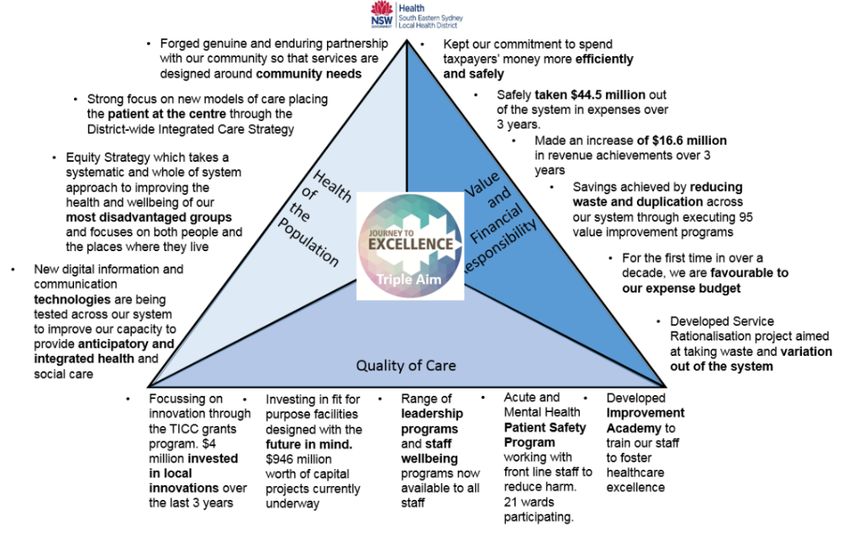
SESLHD’s ADVANCING SURGICAL SERVICES

TABLE OF CONTENTS
EXECUTIVE SUMMARY ................................................................... 3
BACKGROUND ................................................................................ 4
SESLHD’S STRATEGY 2018 - 2021 ................................................... 5
ONGOING NEED FOR CHANGE ...................................................... 6
WHAT WE’VE ACHIEVED ................................................................ 7
WHAT’S UNDERWAY ...................................................................... 9
WHAT ELSE WE’LL DO ...................................................................11
NEXT STEPS .................................................................................. 15
CONSULTATION ........................................................................... 15
ENDORSED ................................................................................... 15
APPENDIX ..................................................................................... 16

                                                                                    Page 2 of 18
SESLHD’s ADVANCING SURGICAL SERVICES
EXECUTIVE SUMMARY
More than 56,000 procedures were performed in South Eastern Sydney Local Health District
(SESLHD) in 2016/17. This surgical activity included nearly 34,000 elective and more than 23,000
emergency procedures, across five hospitals - Prince of Wales Hospital (POWH), Sydney / Sydney
Eye Hospital (SSEH), St George Hospital (SGH), The Sutherland Hospital (TSH) and the Royal
Hospital for Women (RHW).
This activity is projected to increase due to population growth and aging, while changing models of
care, new technologies and interventions will also impact on the delivery of surgical services.
To address this demand SESLHD’s Surgical, Anaesthetic and Perioperative Committee has
prepared this Plan identifying some key projects emphasising:
Improving and enhancing surgical services
Optimising patient care
Fostering safety and
Continuing to focus on equity.
As such the Plan is aligned with SESLHD’s Journey to Excellence Strategy 2018 – 2021.
The SESLHD Clinical Stream Committee – Surgery Peri operative and Anaesthetic Services will
be responsible for the implementation of this Plan in keeping with their role1 to:
Support safe and high-quality patient care, including consistency of quality clinical
outcomes across the LHD:
Lead Service Rationalisation projects by coordinating district wide involvement and
spreading local innovations
Improve equity of outcomes, equity of access and quality across the district at an
international, best practice level
Ensure consistent performance across the District
Lead strategic direction and service planning
Develop and assist implementation of Models of Care
Translate research and innovation
Drive quality and safety
Coordinate responses to the Pillars
Coordinate standardisation of relevant policies and guidelines
Promote standardisation
Reduce unwarranted clinical variation
Provide advice and recommendations regarding the best use and resourcing of medical
workforce across the district
Support site based quality and improvement projects
Improve the quality of care including policy and procedures, clinical pathways and assisting
with redesign of services/processes to improve efficiency, efficacy, access and safety.
1 SESLHD, 2017, Clinical Governance Framework
Page 3 of 18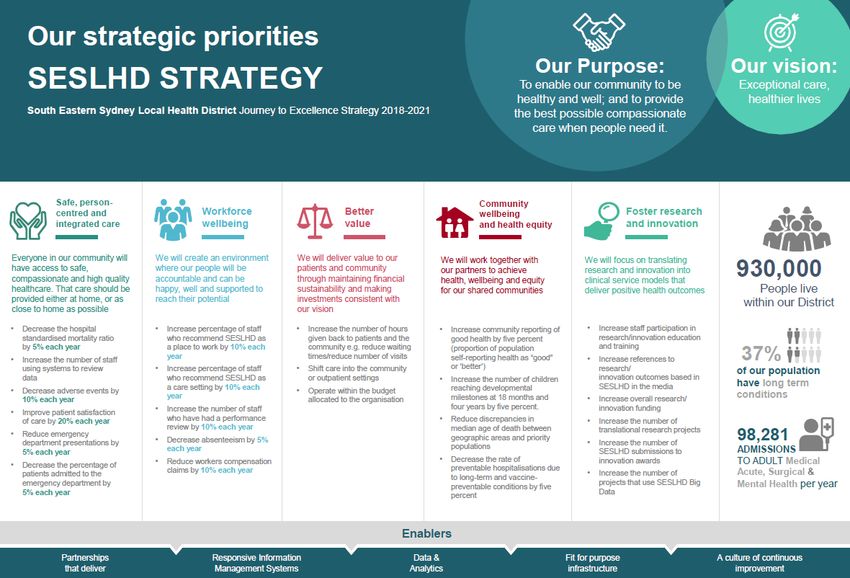
SESLHD’s ADVANCING SURGICAL SERVICES
BACKGROUND
STRATEGIC CONTEXT
SESLHD Roadmap to Journey to Excellence 2018 -
SESLHD Surgical,
Excellence 2014 - 2017 2021
Perioperative and Anaesthetic
Services Clinical Services Plan The Roadmap reflected the After three years of reform
2013 - 2018 pursuit of excellence in and steady improvement on
improving the health of our the “road to excellence”,
The Surgical Plan provided the communities. SESLHD is beginning a new
strategic direction for a five chapter working to empower
year period. It focused on The Journey was developed communities to optimise their
surgical sub-specialities, around the Triple Aim health and wellbeing.
activity and capacity as well as framework prioritising:
models of care. Quality of care SESLHD knows if we do not
Health of the population fundamentally change the
While the timeframe for the Value and financial way we do business, we will
plan was to 2018, projected sustainability. continue on an unsustainable
activity was through to 2021. path of increasing demand for
Major gains have been hospital services, hospital
It is timely to review what has achieved in all three aims beds, community services,
been achieved across surgical (diagram below). with more expenditure
services and identify the next delivering inequitable health.
steps.
On the next stage of its
Journey to Excellence,
SESLHD is starting its most
ambitious stage of
transformation.
SESLHD’s Journey to Excellence: Gains 2014 - 2017
Page 4 of 18
SESLHD’s ADVANCING SURGICAL SERVICES

SESLHD’S STRATEGY 2018 -
2021
        OUR PURPOSE                                  OUR VISION
  To enable our community to be healthy and well;   Exceptional care, healthier lives
  and to provide the best possible compassionate
             care when people need it.

                                                                               Page 5 of 18
SESLHD’s ADVANCING SURGICAL SERVICES

ONGOING NEED FOR
CHANGE
WHY IT’S IMPORTANT
INCREASING DEMAND FOR             EVIDENCE-LED DECISION             manage within financial
SURGICAL SERVICES                 MAKING                            constraints.

Population increases result in    Internationally, nationally and   Continuing to deliver high
more people requiring             locally there is a plethora of    quality health care in this
surgery.                          new and evolving models of        environment requires an
                                  care, interventions and           ongoing focus on improving
Yet, there remains a shortfall                                      value.
                                  technologies.
of surgical beds, operating
theatres and support services     Filtering ‘what works’ requires
across SESLHD.                    ongoing review using              UNWARRANTED CLINICAL
                                  evidence-led decision making.     VARIATION
CHANGING MODELS OF                This approach enables             Unwarranted clinical variation
CARE AND NEW                      ongoing implementation of         by definition is ‘variation that
TECHNOLOGIES AND                  quality of surgical services.     cannot be explained by the
INTERVENTIONS                                                       condition or the preference of
                                                                    the patient; it is variation that
This growing demand is            MORE PEOPLE WITH                  can only be explained by
partially offset by the           MULTI-MORBIDITIES                 differences in health system
introduction of new               As people age they are more       performance.’
interventions and technology      likely to have multi-
and changing models of care       morbidities.                      It can reduce safety, quality,
leading to many patients                                            performance effectiveness
having improved recovery          Patients requiring surgery who    and efficiency outcomes.
time and shorter length of        have multiple conditions may
stay.                             require a multifaceted
                                  approach to their care – prior    EQUITY
Continuous change is              to admission, during their
inevitable and not always                                           While SESLHD has some of
                                  hospital stay and post-
predictable.                                                        the healthiest people in NSW,
                                  operatively.                      not all residents fare equally
                                  Without this approach their       well in terms of their health,
TIMELY ACCESS TO                  multiple conditions may be        wellbeing and longevity.
SURGERY                           unnecessarily exacerbated         “Where systematic differences
Most surgery in SESLHD is         with a longer hospitalisation     in health are judged to be
planned, meaning patients         and recovery.
                                                                    avoidable by reasonable
must be on a waiting list.                                          action they are, quite simply,
                                  DELIVERING BETTER                 unfair.”
Waiting too long for care,
either for surgery and /or pre-   VALUE                             Transforming our health
and post-operative clinics, can   Increasingly the health system    services to systematically
result in some patients’ health   is pursuing efficiencies to       improve equity will take time.
deteriorating and poorer
outcomes.

                                                                                      Page 6 of 18
SESLHD’s ADVANCING SURGICAL SERVICES
WHAT WE’VE ACHIEVED
There have been some important changes in surgical services over the past
five years.
OPHTHALMOLOGY REVIEW Comparing facility REVIEW OF TSH EYE
costing (e.g. clinical OUTPATIENT SERVICE
A Service Rationalisation
staffing, ward costs, etc.)
Project was established to Completion of the
Reviewing the
identify and investigate cost Ophthalmology review.
apportioning and
variances in ophthalmology TSH established the Eye
alignment of costs (e.g.
surgery across SESLHD with a Outpatient Clinic.
anaesthetics, social work,
secondary aim, reviewing
etc.)
efficiencies.
Ensuring appropriate CLINICAL CODING SHEETS
cost recovery
Sites included POWH, SSEH Participation in clinical coding
and TSH with the focus on lens Ensuring VMO payments
are claimed in the correct audits resulted in the
surgery due to the high development of ‘Clinical
year.
volume across SESLHD. Coding sheets’ to assist
clinicians to improve
This review resulted in a VASCULAR REVIEW documentation and maximise
number of recommendations Activity Based Funding (ABF)
being implemented. Similar to the ophthalmology
funding.
review, a Service
At SESLHD Surgical Stream Rationalisation Project
level these included: reviewed select vascular SURGICAL DASHBOARD
Conducting ABM Portal surgical activity to determine
Development of the Surgical
workshops to assist why SESLHD’s cost is higher
Dashboard on Qlik by the
clinicians interrogate than the state price and
Surgical Stream and SESLHD’s
data review clinical variations.
Business Intelligence
Considering using the Efficiency Unit (BIEU).
SSEH’s contract and The foci for the Project were
business rule across Major Reconstructive Vascular
The Dashboard is a ‘one stop
SESLHD Procedures Angioplasty,
shop’ which enhances
Ensuring private health Thrombectomy,
strategic and operational
insurance rebates are Embolectomy and vein
decision-making showing:
ligation and stripping
recovered Waitlist Management
performed at the POWH, SGH
Engaging with – current status
and TSH.
procurement team to Operating Theatre
establish a SESLHD wide Management –
SESLHD clinicians and local
price for prosthesis utilisation
including negotiating a performance managers were
engaged to review and verify Surgical data
better price for IOL-t. Median wait times
data.
Emergency Surgery
At the facility level Access Performance.
recommendations included: This review highlighted
significant variation in the
Reviewing models
price of prosthetics, leading to
including on-call service,
Project Beacon and other
anaesthetic and
recommendations detailed in
outpatient
‘What’s underway’.
ophthalmology clinic
Page 7 of 18SESLHD’s ADVANCING SURGICAL SERVICES
INTERLUMINAL SURGERY Cataract 2nd Eye OPD Intravenous Opioid Pain
HYBRID MODEL AT SGH Clinical Pathway Protocol Learning
Cholecystectomy Clinical Package
Completion of a interluminal Pathway Observations for Total
surgery hybrid operating
Elective Hip and Complete
model at SGH that enhances Thyroidectomy
Replacement Clinical
the level 1 trauma
Pathway PACU Discharge Criteria.
department, neurosurgery,
Elective Knee
vascular, cardiothoracic and
Replacement Clinical
gynaecology service. CLINICAL SAFETY
Pathway
Laparoscopic Appendix
CHECKLISTS
REVIEW OF LOW VOLUME Clinical Pathway Development of SESLHD
HIGH COMPLEXITY Omalizumab Clinical Level 1, 2 and 3 clinical safety
PROCEDURES Pathway checklists, and reports on
Unilateral Hernia Repair compliance to policy.
SESLHD conducted an audit Clinical Pathway
and review of low volume high Vedolizumab Clinical
complexity surgery (including FASTER ROLLOUT OF NEW
Pathway
Oesphagectomies,
Administration of
MODELS OF CARE
Pancreatectomies and
Urokinase in Specific Established a committee
Gastrectomies), which was
Clinical areas- Guideline structure that encourages
developed into an
Community innovation to improve patient
Implementation Plan.
Catheterisation Guideline care through implementation
Fasting Guideline of evidence based models of
COMPLETION OF SESLHD Mobilisation Guideline care including:
CLINICAL PATHWAYS / Advanced Recovery Enhanced Recovery After
PROCEDURES GUIDELINES Orthopaedic Program Surgery (ERAS) at SGH
PHASE 1 (AROP) Elective Hip AROP at POWH.
Pathway
Developed guidelines, AROP Elective Knee
templates and process maps CONSTRUCTION OF SGH’S
Pathway
for documenting clinical Day Surgery Pathway
ACUTE SERVICES BUILDING
pathways including: Hand Surgery Pathway Construction and
Clinical Pathway Mastectomy Pathway commissioning of SGH’s Acute
Guideline Rapid Assessment and Services Building has been
Clinical Pathway Prediction Tool (RAPT) – completed. This new building
Example Templates AROP includes additional surgical
Clinical Pathway Process Acute Pain Management beds, operating theatres and
Map of Adults in the Post supporting infrastructure and
Cataract Day Procedure Anaesthetic Care Unit equipment.
Clinical Pathway (PACU)- Protocol
Cataract Pre-operative Gastrografin Prescribing
Procedure OPD Clinical Protocol
Pathway
Page 8 of 18SESLHD’s ADVANCING SURGICAL SERVICES
WHAT’S UNDERWAY
Some of the achievements of the past five years have generated more work that is
currently being implemented including:
IMPLEMENT
ONGOING ROLL-OUT OF CONTINUATION OF
RECOMMENDATIONS
SERVICE WAITLIST MANAGEMENT
FROM VASCULAR REVIEW
RATIONALISATION PHASE 2
Following the vascular review PROJECTS Well-managed waiting lists
a number of key PHASE 2 enable efficient and equitable
recommendations emerged.
Using the principles developed use of resources and minimise
in AROP the Stream will waste, inefficiency and
At SESLHD / Stream level
continue to roll out other duplication of services.
these include:
Investigating intrastate Service Rationalisation
Projects. OPERA, the State’s reporting
cost differences with
tool for waitlist data (replacing
Ministry of Health (MoH)
This entails reviewing select WILCOS), is continuing to be
Ensuring high cost implemented across SESLHD.
disposables are mapped groups to enhance recovery
to the correct cost bucket pathways supported by
education packages, clinical The Stream will:
Reviewing procurement Complete reconciliation
pathways and guidelines.
practices through with EDWARD
standardisation of pricing
Projects include: Develop a process map
and supplier negotiations
Rollout of AROP across for SESLHD
Implementing a
POW and TSH and POW Prepare user guides and
governance structure and
project evaluation training schedules
processes for contractual
Review of SESLHD-wide Conduct training in
agreements, tenders,
Oral Maxillofacial EDWARD and OPERA.
cost of prosthetics,
introduction of new Surgery
products, etc. Expand ERAS principles MONITORING CAPACITY
Ensuring private health to all specialities
insurance rebates are Investigate management Surgical Capacity meetings
of diabetic patients will continue to review
recovered.
having surgery operating theatre, bed, critical
Investigate metabolic care and support services
ADOPT A SESLHD-WIDE disorders and bariatric capacity.
APPROACH TO STAFF surgery.
EDUCATION In addition the Stream will use
SESLHD’s Surgical Dashboard
SESLHD’s approach to staff COLLABORATIVE CARE to routinely monitor the key
education, policies, ARRANGEMENTS indicators:
procedures and work health Waiting lists
There is ongoing
and safety ensures Median waiting times
consistency. consideration of the transfer
of some surgical services to Operating theatre activity
collaborative care Emergency theatre access
The Stream’s development of
arrangements (where public and
online learning packages
patients are treated in private Surgical admissions.
through My Health Learning
hospitals and/or by private
(formerly HETI) include:
providers).
Pain Protocol
OPERA.
Page 9 of 18SESLHD’s ADVANCING SURGICAL SERVICES
SURGICAL NETWORKING Fractured Hip Pathway CLINICAL SERVICE
TO MANAGE WAITING PACU Discharge PLANNING AT SGH
LISTS Guidelines
Clinical service planning is
Reviewing Mastectomy /
SESLHD is managing surgical underway for a proposed
Pathways
activity through the transfer of redevelopment at SGH
Reviewing Gynaecology
patients between facilities. including High Volume Short
Surgical Pathways
Stay Surgery.
Venous
This includes establishing a
thromboembolism (VTE)
networked waitlist model
assessment tool. INFORMATION SHARING
where 786 patients have had
an inter-hospital transfer to The Stream will continue to
reduce their length of time on EXPANSION OF THE have a key role sharing
the waitlist. SURGICAL DASHBOARD information including:
Close collaboration with
Expansion of SESLHD’s
CEC, ACI, My Health
EXPANSION OF SESLHD Surgical Dashboard: a one
Learning and Bureau of
CLINICAL PATHWAYS stop electronic platform for
Health Information (BHI)
PHASE 2 policies and procedures to
Review of policies,
include links to:
Development of guidelines, procedures and guidelines
Clinical Pathways
templates and process maps to ensure safe, high
Clinical coding sheets quality services
for documenting clinical
disseminated across
pathways by the Stream will Ensure support
SESLHD on the Surgery
include: mechanisms in place to
Sharepoint
Gastrograffin Guideline allow adoption of new
Clinical Excellence policies
AROP Anaesthetic Commission (CEC)
Guideline Disseminate information
websites
Day only Assist sites implement
Agency for Clinical
Cholecystectomy new policies, guidelines
Innovation (ACI) websites
Day only Hernia Repair and procedures
MoH website including
Day only Reflux Surgery Collaborate with the sites
Surgical KPIs.
ERAS Framework Hospital Executive,
ERAS - Bowel Resection Coders, Performance
with Stoma MEETING TARGETS Units, Finance Units
ERAS- Bowel Resection Clinical Councils, Surgical
Regular review of Service Heads of Departments,
without Stoma Level Agreement, then and BIEU.
ERAS- Closure of developing plans to ensure
Colostomy targets are met e.g. Hospital
ERAS- Closure of Acquired complications,
Ileostomy Potentially Preventable
ERAS - Endoluminal Hospitalisations, etc.
Repair of Abdominal
Aortic Aneurysm
ERAS- Femoral Popliteal CAPITAL PLANNING AT
Bypass Surgery POWH
ERAS- Gastrectomy Detailed capital planning is
ERAS- Minimally Invasive proceeding at POWH for a
Oesphagectomy major redevelopment
ERAS- Nephrectomy including new operating
ERAS- Open theatres and extra beds with
Oesphagectomy construction due to
ERAS – Trans Urethral commence in 2018.
Resection of the
Prostrate ( TURP)
Page 10 of 18SESLHD’s ADVANCING SURGICAL SERVICES
WHAT ELSE WE’LL DO
The landscape of surgical services will continue to be transformed by new surgical techniques,
technological changes, innovative models of care, etc. Based on these and other developments,
the list of projects below is not necessarily complete. Instead the intent is to outline known projects
while leaving sufficient scope to adapt and include others which respond to the inevitable changes
in the environment.
IMPROVE & ENHANCE SURGICAL SERVICES
ONGOING SERVICE COMPARISON OF ROBOTIC THEATRES
RATIONALISATION SURGICAL SERVICES Robotic surgery is minimally
The Service Rationalisation There are numerous data invasive surgery involving the
Project reviews existing sources which can be used to use of a computer to control
clinical services and processes compare and monitor surgical instruments attached
in relation to value, variation. to robotic arms enabling
effectiveness and efficiency precise and delicate
and facilitates the Over the life of this Plan the procedures with only small
identification of service Stream, in partnership with incisions.
development opportunities BIEU and hospitals’
including new models required Performance and Finance The Stream will investigate
to promote effective service Units, will monitor SESLHD’s opportunities for robotic
provision within SESLHD. Surgical Dashboard, Activity theatres.
Management Portal, National
Over the next three years the Portal, etc. to safely reduce
ROLLOUT OF hTRAK
Stream will work with variation and ensure best
clinicians across all specialities practice health care. Implementing bar code
to review surgical services scanning of all surgical
with the aim to improve products at POWH and RHW
service delivery in line with
NEW INTERVENTIONS commenced in 2016/17.
international best practice. ASSESSMENT PROCESS
(NIAP) This rollout will save money by
REVIEW THEATRE SESLHD is committed to automating purchasing and
UTILISATION ensuring all new interventions, inventory management for
ACI’s Operating Theatre interventional procedures, operating theatres and
Efficiency Guidelines provides technologies and treatments procedure rooms.
recommendations on are subject to appropriate
processes that can be review and assessment prior Over the next three years this
employed to enhance to their introduction into system will be rolled out to
operating theatre efficiency clinical practice. TSH, SSEH and SGH.
while maintaining a high
standard of care. The Stream will assess NIAP
applications for surgical
The Stream will continue interventions prior to
assisting the hospitals adopt submission to the District
these guidelines. Clinical and Quality Council.
Page 11 of 18SESLHD’s ADVANCING SURGICAL SERVICES
PROJECT BEACON METABOLIC DISORDERS / INTRODUCE EMR
(PROCUREMENT REVIEW) BARIATRIC SURGERY (ELECTRONIC MEDICAL
Project Beacon focuses on two The increasing incidence and
RECORD)
procurement work streams: prevalence of obesity and the eMR is a state-wide,
sourcing and sustainability. resulting comorbidities is well comprehensive electronic
known. medical record.
The aim of this project is to
deliver sustainable cost The Stream will collaborate to SESLHD is progressively
savings across SESLHD develop an expression of implementing it to support
without compromising clinical interest investigating patient care including an alert
and service quality, while metabolic disorders and the for patients at risk of
supporting the development role and implications of developing VTE.
of procurement capability and providing bariatric surgery in
capacity. SESLHD. Currently eMR has been
introduced at POWH with it
In 2017/18 procurement being implemented at SGH,
sourcing will generate
INTRODUCE eMEDS
TSH and SSEH in coming
significant savings across (ELECTRONIC MEDICATION years.
three categories: MANAGEMENT)
Cardiovascular eMeds is improving the
Orthopaedics Trauma quality, safety and
Orthopaedics effectiveness of medication
Reconstructive. management across NSW
hospitals.
This has potential to expand
to other specialities. This will benefit the surgical
stream as it includes providing
support for staff to prescribe,
order, check, reconcile,
dispense and record the
administration of medicines.
SESLHD will implement
eMeds during the life of this
Plan.
Page 12 of 18SESLHD’s ADVANCING SURGICAL SERVICES
OPTIMISE PATIENT CARE
OSTEOPOROSIS
UTILISE SESLHD ERAS ADVANCED RECOVERY
REFRACTURE PREVENTION
FRAMEWORK ORTHOPAEDIC PROGRAM
(ORP)
ERAS optimises the patient’s
(AROP)
condition for surgery and Another LBVC project is ORP.
The introduction of AROP is
recovery. In particular, the aim The model is designed to
aimed at providing best
is to achieve an earlier provide best practice care of
practice management for
discharge from hospital for the osteoporosis for people over
patients undergoing elective
patient and a more rapid the age of 50 who experience
Hip and Knee Replacement
resumption of normal a minimal trauma fracture.
surgery.
activities after surgery,
without an increase in The model of care accelerates
It will change the current
complications or the diagnosis and optimal
model of care by improving
readmissions. clinical management of
the recovery pathway based
osteoporosis in people who
on enhancements in surgical
The Stream has established an are at high risk of sustaining
techniques, combined with an
ERAS framework to assist minimal trauma refractures
evolving understanding of
broadening the adoption of with care that is driven,
perioperative care and the
ERAS principles across all coordinated and provided by a
coordination of multiple
specialities. Refracture Liaison
individual elements of patient
Coordinator.
care into an optimized
multimodal approach.
OSTEOARTHRITIS CHRONIC The Stream will support
CARE PROGRAM (OACCP) The Stream will support the
implementation of this model.
The OACCP, an initiative expansion of AROP from
under Leading Better Value POWH to TSH. BUILD RELATIONS WITH
Care (LBVC), was developed in EXTERNAL PROVIDERS
response to long waitlists for
EXPAND Ongoing collaboration with
elective hip and knee
replacement surgery,
MULTIDISCIPLINARY NSW MoH, ACI, My Health
proliferation of those with HEALTH CARE Learning, CEC, Central &
poorly controlled or assessed Eastern Sydney PHN and
Surgery for people with
comorbidities, and many on other Local Health Districts is
comorbidities has been shown crucial for sharing knowledge,
the waiting list who would to lead to better outcomes if
benefit from conservative care and investigating new
provided as multidisciplinary
options. initiatives.
care, both between specialties
and disciplines, e.g.
The model looks at a orthogeriatrics, pre- RESEARCH
coordinated, multidisciplinary habilitation, pre –operative
approach, utilising The Stream will review
assessment for frailty, etc.
conservative care options such research and publications of
as weight reduction, exercise various services with a view to
The Surgical Stream will
programs, education, providing support.
continue to work with other
pharmacological pain Clinical Streams to expand
management, rheumatology multidisciplinary health care.
clinics etc.
The Stream will support
implementation of this model.
Page 13 of 18SESLHD’s ADVANCING SURGICAL SERVICES
FOSTER SAFETY
LEADING BETTER VALUE
PILOT NSQUIP
CARE (LBVC)
American College of Surgeon’s
The LBVC Program seeks to National Surgical Quality
identify and implement Improvement Program
opportunities for delivering (NSQUIP) is an effective tool
better value care to the people to help hospitals measurably
of NSW within the context of improve surgical patient
the Institute for Healthcare outcomes.
Improvement’s Triple Aim
(health of a population, POWH is a pilot site for
experience of care and the NSQUIP enabling
cost per capita). international comparisons so
POWH can develop quality
The Stream will foster projects to meet best practice.
ongoing partnerships with
other clinical Streams and Funding is provided through
specialities to support this to 2018/19.
Program.
CONTINUE FOCUS ON EQUITY
RURAL PEOPLE ACCESSING ACCESS OF ABORIGINAL INTERPRETER SERVICES
CARE PEOPLE TO SURGICAL An estimated 19% of
Rural and regional patients
SERVICES SESLHD’s surgical patients do
have the right to expect Aboriginal and Torres Strait not speak English at home.
appropriate access to high Islander people have higher
quality surgical services rates of hospitalisation and Therefore interpreter services
according to their needs, of a higher rates of many diseases are essential for
quality comparable to that but are less likely than non- communicating effectively
available in metropolitan Aboriginal people to access with many patients.
areas. common surgical procedures
(e.g. cataracts and joint In addition the Stream is
SESLHD has a range of replacements) to treat or developing:
tertiary and quaternary manage a range of conditions. Training videos for junior
surgical services providing an medical officers
important role in caring for The lower procedure rates Online patient
people from regional, rural may be due to a number of information booklet in
and remote NSW. factors including recording of eight languages for
Aboriginality. anaesthetic care.
This care is dependent on
providing pathways for This means there is an
escalation of urgent care, de- ongoing need for clinicians to
escalation and back transfer, confirm identification of
clinical continuity and Aboriginal people is correct.
supporting regional and rural
clinicians in managing patients
with chronic / complex illness.
Page 14 of 18SESLHD’s ADVANCING SURGICAL SERVICES
NEXT STEPS
ONGOING REVIEW
ANNUAL REVIEW 3 YEAR PLAN
The Stream will monitor
Each year this Plan will be Continue to increase
progress of projects as part of
formally reviewed, progress engagement with clinical
monthly Stream meetings.
evaluated noting any changes services across the district,
to projects timeframes, scope, leading and supporting on a
As opportunities arise the
etc. range of quality and
Stream will showcase projects
improvement work, such as
across SESLHD, NSW,
This review will be the Service Rationalisation
nationally and internationally.
summarised in a short report Projects, service planning
and presented to the Stream, initiatives and model of care
Surgical Heads of Department reviews.
and Hospital’s Clinical Council
for Further expand the
Dissemination to relationships with clinical
clinicians services, integrated care
Highlight achievements models and facilities which will
Receive feedback on improve understanding on the
upcoming projects. type of work the streams can
lead and offer support on.
In 2021, the Plan will be
reviewed and projects will be
identified for inclusion in a
new strategic plan.
CONSULTATION
SESLHD Clinical Stream Committee- Surgery Perioperative &Anaesthetics
SESLHD Surgical Heads of Department
SESLHD Anaesthetic Directors
SESLHD Clinical Nurse Consultant and Clinical Nurse Educators Working Group
SESLHD Clinical Advisory Committee
SESLHD Executive Council
ENDORSED
SESLHD Quality & Clinical Council
Page 15 of 18SESLHD’s ADVANCING SURGICAL SERVICES
APPENDIX
SESLHD’S SURGICAL ACTIVITY
SESLHD’S PLANNED SURGICAL INPATIENT ACTIVITY BY HOSPITAL, 2012/13 - 2016/17
Values Hospital Name 2012/2013 2013/2014 2014/2015 2015/2016 2016/2017 Trend Change
Separations Prince of Wales Hospital 11,271 11,350 11,402 11,350 11,309 38
Royal Hospital for Women 2,467 2,732 2,742 2,622 2,662 195
St George Hospital 9,422 9,652 9,940 9,871 10,724 1,302
Sutherland Hospital 5,579 5,291 5,626 5,564 5,646 67
Sydney/Sydney Eye Hospital 8,096 8,285 8,400 8,261 8,750 654
Total Separations 36,835 37,310 38,110 37,668 39,091 2,256
Bed Days Prince of Wales Hospital 57,269 55,429 57,526 61,082 57,170 -99
Royal Hospital for Women 7,793 8,560 9,151 8,332 8,825 1,032
St George Hospital 61,435 58,406 61,785 61,908 64,359 2,924
Sutherland Hospital 22,194 19,483 21,557 20,365 22,590 396
Sydney/Sydney Eye Hospital 12,057 12,916 13,110 12,452 12,897 840
Total Bed Days 160,748 154,794 163,129 164,139 165,841 5,093
ALOS (Days) Prince of Wales Hospital 5.1 4.9 5.0 5.4 5.1 0.0
Royal Hospital for Women 3.2 3.1 3.3 3.2 3.3 0.2
St George Hospital 6.5 6.1 6.2 6.3 6.0 -0.5
Sutherland Hospital 4.0 3.7 3.8 3.7 4.0 0.0
Sydney/Sydney Eye Hospital 1.5 1.6 1.6 1.5 1.5 0.0
Total ALOS 4.4 4.1 4.3 4.4 4.2 -0.20
NWAU 17 Prince of Wales Hospital 29,728 29,455 30,916 31,855 31,092 1,364
Royal Hospital for Women 3,630 4,114 4,247 3,846 4,292 662
St George Hospital 30,983 30,585 31,661 31,834 32,847 1,865
Sutherland Hospital 10,432 9,654 10,602 10,124 11,066 634
Sydney/Sydney Eye Hospital 6,019 6,402 6,436 6,359 6,705 686
Total NWAU 17 80,792 80,210 83,862 84,018 86,004 5,212
Ave NWAU 17 Prince of Wales Hospital 2.64 2.60 2.71 2.81 2.75 0.11
Royal Hospital for Women 1.47 1.51 1.55 1.47 1.61 0.14
St George Hospital 3.29 3.17 3.19 3.23 3.06 -0.23
Sutherland Hospital 1.87 1.82 1.88 1.82 1.96 0.09
Sydney/Sydney Eye Hospital 0.74 0.77 0.77 0.77 0.77 0.02
Total Ave NWAU 17 2.19 2.15 2.20 2.23 2.20 0.01
PEM 17 Prince of Wales Hospital 31,717 31,485 33,286 34,149 33,686 1,969
Royal Hospital for Women 4,017 4,557 4,696 4,231 4,734 717
St George Hospital 33,489 32,946 34,188 34,323 35,507 2,018
Sutherland Hospital 11,788 10,813 11,889 11,355 12,416 628
Sydney/Sydney Eye Hospital 6,794 7,267 7,239 7,051 7,470 675
Total PEM (NWAU 17) 87,805 87,068 91,298 91,108 93,812 6,007
Av PEM 17 Prince of Wales Hospital 2.81 2.77 2.92 3.01 2.98 0.16
Royal Hospital for Women 1.63 1.67 1.71 1.61 1.78 0.15
St George Hospital 3.55 3.41 3.44 3.48 3.31 -0.24
Sutherland Hospital 2.11 2.04 2.11 2.04 2.20 0.09
Sydney/Sydney Eye Hospital 0.84 0.88 0.86 0.85 0.85 0.01
Total Ave PEM (NWAU 17) 2.38 2.33 2.40 2.42 2.40 0.02
Based on ABF Service Type Code of Acute Planned Surgery, Acute Other Surgery, Acute Procedural
PEM is Public Equivalent Model, it is a National Weighted Activity Units (NWAU) without the application of private patient status discounts
Note: The number of separations do not equal the number of procedures identified in the this Plan as the number of procedures includes those performed on non-
admitted patients plus some inpatients have multiple operations
Page 16 of 18SESLHD’s ADVANCING SURGICAL SERVICES
SESLHD’S PLANNED SURGICAL INPATIENT SEPARATIONS BY SERVICE RELATED GROUP, 2016/17
Values SRG V4 Code and Name POW RHW SGH TSH SSEH Total
Separations 11 Cardiology 26 41 25 2 94
12 Interventional Cardiology 1,432 816 559 1 2,808
15 Gastroenterology 317 2 542 323 40 1,224
16 Diagnostic GI Endoscopy 698 1 566 360 70 1,695
17 Haematology 28 51 1 80
18 Immunology and Infections 3 5 8
21 Neurology 63 25 8 96
22 Renal Medicine 23 20 2 45
24 Respiratory Medicine 210 397 145 12 764
26 Pain Management 17 8 25
27 Non Subspecialty Medicine 3 13 4 20
41 Breast Surgery 104 105 278 17 504
42 Cardiothoracic Surgery 478 1 369 13 861
43 Colorectal Surgery 419 9 680 218 9 1,335
44 Upper GIT Surgery 418 8 535 236 1,197
46 Neurosurgery 734 341 8 23 1,106
47 Dentistry 49 34 10 93
48 ENT & Head and Neck 366 267 272 165 1,070
49 Orthopaedics 2,364 2 1,101 1,357 2,122 6,946
50 Ophthalmology 221 11 245 5,600 6,077
51 Plastic and Reconstructive Surgery 779 9 453 110 358 1,709
52 Urology 967 8 1,328 568 2,871
53 Vascular Surgery 389 6 392 119 13 919
54 Non Subspecialty Surgery 992 60 1,217 662 326 3,257
61 Transplantation 50 50
62 Extensive Burns 1 1 2
63 Tracheostomy 94 171 55 320
71 Gynaecology 13 2,330 991 309 3,643
72 Obstetrics 4 2 1 7
73 Qualified Neonate 5 2 7
75 Perinatology 115 115
82 Psychiatry - Acute 5 5
99 Unallocated 51 2 59 17 9 138
Total Separations 11,309 2,662 10,724 5,646 8,750 39,091
Based on ABF Service Type Code of Acute Planned Surgery, Acute Other Surgery, Acute Procedural
Page 17 of 18SESLHD’s ADVANCING SURGICAL SERVICES
SESLHD’S PLANNED SURGICAL INPATIENT BED DAYS BY SERVICE RELATED GROUP, 2016/17
Values SRG V4 Code and Name POW RHW SGH TSH SSEH Total
Bed Days 11 Cardiology 353 457 273 12 1,095
12 Interventional Cardiology 5,852 3,592 1,663 12 11,119
15 Gastroenterology 1,736 10 2,643 1,750 76 6,215
16 Diagnostic GI Endoscopy 1,182 2 1,499 891 89 3,663
17 Haematology 371 851 7 1,229
18 Immunology and Infections 27 53 80
21 Neurology 424 294 46 764
22 Renal Medicine 260 165 63 488
24 Respiratory Medicine 1,481 2,992 1,317 60 5,850
26 Pain Management 74 8 82
27 Non Subspecialty Medicine 13 94 43 150
41 Breast Surgery 137 278 421 21 857
42 Cardiothoracic Surgery 6,037 8 3,974 57 10,076
43 Colorectal Surgery 2,963 116 6,811 1,206 9 11,105
44 Upper GIT Surgery 3,326 42 3,803 957 8,128
46 Neurosurgery 5,598 3,415 49 24 9,086
47 Dentistry 69 46 12 127
48 ENT & Head and Neck 709 536 303 167 1,715
49 Orthopaedics 11,122 6 9,866 7,137 2,682 30,813
50 Ophthalmology 283 13 275 8,456 9,027
51 Plastic and Reconstructive Surgery 2,135 52 1,685 209 695 4,776
52 Urology 2,132 16 2,522 1,089 5,759
53 Vascular Surgery 2,394 12 2,689 805 45 5,945
54 Non Subspecialty Surgery 4,451 224 6,504 1,726 553 13,458
61 Transplantation 722 722
62 Extensive Burns 12 9 21
63 Tracheostomy 2,747 6,198 1,901 10,846
71 Gynaecology 42 4,630 1,977 493 7,142
72 Obstetrics 14 9 3 26
73 Qualified Neonate 127 8 135
75 Perinatology 3,410 3,410
82 Psychiatry - Acute 5 5
99 Unallocated 518 5 1,101 286 17 1,927
Total Bed Days 57,170 8,825 64,359 22,590 12,897 165,841
Page 18 of 18You can also read


