Advocacy: Your Voice Matters Judith Ursitti, CPA, Director, State Government Affairs, Autism Speaks - YAI
←
→
Page content transcription
If your browser does not render page correctly, please read the page content below

Advocacy: Your Voice Matters Judith Ursitti, CPA, Director, State Government Affairs, Autism Speaks
YOU (YES YOU!) CAN BE AN ADVOCATE

Judith Ursitti, CPA
Director State Government Affairs
ADVOCACY GOALS
Increase global understanding and
acceptance of autism by
• Educating legislators and regulators on
  autism spectrum disorder to ensure
  policymaking benefits individuals across the
  spectrum.

                                            4
Be a catalyst for life-enhancing research
breakthroughs by
• Increasing funding for autism research at
  federal agencies, including the National
  Institutes of Health and the Department of
  Education.
• Reauthorizing the Autism CARES Act.
Increase early-childhood screening & timely
intervention by
• Ensuring that individuals with autism have
  access to the healthcare they need,
  irrespective of payer (Medicaid, private
  insurance, etc.).
                                         5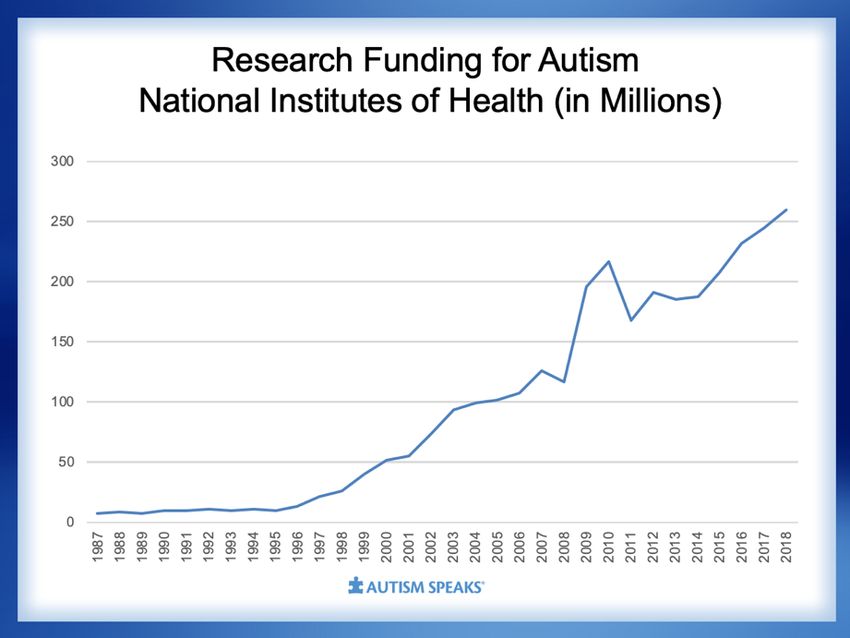
Improve outcomes for transition-age
youth across the spectrum by
• Increasing access to housing and
  community-based services (HCBS) for
  individuals.
• Improving the number of employment-
  focused training systems for individuals with
  autism as increased employment
  opportunities.
• Increasing equitable access to high-quality
  postsecondary education opportunities for
  students with autism.
                                              6
Improve outcomes for transition-age
youth across the spectrum by
• Expanding support for resources and
  practices that keep our community safe,
  including Kevin and Avonte's Law.
• Making ABLE accounts widely available.
• Ensuring staff across settings have
  appropriate training, particularly related to
  challenging behaviors, safety, sensory
  needs, and augmentative and alternative
  communication.

                                                  7
State Update

Medicaid Coverage
•In July, 2014, the Centers for Medicare and
Medicaid (CMS) provided clarification that
Medicaid should cover “medically necessary”
care for autism
•This coverage is required under the Early
Periodic Screening, Diagnosis and Treatment
(EPSDT) section of the federal Medicaid
statute
•EPSDT applies to individuals under the age
of 21

                                           9
•Starting in 2014, Autism Speaks and other
New York stakeholders began meeting with
•Governor’s Office
•Department of Health leadership
•Various legislators (Health Committee
Chairs)
•DOB
•Model state plan amendment language and
fiscal impact data were provided in the
meetings
10• Included in state budget in 2018
• Bills filed
• Included in Executive Budget in 2019
• Bills Filed
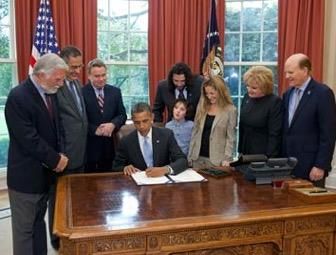
• VICTORY!! Included in final budget passed
by legislature on March 31, 2019
• Implementation work will begin immediately
with coverage in place by the beginning of
2020
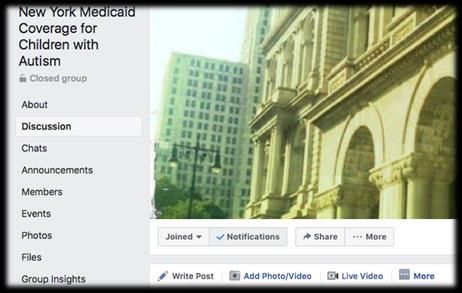
11•25,000 Medicaid-enrolled kids in New York are diagnosed with ASD •More than 40 states have already implemented coverage •Join our Facebook Group!
• CDPAP (Fiscal agent for self-directed
  care.)
• Autism Friendly Emergency Room
• Direct Care Wages
Federal Update
BUDGET
The administration’s fiscal year 2020 budget proposal eliminates
funding for key programs serving children and adults with autism.
This proposal includes cuts to special education technical
assistance and proposes to eliminate the supported employment
program within the Department of Education. Within the
Department of Health and Human Services, significant cuts are
proposed to Medicaid, which is the single largest source of health
care and long-term services and supports for people with autism.
Further cuts are proposed to Autism CARES activities at the Heath
Resources and Services Administration (HRSA). Since 2006, HRSA
has funded critical training, education and health care services for
people and families affected by autism. These activities are critical
in ensuring people with autism have access to personalized, quality
healthcare that addresses the many different medical complexities
associated with autism spectrum disorder.
Federal Efforts | Autism CARES

                                                        S.427 and H.R.1058
                                                                    Today
Combating    Combating Autism        Autism CARES Act
Autism Act   Reauthorization Act
                                          2014
  2006              2011

                                                                             18
Federal Efforts | Autism CARES
19Federal Update: Autism CARES Act
• Since 2006, significant scientific developments resulting from
Autism CARES initiatives have
▪ Established science for reliable diagnosis at 18 – 24 months;
▪ Established that timely intervention makes a lifetime of difference;
▪ Identified co-morbidities;
▪ Increased understanding of biological causes of autism;
▪ Identified genes and possible medication targets; and
▪ Developed early career autism researchers.
20Federal Update: Autism CARES Act
• Unless Congress acts,
portions of the law will sunset
on
• September 30, 2019.
• Ask for members this month:
Please support the Autism
CARES Act.
21Things I’ve learned …
•   March.
•   Make signs.
•   Make phone calls.
•   Make appointments.
•   Focus on solutions.
•   Be respectfully honest.
•   Follow through.
•   Stay on the high road.
•   Never, ever speak on behalf of others
    without their permission.
• You can’t know what everyone believes. • Be a leader or be a follower. The world actually needs both. Just make sure to maintain your convictions. • Ignore the trolls. • Get to know your own legislators and their staff. Yes. You. • Vote. Every time. • Read and watch various news sources. Get out of your echo chamber. • Let go of assumptions. Watch your ego. It can trip you up.
• Listen more. Argue less.
• Don’t forget the world is so much bigger
  than what you read on social media, hear
  in a classroom or discuss around your
  dinner table.
• Never give up. Change often takes time,
  but it is possible.
• And most of all, let all you do be guided by
  love. Love for your cause and love for your
  fellow man. It will fuel you through the
  journey.
Judith.ursitti@autismspeaks.org

www.autismspeaks.org/advocate
You can also read


