Alignment to HB 4 Training Requirements - Texas School Ready is a part of the Children's Learning Institute - CLI Engage
←
→
Page content transcription
If your browser does not render page correctly, please read the page content below
Texas School Ready is a part of the Children’s Learning Institute

Alignment to
HB 4 Training
Requirements

The Children’s Learning Institute at The University of Texas Health Science Center at Houston
   (UTHealth) was founded in 2003 and serves as the Texas State Center for Early Childhood
   Development. Currently, CLI impacts children, families, and teachers across Texas and the
country through our research, clinical programs, statewide early childhood initiatives, parenting
programs, and teacher mentoring programs. CLI has managed the implementation and ongoing
  enhancement of the Texas School Ready Project since 2003. To learn more about the Texas
             School Ready Project, visit our website: www.texasschoolready.org.

Texas School Ready Project
Children’s Learning Institute at UTHealth
7000 Fannin | UCT 1900 | Houston, TX 77030
childrenslearninginstitute.org | texasschoolready.org | cliengage.org

Find us on …

         Children’s Learning Institute
         CLI Engage

        @CLI_UTHealth
        @CLIengage
Texas School Ready - HB 4 Training Alignment

Overview
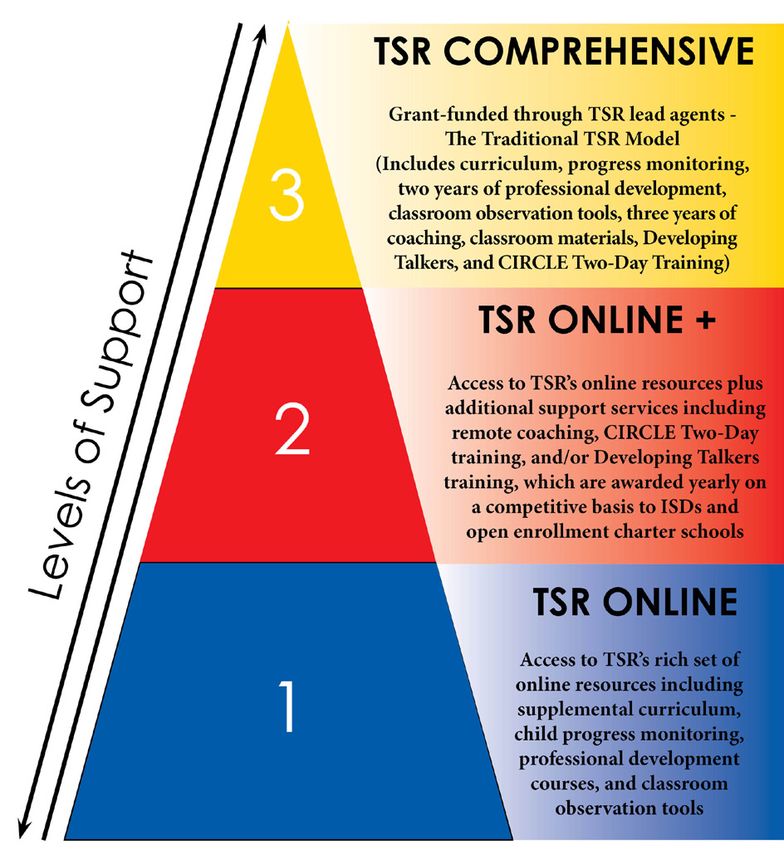
              Texas School Ready (TSR) is a comprehensive,
              3-tiered preschool teacher training program
              that combines ongoing professional
              development, child progress monitoring,
              teacher observation and goal-setting tools,
              and supplemental curriculum. Beginning
              in 2003, the traditional and most intensive
              tier, TSR Comprehensive, has served more
              than 25,000 preschool teachers from public
              schools, Head Start programs, and child
              care programs across the state of Texas.
              In collaboration with the Texas Education
              Agency, TSR’s electronic resources (TSR
              Online) became freely available to all Texas
              public school districts and charter schools at
              the start of the 2015-2016 school year.

              Throughout the history of our program, TSR
              has expanded and refined the training opportunities provided to participating teachers. TSR
              plans to continue this expansion and refinement of resources to ensure our tools provide
              the highest quality professional development to teachers preparing their students for
              kindergarten and success in school. The purpose of this document is to outline the alignment
              between HB 4 training requirements for prekindergarten teachers with past, current, and
              future TSR resources and participation. Specifically, this document details:

                  •   Training provided to TSR Comprehensive participants, past and present, and how this
                      training can be applied toward HB 4 training requirements;

                  •   Current eCIRCLE Professional Development provided through TSR Online, with
                      additional information for how districts can use the online resources to provide
                      face-to-face training; and

                  •   CLI’s new initiative to provide free training for teachers to receive their Child
                      Development Associate (CDA) Credential™.

HB 4 Rule Analysis and Application Guidelines
              The High Quality Prekindergarten Grant Program established by House Bill 4, 84th Texas
              Legislature, will allow districts and charters to receive funding for eligible prekindergarten
              students participating in high quality programs. TAC#102.1003e (proposed text) outlines
              the requirements teachers must meet in order to provide instruction in a high quality

© 2016 The University of Texas Health Science Center at Houston                                           Page 3
Texas School Ready - HB 4 Training Alignment

              prekindergarten program. In addition to being certified to teach in the state of Texas (under
              TEC Chapter 21, Subchapter B), each teacher must also have additional training or credentials
              in order for the program to qualify for funding. The application for the grant program specifies
              six mechanisms for satisfying the additional education requirements, including:
                  1. a Child Development Associate (CDA™) credential;
                  2. a certification offered through a training center accredited by Association Montessori
                     Internationale or through the Montessori Accreditation Council for Teacher Education;
                  3. at least eight years’ experience of teaching in a nationally accredited child care
                     program;
                  4. a graduate or undergraduate degree in early childhood education or early childhood
                     special education;
                  5. documented completion of the Texas School Ready Training Program (TSR
                     Comprehensive); or
                  6. be employed as a prekindergarten teacher in a school district that has ensured
                     that:
                            a. prior to assignment in a prekindergarten class, teachers who provide
                               prekindergarten instruction have completed at least 150 cumulative hours
                               of continuing professional education (CPE) over a consecutive five-year
                               period;
                            b. teachers who have not completed the required training prior to assignment
                               in a prekindergarten class complete the first 30 hours before the end of
                               the 2016-2017 school year and complete the additional CPE hours in the
                               subsequent four years in order to continue providing instruction in a high-
                               quality prekindergarten program classroom;
                            c. at least half of the training hours required above include experiential
                               learning, practical application, and direct interaction with master teachers
                               or instructional coaches; and
                            d. training used to meet the requirement above addresses all ten domains in
                               the Texas Prekindergarten Guidelines (updated 2015) in addition to other
                               relevant topics related to high-quality prekindergarten.

              This document details how the Texas School Ready training opportunities (past, current, and
              future) may be used by districts and charters applying to the high quality prekindergarten
              grant program to satisfy the additional teacher qualification requirements specified above.
              The TSR resources specifically align well with options 1, 5, and 6.

Past and Present TSR Comprehensive Participants
              TSR Comprehensive is a 3 year intensive teacher intervention that includes a core set of
              26 trainings (Table 1 - See Appendix) totaling 128.5 hours of professional development. An
              additional 8 courses, 35.75 hours, have also been made available to participants in given
              years (Table 2 - See Appendix).

© 2016 The University of Texas Health Science Center at Houston                                        Page 4
Texas School Ready - HB 4 Training Alignment
To date, more than 25,000 teachers have participated in TSR Comprehensive [previously
known as the Texas Early Education Model (TEEM) and Texas School Ready (TSR)], many
of whom were Texas public school teachers. Additionally, public school teachers who
participated in Texas School Ready through the Prekindergarten Early Start grant program
(PKES) may also qualify.
To help districts and charters satisfy H.B. 4 teacher training requirements (through option
5), the Children’s Learning Institute is able to verify participation in TSR Comprehensive
from 2008-present. Prior TSR Comprehensive teachers completing two or more years of the
program, who are unable to locate their CPE certificates for the training they received, will
be able to apply to the Children’s Learning Institute to receive a certificate verifying their
completion. More information about the process to request TSR completion certificates will
be posted at www.texasschoolready.org/hb4.
TSR Online: eCIRCLE Online Professional Development Opportunities
Through TSR Online, public and charter school teachers have the opportunity to earn
high quality training hours by utilizing CLI’s eCIRCLE courses library. The eCIRCLE Online
Professional Development represents more than 80 hours of online courses featuring
extensive video-based demonstrations of effective instructional practices, as well as
application-based assignments and activities. Courses are housed on CLI Engage, CLI’s
eLearning platform. CPE certificates are generated and stored on CLI Engage after successful
completion of a course. The courses were developed by the Children’s Learning Institute and
have been used by teachers participating in the TSR Comprehensive model for more than a
decade.
eCIRCLE Online Professional Development covers a broad range of topics aligned with the
Texas Prekindergarten Guidelines and include research-based key predictors of language
and literacy development. Courses are also offered in emerging areas of early childhood
instruction including science, technology, engineering, and math (STEM). A block of 5 courses
cover responsive instruction areas of study including classroom management, social and
emotional learning, Pre-kindergarten response to instruction, English Language Learners
and Understanding Special Needs. Leadership courses on effective use of data and coaching
practices are also included. (See the appendix for a description of each course.)
Customization of eCIRCLE Course Context
There are two main ways courses in the library can be delivered to teachers:
1. By default, all teachers enrolled in TSR Online have access to the self-instructional
version of eCIRCLE courses. This allows teachers to access the information on their
own, when they want/need to;
2. CLI Engage also offers a unique opportunity for school districts, charters, and
Education Service Centers to offer these same eCIRCLE courses through a facilitated
model that combines self-study with face-to-face activities and interactions with a
course facilitator or master teacher. This allows the content to be delivered in a more
customized manner, meeting the needs of the district and teachers.
© 2016 The University of Texas Health Science Center at Houston Page 5Texas School Ready - HB 4 Training Alignment
CLI has designed detailed facilitation guides for all of the online courses that delve deeper
into interactively exploring and processing the research and strategies. These guides are
provided at no cost to approved facilitators after a brief vetting process. The facilitator uses
the guides to chart a path for the cohort of participants. The following delivery models are
recommendations for school districts to consider when determining training plans from their
teachers to meet HB 4 training requirements using eCIRCLE courses:
Face-to-Face Sessions
This delivery model allows for participants to come together in a face-to-face setting and
participate in the courses as a group, covering one or two sections of each course. These
sessions are designed to be one-two hours in length and be held at regularly scheduled
intervals, such as weekly or every other week throughout the year. Activities for participants
to practice in the classroom between sessions are included.
Extended Face-to-Face Sessions
In this model, participants meet together for a full, six to eight hour day of professional
development and cover multiple sections of each course. These sessions may take place
during scheduled professional development days, on additional days set aside specifically
for eCIRCLE classes, release days, etc. As in the shorter face-to-face sessions, activities for
participants to implement in the classroom are included as part of the agenda.
Hybrid Sessions
The hybrid session combines a face-to-face session with additional assigned, self-paced
learning. The participants meet together face-to-face to cover one or two sections of the
course. At the end of the session, the facilitator assigns additional course sections to be
covered independently by the participants and completed by a specific deadline. The
face-to-face learning sessions are one or two hours in length and spaced out sufficiently to
allow participants ample time to complete the independent course work between sessions.
Self-Paced Courses
In this delivery model, no face-to-face sessions for participants are offered. The eCIRCLE
facilitator determines specific content to be covered and assigns it to participants for
independent study. A discussion board can be included in this model.
This set of resources will help districts applying for grant funding to meet the additional
training requirements (under option 6b-d) for teachers who do not have one of the other
credentials or 150 hours of training prior to becoming a prekindergarten teacher.
Utilizing TSR Professional Development
If your teachers do not have one of the additional credentials to qualify for the grant program,
they may also qualify by participating in high quality professional development opportunities.
© 2016 The University of Texas Health Science Center at Houston Page 6Texas School Ready - HB 4 Training Alignment
Through TSR Online, teachers at school districts and charter schools have an opportunity
to complete the required 30 hours of training (all aligned to the Texas Prekindergarten
Guidelines) for free during the 2016-17 school year. CLI Engage houses 15 eCIRCLE online
courses, used in TSR classrooms for over ten years; these courses have been proven to
improve teachers’ content knowledge in these important skill areas, and can be completed
self-paced or through facilitated sessions. Additionally, Texas school districts can apply for
their teachers to receive free CIRCLE Two-Day Training, a well-known face-to-face training
aligned to the Texas Prekindergarten Guidelines, through TSR Online+.
TSR Online+
All Texas school districts and charter schools are encouraged to apply for additional support
for their prekindergarten teachers through TSR Online+ through a competitive application
process. The TSR Online+ 2016-17 application will open in April 2016. Through funding from
the Texas Education Agency, the Children’s Learning Institute (CLI) provides the necessary
training and materials included as part of these additional support services at no cost, but CLI
does not reimburse public school districts or charter schools for the time or expense incurred
to receive these services. For 2016-17, school districts may apply for CIRCLE Two-Day Training,
a 15-hour face-to-face training in foundational early childhood concepts, in addition to other
services. School districts and charter schools that applied for the High Quality Prekindergarten
Grant Program will be prioritized for TSR Online+ awards.
Sample Training Plans
Below are several examples for your teachers to utilize TSR’s free trainings to meet the
grant program’s requirements, but the opportunities are not limited to these proposed
implementations. We encourage your district/charter to consider these sample training plans
and how TSR’s training options might fit into your district/charter’s established early release
days, waiver days, or new teacher academies.
Sample Training Plan 1
Teachers complete 15 hours of face-to-face training through the CIRCLE Two-Day Training,
and additional hours of online, self-instructional training using eCIRCLE courses to meet the
minimum requirement of 30 hours. (Your district/charter is encouraged to apply for your
teachers to receive free CIRCLE Two-Day Training through TSR Online+.) See Table 4 for more
information.
Sample Training Plan 2
Teachers complete 15 hours of face-to-face, facilitated training of eCIRCLE courses, using
free facilitation guides provided by TSR to your district/charter. Teachers will also complete
additional hours of online, self-paced training using eCIRCLE courses to meet the minimum
requirement of 30 hours. See table 5 for more information.
© 2016 The University of Texas Health Science Center at Houston Page 7Texas School Ready - HB 4 Training Alignment
CIRCLE CDA Training Program
Beginning in Fall 2016, TSR will offer the CIRCLE CDA Training Program to all TSR Online
participants. Through the CIRCLE CDA Training Program, preschool teachers can earn all 120
training hours needed to apply for the CDA-Preschool Endorsement for free. The CIRCLE
CDA Training Program utilizes eCIRCLE courses, supplemented with additional online courses
to fulfill all content knowledge required to successfully achieve a Child Development
Associate (CDA) Credential™. Like the eCIRCLE online courses, the CIRCLE CDA Training
Program could also be facilitated through face-to-face sessions using TSR-provided facilitation
guides. The CIRCLE CDA Training Program is being piloted in Spring 2016, the full set of
courses, facilitation, and supplemental guides will be available to all TSR Online users in fall
2016.
There is no cost to teachers participating in the CIRCLE CDA Training Program. However, each
teacher will be required to purchase the CDA Value Package with Preschool Competency
Standards Book. The book can be purchased from The Council for Professional Recognition
for $95. Also, each teacher will be responsible for submitting the non-refundable/non-
transferable application fee of $425 that must be submitted with the CDA application to the
Council for Professional Recognition.
Given the 150 training hour requirement outlined in HB 4, districts and teachers may opt to
complete the Child Development Associate Credential (option 1) to satisfy this requirement.
Course Descriptions
Teachers participating in the CIRCLE CDA Training Program will complete 80 hours of eCIRCLE
online professional development courses in the following areas: Foundations for Responsive
Instruction, School-wide Improvement, Early Language and Literacy Instruction, and STEM
Instruction. CDA Supplemental guides will accompany the existing eCIRCLE courses to ensure
that all of the required key topics areas for the CDA is covered.
CLI is currently creating 40 hours of new online courses to supplement eCIRCLE and prepare
teachers for the CDA in the following areas: Guidance, Health, Safety, Families, Physical
Development, Creative Arts, Program Management and Professionalism. All of these courses
align with the ten domains in the Texas Prekindergarten Guidelines (updated 2015); the
exception is Families and Professionalism which aligns with the foundational matter found in
the Texas Prekindergarten Guidelines.
Courses will be available as self-instructional and hybrid model classes with facilitation guides.
Hybrid model classes will allow for experiential learning, practical application, and direct
interaction with master teachers. The facilitation guides will be available with the courses in
the fall. Table 3 (See Appendix) details the courses for the CIRCLE CDA Training Program, the
CPE content areas, and alignments to the Texas Prekindergarten Guidelines domains and the
Core Competency areas.
© 2016 The University of Texas Health Science Center at Houston Page 8Texas School Ready - HB 4 Training Alignment
Appendix: Training and Course Descriptions
CIRCLE 2-Day Training
The CIRCLE 2-Day Teacher Training is a face-to-face introduction to the foundational,
research-based concepts underpinning the Texas School Ready project and the CIRCLE line
of professional development tools. The goal of the training is to provide a strong knowledge
base of early childhood development and quality instructional strategies that support it, so
that moving forward teachers feel comfortable exploring eCIRCLE online courses and the
CIRCLE Activity Collection on their own.
eCIRCLE: Letter Knowledge
Learning letters is a child’s first step toward developing early literacy skills and understanding
the concepts of reading and writing. The letters of the alphabet are a child’s window to the
world of written words and written expression; by exposing children to letters, you lead them
to understand that spoken thoughts and ideas can be communicated exactly the same way
in writing. They begin to understand that letters make sounds and combine to make words;
words combine to make sentences; and sentences, whether they are written or spoken,
communicate ideas. This course introduces key letter knowledge concepts, strategies, and
practices.
eCIRCLE: Phonological Awareness
Research tells us that young children who can hear the individual sounds in words generally
develop into good readers. Research has also shown that phonological awareness in Spanish
helps children develop phonological awareness skills in English. This course demonstrates
effective strategies for teaching this concept of phonological awareness and provides
examples of effective instructional strategies for teachers to develop meaningful phonological
awareness activities in both languages.
eCIRCLE: Building Vocabulary
Vocabulary instruction for pre-kindergarten children involves striking a balance between
making the most of every teachable moment and ensuring that the classroom and activities
are engaging, meaningful, and fun. This course introduces key vocabulary and early literacy
concepts, strategies, and practices. The course highlights CIRCLE’s philosophy on vocabulary
planning, themes, and activities appropriate for three- and four-year-olds.
eCIRCLE: Prekindergarten Response to Intervention
This course focuses on understanding Pre-kindergarten Response to Intervention (P-RTI).
It includes evidence-based instructional practices that support school readiness by using
a tiered model for providing instruction at increasing levels of intensity and measuring
children’s response to instruction. P-RTI frameworks can enhance existing practices with clear
decision- making criteria for evaluating instructional quality and the fit for each child.
© 2016 The University of Texas Health Science Center at Houston Page 9Texas School Ready - HB 4 Training Alignment
eCIRCLE: Read Alouds
Through read alouds in English and Spanish, children build essential language and literacy
skills while imagining other times and places, considering new concepts and ideas, and
following up on their interests and curiosity. Effective read alouds are critical to developing
literacy in young learners. Read alouds in early childhood classrooms require both planning
and practice, and research shows that the results are well worth the effort. By building read
alouds from the ground up—from selecting books in both languages through designing
book-related center activities—teachers ensure that their students will have an engaging,
meaningful and fun introduction to books, stories, and the written word. This course
highlights CIRCLE’s philosophy regarding the preparation and leadership of read alouds for
three- and four-year-olds.
eCIRCLE: Setting the State for Children’s Talk
Children’s talk, in many ways, sets the foundation for all the other teaching and learning that
takes place in a pre-K classroom. Through listening and talking, children explore ideas, form
understandings, solve problems, make decisions, and build relationships. Although children’s
ability to talk is often taken for granted, vibrant and articulate verbal communication skills
in both English and Spanish can be modeled, supported, scaffolded, and taught. This course
covers key written expression concepts and highlights CIRCLE’s philosophy on scaffolding talk.
eCIRCLE: Social and Emotional Learning
Social emotional skills are really important in terms of thinking about school success. Part of
what that means is for children to be able to sit still, listen to instructions, focus on activities,
have relationships with peers and their teachers. Social and emotional learning gives
children sense of self and purpose, and having a class community allows children to practice
positive relationships with teachers and other children. This course covers key strategies for
incorporating social and emotional learning into preK classrooms.
eCIRCLE: Classroom Management
Classroom management is as much about relationships as it is about routines; it is as much
about warmth and community as it is about structure. Research indicates that children in
classroom environments that are planful, playful, and purposeful begin to develop a lifelong
love of learning. The course highlights the design, structure, evolution, and management of
one teacher’s real preK classroom.
eCIRCLE: Written Expression
From their first attempts to control a crayon to the first time they express themselves with
conventional writing, a child’s journey through the stages of written expression is long,
complex, rich, and exciting. At the pre-K level, the goal of writing instruction is to introduce
children to why we write, when we write, and what we write, as much as how we write; to
help children begin to develop fine motor skills; and to help children understand that their
words, thoughts, and ideas can be communicated to others in writing. The overall goal of this
course is to understand the importance of written expression and how to foster children’s
written expression development.
© 2016 The University of Texas Health Science Center at Houston Page 10Texas School Ready - HB 4 Training Alignment
eCIRCLE: Discovering Early Childhood Science
Early childhood teachers have a unique opportunity to extend children’s natural curiosity
and passion for hands-on exploration by helping them to record and repeat investigations,
use tools for observation and measurement, and think more deeply about the physical
world. In turn, research demonstrates that science learning at the preschool level promotes
development in other domains, including language and literacy abilities, problem solving, and
reasoning skills. This course designed to introduce the foundations of science methods and
teaching science at the preschool level.
eCIRCLE: Early Childhood Mathematics
Young children have a natural curiosity about how the world works. They intuitively look
for ways to understand their material world as well as the world of ideas. In mathematics,
young children enjoy counting things, exploring shapes and patterns, sorting and organizing
collections, and comparing shapes and sizes. Early childhood teachers can build upon
this natural interest and provide systematic support for young children’s mathematical
development. This course highlights two basic strategies for providing mathematics
instruction in early childhood classrooms: 1) planning and implementing 10–15–minute,
focused mathematics lessons with small groups of children, and 2) seamlessly weaving
informal mathematics instruction into daily routines.
eCIRCLE: Effective Mentoring Strategies
This course is designed to prepare mentors for this extremely rewarding—and extremely
complex—role. Through a series of video examples and practice activities, this course will
introduce you to the key components of mentoring, as well as tools and strategies that will
help mentors guide teachers of varying levels of experience. The course highlights mentors
supporting early childhood teachers’ efforts to promote social-emotional development, early
literacy, and math and science skills.
eCIRCLE: English Language Learning
The population of ELLs in United States schools has increased dramatically during the last
two decades. One fifth of the school-age population speaks a language at home other than
English (U.S. Department of Education, 2003). By the year 2030, approximately 40 percent
of the population in U.S. schools will be comprised of language-minority students (Thomas
& Collier, 1997). This course is designed to help pre-K teachers meet the needs of this fast-
growing population. Topics include common program models used to serve ELLs, the impact
of sociocultural issues on the education of ELLs, the stages of language development and
second language acquisition, instructional strategies to support language development, and
the importance of family engagement, and strategies for building school- family partnerships.
eCIRCLE: Understanding Special Needs
In this course, you will learn about the types of children who might be identified as having
“special needs.” While there is a broad range of children who fall within the special needs
category, this course will focus on those children who struggle with their behavior, attention,
© 2016 The University of Texas Health Science Center at Houston Page 11Texas School Ready - HB 4 Training Alignment
emotional responses, or receptive and expressive language. Topics include characteristics
of the most common regulation difficulties and ways to evaluate and provide instruction to
children with special needs.
eCIRCLE: Leading School–wide Improvement
Center directors and principals of early education centers play a central role in identifying
professional development needs and ensuring access to needed resources. As advocates for
the school community, center directors and principals support mentoring efforts, establish
professionalism, and foster the implementation of new strategies at their schools and
centers. Putting into place an evaluation cycle that includes classroom observation around
instructional practices will help you sustain the benefits of your professional development
efforts and help you identify new areas for growth. This course uses introduces key concepts,
tools, and best practices for using classroom observation to identify the needs of your staff
and align your improvement plans with resources.
© 2016 The University of Texas Health Science Center at Houston Page 12Table 1. Training Hours for Past TSR Participants (2003-2013)
Title Type Hours of CPE(s) Pre-K Guidelines 2015 Core Competency Area(s)
Instruction
Two-Day CIRCLE Training 15 Instructional Language and Communication, Responsive interactions and Guidance(2), and
Training: Strategies Diversity/ Emergent Literacy Reading, Emer- Learning Environments, Planning Framework,
Special Populations gent Literacy Writing, Mathemat- Curriculum, and Standards(3), Skill Develop-
Best Practices
Language ics, Social and Emotional Develop- ment (4) - Language and Communication,
Development ment, Social Studies Emergent Literacy Reading and Writing,
Phonological Mathematics
Awareness
Mathematics
Book Reading
Written Expression
Letter Knowledge
Intentional Training 2 Instructional All domains Child Growth and Development (1), Respon-
Teaching and Strategies sive interactions and Guidance (2), and Learn-
Lesson Planning ing Environments, Planning Framework, Cur-
riculum, and Standards (3), Skill Development
(4) - Language and Communication, Emergent
Literacy Reading and Writing, Mathematics,
Science
Progress Training 8 School Leadership & All Domains Child Growth and Development (1), Respon-
© 2016 The University of Texas Health Science Center at Houston
Monitoring Administration-Data sive interactions and Guidance (2), and Learn-
Analysis ing Environments, Planning Framework, Cur-
riculum, and Standards (3), Skill Development
(4) - Language and Communication, Emergent
Literacy Reading and Writing, Mathematics,
Science
Texas School Ready - HB 4 Training Alignment
Classroom Training 4 Instructional All Domains Responsive interactions and Guidance (2),
Observation Tool Strategies and Learning Environments, Planning Frame-
(COT) and Short work, Curriculum, and Standards (3), Skill
Term Goal Reports Development (4) - Language and Communica-
(STGR) tion, Emergent Literacy Reading and Writing,
Mathematics, Science
Making the Most of Training 2 Instructional All Domains Child Growth and Development (1), Respon-
Web Reports Strategies, School sive interactions and Guidance (2), and Learn-
Leadership & Ad- ing Environments, Planning Framework, Cur-
ministration - Data riculum, and Standards (3), Skill Development
Analysis (4) - Language and Communication, Emergent
Literacy Reading and Writing, Mathematics,
Page 13
Science
Continued on the next page.Title Type Hours of CPE(s) Pre-K Guidelines 2015 Core Competency Area(s)
Instruction
Developing Talkers Training 15 Instructional Language and Communication, Responsive interactions and Guidance (2),
Strategies Emergent Literacy Reading, Emer- and Learning Environments, Planning Frame-
gent Literacy Writing, Language work, Curriculum, and Standards (3), Skill
and Communication Development (4) - Language and Communica-
tion, Emergent Literacy Reading and Writing
Texas Prekinder- Training 6 Instructional All Domains Responsive Interactions and Guidance(2), and
garten Guidelines Strategies Learning Environments, Planning Frame-
Training: work, Curriculum, and Standards(3), Skill
Introduction and Development (4) – Social and Emotional
Orientation Development, Language and Communica-
Investigating the tion, Emergent Literacy Reading and Writing,
Five Domains Mathematics, Science, Social Studies, Creativ-
Integration in the ity and Fine Arts
Classroom
Setting Up Your Video 1 Instructional All Domains Child Growth and Development (1), Re-
Classroom Strategies sponsive interactions and Guidance(2), and
Learning Environments, Planning Framework,
Curriculum, and Standards(3)
Filming Your Class- Video 1 Instructional All Domains Child Growth and Development (1), Re-
room Walk-Through Strategies sponsive interactions and Guidance(2), and
© 2016 The University of Texas Health Science Center at Houston
and Classroom Envi- Learning Environments, Planning Framework,
ronment Checklist Curriculum, and Standards(3), Skill Develop-
ment (4)
Taking a Closer Video 1 Instructional Language and Communication, Child Growth and Development (1), Skill
Look: Building Vo- Strategies Emergent Literacy: Reading Development (4) - Language and Communica-
cabulary, Part 1 tion, Emergent Literacy: Reading and Writing
Texas School Ready - HB 4 Training Alignment
Classroom Manage- Facilitated On- 4 Instructional Social and Emotional Develop- Responsive interactions and Guidance(2), and
ment line Course Strategies ment, Social Studies Learning Environments, Planning Framework,
Curriculum, and Standards(3)
Setting the Stage Facilitated On- 6 Instructional Language and Communication, Skill Development (4) – Language and Com-
for Children’s Talk line Course Strategies Emergent Literacy: Reading munication
Leading School- Online Course 2.5 School Leadership & Administrators: Implementing a Developmen-
wide Improvement Administration tally Appropriate Curriculum and Environ-
ment
Effective Mentoring Online Course 4 Instructional All Domains Skill Development (4) - Emergent Literacy:
Strategies Strategies Reading and Writing, Language and Commu-
nication, Mathematics, Science
Page 14
Continued on the next page.Title Type Hours of CPE(s) Pre-K Guidelines 2015 Core Competency Area(s)
Instruction
Introduction to CLI Facilitated 1 School Leadership & Administrators: Implementing a Developmen-
Online Course Administration tally Appropriate Curriculum and Environ-
ment
Read Aloud Facilitated 6 Instructional Language and Communication, Skill Development (4) – Emergent Literacy:
Online Course Strategies Emergent Literacy Reading, Emer- Reading and Writing
gent Literacy Writing
Building Vocabulary Facilitated 6 Instructional Language and Communication, Skill Development (4) – Language and Com-
Online Course Strategies Emergent Literacy Reading munication
Phonological Facilitated 6 Instructional Emergent Literacy Reading Skill Development (4) – Emergent Literacy:
Awareness Online Course Strategies Reading and Writing
Letter Knowledge Facilitated 6 Instructional Emergent Literacy Writing, Physi- Skill Development (4) – Emergent Literacy:
Online Course Strategies cal Development Reading and Writing
Written Expression Facilitated 6 Instructional Emergent Literacy Writing, Physi- Skill Development (4) – Emergent Literacy:
Online Course Strategies cal Development Reading and Writing
English Language Facilitated 4 Diversity/Special Language and Communication, Learning Environments, Planning Framework,
Learners Online Course Populations Emergent Literacy Reading, Emer- Curriculum, and Standards (3) and Skill Devel-
gent Literacy Writing opment (4) – Language and Communication
and Emergent Literacy: Reading and Writing
Social and Facilitated 4 Instructional Social and Emotional Develop- Skill Development (4) – Social and Emotional
© 2016 The University of Texas Health Science Center at Houston
Emotional Learning Online Course Strategies & Class- ment Development
room Management
Prekindergarten Facilitated 4 Diversity/Special Language and Communication, Learning Environments, Planning Framework,
Response to Online Course Populations Emergent Literacy Reading, Emer- Curriculum, and Standards (3) and Skill Devel-
Intervention (P-RTI) gent Literacy Writing opment (4) – Language and Communication
Texas School Ready - HB 4 Training Alignment
and Emergent Literacy: Reading and Writing
Understanding Facilitated 4 Diversity/Special Social and Emotional Develop- Child Growth and Development (1) and Re-
Special Needs Online Course Populations ment sponsive Interactions and Guidance (2)
Discovering Early Facilitated 4 Instructional Science Skill Development (4) – Science
Childhood Science Online Course Strategies
Early Childhood Facilitated 6 Instructional Mathematics Skill Development (4) – Mathematics
Mathematics Online Course Strategies
TOTAL 128.5
Page 15Table 2. Additional Training Hours for Past TSR Participants (2013-Present)
Year Title Type Hours of CPE(s) Pre-K Guidelines 2015 Core Competency Area(s)
Added Instruction
2013 Texas Infant, Toddler, and three- Training 7.75 Instructional All Domains (3 year olds) Responsive Interactions and
Year-Old Early Learning Guide- Strategies Guidance(2), and Learning Envi-
lines ronments, Planning Framework,
Curriculum, and Standards(3), Skill
Development (4) – Social and Emo-
tional Development, Language and
Communication, Emergent Literacy
Reading and Writing, Mathematics,
Science, Social Studies, Creativity
and Fine Arts
2013 BEECH Training Modules: Online Courses 20 Instructional All Domains Responsive Interactions and
Strategies Guidance(2), and Learning Envi-
(1) Strategies for Responsive ronments, Planning Framework,
Caregiving that Help Build Lan- Curriculum, and Standards(3), Skill
guage Development (4) – Social and Emo-
tional Development, Language and
(2) Responsive Caregiving: Communication, Emergent Literacy
Building Behavior, Language, and
© 2016 The University of Texas Health Science Center at Houston
Reading and Writing, Mathematics,
Literacy Skills Science, Social Studies, Creativity
and Fine Arts
(3) Support Children’s Progress in
Cognitive and Social-emotional
Development
Texas School Ready - HB 4 Training Alignment
(4) Build Learning into All Parts of
the Day
2013 Managing the Early Childhood Replacement 1 Instructional Social and Emotional De- Child Growth and Development
Classroom Teacher Self- Strategies velopment, Social Studies (1), Responsive interactions and
Paced Online Guidance(2), and Learning Envi-
Course ronments, Planning Framework,
Curriculum, and Standards(3)
2013 Language Replacement 1 Instructional Language and Communi- Child Growth and Development (1),
Development Teacher Self- Strategies cation, Emergent Literacy: Skill Development (4) - Language
Paced Online Reading and Communication, Emergent
Course Literacy: Reading and Writing
Continued on the next page.
Page 16Year Title Type Hours of CPE(s) Pre-K Guidelines 2015 Core Competency Area(s)
Added Instruction
2013 Read Aloud Replacement 1 Instructional Language and Communi- Child Growth and Development (1),
Teacher Self- Strategies cation, Emergent Literacy: Skill Development (4) - Language
Paced Online Reading & Writing and Communication, Emergent
Course Literacy: Reading and Writing
2013 Letter Knowledge Replacement 1 Instructional Language and Communi- Child Growth and Development (1),
Teacher Self- Strategies cation, Emergent Literacy: Skill Development (4) - Language
Paced Online Writing and Communication, Emergent
Course Literacy: Reading and Writing
2013 Phonological Awareness Replacement 1 Instructional Emergent Literacy: Reading Child Growth and Development (1),
Teacher Self- Strategies Skill Development (4) - Language
Paced Online and Communication, Emergent
Course Literacy: Reading and Writing
2013 Written Expression Replacement 1 Instructional Emergent Literacy: Writing Child Growth and Development (1),
Teacher Self- Strategies Skill Development (4) - Language
Paced Online and Communication, Emergent
Course Literacy: Reading and Writing
2014 Let’s Make a Mess Training 2 Social and Emotional De- Skill Development (4) – Social and
© 2016 The University of Texas Health Science Center at Houston
velopment, Language and Emotional Development, Language
Communication, Mathe- and Communication, Mathematics,
matics, Science, Physical Science, and Creativity
Development
TOTAL POTENTIAL HOURS 35.75
Texas School Ready - HB 4 Training Alignment
Page 17Table 3. CIRCLE CDA Training Program
CIRCLE CDA Course CDA CPE Pre-K Guidelines 2015
Supplemental
Guide
Competency Goal N/A N/A N/A
Guide
CIRCLE CDA N/A N/A
Introduction
Learning Envi- Instructional Strategies & Classroom Social and Emotional Development Domain (all subdomains)Language and
ronment Management (4) Communication Domain; Emergent Literacy – Reading Domain; Emergent
Literacy – Writing Domain; Technology Applications Domain; Mathematics
Domain; Science Domain; Social Studies Domain: Past and Present Skills &
Relationship with Others
CIRCLE CDA Safety N/A Instructional Strategies (5) Physical Development and Health: Personal Safety and Health Skills
CIRCLE CDA Health N/A Instructional Strategies (5) Physical Development and Health: Personal Safety and Health Skills
CIRCLE CDA N/A Instructional Strategies (5) Physical Development and Health: Gross & Fine Motor Development
Physical
CIRCLE CDA N/A Instructional Strategies (5) Fine Arts Domain: Art Skills; Physical Development and Health: Fine Motor
Creative Development; Language and Communication Domain
Cognitive Instructional Strategies (16) Mathematics Domain; Science Domain; Social Studies Domain: Economic Skills
© 2016 The University of Texas Health Science Center at Houston
Communica- Instructional Strategies (16) Language and Communication Domain; Emergent Literacy – Reading Domain;
tion Emergent Literacy – Writing Domain; Technology Applications Domain
Self Instructional Strategies (4) Social and Emotional Development Domain: Self-Concept Skills & Relationship
with Others
Social Instructional Strategies & Classroom Social Studies Domain: Past and Present Skills, Relationship with Others,
Texas School Ready - HB 4 Training Alignment
Management (4) Citizenship, Geography Skills
CIRCLE CDA N/A Instructional Strategies & Classroom Social and Emotional Development Domain:
Guidance Management (7) Self-Regulation Skills
CIRCLE CDA N/A School Leadership & Administration: N/A (In the foundational matter of the PreK Guidelines professionalism is
Families Increasing and Maintaining Parent discussed. This content aligns with the Parent Engagement Strategies as out-
Involvement (10) line by HB 4.)
CIRCLE CDA Program N/A Instructional Strategies & Classroom Social and Emotional Development Domain (all subdomains); Language and
Management Management School Leadership & Communication Domain; Emergent Literacy – Reading Domain; Emergent
Administration (30) Literacy – Writing Domain; Technology Applications Domain; Mathematics
Domain; Science Domain; Social Studies Domain: Past and Present Skills &
Relationship with Others; Physical Development and Health: Gross & Fine
Motor Development
Page 18
Continued on the next page.CIRCLE CDA Course CDA CPE Pre-K Guidelines 2015
Supplemental
Guide
CIRCLE CDA N/A School Leadership & Administration: N/A (In the foundational matter of the PreK Guidelines professionalism is
Professionalism Ethics and Standards of Conduct. (9) discussed.)
CIRCLE CDA N/A Instructional Strategies, Classroom Social and Emotional Development Domain (all subdomains); Language and
Professional Management, Diversity and Special Communication Domain; Emergent Literacy – Reading Domain; Emergent
Portfolio Needs, School Leadership & Literacy – Writing Domain; Technology Applications Domain; Mathematics
Administration (19) Domain; Science Domain; Social Studies Domain: Past and Present Skills & Re-
lationship with Others; Physical Development and Health: Gross & Fine Motor
Development
© 2016 The University of Texas Health Science Center at Houston
Texas School Ready - HB 4 Training Alignment
Page 19Texas School Ready - HB 4 Training Alignment
Table 4. Sample Training Plan 1
Example training plan for teachers to gain foundational knowledge in early childhood domains
and meet HB4 initial 30 hours of training requirements by end of 2016-17 school year,
utilizing face-to-face CIRCLE Two-Day Training and self -instructional eCIRCLE courses.
Course Title Course Section Face-to-Face Self-Instructional
Contact Hours Contact Hours
CIRCLE Two-Day Training: Day 1 BEST PRACTICES 3
CIRCLE Two-Day Training: Day 1 ORAL LANGUAGE 2
CIRCLE Two-Day Training: Day 1 PHONOLOGICAL 2
AWARENESS
CIRCLE Two-Day Training: Day 2 MATH 2
CIRCLE Two-Day Training: Day 2 LETTER KNOWLEDGE 2
CIRCLE Two-Day Training: Day 2 BOOK READING 2
CIRCLE Two-Day Training: Day 2 WRITTEN EXPRESSION 2
eCIRCLE Classroom Sections 1, 2, and 3 1
Management Sections 4 and 5 1
Sections 6, 7, and 8 1
Section 9 and 10 1
eCIRCLE Phonological Sections 1 and 2 0.5
Awareness Sections 3 and 4 2
Sections 5 and 6 2
Sections 7 and 8 1.5
eCIRCLE Building Vocabulary Section 1 0.5
Sections 2 and 3 1.5
Sections 4 and 5 2
Sections 6 and 7 2
SUBTOTAL 15 hours 16 hours
TOTAL 31 hours
© 2016 The University of Texas Health Science Center at Houston Page 20Texas School Ready - HB 4 Training Alignment
Table 5. Sample Training Plan 2
Example training plan for teachers to gain foundational knowledge in early childhood domains
and meet HB4 initial 30 hours of training requirements by end of 2016-17 school year,
utilizing face-to-face CIRCLE Two-Day Training and a combination of both self-instructional
and facilitated delivery of eCIRCLE courses.
Course Title Course Section Face-to-Face Self-Instructional
Contact Hours Contact Hours
CIRCLE Two-Day Training: Day 1 BEST PRACTICES 3
CIRCLE Two-Day Training: Day 1 ORAL LANGUAGE 2
CIRCLE Two-Day Training: Day 1 PHONOLOGICAL 2
AWARENESS
CIRCLE Two-Day Training: Day 2 MATH 2
CIRCLE Two-Day Training: Day 2 LETTER KNOWLEDGE 2
CIRCLE Two-Day Training: Day 2 BOOK READING 2
CIRCLE Two-Day Training: Day 2 WRITTEN EXPRESSION 2
eCIRCLE Classroom Sections 1 and 2 1
Management Sections 3 and 4 2
Section 5 1.5
Sections 6 and 7 2
Section 8 1.5
Sections 9 and 10 2
eCIRCLE Phonological Section 1 0.5
Awareness Sections 2 and 3 2
Section 4 2
Section 5 2
Section 6 2
Section 7 1
Section 8 0.5
eCIRCLE Building Vocabulary Section 1 1
Sections 2 and 3 2
Section 4 2
Section 5 2
Section 6 2
Section 7 1
SUBTOTAL 29 hours 16 hours
TOTAL 45 hours
© 2016 The University of Texas Health Science Center at Houston Page 21You can also read


