An investigation of institutional arrangements for design and delivery of multimodal public transport in Melbourne
←
→
Page content transcription
If your browser does not render page correctly, please read the page content below
Australasian Transport Research Forum 2010 Proceedings
                       29 September – 1 October 2010, Canberra, Australia
                        Publication website: http://www.patrec.org/atrf.aspx

   An investigation of institutional arrangements
    for design and delivery of multimodal public
               transport in Melbourne
                           Ms Kathren Lazanas1, Dr John Stone1
               1
               c/o GAMUT Centre, PO Box PO Box 4191 The University of Melbourne,
                                        Victoria 3052

Email for correspondence: stoneja@unimelb.edu.au

                                          Abstract
Intermodal service coordination designed to achieve a „seamless network‟ is a common feature
of high-quality public transport systems. This paper explores the intention and the reality of the
institutional arrangements that govern the coordination of bus, tram and train services in
Melbourne under the franchise agreements.

State Government policies and contractual obligations set out the intended lines of
responsibility for the planning of transport networks in relation to design and delivery of
coordinated multimodal services. Interviews, designed to examine the practical application of
these policies and obligations, were conducted during 2009 with staff from the Department of
Transport, the private operators, the Bus Association and from Metlink – the company
established to improve communication and coordination of public transport services.

The results of this investigation highlight the significant differences between actual practices
and the stated intentions of both government policies and existing contracts with private sector
organisations.

The lack of effective designation of responsibilities, ineffective communication at many levels
across numerous institutions, and an absence of skilled staff will continue to impede the
development of a cohesive transport network in Melbourne. These problems were not
addressed in the design of the new franchise agreements that began in December 2009.

Biography of presenting author
Kathren Lazanas completed her Masters of Urban Planning at the University of Melbourne in
2009. She worked with JCDecaux as City Relations Manager for seven years, managing the
roll-out of advertising infrastructure for the tram and train franchise operators.

                                                                                                1
ATRF 2010 Proceedings
1. Introduction
Privatisation of Melbourne‟s tram and train services, introduced in 1999, has undergone several
changes to the structure and content of the franchise agreements between the state
government and private operators, most notably in 2004 when single operators were appointed
to run each mode and in 2009 when the franchises were re-tendered. At each iteration,
promises were made regarding expected improvements to efficiency and coordination of
services across the different modes of transport.
This paper reports on research that contrasts the Victorian government‟s official policies and
procedures for achieving intermodal connectivity in the operation of the public transport system
in metropolitan Melbourne with the actual practice. This practice was revealed through
interviews with key individuals from the Department of Transport‟s Public Transport Division, the
tram and train franchisees (Transdev/Transfield and Connex), the bus association and Metlink.
These interviews were conducted between March and July 2009, before the signing of new
franchise contracts, which saw new operators installed for both tram and train1.
The paper starts with a very brief review of recent literature on the importance of connectivity in
creating successful public transport systems. This literature is notable for the rare agreement it
reveals between researchers as diverse as Paul Mees and David Hensher.
The paper continues with a description of policies of the Victorian ALP government that have
been published since its election in 1999. Many of these documents set out clear targets and
objectives and include specific organisational responsibilities and timelines for achieving
intermodal connectivity. However, there is clear evidence that outcomes are not as positive as
many supporters of the franchise approach might have been hoped
Three key institutional mechanisms for delivering these policy objectivities are identified and
assessed: strategic development frameworks; Metlink; and the more recent „network
development partnerships‟ that have been formalised in the new franchise agreements.
2. The importance of intermodality and connectivity
Public transport is increasingly called on to serve diverse objectives – ranging from providing
mobility to the disadvantaged through to alleviating traffic congestion – while making efficient
use of financial resources. The challenge for public transport seems daunting. It must cater for
travellers with very different needs, ranging from peak-period access to the CBD to all-day
access to local shops and community centres. It also needs to provide attractive service,
frequencies and operating hours for multiple destinations, while maintaining high occupancy
rates. Some observers have argued that these trade-offs present an insoluble problem (Roth
and Wynne 1982), but there is evidence to counter this assertion.
The essence of public transport, reflected in its name, is carrying people with different origins
and destinations in the same vehicle. These travellers can then be transported with lower
1
Full details can be found in the Appendix. Interviewees were given a draft of this paper and asked if the
quotes selected by the authors accurately represented their views. No interviewee took issue with the
way quotes were used, although some offered further information to clarify the context or the tone. The
final text reflects this.
2An investigation of institutional arrangements for multimodal public transport in Melbourne
economic and environmental cost than if they travelled separately. This is public transport‟s
strength, but also a weakness, as trips do not all have the same origins or destinations.
One approach to diverse travel patterns is to provide separate services for different markets:
express buses and trains for peak commuters; regular buses for local trips along busy corridors;
paratransit for low-demand corridors and times. The problem with this approach is that the more
public transport becomes tailor-made, the more it surrenders its environmental and economic
advantages. A public transport system offering a direct service between every origin and
destination would have low frequencies, low occupancies, high costs and high greenhouse
emissions per passenger.
The alternative is networks (Hensher 2009; Mees 2010; Nielsen and Lange 2005). This
approach enables „anywhere-to-anywhere‟ travel while keeping occupancy rates high, by
carrying different kinds of travellers on the same services. The key to planning a network is to
knit together all available modes of public transport resources. Operational issues associated
with a particular mode are seen as secondary to those of network structure.
To begin the introduction of „networked‟ service planning, decisions must be made about the
location of key suburban interchanges. These decisions largely follow from regional land-use
plans and from the location of fixed-rail infrastructure, although it is necessary to take an
iterative approach, which recognises that decisions about the location of high-quality public
transport routes and interchanges will drive locational choices made by property developers.
Once decisions are made about the basic structure for the network, the details of the operations
of each component line must be considered in a way that allows stable and reliable
performance, and which maximises connectivity at key points in the system.
Transfers are integral to a public transport system that offers access to a large number of
potential destinations at an affordable cost to the operator. Traditional public transport planning
(in the English-speaking world, at least) has treated transfers as an inconvenience to be
avoided (Balcombe et al. 2005; DfT 2006), but the network approach makes transfers the
building blocks of a multidestinational system (Thompson and Matoff 2003, p. 298).
3. Victorian Government plans recognise the need for
intermodality and connectivity
Since its election in 1999, the Victorian ALP government has put forward a long series of
transport plans and policy documents in which intermodal connectivity figures strongly. Many of
these documents set out clear targets and objectives and include specific organisational
responsibilities and timelines. Key policies and action statements are listed in Table 1.
In the 2002 plan, Melbourne 2030, the Department of Infrastructure (DoI) devised a Principal
Public Transport Network (PPTN) as a key mechanism for achieving the government‟s target of
increasing public transport modal share to 20 per cent by 2020 (DoI 2002). Then, Meeting Our
Transport Challenges (MOTC) set a bold target of “synchronising of train, tram and bus
timetables by the end of 2006” (DoI 2006, p. 59).
The mechanisms for achieving these policy objectives are led by the government. The Director
of Public Transport “manages all … contracts. [These] specify the levels of service that the
operators are required to provide” (DoI 2005b, p. 5). There is a formal requirement in the
franchise agreements for trains and trams for timetables to be reviewed every six months.
3ATRF 2010 Proceedings
There is no regular review of bus timetables. A series of regional bus service reviews across the
metropolitan area has been in progress for a number of years but any changes resulting from
these reviews are implemented slowly and irregularly.
Initiative/Priority/
Policy/Document Title Objectives & Actions
Direction
2. Growing and linking all of
Growing Victoria Together Build faster, better, more accessible transport and
Victoria
(Victoria 2001, p. 16) communication links
Melbourne 2030: Planning for 8.2 Improve the operation of the existing …network with
sustainable growth faster, more reliable and efficient on-road and rail public
8. Better transport links transport
(DoI 2002, p. 145) 8.4 Coordinate development of all transport modes to
provide a comprehensive transport system
Priority actions: Integrating services under the Metlink
banner:
Linking Melbourne – - Progressively improve timetable coordination
Metropolitan Transport Plan 2.3 Improve service coordination across modes; for example, by encouraging train
and customer interface and tram operators to appoint full-time managers to
(DoI 2004, pp.33-34) oversee liaison between operators
- Support and develop the role of Metlink as the
integrated face of public transport in Melbourne…
Agency responsible for delivery: DoI
Smart Bus:
Linking Melbourne –
Metropolitan Transport Plan – - Better connections with train and tram services
4.Increase public transport in
continued
middle and outer suburbs - Intelligent passenger information signs to provide
(DoI 2004, p.45) real time information … at key stops, and
information on bus, tram or train services at key
interchanges
Meeting Our Transport - Improving metropolitan interchanges: the
Challenges: connecting synchronising of train, tram and bus timetables by
9. Create accessible, connected
Victorian communities the end of 2006 will also significant improve
communities
transfers between different modes of transport
(DoI 2006, p.59)
- Modal interchange program will commence in 2007
An integrated and coordinated system. An effective
Towards an Integrated and transport system requires excellent integration and
Sustainable Transport Future: A coordination between all agencies involved in
new legislative framework for transport policy and planning… Integration and
Transport system objectives
transport in Victoria coordination is also desirable between all land
transport modes and among the different service
(DoI 2007, p.18) providers. This ensures transport networks and
services operate effectively and maximise the value
of our investment in transport infrastructure.
Victorian Transport Plan Continued integration of bus timetables with train
3. Creating a Metro System services
(DoT 2008c, p.61 & 68) - To make our trams, trains and buses more
accessible and connected to one another…
Encourage improved usability and service quality
DoT Corporate Plan through the new contractual arrangements for the
Improve the accessibility and
service quality of the transport operation of the metropolitan train and tram franchises
(DoT 2009, p. 34) including:
system and address transport
disadvantage
- Better integration between modes
Responsibility: DoT; Commercial Timeline: 2009
4An investigation of institutional arrangements for multimodal public transport in Melbourne
Table 1: Victorian Government policies and processes for intermodal connectivity
In 2004, when the franchise agreements were re-negotiated and single operators for both trams
and trains were put in place, the government established a framework for translating its long-
term strategic plans into projects that can be implemented through its „partnerships‟ with the
franchisees. This framework is described in Figure 1
Figure 1: Strategic Planning Framework. (DoI 2005a, p. 83)
At this time, new arrangements were established to manage relationships between the
government and the private operators through changes in the role of Metlink.
Metlink began as a private company – set up during the first franchise period as a clearing-
house for the distribution of revenues collected through the multimodal ticketing system.
However, during the reviews leading to 2004 re-franchising, the Victorian Auditor General
identified a “lack of coordination between franchisees” (DoI 2005a, p. 19). DoT officials
acknowledge that an intermodal approach was:
effectively left out left out in the first round of franchises…there was no central body to
facilitate the clashes between franchisees or public transport service operators over
issues such intermodality (Alexander, research interview).
In order to rectify this failure, the role of Metlink was upgraded. Its primary responsibility
became securing:
substantial and sustainable increases in public transport use and farebox revenue in
Melbourne through improvements in key aspects of the network-wide product and
marketing mix over which it has control (DoI 2005a, p.41).
According to Alexander:
Metlink is the coordinating body [that enables] discussions to take place between tram,
train and bus on how they are going to deliver intermodal services. (research interview)
5ATRF 2010 Proceedings
Metlink‟s central position in the intended lines of communication between the department and
the operators is shown in Figure 2.
Figure 2: Metlink’s intended coordinating role (DoI 2005a, p.42)
A further coordination mechanism between the department and the operators has been
formalised in the 2009 franchise agreements, the Network Development Partnerships (NDP):
will be the primary strategic forum for the State and the Franchisee to discuss and
consider issues associated with the Franchise including strategic issues affecting
infrastructure capacity, rolling stock capacity, operational performance, timetabling and
passenger demand. (DoT 2008a, p. 49; 2008b, p. 49)
4. Have these institutional arrangement delivered?
Despite the clear government policies and targets for improved intermodal connectivity, the
arrangements established through „strategic planning frameworks‟ and Metlink have failed to
deliver. Service coordination is still poor. The Secretary of DoT, Jim Betts, admits that
“generally speaking … interchange is not as high as it might be” (Betts 2009). A study by the
Public Transport Users Association (PTUA) in early 2010 found that just 37.5 percent of train
arrivals have bus connections at stations and, of those, 42.5 percent require passengers to wait
more than 10 minutes (PTUA 2010).
DoT staff commonly make the argument that is impossible to deliver good connections at all
transfer points when bus routes typically cross many rail lines (seven, in the case of the new
orbital SmartBus route #903). However, this begs the question of the lack of rigour in the design
of the basic network structure. And, even using the current route layout, poor timetable
coordination is not confined to obscure corners of the system. A sample of points at which high
demand for interchange should be expected (including the connection between train and bus at
6An investigation of institutional arrangements for multimodal public transport in Melbourne
Huntingdale station for travel from the inner city to Monash University) also shows poor
timetable coordination (Lazanas 2009).
4.1. What actually happens?
The actual operation of each of the three key mechanism set up to deliver coordinated services
is described below.
4.1.1. Strategic planning framework
To illustrate the strategic planning framework in action, Chris White (Connex General Manager,
Network Development) described the introduction of the cross-city SmartBus route from Altona
to Mordialloc (which commenced operations in April 2009). SmartBus is a key project in the
implementation of the PPTN.
SmartBus services are designed to operate at regular 15-minute headways and, in 2008, the
Government asked Connex to match this during off-peak periods on the Werribee line by
reducing the headway from 20 minutes to 15 minutes (White, research interview). However,
Connex had already been planning independently to meet its own needs for greater capacity on
the Werribee line by moving to a 10-minute headway. It argued that:
the rail system does not cope with 15-minute frequencies particularly well due to the
design of the extremities of the network, the single tracks do not allow for a 15-minute
frequency (research interview).
Although the SmartBus and the new Werribee rail services represent improvements to public
transport, they were developed independently and opportunities for better connectivity were
missed.
4.1.2. Metlink
Although, as described above, it may have been the DoT‟s intention for Metlink to be the central
coordinating body for issues including improved intermodal connectivity, this is not reflected in
Metlink‟s formal agreements with the government.
Under Metlink‟s service agreement with the DoT (Allens Arthur Robinson 2009), its key
objectives are stated as follows:
Metlink's primary objective is to act as a comprehensive customer service provider,
becoming a front-of-mind and coordinating resource for customers across all of the
Victorian Public Transport Network.
Metlink will develop a superior understanding of customers and apply this knowledge
to provide customers and potential customers with continuously improving products
and services. Metlink will contribute to public transport fulfilling its potential as a key
component in Victoria's overall transport system by aiming to increase awareness of
public transport services in such a way that any increased usage of those services is
sustainable (p.25).
7ATRF 2010 Proceedings
Bernie Carolan (former Metlink CEO) pointed to this service agreement to demonstrate that
Metlink was not responsible for managing the coordination of the timetables. He also
emphasised the point that the organisation did not have the resources or professional
capabilities to undertake this task (research interview).
It is, therefore, not surprising that Metlink does not play a role in delivering a coordinated
timetable across the various modes of transport.
Dennis Cliche (then CEO of Yarra Trams) observed that::
Metlink doesn‟t do anything in that regard, nothing at all. Each operator does look at
their own modes and we probably do lack a mechanism or a forum by which we could
get altogether and run [public transport] to maximise intermodal connections (research
interview).
Cliche went on to explain that as part of his bid to retain the franchise for a third term:
we got all the bus timetables, all the train timetables and the all tram timetables and we
worked out how we could increase the opportunity for greater connectivity…we found
significant opportunity to increase connectivity. What this showed is that in the current
model there is something lacking to do that, whether or not you need a separate
organisation or the auspices of a more powerful Metlink…or a more focused
Government Department.
At Connex, White described the timetabling process in these terms:
we will make timetable changes every six months, and these are dictated by [Connex]
projects and this is where it starts to get difficult because everyone thinks that they are
the most important in the world. To get a timetable out every six months is a lot of hard
work…The harsh reality in train timetabling, is the fact that there are many things that
limit [what we can do], we certainly don‟t timetable to meet bus „x‟. Generally, we are
dependent on [a bus operator] modifying its own behaviour…” (research interview).
White went on to explain that once the timetables are internally signed off, they are then
provisionally sent to the train section of the public transport division (PTD) in DoT for review and
approval. When DoT signs off, the timetables are then submitted to Metlink for publication. At
the same time, Connex also supply the relevant bus operators with a copy of the new timetable.
However, bus operators have limited time and resources to amend their own timetables to
reflect new train timetables, and there is no accountability to ensure that this takes place.
Tram and bus timetabling happens in a similar manner, with each operator reporting to a
different section of the PTD.
Chris Loader (Transport Planning & Policy Manager, Bus Association of Victoria) discussed his
personal views on the intermodality of public transport services in Melbourne. He believes that
there are significant inefficiencies in the current system. He stated:
we have lots of meetings with a range of stakeholders however there is a serious
disconnect between transport planners in DoT and Metlink marketers. The operators do
talk to Metlink but Metlink is responsible for printing timetable information that they are
provided by the operators. Metlink have made an effort to understand operations but
8An investigation of institutional arrangements for multimodal public transport in Melbourne
they are another step removed from what is happening on the ground (research
interview).
Loader believes that a single centralised transport authority, similar to Translink in Vancouver,
could deliver effective intermodal transport connections for Melbourne:
if you had an agency that was doing the planning and also managing the tactical
layer…you would have all the right people in one organisation… you wouldn‟t have to try
and do [intermodal planning] across organisational boundaries.
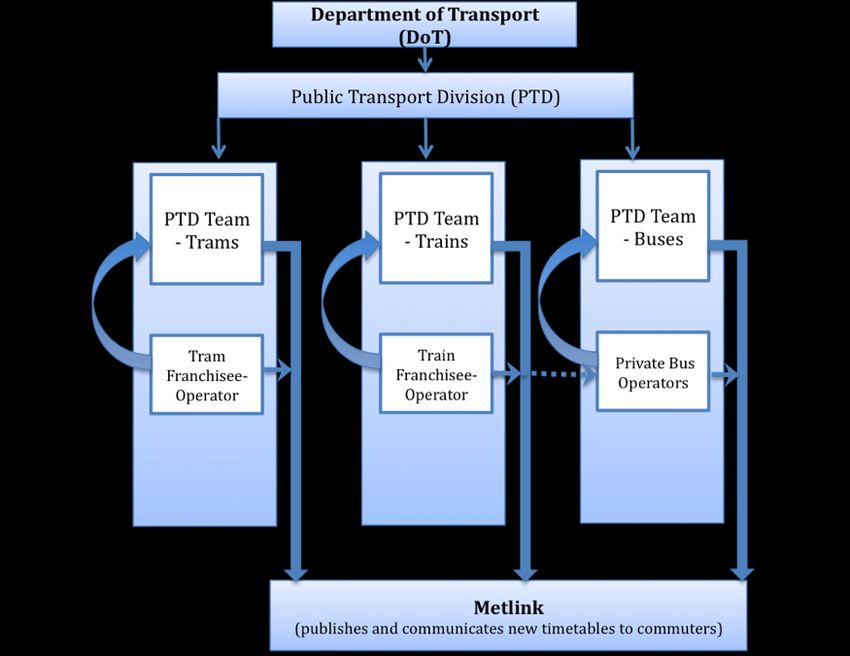
These comments confirm that no-one has responsibility for timetable coordination across the
modes. It certainly does not occur through the mechanism shown in Figure 2. In fact, timetable
changes are developed independently by each operator and approved by the relevant section
of the PTD responsible for that mode of transport: timetabling of services is conducted in silos,
both at the PTD level and at the operational level.
A more accurate picture of the arrangements for timetable development is shown in Figure 3.
Figure 3: Actual arrangements for timetable delivery – no active intermodal coordination
9ATRF 2010 Proceedings
4.1.3. Network Development Partnerships
The new Network Development Partnerships (NDP), as established under the new franchises
for both tram and train, codify a process that already exists between Connex and the DoT. It is
now also part of the new tram franchise.
The DoT sees the NDP as:
a joint working group between the Government and operator to address common
issues... it has been expanded to [look at] how are we going to develop the network in
the short to medium term [and] how are we going to get together to deliver better
services through rolling stock, infrastructure as well as service change (Alexander,
research interview).
As a participant in the NDP between Connex and the PTD, White confirmed that it operates on
a single modal basis, he confirmed that in the new franchise term the NDP will enable
metropolitan train issues to be discussed at the same time as regional train issues:
there isn‟t really an equivalent forum … that gets tram and bus together. I think it would
be worthwhile because DoT is not a very homogenous organisation, it is highly political,
so even getting metropolitan rail, and V/Line together is a big step forward.
Why have these institutional mechanisms failed?
The principal reasons for the failure of current arrangements to deliver improved intermodal
connectivity centre on the continued expectations of the intervention of market forces and as
the evidence demonstrates, the absence of skilled transport planners, who have direct
experience of the modern network planning practices described earlier.
5.1. Still waiting for the market
There is still an assumption that the financial incentives in place under the franchise
agreements for train and tram and private contracts for bus operators should result in improved
intermodal connections. Interestingly, this expectation is more strongly held by officials in the
DoT than by the private operators themselves:
because everybody is tied into the one revenue pool, the economic theory is that
everyone is motivated to grow the pie, so the way you actually increase your revenue is
not just about the services you produce, it is also about the services that other parties
produce (Alexander, research interview).
However, experience is against ideology on this question.
The underlying problem of the government relying on economic market forces to increase
services in the hope of making intermodal connections is that there is no incentive (financial or
other) for the operators to invest the time and resources to undertake this activity at their own
expense. It took Transdev ten years of operating the existing tram system before it began to
explore the potential for better intermodal connectivity, as there was simply no incentive to do
10An investigation of institutional arrangements for multimodal public transport in Melbourne
this at its own cost. With the franchise now having gone to Keolis, it will be interesting to see if it
will try to drive any positive changes to intermodal connections from the bottom up.
5.2. More transport planning professionals where it counts
As part of the research interviews, each individual was asked whether their relevant
organisation employed transport planners with knowledge of the theory and practice of
intermodal connectivity.
At DoT transport planners are employed across the different sections of the Public Transport
Division. However, there is little sign that, if they are providing internal advice based on
international best-practice, this is being used to create good mechanisms for better timetable
coordination or bus-route design. Nor do they seem to play a role in major operational
decisions. Alexander noted that no transport planning professionals were on the panel that
assessed the most recent round of franchise agreements awarded in November 2009 (research
interview). The assessors, therefore, lacked the capacity to evaluate the significance of the
efforts taken by Transdev to identify intermodal connections that could be made across the
network.
Interestingly, Cliche admitted that during his tenure at Yarra Trams he had not employed a
transport planner but, had he retained the franchise, he was “looking to hire one” (research
interview).
At Connex, White questioned the benefits that intermodal transport planners would bring to the
organisation as his company already employed numerous timetable analysts who understand
the intricate operational safe systems within the rail network (research interview).
Loader from the BAV, who demonstrated sound knowledge of intermodal planning theory and
practice, acknowledged that there is a large disparity in the level of timetabling sophistication
between different bus operators.
Finally, Carolan confirmed that there were no transport planning professionals employed within
Metlink (research interview).
We are faced with a system where there is severe disconnect between written policy and
practical application. Each organisation has their own idea of what intermodal connectivity
means, but without skilled transport planning professionals with the power to guide and drive
best practice, no organisation is actively concerned with delivering coordinated services.
Currently, coordinating timetables across the modes is, at best, a reactive process by interested
individuals, as opposed to a planned, strategic proactive process.
11ATRF 2010 Proceedings
5. Conclusion
The research has demonstrated that, although Government policies have been written and
rewritten over many years using the same transport planning rhetoric of coordination, timetables
across the different modes are not coordinated.
It is clear from the interviews that, despite government policies, few of those in a position to act
on these policies see intermodal coordination as a priority. Benefits of coordination are
recognised in principle, but in day-to-day activity, problems within the operations of each mode
take precedence. This is unsurprising given the existing structures in which public transport
planning takes place and the professional experience of most managers.
So, what structures or incentives might be put in place to ensure that coordination is given the
priority that reflects both the content of government policy and the essential role of intermodality
in the creation of effective public transport networks?
The DoT still appears to rely on the existence of financial incentives: as Ross Alexander put it
“everyone is motivated to grow the pie”. However, there is little indication that this incentive was
motivating behaviour during the first decade of franchising. In the early years, the role of
sfinancial incentive was obscured by a serious dispute between the operating companies over
the distribution of revenues. This was partly resolved through the departure of National Express
and the 2004 contract renegotiations that established train and tram operations under single
franchises. However, as described in a separate paper at this conference, operators have over
the past decade been able to increase their revenues by obtaining larger government subsidies
rather than by increasing the revenue “pie” through better coordination (Stone 2010).
It was only in the most recent bidding process that any operator showed interest in intermodal
coordination. However, even if this was a sign that financial or regulatory aspects of the
franchise contracts were beginning to drive change, it was not seen by decision-makers in
government or the DoT as a significant enough offering to enable the Transdev consortium to
win its bid for contract renewal. This must be seen as a further sign of the lack of priority given
to intermodal coordination and the weakness of financial incentive as a motivator for change.
However, even if the government did strongly re-assert its policy commitments and make
coordination a high priority for senior officials in the Department of Transport, is it likely that the
current convoluted and highly bureaucratic environments could deliver significant outcomes?.
Under current institutional arrangements, there continues to be a gap of communication
between and within the many organisations responsible for timetabling activities. No single
organisation is responsible for this task. There appears to be a growing recognition, among the
private-sector operators, if not in the government or the DoT, that new mechanisms must be
created if Melbourne is to ever experience the benefits of a comprehensive and connected
public transport network.
What mechanisms are appropriate for Melbourne? Lessons can learned from the mechanisms
for coordination that that are used in cities that have made significant steps towards the
development of „networked‟ public transport: cities in which, in large part, patronage growth is
driven by good intermodal coordination.
12An investigation of institutional arrangements for multimodal public transport in Melbourne
In cities with good intermodal coordination, planning for public transport networks is done
through a single public agency with the power to plan and share resources across the urban
region. This approach has achieved positive results in London and Copenhagen and in Swiss,
German and Swedish cities and towns (Mees 2010). It is also being introduced to improve
integration of buses and trains in Singapore (Land Transport Authority of Singapore 2008, pp.
38-39). In Australia, these institutional arrangements are in place in Perth, where public
transport patronage has grown steadily since the early 1990s (Stone 2009), and in Brisbane,
Translink was established for this purpose in 2008. This direction is also gaining ground in
Australian national policymaking through the findings of an all-party Senate committee (Senate
Rural and Regional Affairs and Transport Committee 2009) and support from Infrastructure
Australia (IA 2009).
So, Melbourne would be aligning itself with national and international trends if it were to move to
establish a public authority to plan coordinated multimodal public transport network. To do this,
government would need to abandon the current bipartisan support for the franchise model.
However, this could be done without financial penalty and, given the degree of dissatisfaction
with current public transport operations, would arguably be popular with voters.
To succeed in Melbourne, such an agency would need to be given clear guidance from
government that intermodal coordination was a key priority and it would need to employ skilled
professionals who would guide strategy and policymaking as well as oversee implementation
with achievable targets and commensurate incentives. . It remains to be seen whether the
Victorian Government will rise to the challenge.
References
Allens Arthur Robinson 2009, Metlink Services Agreement, unpublished, Melbourne.
Balcombe, R, Mackett, R, Paulley, R, Preston, J, Shires, J, Titteridge, H, Wardman, M & White,
P 2005, The Demand for Public Transport: A practical guide, Report TRL593, TRL
Limited, Crowthorne, UK.
Betts, J 2009, Evidence to the Victorian Legislative Council Select Committee on Train
Services, http://www.parliament.vic.gov.au/council/trainservices/, viewed 20 May 2010
DfT 2006, Putting Passengers First: The Government's proposals for a modernised national
framework for bus services, Department for Transport, London.
DoI 2002, Melbourne 2030: Planning for Sustainable Growth, State of Victoria, Melbourne.
--- 2004, Linking Melbourne: Metropolitan Transport Plan, Department of Infrastructure,
Melbourne.
--- 2005a, Public Transport Partnerships: An overview of passenger rail franchising in Victoria,
Public Transport Division, Melbourne.
--- 2005b, Track Record: Victoria’s, Train, Tram and Bus Services, Quarterly Performance
Bulletin: January-March 2005, Department of Infrastructure, Melbourne.
--- 2006, Meeting our Transport Challenges, State of Victoria, Melbourne.
--- 2007, Towards an Integrated and Sustainable Transport Future: A new legislative framework
for transport in Victoria, Department of Infrastructure, Melbourne.
DoT 2008a, Invitation to Tender (ITT) Melbourne Metropolitan Train Franchise, Vol 1&2,
Department of Transport, Melbourne.
13ATRF 2010 Proceedings
--- 2008b, Invitation to Tender (ITT) Melbourne Metropolitan Tram Franchise, Vol 1&2,
Department of Transport, Melbourne.
--- 2008c, Victorian Transport Plan, Victorian Department of Transport, Melbourne.
--- 2009, Corporate Plan, Department of Transport, Melbourne.
Hensher, D 2009, Frequency and connectivity: key drivers of reform in urban public transport
provision. Submission to Senate Inquiry into the investment of Commonwealth and State
funds in public passenger transport, viewed 10 June 2009
www.aph.gov.au/Senate/Committee/rrat_ctte/public_transport/submissions/sub07.pdf.
IA 2009, National Infrastructure Priorities: Infrastructure for an economically, socially, and
environmentally sustainable future, Infrastructure Australia, Canberra.
Land Transport Authority of Singapore 2008, Land Transport Master Plan: A People-Centred
Land Transport System Singapore.
Lazanas, K 2009, An investigation of the current institutional arrangements for the design and
delivery of intermodal public transport services in Melbourne, MUP thesis, University of
Melbourne, Melbourne.
Mees, P 2010, Transport for Suburbia: Beyond the Automobile Age, Earthscan, London.
Nielsen, G & Lange, T 2005, HiTrans Best Practice Guide No. 2, Public Transport: Planning the
Networks, European Union, Interreg IIIB Stavanger, Norway.
PTUA 2010, Poor connections leave passengers waiting, viewed 20 May 2010
http://www.ptua.org.au/2010/05/09/train-bus-connections/#more-1354.
Roth, G & Wynne, G 1982, Free enterprise urban transportation, Transaction, New Brunswick,
USA.
Senate Rural and Regional Affairs and Transport Committee 2009, Report of the Senate
Committee Inquiry into Investment of Commonwealth and State funds in public
passenger transport infrastructure and services, Commonwealth of Australia, Canberra.
Stone, J 2009, 'Contrasts in reform: how the Cain and Burke years shaped public transport in
Melbourne and Perth ', Urban Policy and Research, vol. 27, no. 4, pp. 419-434.
--- 2010, 'Turning over a new franchise: assessing the current health of public transport
management in Melbourne' 33rd Australian Transport Research Forum, Canberra,
ATRF
Thompson, G & Matoff, T 2003, 'Keeping Up with the Joneses: Radial vs. Multidestinational
Transit in Decentralizing Regions', Journal of the American Planning Association, vol.
69, no. 3.
Victoria 2001, Growing Victoria Together: Innovative State, Caring Communities State
Government of Victoria, Melbourne.
14An investigation of institutional arrangements for multimodal public transport in Melbourne
Appendix
Interview
Name Title Organisation
Date
Transport Planning & Bus Association
Chris Loader 6 March 2009
Policy Manager Victoria
Deputy Director Public Department of
Ross Alexander 9 April 2009
Transport Transport
General Manager,
Chris White Connex 12 June 2009
Network Development
Adjunct Professor, Bus
Institute of
Industry Confederation,
Transport and
John Stanley2 Senior Fellow in 23 July 2009
Logistics Studies
Sustainable Land
(ITLS)
Transport
Dennis Cliche Chief Executive Officer Yarra Trams 27 July 2009
Bernie Carolan Chief Executive Officer Metlink 31 July 2009
Table 2: Practitioners interviewed for this research (notes and recordings in
possession of the author)
2
John Stanley was a former Executive Director of the Bus Association of Victoria
15Minerva Access is the Institutional Repository of The University of Melbourne Author/s: Lazanas, K; Stone, J Title: An Investigation of Institutional Arrangements for Design and Delivery of Multimodal Public Transport Date: 2010 Citation: Lazanas, K. & Stone, J. (2010). An Investigation of Institutional Arrangements for Design and Delivery of Multimodal Public Transport. Australasian Transport Research Forum 2010 Proceedings, pp.1-15. Australasian Transport Research Forum. Persistent Link: http://hdl.handle.net/11343/234427 File Description: Published version
You can also read


