ANTONIA HIRSCH Double Blind - PUBLIC ART
←
→
Page content transcription
If your browser does not render page correctly, please read the page content below
ANTONIA HIRSCH
  Double Blind

             PUBLIC
            ART
             vancouver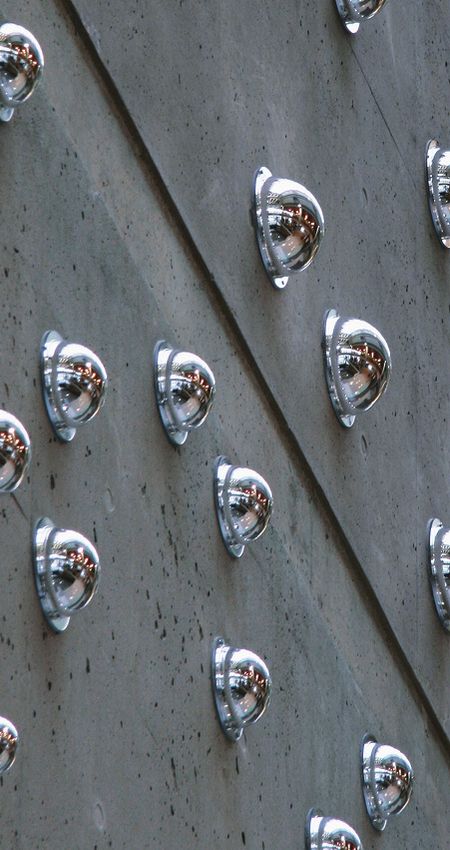
On a basic level, the work reveals the inaccessibility of
                                                                   mainstream communication for the blind and relates to VCC’s
                                                                   programming for visually impaired adults. Double Blind brings
                                                                   into relief cultural exclusions that most take for granted. A
                                                                   plaque next to the sculpture explains in braille the concept
                                                                   behind the work, and while developing the piece, Hirsch had
                                                                   ongoing consultations with students, staff and faculty in VCC’s
                                                                   program for the visually impaired. The work “makes visible”
                                                                   the situation of not seeing — and the implications of exclusion
                                                                   in a place of higher learning, with its promises of knowledge,
                                                                   social interaction and professional advancement. The fact
                                                                   that students of VCC’s School of Health Sciences might learn
                                                                   about “double blind” medical trials during their studies makes
                                                                   an additional connection between Hirsch’s eye chart and the
                         About the Work                            activities and pedagogies going on elsewhere in the building.
                                                                       More generally, the work poses questions about “seeing”
Double Blind, Antonia Hirsch’s large-scale artwork in the          as a means of control. The convex security mirrors make an
atrium of the north building on the Broadway Campus of             explicit reference to the links between sight and power; those
Vancouver Community College (VCC) is not, at first glance,         who have the wider view preside over those who, in their
an easy read. As a formal presence, it lacks the kind of heavy     visibility, might be “counted.” One is reminded of Michel
“materiality” expected from public work; the formal heft of        Foucault’s writing on the Panopticon — an architecture that
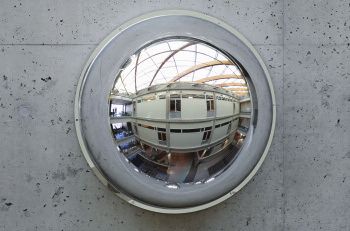
iron, bronze or steel gives way here to a luminous collection      allows for a seemingly all-seeing vantage point — as a tool to
of convex acrylic security mirrors that protrude, bubble-like,     enforce power, and it seems fitting that these mirrors reflect
from concrete walls. The materials — the kind one might find       the goings-on in an institutional hall of windows, balconies
in any number of security-conscious convenience stores —           and open sight lines. Thus, Double Blind elevates the surface
hint at the artist’s larger project: to make visible overarching   of the mirrors to a reflection of consciousness: our realization
systems of control and exclusion.                                  that we are watched, and that, as we ascend staircases and
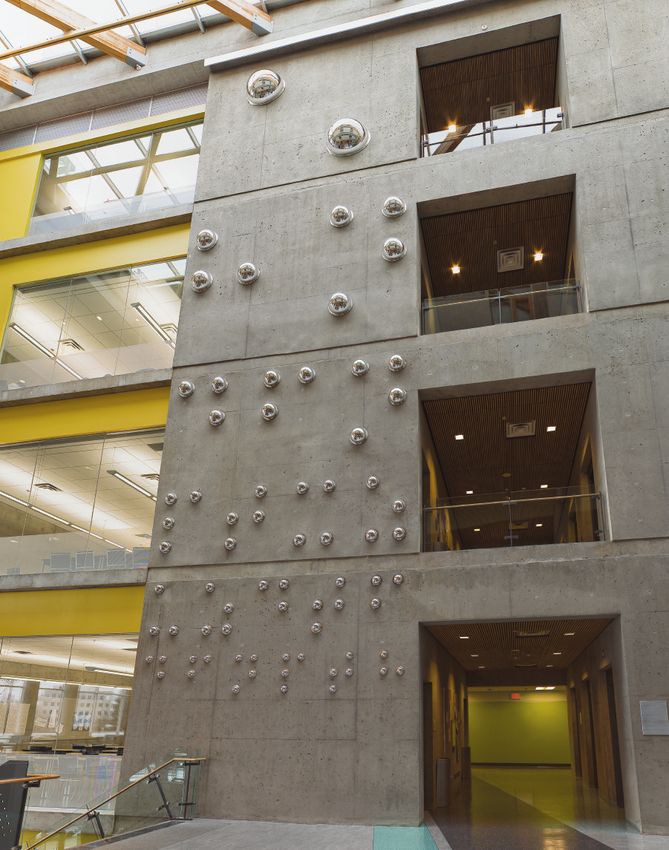
    The work is a disjointed reflection. In descending layers,     sit in classrooms, we are also watching.
the mirrors spell out a four-storey Snellen eye chart — that           In this way, Double Blind doubles back on itself, making
familiar series of letters that many of us recognize from rou-     systems of power visible through the obfuscation of clear
tine eye exams — as enormous braille letters. The domes            meaning. With a series of sensory dead-ends, pointed cul-
present a formal conundrum — they remain unreadable for            tural associations and a canny awareness of surrounding
people without sight, and, for those that can see, the array at    architecture, Hirsch has created a piece that reflects our own
first appears as a random association of dots, vague punc-         reality back to us — but with insights that do not sit on the
tuations unable to express. In the words of the artist, it is      surface to be seen.
an “eye chart for the blind,” and this sensory inconsistency
brings us to a far-reaching conclusion that the work refers        — Vanessa Kwan
to a more widespread cultural invisibility.
                                                                   Vanessa Kwan is a Vancouver-based artist and writer.

Above Dome detail, Double Blind, 2008. Photo: Photo Technic        Opposite Installation view of Double Blind, 2008. Photo: Photo Technic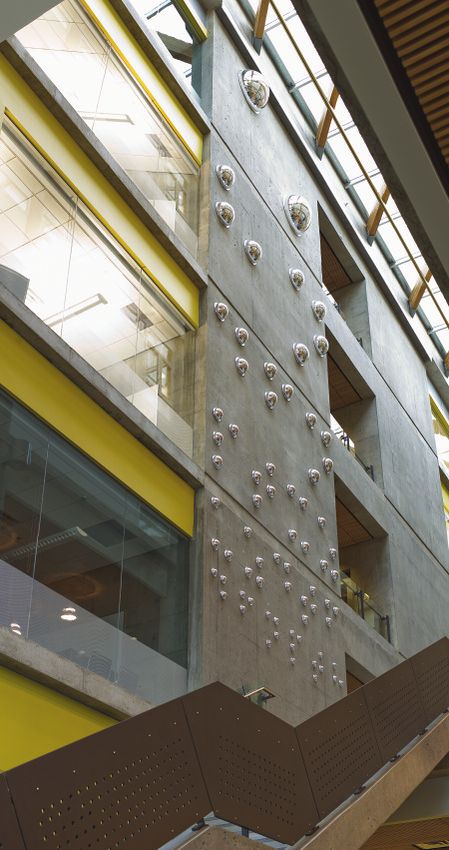
About the Artist
Antonia Hirsch is a Vancouver-based artist whose practice
has consistently engaged with systems — geographical,
financial, architectural and social — that underwrite our
most basic understandings of the world. Working in a vari-
ety of media, Hirsch’s work has often been sited publicly,
and the artist has exhibited work at the Vancouver Public
Library (Anthropometrics, Vol. I, 2006) and on the massive
LED screens at Robson and Granville Streets in downtown
Vancouver (Vox Pop, 2008). In these, as in her gallery-based
practice, Hirsch questions the often invisible hierarchies of
culture and knowledge by relating them to more familiar
territory: the scale of one’s own embodied experiences.
In previous works, she has reconfigured world maps to
reflect statistics of annual rainfall, the metric system to
the length of an arm, or mass spectacle to the function of
a single audience member.

Above Antonia Hirsch wearing the Double Blind T-shirt multiple.
Photo: Photo Technic
The City of Vancouver’s Public Art Program incorporates con-
temporary art practices into city planning and development
processes. The program supports excellence in art making
of many kinds — by emerging and established artists, in new
and traditional media, from stand-alone commissions to artist
collaborations. The program is part of the Cultural Services
Division and oversees the development of public art opportuni-
ties throughout the city. Projects at civic buildings, greenways,
parks and other public spaces are funded through annual
civic capital budgets. Private sector projects are funded by
developments in the rezoning process. Learn more about
this and other public artworks in the Public Art Registry at
www.vancouver.ca/publicart; subscribe to the Public Art Listserv
at the same site to be notified of upcoming artist opportunities.

                                                              VCC/Clark Skytrain Station
     Great N
               orthern
                       Way
                                          6th Avenue East
                                                                  Clark Drive
                                                Keith Drive
                             Glen Drive

        7th Avenue East                                                         7th Avenue East

        8th Avenue East                   ★
                                          VCC
                                                                                8th Avenue East

        East Broadway                                                           East Broadway

Double Blind was commissioned by Vancouver Community College as
part of their participation in the City of Vancouver’s Public Art Program.
Double Blind is accompanied by a T-shirt multiple that is available at the
VCC Broadway Campus Bookstore. The T-shirt echoes the installation’s
conundrum with the Snellen chart rendered on the front in braille using
reflective foil and again on the back using raised letters in the same colour
as the T-shirt fabric.

Coverpage Installation view of Double Blind in the north building atrium on
the Vancouver Community College Broadway Campus. Photo: Colin Griffiths
PUBLIC
ANTONIA HIRSCH
ART Double Blind
Photo: Photo Technic
vancouverYou can also read


