Applying
to CAO
GCE Applicants
←
→
Page content transcription
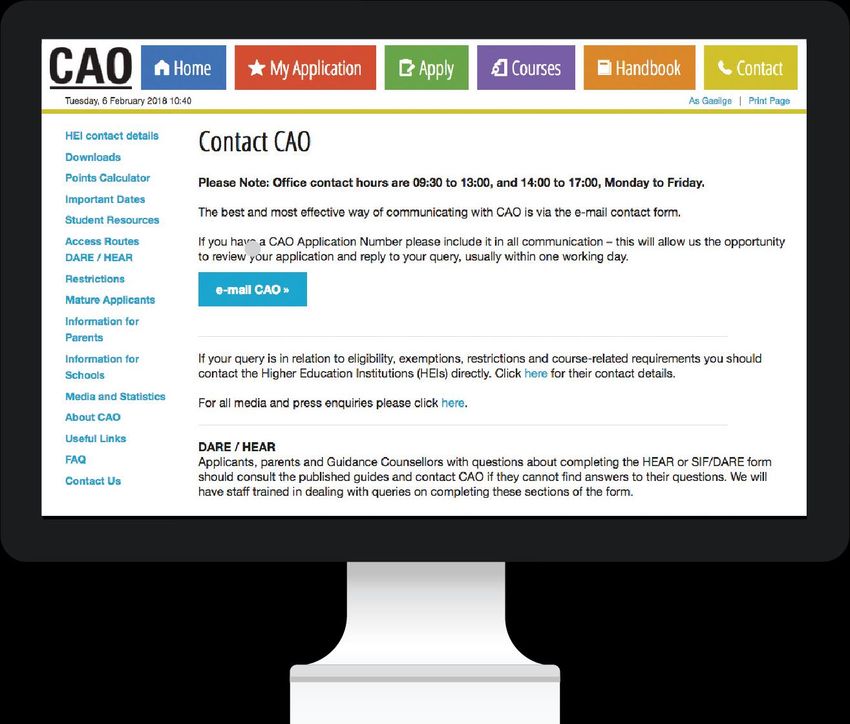
If your browser does not render page correctly, please read the page content below
Applying to CAO GCE Applicants
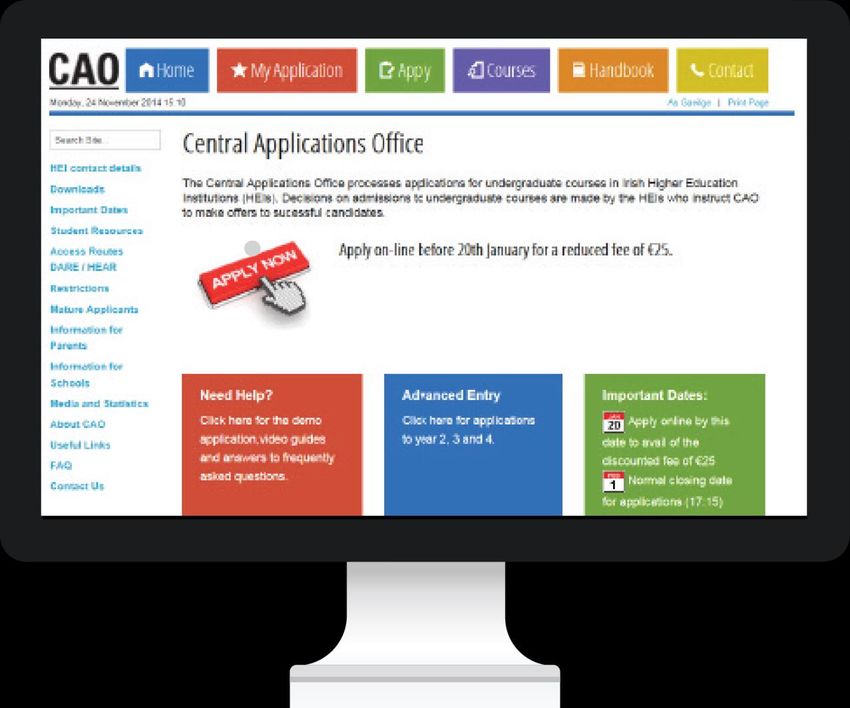
Purpose of the CAO

• CAO processes applications to undergraduate courses
  in Higher Education Institutions (HEIs).

• Offers are issued and acceptances are recorded by CAO.

• Assessment of applications and decisions on
  admissions are made by HEI Admissions Officers.
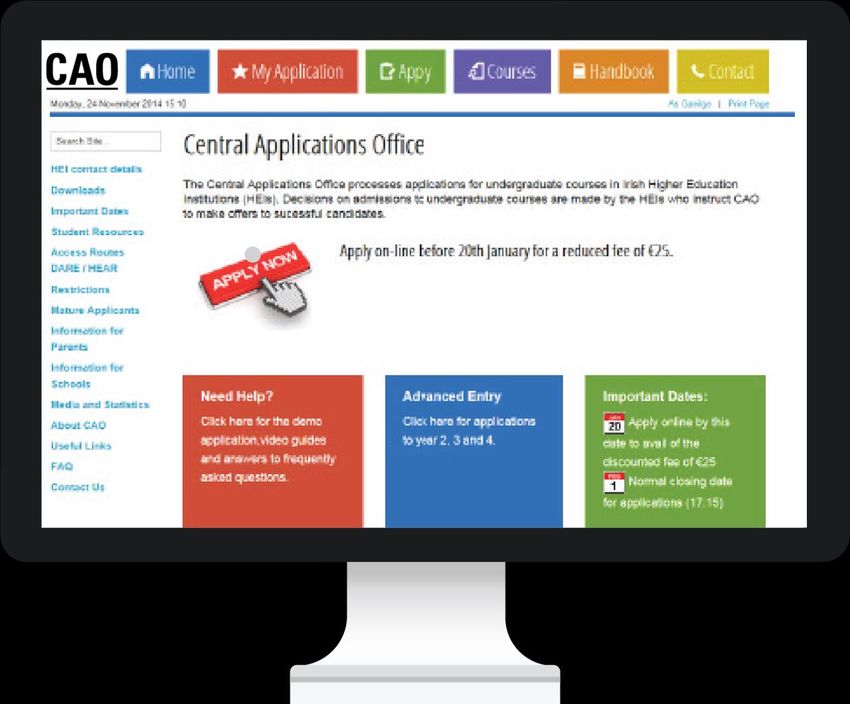
Application Process
CAO Handbook

CAO distributes to schools
and individuals a handbook    Every applicant should be
containing instructions and   familiar with the contents of
                              the CAO Handbook.
information about the
application process.
HEI Prospectuses

 Information on courses is
 available from each HEI and
 prospectuses should be
 consulted before making
 an application. A course search
 facility is also available at
 www.cao.ie

 Participating HEIs in the Republic
 of Ireland include Universities,
 Institutes of Technology and
 other designated institutions.

Making an Application

  Applicants are encouraged
  to apply online.

  The website address is
  www.cao.ie

  Click on ‘Apply’ and enter
  the information requested.

Timely Action

 DO NOT LEAVE   In order to be fair to all
                applicants, closing dates
 EVERTHING TO   are strict and therefore
 THE LAST       action should be taken
 MINUTE!        in good time.
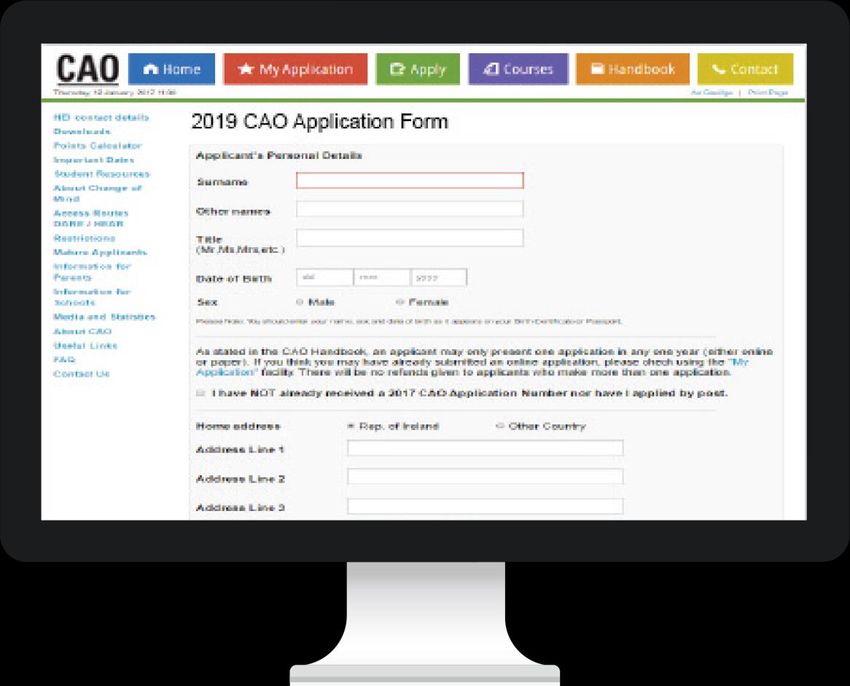
Application Form

• Information which identifies you is of the
  utmost importance.
                                               CAO Application Form
• Carefully enter details such as your name,
  address, date of birth, schools attended,
  board numbers, candidate numbers, etc.
• Your examination details must be entered
  with great care.
• Make sure you inform CAO about all
  relevant qualifications and exemptions –
  select the relevant section(s) from the
  Qualifications and Assessments summary on
  the application form.
Application Number

• When you apply online your application number will
  appear on screen. You will also receive an email
  containing your CAO application number.

• This number is private and it will be used in every
  correspondence between you and the CAO for the
  rest of the year.

Qualifications & Assessment

• You must complete the Qualifications and Assessments
  section(s) that is relevant to you.

     Applicants presenting GCE/GCSE examinations
     are required to provide additional information
     to support their application.
Qualifications & Assessment
• Applicants completing A Level examinations in
summer will be asked to insert their 5-digit
centre number and 4-digit candidate number
for each examination. 2019 CAO Application Form
• You must inform CAO if you are taking your
summer examinations with CCEA and/or with
British/Welsh examining boards. If we do not
have this information CAO will be unable to
obtain your results electronically. If this
information is not received a minimum of 10
working days before Round One offers you will
not receive an offer in this round. It will be the
responsibility of the applicant to provide CAO
with certified photocopies of results.
• Detailed instructions for the completion of this
part of the application form may be found in
the CAO Handbook (see pages 4, 5 & 6) and on
the website.Informing CAO of all GCSE, AS & A Levels • GCE/GCSE Applicants must inform CAO of any GCSE, AS & A Level examinations previously taken – these results are required to meet minimum entry requirements, but are not used for points computation purposes. • Applicants must also advise CAO of any previous AS and A Level awards and provide certified photocopies of certificates/statements of results produced by an examining board to support their application. Certified photocopies of certificates/statements of results produced by an Examining Board must be supplied to CAO a minimum of ten working days in advance of Round One offers. A certified photocopy means that you photocopy the documents and then bring both the originals and the photocopies to an acceptable person or body (School, University, Police Station, Admissions Office, Notary) where they will stamp the photocopy as being a true copy of the original.
AS Level Results

• CAO advises GCE applicants to discuss the AS Level certification process with their school.
• AS Level results are frequently cashed in along with A2 Level results in the final year. As a
  result, candidates often will not have evidence of their AS Level results until the release of
  their A2 Level results in August.
• In this instance, CAO will expect to receive electronic notification of the AS Level results
  provided that the applicant has supplied their correct Board, Centre Number and Candidate
  Number for all subjects that will be cashed in in August.
• If your school cashes in AS Level results in the same year as A2 Level results, you must enter
  the remaining AS Level subject carried forward on your CAO application – you must use the
  space provided for ‘Examinations to be taken’ in the Qualifications & Assessments section.
• CAO must be informed if the candidate sat any AS or A2 Level examinations at a different
  school.
Common Errors

• No school stamp on supporting documentation
• Providing documents provided by a school as opposed to an examining board
• Not informing CAO of GCSE examination results
• Not informing CAO of previously taken AS & A Levels
• Not supplying Centre Number and Candidate Number for current year examinations
• Pre-U examinations should be included under Other School Leaving qualifications. You
  must also supply Centre Number and Candidate Number in the GCE section.
• BTEC qualifications should be listed under Other School Leaving qualifications
Choosing Courses

• Consult your Careers Teacher/Adviser.

• Discuss your options with family and friends.

• Details about courses may be found in HEI
  prospectuses and by consulting HEI websites.

• A course search facility is available on the CAO
  website.
Level 8 and Level 7/6 Courses

•   The National Framework of Qualifications (NFQ) is a system of
    10 levels which allows the different standards and levels of
    qualifications to be compared in the Republic of Ireland.
•   CAO process applications for Levels 6-8 in the Framework:
     Level 6 courses result in the awarding of a Higher Certificate
     Level 7 courses result in the awarding of an Ordinary Degree
     Level 8 courses result in the awarding of an Honours Degree
•   A diagram of the NFQ is on the website of the Quality and
    Qualifications Ireland (QQI) www.qqi.ie.
•   For more information see page 3 of the CAO Handbook.
2 Applications in 1 • There are two course choice lists (Level 8 and Level 7/6) and applicants may make up to 10 course choices on each list. • Your choices on one list do not in any way affect your choices on the other list. They may be considered two separate applications on one form. • It is possible to receive an offer on both lists. You may then decide to accept either your Level 7/6 or your Level 8 offer. • Alternatively, you might not wish to accept either offer.
Order of Preference

• If you learn nothing else from this presentation let it be this...

    PLACE YOUR                                                         To do otherwise is a
                                                                          grave mistake.
    COURSES IN
    GENUINE ORDER
    OF PREFERENCE!
Order of Preference • It is most important that applicants state their course choices in order of genuine preference and/or career plans. • It is a mistake to base course choices only on your present expectations of examination performance or the points level of previous years. • If you are not successful in your first choice this will have no effect on your chances of obtaining a place in one of your lower preferences. • Having received an offer in any round, you may get a higher preference offer in a later round. You will never be offered a lower preference in a later round.
Restrictions

• Certain courses are ‘Restricted Courses’. They have early assessment procedures which may
  start as early as February.
• This includes courses such as Music, Art and Drama which may require interviews,
  assessments or presentation of a portfolio as part of the application process.
• Restricted courses are clearly marked in the relevant prospectus and also on the CAO
  Handbook (by the words 'Restricted – see page 3').
• An application for a Restricted Course will not be considered unless:
• a) it has been included among original course choices by 1 February b) it has been added to an
  existing application not later than the final date for correction of errors or omissions (1
  March).
• Please see page 3 of the CAO Handbook for further information.
Change of Mind Facility

                            You may use this facility to change the order
                            of your course choices and/or to introduce
                            new courses, subject to the restrictions
                            detailed in the handbook.

                          The Change of Mind opens in early May
                          and closes on 1 July at 5:15pm.
Statement of Application Record
Before the end of May you will be sent a Statement of Application
Record as a final acknowledgement and to enable you to verify
If you do not that all information has been recorded completely and correctly.
receive a Check the following carefully, and if there is any error or omission
amend the Statement and return it to CAO.
Statement by
Are all the courses shown and in the correct order?
Are all the codes correct?
Are the exam numbers correct?
Are all exams mentioned?
Are all exemptions listed?
contact CAO If you are presenting both Northern Ireland and British Board
immediately. results, two records should appear for the current year.The Offer Process
• In the week following the release of the A Level
results CAO will email all GCE/GCSE applicants.
• Applicants must read this email carefully and
inform CAO immediately if any details are
incorrect or missing.
• Applicants must supply evidence of any results
that are missing or incorrect by post as soon as
possible.The Offer Process
• If you are entitled to an offer you will be sent an e-mail
and SMS text message if you have selected this option.
• You should check that all of the details on the offer
notification are correct and that there are no omissions.
• Offers will also be available on the CAO website.
• You may check for and accept offers on the website.The Offer Process
There can be no delays at the offer/acceptance stage.
• Any offer not accepted by the closing date for receipt
of acceptance of offers in CAO will be offered to
another applicant in the next round of offers.
• You will receive an e-mail acknowledging your
acceptance if you accept online.Place Allocation
• We will look just at Level 8 courses, but
exactly the same process will take place
with Level 7/6 courses, and at the same
time.
• The importance of you, the applicant,
placing courses in genuine order of
preference will become apparent in the
following pages.Place Allocation
• When examination results are released in
August they are entered into the CAO
computer.
• The computer checks each applicant’s results.
For each course the applicant has applied for,
the computer first determines if the applicant has
the minimum entry requirements for the course.Place Allocation If the applicant meets the minimum To view how to calculate your points go to entry requirements for the course, the Student Resources section of the applicant’s points are calculated www.cao.ie or see the CAO Handbook. for this course choice. All eligible applicants are then placed on a list, in order of academic merit, for each course that they applied for. Minimum Entry Requirements + Points Score = Position on Order of Merit List
Place Allocation

                   • The admissions officers of the Higher
                     Education Institutions tell CAO how many
                     places are to be offered on each course.
                   • CAO then makes offers to the required
                     number of applicants on each course,
                     starting with the applicant with the highest
                     points and working down until enough
                     places have been offered.
Place Allocation
• Should some applicants decline to accept
their offers these places become available in
the next round of offers.
• They will be offered to the next applicants on
the Order of Merit list. This process
continues until all of the places on the course
are filled or until all the eligible applicants on
the Order of Merit list have been offered
places.Place Allocation
EXAMPLE
– no results yet!
• These are the applicants for CK101 - Arts in
UCC.
• The examination results have not yet been
released, so these applicants are in no
particular order.
• We are going to trace the progress of the
applicant marked in red.Place Allocation
1. CK101 EXAMPLE
– Exam results have been released.
2. DN201
• Applicants are placed in a queue for each course they
applied for - their position in the queue is determined
by their points.
3. AL850
• The applicant with the highest points is placed at the
top of the queue. The points achieved by the
applicant in red determines her position in the queue
10. LM040 for each course she has applied to.Place Allocation
1. CK101 EXAMPLE
– HEIs issue R1 offers
2. DN201
• The applicants marked in GREEN have enough points
to be offered places.
3. AL850 • The applicant marked in RED has enough points for
her second preference.
10. LM040Place Allocation
1. CK101 EXAMPLE
– HEIs issue R1 offers
2. DN201
• The applicant in RED is offered her second preference,
the highest preference course that she has enough
points for, and she will now disappear from the queue
for all her lower choices.
• Placing DN201 as her second preference meant that she
would prefer to receive an offer on DN201 than on any
other course except CK101 - which is her first
preference.Place Allocation
1. CK101 EXAMPLE – R2 offers
• After Round 2 offers are issued, our applicant is now
in first place on the waiting list for her first preference
course.
• She has already accepted her 2nd preference course.
Accepting or not accepting her 2nd preference course
will not prevent her from receiving an offer of her 1st
preference course if she is deemed eligible by the
institution in a later round.Place Allocation
1. CK101 EXAMPLE
– An offer is issued in R3 for her
1st preference!
• In the third round of offers two more offers are
made on CK101 and our applicant, who was at the
top of the queue, now receives an offer.
• She may do nothing and remain in DN201 or she
may accept the offer.Genuine Order
• You do not need to guess what the points are going
to be for the courses you are interested in.
• Simply list your courses in genuine order of
preference from the highest preference 1, to the
lowest preference 10.
• If you are entitled to an offer, you will be offered the
highest preference that you are entitled to.Applicant Scoring for GCE/GCSE
From 2019 Universities and associated colleges From 2019 Institutes of Technology & TU Dublin (other
than DkIT)
Best 3 A- 4th Subject Best 3 A-Levels AS Levels
Levels
A-Level AS Level (& 4th A-Level where presented)
A* 185 45 31†
A* 185 74††
A 156 38 26
A 156 62
B 131 32 22
B 131 52
C 106 26 18
C 106 42
D 84 20 14
D 84 34
E 63 15 11
E 63 25
† Extended Project is now accepted and scored as AS. It is possible to attain an A* in
this.
†† Applies to A-level onlyApplicant Scoring for GCE/GCSE Universities and associated colleges: • Applicants are scored on the basis of their best four A levels or three A levels and an AS level in a different subject from the same or preceding year. The maximum number of points that can be achieved is 600. • Note: Applicants presenting Grade E or above in one of A-Level Mathematics, Further Mathematics or Pure Mathematics will have 25 points added to their score for that subject. The bonus points will only be relevant where that subject is scored as one of the applicant's best four subjects for points purposes. This gives a maximum possible score of 625.
Applicant Scoring for GCE/GCSE

Institutes of Technology & TU Dublin (other than DkIT) and other HEIs offering QQI HET awards:
Applicants are scored on the basis of a maximum of 4 different subject results at A and/or AS
level. For scoring purposes, the following combination of A Levels and AS Levels are permitted:
• The best 4 A level results in a single sitting.
• The best 3 A level results in a single sitting, plus the best AS level result from the previous or
  the same sitting.
• The best 2 A level subject results in a single sitting, plus the best 2 results at AS level from the
  previous or the same sitting.
• The best 1 A level subject result in a single sitting, plus the best 3 results at AS level from the
  previous or the same sitting.
• The best 4 AS level subject results in a single sitting.
Communication with CAO

                     •   The easiest and most efficient way to communicate
                         with CAO is by using the Correspondence Section of
                         your CAO Account. You will receive a reply to your
                         query usually within one working day.
                     •   Always quote your CAO application number in any
                         communication with CAO.
                     •   If you post something to CAO, always obtain a
                         certificate of posting at the post office. This is a free
                         service and it offers you peace of mind.
Useful Resources
An online copy of the
CAO Handbook is
available here
Visit the ‘Student Resources’
section accessible here for
Video Guides and useful
resources including the
‘Demo Application’ facility.
Watch this space for
‘Important Dates’.Finally...
Most applicants follow
the simple instructions If you are unclear on any
Remember to carefully from CAO and get matter concerning the
read all of the documents along just fine. application process, please
and instructions contact us via our
from CAO. website: www.cao.ieYou can also read


