Development of Intranet App with JAVA on Oracle Cloud
←
→
Page content transcription
If your browser does not render page correctly, please read the page content below
International Journal of Emerging Technology and Advanced Engineering
       Website: www.ijetae.com (ISSN 2250-2459, ISO 9001:2008 Certified Journal, Volume 4, Issue 5, May 2014)

      Development of Intranet App with JAVA on Oracle Cloud
                                                Saumendu Bose1, Saurabh Kumar2
                                    1
                                     M.Tech, 2Asst. Prof., Dept. of CSE, S.I.T.E, S.V.S.U, Meerut
   Abstract— Cloud computing is a computing environment,                    These are:
where a large pool of systems are connected in private or
                                                                         Software as a Service (SaaS)
public networks, to provide dynamically scalable
infrastructure for application, data and file storage. With the          Platform as a Service (PaaS)
advantage of this technology, the cost of computation,                   Infrastructure as a Service (IaaS)
application hosting, content storage and delivery is reduced                In the Infrastructure as a service (IaaS) model, refers to
significantly. The idea of cloud computing is based on a very            the sharing of hardware resources for executing services,
fundamental principal of ‘reusability of IT capabilities'.               typically using Virtualization technology.
Developed system is a technique through cloud computing in                  In the Platform as a service approach (PaaS) model,
which user will handle systems from Intranet with the help of
servers as cloud and can access applications as well. User can
                                                                         includes a software execution environment, e.g. JRE
also deploy application from client machines, and can store              provide platform independent execution environment.
data on data storage area on cluster server. The proposed                   In the Software as a service (SaaS) model, cloud
system will be used by an institute to deploy and execute                providers install and operate application software in the
application on centralized server Oracle Weblogic 11g as                 cloud and cloud users access the software from cloud
cloud. User does not have to install server and database as              clients.
Oracle XE on each machine. The proposed system will also be                 There are three main types of Cloud deployment models.
used for providing various services on clustering of server.             These are:
   Keywords—     cluster,   virtualization,   cloud,   scalable,         Private Cloud
detacenter.                                                              Public Cloud
                                                                         Hybrid Cloud
                     I. INTRODUCTION                                        In Public cloud, various applications, data storage, and
   Cloud computing is a style of computing in which                      other resources are made available to the general public by
dynamically scalable and often virtualized resources are                 a service provider. These services are free or offered on a
provided as a service over the Internet and Intranet. In                 pay-per-use model. Generally, public cloud service
System the development of a technique through cloud                      providers like Amazon AWS, Microsoft and Google. These
computing in which user will access application on server                services are owned and operated by service provide and
which is allocated far away from user system or different                access only via Internet
node in an organization. According to independent                           Private cloud is cloud infrastructure operated solely for a
technology and market research, cloud computing is a                     single organization, whether managed internally or by a
standardized IT capability, such as software application                 third-party and hosted internally. In private cloud
platform or infrastructure, delivered via Internet                       environment servers are clustered in virtual and also
technologies and Intranet technologies in a pay-per-use and              physical machine and interconnected with Wi-Fi and LAN.
self-service way. The word Cloud Computing is not                        Services are provided in limited geographical area, e.g.
associated with any particular technology, protocol or                   Institution.
vendor. It allows cloud applications to service the users                   Hybrid cloud is a composition of two or more clouds
(usually via websites, client applications, and so on)                   (private, community or public) that remain unique entities
assuring that the service will have a single point of access             but are bound together, offering the benefits of multiple
(i.e. from main server and managed server ) and all the                  deployment models. Hybrid cloud architecture requires
scaling, parallel computation, virtualization and whatever               both on-premises resources and off-site (remote) server-
technology is used on the back end will be transparent to                based cloud infrastructure.
the client. There are main three types of Cloud computing
service models used by the Cloud computing providers.

                                                                   430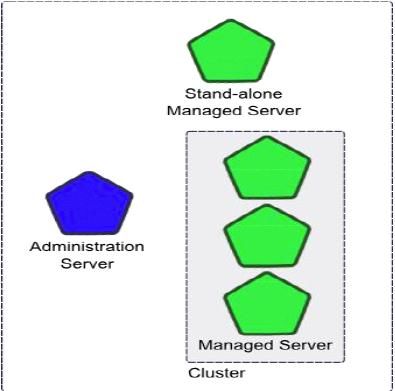
International Journal of Emerging Technology and Advanced Engineering
Website: www.ijetae.com (ISSN 2250-2459, ISO 9001:2008 Certified Journal, Volume 4, Issue 5, May 2014)
II. INTRANET AND THE CLOUD IV. PROPOSED EXECUTION ENVIRONMENT
While my operation is not big as Amazon S3 cloud Equal load distribution may improve resource utilization
computing, I can use the same sorts of principles within my by transferring load from heavily loaded server to the idle
institution to develop our IT infrastructure. By setting up server. This research work based Weblogic server on
thin clients with LAN and Wi-Fi to run, deploy and clustering environment and this clustering environment
develop applications on local servers, rather than on their based on virtualization (Oracle VM). Datacenter
desktops, I ease the costs of deployment and maintenance, component is used for handling service requests. VM
as well as reducing power costs. In my project, I develop consist of application elements e.g. database, which are
Admin Server and Managed Servers by clustering on connected with these requests, so Datacenter’s host
virtual machine by virtualization. Intranets are customarily components should allocate VM process sharing.
used within an organization and are not accessible publicly. According to below image my execution environment will
That is, a web server is maintained in-house and company work.
information is maintained on it that others within the
organization can access. However, now intranets are being
maintained on the cloud.
III. WEBLOGIC SERVER CLUSTER
A cluster is a logical group of managed servers within a
domain. Managed servers can reside on different machine
but a cluster cannot span across more than one domain.
WebLogic Server cluster consists of multiple WebLogic FIG .1 BASIC VIRTUALIZATION IMAGE
Server, server instances running simultaneously and
working together to provide increased scalability and
reliability. A cluster appears to clients to be a single
WebLogic Server instance. The server instances that
constitute a cluster can run on the same machine, or be
located on different machines. You can increase a cluster’s
capacity by adding additional server instances to the cluster
on an existing machine, or you can add machines to the
cluster to host the incremental server instances. Each server
instance in a cluster must run the same version of
WebLogic Server.
Web applications can consist of different types of
objects, including Enterprise Java Beans (EJBs), servlets,
and Java Server Pages (JSPs). Each object type has a
unique set of behaviours related to control, invocation, and FIG .2 EXTENDED VIRTUALIZATION IMAGE
how it functions within an application. For this reason, the
In my proposed execution environment, application
methods that WebLogic Server uses to support clustering
based on first virtual disk is Weblogic Application Server
can vary for different types of objects. The following types
and on second virtual disk Oracle Database server reside.
of objects can be clustered in a WebLogic Server
In first virtual disk Weblogic Application Server have a
deployment:
single domain and this domain is clustered and provides
Servlets two managed server. First managed server is handling for
JSPs request processing with client and according to client
EJBs demand second managed server extract data from database.
Remote Method Invocation (RMI) objects Proposed execution environment may reside on different
Java Messaging Service (JMS) destinations physical system with LAN and Wi-Fi connectivity.
Java Database Connectivity (JDBC) connections In proposed execution environment one client deploy
their application remotely and other client also access
application with proper internet protocol address.
431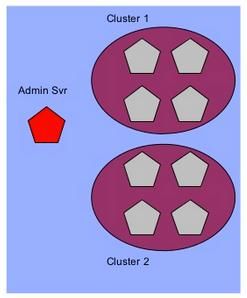
International Journal of Emerging Technology and Advanced Engineering
       Website: www.ijetae.com (ISSN 2250-2459, ISO 9001:2008 Certified Journal, Volume 4, Issue 5, May 2014)
   Clients have no need to install Server Application and                   VI. INSTALLATION SETUP FOR ORACLE CLOUD
database in their own system. They have only need to
                                                                       Operating System:
connect with datacenter with LAN and Wi-Fi. Client can
deploy different type of application based on different                  On Host Operating System (Window 8) installed two
technology, e.g., Servlet and JSP based application, EJB or            Guest Operating System (Window XP Service Pack2).
Hibernate based application, Struts and Spring based                   Virtualization:
application.
                                                                          On Host Operating System two Virtual Disks stabilised
   Physical setup of propose execution environment are as
                                                                       with Oracle VirtualBox
follows:
   Two main servers:                                                   Guest Operating System:
              1) Server 1 i.e. clustered of Admin and two                Two Operating Systems install on two Virtual Disks.
                   managed server.
              2) Server 2 i.e. database server.                        Server Installation:
   Multiple clients: Client facilitated to access and deploys             Oracle Weblogic Server and Oracle Database Server
application.                                                           installed on both Operating System respectively.
   The client will be communicates with server1 which is a
cloud server as datacenter with the help of private                        VII. CONFIGURATION STEPS FOR ORACLE CLOUD
switching with Wi-Fi. The server 1 and server 2 will                     Assumption: Weblogic Server is already installed on the
communicate with each other using private switching with               machine with Windows Operating System.
LAN.                                                                     1. Creating Weblogic Domain
                                                                         2. Configuring Domain
                    V. REQUIREMENTS                                      3. Configure the cluster
A. Software requirements:-                                               4. Start Admin Server
        Window 8                                                         5. Start Managed Servers
        Window XP ServicePack3                                           6. Configure a Node manager service on localhost
        Oracle Weblogic Server 11g                                       7. Testing Nodemanager
        Oracle Database 10g Express Edition                              8. Deploying Application
        Eclipse or Oracle JDeveloper                                     9. Testing Deployment
        Oracle VirtualBox-4.3.6                                          10. Testing Load Balancing and Failover Replication
                                                                         11. Installing Oracle Database in other Windows
B. Hardware requirement:-                                                     Operating System
                                                                         12. Configure Oracle Database and unlock user
    Item          Server 1         Server2          Client               Configure Weblogic Server with Oracle Database as
                                                                       Thin Client
               Intel Core i7-   Intel Core i7-   Intel Pentium
    CPU        3630             3630             Dual     CPU
               @2.40GHz         @2.40GHz         @1.6GHz
               @2.40GHz         @2.40GHz
   Main            8 GB            8 GB            2 GB
  Memory          Minimum         Minimum         Minimum

Virtual Disk       50 GB           50 GB             N/A
                  Minimum         minimum

 Local Disk       200 GB          200 GB            80GB
                  Minimum         Minimum

 Networking      Wi-Fi/LAN       Wi-Fi/LAN        Wi-Fi/LAN

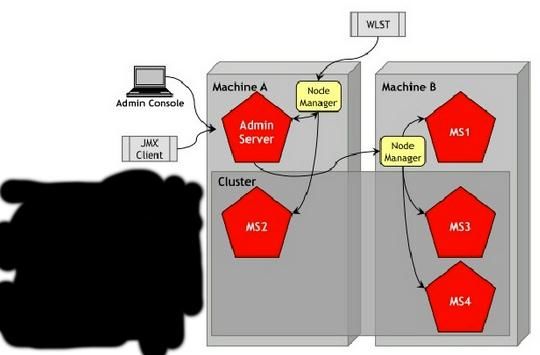
                                                                                      Fig: 3 Weblogic Managed Server

                                                                 432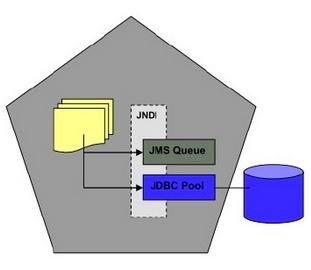
International Journal of Emerging Technology and Advanced Engineering
Website: www.ijetae.com (ISSN 2250-2459, ISO 9001:2008 Certified Journal, Volume 4, Issue 5, May 2014)

                                                                           Fig: 6 Weblogic Cluster

                                                                           VIII. CONCLUSIONS
                                                          This paper introduces implementation of private cloud
          Fig: 4 Weblogic Topology                     computing environment in small infrastructure based
                                                       institution. Implementation of Cloud Computing
                                                       environment is an expensive and complex work and only
                                                       big player can implemented it – is a myth. Implementation
                                                       of cloud computing is cost effective and better utilization of
                                                       resources. In low budget project, project must run on open
                                                       source technology. So in my project, I implemented private
                                                       Cloud computing environment on open source technology
                                                       like Oracle, JAVA, Eclipse, etc. My implementation is not
                                                       big as Amazon S3 or Google but my need to deploy and
                                                       access JAVA based web application into a cloud based
                                                       server accomplished.
                                                       Acknowledgment
                                                         I am very grateful to my guide, Saurabh Kumar (Asst.
                                                       Professor) for his support to write this paper.
         Fig: 5 Weblogic Node Managers

                                                 433
International Journal of Emerging Technology and Advanced Engineering
Website: www.ijetae.com (ISSN 2250-2459, ISO 9001:2008 Certified Journal, Volume 4, Issue 5, May 2014)
REFERENCES [6] Introduction to Cloud Computing, July 2010. Dialogic Corporation
(www.dialogic.com)
[1] Phil Choi, Chris McGuire, Caroline Roth, October 2013. An
Introduction to Custom Application Development in the Cloud, [7] P.Shanthi Bala. Intensification of Educational Cloud Computing and
Version 8. Crisis of Data Security in Public Cloud. Vol. 02, No. 03, 2010, 741-
745, IJCSE.
[2] K Nava Jyothi. September 2010. Practical Approach to Cloud. C-
DAC, Hydrabad. [8] Intranet Optimization, 2010, SOURCE White Paper,
(www.source.co.uk).
[3] Pankaj Arora, Rubal Chaudhry Wadhawan, Er. Satinder Pal Ahuja.
volume 2,2012 ijarcsse. [9] Bhupendra Panchal, Dynamic VM Allocation Algorithm using
Clustering in Cloud Computing, ijarcsse, volume3(9),2013
[4] Jerry Ablem. Developing Intranet Applications with JAVA. October
1996, Sams Publishing; Pap/Com edition [10] Sonam Rathore. Efficient Allocation of Virtual Machine in cloud
computing environment, IJCSI, volume 2(3) 2012
[5] Gilbert Lau,Raj Ramanujam. VMware and BEA Weblogic Solutions
Deployment Guide. white paper, vmware inc. [11] Vinay Khedekar, Girish Mane, Siddhi Khanvilkar, Shreedhar
Karade, Prof. Atul Yadav,” Study of Cloud Setup for College
Campus” ijarcsse ,Volume 2(8),2012
434You can also read


