Archiving Social Media Data - Challenges and Proposed Solutions - Zenodo
←
→
Page content transcription
If your browser does not render page correctly, please read the page content below

Archiving Social Media Data
Challenges and Proposed Solutions
Johannes Breuer; GESIS – Leibniz Institute for the Social Sciences
Kerrin Borschewski; GESIS – Leibniz Institute for the Social Sciences

June 4th 2020 / CESSDA webinar
DOI: 10.5281/zenodo.3875963

    cessda.eu                 @CESSDA_Data

 Licence: CC-BY 4.0
•Introduction of Speakers
         •Presentations Panelists
Agenda
         •Roundtable Discussion
The Organizers

Johannes Breuer
Johannes.Breuer@gesis.org
@MattEagle09
Kerrin Borschewski
Kerrin.Borschewski@gesis.org
The Panelists

Libby Hemphill
libbyh@umich.edu
@libbyh

Janez Štebe
Janez.Stebe@fdv.uni-lj.si
@Janez_Stebe
Sara Day Thomson
sthoms13@exseed.ed.ac.uk
@sdaythomson
Libby Bishop
ElizabethLea.Bishop@gesis.org
@LibbyBishopPhi
Sebastian Karcher
skarcher@maxwell.syr.edu
@adam42smith
Oliver Watteler
Oliver.Watteler@gesis.org
CESSDA Webinar
Archiving Social Media
Data: Challenges and
Proposed Solutions
Libby Hemphill
Director, Resource Center for Minority Data
ICPSR

                              This work is licensed under a Creative Commons Attribution 4.0
                                                                                               1
                              International License.
How is social media like other
social science data?
1. Researchers worry about getting scooped
2. Preparing data for reuse takes a lot of effort
3. Found data requires special manipulation and
documentation
2What makes social media data
special?
1. Data properties: scale, speed, structure
2. Data practices: finding, curating, sharing, and
storing
3. Ethics: private owners, PII
3Scale
ICPSR’s existing archive: 8-9TB
1,979,707,993 Tweets
1403 months of Gab posts
15 months of Reddit comments
4Structure
● What should metadata for social media data
look like?
● How much should we invest in observation-level
indexing?
5Ethics
● When and how should we consider user’s intent
in making collection development decisions?
● Should SOMAR be all restricted access?
● How should we decide who can see the data
and how it can be used?
6Social Media Archive (SOMAR) at
ICPSR
7SOMAR’s Main Challenges
● Metadata and structure
● Platforms’ terms of service
● Technical and computational resources
● Privacy
● Costs/benefits
8ICPSR Publications
Hemphill, L., Hedstrom, M. L., & Leonard, S. H. (2020). Saving social media
data: Understanding data management practices among social media
researchers and their implications for archives. Journal of the Association for
Information Science and Technology, 3, 34. https://doi.org/10.1002/asi.24368
Hemphill, L., Leonard, S. H., & Hedstrom, M. (2018). Developing a Social
Media Archive at ICPSR. Proceedings of Web Archiving and Digital Libraries
(WADL’18). http://hdl.handle.net/2027.42/143185
9The application of FAIR Data Maturity Model to
social media archiving
Overview of selected cases
Janez Štebe / CESSDA ADP, University of Ljubljana
June 4, 2020, 3 pm CEST / CESSDA webinar “Archiving Social
Media Data – Challenges and Proposed Solutions”
cessda.eu @CESSDA_Data
Licence: CC-BY 4.0FAIR Data Maturity Model
Operationalisation of FAIR Data Principles by defining the fine
grade attributes of metadata and data to qualify as Findable,
Accessible, Interoperable and Reusable
FAIR to be considered through data lifecycle stages
data repository characteristics are important
CTS + FAIR
(community specific)
Ge Peng (2020): Evaluating the FAIRness of Environmental Data. Application of the
RDA FAIR Data Maturity Indicators. #9 Workshop of the RDA FAIR Data Maturity
Model Working Group, May 20–21, 2020 . https://www.rd-
alliance.org/system/files/documents/20200520_FAIR_WG_slides_v0.04.pdf
Hervé L'Hours, Anusuriya Devaraju, Ilona von Stein, & Mustapha Mokrane. (2020, May 14).
FAIRsFAIR Comments Response on RDA FAIR Data Maturity Model Working Group (2020).
FAIR Data Maturity Model: specification and guidelines (Version 01.00). Zenodo.
http://doi.org/10.5281/zenodo.3827109SERISS project WP6: New forms of data – legal, ethical and quality issues ADP: Linked third party CESSDA partner Reports and Guidelines: https://seriss.eu/resources/deliverables/ Overview around ethical issues Consent (when it‘s necessary, if practical, and how to obtain) Public or private communication Confidentiality: Anonymization, sensitive content, vulnerable population Legal issues Terms of Services (changing, limiting use, when to and when not to follow) Licences and permissions of use (Controlled access to sensitive data, evaluating purpose of use to balance the risks) GDPR (rules and exceptions for research)
Work Plan Tasks Project: New Data Types 2020

Leading Partner   GESIS
  Challenge:

   „Led by the FAIR principles, these new data need to be made
 findable, accessible, identifiable, and re-usable by adapting and
 extending infrastructures designed for traditional data sources.“
 WP Project starts from where some previous projects ended:

    Assessment of examples of sharing SM data
Preliminary work around FAIR & SM data
Aim:
Pilot test FAIR Data Maturity Model (DMM)- produced by RDA WG, 2019-2020:
https://www.rd-alliance.org/groups/fair-data-maturity-model-wg
To demonstrate the usefulness of evaluating FAIR DMM on selection of SM data sharing
cases
Expected outcome:
Orientation for future work
• about the need to adapt FAIR DMM for the purpose of SM evaluation, and
• about potential results of assessment of practice of SM data archivingSelection of SM data archiving cases Based on literature overview (CESSDA DMEG, SERISS report, Kinder-Kurlanda et al., Mannheimer&Hull, DocNow) Covering following categories of cases: Typical, exceptional, problematic and Repository services: Thematic social media data sources, General repositories and Disciplinary data centres
List of suggested cases / 4 preliminary assessed
DO_ID                     Link                                         Repository
TAttacks                  https://doi.org/10.18712/nsd-nsd2434-v1      CESSDA/NSD
                          https://dx.doi.org/10.5255/UKDA-SN-
UK_2015_G_E               852772                                       CESSDA/reshare.ukdataservice
German_Bundestag_E_2013   https://doi.org/10.4232/1.12319              CESSDA/GESIS Data Archive
Geotagged_Twitter         http://doi.org/10.7802/1166                  CESSDA/data.gesis.org
Janes_Tweet               http://hdl.handle.net/11356/1142             CLARIN.SI/repository
TweetsKB                  http://doi.org/10.5281/zenodo.1629949        ZENODO
News_Sharing              https://doi.org/10.7910/DVN/5XRZLH           Harvard Dataverse
WOI_2018                  https://doi.org/10.7910/DVN/YMJPFC           Harvard Dataverse
T3                        https://dataverse.harvard.edu/dataverse/t3   Harvard Dataverse
OkCupid                   https://osf.io/5qwr8/                        OSF
Occupy                    https://doi.org/10.5061/dryad.q1h04          DRYAD
In_the_mood               https://doi.org/10.5061/dryad.5302r          DRYAD
COVID_19                   http://dx.doi.org/10.21227/781w-ef42        ieee-dataport
                          https://www.schlesinger-metooproject-
#metoo_project            radcliffe.org/access-the-collection          Thematic social media data sources
GeoCoV19                  https://crisisnlp.qcri.org/covid19           Thematic social media data sources
Summary results of FAIR DMM assessment
Counts of 1 – present / 0 – absent for each of the FAIR DMM indices divided by N indices RDA-R1.1-02M :
Standard reuse
Fair
DO_ID Case F A I R Mean over groups
Repository licences
RDA-R1.1-03M :
In_the_mood 57% 92% 33% 90% 68% Metadata refers to a
DRYAD
machine-
News_Sharing 100% 92% 17% 90% 75% understandable
Harvard Dataverse
reuse licence
TAttacks 100% 100% 33% 70% 76% CESSDA/NSD
UK_2015_G_E 71% 92% 83% 70% 79%
CESSDA/reshare.ukdataservice
Total Mean over
cases 82% 94% 42% 80% 74%
N indices per
group 7 12 12 10 41
Partially absent from F: F1-01D Data is identified by a Absent from I: 1-02D Data uses machine-
persistent identifier understandable knowledge representationIllustration of one of the Accessible points
RDA-A2-01M Metadata is guaranteed to remain available after data is
no longer available
UK_2015_G_E (Reshare UK DS):
The Data Service Provider shall: Retain the right to remove
all or any part of the Data Collection if it is found to be in
breach of the law. A metadata record that cites the Data
Collection will remain visible.
http://reshare.ukdataservice.ac.uk/legal/#Deposit ReShare
Legal Documentation
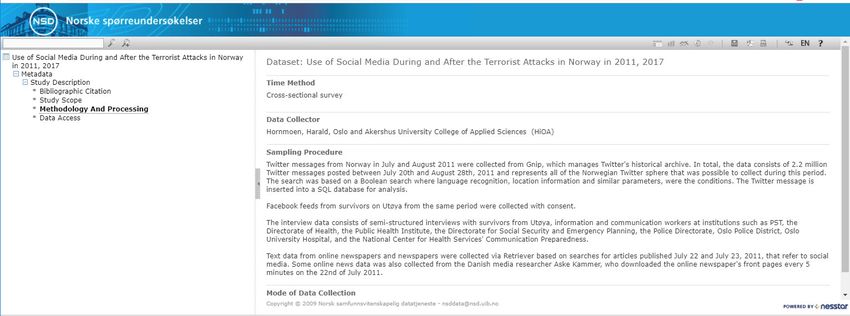
Hornmoen, H. (2017). Use of Social Media During and After
the Terrorist Attacks in Norway in 2011, 2017 [Data set]. Tastes, Ties, and Time Dataverse:
NSD – Norwegian Centre for Research Data. https://dataverse.harvard.edu/dataverse/t3
https://doi.org/10.18712/nsd-nsd2434-v1Future work
Possible improvements of measurement tool:
Selection of most relevant indicators or assign weights
Indicators that are hard to assess:
Need to establish specific operationalisation of maturity levels for certain indicators
depending on the SM data types characteristics:
E.g. Reusable R1.2 RDA-R1.2-02M Metadata includes provenance information
according to a cross-community language ⬤ Useful
0 – not applicable
1 – not being considered this yet
2 – under consideration or in planning phase
3 – in implementation phase
4 – fully implemented Need to agree upon what is the ultimate goal?Aspirational FAIR sharing framework Original FAIR Guiding Principles (https://doi.org/10.1038/sdata.2016.18 ): ‚The intent is that these may act as a guideline for those wishing to enhance the reusability of their data holdings.‘
Thank you for attention!
Questions?
                           Janez.Stebe@FDV.Uni-Lj.Si

  cessda.eu          @CESSDA_Data

Licence: CC-BY 4.0
CESSDA WEBINAR
ARCHIVING SOCIAL MEDIA DATA –
CHALLENGES AND PROPOSED SOLUTIONS
4 JUNE 2020
SHARED STRATEGIES FOR
ETHICAL COLLECTION BUILDING
Sara Day Thomson
Digital Archivist
Previously: Research Officer, DPC
Licence: CC-BY 4.0Overview • Background to the DPC Web Archiving & Preservation Working Group • Different Missions & Mandates within WAPWG • Applying Ethical Review in Different Contexts • Shared Strategies for Ethical Collection Building
Digital Preservation Coalition’s
Web Archiving & Preservation
Working Group
Forum for participants to…

• Share experiences

• Establish common goals

• Inform their own policy development

• Engage with a mutually supportive environment
DPC Members Summer 2020
Different Missions & Mandates within WAPWG
    Researcher                                   Legal or Regulatory
                         Heritage Collections
 Generated Datasets                                 Compliance
• Collected for a       • Based on collecting   • Government or
  particular research     policies                Business archive
  question              • Support range of      • Evidential value
• Machine-readable        research needs        • Demonstrate
  datasets for          • Record of major         transparency and
  quantitative            events, groups, or      accountability
  analysis                themes (e.g. COVID-   • Marketing or
• Possible platform       19 collecting)          promotional
  ‘archives’, web       • Gallery exhibitions     content
  captures, or even       or artworks, social   • Metrics or
  screenshots             media as medium         consumer analysis
Applying Ethical Review in Different Contexts
Web Archiving & Preservation Working Group:
Social Media & Complex Content
16 January 2020
National Records of Scotland, Edinburgh
Small Group Breakout Activity
Ethical Deliberation:
To Archive Twitter or Not to Archive Twitter(Observed) Shared Principles • Social media data constitutes a valuable and critical asset • Platforms do not have a mandate or obligation to preserve these data, but collecting institutions do • Requirement to archive social media supersedes the challenges of collecting it • Ethical decisions are not one size fits all, BUT • Shared ethical framework will support more confident collecting
Shared Strategies for Ethical Collection Building
Contextual ethical review that considers:
1. Purpose of Collecting
2. User Awareness and Consent
3. Subjectivity and (Un)conscious Bias
4. Legal and Regulatory Environment
5. Ethical Mandate to Collect
6. Platform and Functionality
7. Access and Use/Re-use
It is unethical, in some contexts, not to
        archive social media data.
Recommendations for Ethical Collecting • (Educate social media users and researchers who might become depositors about terms of service) • Engage and work with relevant communities • Generate documentation beyond what can be collected without permission online • Comply with platforms’ terms of service where they are congruent with the values of the communities being documented • When possible, apply traditional archival practices such as appraisal, collection development, and donor relations
Good practice is in the process
SARA DAY THOMSON
DIGITAL ARCHIVIST
STHOMS13@ED.AC.UK
@SDAYTHOMSON
Archiving Social Media - Twitter
Ethical challenges for data repositories
Libby Bishop GESIS–Leibniz-Institute for the Social Sciences

4 June 2020 Archiving Social Media Data – Challenges and Proposed Solutions CESSDA Webinar

    cessda.eu                    @CESSDA_Data

 Licence: CC-BY 4.0
Easy – IF info minimal, or public
If data have disclosure risks –
        access controls may be one solution
  “Geotagged Twitter posts from the United States: A tweet collection to
  investigate representativeness”
  No tweet content, only IDs - to comply with Twitter Terms of Service
  Data accessible (by request) but not public because of no consent and
  reidentification risk
  Archived in SowiDataNet-datorium
   Findable – Pfeffer, J. and Morstatter, F. (2016)
   Preserved – DOI - (http://dx.doi.org/10.7802/1166)
   Reproducible - Python scripts,tools,documentation
  As open as possible, closed when necessary
Why archive data at all? Archives claim broad social responsibilities Preservation – historical value Reproducibility – integrity of data and methods Open and FAIR data What (new?) responsibilities arise when archiving social media data?
Do archives have broader ethical responsibilties?
 A researcher wants to deposit data containing tweets from an
 account that was deleted by Twitter. She justifies the violation
 of Terms and Conditions on grounds of historic significance
 and public interest. Should you accept the data?

 A world famous researcher offers you gold star data that
 underpins a widely read policy article. Most of the data cannot
 be archived because of restrictions placed by the platform
 owner. Should you accept the data?
Which data have historical significance?
Twitter account was a front,
created impression that antifa
was inciting violence at
protests

Clearly a violation of T&C to
archive

Is there a competing duty that
overrides complying with T&C?
How far will we go to make data FAIR?
                    Raj Chetty (Prof, Harvard U) is
                    doing unbelievably good work,”
                    said Harvard political scientist
                    Robert Putnam “Mostly, it’s
                    because he’s been able to get
                    access to data that nobody else
                    was able to get access to”.

                    https://www.politico.com/story/2018/02/19/facebook-inequality-
                    stanford-417093
“Rules” have multiple interpretations… “At George Washington (GW) University Libraries, we (unofficially) interpreted this [3rd party sharing] to allow sharing Twitter datasets that we collected with anyone affiliated with GW (including students, faculty, and other researchers) and their collaborators. (What constitutes a “collaborator” is, of course, ambiguous.) If someone from outside GW contacts the library about a dataset, only the tweet ids are shared.” (Justin Littman, “Twitter’s Developer Policies for Researchers, Archivists, and Librarians” https://medium.com/on- archivy/twitters-developer-policies-for-researchers-archivists-and-librarians-63e9ba0433b2)
Where do we stand?
Thank you
                           ElizabethLea.Bishop@gesis.org

  cessda.eu          @CESSDA_Data

Licence: CC-BY 4.0
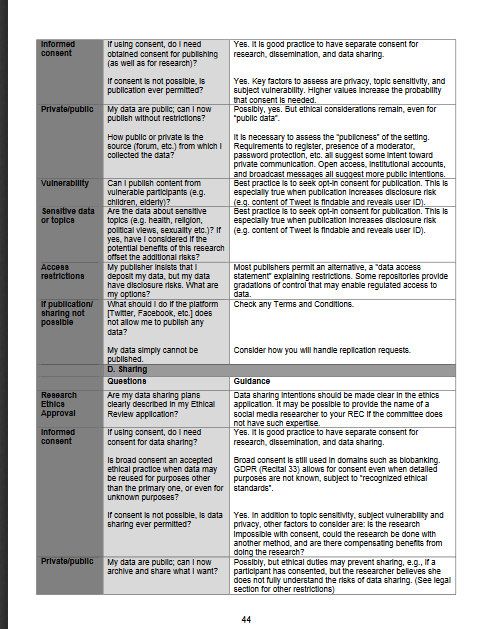
But I need an answer… Towards an Ethical Framework for Publishing Twitter Data in Social Research: Taking into Account Users’ Views, Online Context and Algorithmic Estimation Matthew L Williams, Pete Burnap, Luke Sloan Sociology, First Published May 26, 2017 https://doi.org/10.1177/0038038517708140 Appendix A: Short guide on legal and ethical issues for the researcher to consider when using social media for research WP6-D3 Report (not guidelines) https://seriss.eu/wp- content/uploads/2019/11/D6.3-Report-on- legal-and-ethical-framework-and- strategies...__FINAL.pdf
Archiving Qualitative Social Media Data

                                     Sebastian Karcher (Qualitative Data Repository)
                                                    CESSDA Webinar
                            “Archiving Social Media Data: Challenges and Proposed Solutions ”
                                                      June 4, 2020

This work is licensed under a
Creative Commons Attribution
4.0 International License.
Distinctive Characteristics of Qualitative Social Media Data • Manually collected: • Wide range of sources within single project • Typically no use of API • Small(-ish) n: Individual assessment possible, e.g. • Creators’ intent • Originality • Copyright / Fair use • Consent
Case Study: Clarke (2018)

• Supplementary Data to article in Perspectives on Politics,
• Why and when do refugees in camps/settlements protest? Common
  in Jordan, but not in Turkey and Lebanon
• UNHCR Reports, Socia Media “Event Data”, Interviews (not shared)
Clarke, Killian B. 2018. "Data for: When do the dispossessed protest? Informal leadership and
mobilization in Syrian refugee camps". Qualitative Data
Repository. https://doi.org/10.5064/F6CN723S
Clarke: Event Data Challenges
(Ethics, Copyright, Preservation)

                                    https://doi.org/10.2218/ijdc.v12i2.518
Tools: perma.cc & Internet Archive • Both provide archiving capabilities for web content • IA • Free to use • Large existing archive (WayBackMachine) • Awkward API for archiving • Perma.cc • Archiving requires payment of membership through library • Archiving via API • Screenshots and regular WARC files
Case: Syrian Civil War

                         Wedeen, Lisa. 2019. “Data for: Authoritarian apprehensions:
                         Ideology, judgment, and mourning in Syria.” Qualitative Data
                         Repository.
                              “What led a sizable part of the citizenry to stick by the
                              regime through one atrocity after another? What
                              happens to political judgment in a context of pervasive
                              misinformation? And what might the Syrian example
                              suggest about how authoritarian leaders exploit digital
                              media to create uncertainty, political impasses, and
                              fractures among their citizenries?”

                         • Hundreds of online sources used
                           throughout text
                         • Many of them video (Youtube, Vimeo,
                           etc.)
                         • Additionally, videos from Syrian TV
                           licensed for copyright
Tool: archivr • R-tool developed by QDR • Scans text (or spreadsheet) extracts URLs • Option to archive using IA or perma.cc • Returns list with original URLs and archived URLs (or error) • https://github.com/QualitativeD ataRepository/archivr/
Tool: Webrecorder.io

                       “Webrecorder is both a tool to
                       create high-fidelity, interactive
                       recordings of any web site you
                       browse and a platform to make
                       those recordings accessible.”

                       • Used by QDR to make videos and
                         other non-static formats available
                       • Allows for publish sharing of
                         collections (similar to
                         IA/perma.cc)
A Very Recent Example: Individual Consent From IASSIST List: “A post-doc here wants to download posts and comments from a private Facebook group (…) The group was created by and is managed by some faculty here, so the administrators and members of the group are on-board with the project and with using the posts/comments for research purposes. ”
General Lessons
Sharing Qualitative Social Media Data

• Similar challenges to sharing larger-scale social media data
• Given smaller number of items, individual curation & checks are
  feasible, allowing for more sharing
• Trade-off to “outsourcing” archiving to services such as perma.cc
  and webrecorder.io, but both the technical and legal benefits
  outweigh the risks
• Especially for larger scale efforts, further tools are available from
  Documenting the Now: https://www.docnow.io/
Questions? Comments?

Please stay in touch:
https://qdr.syr.edu

            @adam42smith (Sebastian)
            @qdrepository  (QDR)

Email:      skarcher@syr.edu
            qdr@syr.edu
Archiving Social Media Data –
Challenges and Proposed Solutions
Legal Issues
Oliver Watteler (GESIS)
CESSDA Webinar Archiving Social Media Data –
Challenges and Proposed Solutions (4th of June 2020)
cessda.eu @CESSDA_Data
Licence: CC-BY 4.0Archiving social science research data
View of a repository / research data center / data archive
Archiving = preservation + documentation + publication (e.g. CoreTrustSeal)
Pre-Ingest (> archive agreement):
Clarify legal basis of data collection and thus rights to the data
Clarify conditions for re-use
Ingest - ingest check
Check data quality
Check content of data and documentation for legal issues
Information reduction if necessary
Restrict access if necessaryWhat are Social Media data? Social media data - attributes (Obar, Wildman 2015): Internet-based applications User-generated content User-specific profiles for individuals and groups Social networking by connecting profiles of different users Which (most prominent) rights are involved in the use of Social Media platforms? Contractual agreement between user and platform provider (‘Terms of Service’) Data protection for personal information Intellectual property rights (IPR) for content like photos, videos, audios, (creative) texts Database rights
How are Social Media data collected?
 Research interests?
  As diverse as social research (Van Osch, Coursaris 2015)
 Which ways of collection are there (Breuer et al. 2020)?
  Web scraping – problem: restricted access to some information behind login
  Application Programming Interfaces (API) – bound by technical limitations
  Cooperating with platform provider (“privileged access”)
  Purchase the data
 What are the legal bases for data collection?
  Application of a law (rather not in our case)
  Informed consent (scraping with consent, “data donation”, tracing with sensors …)
  Freedom of research (not equally established internationally; Santosuosso 2012)?
  Agreement to ‘Terms of Service’ (usage agreement, purchasing contract)
     Circumvention a „gray area“ (Halavais 2019, franzke et al. 2020)
     Illegal techniques applied? (“hacking”, deceit, fraud, …)
What is supposed to be archived?
What data are we looking at? What are the legal Possible challenges
impediments?
Personal data Data Protection Legislation Breach of confidentiality, breach of privacy, re-
(e.g. names if no alias or nickname, personal identification (also others)
information)
Also from other individuals!
Images / videos / sound recordings IPR, Data Protection Legislation Copyright violation, breach of individual personal
rights
Texts IPR Copyright violation
(depending on the level of creativity)
Parts of a database (platform providers) Database Protection Database creator‘s rights violation
Technical metadata ? Some technical metadata might enable disclosure
(e.g. time stamps, IP ranges, …) of information (e.g. preferences), or lead to
‚profiling‘ (linking various social media profiles)
Main problem: data might have been collected without neither consent by the ‘data
subjects’ (GDPR term) nor consent by the platform providers (violation of ‘Terms of
Service’)Means of archives to meet the challenges?
In the ideal case: all rights are clarfied - in the real world: often rights are not clarified
“Classical instruments” of data archiving on data level (pro‘s and con‘s):
Activity Pro‘s Con‘s
A Data Protection • Information reduction • No need to protect anonymized data • Anonymization hardly possible
(pseudonymization / anonymization) (Narayanan, Felten 2014)
• Aggregation • Information reduction reduces value
of data
B Protection of copyright • Delete copyright protected material • Non copyright-protected information • Information reduction reduces value
• Keep content if possible can be published (without personal of data
(e.g. text korpus) information under A)
C Protection of databases • Only archive (part of) content of • Data („facts“) per se (if not under A • Access to data more difficult
database or B) often not protectable
If data was collected legally and purpose of use remains public interest (esp. UK), science or
statistics: restrict access (for ‘person-related’ data, see GDPR)
Other tools might be transferrable - e.g. ‘fabrication’ (≈ ‘synthetic data’ in Official Statistics)
Repositories’ answer: need for new tools to match Big Data’s 3 v’s (volume, velocity, variety –
sometimes also veracity); solutions in the making
(Kinder-Kurlanda et al. 2017; Breuer et al. 2020)Thank you for your attention
oliver.watteler@gesis.org
cessda.eu @CESSDA_Data
Licence: CC-BY 4.0References AAPOR (2015): AAPOR Big Data Task Force, AAPOR Report on Big Data, https://www.aapor.org/Education-Resources/Reports/Big-Data.aspx; last access: 01.06.2020 Breuer et al. (2020): Johannes Breuer, Libby Bishop, Katharina E. Kinder-Kurlanda (Forthcoming), The practical and ethical challenges in acquiring and sharing digital trace data: negotiating public-private partnerships, in: New Media & Society CoreTrustSeal (2018): CoreTrustSeal, Core Trustworthy Data. Repositories Extended Guidance, 2018, https://www.coretrustseal.org/wp-content/uploads/2017/01/20180629- CTS-Extended-Guidance-v1.1.pdf; last access: 29.05.2020 Corti et al. (2020): Louise Corti, Libby Bishop, Veerle Van den Eynden and Scott Summers, Working with Big and Novel Data, in: Louise Corti et al., Managing and Sharing Research Data. A Guide to Good Practise, SAGE, 308-332 franzke et al. (2020): aline shakti franzke, et al., Internet Research: Ethical Guidelines 3.0, https://aoir.org/reports/ethics3.pdf; last access: 29.05.2020 Halavais (2019): Alexander Halavais, Overcoming terms of service: a proposal for ethical distributed research, in: Information, Communication & Society, 22(11), 1567-1581, https://doi.org/10.1080/1369118X.2019.1627386; last access: 29.05.2020 Kinder-Kurlanda et al. (2017): Katharina Kinder-Kurlanda et al., Archiving Information from Geotagged Tweets to Promote Reproducibility and Comparability in Social Media Research, in: Big Data & Society, 4 (2), 1-14, http://dx.doi.org/10.1177/2053951717736336; last access: 02.06.2020 Lynch (2017): Clifford Lynch, Stewardship in the "Age of Algorithms“, in: First Monday, 22(12), https://doi.org/10.5210/fm.v22i12.8097; last access: 29/05/2020 Narayanan, Felten (2014): Arvind Narayanan, Edward W. Felten, No silver bullet: De-identification still doesn't work, Princeton, https://www.cs.princeton.edu/~arvindn/publications/no-silver-bullet-de-identification.pdf; last access: 29.05.2020 Obar, Wildman (2015): Social media definition and the governance challenge: An introduction to the special issue, in: Telecommunications Policy, 39(9), 745-750, https://doi.org/10.1016/j.telpol.2015.07.014; last access: 29/05/2020 Santosuosso (2012): Amedeo Santosuosso, Freedom of Research and Constitutional Law. Some Critical Points, in: Simona Giordano et al. (Eds.), Scientific Freedom: An Anthology on Freedom of Scientific Research, London, 73-82, https://www.bloomsburycollections.com/book/scientific-freedom-an-anthology-on-freedom-of-scientific-research/ch6-freedom-of-research-and-constitutional-law; last access: 29/05/2020 Van Osch, Coursaris (2015): Wietske Van Osch, Constantinos K. Coursaris, A Meta-Analysis of Theories and Topics in Social Media Research, 2015 48th Hawaii International Conference on System Sciences, Kauai, HI, 2015, pp. 1668-1675, https://ieeexplore.ieee.org/document/7070011; last access: 29/05/2020
Archiving Social Media Data
Challenges and Proposed Solutions

           Roundtable Discussion
Questions
@ Libby Hemphill:
Given your role with archiving ethnic minority data
 and the fact you are based in Michigan, what do
  you know of what is being collected about the
 current #Blacklivesmatter activity and what are
  the specific ethical or other challenges of that?
@ Libby Hemphill:
    In your presentation you talked about
 metadata enhancement. Could you maybe
specify this a bit? (in our experience, we may
   have the feeling that metadata must be
         « perfect » when published)
@ Janez Štebe:
Is there minimum requirement for data to
meet each of the FAIR principles? For
example 80% or higher?Is it legal to use images/videos shared on
the social media platform? For example,
profile pictures, screenshots showing tweet
or Facebook postsWhat if researchers do not know which Terms of Service they agreed to? What if they scraped the data?
Where/how do copyright and 'legal
restrictions' impact archiving social media
                   data?
Who should archive social media data?
For how long is the commitment?
Where is the funding to curate the
collections coming from?follow up question to my previous question,
for a research, if we are working with 1000
twitter profile, It is not possible to ask
everyone and take permission to use their
profile picture and name. In this case, can
we stop bothering about about IPR and
publish the results? Or what should we do?This is a question for everyone not from GESIS :) What are your experiences
with social media researchers’ interest in archiving their data? Are they e.g.
actively approaching archives? Especially authors of ‘gold standard’, high-
quality datasets that Libby Bishop just mentioned? From our experience some
researchers from social science/media and communication backgrounds are
indeed interested, but e.g. the large georeferenced dataset that Libby
mentioned needed to be very actively recruited (eventually by making it a
paper project:
) - so
considerable effort from various GESIS archivists was required.« everybody » , what type of standards
do you use to implement metadata ?
DDI, RDF , (Disco) ?Thank You! cessda.eu @CESSDA_Data Licence: CC-BY 4.0
You can also read


