2021 NACOR USER GUIDE - Anesthesia Quality Institute
←
→
Page content transcription
If your browser does not render page correctly, please read the page content below
2021 NACOR USER GUIDE
 NACOR Basic
 NACOR Benchmarking
 NACOR Standard Quality Reporting

A step-by-step guide to submitting data to the
Anesthesia Quality Institute’s National Anesthesia
Clinical Outcomes Registry (NACOR).

April 2021

       1061 American Lane, Schaumburg, IL 60173
           847-268-9192 | askaqi@asahq.org.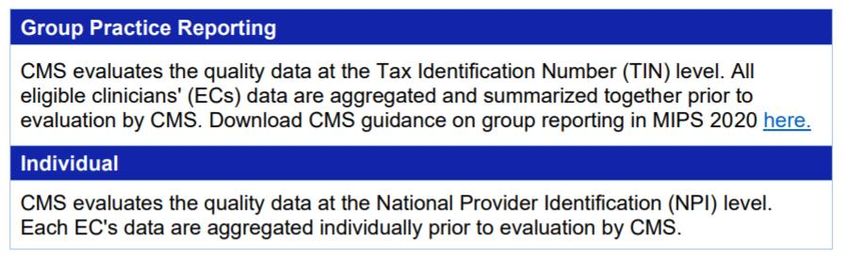
Contents
Disclaimer and Copyright Statement ............................................................................................................ 3
Introduction.................................................................................................................................................... 4
NACOR Basic ............................................................................................................................................... 5
Benefits ......................................................................................................................................................... 5
NACOR Benchmarking ................................................................................................................................. 6
Reporting Clinical Outcomes/Adverse Events (excluding CMS measure data) ........................................... 7
NACOR Standard Quality Reporting ............................................................................................................. 9
   Quick Quality Payment Program (QPP) Links......................................................................... 9
NACOR Quality Reporting Options ............................................................................................................. 10
   Considerations for Individual vs. Group Practice Reporting ...................................................10
NACOR Quality Reporting Mechanisms – QR and QCDR ......................................................................... 13
   QR versus QCDR ..................................................................................................................13
   QR – Measures and Reporting Requirements .......................................................................13
   QCDR– Measures and Reporting Requirements ...................................................................15
MIPS Reporting – Improvement Activities (IA) Component ........................................................................ 16
   Attesting to Improvement Activities ........................................................................................16
2021 Quality Reporting Deadlines .............................................................................................................. 17
Deadlines .................................................................................................................................................... 17
Collecting Your Data ................................................................................................................................... 18
   Reporting Outcomes/Adverse Events (excluding CMS measure data) ..................................19
Collection Methodologies ............................................................................................................................ 20
NACOR Quality Concierge.......................................................................................................................... 22
Creating Your Data File............................................................................................................................... 23
Submitting data to NACOR ......................................................................................................................... 25
   File Review and Notification ..................................................................................................25
Error notifications will be sent when: ........................................................................................................... 25
   Additional Support .................................................................................................................25
Data Transmission ...................................................................................................................................... 26
   File Format Specifications .....................................................................................................26
   File Naming ...........................................................................................................................26
Data Submission Process ........................................................................................................................... 26
Submission Options .................................................................................................................................... 27
   Secure FTP (SFTP) ...............................................................................................................27
   Web Portal ............................................................................................................................27
©2021 Anesthesia Quality Institute. All rights reserved. Please contact the Anesthesia Quality
Institute at askaqi@asahq.org for permission to use any of the information in this document.
Updated February 2021.
Directory Configuration ..........................................................................................................27
   Login Page ............................................................................................................................28
   Data Submission Directory ....................................................................................................28
   Account Profile ......................................................................................................................29
   SFTP Keys ............................................................................................................................30
   Data Validation Emails ..........................................................................................................31
Example 1: File passed minimum validation criteria ................................................................................... 31
Example 2: File passed validation .............................................................................................................. 32
Example 3: File Failed Validation ................................................................................................................ 33
Additional Resources and Contacts ............................................................................................................ 34
Appendix A: 2021 NACOR Minimum Data Set ........................................................................................... 35
Appendix B: NACOR Quality Reporting – Roles and Responsibilities ....................................................... 36

©2021 Anesthesia Quality Institute. All rights reserved. Please contact the Anesthesia Quality
Institute at askaqi@asahq.org for permission to use any of the information in this document.
Updated February 2021.
Disclaimer and Copyright Statement

Participation in NACOR Quality Reporting does not guarantee satisfactory participation in the Centers for
Medicare and Medicaid Services (CMS) Merit-based Incentive Payment System (MIPS) program.
Successful submission to CMS is contingent upon each individual eligible clinician (EC) and/or practice
meeting the MIPS program requirements and the timeliness, quality, and accuracy of the data they
provide for reporting. The information provided is not to be construed as practice management or legal
advice. Every reasonable effort has been made to ensure the accuracy of the information presented at
the time of posting, but the American Society of Anesthesiologists (ASA), and its related organization, the
Anesthesia Quality Institute (AQI) do not warrant or guarantee that the information presented is
exhaustive or error- free. AQI and ASA further disclaim all liability for loss or damage incurred by third
parties arising from the use of the information. Please consult your legal advisor or other qualified
professional for guidance and information specific to your situation.

The performance measures (Measures) and this guidance are not clinical guidelines, do not establish a
standard of medical care, and have not been tested for all potential applicants. ASA and AQI shall not be
responsible for any use of the Measures or guidance materials. The Measures and guidance, while
copyrighted, can be reproduced and distributed, without modification, for noncommercial purposes, e.g.,
use by health care providers in connection with their practices. Commercial use is defined as the sale,
license or distribution of the Measures or guidance for commercial gain, or incorporation of the Measures
or guidance into a product or service that is sold, licensed, or distributed for commercial gain. ASA and
AQI encourage use of the Measures and guidance by other health care professionals, where appropriate.
Please contact AQI at askaqi@asahq.org before using information contained in this document to ensure
proper permissions are obtained.

Limited proprietary coding is contained in this guidance for convenience. Users of the proprietary code
sets should obtain all necessary licenses from the owners of these code sets. ASA and AQI disclaim all
liability for use or accuracy of any Current Procedural Terminology (CPT®), or other coding contained
herein. THE MEASURES AND GUIDANCE ARE PROVIDED “AS IS” WITHOUT WARRANTY OF ANY
KIND.

©2021 Anesthesia Quality Institute. All rights reserved. Please contact the Anesthesia Quality
Institute at askaqi@asahq.org for permission to use any of the information in this document.
Updated February 2021.
Introduction

The Anesthesia Quality Institute (AQI) was established by the American Society of Anesthesiologists in
October 2008 to facilitate practice-based quality management through education and quality data
feedback.

Home to the National Anesthesia Clinical Outcomes Registry (NACOR), the largest anesthesia registry in
the country, AQI's vision is "to be the primary source of information for quality improvement in the clinical
practice of anesthesiology. Through education and quality feedback, AQI will help to improve the quality
care of patients, lower anesthesia mortality and lower anesthesia incidents."

AQI is listed as a Patient Safety Organization (PSO) by the Department of Health & Human Services
(HHS), and ASA is a member of the National Quality Forum (NQF). AQI’s NACOR is a designated
Qualified Registry (QR) and Qualified Clinical Data Registry (QCDR) for the Centers for Medicare &
Medicaid Services (CMS) Quality Payment Program (QPP). With millions of cases and growing, AQI's
clinical data informs treatment choices and helps informs treatment choices and helps control treatment
costs.

©2021 Anesthesia Quality Institute. All rights reserved. Please contact the Anesthesia Quality
Institute at askaqi@asahq.org for permission to use any of the information in this document.
Updated February 2021.
NACOR Basic

NACOR Basic is intended for all anesthesia providers in all practice settings
and does not include additional quality reporting options. The registry
provides:
        •   Interactive analytical reports
        •   Ability to analyze data across various dimensions.
        •   Local benchmarks

NACOR participants have continuous online access to NACOR reports, which they can use to
identify gaps in specific quality measures. Performance tracking reports capture trends over
time and help measure improvements in care. NACOR Basic provides access to local
benchmarking reports.

Participants also can use NACOR to identify outliers and review performance results across
their patient populations to help address clinical gaps and better inform local practice
improvement interventions. Data can be used to review performance and quickly determine the
impact of an improvement intervention. Results are presented graphically to identify trends in
performance.

Participants range from pen-and-paper anesthesiology practices to the most technologically
advanced academic centers. An Anesthesia Information Management System (AIMS) or
electronic health record (EHR) is not required to participate. Participation requires close
collaboration between the anesthesia practice, its providers and health care technology
vendors.

Benefits
   • Provides comprehensive MIPS reporting and supports your local quality improvement
       activities.
   • Includes specialty-specific reporting measures, providing broader options that may be
       more meaningful to your practice

©2021 Anesthesia Quality Institute. All rights reserved. Please contact the Anesthesia Quality
Institute at askaqi@asahq.org for permission to use any of the information in this document.
Updated February 2021.
NACOR Benchmarking
NACOR Benchmarking, which is intended for all anesthesia providers in all practice settings. Ideal for
national benchmarks and quality improvement initiatives, the registry provides:
• All features of NACOR Basic, plus national performance indicators
• Custom continuous performance monitors
• Ability to measure performance beyond local facility.
• Performance gap analysis and patient outlier identification
• National comparative analytic reports
• Peer-to-peer benchmarks
Performance
Participants have continuous online access to NACOR reports, which they can use to identify gaps in
specific quality measures and focus efforts to close those gaps.
Performance tracking reports capture trends over time and help measure improvements in quality care.
NACOR also provides access to national benchmarking reports.
Identify Outliers
NACOR participants also can improve care by reviewing performance results across their patient
population, which helps address clinical gaps in a timely manner. Consider interventions that can lead to
sustainable practice improvement for your aggregate performance, which can help reduce outliers in the
future.
Improvement
NACOR identifies possible interventions based on clinical quality gaps found through calculating selected
data. Data can be used to review performance and quickly determine the impact of an improvement
intervention. Results are presented graphically to identify trends in performance.
Participants range from pen-and-paper anesthesiology practices to the most technologically advanced
academic centers. An AIMS system or electronic health record (EHR) is not required to participate.
Participation requires close collaboration between the anesthesia practice, its providers and healthcare
technology vendors. Roles are defined as follows:
Key roles for individual anesthesia practices, hospitals, and providers
• Provide data to NACOR.
• Use reports to improve patient care to meet various local, state and
federal regulatory requirements.
Key roles for anesthesia information technology vendors
Facilitate NACOR reporting with practices; vendors that provide formatted data for NACOR will be listed
as AQI Vendors.
©2021 Anesthesia Quality Institute. All rights reserved. Please contact the Anesthesia Quality
Institute at askaqi@asahq.org for permission to use any of the information in this document.
Updated February 2021.Intended for all clinicians in all practice settings, NACOR Benchmarking provides:
• All features of NACOR Basic plus national performance indicators
• Custom performance monitors
• Ability to measure performance beyond local facility
Features and reports include:
• Billing and administrative data
• Comorbidities and outcomes
• National peer-to-peer benchmarking
• National comparative analytic reports
• Performance gap analysis
• Patient outlier identification
Reporting Clinical Outcomes/Adverse Events (excluding CMS measure data)
If a practice is reporting clinical outcomes to NACOR, a blank outcome field is interpreted in the database
as "no adverse event." Ideally, the most accurate capture is to record 'yes' or 'no' for an adverse event for
every case. We recognize many practices are capturing outcomes on paper or some other manual
system where clicking a box 'yes' or 'no' for every case may be resource intensive and interrupt workflow.
There are currently 103 clinical outcomes/adverse events available to be reported to NACOR. The
complete list of outcomes can be found on the AQI website, but examples include:
• Airway trauma
• Anaphylaxis
• Arrhythmia
• Cardiac Arrest
• Delirium
The following sample assumes that only 9 outcomes are tracked and maintained by the data submitter.
Outcomes 18 & 20-27 are reported and will be benchmarked for the practice. Other outcomes will not be
as they are not reported. Each practice submitting outcomes will be required to report on a particular
outcome (either occurred or not occurred) to receive benchmarks for that outcome.
©2021 Anesthesia Quality Institute. All rights reserved. Please contact the Anesthesia Quality
Institute at askaqi@asahq.org for permission to use any of the information in this document.
Updated February 2021.Following is an example of how to report a clinical outcome in the data file: 18 true 2019-01-01T07:00:00 Mild Harm PACU 20 false 21 false 22 false 23 false 24 false 25 false 26 false 27 false 10 Beginning in 2018 Outcomes definitions are standardized, and all vendors and groups should report based on definitions posted on the AQI website. ©2021 Anesthesia Quality Institute. All rights reserved. Please contact the Anesthesia Quality Institute at askaqi@asahq.org for permission to use any of the information in this document. Updated February 2021.
NACOR Standard Quality Reporting

For 2021, NACOR will support the Quality and Improvement Activities Components of MIPS. For the
Quality Component, NACOR offers two reporting options (Group Practice Reporting and Individual) and
two reporting mechanisms (Qualified Registry and Qualified Clinical Data Registry).

For the Improvement Activities Component, NACOR supports attestation of the Improvement Activities via
the NACOR dashboard.

Quick Quality Payment Program (QPP) Links

    •   ASA MACRA Website
    •   CMS Quality Payment Program Website

©2021 Anesthesia Quality Institute. All rights reserved. Please contact the Anesthesia Quality
Institute at askaqi@asahq.org for permission to use any of the information in this document.
Updated February 2021.
NACOR Quality Reporting Options
AQI's NACOR offers two quality reporting options for practices participating in MIPS.
Considerations for Individual vs. Group Practice Reporting
ECs reporting for the Merit-based Incentive Payment System (MIPS) via QR or QCDR can report at the
individual level or through Group Practice Reporting in 2021.
Do I have to report MIPS?
Physicians and other clinicians can check their MIPS eligibility here:
https://qpp.cms.gov/learn/eligibility
What is Individual reporting?
As previously mentioned, ECs reporting at the individual level will be assessed based upon their NPI.
Payment adjustments are based on performance across all MIPS categories and will be applied to the
individual EC’s Medicare Part B reimbursements in the correlating payment year.
What is Group Practice Reporting?
A group can report via Group Practice Reporting when two or more ECs reassign their billing rights to a
single Tax Identifier Number (TIN). Groups are assessed collectively at the TIN level across all MIPS
categories and payment adjustments will be applied across the group. To participate in Group Practice
Reporting via QR or QCDR, all ECs within the TIN must be registered with AQI, including CRNAs.
Are there different reporting requirements for individual and Group Practice Reporting?
Requirements for the MIPS performance categories are similar for individual and group reporting for both
QR and QCDR. All ECs, reporting either individually or via Group Practice Reporting must report:
• All payer data, Medicare, and Non-Medicare
• Minimum of 70 percent of all denominator-eligible cases for all measures
• Six measures, including one outcome or high-priority measure as specified by CMS.
• Attest to Improvement Activities equaling 40 points.
ECs and groups electing to report via QCDR will be able to report ASA QCDR measures and MIPS
measures, potentially expanding the pool of applicable measures to report for the MIPS Quality
Component. ECs and groups reporting via QR can report MIPS measures only.
So, should we report individually or via Group Practice Reporting?
There are several factors: unique to each practice, to consider when deciding whether to report
individually or via Group Practice Reporting, including:
©2021 Anesthesia Quality Institute. All rights reserved. Please contact the Anesthesia Quality
Institute at askaqi@asahq.org for permission to use any of the information in this document.
Updated February 2021.• Past performance: Were clinicians successful in PQRS?
If a group elects to report via Group Practice Reporting, any payment adjustment will be applied
at the TIN level to all ECs. If a few ECs fail to meet reporting requirements or have poor
performance, this could affect the entire group’s payment adjustment.
o Please note ECs must notify AQI if they wish to report via Group
Practice Reporting or individually.
• Reporting burden: Can an individual EC successfully meet all reporting requirements? Is it easier
to do so as a group?
Specialty ECs may struggle to meet the six-measure requirement and may find it easier to report
as a group. Practices should consider how this can shift reporting burden to a select few
members of a group. For example, a cardiac anesthesia measure may apply to only two ECs in a
large group. As a reminder, 70 percent of all denominator-eligible cases must be reported
for each selected measure.
What if a few clinicians in a group are exempt from MIPS and the rest are not?
If a few clinicians in a practice are exempt from reporting individually, but the group is eligible to report
MIPS via Group Practice Reporting, practices have a couple options:
• All eligible clinicians report individually. In this case, the clinicians exempt from MIPS do not have
to report at all. Clinicians eligible for MIPS at the individual level must report and meet reporting
requirements as an individual. The low volume threshold for individuals is defined as clinicians
with less than or equal to $90,000 in allowed charges or less than or equal to 200 Medicare
patients and less than or equal to 200 covered professional services for Part B patients.
• All clinicians report as a group. The entire group must report all data for all clinicians, including
clinicians who would have been exempt as individuals. As data are submitted at the TIN level,
payment adjustments are applied at the TIN level. The low volume threshold for groups is defined
as practices with less than or equal to $90,000 in allowed charges or less than or equal
to 200 Medicare patients and less than or equal to 200 covered professional services for Part B
patients.
What about non-patient-facing and hospital-based clinicians? How do they factor in?
ECs who are deemed non patient-facing or hospital-based status must report Quality and Improvement
Activities, but not the Advancing Care Information (ACI) category. For these ECs, the Quality component
is reweighted to 85 percent and Improvement Activities remain at 15 percent. Non-patient facing and
hospital-based ECs and groups still must report six (6) measures or if there are not six, must report all
measures that apply to their patient population. For the Improvement Activities component, activities are
reweighted for non-patient-facing and hospital-based physicians, with medium activities equaling 20
points and high-weighted activities equaling 40 points. Therefore, non-patient facing, and hospital-based
ECs can perform two medium-weighted Improvement Activities or one high-weighted Improvement
Activity to meet component requirements.
An entire group is considered non-patient-facing or hospital-based if 75 percent or more ECs fall into
these categories. CMS letters noting practice eligibility in MIPS clarify whether a group is considered
entirely non-patient-facing or hospital-based. Groups should consider the differences in requirements and
their ability to meet these requirements based on their clinician status and specific practice contingencies.
ECs who are deemed non patient facing will earn 2x the points for each improvement activity you submit.
You will also qualify for automatic reweighting of the Promoting Interoperability performance category to
0%. The 25% category weight will be redistributed to another performance category or categories unless
you choose to submit Promoting Interoperability data. For the Improvement Activities component,
©2021 Anesthesia Quality Institute. All rights reserved. Please contact the Anesthesia Quality
Institute at askaqi@asahq.org for permission to use any of the information in this document.
Updated February 2021.activities are reweighted for non-patient-facing, with medium activities equaling 20 points and high- weighted activities equaling 40 points. Therefore, non-patient facing can perform two medium-weighted Improvement Activities or one high-weighted Improvement Activity to meet component requirements. If you are hospital-based, you qualify for automatic reweighting of the Promoting Interoperability performance category to 0%. The 25% category weight will be redistributed to another performance category (or categories) unless you choose to submit Promoting Interoperability data. Non-patient facing and hospital-based ECs and groups still must report six (6) measures or if there are not six, must report all measures that apply to their patient population. An entire group is considered non-patient-facing or hospital-based if 75 percent or more ECs fall into these categories. CMS letters noting practice eligibility in MIPS clarify whether a group is considered entirely non-patient-facing or hospital-based. Groups should consider the differences in requirements and their ability to meet these requirements based on their clinician status and specific practice contingencies. How should I consider part-time clinicians or locum tenens in my practice? CMS will notify all clinicians of eligibility in MIPS. If a part-time clinician meets the minimum eligibility requirements, he/she is required to report to MIPS to the same standard of a full-time clinician. Locum tenens are not considered MIPS ECs and they should bill for services they provide using the NPI of the clinician for whom they are substituting. ©2021 Anesthesia Quality Institute. All rights reserved. Please contact the Anesthesia Quality Institute at askaqi@asahq.org for permission to use any of the information in this document. Updated February 2021.
NACOR Quality Reporting Mechanisms – QR and QCDR

AQI's NACOR offers two quality reporting mechanisms, QCDR and QR, which use NACOR to collect data
for quality reporting and help ECs meet the CMS requirements. Practices should consider the following to
help them decide which NACOR quality reporting option to choose:

QR versus QCDR

                                  QR
                                                    QR Group           QCDR Individual           QCDR Group
                               Individual

 Number of measures
                                    6                    6                       6                     6
 to be reported

 Number of outcome
 measures to be                     1                    1                       1                     1
 reported
 Payers                        All Payers           All Payers              All Payers             All Payers

 Types of measures                                                       MIPS and non-           MIPS and non-
                               MIPS only            MIPS only
 available to report                                                      MIPS/QCDR               MIPS/QCDR

 Data evaluated by              NPI/TIN                 TIN                  NPI/TIN                  TIN

QR – Measures and Reporting Requirements

Identifying Your Measures
Measure specifications provide the details of each measure, including measure description, type
of measure (process/outcome), domain name, denominator criteria and numerator options.
Denominator: The eligible cases for a measure or the eligible patient population.
Numerator: The specific clinical action required by the measure for performance.

Practices can only report on measures for which they bill the CPT codes listed in the
denominators. In meeting the criteria for reporting measures, participants can only report on
the 16 MIPS measures supported by the NACOR QR.

©2021 Anesthesia Quality Institute. All rights reserved. Please contact the Anesthesia Quality
Institute at askaqi@asahq.org for permission to use any of the information in this document.
Updated February 2021.
For 2021, CMS has recommended the following Anesthesiology-Specific
Measure Set:
• MIPS #44: CABG: Preoperative Beta-Blocker in Patients with Isolated CABG Surgery
• MIPS #76: Prevention of CVC-Related Bloodstream Infections*
• MIPS #404: Anesthesiology Smoking Abstinence*
• MIPS #424: Perioperative Temperature Management*
• MIPS #430: Prevention of PONV – Combination Therapy*
• MIPS #463: Prevention of Post-Operative Vomiting (POV) – Combination Therapy
(Pediatrics)*
• MIPS #477: Multimodal Pain Management*
*designates a proposed "high priority measure."
High-Priority Measure: Measure appropriate use, patient safety, efficiency, patient experience
or care coordination. Eligible clinicians are not required to report across multiple National
Quality Strategy domains.
If your providers see patients in a preoperative clinic or do any inpatient hospital visits that
require billing Evaluation and Management (E&M) Codes, additional MIPS measures may be
available to report.
Reporting Requirements
• Report at least six measures with one outcome measure available under a QR.
• Report each measure for at least 70 percent of the eligible cases for the EC’s patients.
This includes case data for all payers (not just Medicare).
• A measure with a zero percent performance rate will not be counted unless it is an
inverse measure.
MIPS Measure details can be found on the Quality Payment Program website
under the Resource library.
©2021 Anesthesia Quality Institute. All rights reserved. Please contact the Anesthesia Quality
Institute at askaqi@asahq.org for permission to use any of the information in this document.
Updated February 2021.QCDR– Measures and Reporting Requirements
Identifying Your Measures
Measure specifications provide the details of each measure, including measure description, type
of measure (process/outcome), denominator criteria and numerator options.
• Denominator: The eligible cases for a measure or the eligible patient population.
• Numerator: The specific clinical action required by the measure for performance.
Practices can only report on measures for which they bill the CPT codes listed in the
denominators.
2021 non-MIPS/QCDR Measures
For 2021 the NACOR QCDR has been approved for 32 measures (16 MIPS and 16 QCDR
Measures) The measure specifications can be found here:
• 2021 MIPS Measures Available for Reporting through AQI NACOR
• 2021 QCDR Measure Booklet
Reporting Requirements
• Report at least six measures with one outcome measure available under a QCDR.
• Report each measure for at least 70 percent of the eligible cases for the EC’s patients.
This includes case data for all payers (not just Medicare).
• In meeting the criteria for reporting measures, participants can report on a combination
of MIPS and non-MIPS measures through the QCDR.
• A measure with a zero percent performance rate will not be counted
unless it is an inverse measure.
©2021 Anesthesia Quality Institute. All rights reserved. Please contact the Anesthesia Quality
Institute at askaqi@asahq.org for permission to use any of the information in this document.
Updated February 2021.MIPS Reporting – Improvement Activities (IA) Component
For 2021, AQI’s NACOR will support attestation of the Improvement Activities via the NACOR
dashboard.
Improvement Activities is a scored category of MIPS that aims to reward eligible clinicians for
engaging in activities such as care coordination, beneficiary engagement and patient safety.
Improvement Activities account for 15% of the total MIPS Composite Score in performance year
2021 and beyond.
Each activity is assigned a weight of either medium or high. Medium activities receive 10 points
and high activities receive 20 points. To receive full credit, eligible clinicians must receive a
score of 40 points or more. Additionally, for groups (Group Reporting) to attest to an activity at
least 50% of the clinicians must perform the same activity during any continuous 90-day period.
ASA has developed the following resources to assist anesthesia providers and practices with
the selection of Improvement Activities to attest for credit in the MIPS Improvement Activities
category:
• 2021 AQI Supported Improvement Activities for Anesthesiology
For a full list, visit the CMS Quality Payment Program website.
Attesting to Improvement Activities
Before your practice attests to an Improvement Activity please keep the
following in mind:
• Practice must perform the activity for a minimum of 90 days.
• Practice needs to maintain documentation for 6 years in case CMS audits.
• Practice should contact CMS directly (qpp@cms.hhs.gov) to
verify documentation is sufficient.
Improvement Activity attestation is completed using the provider list in the NACOR dashboard.
For further assistance with IA attestation please contact your AQI Account Manager or email
askaqi@asahq.org
©2021 Anesthesia Quality Institute. All rights reserved. Please contact the Anesthesia Quality
Institute at askaqi@asahq.org for permission to use any of the information in this document.
Updated February 2021.2021 Quality Reporting Deadlines
Deadlines
Enrollment in NACOR Quality Reporting October 1, 2021
• January-November 2021 Data
Submission
• Final reconciliation of TIN, NPI and
Report to CMS selection by the
Practice January 31, 2022
• Improvement Activity attestations
must be completed.
• EC’s reporting as individuals must
have signed provider consents on file.
December 2021 Data Submission February 15, 2022
Data submitted by AQI to CMS No Later than March 31, 2022
2021 MIPS Final Scores Released July 2022
©2021 Anesthesia Quality Institute. All rights reserved. Please contact the Anesthesia Quality
Institute at askaqi@asahq.org for permission to use any of the information in this document.
Updated February 2021.Collecting Your Data
NACOR collects data from anesthesia practices and hospitals through data
extracts developed by software vendors or reports generated by the practice
and/or hospital.
Participation in NACOR Basic and NACOR Quality Reporting requires
collection of the NACOR Minimum Data Field Requirements:
NACOR Minimum Data Field Requirements
Unique Anesthesia Episode of Care ID Patient Sex
Provider TIN Patient Age, Patient Date of Birth (one or
both)
Provider Credentials (e.g., Anesthesiologist, ASA Physical Status (with "E" designator
Certified Registered Nurse Anesthetist, etc.) when appropriate)
Facility ID – ID created by the practice. Must ASA CPT Code (with modifiers as
be the same as the number in the roster appropriate)
(see Exhibit A of the Participation
Agreement).
Date of Service Surgical CPT Code (with modifiers as
appropriate)
Anesthesia Start Time Procedure Status (Emergency, Elective)
Anesthesia End Time Payment Method
The source of this data is the administrative and billing data from the practice
billing software.
If your practice enrolls in NACOR Quality Reporting, the following fields must be
added to your data file:
Data Elements Example
MIPS/non-MIPS Measure Number MIPS 424
Reported Value (CPT II Code, HCPCS
G9654 or 11A36
Code, non-MIPS Measure Code)
Appropriate Code Modifiers 1P, 8P, GQ, or GT
CMS Place of Service Codes CMS Place of Service Codes
©2021 Anesthesia Quality Institute. All rights reserved. Please contact the Anesthesia Quality
Institute at askaqi@asahq.org for permission to use any of the information in this document.
Updated February 2021.Reporting Outcomes/Adverse Events (excluding CMS measure data)
If a practice chooses to report patient outcomes to NACOR, the source of the data will be from
the Anesthesiology Department data or from linkage to surgical databases that capture patient
outcomes. Outcomes collected on paper must be converted to electronic format for submission
to NACOR.
• If a practice reports outcome to NACOR the practice must indicate “yes” or “no” for each
outcome they track for each case. Clinicians may still select “no adverse event” in
tracking forms, however when preparing reports for NACOR, “no adverse event” must be
converted to “no” for each outcome the practice tracks.
• Outcomes definitions are standardized and should be used by all vendors and groups.
• Outcomes must be included in the billing data file. If practices require
services to merge billing and administrative data with clinical outcomes data,
please contact us at askaqi@asahq.org.
©2021 Anesthesia Quality Institute. All rights reserved. Please contact the Anesthesia Quality
Institute at askaqi@asahq.org for permission to use any of the information in this document.
Updated February 2021.Collection Methodologies
There are many ways to collect the data required for submission to NACOR including:
• Paper (data capture forms)
o Sample QCDR data capture form
o Sample QR data capture form
• Electronic
o Specially designed applications that utilize tablets,
smartphones and computers
o Electronic Health Record (e.g., Epic or Cerner)
o AIMS
• Third party vendors
Regardless of the collection method, all data files must be properly merged and formatted and
electronically submitted to NACOR.
Note: Data files coming from multiple sources must contain a unique anesthesia episode of care
ID to link the files together, e.g., Epic (Episode of Care ID), Cerner (FIN number).
©2021 Anesthesia Quality Institute. All rights reserved. Please contact the Anesthesia Quality
Institute at askaqi@asahq.org for permission to use any of the information in this document.
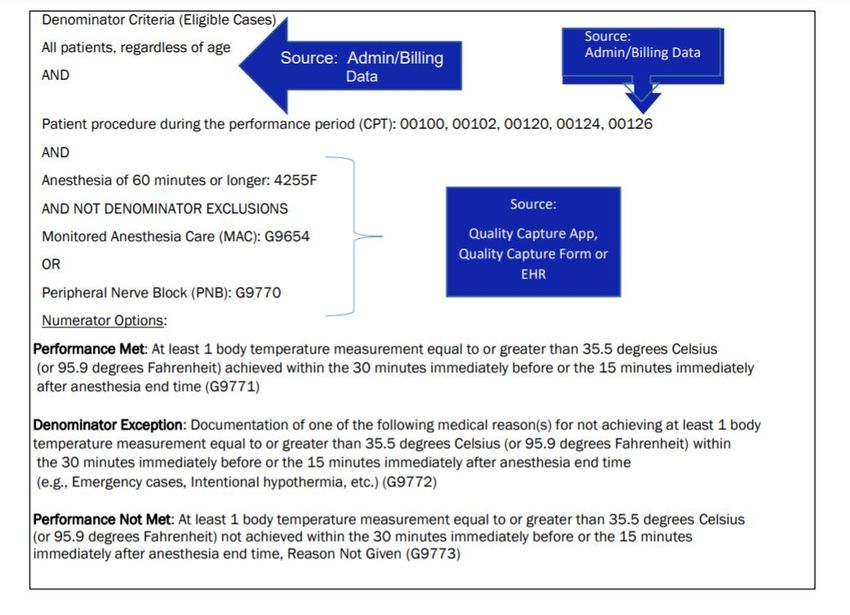
Updated February 2021.The pertinent information that needs to be collected can be found in the measure specifications.
Example: MIPS 424: Perioperative Temperature Management
©2021 Anesthesia Quality Institute. All rights reserved. Please contact the Anesthesia Quality
Institute at askaqi@asahq.org for permission to use any of the information in this document.
Updated February 2021.NACOR Quality Concierge Quality Concierge is a full-service NACOR quality reporting solution with complete quality analytics and tracking and reporting tools that measure compliance across the entire perioperative continuum. The proven reporting platform integrates with most major anesthesia billing services and EHRs and can be used in non-integrated environments. Real-time provider and administrative dashboards help generate data and allow you to document your practice improvement activities. For additional information, visit the Quality Concierge page of the ASA website ©2021 Anesthesia Quality Institute. All rights reserved. Please contact the Anesthesia Quality Institute at askaqi@asahq.org for permission to use any of the information in this document. Updated February 2021.
Creating Your Data File
NACOR collects data from anesthesia practices and hospitals through data extracts developed
by software vendors or reports generated by the practice and/or hospital. Your practice will have
access to QR or QCDR reports which will help you monitor providers’ measures compliance.

The minimum data required to participate in NACOR are Data Types 1 and 2 described below.
Every anesthesia practice has this information available. Type 1 data is self- reported through
the NACOR dashboard. Type 2 data is available in any billing system. Type 3 data is the
applicable measure codes for each MIPS or QCDR Measure.

        Data Type 1: Practice information, Practice Champion information, data submission
        contacts (i.e., vendor or practice name), provider data (i.e., provider ID, staff role, DOB,
        NPI, TIN, quality reporting option) and facility information (practice specific facility ID,
        facility type, facility name and facility location).
        Data Source: The practice is issued a unique login, and the information is entered
        via the NACOR dashboard. This practice demographic information is collected one
        time. The AQI practice champion should review this information annually to review the
        accuracy of the data.
        The Provider List is the source of truth for CMS MIPS reporting as well as ASA billing
        and invoice reconciliation for reporting fees. It is the practices responsibility to maintain
        the accuracy of this list. It is recommended that the provider list is updated quarterly.
        Final changes to the provider list must be completed by January 31, 2021.
        The Facility List maintains a list of the facilities where your providers complete their
        cases. The practice specific facility ID should match the facility ID in your practice’s data
        submission file. If the facility ID does not match the ID submitted on the case data, this
        information will not be linked to the case.
        Data Type 2: Case-specific data (minimum data requirement) in several tiers: simple
        (e.g., CPT code, anesthesia type, provider ID number, patient age), and moderate (e.g.,
        duration of surgery, agents used).
        Data Source: Administrative and billing data from the practice
        billing software. Optional complex data (e.g., output from AIMS with vital signs, fluids,
        drug doses etc.)
        Data Type 3: Quality Reporting measure specific codes. Code examples:

            •    MIPS: Category II CPT or HCPCS codes (e.g., 6030F 1P or
                 G9654)
            •    QCDR: QCDR Measure codes (e.g., 10A28)

Practices may use an NACOR-ready Vendor or have their in-house IT staff create the XML-
formatted file. The table on page 20 shows the required minimum data fields for QR and QCDR
reporting options.

©2021 Anesthesia Quality Institute. All rights reserved. Please contact the Anesthesia Quality
Institute at askaqi@asahq.org for permission to use any of the information in this document.
Updated February 2021.
The 2021 NACOR XML and Measure Specifications document will assist IT vendors or IT developers in cresting the appropriate XML data file for each practice. XML file format testing is recommended prior to file submission. Please use the XML file validator to test files using fake data. If your IT vendor has any questions regarding the XML schema, please email askaqi@asahq.org. ©2021 Anesthesia Quality Institute. All rights reserved. Please contact the Anesthesia Quality Institute at askaqi@asahq.org for permission to use any of the information in this document. Updated February 2021.
Submitting data to NACOR
It is recommended that practices upload data to NACOR monthly to regularly monitor measure
compliance using the QR or QCDR reports in the NACOR dashboard.
All files must be uploaded to NACOR servers. AQI will not pull files from
vendors or practices.
File Review and Notification
To ensure data is successfully uploaded into NACOR, avoid the following file errors:

    •   Non-XML file format
    •   Multiple incomplete files
    •   Files that do not meet the minimum data field requirements to meet.
    •   CMS measure specifications
    •   Files without NPI numbers
    •   Files that do not meet the 2021 Quality Reporting deadlines listed on page 19.
More information on XML file format specifications and test file validation can be
found at: aqihq.org/vendorsQCDRHelp.aspx
File acceptance notifications will be sent when:

    •   Production file processed successfully and placed in the queue for processing.
    •   Test file validated against XSD successfully but not placed in the
        queue for processing.
Note: Only production files will be processed, analyzed, and displayed in the NACOR
dashboard.

Error notifications will be sent when:
   • File does not have a ‘.xml’ or ‘.zip’ extension.
   • File does not pass XSD validation.
   • File data fails to load into the staging environment.
   • File data fails to be placed in the queue

The FTP contact and Practice Champion will receive an email if there are
problems loading a file. It is the practice/vendor’s responsibility to correct
errors and resubmit a production file.
Additional Support
Please contact nacorsupport@asahq.org for further assistance.

©2021 Anesthesia Quality Institute. All rights reserved. Please contact the Anesthesia Quality
Institute at askaqi@asahq.org for permission to use any of the information in this document.
Updated February 2021.
Data Transmission
File Format Specifications
NACOR data file specifications and other pertinent resources are provided on the AQI
website. Files being uploaded undergo full data file validation and must match the
outlined schema and required rules.
File Naming
The NACOR data submission process requires that practice identifiers are both
included in the file name and within the file. This helps identify practices for data
submission should there be any issues opening or reading files. File name length
restriction: 100 characters maximum
The following identifiers are required to be present in the file name for the file to pass
validation:
• PID – This is your AQI Practice ID Number
• .xml – This is the file extension.
• Practice Name (or abbreviation)
• Date the file was generated.
• DOSSTART(YYYYMMDD) – The first date of service in your data file
• DOSEND(YYYYMMDD) – The last date of service in your data file
These values will help identify your practice and ensure your file names are unique
each month. Please be assured that including these values to the file names will not
cause failures or issues. Each value must be separated by the underscore character
“_”.
The following identifier is optional:
• TEST(Y) – indicates the file is a test file.
Following is an example of a complete file name:
Practice NAME_Date_PID (AQI ID #) _DOSSTART (20210701)_DOSEND(20210731).xml
Practice NAME_20210815_PID (AQI ID #) _DOSSTART(20210701)_DOSEND(20210731).xml
Additional example file names:
AQI ANESTHESIA_202106010_PID(554711)_DOSSTART(20210501)_DOSEND(20210531).xml
AQI NESTHESIA_202106010_PID(554711)_DOSSTART(20210501)_DOSEND(20210531)_TEST(Y).xml
Data Submission Process
NACOR participants have two options when uploading their files to the registry – secure FTP
(SFTP) or web portal. The URL or host to upload files is nacor.epreop.com. More details about
file naming convention and file upload can be found on the following pages and in the NACOR
data submission user guide. For assistance with ftp login credentials, file upload and file
feedback reports, email nacorsupport@asahq.org
©2021 Anesthesia Quality Institute. All rights reserved. Please contact the Anesthesia Quality
Institute at askaqi@asahq.org for permission to use any of the information in this document.
Updated February 2021.If you are a new user and do not have ftp credentials, or if you need additional
support, please contact nacorsuppport@asahq.org.
Submission Options
Secure FTP (SFTP)
Any SFTP Client can be used to upload data files for submission. Connection
detail information is below:
• Host: nacor.epreop.com
• Port: 22
• Protocol: SSH/SFTP
FileZilla SFTP client is suitable for data uploads. Please use the connection information above
along with the username/password setup instructions in the previous section.
Note: It is possible that hospital firewalls may limit access to this port for outgoing
traffic. If that is the case, you can speak with your hospital IT department to have it
opened or utilize the web portal option below.
Web Portal
A new submission portal has been added as another data transfer option.
URL: https://nacor.epreop.com/
After receiving your account activation email and setting up access, you can utilize the
link above to access the web portal. The following screen captures will walk you through
the features in the portal.
Directory Configuration
There is a folder in the upload directory utilized for any special feedback reports and
documentation back to the practice. Contents of this directory will not be utilized for
processing data.
©2021 Anesthesia Quality Institute. All rights reserved. Please contact the Anesthesia Quality
Institute at askaqi@asahq.org for permission to use any of the information in this document.
Updated February 2021.Login Page You will enter your username and password on the login page. There is a link at the bottom of the page should you forget or require resetting your password. Additional resource links are located at the bottom of the page. Data Submission Directory After login, you will be placed into your practice folder or vendor folder depending on your permissions. You can drag and drop files into the window for upload or choose the ©2021 Anesthesia Quality Institute. All rights reserved. Please contact the Anesthesia Quality Institute at askaqi@asahq.org for permission to use any of the information in this document. Updated February 2021.
“Upload Files” button in the upper right corner. There is no need to create folders
in the directory. Note: Files will be pulled from all folders.
                                    In the upper right corner, the currently logged
                                   in user is highlighted. Click on “My Account” to
                                   change profile information.

Account Profile
Within “My Account” you may update your password, email, time zones and language
preference.

©2021 Anesthesia Quality Institute. All rights reserved. Please contact the Anesthesia Quality
Institute at askaqi@asahq.org for permission to use any of the information in this document.
Updated February 2021.
SFTP Keys SSH Keys can be uploaded to the portal by clicking the “Add SFTP Key” button. A title and the public key will be placed into the text boxes for connection. ©2021 Anesthesia Quality Institute. All rights reserved. Please contact the Anesthesia Quality Institute at askaqi@asahq.org for permission to use any of the information in this document. Updated February 2021.
Data Validation Emails

AQI Practice Champions and/or their vendors will receive a data validation email
one (1) business day after uploading a data file. Examples of the emails are below:

        Example 1: File passed minimum validation criteria

Thank you for submitting your data file to NACOR for processing.

Your file successfully passed minimum validation criteria; however, not all cases were
able to be processed. Cases passing validation will be incorporated into NACOR. Data
analytics will be completed and reports available in the NACOR
Dashboard within 48 hours. We are currently working to decrease the processing time
to 24 hours. Cases that did not pass validation will not be incorporated into NACOR.
You may fix errors for those cases and resubmit your file to NACOR.

10889 of 11225 (97.01%) records were valid for submission in the file : 004/AQI
Anesthesia_01112021_PID (004) _DOSSTART(20210401)_DOSEND(20210430).xml.
This validation checks whether your file adheres to the NACOR XML schema and
performs certain basic logic checks. It does not confirm the completeness of
measures reported (i.e., numerator and denominator codes).

To review accuracy of the data provided and, if applicable, whether your data meet
QCDR/QR reporting and performance thresholds, please review the data and CMS
Quality Reporting reports within the NACOR Dashboard.

Below is a summary of any issues:

    •   Thehttps://www.aqihq.org/AQIXMLResources/AQISchema.xsd:AnesthesiaCateg
        ory' element is invalid - The value 'Other' is invalid according to its datatype
        'https://www.aqihq.org/AQIXMLResources/AQISchema.xsd:AnesthesiaCategory
        CodeType' - The Enumeration constraint failed (occurs 3 times). The
        AnesthesiaRecordIds of the records containing the error are: 3608913, 3608918
        3628739.
    •   The 'https://www.aqihq.org/AQIXMLResources/AQISchema.xsd:HomeState'
        element is invalid - The value 'Ou' is invalid according to its datatype
        'https://www.aqihq.org/AQIXMLResources/AQISchema.xsd:USStateCodeType' –
        The Enumeration constraint failed (occurs 1 time). The AnesthesiaRecordIds of
        the records containing the error are: 3622559.
    •   The 'https://www.aqihq.org/AQIXMLResources/AQISchema.xsd:HomeZip'
        element is invalid - The value '7102' is invalid according to its datatype
        'https://www.aqihq.org/AQIXMLResources/AQISchema.xsd:ZipCodeType' - The
        Pattern constraint failed (occurs 1 time). The AnesthesiaRecordIds of the
        records containing the error are: 3632944.
©2021 Anesthesia Quality Institute. All rights reserved. Please contact the Anesthesia Quality
Institute at askaqi@asahq.org for permission to use any of the information in this document.
Updated February 2021.
Example 2: File passed validation Thank you for submitting your data file to NACOR for processing. Your file successfully passed validation and will be incorporated into NACOR. Data analytics will be completed and reports available in the NACOR Dashboard within 48 hours. We are currently working to decrease the processing time to 24 hours. 9925 of 9925 (100.00%) records were valid for submission in the file:123/XYZ_PID (123) _DOSSTART(20211001)_DOSEND(20211130).xml This validation checks whether your file adheres to the NACOR XML schema and performs certain basic logic checks. It does not confirm the completeness of measures reported (i.e., numerator and denominator codes). To review accuracy of the data provided and, if applicable, whether your data meet QCDR/QR reporting and performance thresholds, please review the data and CMS Quality Reporting reports within the NACOR Dashboard. Additional information and support resources: NACOR Data Submission Guide | NACOR Support | AQI Developer Website | NACOR Reporting Portal ©2021 Anesthesia Quality Institute. All rights reserved. Please contact the Anesthesia Quality Institute at askaqi@asahq.org for permission to use any of the information in this document. Updated February 2021.
Example 3: File Failed Validation

Thank you for submitting your data file to NACOR for processing.
Your file failed validation and will not be incorporated into NACOR. You may fix errors for
those cases and resubmit your file to NACOR.
This validation checks whether your file adheres to the NACOR XML schema and
performs certain basic logic checks. It does not confirm the completeness of
measures reported (i.e., numerator and denominator codes).

To review accuracy of the data provided and, if applicable, whether your data meet
QCDR/QR reporting and performance thresholds, please review the data and CMS
Quality Reporting reports within the NACOR Dashboard.

Below is a summary of any issues:

    •   The 'https://www.aqihq.org/AQIXMLResources/AQISchema.xsd:AnesthesiaCategory'
        element is invalid - The value 'Other' is invalid according to its datatype
        'https://www.aqihq.org/AQIXMLResources/AQISchema.xsd:AnesthesiaCategory
        CodeType' - The Enumeration constraint failed (occurs 8 times). The
        AnesthesiaRecordIds of the records containing the error are: 3517883, 3524851,
        3524857, 3526127, 3527661, 3528622, 3528649, 3532178.

    •   The 'https://www.aqihq.org/AQIXMLResources/AQISchema.xsd:HomeState'
        element is invalid - The value 'NS' is invalid according to its datatype
        'https://www.aqihq.org/AQIXMLResources/AQISchema.xsd:USStateCodeType' -
        The Enumeration constraint failed (occurs 2 times). The AnesthesiaRecordIds of
        the records containing the error are: 3509819, 3535900.
    •   The 'https://www.aqihq.org/AQIXMLResources/AQISchema.xsd:HomeState'
        element is invalid - The value 'On' is invalid according to its datatype
        'https://www.aqihq.org/AQIXMLResources/AQISchema.xsd:USStateCodeType' -
        The Enumeration constraint failed (occurs 1 time). The AnesthesiaRecordIds of
        the records containing the error are: 3512219.
    •   The 'https://www.aqihq.org/AQIXMLResources/AQISchema.xsd:HomeState'
        element is invalid - The value 'Pr' is invalid according to its datatype
        'https://www.aqihq.org/AQIXMLResources/AQISchema.xsd:USStateCodeType'

©2021 Anesthesia Quality Institute. All rights reserved. Please contact the Anesthesia Quality
Institute at askaqi@asahq.org for permission to use any of the information in this document.
Updated February 2021.
You can also read


