Artificial Intelligence-Enabled Analysis of Public Attitudes on Facebook and Twitter Toward COVID-19 Vaccines in the United Kingdom and the United ...
←
→
Page content transcription
If your browser does not render page correctly, please read the page content below

JOURNAL OF MEDICAL INTERNET RESEARCH                                                                                                      Hussain et al

     Original Paper

     Artificial Intelligence–Enabled Analysis of Public Attitudes on
     Facebook and Twitter Toward COVID-19 Vaccines in the United
     Kingdom and the United States: Observational Study

     Amir Hussain1, PhD, BSc; Ahsen Tahir1,2, PhD, BSc; Zain Hussain3, BSc, MBChB; Zakariya Sheikh3; Mandar Gogate1,
     BSc, PhD; Kia Dashtipour1, BSc, PhD; Azhar Ali4,5, BSc, MBA, MBBS; Aziz Sheikh6, BSc, MBBS
     1
      School of Computing, Edinburgh Napier University, Edinburgh, United Kingdom
     2
      Department of Electrical Engineering, University of Engineering and Technology, Lahore, Pakistan
     3
      Edinburgh Medical School, College of Medicine and Veterinary Medicine, University of Edinburgh, Edinburgh, United Kingdom
     4
      NHS Forth Medical Group, Grangemouth, United Kingdom
     5
      Harvard TH Chan School of Public Health, Harvard University, Boston, MA, United States
     6
      Usher Institute, Edinburgh Medical School, University of Edinburgh, Edinburgh, United Kingdom

     Corresponding Author:
     Amir Hussain, PhD, BSc
     School of Computing
     Edinburgh Napier University
     10 Colinton Road
     Edinburgh, EH10 5DT
     United Kingdom
     Phone: 44 0845 260 6040
     Email: a.hussain@napier.ac.uk

     Abstract
     Background: Global efforts toward the development and deployment of a vaccine for COVID-19 are rapidly advancing. To
     achieve herd immunity, widespread administration of vaccines is required, which necessitates significant cooperation from the
     general public. As such, it is crucial that governments and public health agencies understand public sentiments toward vaccines,
     which can help guide educational campaigns and other targeted policy interventions.
     Objective: The aim of this study was to develop and apply an artificial intelligence–based approach to analyze public sentiments
     on social media in the United Kingdom and the United States toward COVID-19 vaccines to better understand the public attitude
     and concerns regarding COVID-19 vaccines.
     Methods: Over 300,000 social media posts related to COVID-19 vaccines were extracted, including 23,571 Facebook posts
     from the United Kingdom and 144,864 from the United States, along with 40,268 tweets from the United Kingdom and 98,385
     from the United States from March 1 to November 22, 2020. We used natural language processing and deep learning–based
     techniques to predict average sentiments, sentiment trends, and topics of discussion. These factors were analyzed longitudinally
     and geospatially, and manual reading of randomly selected posts on points of interest helped identify underlying themes and
     validated insights from the analysis.
     Results: Overall averaged positive, negative, and neutral sentiments were at 58%, 22%, and 17% in the United Kingdom,
     compared to 56%, 24%, and 18% in the United States, respectively. Public optimism over vaccine development, effectiveness,
     and trials as well as concerns over their safety, economic viability, and corporation control were identified. We compared our
     findings to those of nationwide surveys in both countries and found them to correlate broadly.
     Conclusions: Artificial intelligence–enabled social media analysis should be considered for adoption by institutions and
     governments alongside surveys and other conventional methods of assessing public attitude. Such analyses could enable real-time
     assessment, at scale, of public confidence and trust in COVID-19 vaccines, help address the concerns of vaccine sceptics, and
     help develop more effective policies and communication strategies to maximize uptake.

     (J Med Internet Res 2021;23(4):e26627) doi: 10.2196/26627

     https://www.jmir.org/2021/4/e26627                                                                  J Med Internet Res 2021 | vol. 23 | iss. 4 | e26627 | p. 1
                                                                                                                       (page number not for citation purposes)
XSL• FO
RenderX
JOURNAL OF MEDICAL INTERNET RESEARCH                                                                                                 Hussain et al

     KEYWORDS
     artificial intelligence; COVID-19; deep learning; Facebook; health informatics; natural language processing; public health;
     sentiment analysis; social media; Twitter; infodemiology; vaccination

                                                                          not included in our data set. Further, to comply with privacy
     Introduction                                                         laws and social network policies in accordance with the General
     The imminent availability of COVID-19 vaccines poses a               Data Protection Regulation to collect data from Twitter [16]
     pressing need to continually monitor and better understand           and Facebook CrowdTangle [17] platforms, we have not shared
     public sentiments in order to develop baseline levels of             or published direct tweets or posts by individuals, quotes from
     confidence in them among the general public and enable the           individuals, or names or locations of users who are not public
     identification of early warning signals of loss in confidence [1].   organizations or entities.
     This will help address the concerns of vaccine sceptics [2-4]        Data Sources
     and develop the required public trust in immunization [5,6] to
                                                                          We used data from both Facebook and Twitter, two of the most
     realize the goal of generating herd immunity [7].
                                                                          popular and representative social media platforms [16]. We
     Traditionally, governments use surveys to understand public          used Facebook posts and tweets that were posted in English in
     attitude; however, these typically have limitations including        the United Kingdom and the United States from March 1 to
     small sample sizes, closed questions, and limited spatiotemporal     November 22, 2020. Facebook posts were obtained through the
     granularity. In order to overcome these limitations, we argue        CrowdTangle platform [17] and Twitter posts from a publicly
     that social media data can be used to obtain more, real-time         available Twitter API. We used hydrated tweets from the global
     insights into public sentiments and attitudes with considerable      COVID-19 data set [18], which collects up to 4,400,000 tweets
     spatiotemporal granularity. Over half of the worldwide               per day (including retweets) and up to 1,100,000 cleaned tweets
     population, including approximately 70% the populations of           without retweets. The total number of tweets hydrated and used
     the United Kingdom and the United States, are active social          in this study was >158,000,000. Facebook posts and tweets
     media users, and social media usage has significantly increased      were thematically filtered for both COVID-19– and
     during the pandemic; for instance, Facebook usage increased          vaccine-related keywords and then geographically filtered for
     by 37%. Since social media data are largely unstructured, they       the United Kingdom and the United States. The first step in
     are amenable to the application of established artificial            filtering COVID-19–related keywords involved widely used
     intelligence (AI) techniques such as machine learning, deep          terms from the data set of Banda et al [18] (Multimedia
     learning (DL) [8], and natural language processing (NLP) [9]         Appendix 1). Vaccine-related terms used for second step
     to extract topics and sentiments from social media posts.            filtering were selected by our team: “vaccine,” “vaccination,”
                                                                          “immunise,” “immunize,” “immunisation,” and “immunization.”
     Sentiment analysis involves categorizing subjective opinions
                                                                          A 2-step thematic filtering process was applied using these
     from text, audio, and video sources [9] to determine polarities
                                                                          keywords before processing and analysis.
     (eg, positive, negative, and neutral), emotions (eg, anger,
     sadness, and happiness), or states of mind (eg, interest vs          Analysis
     disinterest) toward target topics, themes, or aspects of interest    The filtered data set was initially preprocessed (eg, removing
     [10]. A complementary approach, termed stance detection [11],        links, hashtags, and stop words) and a new hierarchical hybrid
     assigns a stance label (favorable, against, and none) to a post      ensemble–based AI model was developed for thematic sentiment
     on a specific predetermined target, which in itself may not be       analysis. This utilized an average weighting ensemble [19] of
     referred to or be the target of opinion in the post. Such            2 lexicon-based methods: Valence Aware Dictionary for
     approaches are currently underutilized in health care research.      Sentiment Reasoning (VADER) [20] and TextBlob [21]. These
     In particular, there is significant untapped potential in drawing    were combined with a pretrained DL-based model, Bidirectional
     on AI-enabled social media analysis to inform public policy          Encoder Representations from Transformers (BERT) [22], using
     research.                                                            a rule-based ensemble method (Figure 1).

     Methods                                                              A random 10% sample of Facebook posts and tweets was then
                                                                          manually annotated by the team and screened against our hybrid
     Ethics                                                               ensemble AI model’s sentiment classifications for refinement
     Since the data analyzed in this study were completely in the         and validation. The hybrid ensemble model was optimized on
     public domain, no ethics review was necessary. We conducted          the basis of the validation results, with sensitivity and specificity
     a thorough assessment of the privacy risk that our study posed       analysis revealing that the lexicon-based methods provided
     to individuals, in accordance with previous reports [12,13], to      generally better accuracy for positive sentiments, and the BERT
     ensure compliance with relevant sections of the General Data         model generally provided better accuracy for neutral and
     Protection Regulation. We strived to comply with best practices      negative sentiments, as illustrated using normalized confusion
     for user protection [14,15], ensuring that nonpublic material is     matrices (Multimedia Appendix 1).

     https://www.jmir.org/2021/4/e26627                                                             J Med Internet Res 2021 | vol. 23 | iss. 4 | e26627 | p. 2
                                                                                                                  (page number not for citation purposes)
XSL• FO
RenderX
JOURNAL OF MEDICAL INTERNET RESEARCH                                                                                                       Hussain et al

     Figure 1. Hierarchical hybrid-ensemble–based artificial intelligence model and data pipeline for thematic sentiment analysis. BERT: Bidirectional
     Encoder Representations from Transformers, VADER: Valence Aware Dictionary for Sentiment Reasoning.

     VADER and TextBlob were combined though weighted                          obtained through manual reading of randomly selected posts
     averaging (VADERx0.45 + TextBlobx0.55), with TextBlob                     around target points of interest by our team. Relevant social
     assigned a marginally higher weight of 0.55 owing to its                  media data sets and outputs were anonymized, and statistical
     performance. The weighted averaged output from the lexicons               aggregates were made openly accessible for transparency and
     was combined with the output of the BERT model, using a final             reproducibility (additionally through a publicly available
     rule–based ensemble. The final output was combined through                dashboard [23]).
     “If” and “Else” statements on the basis of the model’s output
     sentiments.                                                               Results
     A number of established NLP techniques were used to analyze               Temporal Sentiment Trends
     the processed data (Multimedia Appendix 1). Specifically, in
     addition to analyzing averaged sentiment trends and their                 Monthly volume trends of the filtered Facebook posts and tweets
     geospatial mappings in the United Kingdom and the United                  in the United Kingdom and the United States for the target study
     States, we statistically analyzed the trends with Pearson                 period are shown in Multimedia Appendix 1. Figure 2 shows
     correlation coefficient (r) and compared the findings with those          the averaged (weekly) positive, negative, and neutral Facebook
     of independent surveys. Sentiment word cloud and N-gram                   sentiments in March-November 2020 in the United Kingdom
     analyses were performed for specific periods of interest, around          and the United States. We identified topics of discussion on
     points of inflexion on sentiment trend graphs, to identify topics         points of interest in the graphs. These are referred to in our
     of discussion and to gain insight into the positive and negative          descriptive analysis of the graphs below, and some are
     content of online discourses. The analysis was also carried out           highlighted in Figures 2 and 3. It was interesting to note that
     over the entire study period to identify underlying themes and            the difference between the averaged positive and negative
     topics. Findings were validated, and further insights were                sentiment trends was more pronounced on Facebook than on
                                                                               Twitter.
     Figure 2. Averaged weekly trends in Facebook sentiments for (A) the United Kingdom and (B) the United States.

     https://www.jmir.org/2021/4/e26627                                                                   J Med Internet Res 2021 | vol. 23 | iss. 4 | e26627 | p. 3
                                                                                                                        (page number not for citation purposes)
XSL• FO
RenderX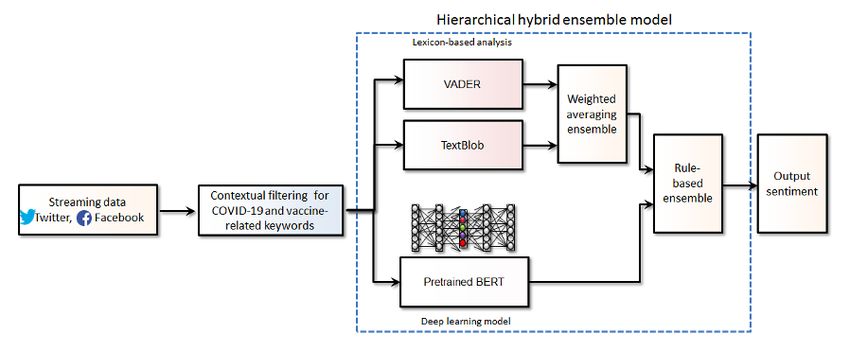
JOURNAL OF MEDICAL INTERNET RESEARCH                                                                                                       Hussain et al

     Figure 3. Average weekly trends in Twitter sentiments for (A) the United Kingdom and (B) the United States.

     For the United Kingdom, positive sentiments on Facebook                   For both the United Kingdom and the United States, we
     displayed the most prominent trend (Figure 2A), showing a                 observed a marked increase in the positive sentiment trend,
     steady increasing trend since May 2020, corresponding to the              since end-October 2020, which was related to recent
     initiation of vaccine trials and the recruitment of the first trial       breakthrough announcements by Pfizer Inc and Moderna Inc.
     volunteer. We observed a peak in mid-August 2020, which was               Analysis of social media conversations indicated public
     potentially associated with news on vaccine development in the            optimism, with trial results being hailed as “good” and
     United Kingdom and Russia. Negative sentiments on Facebook                “amazing” and with “hope” prevailing for the “new year”
     displayed an inverse trend to that of positive sentiments, and            (Multimedia Appendix 1). A notable peak in the negative
     discourse was centered around vaccine conspiracies and halting            sentiment trends for both countries, in approximately
     of trials. For the United States, positive sentiments on Facebook         mid-October 2020, was associated with the growing
     displayed the most prominent trend, showing a small peak in               antivaccination movement and with concerns regarding “fake
     August 2020, which was associated with posts relating to                  news” and “misinformation.”
     research on the COVID-19 vaccine in Russia. Moreover,
     negative sentiments on Facebook displayed a slight increase in
                                                                               Statistical Analysis of Sentiment Trends
     mid-September 2020, which was associated with posts relating              Statistical analysis (results detailed in Multimedia Appendix 1)
     to the accelerated development of the COVID-19 vaccine                    involved the assessment of the strength of the association
     (Figure 2B). More recently, from mid-October 2020, the trend              between the predicted sentiment in the trend graph and the
     of positive sentiments on Facebook in the United Kingdom and              accuracy of the labeled data. Overall, regarding COVID-19
     the United states increased, partly because of announcements              vaccines, we observed stronger sentiments on Twitter for the
     from Pfizer Inc and Moderna Inc on successful vaccine trials              United States, with both positive and negative sentiments
     [24].                                                                     displaying stronger increasing and decreasing trends,
                                                                               respectively, compared to the United Kingdom. Public
     Figure 3 illustrates the positive, negative, and neutral sentiments       sentiments on Facebook reflected a reduction in positive
     on Twitter from March to November 2020 for the United                     sentiments and an increase in neutral sentiments in both the
     Kingdom and the United States. Figure 3A shows that in the                United Kingdom and the United States, with positive sentiments
     United Kingdom, positive sentiments on Twitter displayed the              displaying a slightly stronger decreasing trend in the United
     most prominent trend, showing a small peak at the end of April            Kingdom than in the United States.
     and July of 2020, the former related to the first human vaccine
     trial. The negative sentiment trend on Twitter displayed peaks            Sentiment Word Clouds and Text N-Gram Analysis
     in July and October of 2020, simultaneously with the United               We performed sentiment word cloud and text N-gram analyses
     Kingdom opting out of the European Union vaccination scheme               for the entire study period to identify and analyze notable events
     and halting of the phase III vaccine trials at the University of          that were of interest to social media users, and the findings are
     Oxford owing to safety concerns [25]. Figure 3B shows that in             summarized in Multimedia Appendix 1 (some of these were
     the United States, positive sentiments on Twitter displayed the           also identified in the aforementioned analysis, on the sentiment
     most prominent trend, showing major peaks from end-September              trend graphs).
     to end-November of 2020, which was related to claims by
     ex-President Donald Trump regarding a vaccine being ready in              Geospatial Sentiment Analysis
     a few weeks and an increase in Twitter discourse due to his               A geospatial map of overall (averaged) sentiments at the state
     reference to the “herd mentality.” We observed a small peak in            level in the United States is shown in Figure 4 (left), and it
     the negative trend graph in mid-September 2020, which was                 indicates that most states had a negative sentiment. The states
     related to halting of the phase III vaccine trial at the University       with an overall negative sentiment toward COVID-19 vaccines
     of Oxford.                                                                were concentrated in the West and Midwest regions,
     https://www.jmir.org/2021/4/e26627                                                                   J Med Internet Res 2021 | vol. 23 | iss. 4 | e26627 | p. 4
                                                                                                                        (page number not for citation purposes)
XSL• FO
RenderX
JOURNAL OF MEDICAL INTERNET RESEARCH Hussain et al
namely Idaho, Kansas, New Hampshire, West Virginia, and counties in the United Kingdom had an overall positive
Alabama. The states with an overall positive sentiment were in sentiment toward COVID-19 vaccines. The counties with the
the East, namely Maine, Colorado, Georgia, and Hawaii. most positive sentiments included Cornwall, Kent, East Sussex,
Surrey, and Dorset in England and Aberdeenshire, Angus, and
A geospatial map of averaged sentiments toward COVID-19
Stirlingshire in Scotland. Furthermore, the counties with the
vaccines at the county level in the United Kingdom is shown
most negative sentiments were West Sussex, Somerset, North
in Figure 4 (right). In contrast with the United States, most
Yorkshire, and Durham in England.
Figure 4. Geospatial mapping of averaged social media public sentiments in the United States (left) and the United Kingdom (right) toward COVID-19
vaccines (1 or green: positive sentiments, 0: neutral sentiments, and -1 or red: negative sentiments).
Overall Averaged Sentiments
Overall averaged sentiments in the United Kingdom and the
United States on Facebook and Twitter are shown in Figure 5
and in Multimedia Appendix 1.
Figure 5. Overall averaged sentiments: (A) Twitter sentiments in the United Kingdom, (B) Twitter sentiments in the United States, (C) Facebook
sentiments in the United Kingdom, and (D) Facebook sentiments in the United States.
https://www.jmir.org/2021/4/e26627 J Med Internet Res 2021 | vol. 23 | iss. 4 | e26627 | p. 5
(page number not for citation purposes)
XSL• FO
RenderXJOURNAL OF MEDICAL INTERNET RESEARCH Hussain et al
of our social media analysis, a marked increase in the proportion
Discussion of individuals who are likely to get vaccinated (51% were “very”
Principal Findings or “somewhat” likely to take the first-generation vaccine; this
proportion would increase to 70% if the vaccine was proven
We analyzed temporal variations in public sentiments toward safe and effective by public health officials) [29].
COVID-19 vaccines in the United Kingdom and the United
States. We identified, evaluated, and mapped the key events In the United Kingdom, a YouGov survey in June 2020 [30]
impacting positive, negative, and neutral sentiments to the reported that 41% of respondents would “probably” or
temporal trends. We also mapped spatial variations in public “definitely” get vaccinated, while 1 in 6 (16%) respondents
sentiment to regions in the United Kingdom and states in the would “definitely” or “probably” not get vaccinated. The survey
United States. Our geospatial maps can help identify areas with also reported that individuals who used social media more than
more negative sentiments toward COVID-19 vaccines, which traditional media as their source of news were 9% less likely
can be further studied for potential interventions, to allay the to be in favor of being vaccinated. A more recent YouGov
underlying public fears and concerns. survey in the United Kingdom in November 2020 [31], related
to the Pfizer COVID-19 vaccine, reported that 67% of
Our findings indicate that online public discourse on Facebook individuals were “very” or “fairly” likely to take the vaccine
and Twitter across the United Kingdom and the United States when available, and approximately 1 in 5 (21%) individuals
is evolving, with both complementary and contrasting insights were unlikely to take it. While there has been a slight increase
obtained from the 2 popular platforms. Comparative analysis in the proportion of individuals unlikely to take the vaccine, the
revealed that over the 9-month study period, averaged public proportion of those likely to get vaccinated has increased,
sentiment toward COVID-19 vaccines has been mostly positive indicating a reduction in the number of individuals who were
and similar in both the United Kingdom and the United States previously unsure. This could be attributed in part to the recent
across both platforms (57.70% average across both platforms announcements by vaccine manufacturers, and our results
for the United Kingdom vs 56.80% for the United States). corroborate this finding with a marked increase in positive
Positive sentiments were related to public opinions on vaccine sentiments since mid-October 2020, in both the United Kingdom
development, related trials, and news related to vaccine and the United States, across the 2 social media platforms.
availability. Further studies on changes in sentiments could further the
On both platforms, overall averaged negative sentiments were current understanding of factors that have contributed to this,
found to be similar for the United Kingdom (22.50%) and the with particular focus on the impact of government education
United States (24.10%). It is interesting to note that Twitter programs.
sentiments appeared more negatively biased, with the proportion Limitations
of negative sentiments being almost 2-fold those on Facebook,
for both the United Kingdom (27.95% vs 17.04%) and the It is important to consider the limitations of our data sources
United States (30.57% vs 17.73%), which potentially reflects and techniques and the related challenges and opportunities
their respective user demographics. This finding appears they present for future research. While we attempted to gauge
consistent with those of Waterloo et al [16], who reported that nationwide public sentiments in the United Kingdom and the
public opinions were often more negatively biased on Twitter United States by analyzing posts in English on both Facebook
than on Facebook, with public opinions being more positively and Twitter, our data may not be representative of the broader
biased on Facebook. Negative sentiments in our study were population of both countries. Users are known to differ in their
related to public apprehensions and concerns regarding delays usage and preferences regarding social media platforms on the
or pauses in vaccine trials, vaccine safety, corporations, and basis of their sociodemographics (eg, age, socioeconomic status,
governments influencing vaccine availability and rights and political affiliation). Vaccines are likely to be preferentially
exclusivity for economic benefits. targeted at older populations and possibly ethnic minorities,
communities with historically lower rates of vaccine uptake
A comparative analysis with independent surveys was carried [32,33]. Further exploration is therefore imperative to increase
out. Our findings related to trends of averaged positive and our understanding of the public perception toward vaccines and
negative sentiment across the United Kingdom and the United their underlying behavioral determinants [34]. Social network
States were found to correlate broadly. In the United States, analysis [35,36] can be performed in conjunction with DL
during the early stages of the pandemic, polling indicated that methods to effectively identify sources of fake news or
a significant minority had low trust in a vaccine; for example, misinformation and their social networks to help deal with
a Yahoo News/YouGov survey in May 2020 [26] reported that infodemic challenges [37,38]. Demographic data including age,
only 55% of people in the United States intended to get gender, race, and geographic origin can also be inferred from
vaccinated against COVID-19, while almost 1 in 5 (19%) social media profiles of users by using AI techniques [39]. This
individuals would not get vaccinated. A similar survey in July can help categorize distinct groups and inform the development
2020 [27] reported that 42% of people in the United States of demographic-level engagement and tailored communication
would get vaccinated (27% would not get vaccinated), while a strategies to promote diversity and inclusion in vaccination
survey in September 2020 [28] reported that only 36% of people campaigns. These can also effectively account for the fact that
in the United States were certain they would get vaccinated there are genuine knowledge voids being filled by
(32% would not get vaccinated). More recently, an Axios-Ipsos misinformation [34].
survey in November 2020 reported, consistent with the findings
https://www.jmir.org/2021/4/e26627 J Med Internet Res 2021 | vol. 23 | iss. 4 | e26627 | p. 6
(page number not for citation purposes)
XSL• FO
RenderXJOURNAL OF MEDICAL INTERNET RESEARCH Hussain et al
The technical limitations of our approach include challenges in demographic analysis, to further the current understanding of
determining the geographic location of users and issues relating the underlying determinants of public sentiments. Attitudes
to the accuracy of the AI techniques (eg, interpreting sarcasm toward different vaccine manufacturers could also be explored
and implicit context). Alternative deep neural networks [40-42] to identify and assess effective public engagement strategies to
and fuzzy-based approaches [43,44] can be explored and build support for ethical principles and maximize the uptake of
potentially integrated as part of our ensemble model in an the imminently available vaccines.
attempt to further refine the present findings. The 2-step
keyword-based thematic filtering process and the use of
Conclusions
geotagged posts in this study resulted in relatively small sample One of the main threats to the resilience of vaccination programs
sizes. This could be improved by using more sensitive filtering globally is the rapid and global spread of misinformation. Public
and data-driven search mechanisms, network metadata (such confidence in COVID-19 vaccines can be exacerbated by
as likes and retweets), and additional social media and unproven concerns regarding vaccine safety, which seed doubt
web-based platforms. On account of the current study and distrust. Furthermore, there have been cases where vaccine
limitations, our approach should only be used in conjunction debates have been purposefully polarized, thus exploiting the
with other techniques for understanding public sentiments, such doubting public and system weaknesses for political purposes,
as focus groups, input from civil society organizations, surveys, while waning vaccine confidence elsewhere may be influenced
and public consultations. by a general distrust in the government and scientific elites.
Recent surveys and polls in the United Kingdom and the United
Future studies could consider conducting periodic public surveys States have indicated the fragility of support for vaccination,
over the period of interest being explored through social media which furthers the requirement for a better understanding of
analysis. This would ensure that both methodologies were underlying public concerns and attitudes, both at scale and in
informed by each other over the course of the study to enable real time. Retrospective analysis of 2 popular and most
more granular spatiotemporal analysis, thus allowing more representative social media platforms in this study demonstrates
robust comparisons from reciprocal findings and deeper insights the potential of AI-enabled real-time social media monitoring
for policymakers. These could also complement other qualitative of public sentiments and attitudes to help detect and prevent
methods, such as in-depth interviews and ethnographic studies, such fears and also to enable policymakers to understand the
as part of mixed-study approaches. Manual annotation or reasons why some social groups may be reluctant to be
labeling of datasets is imperative when training AI models for vaccinated against COVID-19. This can inform more effective
NLP tasks to ensure accuracy and generalizability. These can policy-making and promote participatory dialogue on complex
be affected by the skill of annotators and the proportion of the vaccine deployment issues, under conditions of uncertainty,
data set that is labeled. Confounding factors, such as political including decisions on prioritization and equitability, to help
affiliations, should also be included in future studies, by maximize the uptake of imminently available vaccines.
applying further filters to screen strategies and through targeted
Acknowledgments
This study was funded by the Chief Scientist Office of the Scottish Government under its COVID-19 priority research program
(COV/NAP/20/07) and is jointly led by co-Principal Investigators AH and AS. AS was supported by BREATHE - The Health
Data Research Hub for Respiratory Health [MC_PC_19004], which is funded by the UK Research and Innovation Industrial
Strategy Challenge Fund and delivered through Health Data Research UK. AH was supported by the UK Government’s Engineering
and Physical Sciences Research Council grants (EP/T021063/1, EP/T024917/1). This study does not represent the views of the
Scottish or UK Governments.
Conflicts of Interest
AS is a member of the Chief Medical Officer’s COVID-19 Advisory Group of the Scottish Government and the UK Government’s
New and Emerging Respiratory Virus Threats Risk Stratification Subgroup.
Multimedia Appendix 1
Supplementary Material as quoted in the main article.
[DOCX File , 2893 KB-Multimedia Appendix 1]
References
1. de Figueiredo A, Simas C, Karafillakis E, Paterson P, Larson HJ. Mapping global trends in vaccine confidence and
investigating barriers to vaccine uptake: a large-scale retrospective temporal modelling study. Lancet 2020 Sep
26;396(10255):898-908 [FREE Full text] [doi: 10.1016/S0140-6736(20)31558-0] [Medline: 32919524]
2. Gellin B. Why vaccine rumours stick—and getting them unstuck. The Lancet 2020 Aug;396(10247):303-304. [doi:
10.1016/s0140-6736(20)31640-8]
https://www.jmir.org/2021/4/e26627 J Med Internet Res 2021 | vol. 23 | iss. 4 | e26627 | p. 7
(page number not for citation purposes)
XSL• FO
RenderXJOURNAL OF MEDICAL INTERNET RESEARCH Hussain et al
3. Horder J. Toll of vaccine hesitancy. Nat Hum Behav 2020 Apr;4(4):335. [doi: 10.1038/s41562-020-0874-1] [Medline:
32303721]
4. Ten threats to global health in 2019. World Health Organization. URL: https://www.who.int/news-room/spotlight/
ten-threats-to-global-health-in-2019, [accessed 2021-10-26]
5. Lazarus J, Ratzan SC, Palayew A, Gostin LO, Larson HJ, Rabin K, et al. A global survey of potential acceptance of a
COVID-19 vaccine. Nat Med 2021 Feb;27(2):225-228 [FREE Full text] [doi: 10.1038/s41591-020-1124-9] [Medline:
33082575]
6. Bloom BR, Nowak GJ, Orenstein W. "When Will Have a Vaccine?" - Understanding Questions and Answers about Covid-19
Vaccination. N Engl J Med 2020 Dec 03;383(23):2202-2204. [doi: 10.1056/NEJMp2025331] [Medline: 32897660]
7. Fontanet A, Cauchemez S. COVID-19 herd immunity: where are we? Nat Rev Immunol 2020 Oct;20(10):583-584 [FREE
Full text] [doi: 10.1038/s41577-020-00451-5] [Medline: 32908300]
8. Perez S. Report: WhatsApp has seen a 40% increase in usage due to COVID-19 pandemic. TechCrunch. 2020 Mar 26.
URL: https://techcrunch.com/2020/03/26/report-whatsapp-has-seen-a-40-increase-in-usage-due-to-covid-19-pandemic/
[accessed 2021-03-17]
9. Adeel A, Gogate M, Hussain A. Contextual deep learning-based audio-visual switching for speech enhancement in real-world
environments. Information Fusion 2020 Jul;59:163-170. [doi: 10.1016/j.inffus.2019.08.008]
10. Dashtipour K, Gogate M, Li J, Jiang F, Kong B, Hussain A. A hybrid Persian sentiment analysis framework: Integrating
dependency grammar based rules and deep neural networks. Neurocomputing 2020 Mar;380:1-10. [doi:
10.1016/j.neucom.2019.10.009]
11. Majumder N, Bhardwaj R, Poria S, Gelbukh A, Hussain A. Improving aspect-level sentiment analysis with aspect extraction.
Neural Comput & Applic 2020 Aug 17:1-11 [FREE Full text] [doi: 10.1007/s00521-020-05287-7]
12. Al-Ghadir AI, Azmi AM, Hussain A. A novel approach to stance detection in social media tweets by fusing ranked lists
and sentiments. Information Fusion 2021 Mar;67:29-40. [doi: 10.1016/j.inffus.2020.10.003]
13. Zimmer M. “But the data is already public”: on the ethics of research in Facebook. Ethics Inf Technol 2010 Jun
4;12(4):313-325. [doi: 10.1007/s10676-010-9227-5]
14. Williams ML, Burnap P, Sloan L. Towards an Ethical Framework for Publishing Twitter Data in Social Research: Taking
into Account Users' Views, Online Context and Algorithmic Estimation. Sociology 2017 Dec;51(6):1149-1168 [FREE Full
text] [doi: 10.1177/0038038517708140] [Medline: 29276313]
15. Franzke AS, Bechmann A, Zimmer M, Ess CM. Internet Research: Ethical Guidelines 3.0. Association of Internet Researchers.
2020. URL: https://aoir.org/reports/ethics3.pdf [accessed 2021-03-17]
16. ESRC Research Data Policy. Economic and Social Research Council. URL: https://esrc.ukri.org/files/about-us/
policies-and-standards/esrc-research-data-policy/ [accessed 2021-03-17]
17. Waterloo SF, Baumgartner SE, Peter J, Valkenburg PM. Norms of online expressions of emotion: Comparing Facebook,
Twitter, Instagram, and WhatsApp. New Media Soc 2018 May;20(5):1813-1831 [FREE Full text] [doi:
10.1177/1461444817707349] [Medline: 30581358]
18. Garmur M, King G, Mukerjee Z, Persily N, Silverman B. CrowdTangle Platform and API. Harvard Dataverse. 2019. URL:
https://doi.org/10.7910/DVN/SCCQYD, [accessed 2021-03-17]
19. Banda J, Tekumalla R, Wang G, Yu J, Liu T, Ding Y, et al. A large-scale COVID-19 Twitter chatter dataset for open
scientific research -- an international collaboration. arXiv. Preprint posted online November 13, 2020 [FREE Full text]
20. Yoo BH, Kim J, Lee B, Hoogenboom G, Kim KS. A surrogate weighted mean ensemble method to reduce the uncertainty
at a regional scale for the calculation of potential evapotranspiration. Sci Rep 2020 Jan 21;10(1):870 [FREE Full text] [doi:
10.1038/s41598-020-57466-0] [Medline: 31964919]
21. Hutto CJ, Gilbert E. VADER: A Parsimonious Rule-based Model for Sentiment Analysis of Social Media Text. In:
Proceedings of the International AAAI Conference on Web and Social Media. 2014 Presented at: The 8th International
Conference on Weblogs and Social Media; 2014; Ann Arbor, MI URL: http://comp.social.gatech.edu/papers/icwsm14.
vader.hutto.pdf,
22. Loria S, Keen P, Honnibal M, Yankovsky R, Karesh D, Dempsey E. TextBlob: simplified text processing. Secondary
TextBlob: simplified text processing. Textblob. URL: https://textblob.readthedocs.io/en/dev/
#:~:text=TextBlob%20is%20a%20Python%20(2,classification%2C%20translation%2C%20and%20more [accessed
2021-03-17]
23. Devlin J, Chang MW, Lee K, Toutanova K. BERT: Pre-training of Deep Bidirectional Transformers for Language
Understanding. arXiv. Preprint posted online May 24, 2019 [FREE Full text]
24. COVID-19 AI-powered dashboard for sentiment and opinion mining in social media platforms. Edinburgh Napier University.
URL: http://covidtracker.cloud [accessed 2021-03-17]
25. Doshi P. Peter Doshi: Pfizer and Moderna’s “95% effective” vaccines—let’s be cautious and first see the full data. BMJ
Opinion. 2020 Nov 26. URL: https://blogs.bmj.com/bmj/2020/11/26/
peter-doshi-pfizer-and-modernas-95-effective-vaccines-lets-be-cautious-and-first-see-the-full-data/ [accessed 2021-03-17]
26. Mahase E. Covid-19: Oxford researchers halt vaccine trial while adverse reaction is investigated. BMJ 2020 Sep
09;370:m3525. [doi: 10.1136/bmj.m3525] [Medline: 32907856]
https://www.jmir.org/2021/4/e26627 J Med Internet Res 2021 | vol. 23 | iss. 4 | e26627 | p. 8
(page number not for citation purposes)
XSL• FO
RenderXJOURNAL OF MEDICAL INTERNET RESEARCH Hussain et al
27. Sanders L. Who will get a COVID-19 vaccine when it arrives. YouGov. 2020 May 11. URL: https://today.yougov.com/
topics/health/articles-reports/2020/05/11/who-will-get-covid-vaccine [accessed 2021-03-17]
28. Bruce G. Fewer Americans say they’ll get vaccinated for COVID-19. YouGov. 2020 Aug 05. URL: https://today.yougov.com/
topics/politics/articles-reports/2020/08/05/vaccinated-covid-19 [accessed 2021-03-17]
29. Jaimungal C. Concerns over fast-tracked COVID-19 vaccine has Americans unsure about vaccination. YouGov. 2020 Sep
15. URL: https://today.yougov.com/topics/health/articles-reports/2020/09/15/
concerns-over-fast-tracked-covid-19-vaccine-has-am [accessed 2021-03-17]
30. Jackson C, Newall M, Yi J. COVID-19 one year later: American reemergence? Ipsos. 2021 Mar 09. URL: https://www.
ipsos.com/en-us/news-polls/axios-ipsos-coronavirus-index [accessed 2021-03-17]
31. YouGov/CCDH Survey Results. YouGov. URL: https://docs.cdn.yougov.com/5mkju0kxbj/CCDH_RESULTS_
062620_PR%20%28002%29.pdf [accessed 2021-03-17]
32. McDonnell A. How many Britons are willing to take a coronavirus vaccine? YouGov. 2020 Nov 16. URL: https://yougov.
co.uk/topics/health/articles-reports/2020/11/16/how-many-britons-are-willing-take-coronavirus-vacc [accessed 2021-03-17]
33. Forster AS, Rockliffe L, Chorley AJ, Marlow LAV, Bedford H, Smith SG, et al. Ethnicity-specific factors influencing
childhood immunisation decisions among Black and Asian Minority Ethnic groups in the UK: a systematic review of
qualitative research. J Epidemiol Community Health 2017 Jun;71(6):544-549 [FREE Full text] [doi:
10.1136/jech-2016-207366] [Medline: 27531844]
34. Malik AA, McFadden SM, Elharake J, Omer SB. Determinants of COVID-19 vaccine acceptance in the US.
EClinicalMedicine 2020 Sep;26:100495 [FREE Full text] [doi: 10.1016/j.eclinm.2020.100495] [Medline: 32838242]
35. COVID-19 vaccine deployment: Behaviour, ethics, misinformation and policy strategies. The Royal Society. 2020 Oct 21.
URL: https://royalsociety.org/-/media/policy/projects/set-c/set-c-vaccine-deployment.pdf [accessed 2021-03-17]
36. Block P, Hoffman M, Raabe IJ, Dowd JB, Rahal C, Kashyap R, et al. Social network-based distancing strategies to flatten
the COVID-19 curve in a post-lockdown world. Nat Hum Behav 2020 Jun;4(6):588-596. [doi: 10.1038/s41562-020-0898-6]
[Medline: 32499576]
37. Hung M, Lauren E, Hon ES, Birmingham WC, Xu J, Su S, et al. Social Network Analysis of COVID-19 Sentiments:
Application of Artificial Intelligence. J Med Internet Res 2020 Aug 18;22(8):e22590 [FREE Full text] [doi: 10.2196/22590]
[Medline: 32750001]
38. Gallotti R, Valle F, Castaldo N, Sacco P, De Domenico M. Assessing the risks of 'infodemics' in response to COVID-19
epidemics. Nat Hum Behav 2020 Dec;4(12):1285-1293. [doi: 10.1038/s41562-020-00994-6] [Medline: 33122812]
39. Abd-Alrazaq A, Alhuwail D, Househ M, Hamdi M, Shah Z. Top Concerns of Tweeters During the COVID-19 Pandemic:
Infoveillance Study. J Med Internet Res 2020 Apr 21;22(4):e19016 [FREE Full text] [doi: 10.2196/19016] [Medline:
32287039]
40. Brandt J, Buckingham K, Buntain C, Anderson W, Ray S, Pool J, et al. Identifying social media user demographics and
topic diversity with computational social science: a case study of a major international policy forum. J Comput Soc Sc 2020
Jan 07;3(1):167-188. [doi: 10.1007/s42001-019-00061-9]
41. Ieracitano C, Pantó F, Mammone N, Paviglianiti A, Frontera P, Morabito FC. Toward an Automatic Classification of SEM
Images of Nanomaterials via a Deep Learning Approach. In: Esposito A, Faundez-Zanuy M, Morabito FC, Pasero E, editors.
Neural Approaches to Dynamics of Signal Exchanges. Singapore: Springer; Sep 19, 2019:61-72.
42. Mahmud M, Kaiser MS, Hussain A, Vassanelli S. Applications of Deep Learning and Reinforcement Learning to Biological
Data. IEEE Trans Neural Netw Learn Syst 2018 Jun;29(6):2063-2079. [doi: 10.1109/TNNLS.2018.2790388] [Medline:
29771663]
43. Zhang X, Zhou M, Liu H, Hussain A. A Cognitively Inspired System Architecture for the Mengshi Cognitive Vehicle.
Cogn Comput 2019 Nov 15;12(1):140-149. [doi: 10.1007/s12559-019-09692-6]
44. Ali A, Li J, Kanwal S, Yang G, Hussain A, Jane O'Shea S. A Novel Fuzzy Multilayer Perceptron (F-MLP) for the Detection
of Irregularity in Skin Lesion Border Using Dermoscopic Images. Front Med (Lausanne) 2020;7:297 [FREE Full text] [doi:
10.3389/fmed.2020.00297] [Medline: 32733903]
Abbreviations
AI: artificial intelligence
BERT: Bidirectional Encoder Representations from Transformers
DL: deep learning
NLP: natural language processing
VADER: Valence Aware Dictionary for Sentiment Reasoning
https://www.jmir.org/2021/4/e26627 J Med Internet Res 2021 | vol. 23 | iss. 4 | e26627 | p. 9
(page number not for citation purposes)
XSL• FO
RenderXJOURNAL OF MEDICAL INTERNET RESEARCH Hussain et al
Edited by C Basch; submitted 18.12.20; peer-reviewed by E Elyan, C Ieracitano; comments to author 28.12.20; revised version
received 04.01.21; accepted 31.01.21; published 05.04.21
Please cite as:
Hussain A, Tahir A, Hussain Z, Sheikh Z, Gogate M, Dashtipour K, Ali A, Sheikh A
Artificial Intelligence–Enabled Analysis of Public Attitudes on Facebook and Twitter Toward COVID-19 Vaccines in the United
Kingdom and the United States: Observational Study
J Med Internet Res 2021;23(4):e26627
URL: https://www.jmir.org/2021/4/e26627
doi: 10.2196/26627
PMID: 33724919
©Amir Hussain, Ahsen Tahir, Zain Hussain, Zakariya Sheikh, Mandar Gogate, Kia Dashtipour, Azhar Ali, Aziz Sheikh. Originally
published in the Journal of Medical Internet Research (http://www.jmir.org), 05.04.2021. This is an open-access article distributed
under the terms of the Creative Commons Attribution License (https://creativecommons.org/licenses/by/4.0/), which permits
unrestricted use, distribution, and reproduction in any medium, provided the original work, first published in the Journal of
Medical Internet Research, is properly cited. The complete bibliographic information, a link to the original publication on
http://www.jmir.org/, as well as this copyright and license information must be included.
https://www.jmir.org/2021/4/e26627 J Med Internet Res 2021 | vol. 23 | iss. 4 | e26627 | p. 10
(page number not for citation purposes)
XSL• FO
RenderXYou can also read


