WHITE PAPER - Aspera Mobile
←
→
Page content transcription
If your browser does not render page correctly, please read the page content below
Aspera Mobile
An Open Platform for Rapid Content Acquisition and Delivery

                                                              WHITE PAPER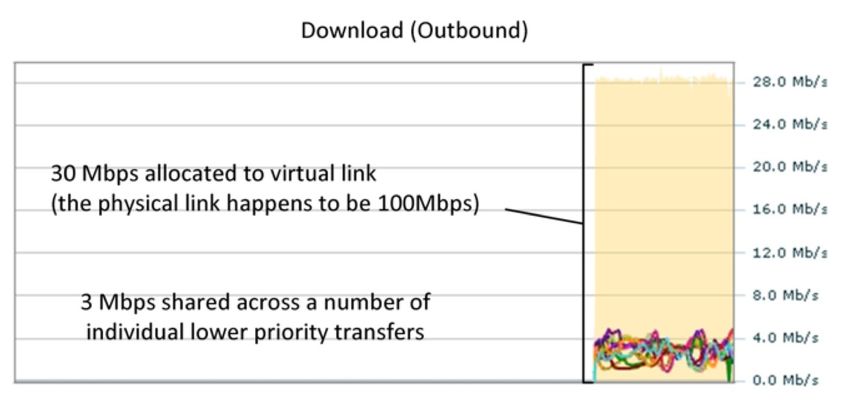
WHITE PAPER

Aspera Mobile

An Open Platform for Rapid Content Acquisition and Delivery

TABLE OF CONTENTS                                                       HIGHLIGHTS

Overview                                                           3   Overview

                                                                        Free-of-charge and available
Transitioning to Mobile Upload                                     3
                                                                        from the Apple App Store, the
Aspera Mobile - an Open Platform for Rapid Upload/Download         3   Aspera Mobile Uploader is the
                                                                        ideal solution for mobile field
Rapid Individual and Concurrent Upload/Download Speed              4   gathering of still and video media,
                                                                        with immediate, high-performance
Predictable Control of Mobile Uploads and Downloads                5   wireless transfer to an Aspera
                                                                        server.
Centralized Management Control Over Mobile Clients and Transfers 6

Familiar, Easy-to-use Clients for Mainstream Operating   Systems   7   Product Highlights

Open Development Platform and Toolkit                              7   Superior Transfer Performance
                                                                        Make the most out of available
Aspera Mobile Platform Components                                  8   bandwidth on wireless networks,
                                                                        including cellular (3G, EDGE) and
                                                                        Wi-Fi (802.11g/n), with speeds
                                                                        that are up to 100X faster than
                                                                        traditional transfer technologies.

                                                                        Easy-to-use Interface
                                                                        Direct accesses to the picture and
                                                                        video library, as well as the iPhone
                                                                        built-in camera, to easily find and
                                                                        upload any content stored on the
                                                                        device.

                                                                        Transfer Control
                                                                        Monitor transfer progress in real
                                                                        time and view performance display
                                                                        to see transfer rate.

                                                                        Benefits

                                                                        • With patented Aspera fasp -
                                                                          AIR TM technology, the Mobile
                                                                          Uploader gets your content
                                                                          to the destination at industry-
                                                                          leading speeds.

                                                                        • Transfers will continue to run
                                                                          in the background during
                                                                          phone calls or when using other
                                                                          applications.

                                                                        • If an upload cannot finish in
                                                                          time, it will be stopped and
                                                                          restarted automatically when
                                                                          the user returns to the Mobile
                                                                          Uploader app.

                                                                                                              2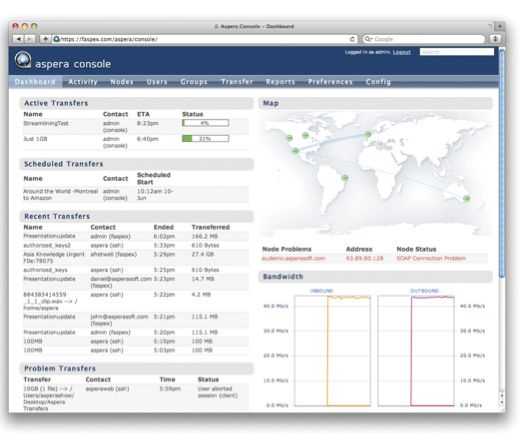
WHITE PAPER

Aspera Mobile

An Open Platform for Rapid Content Acquisition and Delivery

OVERVIEW                                                           TCP fails because of the latency and packet loss created over
                                                                   distance. Network conditions worsen with longer distances,
Today, it’s easy for content creators to remotely capture and
                                                                   irrespective of the medium (wireless, satellite, or land-based
store content on mobile devices. Open a camera and shoot.
                                                                   network).
But transmitting the footage, especially large multimedia files,
is often slow, unreliable, or impossible using conventional FTP.   Wireless networks pose unique problems, as they can be highly
Worse, transfers slow or fail at the worst possible moment:        unpredictable and vary in quality from provider to provider. In
when content is needed most. Under deadline. During breaking       some cases, the conditions may be so bad that no protocol—
news. Covering a major event.                                      TCP, UDP, etc.—will work reliably.

The Aspera Mobile platform solves this remote content              Satellite phones, sometimes more reliable than wireless, have
acquisition and delivery problem for mobile deployments.           limited bandwidth and available windows of operation, making
Solutions built on Aspera Mobile vastly improve the speed and      efficient usage paramount. This poses challenges during
control of mobile uploading and downloading—providing rate         congested usage periods.
control, centralized management, ease of use, and application      Thus, while there is great opportunity for mobile content
extensibility. The platform supplies a one-to-many distribution    capture, there are serious challenges actually acquiring content
model which can be embedded in most any content                    in a timely manner, when relying on conventional TCP transfer
management workflow.                                               tools such as FTP and HTTP.

TRANSITIONING TO MOBILE UPLOAD                                     ASPERA MOBILE - AN OPEN PLATFORM FOR RAPID
The widespread adoption of powerful wireless mobile devices        UPLOAD/DOWNLOAD
and faster networks presents a game-changing opportunity           The Aspera Mobile platform provides a toolkit for developing
for broadcast media and entertainment organizations invested       remote upload/download mobile content acquisition and
in high-value content acquisition and delivery. Mobile devices     distribution solutions. Aspera Mobile is designed for scenarios
can complement and in some cases replace higher-end digital        where content must be securely and predictably acquired,
camera systems.                                                    across any network, from any place in the world. At the heart
Capturing high-quality footage used to require sending out         of Aspera Mobile is the patented, high-speed, location-agnostic
teams of photographers, video crews, and satellite trucks.         transport, FASP, which Aspera is making available on the
Today, high-resolution assets can be captured using any            leading mobile platforms – iOS, Android, and other mobile
number of commercial devices, in a variety of lightweight form     operating systems. A range of devices can be used to reliably
factors such as mobile phones and small flip video cameras.        upload content in support of meeting deadlines over unreliable
                                                                   or congested networks.
Once content is captured, most devices support connecting
to a variety of wireless or satellite networks, either directly,   Users interact with the same familiar devices and notebooks,
through satellite phones (BGAN), or over ad hoc Wi-Fi              from iPhones to notepads running Mac OSX or Windows 7.
networks from just about anywhere. As wireless networks move       An Aspera Application is simply installed on the operating
from 3G to 4G, the mobile medium becomes more suitable for         system. Users interact with files using the same familiar file
remote content acquisition.                                        management tools available on each operating system.

Still, there is a fundamental problem acquiring and distributing   On the server side, the Aspera Mobile platform integrates
content remotely.                                                  with commercial and ad hoc content management workflows.
                                                                   Aspera provides a single point of management for uploads and
While many devices make connecting to networks easy,
                                                                   distribution.
transferring files—especially large files—using conventional

                                                                                                                                     3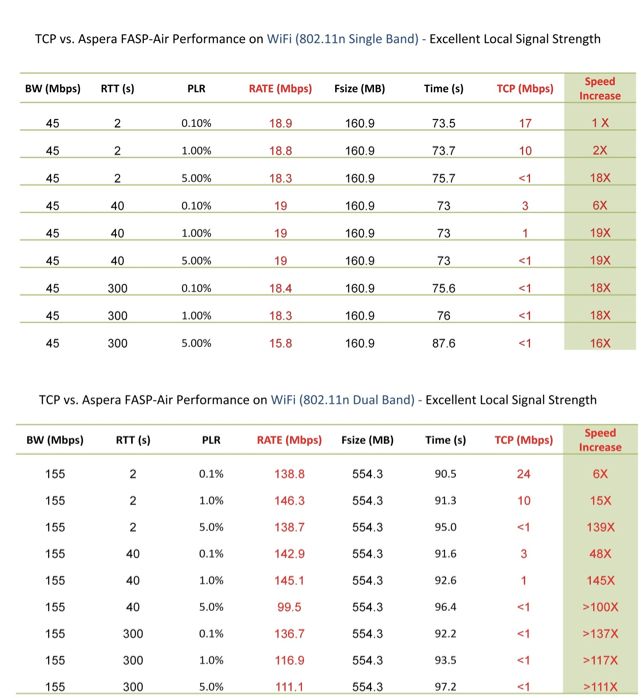
WHITE PAPER

Aspera Mobile

An Open Platform for Rapid Content Acquisition and Delivery

RAPID INDIVIDUAL AND CONCURRENT UPLOAD/
DOWNLOAD SPEED
Aspera fasp-AIR, the core transport used in Aspera Mobile,
overcomes the latency and packet loss associated with many
wireless and land-based networks, present in the most challenging
mobile upload/download scenarios. Using Aspera, transfer speeds
are agnostic to most network conditions—and purely a function
of available bandwidth.1 As bandwidth increases, overall network
speed increases. Compared to TCP, performance gains are
greatest on networks with the worst latency.

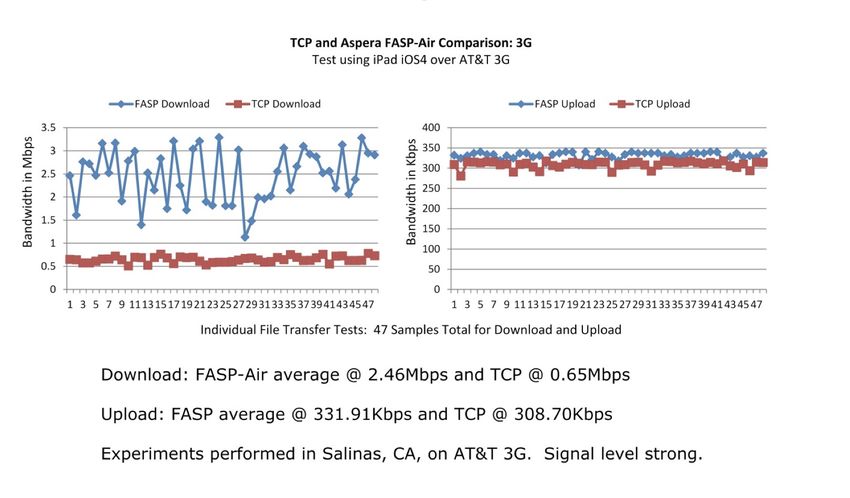
On fixed or mobile satellite networks, it is common to see 100x
performance gains over TCP. Using 3G, performance gains up
to 3x faster than FTP can be achieved, especially in download
scenarios. The chart below depicts modest increases in upload
speed and considerable increases in download speed over TCP.
The spiked download statistics in blue describe full bandwidth
utilization during variable daytime usage hours over 3G.

                                                                    Figure 2: TCP vs. Aspera fasp-AIR comparisons over 4G.

Figure 1: 3G upload and download comparisons- TCP vs.
Aspera fasp-AIR                                                     Performance in the following tests measured performance
                                                                    across the second hop to simulate real-world mobile upload/
                                                                    download scenarios. Wi-Fi networks are fast within the local air
As bandwidth increases using 4G, Aspera fasp-AIR achieves           network, from the device to the gateway or first hop. On this
higher performance. Using 4G, considerable upload and               local loop, bandwidth is usually higher and latency relatively
download performance is achieved. The following sample tests        low. In real-world, end-to-end scenarios, however, files must
were performed over Verizon 4G (LTE) in Emeryville, CA. In          transfer across multiple hops, at variable speeds and conditions
some cases (highlighted in orange below), speeds will vary          over distance.
greatly, depending on available bandwidth and the underlying
                                                                    On Wi-Fi (802.11) networks uplinked to long-haul WANs, Aspera
condition of the wireless network.
                                                                    performance increases from 10 to 100x over TCP can be seen

                                                                                                                                     4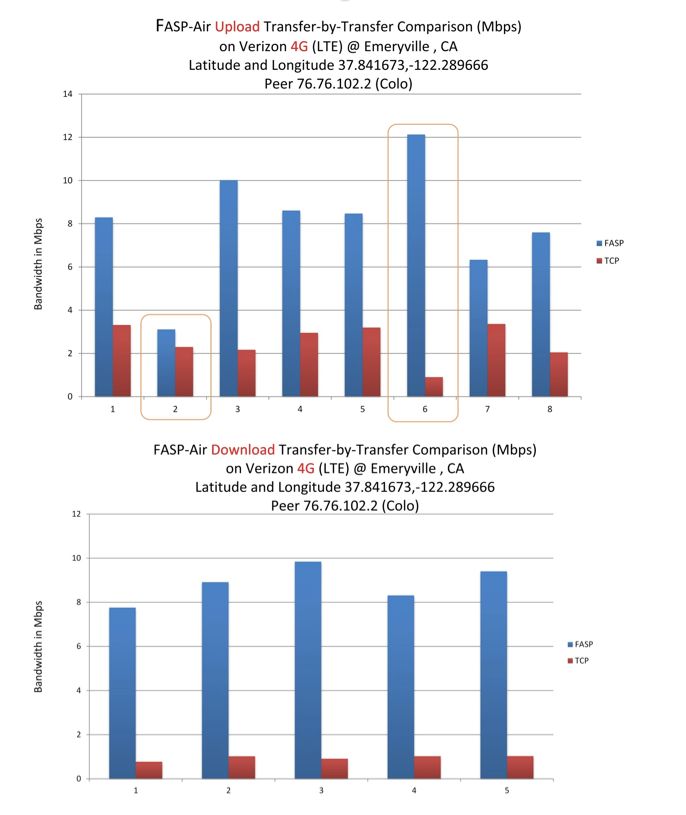
WHITE PAPER

Aspera Mobile

An Open Platform for Rapid Content Acquisition and Delivery

depending on the underlying network and uplink speeds. See       distribution of high-priority assets. An analogy would be FedEx,
Figure 3 below.                                                  which developed package priority over commodity postal
                                                                 transports.

                                                                 Aspera calls its rate control capability over (individual and
                                                                 aggregate) transfer rates virtual link. Priorities can be set down
                                                                 to the user, device, and upload job, while still ensuring full
                                                                 use of the available bandwidth on the server side supporting
                                                                 potentially many concurrent transfers. This is a critical
                                                                 differentiator for mobile scenarios.

                                                                 Proportional bandwidth of varying speeds can be allocated
                                                                 to individual users. For example, one user may receive 90%
                                                                 of available bandwidth—and another user only 2%. fasp-
                                                                 AIR intelligently recognizes continuous changes in available
                                                                 bandwidth, considering all network traffic, without centralized
                                                                 management. Transmission rates and priorities can be pre-set
                                                                 or adjusted on-the-fly and can be associated with particular
                                                                 users or particular asset transfers for arbitrary prioritization.

                                                                 Aspera provides the following example scenarios for mobile
                                                                 rate control:

                                                                 •   Adaptive Rate: In scenarios where multiple users need
                                                                     to share an upload/download link, Aspera transfers
                                                                     automatically adjust transmission speeds to use a fair
                                                                     proportion of the available bandwidth, without slowing
                                                                     down transfer rates during periods of extreme latency and
                                                                     moderate packet losses. The adaptive rate reacts to the
                                                                     smallest physical link on the path, ensuring full use of the
                                                                     available bandwidth without overdriving the network (and
                                                                     causing degraded performance for all applications or users.)
Figure 3: WiFi uplink comparisons of TCP vs. Aspera fasp-AIR
                                                                 •   High Priority: In scenarios where users or uploads/
                                                                     downloads are of the highest priority, individual transfer
PREDICTABLE CONTROL OF MOBILE UPLOADS AND                            sessions, or user accounts, can be configured to use a
DOWNLOADS                                                            high priority policy which will stabilize transfer speeds
Network speed and available bandwidth are important factors.         with higher proportional use of the available bandwidth.
So is the utilization rate, and rate control of the line. When       Bandwidth consumption is adaptive; priority is maintained
networks are congested, Aspera provides rate control and             over other network traffic as available bandwidth changes.
prioritization at the user and device level. Why should a kid
                                                                 •   Low Priority: By contrast, in scenarios where transfers are
uploading a random video to Facebook get the same priority
                                                                     lowest priority, a low priority policy ensures that transfers
as your high-value news footage? They shouldn’t. Aspera’s
                                                                     automatically reduce speed to fully honor all other network
patented adaptive rate control ensures the right users obtain
                                                                     traffic. If another user (with or without an Aspera client)
the right upload priority. During periods of extreme network
                                                                     is uploading a file, an upload set to low priority ensures
congestion, rate control ensures timely acquisition and

                                                                                                                                     5
WHITE PAPER
Aspera Mobile
An Open Platform for Rapid Content Acquisition and Delivery
that Aspera transfers will use the least amount of available
bandwidth during periods of high concurrent usage;
as bandwidth becomes available, Aspera fasp-AIR will
increase speeds to fully utilize available bandwidth.
Figure 5: Virtual link allows Aspera flows to share a portion
of link bandwidth while reserving the rest of the bandwidth
for other traffic regardless of current demand. In this case,
the virtual link is 30 Mbps with several equal priority Aspera
transfers sharing the 30 Mbps. At any time, an individual’s
transfer priority can be increased to allow it to use a higher
proportion of the virtual link bandwidth. The method is fully
Figure 4: Aspera Console with bandwidth control and
decentralized. No centralization or a-priori knowledge of
prioritization capabilities. This example shows two Regular
available bandwidth is required.
Priority transfers and one High Priority transfer sharing a
common virtual link.
CENTRALIZED MANAGEMENT CONTROL OVER
MOBILE CLIENTS AND TRANSFERS
A virtual link can be provisioned to dynamically and virtually
manage the total bandwidth used by a group of transfers, even Remote transfers can be centrally managed, tracked, and
when more physical bandwidth is actually available. Within prioritized through Aspera Console. Aspera Console provides
a virtual link group, bandwidth priorities can be assigned to a centralized, web-based interface to create, manage, control,
dedicate bandwidth to certain individual users, devices (IPs) or track, and report on file transfers. Aspera Console’s role-based
jobs (by job metadata even). For example, even if the overall access control allows users to monitor, start transfers, and
bottleneck bandwidth is 100 Mbps, a virtual link of 30 Mbps generate fully customizable reports. Reports may include or
can be defined such that all ongoing Aspera transfers (or those even be organized and grouped by custom metadata uploaded
within the virtual link group) always maintain 30 Mbps. as part of the transfer session, using the FASP SDK and the
Console 1.5 custom reporting capabilities.
The relative priority and bandwidth of the transfers within the
group can be configured based on a policy. In this example From the Aspera Console, users can also automate files
over 10 concurrent transfers from various network distances transfers. Administrators have the ability to centrally configure
and crossing various Internet paths all equally share a 30 all managed endpoints (or nodes), create and manage users
Mbps virtual link, incoming to a server with 100 Mbps of and groups, initiate and automate transfer jobs, and precisely
WAN bandwidth. The remaining bandwidth can be shared or control and monitor all transfer and bandwidth utilization
allocated to other users as appropriate. parameters.
Optionally, Aspera Mobile can be embedded in any number
of workflow automation or content management frameworks
using Aspera Orchestrator. Aspera Orchestrator provides a
6WHITE PAPER
Aspera Mobile
An Open Platform for Rapid Content Acquisition and Delivery
visual development framework and sophisticated rules engine with immediate, high-performance
to integrate Aspera transfers across multiple endpoints and wireless transfer to an Aspera server.
workflows. The Mobile Uploader client for iOS
is available free-of-charge from the
One of the key benefits of Aspera Mobile is the centralized
Apple App Store.
distribution model. A single upload can be directed to any number
of endpoints within or across existing content management For web-based uploading, Aspera
workflows. For example, a remote mobile user could upload files Connect clients are fully supported
to a single directory, and using jobs through Aspera Console or across major OS environments
workflow automation, automatically distribute files to appropriate (Windows, Mac, Linux, and Unix)
target endpoints (within or outside of the company). and are as easy to use as a web
browser. Aspera Connect is an
install-on-demand web browser
plug-in that powers high-speed
uploads and downloads with the Aspera Connect Server and
the Aspera faspex Server. Compatible with most standard
browsers and sporting a very light system footprint, Aspera
Connect integrates all of Aspera’s high-performance transport
technology in a small, easy-to-use package that provides
unequaled control over transfer parameters.
For notebooks, laptops, and other portables running common
platforms such as Windows 7 and Mac OSX, Aspera Client is
the full-featured desktop transfer client used to initiate and
automate transfers with the Aspera Enterprise Server and the
Aspera Point-to-Point advanced client.
OPEN DEVELOPMENT PLATFORM AND TOOLKIT
Aspera provides customers and industry partners with a
number of tools to embed Aspera’s high-performance FASP
Figure 6: Aspera Console provides comprehensive transfer transport technology and other technologies in 3rd-party
management and job control. software products and end-customer workflows. Aspera
provides a comprehensive, well-documented software
development kit (SDK) featuring SOAP web services and
FAMILIAR, EASY-TO-USE CLIENTS FOR MAINSTREAM Javascript APIs, as well as cross-platform libraries for Mac,
OPERATING SYSTEMS Windows and Linux (Java, C++, C#, .NET).
Aspera’s products are as easy to use as the host device,
The Aspera SDK is available to developers via an annual
desktop, or server.
development subscription that includes all available libraries,
Mobile Uploader clients integrate with the on-board tools of APIs and SOAP/web services, as well as development licenses
common device platforms such as iOS and Android. Uploads and developer support. The SDK features:
can be achieved in a single click. Mobile Uploader is the ideal
• SOAP web services API
solution for mobile field gathering of still and video media,
• Javascript API
7WHITE PAPER
Aspera Mobile
An Open Platform for Rapid Content Acquisition and Delivery
• Complete cross-platform libraries for embedded Aspera
transfer support on Mac, Windows and Linux (Java, C++,
C#, .Net)
• Complete cross-platform libraries for remote file operations
on Mac, Windows and Linux (Java, C++, C#, .Net)
• Fully embeddable client
• Enhanced support for web applications
• Detailed transfer monitoring and reporting
• Java-based API for reliable data streaming.
Through the Aspera SDK or Aspera Orchestrator, workflows can
be extended to include Aspera transfer automation. Example
integrated products include a wide range of technology
partners including digital asset management, content
management, broadcasting, and workflow automation and
design—to custom line-of-business workflows developed for
specific organizations.
ASPERA MOBILE PLATFORM COMPONENETS
SERVER AND TRANSFER MANAGEMENT Aspera Connect Server
Aspera Console
CLIENTS Aspera Mobile Uploader (Add-on to Aspera Connect Server)
Aspera Connect (Included with Aspera Connect Server)
Embedded Client using Aspera SDK (Optional)
Aspera Client (Optional)
DEVELOPMENT TOOLS Aspera SDK (Optional)
Aspera Orchestrator (Optional)
8You can also read


