Assessing the Psychological Impacts of COVID-19 in Undergraduate Medical Students - MDPI
←
→
Page content transcription
If your browser does not render page correctly, please read the page content below
International Journal of
               Environmental Research
               and Public Health

Article
Assessing the Psychological Impacts of COVID-19 in
Undergraduate Medical Students
Alyssa A. Guo              , Marissa A. Crum and Lauren A. Fowler *

                                            Department of Biomedical Sciences, School of Medicine Greenville, University of South Carolina,
                                            Greenville, SC 29605, USA; aaguo@email.sc.edu (A.A.G.); mcrum@email.sc.edu (M.A.C.)
                                            * Correspondence: lfowler3@greenvillemed.sc.edu; Tel.: +1-864-455-9849

                                            Abstract: Medical education has been uniquely affected by the Novel Coronavirus Disease 2019
                                            (COVID-19). As the pandemic’s psychological impacts on medical students remain unclear, this study
                                            assessed COVID-19’s impacts on undergraduate medical students’ stress and anxiety. A nationwide,
                                            online survey was administered via email chains between June-August 2020 to first-fourth year
                                            medical students in the United States. Demographics, 4-point Perceived Stress Scale that measures
                                            stress, 7-point Generalized Anxiety Disorder Scale that measures anxiety, and the impacts of social,
                                            health, and academic stressors due to COVID-19 were collected. Of the 852 students who participated,
                                            66.1% experienced mild, moderate, or severe anxiety. Mean PSS-4 score was 7.25/16. Stress was
                                            highest in second- through fourth-year students. Students with preexisting mental health conditions
                                            had significantly higher stress and anxiety scores, and higher percentage of stress attributed to
                                            COVID-19. Trust in government institutions during COVID-19 was the highest stressor in first-
                                  and second-year students. Delay/availability of standardized exams was the highest stressor for

                                            third-year students. Impact on rotations/residencies was the highest stressor for fourth-year students.
Citation: Guo, A.A.; Crum, M.A.;            Understanding how students’ anxiety and stress have changed due to COVID-19 will allow educators
Fowler, L.A. Assessing the
                                            to identify students in need and guide recommendations on the implementation of psychological
Psychological Impacts of COVID-19
                                            interventions and support strategies.
in Undergraduate Medical Students.
Int. J. Environ. Res. Public Health 2021,
                                            Keywords: COVID-19; undergraduate medical education; stress; anxiety; psychological impacts;
18, 2952. https://doi:10.3390/
                                            mental health
ijerph18062952

Academic Editors: Andrea Fiorillo
and Maurizio Pompili
                                            1. Introduction
Received: 1 February 2021                        The Novel Coronavirus Disease 2019 (COVID-19), declared a pandemic by the World
Accepted: 10 March 2021                     Health Organization in March 2020, spread quickly worldwide and impacted all aspects of
Published: 13 March 2021                    daily life. U.S. undergraduate medical students were uniquely affected by the COVID-19
                                            pandemic due to their positions both as students and future physicians. Undergraduate
Publisher’s Note: MDPI stays neutral        medical students refer to students in the professional degree programs, Medical Doctorate
with regard to jurisdictional claims in     (M.D.) and Doctor of Osteopathic Medicine (D.O.), who are currently in training to become
published maps and institutional affil-     physicians. Due to the need for social distancing, learning opportunities at all levels of
iations.                                    training were disrupted and adapted [1,2]. The pandemic’s social and economic conse-
                                            quences were severe, and as a result, collective mental health suffered [3]. Prior studies
                                            show that life disruptions as a result of natural disasters and prior epidemics lead to
                                            significant mental illness increases [4]. With the unprecedented nature of the pandemic
Copyright: © 2021 by the authors.           impacting students at all levels of training, immediate data collection is needed to identify
Licensee MDPI, Basel, Switzerland.          the psychological impacts of the COVID-19 pandemic in undergraduate medical students.
This article is an open access article           Numerous studies document the high prevalence of depression and depressive symp-
distributed under the terms and             toms in medical students in the United States [5]. Dyrebye and colleagues found that prior
conditions of the Creative Commons          to COVID-19, medical students, from the United States (U.S.) and Canada, experienced
Attribution (CC BY) license (https://       higher levels of emotional distress than their age-matched peers [6]. Rotenstein and col-
creativecommons.org/licenses/by/            leagues found that United States medical students in the age categories of 18–25 and 26–49
4.0/).

Int. J. Environ. Res. Public Health 2021, 18, 2952. https://doi.org/10.3390/ijerph18062952                       https://www.mdpi.com/journal/ijerph
Int. J. Environ. Res. Public Health 2021, 18, 2952 2 of 14
have 2.2 and 5.2 times, respectively, higher chances of having depressive symptoms com-
pared to the prevalence of depressive symptoms in 9.3% and 7.2% of the general public [7].
As we continue to experience the impact of COVID-19, a meta-analysis demonstrated that
the COVID-19 pandemic had significant mental health impacts on medical students in
China, United Arab Emirates, Iran, Brazil, and India [8]. To the best of our knowledge, there
have not been studies addressing COVID-19’s impacts on U.S. medical students’ mental
health nor any studies on identifying stressors specific to each class during the pandemic.
One of the challenges for medical school administrations in addressing the pandemic’s
psychological impact is that each class level had different curricular demands and thus
sources of stress that are exacerbated by the COVID-19 pandemic. In a typical U.S. cur-
riculum, medical students progress through two preclinical years and two clinical years of
hospital clerkships. Multiple studies show that anxiety symptoms are highest in third-year
medical students, the usual transition from preclinical to clinical years [5,9]. In January
20, 2020, the first cases of COVID-19 were reported in the United States [10]. To conserve
personal protective equipment, the American Association of Medical Colleges released
guidelines recommending suspension of clinical activities involving direct patient care [11].
By March of 2020, many schools cancelled hospital clerkships and transitioned curriculums
to online modules and simulated patient care experiences, which may have added to the
anxiety students were already experiencing. Students at other levels were also affected,
with preclinical students learning remotely online. Closures caused testing sites to repeat-
edly reschedule medical licensing exams [12]. Furthermore, the process of applying for a
residency position was modified to accommodate social distancing guidelines [13]. These
numerous last-minute adaptations undoubtedly impacted student learning and added
stress. Therefore, there is a gap in knowledge in identifying specific academic stressors each
school year faces, and these stressors may include reduced quality of clinical educational
experience, challenges with remote learning, delay and availability of standardized exams,
and the pandemic’s impacts on rotations and residency placements.
Aside from curricular disruptions, students were also coping with new stressors
related to life’s realities during a pandemic. Many experienced grief due to loss of loved
ones, loneliness due to social distancing practices, anxiety over the risk of infection, and
financial insecurity [14–17]. Since the beginning of the COVID-19 pandemic, the United
States has faced a severe shortage of personal protective equipment and needed to ration
among healthcare workers [18]. Health concerns such as illness, death and disability, and
personal protective equipment availability may be contributing to increased stress while
students are in the clinic. Students’ stress may also be additive with stressors from outside
the clinic. Social stressors such as COVID-19’s impact on daily life, poor social distancing
practices of others, and decreased trust in government institutions’ handling of COVID-19
may all contribute to heightened stress levels in medical students. Identifying unique
academic, health, and social stressors that are negatively impacting students’ health is
crucial for targeted solutions and interventions.
The present study assesses COVID-19’s impacts on stress and anxiety and seeks to
identify pandemic-related stressors that most impact medical students’ mental health
at different levels of training. While many medical schools have transitioned students
back to in-person activities and as many new students are transitioning into the clinical
environment in the backdrop of active COVID-19 community spread, this knowledge can
guide educators and school administrations’ plans on potential interventions and support
strategies for students in need. Additionally, as many medical schools remain in a virtual-
in-person hybrid instructional style for the unforeseeable future and uncertainty remains,
medical school administrators should continue to monitor pandemic-related stressors that
may be impacting students’ mental health. The ultimate goal of this study is to bring
awareness of the specific needs of medical students in response to unprecedented changes
in learning environments. With this knowledge, tracking the psychological impacts of
COVID-19 will help determine the best paths forward during the ongoing pandemicInt. J. Environ. Res. Public Health 2021, 18, 2952 3 of 14
and serve as a basis in preparing for future events that disrupt undergraduate medical
education.
2. Materials and Methods
2.1. Study Population and Sample
Between June and August of 2020, 929 medical students from the United States,
comprised of Medical Doctorate (M.D.) and Doctor of Osteopathic Medicine (D.O.) degree-
pursuing students, participated in an anonymous online survey. There were 9, 7, 5, 2, and
1 school(s) represented from the South, Northeast, Midwest, West, and Atlantic regions,
respectively. The respondents included 210 first, 286 second, 180 third, and 176 fourth
year students who completed the survey. Email chains through school administration
were the primary method to recruit participants from geographically diverse regions
in the U.S. using cluster sampling. School administrators emailed the survey link to
students. The survey was anonymous, confidential, and without identifiers. The study
protocol was reviewed and approved by the Institutional Review Board at the University
of South Carolina.
2.2. Rating Instruments
A self-reported anonymous online survey collected data on demographic information
and psychometric inventories including the Perceived Stress Scale (PSS-4) and Generalized
Anxiety Disorder Scale (GAD-7) to assess levels of perceived stress and anxiety, respectively.
Students reported how they felt about COVID-19 impacting their mental health and how
they compare to their peers. Students also reported academic, health, and social stressors
that were impacted by COVID-19.
2.2.1. Demographic Characteristics
The online survey collected demographic information including year in medical
school, race, and whether the student had preexisting mental health conditions.
2.2.2. Perceived Stress Scale (PSS-4)
The Perceived Stress Scale (PSS-4) was applied to assess how respondents feel they
can cope with current stressors. The PSS-4 has been shown to be a valid indicator of stress
levels and have been utilized in a number of studies [19,20]. The PSS-4 includes 4 items
to assess how often the respondent experiences certain stressful situations. Respondents
reported their frequency using a 5-point Likert rating scale ranging from 0 (never) to 4
(very often), with the total score ranging from 0–16. The higher the PSS-4 score, the less
the respondent perceives that they can cope with current stressors. PSS-4 does not have
cutoffs but is instead compared to normative data. The PSS-4 had also been reported in the
literature tracking the impact of COVID-19 [21,22].
2.2.3. Generalized Anxiety Disorder Scale (GAD-7)
The respondents also reported their anxiety symptom frequency using the 7-point
Generalized Anxiety Disorder (GAD-7) scale to assess anxiety levels at the time of the
survey. The GAD-7 has been previously validated in the general population and in diverse
clinical settings [23–25]. The GAD-7 is measured using a 4-point Likert rating scale ranging
from 0 (not at all sure) to 3 (nearly every day), with the total score ranging from 0–21. Mild,
moderate, and severe anxiety scores are defined as 5, 10, and 15, respectively. A score
greater than 10 represents probable clinical generalized anxiety disorder.
2.2.4. Unique Stressors during the COVID-19 Pandemic
To identify the stressors caused by COVID-19 that students perceive most contributed
to increased stress, students were asked to rate how they feel certain academic, health, and
social stressors contributed to feelings of stress on a visual analog scale ranging from 0
(not stressful) to 10 (extremely stressful). Examples of the identified stressors include theInt. J. Environ. Res. Public Health 2021, 18, 2952 4 of 14
impact of the transition to remote learning, fear of becoming ill with COVID-19, and the
impact of COVID-19 on daily life.
2.2.5. Perceptions of Stress and Anxiety
Using a visual analog scale ranging from 1 (much less) to 5 (much more), respondents
were asked to recall how stressed or anxious they felt at the time of the survey compared to
a time point before major lockdowns in the United States (this is referred to as changes in
anxiety levels since March 2020 where students were asked “have you noticed any changes
in your anxiety levels since March 2020?”).
They were also asked to report how stressed and anxious they feel compared to their
peers [this is referred to as anxiety/stress compared to other students (before COVID)
where the students were asked “how anxious or stressed do you feel compared to other
medical students?” using the aforementioned visual analog scale].
Students were also asked what percentage of their stress they thought was caused by
COVID-19 (this is referred to as percentage of stress due to COVID-19).
2.3. Data Analysis
Data analysis was performed using SPSS Version 26.0 (IBM Corporation, Armonk, NY,
USA). Descriptive statistics were conducted to describe demographic and other related
respondent characteristics. Stress and anxiety data were not normally distributed across
years in school (according to Levene’s test for equality of variances), and therefore, non-
parametric analyses were used. Kruskal Wallis was used to evaluate whether demographic
information, such as the year in school and preexisting mental health conditions show a
significant difference in relation to stress and anxiety. Relationships between demographic
characteristics and stressors were assessed using Spearman’s Rho. Linear regressions were
performed to assess academic, health, and social stressors that contributed most to PSS-4 and
GAD-7 across year in school. Statistical significance was defined as a two-tailed p < 0.05.
3. Results
3.1. Sample Characteristics
A total of 929 students from 24 medical schools participated, with a completion
rate of 91.7%. During the 2019-2020 academic year, there were 30,367 Doctor of Osteo-
pathic Medicine (D.O.) and 92,674 Medical Doctorate (M.D.) degree-pursing medical
students [26,27]. Therefore, the present study represents 0.755% of the total number of
enrolled medical students. Students’ year in school and race are characterized in Table 1.
Table 1. Sample Characteristics.
Characteristics 852 (100%)
Year in School
First Year 210 (24.65)
Second Year 286 (33.57)
Third Year 180 (21.13)
Fourth Year 176 (20.66)
Race
Black/African American 42 (4.93)
American Indian or Alaska Native 1 (0.12)
Asian 119 (13.97)
Hispanic, Latino, or of Spanish Origin 40 (4.69)
Native Hawaiian or Other Pacific Islander 1 (0.12)
White 576 (67.61)
Multiracial 60 (7.04)
Others 13 (1.53)
Values are expressed as number of students (percentage).Multiracial 60 (7.04)
Others 13 (1.53)
Values are expressed as number of students (percentage).
Int. J. Environ. Res.3.2.
Public Health 2021,
Anxiety 18, 2952
in Undergraduate Medical Students 5 of 14
In first through fourth year medical students, 289 (33.92%) did not have any symp-
toms of anxiety (based on GAD-7), and 298 (34.98%) showed mild anxiety, 164 (19.25%)
had moderate anxiety, and in
3.2. Anxiety 101(11.85%)
Undergraduate had Medical
severe anxiety.
StudentsTable 2 details anxiety levels
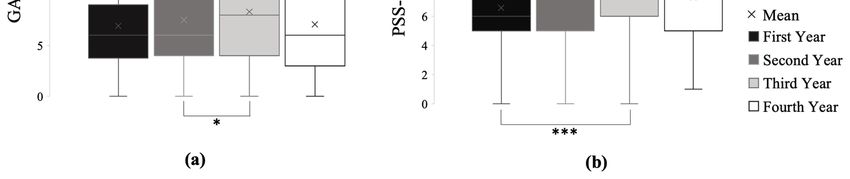
reported in each class. Figure 1a indicates anxiety scores
In first through fourth year medical students,in each class and the did
289 (33.92%) overall anx- any symptoms
not have
iety score. Figure 1a also indicates that third year students reported significantly higher
of anxiety (based on GAD-7), and 298 (34.98%) showed mild anxiety, 164 (19.25%) had
anxiety levels than both first
moderate year (p
anxiety,Int. J. Environ. Res. Public Health 2021, 18, 2952 6 of 14
stressor for fourth years (7.75 ± 2.89). Table 3 delineates the measured stressors across
different classes.
Table 3. Academic, Social, and Health Stressors Related to COVID-19.
Stressors First Year Second Year Third Year Fourth Year Overall
Academic
Quality of Clinical
Educational 5.2 ± 3.2 5.7 ± 3.0 6.3 ± 2.7 6.1 ± 2.6 5.8 ± 2.9
Experiences
Remote Learning 5.8 ± 2.9 6.0 ± 2.7 5.4 ± 2.7 5.1 ± 2.7 5.6 ± 2.8
Delay and Availability
of Standardized 2.8 ± 3.1 3.6 ± 3.5 7.4 ± 3.2 7.2 ± 2.9 4.9 ± 3.8
Exams
Impact on Rotations
2.3 ± 3.1 2.5 ± 3.3 5.0 ± 3.6 7.8 ± 2.9 4.1 ± 3.9
and Residency
Health
Becoming Ill 6.2 ± 2.7 6.4 ± 2.5 6.5 ± 2.6 6.3 ± 2.6 6.3 ± 2.6
Death and Disability 3.6 ± 3.0 3.9 ± 3.1 4.1 ± 2.9 3.8 ± 3.0 3.9 ± 3.0
Personal Protective
Equipment 4.3 ± 2.7 4.4 ± 2.8 4.9 ± 2.6 4.9 ± 2.9 4.6 ± 2.7
Availability
Social
Impact on Daily Life 6.2 ± 2.3 6.2 ± 2.4 6.6 ± 2.3 6.2 ± 2.4 6.3 ± 2.4
Social Distancing
6.3 ± 2.5 6.5 ± 2.6 6.2 ± 2.5 5.9 ± 2.9 6.3 ± 2.6
Practices of Others
Trust in Government
6.7 ± 2.6 7.0 ± 2.7 6.8 ± 2.8 6.9 ± 2.7 6.8 ± 2.7
Institutions
Values are expressed as mean score ± standard deviation. On a scale of 1 (not stressful)–10 (extremely stressful),
students rated how the following stressors have contributed to feelings of stress during the COVID-19 pandemic.
Bolded are the highest rated stressors for each class.
3.4. Predictors of Stress and Anxiety
Correlations and linear regressions were conducted to assess factors that contributed
the most to GAD-7. Students who reported higher changes in anxiety levels since March
2020 were found to have higher GAD-7 scores, rho (852) = 0.572, p < 0.001. Students who
rated high levels of stress due to the impacts of COVID-19 on daily life were also likely to
have higher GAD-7 scores, rho (852) = 0.532, p < 0.001.
Students who reported higher changes in anxiety levels since March 2020 had higher
PSS-4 scores, rho (852) = 0.492, p < 0.001. Students who rated higher levels of stress due
to impacts on daily life had higher PSS-4 scores, rho (852) = .496, p 0.05).
A one-way MANOVA assessed year in school’s effect on the students’ rating of
percentage of stress and anxiety that is caused by COVID-19. Results show that there were
no significant effect, F (1,3) = 1.58, p > 0.05. Though, first year medical students had the
lowest rated percentage of stress and anxiety that is caused by COVID-19.
3.5. Effects of Preexisting Mental Health on Stress and Anxiety
Students who self-reported pre-existing mental health conditions had higher PSS-4
(p < 0.001) and GAD-7 scores (p < 0.001) (Table 4). Furthermore, preexisting mental health
conditions contributed to higher percentage of stress due to COVID-19 (p < 0.05).Int. J. Environ. Res. Public Health 2021, 18, 2952 7 of 14
Table 4. Effects of Preexisting Mental Health Conditions with Higher Stress and Anxiety Levels
During the COVID-19 Pandemic.
Mental Health Number of Standard
Variable Mean p-Value
Diagnosis Students Deviation
PSS-4 Scores Yes 227 8.08 3.00Int. J. Environ. Res. Public Health 2021, 18, 2952 8 of 14
Change in anxiety levels since March 2020 is directly related to self-reported anxiety
and stress compared to other students before COVID-19, change in stress levels since
March 2020, PSS-4 scores, and GAD-7 scores [rho (852) = 0.405, 0.351, 0.751, 0.551, 0.570,
respectively. All p-values are < 0.01].
Change in stress levels since March 2020 is directly related to self-reported anxiety
and stress compared to other students before COVID-19, change in anxiety levels since
March 2020, PSS-4 scores, and GAD-7 scores [rho (852) = 0.327, 0.415, 0.751, 0.553, 0.516,
respectively. All p-values are < 0.01].
4. Discussion
In April 2020, a group of 24 world-leading experts from across the bio-psycho-social
spectrum of expertise, determined that there is an immediate priority in collecting data
on the mental health effects of the COVID-19 pandemic across different populations [28].
The present study answers the call by determining the impact of COVID-19 in the un-
dergraduate medical student population in the U.S. This study reports that 66.1% of
undergraduate medical students in the U.S., across 24 institutions, are experiencing mild to
severe anxiety. As expected, prevalence of anxiety is higher than the previously reported
anxiety levels. A prior meta-analysis estimated the global prevalence of anxiety in medical
students at 33.8% [29]. A prior study, of medical students in the U.S., found anxiety preva-
lence to be 20.3%, as quantified by GAD-7 > 10 [30]. In the present study, we found that
31.1% of students have moderate and severe anxiety (GAD-7 > 10), which represents an
increase from the aforementioned study. This study’s results have important implications
in serving as one time point of anxiety prevalence during the pandemic and may be of
value for future investigations of COVID-19’s psychological impacts on medical students.
Overall, we found that, during the COVID-19 pandemic, there is a high prevalence of
anxiety and stress in students. We also determined that students with preexisting mental
health conditions are more likely to have higher anxiety and stress levels. Furthermore,
we delineated specific COVID-19 related stressors that are unique to medical students in
different levels of training.
4.1. Predictors of Anxiety and Stress
The study results show that students who had higher changes in anxiety levels since
March 2020 had correspondingly high levels of anxiety and stress. Even though the present
study did not include baseline knowledge of stress or anxiety in the study population,
the results indicate that students note that their anxiety is elevated compared to before
the start of the pandemic. The impacts of COVID-19 on daily life was also found to be a
predictor of anxiety and stress. COVID-19 has had significant impacts on daily life, ranging
from Stay at Home orders at the time of the survey to social distancing and mask wearing
practices as areas have lifted restrictions [31]. These overarching public health measures
may have contributed to feelings of distress. Additionally, social isolation because of
physical distancing may contribute to feelings of loneliness that may have led to increased
levels of anxiety and stress.
Furthermore, results show that self-reported changes in anxiety level since March 2020
was significantly different for students in different education levels. Third year students
had higher changes in anxiety levels since March 2020 as compared to first and second
year students. This data is as expected given that at the time of the survey, in addition to
changes in curriculum, third year students had just recently transitioned into the clinical
learning environment when the COVID-19 cases continued to rise in the United States.
As the usual transition from preclinical to clinical years is normally stressful for third year
students, it is imperative that special attention is needed as students transition from the
didactic to clinical curriculums, especially during the pandemic or future events that may
be disruptive to learning [5,9,32].
Predictors of stress included the student’s year in school and the rapid transition to
remote learning. These factors likely impact students’ academic performance and studentInt. J. Environ. Res. Public Health 2021, 18, 2952 9 of 14
wellbeing and thus are important topics for medical school administrators to recognize
and address. Third and fourth year students were unsure about their ability to progress
through their education in a time when students were no longer allowed in or were limited
in choices of clinical learning environments. Students likely feared potential exposure if
they did continue their clinical rotations. For first and second year students, the transition
to remote learning contributed to feelings of stress. Students found themselves having
to work in their more distracting home environments, losing the social support of their
peers. Both faculty and students had to adapt to the use of new technologies quickly [2].
Therefore, stressors unique to both preclinical and clinical learning environments must be
quickly identified and addressed to ensure student success.
Furthermore, study results also show that students who reported higher anxiety and
stress levels compared to their peers as well as students who reported higher change in
anxiety and stress levels since March 2020 is directly correlated with higher PSS-4 and
GAD-7 scores. This is significant given that first, students who self-report higher normal
anxiety and stress levels have heightened levels during the pandemic. Secondly, students
may be self-aware of increased anxiety and stress levels based on the strong correlations of
self-reported scores with PSS-4 and GAD-7 scores. However, this brings up the concern
that while students may be self-aware, are the students cognizant of the extensiveness the
pandemic has altered their mental health? Therefore, it is of utmost importance that mental
health impacts be continuously assessed throughout the pandemic to identify students
who reach concerning levels of stress and anxiety that may require clinical intervention.
4.2. Unique Stressors to Each Class
The present study also identified unique stressors for first to fourth year students.
First and second year students rated higher stress due to trust in government institutions
and stress due to others’ social distancing practices. These stressors are both uniquely
reflective of the United States pandemic response. At the time the survey was administered,
rhetoric from the national leadership frequently downplayed the severity of the virus while
encouraging disregard for various individual and public safety guidelines recommended
by the Centers for Disease Control and World Health Organization (WHO) [33]. As a
potential result of this influence, adherence to social distancing was not a norm for much
of the country [34]. First and second students’ anxiety may be stemmed from a fear of the
disease spreading uncontrolled given that mask wearing in the United States has been
a controversial issue and is frequently politicized [35]. There is a conflict for students
between having an understanding of public health and the behaviors being modeled by
community members, which may be a source of heightened anxiety. Further research is
needed to know whether this effect is more pronounced in areas with a higher proportion
of people who do not wear masks and do not adhere to recommended guidelines.
For third and fourth years, the study results indicate significantly higher stress poten-
tially due to high-stakes checkpoints in medical students’ academic career—disruption of
standardized board exams that determine eligibility for residency and accessing rotations
and residency. The highest stressor for third year students and second highest stressor
for fourth year students was the delay and availability of standardized exams. At the
time of the survey, testing centers were closed due to elevated infection rates across the
country, and many students had their standardized board exams rescheduled multiple
times [36]. Studying for board exams without definitive test dates may contribute to
feelings of burnout for these students. The highest stressor for fourth year students was
the impact of the pandemic on rotations and residency. With clinical rotations cancelled
or postponed and away rotations unavailable due to safety concerns, students may have
had elevated levels of stress being unable to experience or distinguish themselves to resi-
dency programs they hope to apply to as well as losing valuable in-person clinical training
time [12]. Exploring options for additional enriching virtual clinical learning may poten-
tially alleviate some concerns for upperclassmen who were unable to receive the clinical
education normally offered both at home and away institutions.Int. J. Environ. Res. Public Health 2021, 18, 2952 10 of 14
4.3. The Effect of Preexisting Mental Health Conditions on Anxiety and Stress Levels during the
COVID-19 Pandemic
This study reports that students with preexisting mental health conditions had sig-
nificantly higher anxiety and stress levels, as well as a significantly higher percentage of
reported stress attributed to COVID-19. These results are expected given that people with
preexisting mental health conditions may have limited access to essential treatment and
services or may have to adjust methods of receiving care, such as the switch to virtual ses-
sions, during the pandemic. The WHO found that across 130 countries, over 60% reported
disruption to mental health services for vulnerable people [37]. The higher percentage of
stress attributed to COVID-19 is also expected given that people with mental health disor-
ders have increased risk of infection and have worse outcomes than of those without [38].
Therefore, given limited or disrupted access to necessary care, compounded with being a
high risk group of contracting COVID-19, these may be explanations for why preexisting
mental health conditions may lead to higher stress and anxiety levels.
4.4. Study Limitations and Future Research
There are several limitations to the present study, including the limited collection
of demographic data. In the survey, gender and age were not collected out of privacy
purposes. As the survey collected information on school name, year in school, and race,
collecting gender and age may allow for easy identification of students. Several factors
were taken into consideration regarding the decision to omit gender in the survey. Previous
literature showed mixed results about whether gender influences medical students’ health.
Hardeman et al. reported that there were no significant gender differences with respect
to self-rated health in medical students [39]. Similarly, their group also did not find a
significant interaction effect for depressive symptoms using an unadjusted bivariate model.
Dyrbye et al. reported that there were no significant association observed between gender
and serious thoughts of dropping out [40]. Age was also omitted from the survey given
that a majority of students fall under the 20-25 years old category and would provide more
harm than value to the study [41]. Out of privacy concerns, the survey sought to limit in
collecting sensitive information as much as possible. Therefore, caution should be taken
when interpreting the data given the limited demographic information.
Another important area of research that was not further developed in this study was
the impact of racial disparities in stress and anxiety in medical students. Reflective of
medical school enrollment demographics, the present study had a limited response in
students of color. A study reaching a wider population of medical students is needed to
understand how race impacted mental health in medical students during the pandemic.
Black communities share a higher burden of COVID-19 infections and death due to struc-
tural disparities [42]. Asian-American communities have experienced a wave of increased
stigmatization [43]. Understanding how these disparities impact mental health in medical
students is important to promote access to mental health services and resilience.
Another limitation of the present study is that geographic differences in stress and
anxiety in medical students during the COVID-19 pandemic were not evaluated. While
institutional data was collected, the geographic region of the students’ medical school may
not be used as a proxy for their physical location because many students traveled from
their respective campuses when in person classes and clinical experiences were cancelled.
Thus, medical school geographic regions may not accurately show geographic differences
in stress and anxiety. This is an important area of further study to understand how the
intensity of lockdowns and cultural differences may impact medical student stress and
anxiety in different regions of the United States.
As there was not any recent, preexisting data to compare with the present study’s
sample, the survey asked students to recall their own perceptions of how stress and anxiety
compared to their peers before the COVID-19 pandemic. Students were provided with
the definition of anxiety from the American Psychological Association prior to recalling
their anxiety level to ensure students’ understanding of anxiety [44]. Measure of students’Int. J. Environ. Res. Public Health 2021, 18, 2952 11 of 14
perception of their own anxiety compared to their peers may be a proxy to understanding
students’ normal anxiety levels. To that end, caution should still be taken when interpreting
the data given that recalled data may not be accurate. Future studies may collect data at
different time points to compare changes in stress and anxiety during events disruptive to
learning.
Another limitation of the present study is that the survey did not seek to delineate the
specific types of preexisting mental health conditions as reported by students. Students
were only asked to denote yes or no for preexisting mental health conditions. The goal of
the survey question is to provide results of whether students with preexisting mental health
conditions should be prioritized and provide information for current medical students.
Especially for incoming medical students with mental health conditions, it is crucial that
they recognize starting school during the pandemic will be more challenging, and they
may experience higher risks of stress and anxiety compared to their peers. Future studies
may consider whether specific types of mental health illnesses have different influences on
medical students’ stress and anxiety levels during events disruptive to learning.
Given that the data was collected between June to August of 2020, this is a time
period of transition into the next level of training for many students, which may include
heightened stress due to the transition. Therefore, caution should be taken when interpret-
ing the data. However, to account for this, the present data highlight several important
findings that indicate increased stress and anxiety levels may be partially attributed to
the disruptions caused by pandemic. The present study shows that students had much
higher rate of anxiety (31.1%) compared to preexisting data of 20.3% [30]. Students also
rated novel COVID-19 stressors that have contributing to feelings of stress, and the results
showed that students at different levels of training have unique stressors, which were new
challenges that students were facing during the pandemic that may increase their stress
and anxiety levels. Additionally, the study investigated whether year in school had an
effect on students’ rating of percentage of stress and anxiety that is caused by COVID-19.
First year students had the lowest rated percentage of stress and anxiety compared to other
school years. However, there was large variabilities in both percentage of stress and anxiety
within each class. While these differences are not significant, the trends are consistent with
those seen in other stress and anxiety measures. Future studies may investigate whether
different time points of training within one academic year influence students’ stress and
anxiety levels, and this may pinpoint the optimal times for interventions as needed.
This study was conducted towards the start of the pandemic in the United States
and reflects students’ stress and anxiety during that period, which may not reflect the
students’ responses at the time of this publication. Early in the pandemic, there were many
unknowns about the nature of the pandemic, the lockdowns were novel, and there was
often conflicting information regarding the disease process and spread. More impactfully,
the healthcare system was in high burden with increased number of patients compounded
by challenges in diagnosis and treatments of confirmed cases [45]. These fears and stressors
unique to medical students may not hold true today. As the pandemic has progressed
since the data collection, many areas have experienced “lockdown fatigue,” and certain
areas of the country are no longer requiring social distancing guidelines. Therefore, the
psychological impacts of COVID-19 may have changed as personal impacts changed.
As the pandemic continues, there is an increasing need to continue to track the mental
health status of all populations, including medical students. Specifically, for medical stu-
dents, understanding anxiety and stress changes due to COVID-19 will allow educators to
guide recommendations on the potential implementation of psychological interventions
and support strategies for students identified to be in need. Psychological care and coun-
seling should be available, normalized, and destigmatized. Further studies may focus on
delineating specific protective and risk factors as well as precautionary measures that may
have contributed to lower or higher stress and anxiety levels. Furthermore, as the pandemic
has no definitive end in sight, it is crucial that medical school administrators continue to
monitor COVID-19’s psychological impacts on students in order to identify student groupsInt. J. Environ. Res. Public Health 2021, 18, 2952 12 of 14
in need and develop tailored interventions to alleviate mental health concerns. As there
was not any recent, preexisting data to compare with the present study’s sample, this study
asked students to recall their own perceptions of how stress and anxiety compared to their
peers; thus, this presents as a limitation for the present study. Future studies may collect
data at different time points to compare changes in stress and anxiety. Additionally, as
the current research only encompasses 0.755% of the entire U.S. undergraduate medical
student population, more research with larger sample sizes is needed to better understand
the psychological impacts of COVID-19 on students nationwide. Future research may also
focus on increasing participation rates in individual medical schools so that the data is more
representative of their student body. Data collected now will not only benefit current stu-
dents during the ongoing COVID-19 pandemic but also serve as the basis for preparations
for best paths forward during future pandemics or events disrupting medical education.
5. Conclusions
Medical school is a high-pressure environment, and students are not immune to the
added stressors presented by a global pandemic. Previous studies have shown that medical
students are a population vulnerable to higher rates of mental health issues including
stress and anxiety. This study shows that medical students are experiencing significant
impacts due to the stress added by the pandemic and have high levels of anxiety at survey
time. Results indicate a disproportionate impact on second, third, and fourth year students
and those with pre-existing mental health conditions. Students in these groups may
benefit from targeted intervention. Additionally, we identified COVID-19-related stressors
that were unique to each class, and interventions may be implemented to address these
concerns. By understanding the factors that contributed the most to stress due to COVID-
19, educators may be able to formulate tailored interventions. These results may also help
guide recommendations to improve the wellbeing of medical students by recognizing and
addressing COVID-19’s continuous psychological impacts on different classes as well as
preparing for future pandemics and other disruptive events to undergraduate medical
education. As psychological interventions are more effective when intervening early, there
is an urgent need for medical schools to address likely increases in stress and anxiety levels
while the COVID-19 pandemic remains ongoing.
Author Contributions: Conceptualization, A.A.G., M.A.C. and L.A.F.; Methodology, A.A.G., M.A.C.
and L.A.F.; Software, L.A.F.; Validation, A.A.G., M.A.C. and L.A.F.; Formal Analysis, L.A.F.; Investi-
gation, A.A.G. and M.A.C.; Resources, A.A.G., M.A.C. and L.A.F.; Data Curation, A.A.G., M.A.C.
and L.A.F.; Writing—Original Draft Preparation, A.A.G. and M.A.C.; Writing—Review and Editing,
A.A.G., M.A.C. and L.A.F.; Visualization, A.A.G., M.A.C. and L.A.F.; Supervision, L.A.F.; Project
Administration, A.A.G. and M.A.C. All authors have read and agreed to the published version of
the manuscript.
Funding: This research received no external funding.
Institutional Review Board Statement: The study was conducted according to the guidelines of
the Declaration of Helsinki, and approved by the Institutional Review Board of University of South
Carolina (protocol code Pro00101164 and 6/15/2020).
Informed Consent Statement: Informed consent was obtained from all subjects involved in the study.
Data Availability Statement: Data available on request due to restrictions. The data presented in
this study are available on request from the corresponding author. The data are not publicly available
due to the sensitive nature of the data collected from students.
Acknowledgments: The authors would like to thank all of the students who participated in the
survey. The authors would also like to thank Marjorie Jenkins, Julie Linton, Phyllis MacGilvray, and
other school administrators who assisted in survey distribution.
Conflicts of Interest: The authors declare no conflict of interest.Int. J. Environ. Res. Public Health 2021, 18, 2952 13 of 14
References
1. Miller, D.G.; Pierson, L.; Doernberg, S. The Role of Medical Students during the COVID-19 Pandemic. Ann. Intern. Med. 2020,
173, 145–146. [CrossRef] [PubMed]
2. Rose, S. Medical Student Education in the Time of COVID-19. JAMA 2020, 323, 2131. [CrossRef]
3. Salari, N.; Hosseinian-Far, A.; Jalali, R.; Vaisi-Raygani, A.; Rasoulpoor, S.; Mohammadi, M.; Rasoulpoor, S.; Khaledi-Paveh, B.
Prevalence of stress, anxiety, depression among the general population during the COVID-19 pandemic: A systematic review and
meta-analysis. Glob. Health 2020, 16, 57. [CrossRef] [PubMed]
4. Esterwood, E.; Saeed, S.A. Past Epidemics, Natural Disasters, COVID19, and Mental Health: Learning from History as we Deal
with the Present and Prepare for the Future. Psychiatr. Q. 2020, 91, 1121–1133. [CrossRef] [PubMed]
5. Compton, M.T.; Carrera, J.; Frank, E. Stress and Depressive Symptoms/Dysphoria Among US Medical Students. J. Nerv. Ment. Dis.
2008, 196, 891–897. [CrossRef]
6. Dyrbye, L.N.; Thomas, M.R.; Shanafelt, T.D. Systematic Review of Depression, Anxiety, and Other Indicators of Psychological
Distress among U.S. and Canadian Medical Students. Acad. Med. 2006, 81, 354–373. [CrossRef]
7. Rotenstein, L.S.; Ramos, M.A.; Torre, M.; Segal, J.B.; Peluso, M.J.; Guille, C.; Sen, S.; Mata, D.A. Prevalence of Depression,
Depressive Symptoms, and Suicidal Ideation Among Medical Students. JAMA 2016, 316, 2214–2236. [CrossRef]
8. Lasheras, I.; Gracia-García, P.; Lipnicki, D.M.; Bueno-Notivol, J.; López-Antón, R.; De La Cámara, C.; Lobo, A.; Santabárbara, J.
Prevalence of Anxiety in Medical Students during the COVID-19 Pandemic: A Rapid Systematic Review with Meta-Analysis. Int.
J. Environ. Res. Public Health 2020, 17, 6603. [CrossRef]
9. Chandavarkar, U.; Azzam, A.; Mathews, C.A. Anxiety symptoms and perceived performance in medical students. Depress.
Anxiety 2007, 24, 103–111. [CrossRef]
10. Harcourt, J.; Tamin, A.; Lu, X.; Kamili, S.; Sakthivel, S.K.; Murray, J.; Queen, K.; Tao, Y.; Paden, C.R.; Zhang, J.; et al. Severe
Acute Respiratory Syndrome Coronavirus 2 from Patient with Coronavirus Disease, United States. Emerg. Infect. Dis. 2020, 26,
1266–1273. [CrossRef]
11. Guidance on Medical Students’ Participation in Direct In-person Patient Contact Activities. 2020, pp. 1–6. Available online: https:
//www.aamc.org/system/files/2020-08/meded-August-14-Guidance-on-Medical-Students-on-Clinical-Rotations.pdf (accessed
on 30 January 2021).
12. Akers, A.; Blough, C.; Iyer, M.S. COVID-19 Implications on Clinical Clerkships and the Residency Application Process for Medical
Students. Cureus 2020, 12, e7800. [CrossRef]
13. Gabrielson, A.T.; Kohn, J.R.; Sparks, H.T.; Clifton, M.M.; Kohn, T.P. Proposed Changes to the 2021 Residency Application Process
in the Wake of COVID-19. Acad. Med. 2020, 95. [CrossRef] [PubMed]
14. Mortazavi, S.S.; Assari, S.; Alimohamadi, A.; Rafiee, M.; Shati, M. Fear, Loss, Social Isolation, and Incomplete Grief Due to
COVID-19: A Recipe for a Psychiatric Pandemic. Basic Clin. Neurosci. J. 2020, 11, 225–232. [CrossRef] [PubMed]
15. Lopez, M.; Ungaro, R.F.; Baker, H.V.; Moldawer, L.L.; Morris, J.G. Loneliness: A Signature Mental Health Concern in the Era of
COVID-19. Psychiatry Res. 2020, 290, 19–21.
16. Mertens, G.; Gerritsen, L.; Duijndam, S.; Salemink, E.; Engelhard, I.M. Fear of the coronavirus (COVID-19): Predictors in an
online study conducted in March 2020. J. Anxiety Disord. 2020, 74, 102258. [CrossRef]
17. Mann, F.D.; Krueger, R.F.; Vohs, K.D. Personal economic anxiety in response to COVID-19. Pers. Individ. Differ. 2020,
167, 110233. [CrossRef]
18. Emanuel, E.J.; Persad, G.; Upshur, R.; Thome, B.; Parker, M.; Glickman, A.; Zhang, C.; Boyle, C.; Smith, M.; Phillips, J.P. Fair
Allocation of Scarce Medical Resources in the Time of Covid-19. N. Engl. J. Med. 2020, 382, 2049–2055. [CrossRef]
19. Warttig, S.L.; Forshaw, M.J.; South, J.; White, A.K. New, normative, English-sample data for the Short Form Perceived Stress Scale
(PSS-4). J. Health Psychol. 2012, 18, 1617–1628. [CrossRef]
20. Cohen, S.; Kamarck, T.; Mermelstein, R. A global measure of perceived stress. J. Health Soc. Behav. 1983, 24, 385–396. [CrossRef]
21. Jia, R.; Ayling, K.; Chalder, T.; Massey, A.; Broadbent, E.; Coupland, C.; Vedhara, K. Mental health in the UK during the COVID-19
pandemic: Cross-sectional analyses from a community cohort study. BMJ Open 2020, 10, e040620. [CrossRef]
22. Li, D.C.Y.; Leung, L. Psychometric data on knowledge and fear of coronavirus disease 2019 and perceived stress among workers
of filipino origin in Hong Kong. Data Brief 2020, 33, 106395. [CrossRef]
23. Löwe, B.; Decker, O.; Müller, S.; Brähler, E.; Schellberg, D.; Herzog, W.; Herzberg, P.Y. Validation and Standardization of the
Generalized Anxiety Disorder Screener (GAD-7) in the General Population. Med. Care 2008, 46, 266–274. [CrossRef]
24. Spitzer, R.L.; Kroenke, K.; Williams, J.B.W.; Löwe, B. A Brief Measure for Assessing Generalized Anxiety Disorder. Arch. Intern.
Med. 2006, 166, 1092–1097. [CrossRef]
25. Kroenke, K.; Spitzer, R.L.; Williams, J.B.; Monahan, P.O.; Löwe, B. Anxiety Disorders in Primary Care: Prevalence, Impairment,
Comorbidity, and Detection. Ann. Intern. Med. 2007, 146, 317–325. [CrossRef] [PubMed]
26. American Osteopathic Association. Available online: https://osteopathic.org/about/aoa-statistics/#:~{}:text=Number%20of%
20new%20DOs%20sets%20a%20record%20in%202019&text=Nearly%207%2C000%20new%20physicians%20graduated,of%20
the%20American%20physician%20population (accessed on 30 January 2021).
27. Association of American Medical Colleges. Available online: https://www.aamc.org/data-reports/students-residents/
interactive-data/2020-facts-enrollment-graduates-and-md-phd-data (accessed on 30 January 2021).Int. J. Environ. Res. Public Health 2021, 18, 2952 14 of 14
28. Holmes, E.A.; O’Connor, R.C.; Perry, V.H.; Tracey, I.; Wessely, S.; Arseneault, L.; Ballard, C.; Christensen, H.; Silver, R.C.;
Everall, I.; et al. Multidisciplinary research priorities for the COVID-19 pandemic: A call for action for mental health science.
Lancet Psychiatry 2020, 7, 547–560. [CrossRef]
29. Quek, T.T.-C.; Tam, W.W.-S.; Tran, B.X.; Zhang, Z.; Ho, R.C.-M. The Global Prevalence of Anxiety Among Medical Students:
A Meta-Analysis. Int. J. Environ. Res. Public Health 2019, 16, 2735. [CrossRef] [PubMed]
30. Mousa, O.Y.; Dhamoon, M.S.; Lander, S.; Dhamoon, A.S. The MD Blues: Under-Recognized Depression and Anxiety in Medical
Trainees. PLoS ONE 2016, 11, e0156554. [CrossRef] [PubMed]
31. Tull, M.T.; Edmonds, K.A.; Scamaldo, K.M.; Richmond, J.R.; Rose, J.P.; Gratz, K.L. Psychological Outcomes Associated with
Stay-at-Home Orders and the Perceived Impact of COVID-19 on Daily Life. Psychiatry Res. 2020, 289, 113098. [CrossRef]
32. Rosal, M.C.; Ockene, I.S.; Ockene, J.K.; Barrett, S.V.; Ma, Y.; Hebert, J.R. A longitudinal study of students depression at one
medical school. Acad. Med. 1997, 72, 542–546. [CrossRef]
33. Hatcher, W. A Failure of Political Communication Not a Failure of Bureaucracy: The Danger of Presidential Misinformation
during the COVID-19 Pandemic. Am. Rev. Public Adm. 2020, 50, 614–620. [CrossRef]
34. Painter, M.; Qiu, T. Political Beliefs affect Compliance with COVID-19 Social Distancing Orders. SSRN Electron. J. 2020,
103–119. [CrossRef]
35. Kahane, L.H. Politicizing the Mask: Political, Economic and Demographic Factors Affecting Mask Wearing Behavior in the USA.
East. Econ. J. 2021, 1–21. [CrossRef]
36. American Medical Association. Available online: https://www.ama-assn.org/residents-students/usmle/delays-miscommunications-
add-even-more-stress-usmle-step-exams (accessed on 30 January 2021).
37. The Impact of COVID-19 on Mental, Neurological and Substance Use Services: Results of a Rapid Assessment. Available online:
https://www.who.int/publications/i/item/978924012455 (accessed on 10 December 2020).
38. Moreno, C.; Wykes, T.; Galderisi, S.; Nordentoft, M.; Crossley, N.; Jones, N.; Cannon, M.; Correll, C.U.; Byrne, L.; Carr, S.; et al.
How mental health care should change as a consequence of the COVID-19 pandemic. Lancet Psychiatry 2020, 7, 813–824. [CrossRef]
39. Hardeman, R.R.; Przedworski, J.M.; Burke, S.E.; Burgess, D.J.; Phelan, S.M.; Dovidio, J.F.; Nelson, D.; Rockwood, T.H.; Van Ryn,
M. Mental Well-Being in First Year Medical Students: A Comparison by Race and Gender. J. Racial Ethn. Health Disparities 2015, 2,
403–413. [CrossRef]
40. Dyrbye, L.N.; Thomas, M.R.; Power, D.V.; Durning, S.; Moutier, C.; Massie, F.S.; Harper, W.; Eacker, A.; Szydlo, D.W.; Sloan,
J.A.; et al. Burnout and Serious Thoughts of Dropping Out of Medical School: A Multi-Institutional Study. Acad. Med. 2010, 85,
94–102. [CrossRef] [PubMed]
41. Association of American Medical Colleges. Available online: https://www.aamc.org/media/38916/download (accessed on
4 March 2021).
42. Dalsania, A.K.; Fastiggi, M.J.; Kahlam, A.; Shah, R.; Patel, K.; Shiau, S.; Rokicki, S.; Dallapiazza, M. The Relationship Between
Social Determinants of Health and Racial Disparities in COVID-19 Mortality. J. Racial Ethn. Health Disparities 2021, 1–8. [CrossRef]
43. Cho, H.; Li, W.; Cannon, J.; Lopez, R.; Song, C. (Chuck) Testing three explanations for stigmatization of people of Asian descent
during COVID-19: Maladaptive coping, biased media use, or racial prejudice? Ethn. Health 2021, 26, 94–109. [CrossRef] [PubMed]
44. American Psychological Association. Available online: https://www.apa.org/topics/anxiety (accessed on 4 March 2021).
45. Haleem, A.; Javaid, M.; Vaishya, R. Effects of COVID-19 pandemic in daily life. Curr. Med. Res. Pr. 2020, 10, 78–79.
[CrossRef] [PubMed]You can also read


