Kansas Assessment Examiner's Manual 2020-2021
←
→
Page content transcription
If your browser does not render page correctly, please read the page content below
Kansas
Assessment
Examiner’s
Manual
2020-2021
General Assessments: English Language Arts ○ Mathematics ○ Science ○ History, Government, & Social Studies ○
KELPA ○ Dynamic Learning Maps® Assessment ○ cPass® Assessments

Kansas State Department of Education
(785) 296-3201                            900 SW Jackson                            www.ksde.org
Landon State Office Building              Topeka, Kansas 66612-1212

ii

     CONTENTS
     Document Change History                                                       iv
     Contact Information                                                            v
              Service Desk                                                          v
              Kansas State Department of Education                                  v
     SECTION 1: ASSESSMENT OVERVIEW                                                 1
     Test Administration Modes                                                      1
     Assessed Students                                                              1
     Score Reports                                                                  1
     Alternate Assessments                                                          1
     English Proficiency Assessment                                                 2
     Career Pathways Assessments                                                    2
     2020–2021 Kansas Assessment Program Overview                                   3
     SECTION 2: TEST COORDINATORS                                                   4
     Test Security                                                                  4
     Test Security Guidelines                                                       5
     Testing Administration                                                         5
     Local Test Windows                                                             6
              Adding Projected Test Windows and Scoring Dates in Educator Portal    6
     Registering Students for Testing                                               6
     Submission of TEST and TASC Records to KIDS                                    7
     Audits                                                                         7
     Guidelines for Submitting EXIT Records                                         7
     Educator Portal Functions                                                      8
     Kite Teacher Account Access                                                    8
     Personal Needs Profiles (or Access Profile)                                    9
     English Learner Students                                                       9
     Gifted Students                                                                9
     Students with 504 Plans                                                       10
     Students with Disabilities                                                    10
     Alternate Assessment Participation                                            10
     Special Circumstances Codes                                                   10
              Entering Special Circumstances Codes in Educator Portal              10
              Codes                                                                11
     SECTION 3: ACCOMMODATIONS                                                     14
     General                                                                       14
     Overview                                                                      15
     Accommodations Prohibited for All Students                                    16
     Accommodations for English Learners                                           16
     Recording Accommodations                                                      16
     Text-to-Speech Options Available on the Assessment                            17
     Text-to-Speech Accommodation Policy                                           17
     Documenting Need for Text-to-Speech                                           18
iii

      Allowable Practices                                                                19
      Kite Text-to-Speech Feature                                                        19
      American Sign Language Accommodation                                               20
                Kite American Sign Language Feature                                      20
      Braille Accommodation                                                              20
                Obtaining and Distributing Braille Forms                                 21
                Adaptive Test Process for Braille forms                                  21
      SECTION 4: TEACHERS                                                                23
      Scheduling and Time Limits                                                         23
      Test Security and Administration Guidelines                                        23
               Educator/Test Proctor Responsibilities                                    23
               Important Information Regarding Test Security and Reporting Item Issues   24
      Guidelines for Students                                                            25
      Testing Using a Tablet Device                                                      25
      Resource Sheets on the Mathematics Assessment                                      26
               Grades 4–8 and grade 10 (Session 1 only)                                  26
      Calculators on the Mathematics Assessment                                          26
               Grades 6–8 and grade 10                                                   26
      Calculators on the Science Assessment                                              27
      Approved Manipulatives for Mathematics and Science Assessments                     27
      Aids Allowable during the Mathematics Assessment                                   28
      Agreement to Abide by Guidelines                                                   29
      Trainings Attended and Review of Material                                          29
      SECTION 5: TEST ADMINISTRATION                                                     30
      General Directions to Teachers                                                     30
      Preparing Students for Testing – Practice Tests                                    30
      Room Preparation                                                                   30
      Materials Needed for Testing                                                       30
      Beginning the Test Session                                                         31
      Test Access for Students Who Have Moved                                            32
      Notes about the KIDS System                                                        32
      Scripts                                                                            32
      Students Logging in to Kite Student Portal                                         32
      Proctoring Guidance during Testing                                                 33
      Adaptive Test Process                                                              33
      Test Completion                                                                    33
      Monitoring Student Testing Status                                                  34
      Reactivating Student Test Sessions                                                 34
      Script: Mathematics Directions to Students                                         35
      Script: English Language Arts Directions to Students                               37
      Script: Science Directions to Students                                             38
      SECTION 6: RESOURCES                                                               39
      Contacts                                                                           39
      Glossary                                                                           40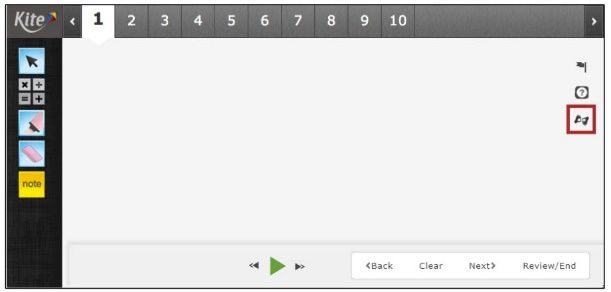
iv

     Document Change History
     The following table lists the changes made to this manual since its release.

        Change Logged           Current Page                   Description of Change

                                                    Removed statement about reactivation.
        January 19, 2021              23          Activation is not required if the student exits
                                                             using the Save button.
v
Contact Information
For help with administration and technology troubleshooting for Kansas assessments, districts
may contact the Kite Service Desk at Agile Technology Solutions (ATS), an Achievement and
Assessment Institute (AAI) center.
The Kite Service Desk provides support for Educator Portal and Student Portal. Service Desk
representatives are available to assist you from 7 a.m. to 5 p.m. Central time weekdays during
non-testing season with extended hours of operation from 6 a.m. to 6 p.m. Central time
weekdays during the assessment window (closed on state holidays). The Service Desk is
unavailable during the week of Christmas through New Year’s Day.
Service Desk
Toll Free: 855-277-9752
kap-support@ku.edu
Find additional information about the Kansas Assessment Program (KAP) at
https://ksassessments.org/.
Name Title Email Phone
Julie Ewing Assessment Coordinator jewing@ksde.org 785-296-4349
Beth Fultz Assistant Assessment bfultz@ksde.org 785-296-2325
Director
Scott Smith Director, Career, sesmith@ksde.org 785-296-3142
Standards, and
Assessment
Kansas State Department of Education
For information regarding the Kansas assessment system, contact the assessment team at
the Kansas State Department of Education (KSDE).1 SECTION 1: ASSESSMENT OVERVIEW
SECTION 1: ASSESSMENT OVERVIEW
The Kansas Assessment Program (KAP), a program of
the Kansas State Department of Education (KSDE),
fulfills a mandate from the Kansas Legislature. KAP
provides general education assessments, alternate
assessments, career and technical education
assessments, and an English language proficiency assessment.
The English language arts (ELA), mathematics, and science assessments are part of the
federal elementary and secondary education legislation. The assessment program does the
following:
• Measures specific claims related to the Kansas Standards in grades 3-8 and high
school.
• Reports individual student scores along with each student’s performance level.
• Provides subscale and total scores that can be used with local assessment scores to
assist in improving a building’s or district’s programs in ELA, mathematics, and
science.
Test Administration Modes
The Kansas assessments are administered using Kite Student Portal, available to download
from the KAP website: https://ksassessments.org/kite. The website contains separate
instructions and files for Windows PCs, Macs, Chromebooks, and iPads.
Assessed Students
All eligible students must be assessed, including students with disabilities.
Score Reports
Assessment scores will be reported after results have been analyzed.
Alternate Assessments
Kansas is using the Instructionally
Embedded model of the Dynamic Learning
Maps® (DLM®) alternate assessment to test
students with the most significant cognitive
disabilities. Alternate assessments are
available for ELA, mathematics, and
science. Throughout the school year, teachers choose Essential Elements (EEs), which are
linked to the Kansas Standards, and then use Kite Educator Portal to access testlets to
measure student progress.2 SECTION 1: ASSESSMENT OVERVIEW
To find information about these assessments, visit the DLM alternate assessment website
(http://dynamiclearningmaps.org/kansas) and also the DLM and EEs page on the KSDE
website (http://www.ksde.org/Default.aspx?tabid=887 ).
English Proficiency Assessment
The KAP test suite includes the Kansas English
Language Proficiency Assessment (KELPA). The test
is part of the federal elementary and secondary
education legislation for English learners (ELs). The
assessments measure English language proficiency
in four domains: listening, reading, writing, and speaking. The grade bands assessed include
Kindergarten, 1, 2–3, 4–5, 6–8, and 9–12. The test is delivered through Kite Student Portal
except for Kindergarten and Grade 1 writing assessments, which are paper/pencil forms.
The assessment program does the following:
• Measures specific claims related to the Kansas Standards for English Learners in
grades K-12.
• Reports individual student scores along with each student’s performance levels.
• Provides domain scores and an overall proficiency score that can be used with local
assessment scores to assist in improving student learning.
More information about KELPA and its administration can be found in the KELPA Examiner's
Manual and KELPA Administration and Scoring Manual (https://ksassessments.org/resources-
and-training).
Career Pathways Assessments
Career Pathways (cPass®) assessments measure high
school students’ readiness for postsecondary
agricultural education or entry into the workforce.
Students in Kansas may take assessments covering comprehensive agriculture.3 SECTION 1: ASSESSMENT OVERVIEW
2020–2021 Kansas Assessment Program Overview
All tests are delivered in Kite Student Portal, (except History, Government & Social Studies [HGSS]), and include multiple-choice and
technology-enhanced items. KELPA speaking and writing assessments are human scored. All other assessments are machine-
scored. Interim assessments are optional. General summative, KELPA, and DLM assessments are mandatory.
Estimated
Assessment Need Not Recently Arrived in U.S.
Subject Grades Time to Testing Window
Type Test Date2 Exemption Date3
Complete1
Classroom- Submit scores in
based HGSS Varies Varies KIDS EOYA N/A N/A
Assessment Collection
Two
sessions,
Mathematics 3–8, 10 No exemption in math.
45–60
minutes each
Two
General
sessions, 04/01/21–05/18/217 Arrived after 04/01/20 exempted.
Summative ELA 3–8, 10 04/01/21
45–60 Must take KELPA.
Assessments
minutes each
Two
sessions,
Science 5, 8, 11 No exemption in science.
45 minutes
each
3-7 Fall
11/02/20–11/18/20
Interim Mathematics 8 (only fall and winter) One session,
Winter
Predictive 10 (no tests available) 45–60 N/A N/A
01/13/21–01/26/21
Assessments4 minutes
Spring
ELA 3–8, 10 03/08/21–03/19/21
Dynamic Follow exemption rules and
Fall
Learning Refer to grades for dates from general summative
Mathematics and 09/14/20–12/18/20
Maps general summative Varies N/A assessments. KELPA
ELA Spring
Alternate assessments. participation not applicable to
02/01/21–05/07/21
Assessments5 DLM students.
Dynamic
Learning
KELPA participation not
Maps Science 5, 8, 11 Varies 02/01/21–05/07/21 N/A
applicable to DLM students.
Alternate
Assessments5
Varies.
Refer to 02/15/21–03/31/21
Four domains:
KELPA Kansas Human scoring No exemption. Required for all
reading, speaking, K–12 N/A
Assessments6 Assessment completed identified EL students.
listening, writing
Examiner’s by 04/20/217
Manual.
Comprehensive Fall
Agriculture, 11/30/20–12/18/20
cPass 9-12 Varies N/A N/A
Plant Systems, Spring
Animal Systems 03/15/21–04/30/21
AMOSS All assessment
K–12 N/A 07/05/21–07/23/218 N/A N/A
Data Check data
Notes
1 Time estimates are for scheduling purposes only. Kansas 5 Headphones required.
Assessments are untimed. Please provide adequate time for students to finish. 6 Headphones with microphone required.
2 Date on or after which student entered the district. 7
Testing and/or Scoring completed by 5 p.m.
3 First entry by the student in a U.S. school. 8 AMOSS data check - tentative
4 Teacher-assembled interim mini tests, which may be tailored to specific curriculum as
needed, are available 09/08/21 and vary in length. For more info, see ksassessments.org.4 SECTION 2: TEST COORDINATORS
SECTION 2: TEST COORDINATORS
Test Security
Test security is essential to obtain reliable and valid scores for accountability purposes.
Accordingly, KSDE must take every step to ensure the security and confidentiality of state
testing materials. It is the responsibility of individuals who develop the tests, who administer
the tests, and those who use the results of the tests to follow test security laws, regulations,
and procedures.
For more information about test security and ethics, see the following fact sheets and
guidelines located on KSDE's Assessment website (https://www.ksde.org/Agency/Division-of-
Learning-Services/Career-Standards-and-Assessment-Services/CSAS-Home/Assessments)
or the KAP website (https://ksassessments.org/resources-and-training):
• Appropriate Testing Practices Fact Sheet
• Test Security and Ethics Fact Sheet
• Test Security Guidelines5 SECTION 2: TEST COORDINATORS
Test Security Guidelines To reactivate a test, log in
No one, including test coordinators, principals, or teachers, may to Kite Educator Portal.
review tests or analyze test items before, during, or after the Click the MANAGE
TESTS menu.
assessment is administered.
• Test materials must never be copied, reproduced, or Click the Test
paraphrased. Coordination tab. Find and
• All chalkboards and whiteboards in rooms used for click the test session in
testing should be clean and have no information on which the student is
them. enrolled.
• It is recommended that the Building Test Coordinator If the student’s test status
do a walk-through of every room used for testing to is In Progress Timed Out,
make certain that all bulletin-board displays that could the user can log into the
assist students in testing have been covered. test session with the
• The best practice is to have two people present when appropriate credential (for
reactivating a student’s test. Teachers may not example, the DAC), and
the session does not need
reactivate student tests, but test coordinators can.
to be reactivated. Session
Note: If the status is In Progress Timed Out, the test
status in Educator Portal
can be re-entered using the appropriate Daily Access
will change from In
Code (DAC). No additional action is needed. Answers Progress Timed Out to In
previously entered by the students are saved. Progress upon session
• The District and Building Test Coordinator must keep login.
a log of all reactivations.
For all other reactivations,
• Once a student’s test is marked complete, the
click the Monitor tab.
student’s test cannot be reactivated.
Select the student by
checking the box before
Testing Administration the Student Record. Click
• Distribute the Kansas Assessment Examiner’s Manual the Reactivate button,
and have test administrators read the following prior to which changes test status
test administration: to In Progress.
o Section 3: Accommodations The student can now log
o Section 4: Teachers into the test and use the
o Section 5: Test Administration DAC to resume testing.
• Test proctors should sign either the Agreement to Answers previously
Abide by Guidelines or a similar district-designed entered by the student are
document. This must be completed prior to test saved.
administration and upon completion of Test Security and Ethics training in your
school district.6 SECTION 2: TEST COORDINATORS
• Students cannot be required to use scratch paper, to show their work, or to use the
online tools (for example, the highlighter).
The District or Building Test
• Students cannot be required to use specific test-taking Coordinator will log in to
strategies. Educator Portal to access
• Teachers may not grade scratch paper. data extracts that show the
• For mathematics, students in grades 6–8, 10, may use randomly generated DACs,
handheld calculators during specific sections of the test. which are linked to grade,
subject, and test session
Local Test Windows (but not to an individual
student).
• Local districts and buildings should define and schedule
test windows for each content assessment. Each DACs are available the day
building’s content cohort windows should be no more before testing beginning at
than three weeks for a subject at a grade level at the 2:30 p.m. and the entire day
of testing. Educator Portal
building level.
also includes the option to
• Testing schedules will be part of the monitor visits.
bundle DACs by selecting
• The Kansas assessments are untimed. Students should associated checkboxes.
be given as much time as necessary to complete each
test session.
• Building test schedules should account for students who need extra time to finish a
test session. Students should finish each test session before the end of the school
day.
Adding Projected Test Windows and Scoring Dates in Educator Portal
• KSDE and AAI request that districts add projected testing schedules and scoring
dates in Educator Portal using the Projected Testing feature.
• Projected test windows and scoring dates allow KSDE, Kite staff, and users to
understand projected testing loads for each day of the test window.
• The Projected Testing feature can be accessed via the MANAGE TESTS menu in Kite
Educator Portal.
• Please see the Kite Educator Portal Manual for Test Coordinators
(https://ksassessments.org/sites/default/files/documents/Kite_Educator_Portal_Manua
l_for_Test_Coordinators.pdf) for more information about creating or uploading
projected testing schedules.
Registering Students for Testing
• Districts must first register all eligible students via a TEST record submission in KIDS
for the appropriate assessment (general, cPass, or KELPA). To help schools sort and
distribute usernames and individual passwords, a Kite grouping feature has been
added that allows districts to organize by desired variables. For example, a school can7 SECTION 2: TEST COORDINATORS
use the two grouping fields on the TEST record to enter a teacher name and class
name (for example, Grouping field 1 = Sarah Smith; Grouping field 2 = 1st pd Alg I).
TASC records must be submitted to KIDS for rosters to be available for interim
assessments.
• Please refer to the DLM Data Management Manual for information regarding
registering students for alternate assessments in ELA, mathematics, and science.
Rather than the KIDS system, DLM assessment uses direct uploads to Kite Student
Portal to roster students.
Submission of TEST and TASC Records to KIDS
For a student to access summative assessments using Kite Student Portal, information must
be submitted to the KIDS system via a TEST record (see the KIDS coordinator for details).
Also, TASC records must be submitted to allow teachers access to student rosters for interim
assessments. For additional information, visit the KIDS website (http://kidsweb.ksde.org/).
Audits
• Within Educator Portal, District Test Administrators can generate data extracts from
the Reports tab to determine the number of braille forms requested. Braille forms are
available for ELA, mathematics, and science general assessments.
• Documentation of accommodations will be part of the checklist while visiting districts
during test administration.
Guidelines for Submitting EXIT Records
• Schools must submit an EXIT record for any student who stops attending the school.
• It is recommended that EXIT records be sent to the KIDS collection as soon as
possible when membership ends. It is the discretion of the schools and districts to
determine at what point an EXIT record is submitted when a student is gone for an
extended period.
• Keep in mind that during a testing window, if an EXIT record is not submitted for a
student no longer attending, that student will be recorded as “not tested,” which will
negatively affect the school’s participation rate.
• If a student transfers to a different school within the same district, sending an EXIT
record is required to guard against unresolved exits on the Dropout/Graduation
Summary Report and to ensure that there is only one accountability school
designated for the student. This information is important for determining performance
or participation for a school and district as well.
• If an EXIT record was accidentally submitted for a student who did not actually leave,
submit an EXIT record with the same State Student Identifier, Accountability School,8 SECTION 2: TEST COORDINATORS
and Exit Date with a code of 99 in the Exit/Withdrawal Type field to undo the previous
EXIT record in KIDS.
Educator Portal Functions
Teachers and test administrators using Educator Portal will typically be able to
• view individual
student
demographic
information.
• view rosters for
DLM, cPass, and
interim
assessments.
• enter student PNP
information to
control and record
accommodations available to students.
• create interim test sessions and assign students to them.
• print student usernames and passwords for interim tests.
For teacher accounts to function correctly, TASC records must be submitted to KIDS to create
rosters for interim assessments. All other Educator Portal
menus and functions are available only to users with a building- Complete documentation
level or district-level account. Only users with a building-level or for using Educator Portal,
a component of Kite
district-level account may reactivate student accounts on the
Suite, is available online
summative assessment or mark a student account complete on
(https://ksassessments.or
the Monitor screen.
g/resources-and-
training).
Note: Verify data and report any errors to your district or the
Service Desk.
Kite Teacher Account Access
Teachers and test administrators access Educator Portal using To download Kite
a supported browser. The username is the user’s professional Student Portal, visit
https://ksassessments.or
email address. After setting up an account and activating it, the
g/kite. View separate
user is prompted to create a case-sensitive password. If a
instructions or downloads
teacher or test administrator does not have access from a
for Windows PCs, Macs,
previous year or is having difficulty with accessing the system,
please contact the Service Desk at kap_support@ku.edu or
785-864-3537 or 855-277-9752 (toll free).9 SECTION 2: TEST COORDINATORS
Personal Needs Profiles (or Access Profile)
Teachers edit individual student records in the Personal Needs Profile (PNP) to control the
types of accommodations that are presented in the student’s test. Accommodations are found
in the PNP’s four categories.
• Display Enhancements
• Language & Braille
• Audio & Environment Support
• Other Supports
English Learner Students
Assessment Recent Arrivals Nonrecent Arrivals
Must take assessment; results Must take assessment; results
Mathematics and Science count for participant count for participant
accountability accountability
Not required to take Must take assessment;
ELA assessment but must take results count for participant
KELPA accountability
Must take KELPA; results used Must take KELPA until
KELPA for participation calculations in Proficient score is reached one
ELA time
• Recent arrivals to the United States (formerly known as newcomers) are defined as
English learner (EL) students who have attended any US school for less than one
calendar year before the first day the assessment window opens.
• For the 2020–2021 testing year, ELs who first attended school in the United States on
or after April 1, 2020, are considered recent arrivals.
• EL students’ first date of education in the United States is a data element submitted to
the KIDS database by the local school or district.
• ELs who first attended school in the United States after April 1, 2020, must take the
mathematics and science assessments.
• ELs who first attended school in the United States after April 1, 2020, are not required
to take the ELA assessment but must take KELPA.
• ELs must take all assessments on grade level. Any student who is tested off grade
level will be considered as not tested.
Gifted Students
Gifted students are to be assessed with the general assessment at the grade level in which
they are enrolled.10 SECTION 2: TEST COORDINATORS
Students with 504 Plans
Students with 504 plans should be assessed with the general assessment. Accommodations
contained in their plan are applied when taking the test. Allowable accommodations on state
assessments can be found on the assessment page of KSDE’s website
(http://www.ksde.org/Agency/Division-of-Learning-Services/Career-Standards-and-
Assessment-Services/CSAS-Home/Assessments).
Students with Disabilities
Students who have been identified as having a disability and who have an Individualized
Education Program (IEP) participate in state assessments. All students must be tested.
Students with an IEP may be tested using one of the following assessment options:
• general assessment with accommodations, as appropriate
• DLM alternate assessment (ELA, mathematics, and science)
It is the responsibility of the IEP team to determine which assessment is appropriate for the
individual student. Guidance for IEP teams on determining the appropriate assessment for a
student is found on the assessment page of KSDE’s website
(http://www.ksde.org/Agency/Division-of-Learning-Services/Career-Standards-and-
Assessment-Services/CSAS-Home/Assessments).
Alternate Assessment Participation
To determine which students should be assessed with alternate assessments, refer to the
Dynamic Learning Maps Participation Guidelines for Kansas on DLM’s website
(https://dynamiclearningmaps.org/sites/default/files/documents/StateBonusItems/KSDE-DLM-
Participation-Guidelines-for-Kansas.pdf).
Special Circumstances Codes
A special circumstances (SC) code indicates the reason a student was not assessed. In some
cases, the code excludes the student from the Every Student Succeeds Act (ESSA) or
accountability calculations. Test coordinators enter the SC codes as seen in the following
chart via Educator Portal. Codes marked “contact KSDE” must be approved by Julie Ewing or
Juanita Anderson at KSDE. Students must be enrolled in an assessment to be able to have an
SC code.
Entering Special Circumstances Codes in Educator Portal
In the event that a student cannot take or complete a high-stakes, summative assessment, the
Test Coordinator at the building or district level will need to enter the SC code in Educator
Portal by performing the following steps:11 SECTION 2: TEST COORDINATORS
1. Log in to Educator Portal.
2. Click MANAGE TESTS.
3. Select the Test Coordination tab.
4. Select the appropriate choices from the drop-down menus.
5. Click Search.
6. Locate the session that needs to be updated.
7. In the Test Session Name column, select the name of the test.
8. Select the appropriate student.
9. In the Special Circumstance column, select the applicable circumstance.
10. Click Save.
Codes
Testing Requirements, ESSA
Category Situation Description SC Code
Implications, Notes
Grades 3–8: Student is
suspended more than 4
weeks, overlapping
testing window.
Long-term Student need not be tested and does not
Suspension
suspension Grades 10–11: Student count against building for participation. SC-01
is suspended for
greater than 4 weeks
during the second
semester.
Student is truant at
beginning of local
testing window and
Papers have been filed
has unexcused Student need not be tested and does not
Truancy
absences for greater
for Child in Need of
count against building for participation. SC-04
Care.
than 2 consecutive
weeks at the time of
testing.
Student is required to be tested.
No truancy paperwork
If the student is not assessed, the student will
Truancy filed with county
be counted as not tested and will count SC-05
attorney
against the school for participation.
Excessive and Student is required to be tested.
intermittent absences If the student is not assessed, the student will
Absences Chronic absences
throughout the state be counted as not tested and will count SC-07
testing window against the school for participation.
Student has been Student need not be tested and does not
Catastrophic illness
Absences
or accident
seriously disabled by count against school for participation. SC-08
accident or illness. Must be approved by KSDE.
Student is enrolled
Student MUST be tested in any assessed
in a private, non-
Private, non- content area in which they are attending.
accredited school or
accredited, or home
is home schooled SC-16
school Refer to KIDS documentation for appropriate
AND attends a
enrollment and TEST codes.
public school.
Student is learning
A decision will be made in June by KSDE to
Student is learning remotely due to Covid-
determine how participation will be counted
COVID-19 remotely due to 19 and is unable to
for this code. SC-19
Covid-19. attend brick and mortar
Must be approved by KSDE.
school to test.12 SECTION 2: TEST COORDINATORS
Testing Requirements, ESSA
Category Situation Description SC Code
Implications, Notes
Student took this
A retained student took Student is required to be tested. Test counts
Previously tested at grade level
this grade level assessment last
the same grade-level for participation. Score will not be included in SC-20
assessment last year. accountability calculations.
year.
If student is
incarcerated in an adult Student need not be tested.
Incarceration in an
In jail or special center
adult facility
facility, USDOE says This does not count against school for SC-24
the student need not be participation.
tested.
Student is in a
Student is in a Student must be tested.
special treatment
substance abuse, If the student is not assessed, the student will
In jail or special center center or residential
mental, or behavioral be counted as not tested and will count SC-25
care center (long-
treatment center. against the school for participation.
term placement).
Student is in a
Student need not be tested.
special detention Student is in a juvenile
In jail or special center
center (short-term detention center.
This does not count against school for SC-26
participation.
placement facility).
Student must be tested. If the student is not
Parent refuses to allow
assessed, the student will be counted as
Parent refusal Parent refusal student to be
not tested and will count against the school SC-27
assessed.
for participation.
Notify your district test coordinator, who will
Student is observed to
call KSDE about possibly giving another form
be engaged in some
Cheating Student is cheating.
inappropriate testing
of the test. Test is invalid and the student is SC-28
counted as not tested. Student counts
practice.
against the school for participation.
Student must be tested. If the student is not
Student is receiving General education or
assessed, the student will be counted as
Homebound homebound IEP student is receiving
not tested and will count against the school SC-31
instruction. homebound services.
for participation.
Student must be tested. If the student is not
Foreign exchange Foreign exchange Student is required to assessed, the student will be counted as
student student be tested. not tested and will count against the school SC-32
for participation.
Student counts as not tested. If this is
English language arts
English language discovered before the test window closes,
Prohibited practices
arts
assessment PASSAGE
notify your district test coordinator, who will SC-34
was read to student.
notify KSDE.
Student used a
Student counts as not tested. If discovered
calculator on the non-
Prohibited practices Math
calculator portions of
before the test window closes, notify your SC-36
district test coordinator, who will notify KSDE.
the assessment.
Student used either a Student counts as not tested. If this is
teacher-generated or a discovered before the test window closes,
Prohibited practices Math
student-generated notify your district test coordinator, who will SC-37
math journal. notify KSDE.
Contact your district Student need not be tested and does not
Other reason for
Other
ineligibility
test coordinator, who count against the school for participation. SC-39
will notify KSDE. Must be approved by KSDE.
The student took one Student is not tested this year on this
Student took one full assessment at school assessment at this school. This does not
Left (moved) during
testing
test and then moved and then moved before count against this school for participation. SC-41
during testing. taking all of the Should be used if this is not the student’s
required assessments. accountability school for this assessment.13 SECTION 2: TEST COORDINATORS
Testing Requirements, ESSA
Category Situation Description SC Code
Implications, Notes
Teacher incorrectly
Mis-administration of or unethically
assessment administered
Students count as not tested. SC-98
assessment.14 SECTION 3: ACCOMMODATIONS
SECTION 3: ACCOMMODATIONS
General
Universal features are accommodation that are either embedded or provided digitally through
Kite Student Portal for KAP (for example, highlighter), or nonembedded and provided
nondigitally at the local level (for example, separate, quiet, or individual setting). Universal
features are available to all students as they access Kite Student Portal for KAP.
Designated features are those features that are available for use by any student for whom
the need has been indicated by an educator (or team of educators including the parents or
guardians and the student if appropriate) who is familiar with the student’s characteristics and
needs. Embedded designated features (for example, color contrast) are provided digitally
through Kite Student Portal for KAP, while non-embedded designated features (for example,
magnification device) are provided locally. Trained educators or teams using a consistent
process must assign designated features to a student on the Personal Needs Profile (PNP) in
Educator Portal.
Accommodations are changes in procedures or materials that ensure equitable access to
assessment content and generate valid assessment results for students who need them.
Embedded accommodations (for example, text-to-speech) are provided digitally through Kite
Student Portal for KAP, while nonembedded designated features (for example, sign
interpretation) are provided locally. Accommodations are generally available on an IEP, 504,
Individualized Learning Plan (ILP), and/or Student Improvement Team (SIT) plan. .
Accommodations fall under four basic areas:
1. Timing/scheduling
2. Setting
3. Presentation
4. Response
Timing/scheduling accommodations might include having a flexible schedule, extended time
on assessments, test administration in several sessions or testing at a specific time of day.
Setting accommodations might include separate location, testing in a small group, providing
special lighting or acoustics, or providing adaptive or flexible seating.
Accommodations for presentation fall under three main areas: display enhancements,
language and braille, and audio and environment supports.15 SECTION 3: ACCOMMODATIONS
Display enhancements available for KAP in Kite Student Portal include magnification,
masking, overlay color, contrast color and invert color choice. Language and braille available
for KAP in Kite Student Portal include Spanish keyword translation display, American Sign
Language, and braille (Unified English Braille). Audio and environment support for KAP in Kite
Student Portal includes auditory background, single switch, and the use of text-to-speech.
Response accommodations may be in test format or the use of assistive devices or supports.
Refer to How to Select, Administer and Evaluate Use of Accommodation for Instruction and
Assessment of All Students for more in-depth information on accommodations for instruction
and assessments located at https://ksdetasn.org/resources/2283 .
Overview
• Accommodations should be used on the state assessments only if they have been a
regular part of instruction. Refer to the Tools and Accommodations for KAP on
Kansas State Department of Education's website
(http://www.ksde.org/Agency/Division-of-Learning-Services/Career-Standards-and-
Assessment-Services/CSAS-Home/Assessments).
• Students with an Individualized Education Program (IEP), 504, Individualized Learning
Plan (ILP), and/or Student Improvement Team (SIT) plan may use only
accommodations documented on those plans.
• Accommodations must be recorded in a PNP or Access Profile in Educator Portal.
Staff may use the PNP Planning Tool for the Kansas Assessment Program (KAP) on
the KSDE website (https://www.ksde.org/Agency/Division-of-Learning-
Services/Career-Standards-and-Assessment-Services/CSAS-Home/Assessments).
• When indicating need for a read-aloud accommodation in a student’s PNP, under text-
to-speech (TTS), the only option allowed is a synthetic (computer-generated voice),
which is the default.
• To use an accommodation other than one listed, contact the District Test Coordinator,
who will send the request to KSDE. If the accommodation changes the construct
being tested, the student will count as not tested.
• Keyword translation allows students to view Spanish translations of critical vocabulary
in mathematics and science.
• Whole screen magnification is an option for any student.
• Students who use large screen magnification should not use the iPad.
• For additional information about accommodations, guidelines about the read-aloud
accommodation, or Kite tools, review Kite documentation on the KAP website
(https://ksassessments.org/resources-and-training).16 SECTION 3: ACCOMMODATIONS
Accommodations Prohibited for All Students
• In general, reading to students any text (including isolated words) in the
passages on the English language arts (ELA) test is prohibited. Violations will
result in the student being counted as not tested. For a very limited number of
students, such as those who cannot access printed text because of blindness, low
vision, or print disability, and who lack adequate braille-reading skills, the use of TTS
software may be permitted. Contact Cary Rogers at KSDE, 785-296-0916, to provide
this accommodation for a student.
• Use of teacher-generated or student-generated journals and logs is prohibited. Notes
cannot be created outside of the test session.
Accommodations for English Learners
• Directions may be read to the student in English. All directions are read by the
computer in English.
• ELA passages, test questions, answer choices, labels, graph titles, and other items
may not be translated into the student’s native language.
• Students may use electronic translators and word-to-word translators for
directions (including ELA), test questions, and answer choices. Students may
not use them for ELA passages.
• Certain Spanish words and terms in the mathematics assessment and science
assessment are available. Students literate in Spanish may use the Spanish Keyword
Translation feature.
• To use Spanish Keyword Translation, students must have the PNP setting for this
feature enabled in Educator Portal.
Recording Accommodations
• Testing accommodations should be entered into the student’s PNP, which should be
updated to ensure proper accommodations.
• TTS requires a local building or district administrator to enter the support in the Audio
& Environment Support section of the student’s PNP. Students receiving read-aloud
via headphones may take the test in the typical group setting.
• Buildings and districts may continue to use the following accommodations but need
not report them to KSDE:
o separate, quiet, or individual setting
o frequent breaks
o student dictation of answers to scribe
o student use of communication device
o American Sign Language (ASL) delivery of directions to student
o student response in ASL17 SECTION 3: ACCOMMODATIONS
o student use of braille writer or slate and stylus
o student self-reading aloud of assessment
o student use of translation dictionary
Text-to-Speech Options Available on the Assessment
• TTS audio – directions: All students can choose to have a synthetic voice read
directions aloud on all assessments. This is a universal feature.
• TTS audio – science: All students can choose to have a synthetic voice read
directions and items aloud on the science assessment. This is a universal feature.
• TTS audio – directions, text, and test items: A synthetic voice will read directions,
text, and test items. KSDE’s expectation is that qualified students are at least one
year below grade level in ELA and that they use the accommodation at least 50% of
the time on classroom assignments and 100% of the time on classroom assessments
that contribute to classroom grades. This accommodation must be selected on a
student’s PNP. Options are text only or text and graphics. Text and graphics is the
default and will read tables and graphs on the mathematics assessment. Text only is
not used for KAP.
• TTS audio – (nonvisual) ELA passages and test items: A synthetic voice will read
ELA passages and test items. In ELA, only very few students with an IEP, 504, or
student intervention plan will receive this accommodation. Districts must submit a
Checklist for TTS for ELA Passages Accreditation located on the KSDE website
(https://www.ksde.org/Agency/Division-of-Learning-Services/Career-Standards-and-
Assessment-Services/CSAS-Home/Assessments) to Cary Rogers crogers@ksde.org
by January 31. Once approved, the accommodation will be available. Approval must
be obtained each year.
Text-to-Speech Accommodation Policy
• A student who needs a TTS accommodation is one whose ability to convey
knowledge of the content area is severely limited by whether he or she can read
the assessment materials; this student would not be successful in the classroom
without the read-aloud accommodation. To use the TTS accommodation on the state
assessment, the student must have the read-aloud accommodation provided in
the classroom on a regular basis (that is, as an on-going practice for both
classroom instruction and classroom assessment). Neither English learners (EL) nor
students who receive Title I or special education services automatically qualify for the
TTS accommodation.
• It is the local district’s responsibility to define “severely limited” and to quantify a
“regular basis” for classroom instruction and assessments. Districts may provide their
own tools and resources for determining need of the TTS accommodations. However,
KSDE’s expectation for the text only and text and graphics TTS is that qualified18 SECTION 3: ACCOMMODATIONS
students are one year below grade level in ELA and that they use the accommodation
at least 50% of the time on classroom assignments and 100% of the time on
classroom assessments that contribute to classroom grades.
• For a very limited number of students, such as those who cannot access printed text
because of blindness, low vision, or print disability, and who lack adequate braille-
reading skills, a TTS of reading passages in ELA (nonvisual) may be permitted. This
accommodation is only for students with an IEP, 504, ILP, or SIT plan with TTS or
audio support included. This accommodation is appropriate for students who receive
daily instruction and assessments orally and through computerized TTS. This
accommodation should only be used by students who have a reading-based disability
(at least two grade levels below) that affects the student’s decoding, fluency or
comprehension skills, or who have a visual impairment or blindness and are not fluent
in braille. For consideration of this accommodation, refer to the Checklist for TTS for
ELA Passages Accreditation located on the KSDE website
(https://www.ksde.org/Agency/Division-of-Learning-Services/Career-Standards-and-
Assessment-Services/CSAS-Home/Assessments). The checklist must be completed
and returned to Cary Rogers crogers@ksde.org by January 31. When approved by
KSDE, this results in a valid test score. Contact Cary Rogers at KSDE, 785-296-0916,
with questions about this accommodation for a student.
• The read-aloud accommodation does not refer to an adult reading an occasional
word, an occasional distractor, an occasional stem, or an occasional question to the
student. However, an adult reading any words in the ELA passage is prohibited.
Documenting Need for Text-to-Speech
• TTS accommodation must be documented on one of the following plans: pre-
intervention plan (SIT plan), ILP, 504, or IEP.
• The following information must be included in the plan that documents the student's
need for the TTS accommodation:
o student name
o student grade
o building/district name
o evidence documenting need for the TTS accommodation, including but not limited
to the following:
ELA test scores
progress monitoring data
ELA level of instructional materials used in the classroom
documentation that the read-aloud accommodation is used in the
classroom for both instructional materials and assessments and the date
that this accommodation was implemented19 SECTION 3: ACCOMMODATIONS
signatures of team members involved in recommending the read-aloud
accommodation, including, at minimum, the student’s teacher and a
building administrator (for plans other than IEPs)
any other documentation required for providing accommodations to
students with an IEP
• A copy of the student’s plan or a summary sheet must be kept on file with the District
Test Coordinator. For students with approved TTS for ELA passages (nonvisual),
a copy of the completed Checklist for TTS for ELA Passages Accreditation
showing approval from KSDE should be kept on file with the district test
coordinator. KSDE will be monitoring 5% of assessment administrations this year
and may ask to see documentation for accommodations.
Allowable Practices
• Practices such as reading aloud an occasional word, an occasional distractor, an
occasional stem, or an occasional question are considered acceptable assessment
practice that does not require special documentation, with the exception of any text
within an ELA passage.
• Teachers, test administrators, and proctors may not read anything aloud for a student
from an ELA passage. A very limited number of students with print disabilities or
visual impairments may have the passages read aloud using the TTS feature
nonvisual when approved by KSDE.
• Teachers should use professional discretion regarding the number of times a student
may request assistance.
Kite Text-to-Speech Feature
A computer-generated voice is provided in Kite Student Portal, the online environment where
students take tests.
• For ELA and mathematics items, to receive TTS, the student’s PNP in Educator Portal
must have Spoken Audio with Synthetic selected under Voice Source.
• The option called Read at Start does not have a functional use in the system at this
time. It can be set to False or True.
• Spoken Preference indicates which elements of a question should be read to the
student. The default is Text & Graphics.
• For students who receive daily instruction orally and through computerized TTS
systems and who have received permission from KSDE for the reading passages to
be read aloud, select NonVisual under Spoken Preference.
The audio voice will read entire questions and answer choices to the student. Students should
adjust and set the audio volume before launching Kite Student Portal.20 SECTION 3: ACCOMMODATIONS
American Sign Language Accommodation
American Sign Language (ASL) is available for math and science items. The PNP must be
marked to receive this accommodation. Directions in ASL are not offered in Kite Student
Portal. The teacher may sign directions to the student.
Kite American Sign Language Feature
• When ASL videos are available, an
ASL icon is displayed on the screen’s
right side. After clicking the ASL
button, the video is shown in a window
that can be resized by expanding the
lower right side of the window.
• To display contents and to pause the
video, choose the Play/Pause Control.
To move between multiple passages, click the Next and Back buttons; however, fast-
forwarding or rewinding cannot be done. The progress bar displays the time
progression of the video.
Braille Accommodation
• All students take the state assessment by computer except in extremely unusual
circumstances. Those who use braille accommodations in the classroom may request
braille test forms. Test coordinators need to select “Braille” on the “Language &
Braille” tab on the student’s PNP in Educator Portal by November 30, 2020. If any
changes are made after this date, or if you have questions, please contact
KAPaccommodations@ku.edu .
• A student’s need for the accommodation must be documented on one of the following
plans: pre-intervention plan (SIT plan), ILP, 504, or IEP.
• Questions to ask about the student when considering a braille form accommodation
include the following:
o Has the student used the computer for the interim assessment(s)?
o Does the student have barriers to using the computer in individual or group
instructional settings that require alternative assignments when the class is using
the computer?
• The following information must be included on a SIT plan, ILP, 504, or IEP that
documents a braille accommodation:
o student name,
o student grade,
o building/district name, and
o evidence documenting the need for the accommodation, including but not limited
to the following:21 SECTION 3: ACCOMMODATIONS
progress monitoring data,
ELA level of instructional materials used in the classroom,
documentation that the accommodation is used in the classroom for both
instructional materials and assessments and the date that this
accommodation was implemented, and/or
signatures of team members involved in recommending the
accommodation, including the student’s teacher and a building
administrator.
• No answer sheets may be generated by the school or district.
• District- or building-level personnel will work in pairs to enter student answer choices
in Kite Student Portal.
• Documentation of the need for accommodations must be kept on file by the District
Test Coordinator. KSDE staff will monitor 5% of all test administration sessions and
will ask at each monitoring visit to see documentation of accommodations.
Obtaining and Distributing Braille Forms
• Title I monitoring and US Department of Education Peer Review findings require
implementation of additional security measures involving access to braille forms.
• The District Test Coordinator will
o deliver the braille forms to appropriate Building Test Coordinators.
o make sure the Building Test Coordinator is aware that student responses on
accommodated test forms must be entered into Kite Student Portal by pairs of
district- or building-level personnel.
o mail all unused tests to AAI and maintain documentation of test security.
• The Building Test Coordinator (when designated) will
o allow only the practice tests (in the test booklets) to be administered once the
booklets are delivered to the building. Tests should not be copied or taken out of
the building.
o return all tests to the District Test Coordinator immediately after the assessment
has been completed.
o maintain documentation of test security.
Adaptive Test Process for Braille forms
ELA tests have two adaptive sessions. A pair of district- or building-level personnel
must enter student responses for Session 1 before the student can begin Session 2.
After Session 1 responses are entered into Kite Student Portal, the District or Building
Test Coordinator can confirm which Session 2 test the student should receive. To
obtain the Test ID for the Session 2 test that should be given to a student, perform
the following steps.22 SECTION 3: ACCOMMODATIONS
1. Log in to Educator Portal.
2. Click MANAGE TESTS.
3. Select the Test Management or Test Coordinator tab.
4. Complete the appropriate fields.
5. Click Search.
6. Click the Test Session Name.
7. Click the braille symbol next to the student’s name.
The Session 2 Test ID displays. Match this Test ID to the Test ID on the cover of the
braille booklet.23 SECTION 4: TEACHERS
SECTION 4: TEACHERS
Scheduling and Time Limits
• English language arts (ELA) assessments are adaptive, with sequential
sessions that can be completed in one testing period for students in higher
grades. Mathematics and science are not adaptive and can be completed in
one testing period.
• In general, the entire session of an assessment should be completed in one testing
period. However, for students in grades 3 and 4, students with disabilities, and English
learners (ELs), each test session may be administered over two separate testing
periods. The two separate sessions must be conducted on the same day.
• It is recommended that all test sessions be administered on consecutive calendar
days.
• All assessments are untimed. Each student must be allowed as much time as
necessary and reasonable to complete each test session in one sitting.
• If a student does not complete a test session within the time given to the class, the
student may be allowed more time provided that the student makes a serious attempt
to complete the test and that the student is provided additional time immediately
following the unfinished session.
o If the test session is during the last period of the day, the student may select the
Save button to finish after school or the next school day. If administrators are
concerned about students not finishing within a testing period, it is advisable for
students to not take the test in the last period of the day.
Test Security and Administration Guidelines
Educator/Test Proctor Responsibilities
• Complete training and sign an agreement to abide by KSDE test security, ethics of
testing, and regulations before local testing begins.
• Follow procedures outlined by the District/Building Test Coordinator.
• Follow test procedures outlined in the manual and in the training received regarding
security and ethical practices for testing.
• Follow established district/building procedures for collecting and destroying testing
materials, student notes, scratch paper, and drawings, etc., upon completion of each
test session and the entire assessment.
• Remove or cover (with opaque material) bulletin board displays, charts and diagrams,
and other instructional material that could give assistance or advantage during testing.24 SECTION 4: TEACHERS
• Establish and describe processes that confirm that usernames and passwords in
Educator Portal are exclusive to the user and rights permitted for that user.
Usernames and passwords should not be shared or exchanged.
• Monitor the testing environment actively by moving around the room; moving around
the room encourages students to focus on their own work.
• Do not say or do anything that would let a student know whether an answer is correct.
• Do not ask students the way in which they arrived at an answer.
• Do not tell students to redo a specific item or to review any specific part of the test
once testing has begun.
• Verify the Review/End Screen upon completion of the test to ensure that all test items
have been answered before a student exits the test.
• Do not go back and review each item individually with the student; simply direct
students to answer items that did not have a blue dot to indicate that the question was
answered.
• Do not store or save on computers or personal storage devices any test items; test
items must never be shared via email or other file sharing systems or reproduced by
any means.
• Report any breach of test security, loss of materials, failure to account for materials, or
any other deviation to the Building Test Coordinator, who will report to the District Test
Coordinator/KSDE for guidance.
For acceptable and unacceptable testing practices, see the KSDE's Kansas Assessment
Fact Sheet (https://www.ksde.org/Agency/Division-of-Learning-Services/Career-
Standards-and-Assessment-Services/CSAS-Home/Assessments/ItemId/5364)
Important Information Regarding Test Security and Reporting Item
Issues
Because of test security issues, we expect administrators and teachers to abide by the
“Test Security and Administration Guidelines” in this manual. If a student questions the
correctness of an item, follow this outlined procedure.
1. To the student, repeat the information from the directions, teacher print directions, or
Kite directions: “Choose the answer that you think is best. There is one correct or best
answer to each question. Carefully read the question. Work the problem.” It may be
appropriate in certain circumstances to tell the student or reader that the concern will
be forwarded to KSDE for review and analysis.
2. Collect the following information and forward the information to the District Test
Coordinator, who will then forward the information to the Kite Service Desk and Julie
Ewing at KSDE.25 SECTION 4: TEACHERS
Reporting item issues
• Give only the student ID only; do not include the name, building, or district
• Report the content area of the test (for example, ELA, math, or science)
• Provide the session number and the item number
• Report the issue, not the item (for example, “no correct answer,” “multiple correct
answers,” “A and C are both correct,” “a word is misspelled,” “the sentence is
grammatically incorrect,” etc.)
• Do not forward the item, the item stem, any answer choices, or narrative descriptions
of the item via email (these are live, secure test items)
• Do not take or send pictures of the item
Guidelines for Students
• Students may use blank paper to show and check their work. The paper must be
collected and destroyed at the end of the test session.
• The use of electronic devices (including cell phones, smart watches, and similar
devices) is not allowed on any portion of the assessment.
• Students are allowed to use scratch paper, graph paper, and manipulatives on the
mathematics and science assessments.
• ELs may use bilingual translation dictionaries for mathematics and science
assessments.
• Textbooks, dictionaries, and other curricular materials should not to be used.
• Before submitting answers, students should stop at the Review/End Screen and raise
their hand. When possible, a student should return to the previous test section only to
answer skipped or omitted items. The teacher may confirm that all questions have
been answered. Once confirmed, the student may submit answers.
• Students should make up any test session that occurred when the student was
absent.
Testing Using a Tablet Device
Students who are testing using a tablet device (for example, iPad) may not access other
applications or websites during testing. Kite Student Portal for iPad has a new auto-lock
feature that prevents users from using other apps until Kite Student Portal is ended. This
means that Single App Mode (SAM), Autonomous Single App Mode (ASAM), and Guided
Access will not be required for testing via iPad. After selecting a test, a pop-up window
displays that allows the user to confirm use of the auto-lock feature. Additionally, students may
not use dictionary look-up features. See the Kite Student Portal Manual for Test
Administrators on the KAP website
(https://ksassessments.org/sites/default/files/documents/Kite/Kite_Student_Portal_Manual_for
_Test_Administrators.pdf) for additional information on how to secure iPads for testing.You can also read


