ADVOCACY REPORT SPRING 2021 - University of Louisiana at Lafayette Graduate Student Organization (GSO) - Graduate Student ...
←
→
Page content transcription
If your browser does not render page correctly, please read the page content below
ADVOCACY REPORT
SPRING 2021
University of Louisiana at Lafayette
Graduate Student Organization (GSO)

Email: gso@louisiana.edu
Website: gso.louisiana.edu
Facebook: @ULLafayetteGSO
2

                                     PREFACE

The following report identifies areas that the Graduate Student Organization (GSO) in
partnership with others at the University of Louisiana at Lafayette (faculty, staff, student
organizations, and campus offices) can continue to develop to sustain our graduate
students.

Our goal is to raise awareness of the role of GSO in advocating, funding, and
communicating with and for graduate students to address the issues that they face
throughout their graduate education.

Thus, this report will add value to the ongoing University-wide discussion on how to
better support graduate students to develop professionally.

Using real student responses, this report also strives to provide a platform for unheard
graduate student voices, candidly sharing ideas and sentiments that may otherwise
never find an audience.

Lastly, the Organization has needed to adapt in 2020-2021, and our Department
Representatives and Executive Board have put in, perhaps, more work than ever
before to increase the Organization’s profile and maintain operations despite
exclusively remote meetings. This report seeks to honor the initiative of our graduate
student leaders during this particularly difficult time in searching for new ways to
represent (and care for) our fellow students.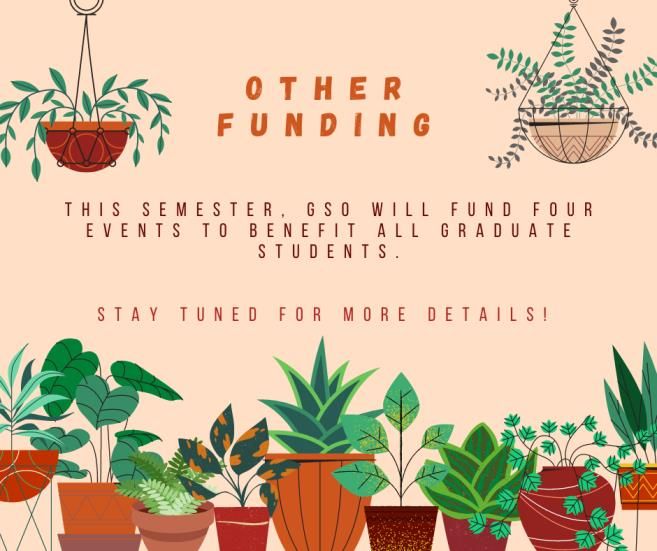
3

     INTRODUCTION TO THE ORGANIZATION
All graduate students at the University of Louisiana at Lafayette are automatically
members of the Graduate Student Organization (GSO).

We are here to advocate for you! The GSO supports graduate students in several
ways:

Advocacy
One of the most important things we do is to represent the needs and concerns of our
members to the university administration. The GSO president serves on the University
Graduate Council, the Graduate Appeals Committee, as well as other administrative
committees the Dean of Graduate School deems appropriate. Student
representatives from graduate departments meet regularly each semester to discuss
issues that are important to graduate students.

Funding
Grad students know that conducting research and presenting at conferences puts a
strain on our limited budgets. The GSO uses student-assessed fees to help offset the
cost of research and travel related expenses! We also provide one-time grants for
purchasing thesis, dissertation, or project supplies.

Communication
The GSO is one of many important relays to get vital information to graduate students.
Check out Facebook and this website often for the latest GSO information. Your
representative is also a great source of information. Find your representative here!

If there is an issue that you would like to see the GSO address, or if you are interested in
helping out, please don't hesitate to contact us at gso@louisiana.edu.

Like us on Facebook!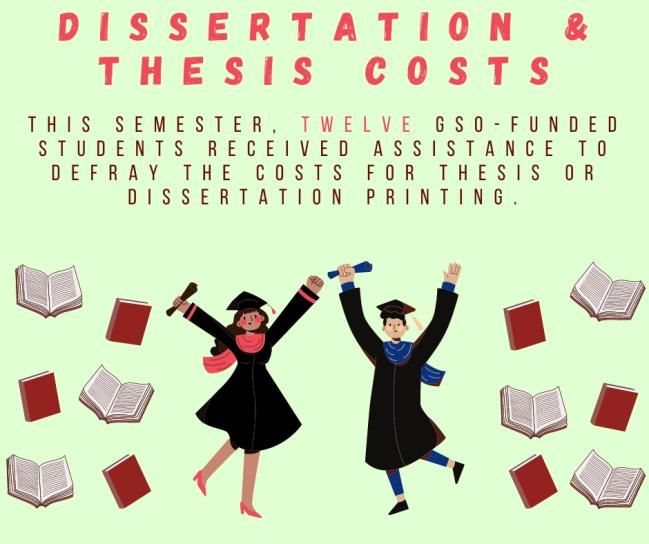
4

                   SPRING 2021 REFLECTIONS
The pages that follow are insights from an “Advocacy Survey” GSO conducted in Fall
2020. The results, perhaps unsurprisingly, speak to students’ difficulties in adjusting to a
rough semester of an already challenging experience (graduate studies). Though
many comments are pandemic-specific, there are nonetheless evergreen responses
that GSO can ponder in developing a refreshed Advocacy Platform and in defining
areas of prioritization for the Organization.

Based upon the responses in the Fall 2020 Advocacy Survey, GSO worked with the SGA
Graduate School President and the Graduate School Office to organize a December
2020 Grad Gather & Grow Series. Featuring external speakers, the virtual sessions gave
students and faculty an opportunity to convene and dive into four topics: motivation
and commitment to pursue graduate studies, self-advocacy as an international
student, remote learning, and how universities can address graduate student mental
health.

In the Fall 2020 Advocacy Survey, respondents asked for more opportunities to
connect with fellow students at other universities and identified professional
development as a priority. In Spring 2021, GSO has opted to make a small
appropriation to facilitate a bulk order of tickets to the National Association of
Graduate-Professional Students (NAGPS) South Central [Virtual] Regional Conference
where students could network with graduate students from across the region and
across all disciplines. Attendance at the conference, wholly subsidized by GSO
funding, allowed UL graduate students to explore workshops on topics of career
readiness and professional development.

In reflecting back on Fall 2020 Advocacy Survey responses and various initiatives by
GSO through the 2020-2021 academic year, Department Representatives are now
able to foresee a future of relative “normalcy” with a return to campus and the
possibility of more in-person interactions.

GSO’s Advocacy Committee (an internal subgroup that relaunched in mid-Spring 2021
to better support the Organization as a whole) has engaged in ongoing discussions on
GSO’s future (see Advocacy Committee Minutes). Informed by many conversations
with graduate students and Department Representatives, GSO has come to three
central initiatives that GSO will pursue in 2021-2022.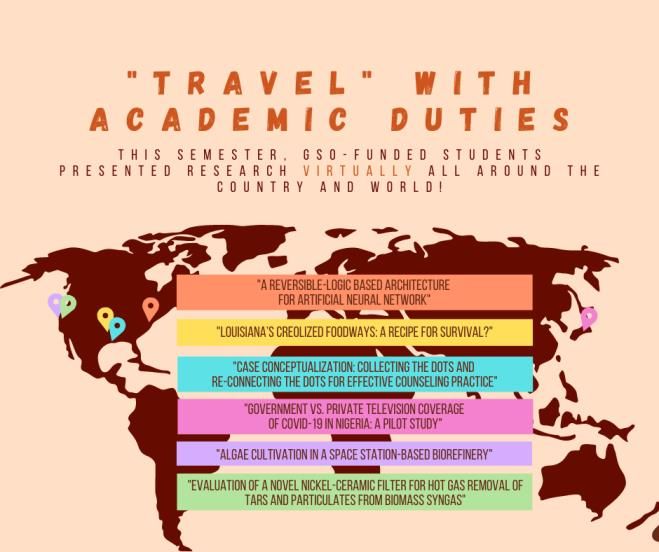
5

               GSO 2021-2022 OBJECTIVES

               Advocacy: Engagement & Empowerment
1. Pivot to an action-oriented Advocacy Committee
2. Identify specialized roles for Advocacy Committee to reflect our diverse graduate
   student population
3. Connect GSO with regional and national graduate education advocacy efforts
4. Train GSO Department Representatives to be true peer advocates
5. Create a culture of activism with GSO weighing in on issues that affect graduate
   students
6. Facilitate regular meetings between GSO Department Representatives and
   University administrators

                       Funding: Accessibility & Equity
1. Increase understanding of funding procedures within Funding Committee to make
   recommendations to the GSO General Council
2. Develop a virtual Funding Workshop (synchronous or asynchronous) to educate
   potential applicants on GSO funding opportunities
3. Present concrete examples of GSO appropriations to potential applicants
4. Investigate and resolve barriers to application for funding; determine which
   restrictive policies are state or University-based
5. Collect feedback on applicability of current funding opportunities to graduate
   students in each department
6. Align GSO Bylaws with webform funding application procedures

                 Communication: Visibility & Relevancy
1. Leverage Communications Committee for delegation of workload
2. Ensure Department Representatives have graduate student lists to communicate
   announcements directly to their departments
3. Design a semester-long communication plan for when and with what message
   GSO and Department Representatives contact graduate students
4. Establish a GSO social media presence on one additional social media platform
   (Instagram, LinkedIn, Twitter)
5. Encourage Department Representative attendance at in-person and virtual
   Graduate School and department events as a visible extension of GSO
6. Find opportunities for GSO to assist with programming and/or co-organize events
   with other organizations or campus offices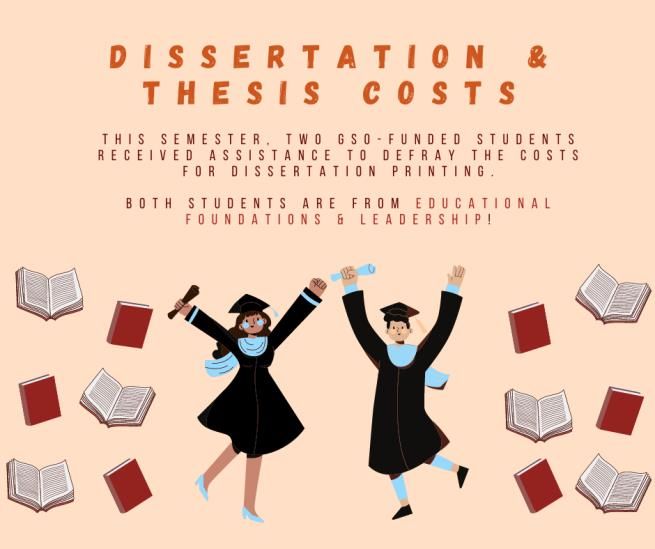
6

             FALL 2020 ADVOCACY SURVEY
The new GSO leadership team sought to understand graduate students’ interests and
concerns in Fall 2020.

At the first Graduate School Townhall Zoom of the semester (August 28), students aired
their anxieties and uncertainties about the University’s policies for return to campus
amid the pandemic, along with questions about the effects of remote learning and
assistantship expectations.

On August 30, after brainstorming students’ priorities for potential GSO programming,
the Executive Board contacted a handful of students (new, returning, American,
international, Master’s, doctoral, STEM, Humanities) to sample the survey.

On September 8, the GSO Advocacy Survey was then shared on Facebook and the
link distributed by our Department Representatives to their classmates on September
11.

On October 20, the Graduate School emailed the Survey link to students, a push that
garnered more responses than the previous efforts.

The Advocacy Survey aims to understand students’ familiarity with GSO and their
previous contact with the organization. Then, students are asked about their interest in
various potential programming offerings. Finally, the survey includes an invitation for
students to give narrative feedback on the challenges they face and what they would
like to see from GSO in the future.

The Advocacy Survey was anonymous, yielding frank feedback. However, the
anonymity proved problematic for instances where students expressed individual
concerns that could easily be remedied by directing them to existing campus
resources.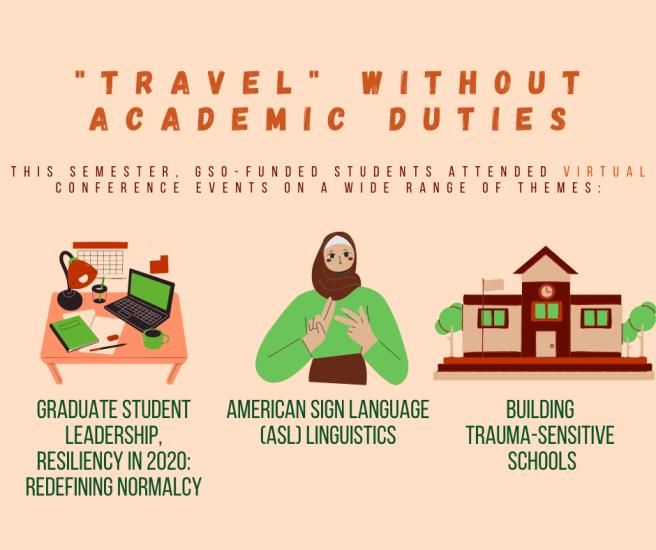
7

                         SURVEY RESULTS

Part I: Background Demographic Information
Question 1: Familiarity

              Have you heard of the Graduate
            Student Organization (GSO) before?

     No, I am not familiar
           with GSO.
              32%

                                          Yes, I am familiar
                                             with GSO.
                                                  68%

Question 2: Personal Experience with GSO Funding

               Have you ever applied for funding
                         from GSO?

               No.
               72%

                                                 Yes.
                                                 28%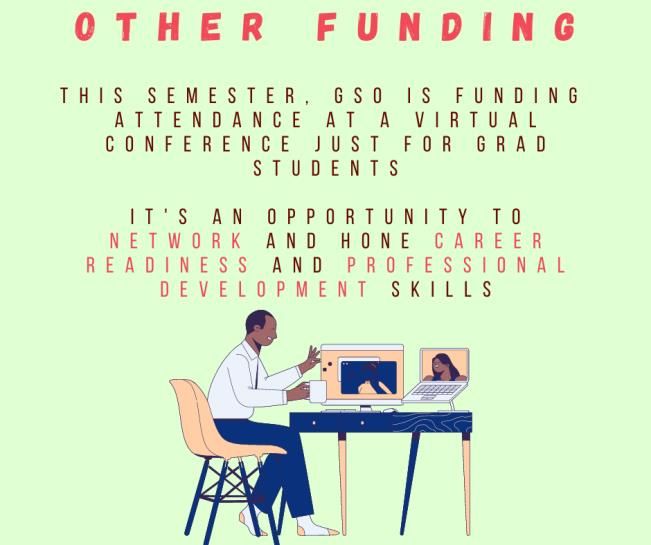
8

Of the 50 graduate student respondents for the Advocacy Survey, most say they are
familiar with GSO, however, the majority of students have never applied for funding
from GSO (an activity that has been highly prioritized since GSO’s inception).

Of the 34 students who indicated familiarity with GSO, 20 have never applied for
funding, 14 have.

It is encouraging that most student respondents have heard of GSO. The organization,
is, after all, the voice of graduate students on campus. GSO Executives traditionally
participate in the Graduate School’s Orientation activities, introducing new students to
the world of research funding through the student-assessed GSO fee. This year, the
GSO President promoted GSO in the virtual Graduate Student Orientation (Moodle) in
short video clips.

As of the preparation of this report, the GSO Facebook has 575 users who like the
page. Since August 12 (the first day of the Fall 2020 semester), the GSO Facebook
page has grown by 60 likes, a very modest given the number of new students who
start Graduate School each year. The Organization has come to realize that it may be
time to expand to an additional social media network to reach more students.

It is revealing that most respondents have heard of GSO but have never applied for
funding. For an organization that has channeled its efforts into offsetting graduate
students’ research costs, most of our students are not accessing these funding
opportunities. Visibility is a clear problem, and many students may have heard of GSO
but do not know their Department Representative. Students who are aware of GSO’s
funding opportunities may not find that the categories correspond to their own
research costs. Other students may not, in fact, incur prohibitive costs for their research
because of the nature of their academic program or because of access to other
funding sources.

At the beginning of the Fall 2020 semester, 11 of GSO’s 27 Department Representative
seats were vacant (40.7% vacancy). At the end of the spring 2021 semester, we
expect to need to fill 7 seats. Due to students’ short tenure in graduate programs,
turnover of representatives (particularly in terminal master’s programs) is quite high. A
lack of Department Representative for students means students’ concerns may be
unheard by the GSO membership. Additionally, students unrepresented by a
Department Representative are not eligible to apply for funding. As an organization,
GSO over the last few years has had periods of trouble maintaining quorum at
meetings (at times, funding appropriations were even in peril) because of this gap in
even and consistent representation from across campus. Thus, it may be most
practical when vacancies arise at the end of an academic year for a new
representative to be chosen among new, incoming students (with the goal of finding a
delegate who can stay with the Organization for two or more years).

The Organization has also entertained discussions of designing a representation system
where more positions are available, not simply a “one department, one student”
model.

9

As of the preparation of this report, the GSO Executive Board has contacted the
Graduate Coordinator of each of the departments without representation in fall 2020.
Thirteen new representatives joined GSO in Fall 2020 or Spring 2021. Although it is
exciting to have new representatives join the Organization at a time of such
momentum, it is also difficult to orient new students with such a lack of institutional
memory. New representatives who joined in Fall 2020 and Spring 2021 had access to a
new Department Representative Training video and have been active participants in
our meetings this semester.

The vacancies that remain in GSO are largely from departments with online programs
or the seat has been unfilled for several years. As of Summer 2020, GSO meetings have
been held remotely (via Zoom), ensuring that even students who live far from campus
are able to attend the meetings and/or serve as a Department Representative.
Perhaps students and Graduate Coordinators from these programs without current
representation could reconsider what GSO can offer their students. We believe
participation in GSO is, indeed, valuable for students in all departments.

     Year-Long, Unfilled GSO Department Representative Vacancies (2020-2021)

      Department                                   Programs

 Accounting               Accounting, M.S.

                          Engineering, M.S.E., Electrical Engineering Concentration;
 Electrical Engineering
                          Systems Engineering, Ph.D.

                          Nursing, M.S.N. programs;
 Nursing
                          Doctor of Nursing Practice, D.N.P.
10

Part II: Defining GSO Priorities
Question 3: Interest in Advocacy and Programming
In the next part of the survey, GSO requested that graduate student survey
respondents provide their feedback on advocacy priorities. Informed by ongoing
initiatives from the Graduate School and various campus student services, GSO would
like to pinpoint graduate students’ current preoccupations to provide supplemental
support and programming.

On the following page, students’ responses are noted. For each question, a paragraph
of commentary is provided to contextualize its inclusion in the Advocacy Survey, to
assist in the interpretation of the results or to offer an update on progress toward these
goals since the survey’s initial release.

                         The conversation bubbles interlaced in the commentary are
                         students’ responses to the prompts, grouped for your
                         convenience by topic. However, in the original survey,
                         students were asked to rate the importance of various
                         advocacy and programming ideas (as illustrated in the
                         chart), then answer three questions:

   ➢ Do you have ideas on how GSO can better support graduate students? Specific
     initiatives? Programming suggestions? Additional categories for funding
     opportunities?

   ➢ What is your biggest challenge as a graduate student this semester? Is there a
     way GSO can help?

   ➢ Any additional comments?
11
GSO would like your help in determining how to prioritize
advocacy and programming for our UL Lafayette
graduate students.
Please rate the following areas by level of importance to
you as a grad student.
Very important Important Somewhat important Not at all important
Ne tw orking pro fes s ional l y w ith
21 20 9 0
other grad s tu d ents
Provid ing s oc ial c onnec ti on
18 21 8 3
betw een grad s tu d ents
O ffering oppor tu ni ties for grad
12 21 15 2
s tu d ents to m entor u n d e rgrad s
S u ppor tin g grad s tu d en ts ' m ental
36 7 5 2
and physic al w el l nes s
As s is tin g grad s tu d en ts w i th
profes s ion al and career 35 12 10
d evel opm ent
Fos tering a d iv ers e ac ad em ic
c om m u nity an d enc ou raging
35 11 2 2
incl u s ive s c hol arship am ong grad
s tu d ents
Devel oping grad s tu d en ts ' m oney
16.8 24 8.4
m anagem ent s kil l s
Fu nd ing of grad s tu d en ts '
29 19
res earc h12
3a. Networking professionally with other graduate students.
In a typical academic year, the Graduate School would offer beginning-of-semester
mixers for graduate students from different departments to meet one another (Trivia at
Jefferson Street Pub, Grad School Bingo, etc.). Because of COVID-19 restrictions, the
Graduate School’s programming has been limited to virtual events (Zoom) and
although during these events students do minimally interact with one another by video
or in the chat, most conversation is limited to a presenter (Dean Farmer-Kaiser,
Assistant Dean de Mahy, faculty speakers) and individual students who come forward
to participate as invited panelists.
Additionally, because of social distancing restrictions and the risk of congregant
events, many departments have likely forgone new student orientation events where
returning students greet newcomers and all department faculty members and
students share their research interests.
Until social distancing restrictions are lifted and in-person events resume in earnest,
networking with other graduate students may be limited to Zoom events and virtual
connections (for example, through LinkedIn). Unless a virtual networking event is
devised by GSO or the Graduate School, graduate students’ professional connections
may be restricted to members of their own program because, as of yet, no event has
targeted this specific need in an interdepartmental fashion.
Do you have ideas on how GSO can better support graduate students?
The GSO could leverage
Help connect students
graduate studies across the
with other students and
UL System for networking
other job opportunities
and professional
with those students or
development across the
industries or companies
state and a broader, more
outside USA, too.
diverse student body.
(survey response)
(survey response)13
3b. Providing social connection between grad students
Although social connection did not rank as high as engaging with others for
professional or academic gain, the narrative comments in the survey showed how
students, especially new graduate students and international students, are feeling
isolated and disconnected from campus life and the traditional graduate school
experience.
In response to this observation of a lack of social connection, GSO organized a “Tea &
Talk” Zoom session, though no students attended. Although students say they would
like opportunities to socialize – even if it has to be virtual – the lack of attendance at
the event did not match the apparent interest. A GSO Zumba event similarly had few
attendees (it was originally devised as in-person event with an online option, later
converted to “Zoomba” only as the University restricted student organization events).
As GSO increases its visibility and reaches more students, such events should surely be
more widely attended.
GSO is working to remind graduate students that they may participate in other student
organizations around the University with a page dedicated to Student Organizations
on its website. However, some graduate students feel like outsiders in these
organizations with such strong undergrad participation and membership.
Do you have ideas on how GSO can better support graduate students?
Creating more online
opportunities for students
More interaction
to engage remotely.
between the
Getting creative with
disciplines, maybe
hybrid options (ie, drive
intramural sports when
thru meal and then Zoom
we can get back on
meeting for a Lunch &
campus.
Learn)
(survey response)
(survey response)
Initiatives for international
graduate students to
interact with
local/domestic graduate
students for adjustment to
graduate school system in
the USA.
(survey response)14
What is your biggest challenge as a graduate student this semester? Is there a way
GSO can help?
Feeling connected
with others and getting
I’m wondering if it’s involved in campus
possible to have some activities due to most
happy hours on Zoom so classes/ activities
that we can break ice being online.
and get to know each (survey response)
other more.
(survey response)
Fostering social connections and
intradepartmental
bonding/socialization with other
graduate students. I feel sad that I don't
have the same opportunities to get to
know my department and other
students as I would during a normal
semester. I don't have concrete
suggestions, but more opportunities to
get to know other new grad students
would be appreciated.
(survey response)
Feeling secluded
and not a part of GSO could have a
campus life Zoom meeting room
(survey response) which graduate
students may log into
for doing remote group
discussions.
(survey response)15 3c. Offering opportunities for grad students to mentor undergrads This prompt was included after a conversation between two graduate students in a Zoom with the Dean of the Graduate School. Mentoring undergrads is a great CV- builder and it allows graduate students entering an academic job market to have concrete experience to draw from in an interview. In addition, our graduate students are – perhaps – a more diverse body than our graduate faculty, thus, undergraduates are more likely to see a scholar who looks like them and who may be more familiar with their lived experience. However, graduate students in the survey expressed little interest in being paired with undergraduates to help guide their research, so this does not appear to be an endeavor that GSO will pursue. It seems that this semester graduate students already have a lot on their plates. 3d. Supporting grad students' mental and physical wellness In a semester of remote learning, slowed research, a worldwide pandemic, acts of social injustice, an overactive hurricane season, everchanging international student visa situations, and a polarized presidential election… some graduate students are decidedly struggling. GSO has reminded Department Representatives to spread the word about the University’s free, confidential counseling (and its telehealth accommodations). GSO has shared numerous posts from the UL Counseling & Testing Center Facebook page. As the survey data shows, wellbeing is a major preoccupation of our University’s graduate students. However, students’ narrative comments in the survey are particularly telling of how difficult it is to complete graduate coursework and research in a time of such uncertainty. At the beginning of the semester, several students who responded to the survey cited concerns for their personal health and safety on campus. One suggestion from a respondent was for a campus COVID testing site, which has become active since the survey’s release. The development of the University’s COVID Dashboard surely assuaged some graduate students’ concerns over transparency in number of cases and risk level on campus; the data included in the Dashboard reveals that UL has been able to greatly isolate cases in our University community.
16

   What is your biggest challenge as a graduate student this semester? Is there a way
   GSO can help?

                                                                           My biggest challenge is managing
                                                                           my time and making sure I get all
   Time management, perfectionist                                          my work done on time. I'm not sure
   trap and minimizing helping                                             that GSO can help except maybe
   other graduate students while                                           providing a self-care or time-
   getting my work done. GSO can                                           management education to help
   help with online 10-minute videos                                       during COVID especially. Usual
   on these topics Motivate                                                resources don't seem to fit well with
   graduate students to overcome                                           COVID restrictions.
   failure, self-doubt                            Adaptation.
                                                                                                  (survey response)
                        (survey response)         (survey response)

Mental health and
wellness. With working
                                        Mental health.
from home, it has
                                            (survey response)         The
become increasingly
                                                                      pandemic.
challenging to separate
                                                                      (survey response)
work and relax time. I'm
not sure if the GSO could
                                                                                                All courses online with
help with this specifically.
                                                      Mental Health &                           Two hurricanes.
             (survey response)
                                                      Lack of                                   Teachers and the
                                                      Productivity                              university were not
                                                          (survey response)                     sensitive to the
                                                                                                situation.
COVID and trying to figure out how
                                                                                                          (survey response)
to do my work, graduate on time,
lab work is taking extra long due to
COVID loss of time, I just want to be
                                                                                     Can you let the UL
able to graduate. I don’t even
                                                                                     upper admins know
want to come to the lab most of
                                                                                     the pandemic isn’t
the time but I’ve compromised to
                                                                                     over.
nights when people aren’t there.
                                                                                            (survey response)
Otherwise I have no way to get
data.
                        (survey response)
17 3e. Assisting grad students with professional and career development It comes as little surprise that graduate students have ranked professional and career development in the top three priorities for GSO’s potential advocacy initiatives. Students did not offer many narrative comments in the survey pertaining to this topic (other than those already shared, like connecting with international employers). Between the Graduate School, Career Services, and department-specific programming, students are likely well-served in this regard. In Fall, for example, both the Graduate School and Career Services have oriented their events and messaging to online environments (i.e. online interview etiquette, remote job search). The programming that GSO may offer will surely only supplement the existing plans. In a recent GSO meeting, we asked Department Representatives to brainstorm topics for an invited speaker series that may draw a wide audience of students from across disciplines. Among the top suggestions were professional or career development- minded subjects, like grant writing, machine learning from industry professionals, data analytics, LinkedIn for graduate students, informing graduate students of in-demand careers and current job market demand, etc. 3f. Fostering a diverse academic community and encouraging inclusive scholarship among grad students Students resoundingly support Diversity, Equity, and Inclusion initiatives as one of the three highest scoring advocacy concerns. Comments in the survey point to underserved graduate student populations: international students (feeling particularly isolated, having tighter budgets, linguistic challenges), students who are parents (time constraints, difficulties managing childcare), students entering graduate school years after completing their undergraduate degree, students from varying socioeconomic backgrounds, etc. Of course, some students belong to several of these groups simultaneously! The Graduate School, in conjunction with the Office of Campus Diversity, has been particularly responsive to DEI concerns. This semester graduate students have been invited to participate in Town Hall Listening Sessions for the Graduate Council’s Diversity and Inclusion Committee to gather students’ perspectives, a Project ALLIES workshop and meeting to learn of campus and local resources for the LGBTQIA+ community, and a forum for international students’ experiences and cultural diversity. The Diversity and Inclusion Committee of the Graduate Council asked GSO to put forward the names of two graduate students from our membership to serve alongside its faculty members. Two students had already come forward after a Diversity and Inclusion event, and GSO was happy to support their participation with the group. One of GSO’s Department Representatives volunteered to work specifically with the James Jackson Community of Scholars working group of the Graduate Council Diversity and Inclusion Committee.
18

What is your biggest challenge as a graduate student this semester?
Is there a way GSO can help?
                                                                      Many of us are forced to be on
Graduate students
                                 I am an international                Zoom for classes. However,
who are also
                                 student and need more                international graduate students
international students
                                 assistance on graduate               can seldom save up for
                                 academic writing. I                  purchase of webcams and
                                 needed help on writing, but          decent headsets after meeting
                                 I struggle to manage help            housing expense, food, and
                                 from the Writing Center.             other university related
                                               (survey response)      expenses.
                                                                                             (survey response)

Graduate students
who are also                  Many hurdles from
parents                       children’s schools and
                                                               My biggest challenge is
                              daycare surrounding
                                                               making sure I have
                              pandemic
                                                               enough money to take
                                       (survey response)
                                                               care of my family while
                                                               also earning my master's
                                                                         (survey response)
Graduate students
who are also
returning to the University setting

                                            Older students returning back to school could use
                                            more support. There may not be many of us, but
                                            things have changed. A grad seminar or series prior
                                            to our first semester on writing expectations,
                                            formatting papers, synthesizing articles, literature
                                            reviews, annotated bibliographies, frequently used
                                            technology programs, etc. unique to our disciplines
                                            would have been very helpful! For example, we
                                            had fewer papers to write, format was not that
                                            important, tests were basically the measure of our
                                            grades--coming into a doc program and having to
                                            write literature reviews, journal articles, etc. is
                                            intimidating. It is assumed we know how to do this
                                            and we should. However, some of us are in unique
                                            situations and haven't been in school for over 20
                                            years. The Writing Center and tutoring are GREAT
                                            and I use both, but many of us could use refreshers
                                            prior to beginning or in conjunction with our first
                                            semester.
                                                                                     (survey response)
19 3g. Developing grad students' money management skills This prompt was included in the Advocacy Survey following a conversation with Assistant Dean de Mahy about a personal finance resource that has been offered to the Graduate School by a member of the College of Business Administration faculty. Money seems to be one of the more divisive issues for graduate students. Some welcome the extra support in understanding their finances. However, others find money-related programming to be condescending or insensitive to the socioeconomic reality of assistantship stipends that force some to live paycheck to paycheck. One comment in the Diversity and Inclusion Listening Session echoed this sentiment, that perhaps efforts to help students manage their limited resources skirt frank and necessary conversations about the problems of trying to survive and thrive on too little. Nonetheless, GSO did offer Money Monday Facebook posts in the month of October, sharing small suggestions. For example, GSO directed graduate students to seek out Red Dot Discounts (negotiated by SGA and the Alumni Association) when frequenting local businesses. The Money Monday series culminated in a Zoom session Q & A with the GSO Faculty Advisor, Dr. David Khey, who volunteered to share his experience navigating the Public Service Loan Forgiveness program. Drawing a group of students from various Liberal Arts and Education graduate programs, the Q & A proved valuable to attendees and several students who were not able to join the live session requested a link for the recording.
20

    Do you have ideas on how GSO can better support graduate students?

                                 Advocacy for                  Don't know how feasible this would be but
 Talk about maybe                raises in salaries            accessible financial advising for graduate
 unionizing like other               (survey response)         students would be amazing! I have so
 universities to advocate                                      many questions about starting a career,
 a better wage, working                                        paying off student loans, saving for
 conditions because of                                         retirement, etc. It would be amazing to
 COVID                                                         have a resource for financial
             (survey response)                                 advising/counseling on campus that was
                                                               accessible to those on a limited budget
                                                               (aka grad students) as I don't really feel I
                                                               have the money to pay for financial
                                                               counseling myself, but would be incredibly
                                                               beneficial and helpful to me and others.
    What is your biggest challenge as                                                          (survey response)
    a graduate student this semester?
    Is there a way GSO can help?

The cost of grad school is        Concerned about
immense. Not all grad             finances, especially              My biggest
students understand the           summertime for                    challenge has
process for acquiring             graduate assistants               been income.
funding.                                   (survey response)             (survey response)
            (survey response)

                                                 Grad students generally have
                                                 better money management skills
    Any additional comments?
                                                 than this survey seems to indicate;
                                                 we survive on very little, particularly
                                                 if we have families we are also
                                                 helping to support during a global
                                                 pandemic and two natural
                                                 disasters. We need better pay and
                                                 insurance, not workshops on money
                                                 management.
                                                                           (survey response)
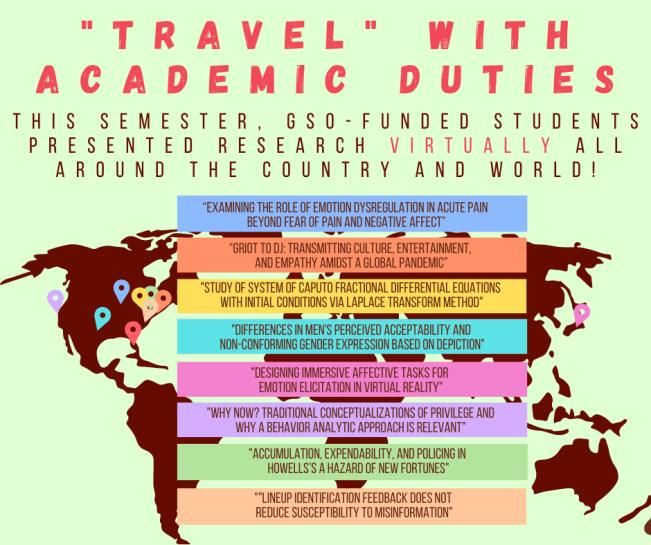
21 3h. Funding of grad students' research The prompt on funding was included as the last of the prioritization questions because GSO officers for years have lamented, “GSO is not just a bank!” After a spring 2020 and summer 2020 of relative inactivity (COVID disruptions), this fall GSO has tried to ramp up its messaging about funding opportunities, seeking to reach new audiences. With a thorough update of the Funding pages of the GSO website, the Executive Board has attempted to eradicate any confusing, redundant or contradictory wording. New this fall, students are now able to complete their Application for Financial Support through an online webform. In combing through the organization’s Bylaws, the Executive Board discovered a few underutilized funding opportunities that have gone unpromoted for several years, like reimbursement for InterLibrary Loan requests and help with comprehensive exam preparation. Because of current travel restrictions, GSO has wholeheartedly encouraged students to seek virtual events at which they can present their research. Thanks to our Faculty Advisor, Dr. David Khey, GSO was able to advertise to students that a space on the UL campus is available to them by reservation; the Conference Room at the Ernest J. Gaines Center has kindly lent their space for graduate students needing a quiet, professional setting to deliver conference presentations. As the Advocacy Survey reveals, awareness of GSO funding could be more widespread and students have some misconceptions about our current budget and our funding procedures. For example, one student argues that it is difficult to apply for Travel with Academic Duties (presenting at a conference) funding if you do not yet have a confirmation of your abstract’s acceptance from a conference. In fact, you may apply for funding before receiving confirmation from the conference. Some students say that $160 for Research Equipment and Supplies does not stretch far enough. Many students suggested that GSO funds be used to offset technology costs. GSO’s Bylaws restrict the purchase of certain technology items for students’ use (and all equipment and supplies purchased through GSO funds, if not consumed by the end of the semester, must be surrendered to University laboratories or the University library, per GSO Bylaws). An overhaul of GSO’s Bylaws on funding may be in order to align with student needs and demands. GSO has shared with Department Representatives and on Facebook that there is technology equipment available for student use around campus. The Dupré Library has headsets and webcams for checkout, the Guilbeau Center in the History Department has a variety of gadgets for conducting research (podcast mics, voice recorders, video cameras, etc.). Perhaps an underutilized funding pool is STEP Grants, which must be submitted by a faculty or staff member but could be used to better outfit buildings with the technology students need and could help with licenses for software specific to graduate programs.
22

Fall 2020 Funding   Spring 2021 Funding
23
24

In speaking directly with Department Representatives, the GSO Executive Board has
learned that its traditional funding categories favor certain degree programs and
certain types of research over others. For context, GSO funds within five categories:

   ➢ Travel with Academic Duties (up to $500) | presenting at a conference

   ➢ Travel without Academic Duties (up to $100) | attending a conference

   ➢ Research Equipment & Supplies (up to $160) | laboratory items or books used for
     thesis or dissertation research, items needed for comprehensive exam
     preparation, InterLibrary loan fees

   ➢ Thesis, Dissertation or Graduation Project Costs ($100) | for printing and binding

   ➢ Other Funding (up to $500) | for events designed to benefit all graduate
     students

Department Representatives have suggested that their constituents may see the
funding category list and think their research costs do not fall into GSO’s set of funding
opportunities.

Here is a list of additional potential funding ideas suggested by GSO Department
Representatives to better reflect their students’ research costs:

   ➢ Professional organization membership dues, specifically when membership is a
     requirement for certification or licensing in graduate students’ fields (example:
     Speech Language Pathology)

   ➢ Exam fees for professional certifications that complement graduate students’
     academic preparation (example: Project Management certification for an
     MBA)

   ➢ Supplies (implements) that graduate students often purchase themselves to be
     used when completing clinical hours in school settings (example: Counselor
     Education, Speech Language Pathology)

   ➢ Travel:
        o to conduct research outside of the context of a conference (example:
            visiting museums or archives for History, collecting data samples for
            Biology)
        o as part of a twice weekly commute to complete internship duties that are
            tied to thesis research (example: medical research center for Kinesiology)
        o to pick up equipment that is too large to be reasonably shipped but is
            necessary for dissertation research (example: machine for Physics)

If requested, the Executive Board is committed to meeting with each department
(GSO Department Representative, Graduate Coordinator, and other interested
25
students) to determine how the existing funding categories can best support graduate
students and to discuss potential new funding opportunities to serve students across
programs.
As of the preparation of this Advocacy Report in April 2021, GSO has received 78
funding applications from 56 graduate students. Of the 56 students who have been
approved for funding, 11 (19.6%) are themselves GSO Department Representatives.
Semester after semester, GSO Department Representatives themselves are among the
top funding requestors. This could certainly be the product of very proactive graduate
students who are heavily engaged in research and well-supported by faculty mentors.
It is also possible that understanding of GSO funding opportunities (categories, ease of
application, likelihood of approval, funding procedures) is not reaching far beyond the
Department Representatives who have inside knowledge of the process through their
regular meeting attendance.
Another long-standing trend to note is the skewing of funding applications toward
STEM fields. Laboratory supplies do add up and that disposable equipment is often
expended in a manner and speed unlike books for dissertation research in the
Humanities or needs of students in the Arts or Social Sciences. However, GSO could do
a better job of educating all graduate students on the available funding categories.
GSO FALL 2020 & SPRING 2021 FUNDING ALLOCATIONS
TRAVEL RESEARCH
DEPT With Duties Without Duties Supplies Printing TOTALS
FA20 SP21 FA20 SP21 FA20 SP21 FA20 SP21
BIOL $100.00 $1,917.20 $1,918.84 $100.00 $4,036.04
CHEE $290.00 $320.00 $320.00 $930.00
CMCN $50.00 $320.00 $370.00
CODI $100.00 $100.00
CMIX $400.00 $160.00 $313.53 $200.00 $1,073.53
COUN $200.00 $200.00
EDFL $74.00 $79.00 $153.93 $160.00 $200.00 $400.00 $1,066.93
ENGL $55.00 $55.00
GEOS $50.00 $100.00 $150.00
KNES $160.00 $100.00 $260.00
MATH $50.00 $119.74 $169.74
MCHE $160.00 $100.00 $260.00
MODL $50.00 $80.00 $28.16 $46.30 $99.12 $100.00 $403.58
PETE $95.00 $95.00
PSYC $535.00 $95.00 $107.43 $84.99 $822.42
Other - events/programming for all students (Grad Gather & Grow; NAGPS SC) $2,000.00
Departments without applications:
ACCT BUS/MBA CJUS EECE ITEC NURS
ARCH CIVE EDCI HIST MUS PHYS26
Do you have ideas on how GSO can better support graduate students?
Funding for
Providing funding for More money
research related
Categories for funding research towards research
trips like museum
opportunities for management tools supplies and less
collections visits
research supplies that to be used for thesis towards travel
(survey response)
cost more than $160. research (survey response)
(survey response) (survey response)
Funding is often unavailable midway
We should have funding for purchase through the semester and may of us don't
of webcams and headsets. I think GSO get notices of conference and such until
should supply some webcams and then. Perhaps split the funds in half and
headsets to each lab if supporting only allow half of the funds to go out the
individual students with these two items first semester with a new open application
becomes too expensive. Additionally, process at midterm. Also, please ensure
GSO may partner up with technology that anyone presenting can have their
companies to give students big fees paid regardless of the time they
discounts which would then make apply. These individuals often don't know if
purchase of such devices their proposals or papers are accepted
manageable. until close to the conference day.
(survey response) (survey response)27
What is your biggest challenge as a graduate student this semester? Is there a way
GSO can help?
Funding,
Insufficient
probably not
Providing one time funding for
more than GSO is
help with purchase of research and
already doing.
decent webcam and studies.
(survey response)
headset would go a (survey response)
long way to help
graduate students
(survey response)
I think for a lot of our students, we
may need to redefine what
Finding
acceptable expenses are...
research
consider things like allowing
participants.
students to apply for funding to
(survey response)
offset internet costs, headsets, etc...
Communication tools between
departments and within
departments will be very helpful as
well
(survey response)28 Other Concerns Throughout the comments in the GSO Advocacy Survey, students expressed concerns that did not neatly fit with the prioritization questions. However, their voices should nonetheless be heard. The remaining student concerns are grouped and summarized below. Remote learning: Difficulty of following a class by email when instructor had late access to Moodle Virtual format of classes is challenging to adjust to Self-learning of unfamiliar classes with no direct instructor teaching is difficult All graduate students should be given access to a Zoom pro license Hard time adjusting to a new class schedule in hybrid format It is not easy to feel connected to the University at a distance Campus resources: Limited parking permit options for graduate students; grad lots are far away from many academic buildings, especially if you have night classes Difficulty scheduling machines [laboratory?]
You can also read


