CHARACTER & CITIZENSHIP EDUCATION ( CCE)
←
→
Page content transcription
If your browser does not render page correctly, please read the page content below
CHARACTER & CITIZENSHIP
      EDUCATION (CCE)
                                                   SYLLABUS
                                                  Secondary

                               Implementation starting from 2021

© 2020 Student Development Curriculum Division.
This publication is not for sale. Permission is granted to reproduce this
publication in its entirety for personal or non-commercial educational use
only. All other rights reserved.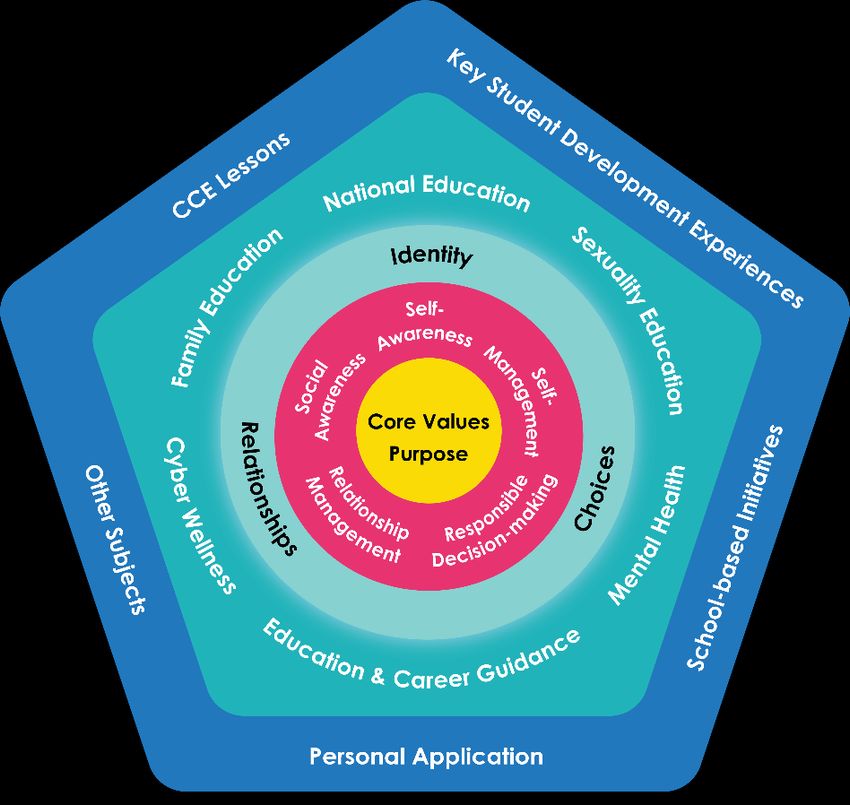
CONTENTS
                                                               Page
1.   PHILOSOPHY OF CHARACTER AND CITIZENSHIP EDUCATION (CCE)    4

2.   CCE 2021 CURRICULUM FRAME
     • The 21CC Framework and CCE 2021                         6
     • Guiding Principles                                      7
     • CCE Goals and Curriculum Content                        8
     • Enactment of CCE                                        14
     • A Caring and Enabling Environment                       16
     • Curriculum Time                                         19

3.   PEDAGOGY AND ASSESSMENT
     • Principles for Effective Pedagogical Practices          21
     • CCE Pedagogical Approaches                              22
     • Assessment Processes in CCE                             24

4.   CCE SYLLABUS CONTENT
     • Overview of CCE Themes                                  26

5.   APPENDICES
     • Appendix A: References                                  34

                                            2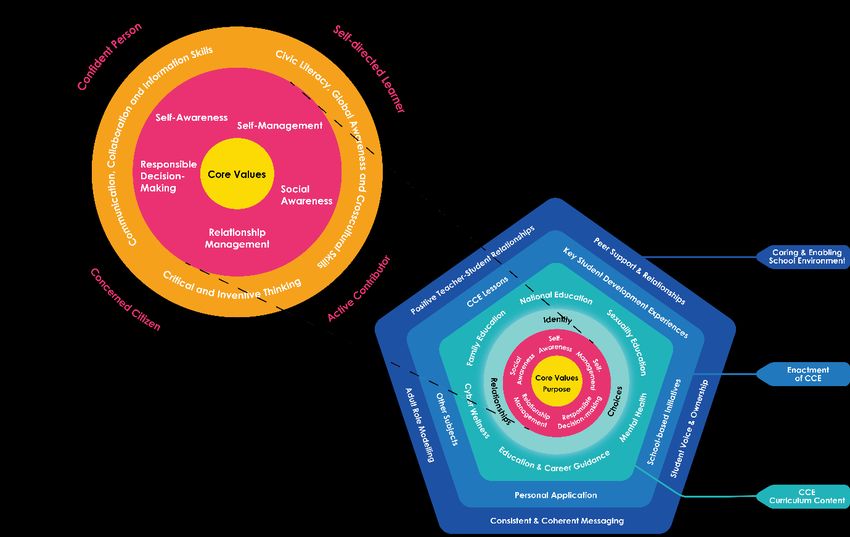
SECTION 1:
PHILOSOPHY OF CHARACTER AND
 CITIZENSHIP EDUCATION (CCE)

          3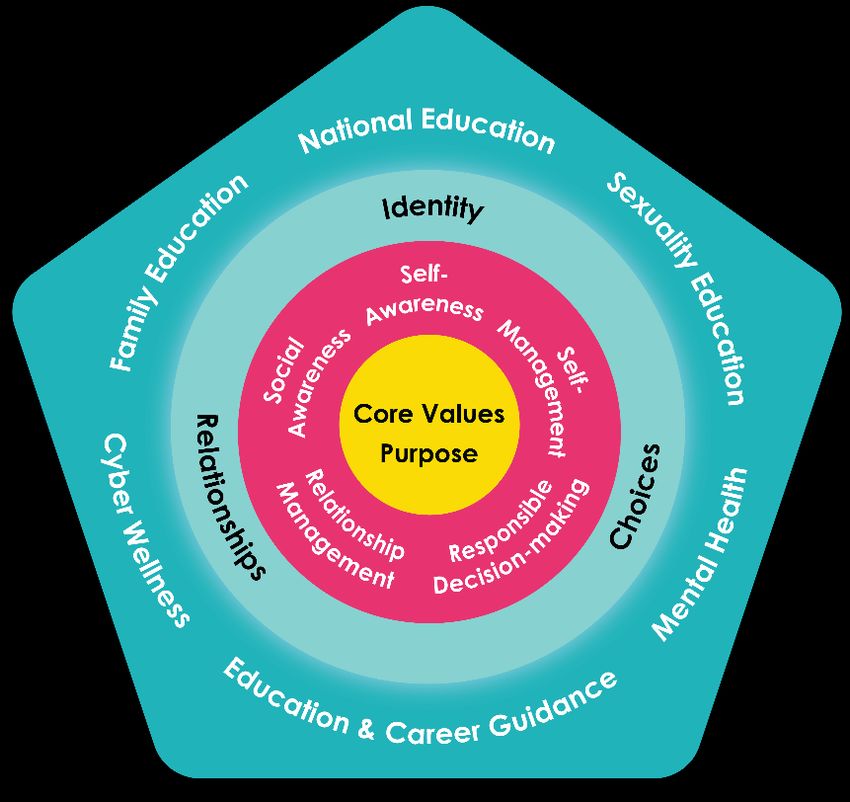
1.      PHILOSOPHY OF                     CHARACTER              AND         CITIZENSHIP
        EDUCATION (CCE)
Character and Citizenship Education (CCE), including National Education (NE), and Social and
Emotional Learning (SEL), are integral to the holistic development of our students, leading to
positive life outcomes. CCE 2021 provides an integrated approach to addressing our students’
development of values, character, social-emotional well-being, and citizenship dispositions in
a coherent and holistic way.
The following philosophical foundations are fundamental to the broad approach towards the
design and enactment of CCE 2021, in alignment with the Singapore Curriculum Philosophy.
The Individual
•    Every child has the potential to flourish and live fulfilling lives – as individuals, family
     members, friends, community members, and citizens of Singapore and the world.
•    We can consciously build our character, and who we choose to be, as we engage and
     interact with one another and the environment around us, and as we encounter life’s ups
     and downs.
•    Every context and experience of life, whether planned or unplanned, holds immense
     possibility for developing our character and citizenship competencies and dispositions.
•    The key to living a fulfilling life is to develop a sense of purpose, knowing we can have a
     positive impact on others, or do something constructive to contribute to society.
The School
•    Schools serve a critical function as they provide rich learning platforms and opportunities
     for students to be equipped with the knowledge, moral and civic values, skills and
     dispositions to understand who they are and who they can become. Through a variety of
     learning activities within and beyond the classroom, students experience being part of
     something larger than themselves and become cognizant of their roles and
     responsibilities in their families, communities, the nation, and beyond.
•    School leaders, key personnel, and teachers play a key role in CCE. Their conviction and
     commitment to be role models influence the effectiveness of school efforts for the
     development of character, social-emotional well-being, and citizenship dispositions in our
     students.
•    Teachers have direct influence over their students and need to be reflective practitioners.
     Using developmentally appropriate, process-based pedagogies, they need to be able to
     facilitate their students’ learning, practice and internalisation of moral and civic values,
     and social-emotional competencies.
School-Family-Community Partnership
•    It takes a village to raise a child. Schools partner with families and the broader community
     in the upbringing and education of our children to grow in character, and play an active
     role in society, the nation, and beyond.

                                                4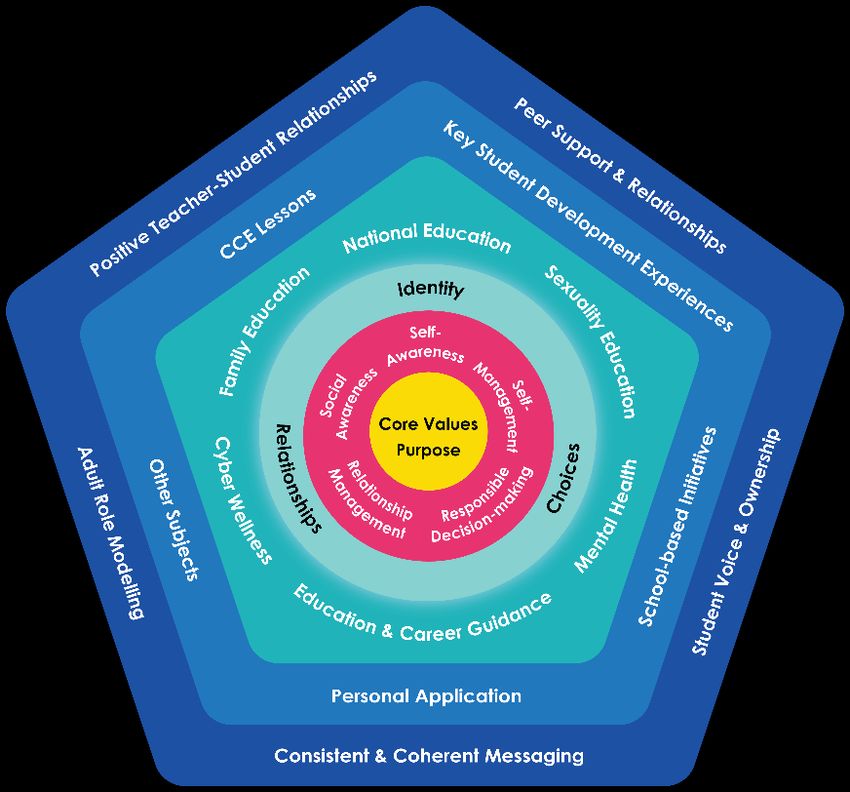
SECTION 2:
CCE 2021 CURRICULUM FRAME

             The 21CC Framework and CCE 2021
                             Guiding Principles
              CCE Goals and Curriculum Content
                             Enactment of CCE
             A Caring and Enabling Environment
                               Curriculum Time

         5
2. CCE 2021 CURRICULUM FRAME
I. The 21CC Framework and CCE 2021
The CCE 2021 Curriculum Frame takes reference from the existing Framework for 21st
Century Competencies and Student Outcomes and aims to enhance clarity on how the core
values are linked to the social-emotional competencies, and how they are internalised and
lived out by our students. This relationship is illustrated in Figure 1.
Figure 1: Relationship between 21CC Framework and CCE 2021
6II. Guiding Principles
Three key guiding principles undergird the design and enactment of the CCE 2021 Curriculum
Frame:
1. Student-centricity
We place students at the heart of all our efforts in CCE, catering to their developmental
needs and their social-emotional well-being, as we nurture their character growth and
help to socialise them into morally upright individuals, and responsible and active citizens.
The essence of student-centricity is to seek to understand students’ needs and interests
when designing learning experiences, focusing on student engagement and voice. In this
way, we empower them to derive personal meaning from their learning experiences. We
also focus on understanding the purpose and impact of what we do for our students, and
regularly take stock of our efforts. We continue and strengthen the approaches that are
effective, and modify or discard those that are not.
2. Intentionality
We design and carry out programmes and learning experiences within and outside the
classroom with intentionality, and do not leave learning to chance. This means that we
articulate with clarity the intended learning outcomes that develop the desired values,
social-emotional competencies, and citizenship dispositions in our students, and
purposefully apply pedagogical approaches, and design learning experiences that are
developmentally appropriate, engage students cognitively and affectively, and have an
impact on their learning.
3. Coherence
CCE cannot be perceived in a silo or taught as a subject. Instead, the educational
experience that we provide in our schools for our students needs to facilitate the
development of character and citizenship dispositions, and social-emotional well-being,
in a coherent way across the total curriculum. As such, important aspects of CCE, such as
National Education (NE), Sexuality Education (SEd), Mental Health (MH), Education and
Career Guidance (ECG), Cyber Wellness (CW), and Family Education (FE), are integrated
within a school-wide approach. This is essential for students to internalise the necessary
values, attitudes, and competencies to become self-directed learners, confident people,
active contributors, and concerned citizens, which are the desired outcomes of education.
Effective CCE implementation also requires conviction and dedicated support from school
leaders, all key personnel, teachers, and other staff. For this reason, there is a need to
establish and internalise a shared vision and purpose for CCE through a process of
dialogue and meaning-making. We need to build and use a common language to
communicate and reinforce consistent messages on what it takes to foster dispositions of
character and citizenship and apply social-emotional competencies in the process.
7III. CCE Goals and Curriculum Content
Goals
CCE 2021 aims to develop in our students:
a) Good character: Have a sound moral compass, a strong sense of right and wrong, think
critically and ethically, be discerning in judgment, take responsibility for choices and
actions, be caring towards others and strive for excellence;
b) Resilience and social-emotional well-being: Have a balanced sense of self, form healthy
relationships, be resilient when faced with challenges, find meaning in life, and have a
sense of gratitude and appreciation;
c) Future readiness: Have a sense of purpose in life, develop the dispositions of adaptability
and lifelong learning so as to be able to navigate education and career pathways
purposefully and take on the challenges of the future, including the world of work; and
d) Active citizenship: Develop a strong national identity based on a sense of belonging to the
nation, a sense of hope in themselves and the future, an awareness of the reality of
Singapore’s vulnerabilities and constraints, and the will to act on improving the lives of
others, and building a future for our nation.
Figure 2 depicts the CCE 2021 Curriculum Frame.
Figure 2: The CCE 2021 Curriculum Frame
8CCE Curriculum Content
Figure 3: CCE Curriculum Content
The curriculum content of CCE is based on the three big ideas of Identity, Relationships, and
Choices, and comprises the teaching and learning of core values and social-emotional
competencies with a focus on developing a sense of purpose in our students. This is shown in
Figure 3. The following sections elaborate on these ideas:
a) Core values and purpose
Values are at the core of one’s character. Our personal values are those principles and
beliefs which guide our behaviour in the private and public sphere. At the broader societal
level, they are those enduring shared beliefs about “what is worthwhile, ideals for which
people strive for, and broad standards by which particular practices are judged to be good,
right, desirable, or worthy of respect”1.
Our core values include respect, responsibility, resilience, integrity, care, and harmony,
which are acknowledged as values that are at the foundation of our shared societal and
national values. Recognising the potential in every child, the schooling environment
creates learning opportunities that draw out and develop our students’ personal
character strengths, e.g. adaptability, empathy, creativity, and curiosity; as well as nurture
in them our shared societal and national values. Besides developing their personal
character strengths, our students are encouraged to demonstrate care for others,
consider others’ perspectives, and show sensitivity towards the thoughts and feelings of
others.
1 Halstead, J.M., & Taylor, M.J. (1996). Values and values education in schools. In J.M. Halstead & M.J. Taylor (Eds.), Values
in Education and Education in Values. London: Falmer Press.
9In addition to values, there is a need to emphasise a sense of purpose. Finding a sense of
purpose gives our life meaning. It is about discovering how one’s values, strengths,
talents, and interests can be meaningfully applied so that one feels a sense of personal
significance within one’s sphere of influence and beyond. Students may know and
understand values, be able to articulate what they look like in practice, and have the
competence to apply them; but they may not have the motivation to act on them when
the situation calls for it. Integrating a sense of purpose into one’s identity is a vital part of
the internalisation of values for character development and transformation2. With a sense
of purpose, an individual is more likely to live out the core values that make up the
foundation of his/her character, and meaningfully apply the social-emotional
competencies learnt.
b) Social-emotional competencies
Social-emotional competencies enable us to examine and understand our own thoughts
and emotions, develop a sense of responsibility and concern for others, and act for the
good of self, others, and the society. When we apply these competencies, we live out our
values and grow our character.
- The competencies related to developing self-awareness allow us to understand our
emotions, thoughts, values, personal goals, and mind-sets, which enable us to
construct an understanding of who we are.
- The competencies related to social awareness enable us to develop cognitive and
emotional empathy, understand the perspectives of people with different
backgrounds or cultures, and to become more sensitive to the social environment and
the needs of others.
- The competencies for self-management enable us to self-regulate our emotions,
thoughts and behaviours, to achieve personal well-being, to demonstrate pro-social
behaviours, and to choose to be our best selves.
- The competencies for relationship management enable us to build and maintain
positive relationships with others in accordance to social norms and culture. We also
develop empathy through practising perspective-taking, and understanding the
impact and consequences of our actions on others.
- Responsible decision-making enables us to apply moral reasoning and sound values-
based judgements in the choices we make.
These competencies can be taught, demonstrated, and applied through explicit
instruction, planned authentic learning experiences, as well as teachable moments. For
sustainable lifelong character development, these competencies must be taught, learnt,
and applied within the broader context of values learning so that students understand the
purpose and meaningfulness of acquiring these competencies.
2Aquino, K., & Reed, A. (2002). The self-importance of moral identity. Journal of Personality and Social Psychology, 83(6), pp.
1423-1440.
Damon, W., Menon, J., & Bronk, K. C. (2003). The Development of Purpose During Adolescence. Applied Developmental
Science, 7(3), pp. 119–128.
Hardy, S.A., & Carlo, G. (2011). Moral Identity: What Is It, How Does It Develop, and Is It Linked to Moral Action? Child
Development Perspectives, 5(3), pp. 212–218.
Jennings, P. L., Mitchell, M.S., & Hannah, S.T. (2015). The moral self: A review and integration of the literature. Journal of
Organisational Behaviour, 36(S1), pp. 104-168.
10c) The 3 big ideas: Conceptual core of CCE
(i) Identity
Identity, which is a complex and multi-faceted construct in developmental psychology, is
at the core of the process of human psychosocial development. It is described by the
fundamental question, “Who am I?”. This is a person's subjective experience of who he or
she is, largely influenced by his or her interaction with the social environment3. Identity is
also about how a person sees himself/herself as belonging to a social group characterised
by different features such as ethnicity, religion, profession, nationality, etc.
The question “Who am I?” prompts reflection on one’s self-identity and self-concept. The
questions “Who do I want to be?” and “What does my best self look like?” aim to
empower individuals to shape their identity and self-concept positively with a sense of
purpose and awareness of their personal significance in the world around them. One’s
purpose needs to be not only meaningful to oneself, but also positively impacts the world
beyond oneself4.
(ii) Relationships
Humans are social beings. An individual’s social context, relationships, and social
interactions play a significant role in shaping his/her identity. In educational settings, the
nature and quality of relationships within the classroom and beyond have the potential
to not only influence the students’ personal and social identity, but also their civic and
national identity. Flanagan highlights that the school is a “mediating institution” of
students’ experiences of the socio-political system of a nation5.
Accordingly, the development of character strengths and potential of individuals must be
balanced with considerations of the broader social, cultural, national, and global contexts
within which the individual lives and flourishes. Furthermore, their understanding of their
role as citizens is internalised through cultural transmission along with a social,
collaborative process of meaning-making. This is especially so during the adolescent years.
It is also important for all students to feel a sense of belonging and social trust, and an
understanding of the common good, established through relationships and a sense of
community.
The big idea of “Relationships” is guided by the question, “How do I relate to myself,
others and the world around me?”. This question intends to prompt self-reflection and
reflection on the individual’s interaction with the environment around him/her. This idea
also signifies the importance of intentionally building a positive school culture, and
establishing strong teacher-student relationships, student-student relationships, and peer
support networks. This is so that students can experience a sense of belonging to the
school community and develop resilience in the face of adversity. Students must also
learn how to be inclusive and relate well to those who are different from them.
3 Erikson, E. (1959). Identity and the Life Cycle. New York & London: W.W. Norton & Company.
4 Damon, W., Menon, J., & Bronk, K. C. (2003). The Development of Purpose During Adolescence. Applied Developmental
Science, 7(3), pp. 119–128.
5 Flanagan, C.A. (2013). Teenage citizens: The political theories of the young. Cambridge, Massachusetts and London, England:
Harvard University Press, p.18
11(iii) Choices
The big idea of “Choices” emphasises the complex environment that our students are
growing up in, and the various types of decisions they will need to make. These decisions
will determine - and be determined by - who they are and who they want to be. The
questions, “How do I choose to be?”, “How do I choose to act?”, and “What kind of future
do I want?”, emphasise agency or self-directedness, and personal responsibility in the
choices one makes during the decision-making process both internally and externally.
Within the internal sphere, decisions are made in areas such as one’s value system,
morality, personal excellence, and education and career goals. Externally, decisions on
how to be and act occur within various contexts such as: the home, school, cyberspace,
neighbourhood, common public spaces, the nation, and the world; relationships with
family, friends, fellow citizens, others, and the environment; situations involving moral
dilemmas, multiple perspectives, and contentious issues.
d) CCE Curriculum Content Areas
While the CCE Curriculum Content is premised on the three big ideas of Identity,
Relationships and Choices, and anchored on the teaching of core values and social-
emotional competencies, to help students find a sense of purpose, these fundamentals
are taught and applied in the following Curriculum Content Areas:
(i) National Education (NE): NE, a significant aspect of CCE, comprises a wide range of
school efforts that help students experience and explore their national identity as
Singaporeans, understand the realities and challenges unique to our nation, and
foster a sense of hope and belonging to Singapore. A strong sense of belonging,
reality, and hope motivates our students to be active citizens. While they seek to
achieve their personal life goals, they also see themselves as playing a contributory
role in their immediate communities and in the nation. NE in CCE aims to be
empowering and aspirational, allowing for individual sense-making, so as to
nurture engaged citizens, who are socially aware, adept at critical thinking, and
informed about local, regional, and global issues.
(ii) Sexuality Education (SEd): In this current age, better nutrition and improved health
care has resulted in children reaching puberty and sexual maturity at a younger
age. Furthermore, our young are also exposed to a wide range of influences from
the media, including sexual mores that could endanger health and undermine the
integrity of the family. Our students require guidance so that they can respond
with discernment to the sexual messages in the media and other sources. SEd
enables our students to understand the physiological, social, and emotional
changes they experience as they mature, develop healthy and rewarding
relationships including those with members of the opposite sex, and make wise,
informed and responsible decisions on sexuality matters. While parents play the
primary role in the sexuality education of their children, especially in the teaching
and transmission of values about sex and sexuality, schools play an important
supportive role.
12(iii) Mental Health (MH): Mental health is about having a balance in various aspects of
life, and learning values and social-emotional competencies to cope with life’s
situations, relate to others and contribute to the community. A focus on MH in
CCE at the secondary level helps students to strengthen their resilience and well-
being; differentiate between stress, distress (overwhelming stress), and illness;
enhance help-seeking efficacy; as well as destigmatise mental illness.
(iv) Education and Career Guidance (ECG): Young people in our schools today face a
future that will be very different from that experienced by their parents and
teachers. ECG is about equipping students with the necessary knowledge, skills,
and values to make informed decisions at each key education stage for successful
transition from school to further education or work, and hence to manage their
career pathways and lifelong learning throughout their lives. Through ECG,
students explore their strengths and abilities, examine their life’s purpose, and
develop qualities of proactivity, adaptability, and resilience to prepare themselves
for the 21st Century.
(v) Cyber Wellness (CW): Information and Communication Technologies (ICT) are
becoming increasingly pervasive in our world. While creating instant connectivity
and access to vast repositories of information, knowledge, and opinions, the open
nature of the Internet can expose our students to undesirable content and
influences. CW in CCE is important as it focuses on the well-being of our students
as they navigate cyberspace, equipping them with the knowledge and skills to
harness the power of ICT for positive purposes, maintain a positive presence in
cyberspace, and be safe and responsible users of ICT.
(vi) Family Education (FE): FE is premised on the nation’s shared value of the family as
the basic unit of society, and focuses on the importance of having stable family
units with extended family support. Students learn about being responsible family
members, and to be grateful for the role their families play in shaping who they
are and who they become. They are encouraged to love and appreciate their
families despite imperfections, and urged to reflect on the value of family
relationships, and the importance of broadening their definition of success to
include quality family life.
13IV. Enactment of CCE
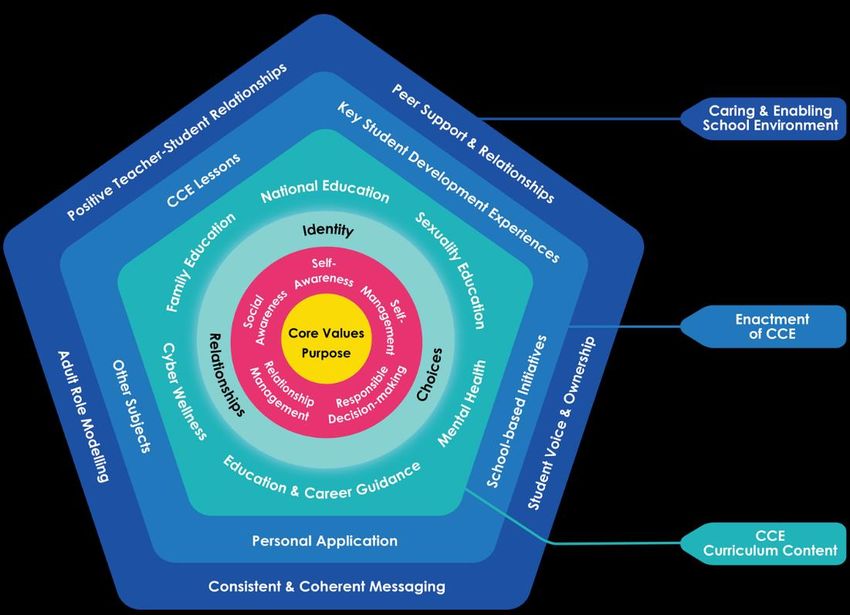
Figure 4: Enactment of CCE
There are several learning platforms where CCE is enacted with intentionality. These include
CCE Lessons during curriculum time, Key Student Development Experiences (SDEs) beyond
the classroom, school-based initiatives, teachable moments during other subject lessons, and
learning opportunities beyond school. Figure 4 shows the different platforms in which CCE
may be enacted.
a) CCE Lessons
These lessons provide the time for teachers to engage and build relationship with their
students through discussions and effective classroom strategies. Broadly, there are three
ways CCE lesson time is used:
(i) explicit teaching of values and social and emotional skills to address the holistic
developmental needs of students, e.g. understanding emotions and how to regulate
them, learning how to manage relationships, learning about sexuality, developing a
sense of purpose in life;
(ii) equip students with knowledge and skills to better understand real-world contexts,
e.g. understand mental health issues, navigate cyberspaces responsibly, make
appropriate educational and career choices, appreciate family life, understand
Singapore’s racial and religious diversity; and
(iii) discussions on contemporary issues to enable our students to grasp current realities
in our national, regional, and global contexts, reflect on their national identity,
14develop civic consciousness, and the will to make a difference in society, as well as
learn social-emotional competencies and 21CC skills such as civic literacy, cross-
cultural skills, and global awareness.
b) Key Student Development Experiences
Student Development Experiences (SDEs) are programmes and activities that contribute
towards the holistic development of our students in the physical, aesthetic, intellectual,
moral, and social domains.
Key SDEs are programmes and activities that all Singapore schools provide for all their
students. These comprise the following:
- Co-Curricular Activities (CCA);
- Cohort Learning Journeys (LJs);
- Education and Career Guidance (ECG) Experiences;
- National Education (NE) Commemorative Days;
- NRIC Presentation Ceremony;
- Outdoor Adventure Learning (OAL) Cohort Camps;
- Student Leadership Development (SLD) Programmes; and
- Values in Action (VIA).
For each of these programmes and activities, specific CCE Learning Outcomes are
articulated and planned activities are incorporated with the intention of realising the
identified learning outcomes. These activities are based on experiential learning
pedagogy, including dialogue, discussion and reflection, and intentional application of
values, social-emotional, and civic competencies.
Besides the Key SDEs, there are also SDEs which are school-based initiatives. These are
programmes and activities that cater to the needs and interests of students within the
school, and may also target specific groups of students within the school.
c) School-based Initiatives
As every school context is different, and the needs, interests and abilities of students vary
within each context, schools design and implement programmes and activities for CCE
that cater to the profile of their students. These school-based initiatives also take
reference from the CCE learning outcomes and apply the guiding principles of student-
centricity, intentionality, and coherence to ensure that students’ learning experiences
meaningfully blend in with the overall school-wide approach to CCE.
d) Other Subjects
Subjects such as Social Studies, History, Music, and Art, include content knowledge that
provides opportunities for exploration into national identity, contemporary issues, as well
as Singapore’s constraints and vulnerabilities. The teaching of English and Mother Tongue
Languages also provide opportunities to hone students’ sensitivity towards others and
learn communication skills for relationship building. Physical Education (PE) allows for
students to learn sportsmanship and take responsibility for a healthy lifestyle.
15Besides linking CCE learning outcomes to content knowledge in other subject areas, the
learning of values and social-emotional competencies can also occur through teachable
moments. As students interact with one another through group activities, they learn the
skills of working together harmoniously, appreciating diversity, and active listening. They
also learn how to demonstrate values such as respect, integrity, and responsibility as they
are encouraged to do their best in various learning tasks and relate to their teachers and
fellow classmates. They demonstrate care as they look out for and support their
classmates and friends in times of need.
e) Personal Application
For CCE to be meaningful for our students, they should be taught to reflect on their
character growth as a lifelong process. There are many authentic learning opportunities
within and beyond school for our students to develop the habit of self-reflection and
gratitude. As they practise thinking back on positive and negative life experiences, they
consider what can be learnt from these experiences and commit to working towards
better versions of themselves. The time they spend in school after lessons, during recess,
and lunch break with their school mates, as well as after school with their families, friends
in the community, and other social groups, online and offline, have a great influence on
who they are and who they choose to become. CCE provides the knowledge and skills to
help our students make sense of their life experiences and the language to express their
learning and development.
V. A Caring and Enabling School Environment
Figure 5: Caring and Enabling School Environment
16For the enactment of CCE to have sustainable impact on our students, the school environment
needs to support their dispositional development.
As humans, we have basic psychological needs to connect with others, feel emotionally and
physically safe, have a sense of belonging, exercise autonomy, and experience competence.
These fundamental needs shape our motivation and have important implications for learning
and development6. Schools are places where these needs can be met by building a caring
community through positive relationships among staff and students where there is mutual
respect, care, and support for one another. When these needs are met, students feel more
connected to their school and are motivated to own their learning and school community
together.
A caring and enabling school environment, as shown in Figure 5, is one that is characterised
by caring and responsible leadership, a pervasive growth mindset, emotional and physical
safety, and a focus on learning and development of students, teachers and all other members
of the school community. In such a rich learning environment, our students can cultivate
dispositions of character and citizenship, and social-emotional well-being, as well as feel
empowered to become their best selves.
Some necessary features of the school environment include:
a) Consistent and Coherent Messaging
For schools to provide a conducive environment for positive dispositional development in
our students, it is of critical importance that the messaging about values, character, social-
emotional well-being, and citizenship is consistently and coherently demonstrated in the
various experiences the student encounters throughout the school day. A common
language used intentionally by all members of the school community will demonstrate
coherence between intentions, goals, actions, decisions, habits, and behaviours. Systems
and structures in the school also support and make explicit the messaging on the centrality
of the development of students’ character and citizenship dispositions in the school
environment.
b) Positive Teacher-Student Relationships
Positive interpersonal relationships between teachers and students contribute
significantly to the students’ learning process. In positive Teacher-Student Relationships
(TSR), students perceive they are respected, supported and valued by their teachers.
When students experience positive TSR, they are more engaged in school and able to
sustain their learning motivation. When teachers build positive relationships with their
students, they feel a sense of security which allows them to engage more actively in
interactions within the school environment, shaping their character, and social-emotional
well-being and development.
6 Deci, E.L., & Ryan, R.M. (1985). Intrinsic Motivation and Self-Determination in Human Behaviour. New York: Kluwer
Academic/Plenum Publishers.
17c) Adult Role Modelling
Adults in the school, especially school leaders, key personnel, teachers, and coaches have
a powerful influence on students, who look to them for guidance, inspiration, wisdom,
and support. Adults need to be aware of the positive or negative impact they can have on
young minds, and consciously try to be good role models of the values, social-emotional
competencies, and citizenship dispositions that we hope to see in students.
d) Peer Support and Relationships
Supportive peer relationships form a critical part of the network of positive relationships
in school. Peers are a significant source of support for most students and especially so for
adolescents as they are more likely to turn to their friends rather than adults for help.
With Peer Support and Relationships (PSR), students participate in fostering strong bonds
of friendships and a sense of belonging to the school community (peer bonding), provide
practical help, and social-emotional support to one another (peer helping) and promote
positive mindsets, pro-social behaviours both online and offline, well-being and role-
model good character (peer influencing). Taken together, these efforts contribute to the
building of a caring and supportive peer culture, by students for students.
e) Student Voice and Ownership
To establish an effective learning environment for CCE, it is critical to take into account
student voices, and co-design learning approaches and activities that cater to their needs
and interests. Creating space for students to be heard and encouraged to play an active
role in what and how they learn, provides opportunities for them to develop agency or
self-directedness, responsibility, and ownership of their learning. Student participation in
the planning and implementation of some aspects of CCE, e.g. Values in Action (VIA)
activities, Co-curricular activities (CCAs), outdoor activities, Cyber Wellness, peer-support
initiatives and other relevant aspects, will create opportunities for them to develop
leadership competencies, as well as a sense of belonging to their school community and
the motivation to make a positive difference.
18VI. Curriculum Time
To intentionally address the desired learning outcomes for CCE, curriculum time is allocated
for explicit teaching, and reinforcement and application of learning. CCE learning is deepened
when there is coherence between what is taught explicitly and what is reinforced and applied
beyond the classroom.
a) Explicit Teaching
Explicit teaching involves systematic planning and use of curriculum time for students to
learn and internalise values and specific social and emotional skills as well as understand
how to apply them. Teachers use appropriate pedagogical principles, approaches, and
strategies to engage students in discussion, sense-making and reflection.
Explicit teaching mainly takes place during CCE Lessons for which two periods a week
(minimally 1 hour) are allocated. In addition, explicit teaching also occurs through school
assemblies, debriefing and reflection activities set aside during key Student Development
Experiences such as VIA, Cohort Learning Journeys (LJs), and ECG Experiences.
b) Reinforcement and Application of Learning
Opportunities for learning, reinforcement and application of values, social-emotional
competencies, and citizenship dispositions occur throughout the school day during
various activities and programmes, as well as teachable moments. What is critical is that
students have time set aside to reflect on their experiences and consider what they have
learnt from positive and negative life encounters, and how these encounters may or may
not have transformed them.
19SECTION 3:
PEDAGOGY AND ASSESSMENT
Principles for Effective Pedagogical Practices
CCE Pedagogical Approaches
Assessment Processes in CCE
203. PEDAGOGY AND ASSESSMENT
In CCE, learning is a continual lifelong process and occurs through a variety of experiences.
Teachers create and scaffold these experiences to bring about the effective learning and
realisation of the CCE learning outcomes and goals. These experiences are tuned finely to the
needs and interests of our students and maximised through authentic and meaningful
connections to real-world contexts.
Assessment in CCE is integral to the learning process and is a part of pedagogy. Pedagogical
and assessment processes and strategies are intertwined in CCE learning experiences.
Teachers gain insight into how their students are learning and developing in CCE, and what
they can do to enhance that process. The gathering and use of assessment information is part
of the ongoing learning process in which teachers address students’ learning gaps.
I. Principles for Effective Pedagogical Practices
In the process of determining effective pedagogical practices, it is critical for teachers to
consider the interplay of key pedagogical principles and approaches, and select appropriate
strategies for the classroom or learning experiences beyond the classroom. Some key
principles for effective pedagogical practices in CCE are:
a) Positive Relationships for Learning
Positive teacher-student and student-student relationships are built and supported by an
environment where students feel accepted, safe, and empowered. By providing for the
social and emotional dimension, students are more ready to respond to pedagogical
practices that engage them to articulate their thoughts and dialogue with one another.
They are also able to access the diverse experiences and perspectives of all in the class,
work collaboratively, and empower them to take ownership of their own learning.
b) Sense-Making
Learning occurs when students process their emotions and make sense of new knowledge
by asking critical questions and making connections to prior knowledge, concepts and
ideas that they have internalised. This process allows them to find relevance, meaning,
and purpose in the learning tasks they engage in. Effective CCE learning experiences
provide students with opportunities to think, dialogue, reflect on, rationalise, and express
their opinions, emotions, choices, and actions. To facilitate this sense-making process in
CCE, teachers identify and understand students’ learning needs, prior knowledge, and
experiences, and use teaching and learning strategies that best support their dispositional
development.
c) Metacognition and Deep Learning
Deep learning is more natural to the human condition as it connects to one’s core
motivations and deepens one’s desire to connect with others and do good. To facilitate
this process, thought-provoking scenarios and questions are considered, and students’
voices are honoured. Metacognitive strategies are used to help students make their
thinking visible, apply their learning and guide them in high quality reflection to facilitate
21deep learning and internalisation. Deep learning manifests in the motivation to act and
make a positive difference.
II. CCE Pedagogical Approaches
a) Narrative Approach
The Narrative Approach is based on the understanding that people make sense of the
world and their experiences through stories or the construction of stories. Narratives
allow people to understand real-life moral dilemmas more deeply. Using stories, students
get to understand what influence decisions, how decisions are made and lived out in
different contexts, and the consequences of the actions. Students come to recognise and
clarify their values through the process of storytelling and reflection. They are guided in
identifying personal beliefs and values, taking perspectives as they construct their own
narratives, and consider the narratives of others. The Narrative Approach requires open-
ended questioning, clarifying, summarising, building on each person’s contributions, and
encouraging students’ voices in responding to one another.
b) Explicit Skills Instruction Approach
This approach is important for the teaching and learning of social and emotional skills. It
is characterised by a series of scaffolds, whereby students are guided through the learning
process with clear statements about the purpose and rationale for learning specific new
skills, clear explanations, and demonstrations of learning to be acquired, and supported
practice with feedback until independent mastery has been achieved 7 . One important
strategy that helps students learn, practise and internalise these skills is role play, where
they take on the perspectives of others and demonstrate appropriate responses in
different scenarios.
c) Experiential Learning Approach
Experiential Learning Theory defines learning as “the process whereby knowledge is
created through the transformation of experience” 8 . This pedagogical approach sees
students going through a cycle involving experiencing, reflecting, thinking, and acting to
transform their experiences into learning. Observations and reflections are made through
concrete experiences (e.g. Cohort Learning Journeys, Cohort Camps). Reflections are
assimilated and distilled into abstract concepts. New implications for action are then
drawn, actively tested, and eventually serve as learning to be applied in new experiences.
Learner participation is central. Identification, understanding, and internalisation of
content arise only through the learner’s experiences.
7 Archer, A.L., & Hughes, C.A. (2011). Explicit Instruction: Effective and Efficient Teaching. New York: The Guilford Press.
8 Kolb, D. A. (1984). Experiential Learning: Experience as the source of learning and development. NJ: Prentice-Hall, Inc. p.41
22d) Cognitive Development Approach
This approach, based on Lawrence Kohlberg’s theory of moral development, uses moral
dilemma scenarios for students to apply moral reasoning to examine their motives and
consider the values and principles they choose to uphold in making decisions and taking
action. The aim of the process is for students to progress from a self-centred perspective
to a higher stage of moral development, focusing on societal and universal perspectives.
e) Consideration Approach
The Consideration Approach focuses on perspective-taking to develop caring dispositions
in students by building cognitive and emotional empathy. The critical question to ask in
this approach is, “How would you feel, think or act if you were in this situation or if you
were that person?” This approach involves helping students to make moral decisions by
taking into consideration the impact of their decisions and actions on others. Through the
use of appropriate strategies (e.g. Hot Seat), teachers help students to adopt the
perspectives of others, understand their thoughts and feelings, and develop a balanced
view of a given situation. In this way, students not only develop the capacity for empathy
but also learn to care for others.
f) Values Clarification Approach
Values clarification involves helping students to articulate their values through examining
their personal feelings and behaviour patterns using rational thinking and emotional
awareness. Students develop moral sensitivity as they are guided to clarify their beliefs
and values by examining their personal feelings, understanding the values and beliefs held
by others, and considering the impact of their actions on others. In this way, students are
motivated to construct ethical and well-reasoned positions, make responsible decisions
and uphold sound values which stand the test of review and comparison.
23III. Assessment Processes in CCE
The Singapore Curriculum Philosophy outlines the following fundamental beliefs about
assessment:
(i) Assessment is integral to the learning process;
(ii) Assessment begins with clarity of purpose; and
(iii) Assessment should gather information to inform future practices.
In line with these beliefs about assessment, teaching and learning in CCE involves an iterative
and continuous process of motivating and helping students to work towards the learning
outcomes. Teachers weave in appropriate teaching and learning strategies and opportunities
to equip students with the necessary skills to evaluate themselves for continuous personal
growth and development.
Assessment in CCE is thus underpinned by a developmental purpose, moving away from a
teacher-centric emphasis on curriculum coverage, and an outcome-oriented approach that
focuses on objective measures and summative assessment of learning. Assessment processes
in CCE involve the following aspects:
a) Co-construction of collective and individual goals
To create responsibility for and ownership of learning, it is important that students
collectively and individually construct their own learning goals together with the teacher.
Using assessment information from tools such as the Social Emotional Competency
Inventory (SEC Inventory), teachers identify students’ domains of strengths and areas for
improvement. Students are guided to self-assess, self-regulate, and set personal goals.
b) Making sense of learning progress through dialogue and reflection
CCE lesson time could be used for students to make sense of and reflect on their progress.
Form teacher interaction time and peer dialogue could also be used to guide students in
identifying and interpreting the evidence of their learning, and committing to the next
step.
c) Building students’ capacity for self-assessment and peer assessment
By providing opportunities for students to self- and peer-assess, they learn the
knowledge, skills, and attitudes needed for life-long character growth and the journey
towards becoming their best selves.
24SECTION 4:
CCE SYLLABUS CONTENT
Overview of CCE Themes, Lessons, Contemporary Issues and
Key Student Development Experiences
254. CCE SYLLABUS CONTENT
The curriculum content of CCE is premised on the three big ideas of Identity, Relationships and
Choices, and anchored on the teaching of core values and social-emotional competences and
citizenship dispositions to help students find a sense of purpose.
Overview of CCE Themes
The content of CCE is organised by three themes which are based on these three big ideas, taking into
consideration the social and cultural context of Singapore. The three themes are as follows:
• Becoming my Best Self
“Who am I? Who do I want to be? What does my best self look like?”
Students learn to navigate through life experiences like transitions and develop a better
understanding of themselves. They strengthen their mental well-being through better self-awareness
and self-management. They learn to overcome challenges and are hopeful in the face of adversity.
Students reflect on and make sense of their values, who they are, and who they want to be. They
reflect on their aspirations and purpose, and set goals to work towards their best self, in relation to
others and the larger environment.
• Building Connections
“How do I relate to myself, others and the world around me?”
In working towards their best selves, students should also consider the broader social, cultural,
national, and global context within which they live.
The learning within this theme offers opportunities for students to develop respect and appreciation
for our socio-cultural diversity, and learn how to empathise with and relate to others who are different
from themselves. They are encouraged to positively influence their peers and others, online and
offline.
Students strengthen their sense of national identity and commitment to contribute to society.
• Making Choices
“How do I choose to be? How do I choose to act? What kind of future do I want?”
Living in an increasingly complex environment brings challenges to the various types of decisions that
our students would be required to make.
This theme helps students understand that they have personal responsibility in making choices that
will determine who they are and who they want to be. They learn the importance of exercising
discernment in risky situations to safeguard themselves and others.
Students identify and manage obstacles to responsible decision-making, consider the consequences
of their decisions and actions, and develop courage and conviction to stand by them.
Table 1 provides an overview of the content of the three themes covered in the course of a
student’s secondary school experience.
26TABLE 1: OVERVIEW OF CCE CONTENT
Theme Lower Secondary Upper Secondary
Becoming my Best Self CCE Lessons
“Who am I? Students develop in self-awareness, reflect on who they want to Students deepen their self-awareness and self-management as
Who do I want to be? be, consider their purpose in life and learn ways in which they can they continue to seek growth towards becoming a better version of
What does my best self work towards the self they aspire to be. themselves, clarify their sense of purpose and goals in life to be
look like?” future oriented, and develop positive disposition to see hope in the
The lessons provide opportunities for students to understand face of adversity.
themselves and to appreciate what is a healthy self-identity. They
learn how to seek continual self-improvement and take action to The lessons provide opportunities for students to recognise that
develop their character strengths, values, interests, talents and their self-perceptions are shaped by their life experiences and roles
skills. This also includes setting short term goals and developing they play in school, home and community. In the process, they will
actionable plans to work towards their envisioned best selves and learn how to evaluate their self-perception, calibrate unhealthy
long term educational and career goals. expectations on themselves, and practise self-compassion, to
construct an accurate perception of themselves and develop
They are taught strategies for self-monitoring and self-regulation to positive self-esteem and self-worth. Students will also evaluate the
help them improve how they regulate their emotions, thoughts and consequences of their behaviours to self and others, learn to
behaviours. Students learn to differentiate normal stressors from a control their impulses to avoid risky behaviours, and take
state of distress and illness and take steps including seeking help to responsibility for their actions. They will also learn to develop
address it. In addition, students learn to tap on their internal and healthy habits and maintain good mental health.
external resources to build resilience and handle challenges.
As students discover and work towards their best self, to contribute
In the process, students learn the importance of valuing and positively to their family, communities and country, they learn to
strengthening positive relationships with family, friends and others review their plans and goals, persevere in developing key skills and
as they work towards their best selves, build moral courage to abilities to improve themselves, and develop habits of lifelong
make values-based decisions regardless of circumstances they may learning. Students will also learn to identify current and future
face. challenges, as well as opportunities and healthy ways to cope with
or overcome them so that they will be better prepared to face
changes and stay relevant for the future.
27Theme Lower Secondary Upper Secondary
Becoming my Best Self CCE Lessons
“Who am I? Who do I want CCE lessons are designed based on students’ life experiences and CCE lessons are designed based on students’ life experiences and
to be? include the following topics: include the following topics:
What does my best self • Transitioning to secondary school • Applying knowledge of their values, interests, personality and
look like?” • Maintaining healthy balance of their online and offline skills to be positive contributors
activities • Managing expectations from self and others
• Exploring personal values, interests, personality and skills • Resisting the pressure for perfect portrayal and social
• Facing challenges and coping with failures comparisons on social media
• Exploring influences on self-image and body image • Maintaining a healthy and balanced lifestyle
• Exploring and choosing post-secondary education pathways
Contemporary Issues
Discussions on current and relevant issues within this theme include these topics:
• Defining and refining one’s sense of purpose based on the current world context students are living in
• Being resilient in the face of disruptions in the local and global context
• Influence and impact of the countries in our surrounding regions, including ASEAN, on our society and career trends
Key Student Development Experiences
In CCA, students are given the opportunity to develop passion in their areas of interests. Through various experiences offered in CCA,
students learn to recognise the importance of committing time and effort in developing their talents, skills and interests. As they navigate
through challenges along the way, they learn to view successes and setbacks as learning experiences with opportunities for growth.
The richness and complexities of experiences through other key SDEs, such as the Outdoor Adventure Learning (OAL) Cohort Camp and
Values in Action (VIA) projects, also allow students to apply creative problem-solving skills to a variety of challenging tasks. In the process,
students develop the ability to face challenges and recognise the importance of resilience.
To develop students as effective leaders of self, Student Leadership Development (SLD) elements are also integrated into the various
authentic experiences. In developing self-awareness and self-management, students learn to cope with and manage emotions, knowing
when and where to seek help, as they continue to believe and find a sense of purpose in becoming the best versions of themselves.
28Theme Lower Secondary Upper Secondary
Building Connections CCE Lessons
“How do I relate to myself, Students learn skills to develop in their social awareness, to Students continue to develop their skills for social awareness and
others and the world recognise, accept and embrace diversity, show empathy and be relationship management, as they learn to build supportive
around me?” civic conscious. They also learn skills to manage relationships network of family and friends, as well as contribute towards
effectively to contribute towards their personal well-being and a building an inclusive society. They also deepen their reflection of
harmonious society. their roles and responsibilities in consideration of the broader
social, cultural, national and global contexts within which they live.
The lessons provide opportunities for students to reflect on their
relationships with peers and with their families, and to The lessons provide opportunities for students to maintain and
contemplate why they value these relationships. They are guided deepen their relationships with their family and friends. They learn
to consider how they can build, maintain and strengthen these to value and cherish relationships with family members and friends
relationships, in a way that is positive and harmonious, both online who support them to become better versions of themselves.
and offline. They learn how to resolve conflicts in a respectful Students will also learn that changes and challenges in relationships
manner, as well as how they can demonstrate sensitivity and care within their family and among friends serve as opportunities to
in their interactions with others. In the process, students develop a strengthen family ties and friendships. In the process, students will
sense of gratitude and positive outlook towards their families and recognise the importance and reflect on how they can build
peers. resilient families and healthy friendships.
Students also have the opportunity to develop their sense of Students also have the opportunity to gain deeper understanding
national identity and civic consciousness, through gaining a deeper of the varied and shared values of different groups in our diverse
understanding about Singapore and learning more about relating society and reflect on how they can contribute towards fostering
to people who come from diverse backgrounds. They reflect on social cohesion and harmony amidst this diversity. They learn to
their own stereotypes, prejudices and biases against others, appreciate multiple perspectives to deepen their understanding of
appreciate their socio-cultural diversity, and consider the ways in people and situations, as well as the value of dialogue when faced
which they can contribute to a sense of belonging for themselves with complex issues. In the process, they are guided to keep an
and others. They also start thinking about what it means to be open mind to listen to the perspectives of others and to
active citizens who take an interest in the well-being of the demonstrate sensitivity and empathy when engaging in dialogue
community and who take action to make a positive difference on with people from different backgrounds and communities.
the environment, in their school or community. Students continue to make sense of their national identity and
develop their sense of belonging, as they become aware of their
roles and responsibilities as members of Singapore society and as
they commit to making positive differences to their homes,
communities and the nation.
29Theme Lower Secondary Upper Secondary
Building Connections CCE Lessons
“How do I relate to myself, CCE lessons are designed based on students’ life experiences and CCE lessons are designed based on students’ life experiences and
others and the world include the following topics: include the following topics:
around me?” • Resolving conflicts in friendships and family relationships • Applying mediation skills when managing conflicts among
• Building and maintaining relationships with family members peers and family members
and one’s extended family • Deepening relationships with family and friends and managing
• Appreciating our multicultural heritage (e.g. significance of changes or challenges
different cultural practices, celebration of festivals) • Appreciating religious harmony in Singapore
• Appreciating diversity in our neighbourhoods and practising • Interacting with people from diverse backgrounds
inclusivity within our communities • Recognising community concerns
• Contributing meaningfully to the community • Contributing meaningfully to community
Contemporary Issues
Discussions on current and relevant issues within this theme include these topics:
• Practicing neighbourliness in a diverse society
• Addressing stereotypes and prejudice in society (e.g. attitudes towards mental illnesses, race, socio-economic status, etc.)
• Practicing respect and responsibility in common spaces
• Understanding social inequality and how to address it
• Care for nature and animal welfare
• Environmental issues and sustainability
Key Student Development Experiences
At the lower Secondary level, students learn to work together for synergy through taking turns to lead, perform different tasks and
working collaboratively towards common goals through platforms like CCA, OAL Cohort Camp and VIA. As students progress to upper
Secondary level, they further develop their interpersonal skills such as learning to clarify their assumptions and communicating
respectfully and sensitively. Students also learn the importance of open dialogue and clarifying shared team goals to facilitate consensus
building in a team.
Peer interaction in CCA and serving the community through VIA allow students to develop empathy as they demonstrate respect and
care for others despite differences. Along the way, students learn to mediate conflicts towards common goals, manage team dynamics
and build trust, as well as lead others with care and competence. Through relating to self, others and the world, they gain wider
perspectives and better understand situations, needs and concerns in different contexts.
30You can also read


