Association between humidifier disinfectant exposure during infancy and subsequent neuropsychiatric outcomes during childhood: a nation-wide ...
←
→
Page content transcription
If your browser does not render page correctly, please read the page content below
Kim et al. BMC Pediatrics    (2021) 21:340
https://doi.org/10.1186/s12887-021-02825-7

 RESEARCH                                                                                                                                           Open Access

Association between humidifier disinfectant
exposure during infancy and subsequent
neuropsychiatric outcomes during
childhood: a nation-wide cross-sectional
study
Ju Hee Kim1†, Sihyeong Park2†, Eun Kyo Ha3, Dong Keon Yon4, Seung Won Lee5, Hyun Yong Koh6*† and
Man Yong Han7*†

  Abstract
  Background: The purpose was to determine the association between infant exposure to humidifier disinfectant
  (HD) with neuropsychiatric problems in pre-school children.
  Methods: A total of 2,150 children (age 4–11 months) were enrolled in the Panel Study of Korean Children (PSKC)
  study. The Korean version of the Child Behavior Checklist (CBCL) was used for assessments of neuropsychiatric
  problems. 1,113 children who participated in all the first to third PSKC studies and answered a question about HD
  exposure were finally enrolled.
  Results: There were 717 (64.5%) children in non-HD group who were not exposed to HD and 396 (35.5%) in HD
  group with former exposure to HD. Exposure to HD was associated with total neuropsychiatric problems (adjusted
  odds ratio, aOR = 1.54, 95% CI = 1.15–2.06), being emotionally reactive (aOR = 1.55, 95% CI = 1.00–2.39), having
  attention problems (aOR = 1.96, 95% CI = 1.10–3.47), having oppositional defiant problems (aOR = 1.70, 95% CI =
  1.07–2.71), and having attention deficit/hyperactivity problems (aOR = 11.57, 95% CI = 1.03–2.38). The risks for
  neuropsychiatric problems were clearly increased in boy, firstborn, and secondary smoker.
  Conclusions: Exposure to HD during early childhood had a potential association with subsequent behavioral
  abnormalities.
  Keywords: Humidifier disinfectant, Neuropsychiatric outcomes, Developmental problem, Behavior

* Correspondence: hyunyong.koh@childrens.harvard.edu; drmesh@gmail.com
Ju Hee Kim and Sihyeong Park this work is equally contributed by these
authors.
Hyun Yong Koh and Man Yong Han this work is equally supervised by these
authors.
6
 F.M. Kirby Neurobiology Center, Boston Children’s Hospital, Harvard Medical
School, Boston, Massachusetts, USA
7
 Department of Pediatrics, CHA Bundang Medical Center, CHA University
School of Medicine, Seongnam 13496, Korea
Full list of author information is available at the end of the article

                                        © The Author(s). 2021 Open Access This article is licensed under a Creative Commons Attribution 4.0 International License,
                                        which permits use, sharing, adaptation, distribution and reproduction in any medium or format, as long as you give
                                        appropriate credit to the original author(s) and the source, provide a link to the Creative Commons licence, and indicate if
                                        changes were made. The images or other third party material in this article are included in the article's Creative Commons
                                        licence, unless indicated otherwise in a credit line to the material. If material is not included in the article's Creative Commons
                                        licence and your intended use is not permitted by statutory regulation or exceeds the permitted use, you will need to obtain
                                        permission directly from the copyright holder. To view a copy of this licence, visit http://creativecommons.org/licenses/by/4.0/.
                                        The Creative Commons Public Domain Dedication waiver (http://creativecommons.org/publicdomain/zero/1.0/) applies to the
                                        data made available in this article, unless otherwise stated in a credit line to the data.
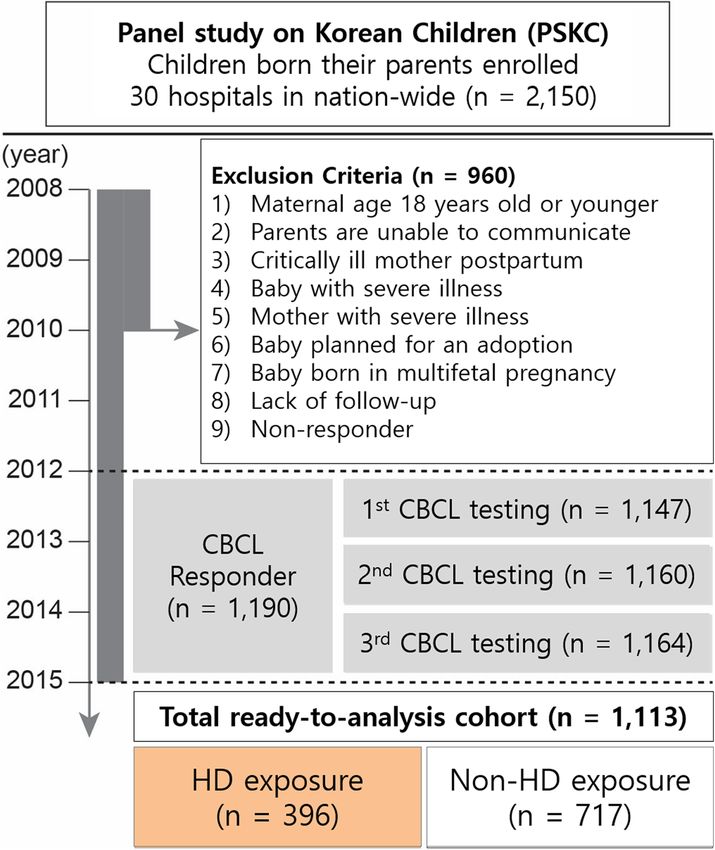
Kim et al. BMC Pediatrics (2021) 21:340 Page 2 of 9 Background that HD exposure during early childhood is associated Chemical components to which the respiratory organs with behavioral abnormalities, and that these increase are sensitive can have systematic effects. Pre/postnatal the risk for neuropsychiatric diseases such as attention exposure of chemicals may contribute to the develop- deficit hyperactivity disorder (ADHD) and developmen- ment of several diseases, including allergic disease [1–3], tal problems. eczema [4], low birth weight [5], preterm birth [6], and neurodevelopmental disorders [7, 8]. In particular, previ- Methods ous studies showed that pollutants can affect the brain Study population via neuroinflammatory pathways, through systemic or The Panel Study on Korean Children (PSKC) is a na- direct nose-to-brain routes, and lead to depression-like tional representative, general population-based birth co- phenotypes in animal model [9]. In addition, there is evi- hort participated children who born in 2008 and their dence that prolonged exposures to these chemicals could parents. It collects and provides cross-sectional and lon- lead to behavioral and social problems [8]. Patients with gitudinal data at a national level [11, 20] . The survey chronic pulmonary disorders who are exposed to chem- was explained to the mothers and went through the ical irritants may develop cognitive impairment, such as process of obtaining consent to participate in the survey. deficits in attention, concentration, and memory, and Through a stratified multi-stage sampling method, 2,150 these are presumably mediated by hypoxemia and hyper- newborns born between April and July 2008 and their capnia [10]. parents were finally enrolled from 30 sampled hospitals Exposure to humidifier disinfectant (HD) in South with more than annual 500 deliveries across the country. Korea — the ‘humidifier disinfectant scandal’ — caused The exclusion criteria were: (i) mother less than 18 multiple social and health-related problems that are still years-old at birth; (ii) parents unable to communicate in ongoing [11–13]. Nation-wide epidemiologic and animal the Korean language; (iii) critically ill mother postpar- studies confirmed that the outbreak of interstitial lung tum; (iv) baby with severe illness; (v) mother with severe disease (ILD) in children and adults was caused by HD illness; (vi) baby planned for adoption; (vii) baby from a exposure. The high mortality rate in infants (18–27%) multi-fetal pregnancy; (viii) loss to follow-up; and (ix) led to discontinuation of HD sales [14]. The long-term non-responders to the questionnaire or failure to pro- prognoses of individuals who were exposed as preschool vide complete answers. Parents completed a self- children are still uncertain. In addition, most of the pre- answered questionnaire that asked for a history of vious studies have focused on the relationship between pediatric diseases, such as physician-diagnosed asthma, HD exposure and lung injury in adults and children allergic rhinitis, and atopic dermatitis, and socio- [15–17]. However, we postulated that the extent of the demographic information including birth order, house- toxic effects of HD would not be confined to the respira- hold income, parents’ educational level, alcohol drinking tory system. (we believe it is unlikely that the toxic ef- history, and smoking history [21]. In addition, parents fects of HD are limited to the respiratory system.) and child performed an investigator-administrated sur- Although the association between various chemicals in- vey regarding their child’s behavior every year from 2012 cluding air pollutants and neurodevelopment disease to 2014. Of 2,150 children who were enrolled, 1,113 chil- have been well known, the effect of HD is still limited. dren were included whose responses to all 3 CBCL ques- In a previous study of 135 individuals who were exposed tionnaires were complete and whose information on HD to HD, 82 adults and 19 children had high risk for de- exposure was available (Fig. 1). pression (self-evaluation), anxiety, anger, and post- traumatic stress disorder (PTSD) [18]. Ethical consideration HD exposure is likely to lead to problems involving Informed consent was obtained from participants’ par- other organ systems, such as neuropsychiatric abnormal- ents or a legal guardian. All methods were carried out in ities, given that the nano-size of the toxic chemicals in accordance with relevant guidelines and regulations. The HD can irritate cell membranes and migrate into the survey was approved by the IRB of the Korea Institute of systemic circulation [19]. Because brain development is Child Care and Education. one of the most important processes during early infant development, we hypothesized that infants exposed dur- Behavioral/neuropsychiatric assessment ing this critical time window would subsequently de- Behavioral and emotional problems of pre-school chil- velop neurodevelopmental disabilities. To further dren were evaluated in the psychometric properties sec- investigate this matter, we examined children and fam- tion of the Korean version of the Child Behavior ilies in the PSKC cohort which has data on HD expos- Checklist for children aged 1.5–5 years (CBCL 1.5–5) ure, multiple clinical and demographic factors, and from 2012 to 2014 [22, 23]. The CBCL 1.5–5 test con- developmental assessments. Therefore, we hypothesized sists of 8 subscales: emotionally reactive, anxious/
Kim et al. BMC Pediatrics     (2021) 21:340                                                                                              Page 3 of 9

 Fig. 1 Study design and disposition of enrolled patients. In 2008, 2,150 children and families from 30 Korean hospitals were enrolled in the Panel
 Study on Korean Children (PSKC). We excluded 970 children for the indicated reasons, and initially included 1,113 children whose parents
 responded to all from the 1st to 3rd CBCL questionnaire. We ultimately analyzed 396 children in an HD exposure group and 717 children in a
 non-HD exposure group. CBCL, Child Behavior Checklist; HD, humidifier disinfectant

depressed, somatic complaints, withdrawn, attention                         HD exposure
problems, aggressive behavior, sleep problems, and other                    The status of HD exposure was estimated using a
problems. In addition, Diagnostic and Statistical Manual                    questionnaire in 2015. In this questionnaire, partici-
(DSM)-oriented scales were used to assess 5 scales:                         pants were asked whether they used a humidifier dis-
affective problems, anxiety problems, pervasive develop-                    infectant, and the total duration of HD use. The
mental problems, attention deficit/hyperactivity prob-                      period of use was classified as more than or less than
lems, and oppositional defiant problems.                                    3 months [15].
  The sum of the scores for individual items was con-
verted to a T-score, in which a higher score indicated
more severe problems. Internalizing problem was the                         Assessment of innate neurodevelopmental risk in
sums of 4 subscales: emotionally reactive, anxious/de-                      newborns
pressed, somatic complaints, and withdrawn, and ex-                         The Korean version of the Ages and Stages Question-
ternalizing problem was the sums of 2 subscales:                            naires (K-ASQ) was used to evaluate the baseline neuro-
attention problems and aggressive behavior. The total                       developmental status of infants before HD exposure [25,
problem was the sum of all subscales. The cut off                           26], which has good performance in screening children
score for internalizing, externalizing, and total prob-                     with biological and environmental risk factors [27, 28].
lem was 60 and the cut off score for the other scales                       This questionnaire was performed at the participants’ 4
was 65 [24].                                                                months of age.
Kim et al. BMC Pediatrics   (2021) 21:340                                                                     Page 4 of 9

Assessment of maternal depression                             Behavioral/neuropsychometric properties of the HD and
To rule out poor parenting from maternal post-partum          non-HD groups
depression as the cause of a child’s poor mental health       Table 2 shows the results of psychometric properties re-
[29], the Kessler Depression scale (K6) was administered      ported in first, second, and third CBCL test. In the first
at delivery and the results were considered as a potential    CBCL test, HD group had more children having atten-
confounder in the multivariable analysis [30, 31]. We de-     tion problems than non-HD group. In the second CBCL
fined a total score of 6 to 13 points as ‘normal’, 14 to 18   test, children having total problems, emotionally react-
points as ‘mild/moderate depression’, and 19 to 30            ive, withdrawal, sleep problems, affective problems, per-
points ‘severe depression’.                                   vasive developmental problems, and attention deficit/
                                                              hyperactivity problems were more in HD group than
Statistical analysis                                          non-HD group. In addition, in the third CBCL test, sev-
The chi-square test was used to determine the signifi-        eral neuropsychiatric problems were prominent in HD
cance of differences between the HD and non-HD                group, including emotionally reactive problems, anxious/
groups in baseline demographic factors, pre-exposure          depressed problems, all externalizing problems, sleep
risk assessments and the number of children reporting         problems, other problems, affective problems, and op-
problems. Associations of HD exposure with behavior           positional defiant problems.
problems from age 3 to 5 years were evaluated as Odds           Table 3 showed the association of HD exposure with
ratios (ORs) and adjusted odds ratios (aORs) using gen-       the CLBL and the DSM-oriented scales. The crude ana-
eralized estimating equation (GEE) models with an un-         lysis showed that the HD group had statistical significant
structured     correlation   matrix.    The    potential      ORs for total problems, internalizing problems, being
confounding factors considered in this analysis were:         emotionally reactive, externalizing problems, attention
gender, birth weight, BMI z score each year, maternal         problems, sleep problems, other problems, affective
and paternal age at initial assessment, household in-         problems, and attention deficit/hyperactivity problems.
come, maternal and paternal level of education, parental      After adjustment for confounders, the HD group had
allergic history, depression of mother at delivery, and       statistical significant aORs for total problems (aOR =
child’s innate neurodevelopmental risks based on the K-       1.538, 95% CI = 1.148–2.059; P = 0.004), being emotion-
ASQ [32]. All statistical analyses were performed using       ally reactive (aOR = 1.548, 95% CI = 1.004–2.387; P =
SPSS version 26.0 (IBM, Armonk, NY, USA), and P               0.048), attention problems (aOR = 1.957, 95% CI =
value less than 0.05 was considered statistically             1.104–3.469; P = 0.022), sleep problems (aOR = 1.637,
significant.                                                  95% CI = 1.099–2.438; P = 0.015), oppositional defiant
                                                              problems (aOR = 1.699, 95% CI = 1.065–2.709; P =
Results                                                       0.026) and attention deficit/hyperactivity problems (aOR
Demographic characteristics of the study population           = 1.566, 95% CI = 1.029–2.384; P = 0.036).
We initially examined the baseline characteristics of
1,113 children from the PSKC study (Table 1). There
were 551 girls (49.5%) and 562 boys (50.5%), and 396          Subgroup analyses on association of HD exposure with
children (35.6%) who were exposed to HD and 717               psychometric outcomes
(64.4%) who were not exposed. Mothers of the non-HD           We examined the effect on neuropsychiatric abnormal-
group were approximately 7 months older than those of         ities according to duration of HD exposure, gender, and
HD group (31.4 vs. 30.8 years; P = 0.046), but the two        the status of paternal smoking. First, Both durations (< 3
groups had no significant differences any other in base-      months and ≥ 3months) had positive association with
line characteristics.                                         total problems (aOR = 1.492; P = 0.049, aOR = 1.606; P
                                                              = 0.044, respectively). The risk for being anxious/de-
Assessments of innate neurodevelopmental risk in              pressed problems (aOR = 1.953; P = 0.030), attention
newborns and maternal depression                              problems (aOR = 3.045; P = 0.004), and oppositional de-
We assessed the presence of innate neurodevelopmental         fiant problems (aOR = 2.178; P = 0.028) were statistically
risk in the children and maternal depression soon after       significant in long-term HD exposure group, but not in
delivery (Supplementary Table 1). The HD and non-HD           the short-term HD exposure group (Supplementary
groups had no significant differences of the innate neu-      Table 2).
rodevelopmental status in all five categories of the K-          Second, boy in the HD group had statistically signifi-
ASQ (communication, fine motor skills, gross motor            cant associations with total problems (OR = 1.526; P =
skills, personal-social skills, and problem solving). In      0.031), attention problems (OR = 2.251; P = 0.017), sleep
addition, there were no significant differences in mater-     problems (OR = 1.812; P = 0.035), and other prblems
nal depression between two groups.                            (OR = 1.776; P = 0.038). In contrast, girl in HD group
Kim et al. BMC Pediatrics (2021) 21:340 Page 5 of 9
Table 1 Baseline demographics of the study subjects
Total (n = 1113) Non-HD (n = 717, 64.4%) HD (n = 396, 35.6%) P value
Maternal age (years), mean (SD) 31.16 (3.5) 31.38 (3.5) 30.76 (3.4) 0.046
Paternal age (years), mean (SD) 33.61 (3.8) 33.71 (3.9) 33.43 (3.7) 0.051
a
Birth weight (kg), mean (SD) 3.26 (0.42) 3.25 (0.42) 3.28 (0.41) 0.654
Gender, n (%) 0.896
Boy 562 (50.5) 361 (50.3) 201 (50.8)
Girl 551 (49.5) 356 (49.7) 195 (49.2)
Infant’s birth order, n (%) 0.323
Firstborn 554 (49.8) 349 (48.7) 205 (51.8)
Later-born 559 (50.2) 368 (51.3) 191 (48.2)
Household income, n (%)b 0.191
I (3279US$) 200 (18.0) 140 (19.5) 60 (15.2)
Maternal education level, n (%) 0.176
High school 341 (30.6) 223 (31.1) 118 (29.8)
College 328 (29.5) 198 (27.6) 130 (32.8)
University 444 (39.9) 295 (41.3) 148 (37.4)
Maternal smoking, n (%) 0.148
No 1084 (97.4) 702 (97.9) 382 (96.5)
Yes 29 (2.6) 15 (2.1) 14 (3.5)
Maternal alcohol drinking, n (%) 0.784
No 467 (42.0) 303 (42.3) 164 (41.4)
Yes 646 (58.0) 414 (57.7) 232 (58.6)
Paternal education level, n (%) 0.582
High school 297 (26.7) 184 (25.4) 113 (28.5)
College 264 (23.7) 172 (24.0) 92 (23.2)
University 552 (49.6) 361 (50.3) 191 (48.2)
c
Paternal smoking, n (%) 0.540
No 558 (50.2) 365 (50.9) 193 (49.0)
Yes 553 (49.8) 352 (49.1) 201 (51.0)
Paternal alcohol drinking, n (%)d 0.388
No 240 (21.8) 161 (22.6) 79 (20.4)
Yes 860 (78.2) 551 (77.4) 309 (79.6)
Abbreviation: SD standard deviation
a
Missing values: non-HD group = 19, HD group = 15
b
Missing value: HD group = 1
c
Missing value: HD group = 2
d
Missing values: non-HD group = 5, HD group = 8
P values less than 0.05 are in bold
had no statistical association with behavioral/neuro- problems (OR = 3.042; P = 0.003), aggressive behavior
psychiatric problems (Supplementary Table 3). (OR = 1.907; P = 0.019), sleep problems (OR = 1.925; P =
Third, secondary smokers in HD group had statistically 0.024), and oppositional defiant problems (OR = 2.135; P
significant associations with total problem (OR = 1.622; P = 0.014). In contrast, no secondary smokers in HD group
= 0.012), somatic complaints (OR = 1.737; P = 0.042), ex- had only association with anxious/depressed problem (OR
ternalizing problems (OR = 1.530; P = 0.024), attention = 1.687; P = 0.040) (Supplementary Table 4).Kim et al. BMC Pediatrics (2021) 21:340 Page 6 of 9
Table 2 Number of children reporting behavioral/neuropsychiatric problems at each three test periods
1st test (n = 1147) 2nd test (n = 1160) 3rd test (n = 1164)
Non-HD HD P value Non-HD HD P value Non-HD HD P value
(n = 741) (n = 406) (n = 749) (n = 411) (n = 750) (n = 414)
Total problems Normal 635 (85.7) 332 (81.8) 683 (91.2) 342 (83.2) 689 (91.9) 369 (89.1)
Over borderline 106 (14.3) 74 (18.2) 0.081 66 (8.8) 69 (16.8)Kim et al. BMC Pediatrics (2021) 21:340 Page 7 of 9
a
Table 3 Association of HD exposure with behavioral/neuropsychiatric outcomes
OR (95% CI) P value aORb (95% CI) P value
Total problems 1.553 (1.181 to 2.042) 0.002 1.538 (1.148 to 2.059) 0.004
Internalizing problems 1.375 (1.060 to 1.784) 0.017 1.296 (0.981 to 1.712) 0.068
Emotionally reactive 1.571 (1.043 to 2.365) 0.031 1.548 (1.004 to 2.387) 0.048
Withdrawal 1.419 (0.995 to 2.025) 0.053 1.449 (0.995 to 2.109) 0.053
Somatic complaints 1.283 (0.888 to 1.852) 0.184 1.176 (0.803 to 1.723) 0.404
Anxious/Depressed 1.438 (0.972 to 2.127) 0.069 1.430 (0.955 to 2.143) 0.083
Externalizing problems 1.407 (1.067 to 1.856) 0.016 1.393 (0.992 to 1.955) 0.056
Attention problems 2.123 (1.240 to 3.635) 0.006 1.957 (1.104 to 3.469) 0.022
Aggressive behavior 1.451 (0.942 to 2.235) 0.091 1.489 (0.947 to 2.342) 0.085
Sleep problems 1.490 (1.016 to 2.186) 0.041 1.637 (1.099 to 2.438) 0.015
Other problems 1.544 (1.031 to 2.313) 0.035 1.369 (0.888 to 2.109) 0.155
DSM-oriented scales
Affective problems 1.458 (1.006 to 2.115) 0.047 1.403 (0.951 to 2.071) 0.088
Anxiety problems 1.340 (0.848 to 2.117) 0.210 1.294 (0.803 to 2.085) 0.290
Pervasive developmental problems 1.440 (0.979 to 2.118) 0.064 1.480 (0.980 to 2.236) 0.062
Oppositional defiant problems 1.493 (0.952 to 2.343) 0.081 1.699 (1.065 to 2.709) 0.026
Attention deficit/hyperactivity problems 1.642 (1.107 to 2.434) 0.014 1.566 (1.029 to 2.384) 0.036
Abbreviations: CBCL Child Behavior Checklist, OR odds ratio, aOR adjusted odds ratio, CI 95% confidence interval
a
ORs and aORs were calculated using logistic regression using a generalized estimating equation model, with the non-HD group as the reference
b
Adjusted for the following confounding factors: sex, birth weight, BMI z-score each year, maternal and paternal ages, household income, maternal and paternal
education levels, parental allergic history, mother's depression during delivery, and child’s baseline neurodevelopmental properties prior to HD exposure (K-ASQ)
P values less than 0.05 are in bold
ethoxy]ethoxyethyl) guanidine chloride (PGH), and comparable to those reported in previous studies [11].
chloromethylisothiazolinone/methylisothiazolinone Second, many factors can affect the developmental
(CMIT/MIT), increased the levels of oxidative interme- process in children. Although our study adjusted for a
diates that are toxic to the brain [33]. In particular, this broad range of confounding factors, other factors not
study found that 40 mg/L of PHMG, PGH, and CMIT/ considered in our analysis may have influenced the iden-
MIT increased the levels of ROS in the optic tectum, a tified associations. For example, genetic predisposition
major part of the midbrain of vertebrates that is involved may have an effect, but this was outside the scope of this
in visual processing, sensorimotor integration, and be- study. Third, the alpha error could not be ruled out. A
havioral motor patterns during brain development [34]. further analysis using Holm methods, including total
Other in vitro research reported that 16 mg/L of PHMG, problems, internalizing problems, externalizing prob-
PGH, and CMIT/MIT decreased the viability of human lems, sleep problems, other problems, and DSM-
fibroblasts by 32%, 49%, and 41%, respectively. In oriented scales, was carried out that total problem was
addition, CMIT/MIT was reported to have toxicity in statistically significantly associated with HD exposure
cultured neurons through zinc-dependent process, and (P = 0.040). However, the results need to be inter-
this toxic effect required the activation of p44/42 extra- preted carefully. Lastly, the underlying mechanism
cellular signal-regulated kinase (ERK) via a 12- that exposure to HD at early childhood is associated
lipoxygenase-mediated pathway [35]. These molecular with certain neuropsychiatric problems is unclear. In
events lead death of neurons and adverse neuropsychi- addition, because we were not able to access the pre-
atric outcome. This is one possible mechanism by which cise data about the types of the HD, the association
HD may adversely affect neurons in infants. with behavioral/neuropsychiatric problems according
Our study has some limitations. First, it was based on to the type of the HD could not be analyzed. How-
questionnaires, and therefore may be susceptible to re- ever, major types of HD including PHMG, PGH,
call bias regarding HD exposure. However, the short in- CMIT/MIT cause neuronal toxicity in animal models
tervals between the CBCL tests and the social hot issue [34, 35], so future animal and human studies are
of lung disease from HD exposure might help their par- needed to examine the effects of these chemicals and
ents to remember whether to use HD and minimize this confirm a causal relationship of HD exposure with
bias. In addition, the rate of HD use in our study was neuropsychiatric problems.Kim et al. BMC Pediatrics (2021) 21:340 Page 8 of 9
Our study showed that exposure to HD at early child- Declarations
hood is a potential risk for behavioral abnormalities in
Ethics approval and consent to participate
preschool age children. Thus, we suggest that clinicians The survey was approved by the IRB of the Korea Institute of Child Care and
consider the assessment of neuropsychiatric status of Education. Informed consent was obtained from all subjects or, if subjects
children with risk factors. are under 18, from a parent or a legal guardian.
Consent for publication
Conclusion Not applicable
Exposure to HD at early childhood was the potential risk
for subsequent behavioral abnormalities, and longer ex- Competing interests
posure, male, and secondary smoke were the factors to The authors declare no potential conflicts of interest with respect to the
research, authorship, and/or publication of this article.
increased risk for certain neuropsychiatric outcomes.
The use of HD in young age should be avoided in light Author details
1
of its association with behavioral abnormalities. Department of Pediatrics, Kangdong Sacred Heart Hospital, Hallym
University College of Medicine, Seoul, Korea. 2Department of Neurology,
University of Toledo, Toledo, Ohio, USA. 3Department of Pediatrics, Kangnam
Abbreviations
Sacred Heart Hospital, Hallym University Medical Center, Seoul, Korea.
HD: Humidifier disinfectant; PSKC: Panel Study of Korean Children; 4
Department of Pediatrics, Seoul National University, Seoul, Republic of
CBCL: Child Behavior Checklist; ILD: Interstitial lung disease; PTSD: Post-
Korea. 5Department of Data Science, Sejong University College of Software
traumatic stress disorder; ADHD: Attention deficit hyperactivity disorder; K-
Convergence, Seoul, Korea. 6F.M. Kirby Neurobiology Center, Boston
ASQ: Korean version of the Ages and Stages Questionnaires; K6: Kessler
Children’s Hospital, Harvard Medical School, Boston, Massachusetts, USA.
Depression scale; DSM: Diagnostic and Statistical Manual; GEE: Generalized 7
Department of Pediatrics, CHA Bundang Medical Center, CHA University
estimating equation; ORs: Odds ratios; aORs: Adjusted odds ratios;
School of Medicine, Seongnam 13496, Korea.
PHMG: Polyhexamethylene guanidine; PGH: oligo (2-[2-ethoxy]ethoxyethyl)
guanidine chloride; CMIT: Chloromethylisothiazolinone;
Received: 11 November 2020 Accepted: 30 July 2021
MIT: Methylisothiazolinone; ROS: Reactive oxygen species; ERK: Extracellular
signal-regulated kinase
References
Supplementary Information 1. Lu C, Norbäck D, Li Y, Deng Q. Early-life exposure to air pollution and
The online version contains supplementary material available at https://doi. childhood allergic diseases: An update on the link and its implications.
org/10.1186/s12887-021-02825-7. Expert Rev Clin Immunol. 2020;16(8):813–27.
2. Lu C, Norbäck D, Zhang Y, Li B, Zhao Z, Huang C, et al. Furry pet-related
Additional file 1: Supplementary Table 1. Innate wheeze and rhinitis in pre-school children across China: Associations with
neurodevelopmental problems in newborns (before HD exposure) and early life dampness and mould, furry pet keeping, outdoor temperature,
maternal depression at delivery. PM10 and PM2. 5. Environ Int. 2020;144:106033.
3. Deng Q, Lu C, Li Y, Sundell J, Norbäck D. Exposure to outdoor air pollution
Additional file 2: Supplementary Table 2. Subgroup analysis of the during trimesters of pregnancy and childhood asthma, allergic rhinitis, and
association of HD exposure with behavioral/neuropsychiatric outcomes, eczema. Environ Res. 2016;150:119–27.
divided into exposure duration*. 4. Lu C, Norbäck D, Zhang Y, Li B, Zhao Z, Huang C, et al. Onset and remission
Additional file 3: Supplementary Table 3. Subgroup analysis of the of eczema at pre-school age in relation to prenatal and postnatal air
association of HD exposure with behavioral/neuropsychiatric outcomes, pollution and home environment across China. Sci Total Environ. 2021;755:
divided into sex*. 142467.
Additional file 4: Supplementary Table 4. Subgroup analysis of the 5. Lu C, Zhang W, Zheng X, Sun J, Chen L, Deng Q. Combined effects of
association of HD exposure with behavioral/neuropsychiatric outcomes, ambient air pollution and home environmental factors on low birth weight.
divided into status of paternal smoking*. Chemosphere. 2020;240:124836.
6. Lu C, Cao L, Norbäck D, Li Y, Chen J, Deng Q. Combined effects of traffic air
pollution and home environmental factors on preterm birth in China.
Acknowledgements Ecotoxicol Environ Saf. 2019;184:109639.
Not applicable. 7. Khan A, Plana-Ripoll O, Antonsen S, Brandt J, Geels C, Landecker H, et al.
Environmental pollution is associated with increased risk of psychiatric
disorders in the US and Denmark. PLoS Biol. 2019;17(8):e3000353.
Authors’ contributions
8. Berman JD, Burkhardt J, Bayham J, Carter E, Wilson A. Acute air pollution
SP, JHK, HYK, and MYH had full access to all of the data in the study and
exposure and the risk of violent behavior in the United States.
take responsibility for the integrity of the data and the accuracy of the data
Epidemiology. 2019;30(6):799–806.
analysis. Study concept and design: DKY and MYH; Acquisition, analysis, and
9. Costa LG, Cole TB, Coburn J, Chang Y-C, Dao K, Roque P. Neurotoxicants are
interpretation of data: SP, JHK, HYK, JHK, and SWL; Drafting of the
in the air: convergence of human, animal, and in vitro studies on the effects
manuscript: SP JHK, and HYK; Critical revision of the manuscript for important
of air pollution on the brain. Biomed Res Int. 2014;2014:736385.
intellectual content: JHK, EKH, DKY, and SWL; Statistical analysis: SP, JHK, HYK,
10. Cleutjens FA, Janssen DJ, Ponds RW, Dijkstra JB, Wouters EF. COgnitive-
and MYH; Obtained funding: MYH; Study supervision: MYH. All authors
pulmonary disease. Biomed Res Int. 2014;2014:697825.
approved the final version before submission.
11. Yon DK, Lee SW, Woo A, Koh HY, Jee HM, Ha EK, et al. Exposure to
humidifier disinfectants is associated with upper and lower airway diseases.
Funding Pediatr Allergy Immunol. 2020;31(5):578–82.
This study was supported by a grant from the Seongnam Atopy Project of 12. Kim KW, Ahn K, Yang HJ, Lee S, Park JD, Kim WK, et al. Humidifier
the Seongnam City Government, Republic of Korea. disinfectant–associated children’s interstitial lung disease. Am J Respir Crit
Care Med. 2014;189(1):48–56.
Availability of data and materials 13. Kim P, Leem J-H. The humidifier disinfectant scandal: the need for vigorous
The datasets used during the current study are available from the government oversight of chemicals and household products to secure
corresponding author on reasonable request. public safety. Environ Health Toxicol. 2016;31:12.11–2.Kim et al. BMC Pediatrics (2021) 21:340 Page 9 of 9
14. Paek D, Koh Y, Park D-U, Cheong H-K, Do K-H, Lim C-M, et al. Incidence and
dose–response relationships. Ann Am Thoracic Soc. 2015;12(12):1813–21.
15. Kim W-Y, Hong S-B. Humidifier disinfectant-associated lung injury: six years
after the tragic event. Tuberc Respir Dis. 2017;80(4):351.
16. Lee E, Lee S-Y, Hong S-J. The past, present and future of humidifier
disinfectant-associated interstitial lung diseases in children. Clin Exp
Pediatrics. 2020;63(7):251.
17. Jenabi E, Bashirian S, Khazaei S, Basiri Z. The maternal prepregnancy body
mass index and the risk of attention deficit hyperactivity disorder among
children and adolescents: a systematic review and meta-analysis. Korean J
Pediatrics. 2019;62(10):374.
18. Choi JE, Hong S-B, Do K-H, Kim HJ, Chung S, Lee E, et al. Humidifier
disinfectant lung injury, how do we approach the issues? Environ Health
Toxicol. 2016;31:e2016019.
19. Choi Y, Paek D. Humidifier disinfectants, unfinished stories. Environ Health
Toxicol. 2016;31:e2016004.
20. Bahk J, Yun S-C, Kim Y-m, Khang Y-H. Impact of unintended pregnancy on
maternal mental health: a causal analysis using follow up data of the
Panel Study on Korean Children (PSKC). BMC Pregnancy Childbirth.
2015;15(1):1–12.
21. Ha J, Lee SW, Yon DK. Ten-year trends and prevalence of asthma, allergic
rhinitis, and atopic dermatitis among the Korean population, 2008–2017.
Clin Exp Pediatrics. 2020;63(7):278.
22. Achenbach TM, Rescorla L. Manual for the ASEBA school-age forms &
profiles: An integrated system of multi-informant assessment: Aseba
Burlington, VT; 2001.
23. Ivanova MY, Achenbach TM, Rescorla LA, Harder VS, Ang RP, Bilenberg N,
et al. Preschool psychopathology reported by parents in 23 societies:
testing the seven-syndrome model of the child behavior checklist for ages
1.5–5. J Am Acad Child Adolesc Psychiatry. 2010;49(12):1215–24.
24. Tan TX, Dedrick RF, Marfo K. Factor structure and clinical implications of
child behavior checklist/1.5–5 ratings in a sample of girls adopted from
China. J Pediatr Psychol. 2007;32(7):807–18.
25. H-y G, Kwon JY. A comparison of the Korean-ages and stages
questionnaires and Denver developmental delay screening test. Ann
Rehabil Med. 2011;35(3):369.
26. Squires J, Bricker D, Potter L. Revision of a parent-completed developmental
screening tool: Ages and Stages Questionnaires. J Pediatr Psychol. 1997;
22(3):313–28.
27. Marks K, Hix-Small H, Clark K, Newman J. Lowering developmental
screening thresholds and raising quality improvement for preterm children.
Pediatrics. 2009;123(6):1516–23.
28. Jee SH, Szilagyi M, Ovenshire C, Norton A, Conn A-M, Blumkin A, et al.
Improved detection of developmental delays among young children in
foster care. Pediatrics. 2010;125(2):282–9.
29. Bernard-Bonnin A-C, Society CP, Health M, Committee DD. Maternal
depression and child development. Paediatr Child Health. 2004;9(8):575–83.
30. Kessler RC, Andrews G, Colpe LJ, Hiripi E, DKM, Normand ST, et al. Short
screening scales to monitor population prevalences and trends in non-
specific psychological distress. Psychol Med. 2002;32(6):959.
31. Kessler RC, Barker PR, Colpe LJ, Epstein JF, Gfroerer JC, Hiripi E, et al.
Screening for serious mental illness in the general population. Arch Gen
Psychiatry. 2003;60(2):184–9.
32. Mulraney M, Giallo R, Efron D, Brown S, Nicholson JM, Sciberras E. Maternal
postnatal mental health and offspring symptoms of ADHD at 8–9 years:
pathways via parenting behavior. Eur Child Adolesc Psychiatry. 2019;28(7):
923–32.
33. Cho K-H, Kim J-R. Comparison study of dermal cell toxicity and zebrafish
brain toxicity by humidifier sterilizer chemicals (PHMG, PGH, CMIT/MIT).
Korean J Environ Biol. 2020;38(2):271–7.
34. Fedtsova N, Quina LA, Wang S, Turner EE. Regulation of the development of
tectal neurons and their projections by transcription factors Brn3a and Pax7.
Dev Biol. 2008;316(1):6–20.
35. Du S, McLaughlin B, Pal S, Aizenman E. In vitro neurotoxicity of
methylisothiazolinone, a commonly used industrial and household biocide,
proceeds via a zinc and extracellular signal-regulated kinase mitogen-activated
protein kinase-dependent pathway. J Neurosci. 2002;22(17):7408–16.
Publisher’s Note
Springer Nature remains neutral with regard to jurisdictional claims in
published maps and institutional affiliations.You can also read


