Factors associated with metabolic syndrome and quality of life of adults in a northeast brazilian municipality
←
→
Page content transcription
If your browser does not render page correctly, please read the page content below
Factors associated with metabolic                                                                     Research Article

syndrome and quality of life of adults                                                                     Open access

in a northeast brazilian municipality
Factores asociados con síndrome metabólico y calidad de vida de                                                 Check for
                                                                                                                updates
adultos en un municipio noreste de brasileño

Fatores associados à síndrome metabólica e qualidade de vida de
adultos em um município do nordeste brasileiro

How to cite this Article:
Santos, Isleide Santana Cardoso; Boery, Rita Narriman Silva de Oliveira; Fernandes, Josicélia Dumêt; Rosa, Randson
Souza; Ribeiro, Ícaro José Santos; Souza, Andréa dos Santos. Factors associated with metabolic syndrome and quality
of life of adults in a northeast brazilian municipality. Revista Cuidarte. 2021;12(2):e.1678.
http://dx.doi.org/10.15649/cuidarte.1678

Revista Cuidarte
Rev Cuid. May - Ago 2021; 12(2): e1678
                                               Abstract
    http://dx.doi.org/10.15649/cuidarte.1678
                                               Introduction: Metabolic Syndrome (MS) is currently considered
                    E-ISSN: 2346-3414          a multi-factorial disease related to the asymptomatic, insidious,
                                               and deleterious inflammation that predisposes the individual
                                               to vulnerability by aggregating cardiovascular risk markers.
   Isleide Santana Cardoso Santos1             Objective: to analyze the factors associated with Metabolic
   Rita Narriman Silva de Oliveira             Syndrome and Quality of Life (QOL) in adult users of a health
   Boery2                                      unit. Material and Methods: a cross-sectional study carried
   Josicélia Dumêt Fernandes3
   Randson Souza Rosa4
                                               out with 108 adult users. Data collection was performed
   Ícaro José Santos Ribeiro5                  using a sociodemographic, clinical, and metabolic structured
   Andréa dos Santos Souza6                    questionnaire and The Medical Outcomes Study 36-item Short-
                                               Form Health Survey (SF-36) questionnaire. For the diagnosis of
1 Ph.D Nursing and Health, Health              Metabolic Syndrome, the following criteria were used: increased
  Department, Postgraduate Program
  in Nursing & Health, State University        abdominal circumference and arterial hypertension, diabetes,
  of Southwest Bahia (UESB), Jequie,           hypertriglyceridemia, and low HDL-cholesterol. Statistical analysis
  BA, Brazil.
  E-mail: isleide71@yahoo.com.br               was performed using the Statistical Package for Social Sciences
2 Ph.D. Professor, Health Department,          (SPSS) 21.0 software. Results: Metabolic Syndrome was identified
  Professor of the postgraduate
  program in nursing health, State             in 88.0% of the adults. Of this total of users evaluated with the
  University of Southwest Bahia                syndrome, 87.4% of the individuals were female; 71.7% had
  (UESB), Jequie, BA, Brazil.
  E-mail: rboery@uesb.edu.br                   diabetes; 87.0% had arterial hypertension; sedentary lifestyle
3 Ph.D. Professor of the Postgraduate          was identified in 53.7%. In the assessment of the BMI, overweight
  Program in Nursing & Health, State
  University of Southwest Bahia (UESB),        and obesity predominated in 68.4% and 24.9%, respectively. The
  Jequie, BA, Brazil. Federal University       domains with the lowest quality of life scores were General Health
  of Bahia/UFBA. Salvador (BA), Brazil.
  E-mail: jodumet@hotmail.com                  and Vitality. Conclusions: The study made it possible to identify
4 MSc Nursing and Health, Health               the Metabolic Syndrome in most of the adults evaluated. There
  Department, Postgraduate Program
  in Nursing & Health, State University        was a low perception of quality of life among adults in all domains,
  of Southwest Bahia (UESB), Jequie,
  BA, Brazil.                                  except for physical aspects and vitality. Thus, there is a need for
  E-mail: enfrandson@gmail.com                 surveillance and health education for the studied population and
5 Ph.D Nursing and Health, Health
  Department, Postgraduate Program             improvement of their quality of life.
  in Nursing & Health , State University
  of Southwest Bahia (UESB), Jequie,
  BA, Brazil.                                  Keywords: Metabolic Syndrome; Quality of life; Diabetes;
  E-mail: icaro.ribeiro29@gmail.com            Hypertension; Obesity; Dyslipidemia.
6 Ph.D Nursing Federal University
  of Bahia/UFBA. Salvador (BA),
  Brazil. Professor at the Department          Received: September 6th, 2020     *Correspondência
  of Health Sciences at the State
  University of Santa Cruz –UESC.              Accepted: May 6th, 2021         Isleide Santana Cardoso Santos
  E-mail: andreassouza75@gmail.com             Published: July 12th, 2021      E-mail: isleide71@yahoo.com.br
http://dx.doi.org/10.15649/cuidarte.1678 Revista Cuidarte mayo - agosto 2021; 12(2): e1678
Factores asociados con síndrome metabólico y calidad de vida de
adultos en un municipio noreste de brasileño
Resumen
Introducción: El Síndrome Metabólico (SM) se considera actualmente una enfermedad multifactorial
relacionada con la inflamación asintomática, insidiosa y deletérea que predispone al individuo a la vul-
nerabilidad al agregar marcadores de riesgo cardiovascular. Objetivo: analizar los factores asociados al
síndrome metabólico y calidad de vida en adultos usuarios de una unidad de salud. Materiales y Mét-
odos: estudio transversal realizado con 108 usuarios adultos. La recogida de datos se realizó mediante
un cuestionario sociodemográfico, clínico y metabólico, estructurado y mediante el cuestionario The
Medical Outcomes Study 36-Item Short-Form Health Survey (SF-36). Para el diagnóstico de Síndrome
Metabólico se utilizaron los siguientes criterios: aumento de la circunferencia abdominal e hipertensión
arterial, diabetes, hipertrigliceridemia y colesterol HDL bajo. El análisis estadístico se realizó utilizando
el software Statistical Package for Social Sciences (SPSS) 21.0. Resultados: Se identificó síndrome me-
tabólico en el 88,0% de los adultos. De este total de usuarios evaluados con el síndrome, el 87,4% de
los individuos eran mujeres; 71,7% con diabetes; 87,0% tenía hipertensión arterial; Se identificó seden-
tarismo en 53,7%. En la valoración del IMC, predominaron el sobrepeso y la obesidad en 68,4% y 24,9%,
respectivamente. Los dominios con las puntuaciones más bajas de calidad de vida fueron Salud general
y Vitalidad. Conclusiones: el estudio permitió identificar el Síndrome Metabólico en la mayoría de los
adultos evaluados. Hubo una baja percepción de la calidad de vida entre los adultos en todos los domin-
ios, excepto en los aspectos físicos y vitalidad. Por tanto, es necesaria la vigilancia y educación sanitaria
de la población estudiada y la mejora de su calidad de vida.
Palabras clave: Síndrome Metabólico; Calidad de Vida; Diabetes; Hipertensión; Obesidad; Dislipidemia.
Fatores associados à síndrome metabólica e qualidade de vida de
adultos em um município do nordeste brasileiro
Resumo
Introdução: A Síndrome Metabólica (SM) é atualmente considerada uma doença multifatorial rela-
cionada à inflamação assintomática, insidiosa e deletéria que predispõe o indivíduo à vulnerabilidade
por agregar marcadores de risco cardiovascular. Objetivo: analisar os fatores associados à Síndrome
Metabólica e a Qualidade de Vida (QV) em adultos, usuários de uma unidade de saúde. Materiales e
Métodos: estudo transversal realizado com 108 usuários, adultos. A coleta de dados foi realizada por
meio de um questionário sociodemográfico, clínico e metabólico, estruturado e pelo questionário The
Medical Outcomes Study 36-Item Short-Form Health Survey (SF-36). Para diagnóstico da Síndrome Metabó-
lica utilizou-se como critérios: a circunferência abdominal aumentada e hipertensão arterial, Diabetes,
hipertrigliceridemia e baixo HDL-colesterol. A análise estatística foi realizada com auxílio do software
Statistical Package for Social Sciences (SPSS) 21.0. Resultados: a Síndrome Metabólica foi identificada em
88,0% dos adultos. Desse total de usuários avaliados com a síndrome, 87,4% dos indivíduos eram do
sexo feminino; 71,7% com Diabetes; 87,0% apresentaram hipertensão arterial; o sedentarismo foi identi-
ficado em 53,7%. Na avaliação do IMC preponderou o excesso de peso e a obesidade em 68,4% e 24,9%,
respectivamente. Os domínios com menores escores da qualidade de vida foram Estado Geral de Saúde
e Vitalidade. Conclusões: o estudo possibilitou a identificação da Síndrome Metabólica na maioria dos
adultos avaliados. Observou-se, em todos os domínios, uma baixa percepção da qualidade de vida entre
os adultos, exceto nos aspectos físicos e vitalidade. Assim, faz-se necessária vigilância e educação em
saúde para a população estudada e melhoria de sua qualidade de vida.
Palavras chave: Síndrome Metabólica; Qualidade de Vida; Diabetes; Hipertensão; Obesidade;
Dislipidemia.
2http://dx.doi.org/10.15649/cuidarte.1678 Revista Cuidarte mayo - agosto 2021; 12(2): e1678
Introduction
Metabolic Syndrome (MS) is currently Metabolic Syndrome (MS) is currently
considered a multi-factorial disease related to considered a multi-factorial disease
the asymptomatic, insidious, and deleterious related to the asymptomatic, insidious,
inflammation that predisposes the individual to and deleterious inflammation
that predisposes the individual
vulnerability by aggregating cardiovascular risk to vulnerability by aggregating
markers. It involves the identification of at least cardiovascular risk markers.
three diagnostic criteria, among which increased
waist circumference, elevated fasting blood glucose, blood pressure, triglycerides and/or
reduced high-density cholesterol stand out1. The estimated prevalence is 23.7%, in line with the
criteria of the III Adult Treatment Panel2.
Chronic non-communicable diseases have multiple impacts in terms of limiting quality of life.
Metabolic Syndrome represents a public health problem due to the increase in its incidence,
prevalence, and considerable economic burden for individuals, families, and society. This
context was considered to establish the object of this study: associated factors that promote
Metabolic Syndrome, which are added to it and reflect on the quality of life of adults as users of
a health unit.
Thus, the confirmation of the metabolic syndrome in people doubles the risk of Cardiovascular
Disease (CVD). However, its components are considered to be reversible and are closely associated
with the Western lifestyle, which is attributed to physical inactivity and the consumption of
high-fat foods3. A number of studies show the effects that MS can have on people’s quality of
life, which makes it necessary to increase studies of interventions capable of promoting new
prevention and control strategies in relation to MS, since this pathology has its importance for
public health today and that studies of interventions have shown improvements not only in MS
but also in QoL scores4.
It is worth highlighting that childhood obesity is considered a risk factor for the development
of MS in adults and other components for MS have been postulated with a higher prevalence
in needy populations3. The associated factors with MS are progressive, insidious and silent, they
often start during childhood and are perpetuated throughout the adult’s life course, but their
deleterious impacts are noticeable in the older adult’s life cycle. This stage is where barriers to
health rehabilitation are found, which requires health professionals to develop clinical health
care capable of restoring people’s health and quality of life in all the phases of the life cycle.
Many studies have been developed with regard to MS and the harms it causes to the quality
of life of the patients. However, there is little evidence of its impact on patients’ quality of life4.
On the other hand, not all individuals are affected by the Metabolic Syndrome, although there
are genetic factors that are already well established for the components of the syndrome, such
as type 2 diabetes and dyslipidemia as well as body composition (proportion between fat and
muscle mass)3.
Thus, contemplating the practical bases for the prevention of the MS clinic condition, in line with
the recommendations of the Primary Health Care Notebooks of the Ministry of Health and the
lines of care aimed at people with arterial hypertension and diabetes, effectively contributes to
the increase in knowledge and to improving the living and health conditions of the population,
who is unaware of the clinical signs and symptoms of MS5.
3http://dx.doi.org/10.15649/cuidarte.1678 Revista Cuidarte mayo - agosto 2021; 12(2): e1678
Thus, this study aims to analyze the factors associated with Metabolic Syndrome in adult users
of a health unit.
Material and Methods
This is a cross-sectional study with a quantitative approach carried out with adults at risk of
Metabolic Syndrome, followed-up on an outpatient basis in a municipality in the Northeast of
Brazil. Data collection took place in a Basic Health Unit in the urban area, between September
2018 and March 2019. Adults aged 18 years old and older and younger than 60 years old,
overweight/obese and/or with hypertension and/or diabetes, regardless of gender, followed-
up in consultations with nurses and/or nutritionist in the morning and evening shifts were
included. Pregnant women with type 1 diabetes were excluded. In this sense, all individuals
who agreed to participate in the research and met the pre-established criteria were interviewed
individually, with prior appointment, and in a private room.
Structured instruments elaborated for the study were used for sociodemographic, clinical, and
metabolic characterization: the SF-36 questionnaire to assess quality of life, and the IPAQ to
assess physical activity. After the initial interview, blood pressure was measured with a validated
semiautomatic sphygmomanometer (Onrom -742 INT) with the validation standards required
by international entities such as that of the British Hypertension Society6, with the interviewee
seated, feet on the floor, left arm at height of the heart and palm facing upwards, empty bladder
and after 30 or more minutes of the last caffeine intake and cigarette use, after 10 minutes of
rest7.
The anthropometric data (weight and height) were measured only once, considering some
precautions. Weight was obtained with the participants barefoot and wearing light clothing,
using a digital scale with a capacity of 150 kg and an accuracy of 100 g. The height was verified
in a portable metallic stadiometer with 0.1 mm resolution. For the calculation of the Body Mass
Index (BMI), defined as the ratio between weight (kg) and the square of height (m), participants
with values between 18.5 kg/m2 and 24.9 kg/m2 were considered eutrophic; between 25.0 kg/
m2 and 29.9 kg/m2, overweight; and those with a BMI ≥ 30 kg/m2 were considered obese8,9.
Finally, blood collection was scheduled to obtain information from laboratory tests, High
Density Lipoproteins (HDL) cholesterol, triglycerides, and blood glucose after 12 hours of fasting.
Blood samples of 4 ml were collected by median antecubital venipuncture, using a vacuum
system (VACUETTE), identified, stored in a thermal box, and transported to the accredited
laboratory, where they were centrifuged and analyzed by dry chemistry in an Ortho Clinical
Vitros® equipment.
For the assessment of MS, the criteria of the National Cholesterol Education Program Adult
Treatment Panel III (NCEP-ATPIII) and of the International Diabetes Federation (IDF) were
used; following the NCEP-ATPIII criteria, the presence of at least three metabolic changes is
necessary: blood glucose fasting increased when ≥ 100 mg/dl or drug treatment for diabetes;
increased triglycerides ≥ 150 mg/dl or drug treatment for hypertriglyceridemia; HDL cholesterol
decreased when < 40 mg/dl (male), < 50 mg/dl (female) or drug treatment for low HDL; high
abdominal circumference when ≥ 102 cm (male) and ≥ 88 cm (female); increased systolic
blood pressure ≥ 130 mmHg and/or diastolic blood pressure ≥ 85 mmHg or drug treatment
4http://dx.doi.org/10.15649/cuidarte.1678 Revista Cuidarte mayo - agosto 2021; 12(2): e1678
for hypertension8,10-13. The use of medication was assessed in the interview by asking for a
prescription and/or card for the outpatient follow-up at the Basic Health Unit (BHU). The
information on smoking and drinking habits was self-reported.
For the calculation of physical activity, the IPAQ (International Physical Activity Questionnaire),
short and weekly version, was used, which classifies the person as very active, active, insufficiently
active, and sedentary, validated for Brazil14.
The SF-36 Questionnaire constructed and validated for the Brazilian context by15 was used to
assess quality of life. The SF-36 (Medical Outcomes Study 36 – Item Short – Form Health Survey) is
a generic instrument for assessing quality of life, easy to administer and understand, consisting
of a multidimensional questionnaire made up of 36 items encompassed in eight domains:
functional capacity, physical aspects, pain, general health, vitality, social aspects, emotional
aspects, and mental health, whose score ranges from 0 to 100 (obtained by calculating the Raw
Scale), where zero (0) corresponds to the worst general health status and one hundred (100), to
the best health status.15
The study complied with Resolution No. 466/2012 of the National Health Council (Conselho
Nacional de Saúde, CNS), which deals with the ethical aspects of research involving human
beings. Thus, data collection was carried out only after the project was released by the Research
Ethics Committee of the Southwest Bahia State University (Comitê de Ética em Pesquisa/
Universidade Estadual do Sudoeste da Bahia, CEP/UESB), under CAAE No. 92352818.9.0000.0055,
and the consent of the individuals was obtained by their signing the Free and Informed Consent
Form (FICF) and other ethical aspects provided in the Resolution.
The Statistical Package for Social Science (SPSS), version 21.0 for Windows, was used for data
analysis. The data were presented in the format of tables of relative (%) and absolute (n)
frequency for the qualitative variables in order to establish the profile of the studied population.
Pearson’s chi-square and Fisher’s exact tests were used to analyze the association between the
sociodemographic and clinical variables and the presence of MS.
The analyzed data were presented in relative (%) and absolute (n) frequency. In order to compare
the frequencies of the variables according to the presence of the metabolic syndrome, the chi-
square test and the prevalence ratio (PR) and its respective 95% confidence interval were used
with a significance of 0.05.
Results
The prevalence of Metabolic Syndrome was 88.0% (n=95), with a mean age of 48 years old.
Among those affected by MS, these prevailed: female individuals (87.4%), with a partner (68.4%),
non-white (84.2%), with eight or less years of study (62.1%), and with an income equal to or
higher than a minimum wage (69.5%), as shown in Table 1 below.
5http://dx.doi.org/10.15649/cuidarte.1678 Revista Cuidarte mayo - agosto 2021; 12(2): e1678
Table 1. Characterization of the factors associated with Metabolic Syndrome. Jequié, Bahia,
2020.
Metabolic Syndrome
Absent Present PR [95%CI]
n (%) n (%)
Gender
Male 3 (23.1) 12 (12.6) 1
Female 10 (76.9) 83 (87.4) 1.12 [0.86-1.45]
Marital status
Has a partner 9 (69.2) 65 (68.4) 1
No partner 4 (30.8) 30 (31.6) 1.01 [0.86-1.16]
Ethnicity
White 3 (23.1) 15 (15.8) 1
Non-white 10 (76.9) 80 (84.2) 1.07 [0.86-1.32]
Schooling years
> 8 years 7 (25.0) 36 (45.0) 1
< 8 years 21 (75.0) 44 (55.0) 0.81 [0.65-1.00]
Income
One MW or more 32 (76.2) 45 (68.2) 1
Less than one MW 10 (23.8) 21 (31.8) 1.16 [0.85-1.57]
Source: Prepared by the authors, 2020.
Table 2. Associated factors of the sample studied according to Metabolic Syndrome involvement.
Jequié, Bahia, 2020
Metabolic Syndrome
Absent Present PR [95%CI]
n (%) n (%)
Diabetes Diagnosis
No 9 (69.2) 26 (28.3) 1
Yes 4 (30.8) 66 (71.7) 3.67 [2.08-6.45]
Hypertension Diagnosis
No 9 (75.0) 12 (13.0) 1
Yes 3 (25.0) 80 (87.0) 1.69 [1.16-2.45]
Smoking habit
No 13 (100.0) 70 (73.7) 1
Smoke/Smoked 0 25 (26.3) 1.14 [1.01-1.28]
Drinking habit
No 8 (61.5) 49 (51.6) 1
Drink/Drank 5 (38.5) 46 (48.4) 1.05 [0.91-1.20]
Physical Activity
Yes 8 (61.5) 44 (46.3) 1
No 5 (38.5) 51 (53.7) 1.07 [0.94-1.24]
BMI
Eutrophic 3 (23.1) 7 (7.4) 1
Overweight 7 (53.8) 65 (68.4) 1.29 [0.85-1.94]
Obesity 3 (23.1) 23 (24.2) 1.26 [0.82-1.94]
Source: Prepared by the authors, 2020.
6http://dx.doi.org/10.15649/cuidarte.1678 Revista Cuidarte mayo - agosto 2021; 12(2): e1678
As for the exposure to the risk factors, of the 108 adults with metabolic syndrome,
108 adults with metabolic syndrome, it was verified it was verified that the prevalence of
that the prevalence of diabetes was 66.7% (n=70) diabetes was 66.7% (n=70) and that of
hypertension, 76.9% (n=83). Among
and that of hypertension, 76.9% (n=83). the individuals affected by MS, those
Among the individuals affected by MS, those diagnosed with diabetes (77.3%),
diagnosed with diabetes (77.3%), without without hypertension (66.7%), non-
hypertension (66.7%), non-smokers (69.7%), smokers (69.7%), without drinking
without drinking habits (53.0%), not practicing habits (53.0%), not practicing physical
activity (69.6%), and obesity (69.7%)
physical activity (69.6%), and obesity (69.7%) prevailed
prevailed, as shown in Table 2 below.
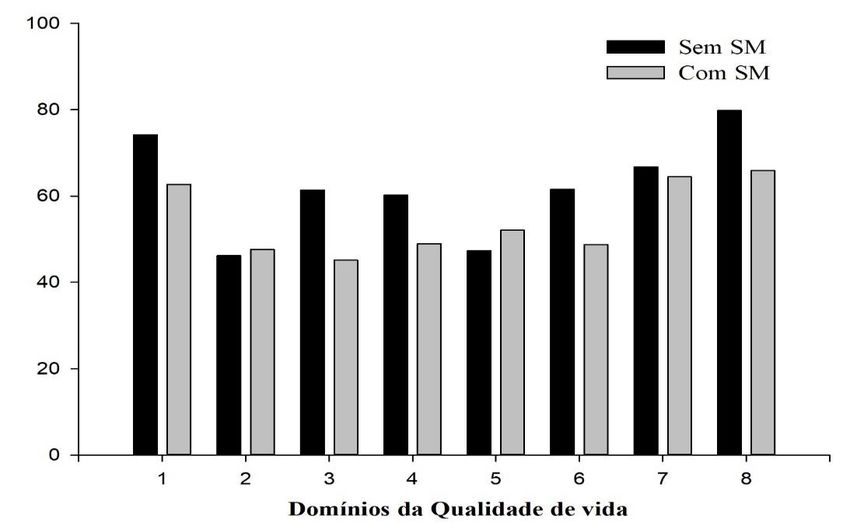
Regarding the assessment of quality of life, Figure 1 shows that, except for the physical aspects
and vitality domains, the totality of the others was reduced in individuals affected by MS.
Without MS
With MS
Quality of Life Domains
Figure 1. Quality of life domains according to involvement by Metabolic Syndrome. Jequié,
2020.
Note: 1. Functional capacity; 2. Physical aspects; 3. Pain; 4. General health status; 5. Vitality; 6.
Emotional aspects; 7. Mental health; 8. Social aspects
Discussion
In this study, a high prevalence (87.4%) of MS was noticed in females, corroborating the results
of other studies16-19, statistically exceeding the value observed in the male population. This
fact is due to the difficult therapeutic itinerary present in primary health care services, since
consultations of specific programs such as HiperDia operate at inconvenient times, hindering
men from seeking basic health units, due to labor issues that prevent them from attending
routine appointments, leading to absenteeism.
A high prevalence of MS (68.4%) was observed in people with partners. These data are similar
to what was found in the study20, which showed that, among those diagnosed with MS, men
were often married or living in a stable relationship and women were less likely to be married or
living in a stable relationship compared to men.
7http://dx.doi.org/10.15649/cuidarte.1678 Revista Cuidarte mayo - agosto 2021; 12(2): e1678
In this follow-up, there was a high prevalence (84.2%) in non-white people, with an MS diagnosis.
The aforementioned corroborating the data from a study with quilombolas from Bahia, where
86.5% of the participants reported being black-skinned21.The highest prevalence of MS is among
those with lower schooling and those with the lowest incomes16,22. In this group, homogeneous
socioeconomic characteristics, urban area origin, users of the Unified Health System, non-white
ethnicity, low schooling, and low family income were observed, highlighting the condition of
social inequality that are potentiating characteristics of MS23.
The analyses of the study signal the diagnosis of diabetes, the diagnosis of hypertension, and
smoking as factors associated with MS. Statistically considerable results were found between the
analyses of the prevalence of MS and diabetes, highlighting a significant increase in the studied
sample24. MS exposes disastrous conditions, since it has a high prevalence and is associated
with an increase in cardiovascular diseases and diabetes25.
A cross-sectional study carried out in a BHU, located in the North of the state of São Paulo,
verified that MS was present in 119 patients (45.6%), 102 (60.7%) of whom were hypertensive
and 17 (18.3%) normotensive.26 The hypothesis of the presence of MS among hypertensive
individuals is much more expressive and can be confirmed with results from other studies16,27,28.
The meta-analysis study highlights that smoking increases the risk of having MS, since the
effects of smoking on the cardiovascular system can be caused by the increase in nicotinic
receptors29. Smokers are 2.24 times more likely to have MS, compared to non-smokers, due to
insulin resistance30. The results of diverse research that study the association between alcohol
consumption and MS are not so consistent and can vary according to the size of the population,
age, gender, ethnicity, cultural traditions, and lifestyles of the people who constitute that
population20.
In a cohort conducted in the community where 10,037 participants were analyzed, of which
3,076 had MS and 6,961 did not have MS, it was verified that the prevalence of MS in both
genders was associated with the habit of drinking alcohol. The results also show that the amount
of alcohol consumption (0.1-5.0 g/day) was significantly associated with a lower prevalence of
MS in both genders compared to those who did not have the habit of drinking31.
Diverse scientific evidence suggests that several levels of alcohol consumption have a positive
association with MS. In turn, there is a need for the results of these analyses to be carefully
interpreted by the scientific community. And they reinforce that people must not adopt alcohol
consumption or be advised to consume alcohol to improve their risk profile for CVD or prevent
MS, but they should be advised to adopt changes in a healthy lifestyle as a benefit to reduce the
risk of MS32.
The probability of having or not having MS has a direct relation with the modifiable factors
associated with lifestyle, which include lack of physical exercise, overweight, and obesity33.
Although the scientific evidence highlights studies with a positive association between physical
exercise and MS, there is little evidence to prove the necessary amount of physical exercise to
avoid MS34.
A study that assessed the level of physical activity and the prevalence of MS highlighted a
significant prevalence of MS in people with low levels of physical activity compared to those
8http://dx.doi.org/10.15649/cuidarte.1678 Revista Cuidarte mayo - agosto 2021; 12(2): e1678 who practice moderate or high physical exercise. The same study also showed that moderate and high physical exercise proved to have statistically significant protective effects for MS33. Obesity increases the risk of MS with advancing age, and the role of abdominal obesity over the components of the metabolic syndrome in both genders can be observed35. Abdominal obesity was the most prevalent factor in the secondary study of the National Health Survey, with 53.8% being overweight18. The final multivariate regression model from another study that assessed the prevalence of MS and associated factors in adults from the Brazilian Amazon verified that overweight and middle- aged obese individuals remained statistically significant, showing that, in general, obesity was the risk factor most related to MS, with nine times the approximate risk of occurrence of MS (OR = 8.82, 95% CI = 5.56 ± 13.98, p
http://dx.doi.org/10.15649/cuidarte.1678                           Revista Cuidarte mayo - agosto 2021; 12(2): e1678

conditions and shows chaotic conditions in people’s health, being possible to observe a dete-
rioration of quality of life in its domains of functional capacity, pain, general health, emotional
and social aspects, and mental health.

It is expected that this study will be used as a subsidy for the evaluation, tracking, and monitor-
ing of adults attended in Basic Health Units (BHUs) present in Primary Health Care, distributed
throughout the Brazilian territory and serve as a model for the production of clinical health
care aimed at patients with MS in order to ensure health promotion and comprehensive care
in Primary Health Care services, through primary health surveillance actions and educational
interventions, which positively impact the health situation of the communities.

The possible limitations of the study are due to the methodological design of the cross-section-
al approach and to the sample size of research participants, which makes it difficult to establish
a cause and effect relation, since they are analyzed in a single moment in a health unit, making
it impossible to make generalizations. It is necessary to clarify that the 108 individuals in the
study have basic conditions such as obesity, diabetes and hypertension, therefore being a lim-
iting factor of the study that cannot be generalized to the general population. Furthermore, it
reinforces the need for new longitudinal research studies to understand the factors associated
with MS in adults living in other social, cultural, and economic contexts.

Conflicts of Interest: The authors have no conflicts of interest to declare.

Source of Funding: None

References
1. Félix NDC, Nóbrega MML. Metabolic Syndrome: conceptual analysis in the nursing context.
   Rev. Latino-Am. enfermagem. 2019;27:e3154. https://doi.org/10.1590/1518-8345.3008.3154
2. Saboya PP. Bodanese LC, Zimmermann PR, Gustavo AS, Macagnan FE, Feoli AP, et al .
   Lifestyle Intervention on Metabolic Syndrome and its Impact on Quality of Life: A Randomized
   Controlled Trial. Arq Bras Cardiol. 2017 Jan;108(1):60-9. https://doi.org/10.5935/abc.20160186
3. Han TS, & Lean MEJ. Metabolic syndrome. Medicine. 2015;43(2),80–87.
   https://doi.org/10.1016/j.mpmed.2014.11.006
4. Saboya PP, Bodanese LC, Zimmermann PR, Gustavo AS, Assumpção CM, Londero F.
   Metabolic syndrome and quality of life: a systematic review. Rev. Latino-Am. Enfermagem.
   2016;24:e2848. https://doi.org/10.1590/1518-8345.1573.2848.
5. Silva Junior AC, Cruz DP, Souza Junior EV, Rosa RS, Moreira RM, Santos ISC. Repercussões
   da prevalencia da síndrome metabólica em adultos e idosos no contexto da atenção primária.
   Rev. Salud Pública. 2018;20(6):742-747. https://doi.org/10.15446/rsap.V20n6.65564
6. O’Brien E, Mee F, Atkins N, Thomas M. Evaluation of three devices for self - measurement
   of blood pressure according to the revised British Hypertension Society protocol: the Omron
   HEM – 705 CP, Philips HP 5332 and Nissel DS-175. J. Hypertens., London, 1994;12(1):54-61
7. Sociedade Brasileira de Hipertensão Arterial (VII DBHA). Arquivo Brasileiro Cardiologia.
   São Paulo. 2016;107(supl.3):1-83
8. Associação Brasileira para o Estudo da Obesidade e da Síndrome Metabólica. Diretrizes
   brasileiras de obesidade 2016 / ABESO - Associação Brasileira para o Estudo da Obesidade e
   da Síndrome Metabólica. – 4.ed. - São Paulo, SP
9. Pires CGS, Mussi FC. Excesso de peso em universitários ingressantes e concluintes de um
   curso de enfermagem. Revista Escola Anna Nery. 2016:20(4):e20160098.
   https://doi.org/10.5935/1414-8145.20160098.
                                                                                                                         10
http://dx.doi.org/10.15649/cuidarte.1678 Revista Cuidarte mayo - agosto 2021; 12(2): e1678
10.Grundy SM, Pasternak R, Greenland P, Smith S, Fuster V. Assessment of cardiovascular
risk by use of multiple-risk-factor assessment equations. J Am Coll Cardiol. 1999;34:1348-59.
https://doi.org/10.1161/01.CIR.100.13.1481
11.Adult Treatment Panel III. Executive summary of the third report of the National Cholesterol
Education Program (NCEP/ATPIII) Expert Panel on Detection, Evaluation, and Treatment of
High Blood Cholesterol in Adults. JAMA. 2001;285(19):2486-97.
https://doi.org/10.1001/jama.285.19.2486
12.Nobre RS, Guimarães Mr, Batista AMO, Souza AF, Lima LHO, Silva ARV. Indicadores
antropométricos como preditores da síndrome metabólica em adolescentes. Revista Texto
Contexto Enferm, 2018;27(1):e5270016. https://doi.org/10.1590/0104-070720180005270016
13.Sociedade Brasileira de Diabetes (SBD) Diretrizes da Sociedade Brasileira de Diabetes 2019-
2020 / Adolfo Milech... [et. al.]; organização José Egidio Paulo de Oliveira, Renan Magalhães
Monteiro Júnior, Sérgio Vencio - São Paulo: Editora Clannad, 2019.
14.Matsudo S, Araújo T, Matsudo V, Andrade D, Andrade E, Oliveira LC, et al. Questionário
Internacional de Atividade Física (IPAQ): estudo de validade e reprodutibilidade no Brasil. Rev
Bras Ativ Fís Saúde. 2001;6:5-18. https://doi.org/10.12820/rbafs.v.6n2p5-18
15.Ciconelli RM, Ferraz MB, Santos W, Meinão I, Quaresma MR. Tradução para o português
e validação do questionário genérico de avaliação de qualidade de vida SF-36 (Brasil SF-36).
Revista Brasileira Reumatologia. 1999;39(3):143-150.
16.Rojas R, Aguilar-Salinas CA, Jimenez-Corona A, Shamah-Levy T, Rauda J, Avila-Burgos L,
et al. Metabolic Syndrome in Mexican adults. Results from the National Health and Nutrition
Survey 2006. Salud Publica Mex. 2010;52 suppl 1:S11-S18.
https://doi.org/10.1590/S0036-36342010000700004
17.França SL, Lima SS, Vieira JR. Metabolic syndrome and associated factors in adults of the
amazon region. PLoS One. 2016;11:e0167320. https://doi.org/10.1371/journal.pone.0167320
18.Ramires EKNM, Menezes RCE, Longo-Silva G, Santos TG, Marinho PM, Silveira JAC.
Prevalência e Fatores Associados com a Síndrome Metabólica na População Adulta Brasileira:
Pesquisa Nacional de Saúde - 2013. Arq. Bras. Cardiol. 2018;110(5):455-466.
https://doi.org/10.5935/abc.20180072
19.Jahangiry L, Khosravi-Far L, Sarbakhsh P, Kousha A, EntezarMahdi R, Ponnet K.
Prevalence of metabolic syndrome and its determinants among Iranian adults: Evidence of
IraPEN survey on a bi-ethnic population. Sci. Rep. 2019;9:7937.
https://doi.org/10.1038/s41598-019-44486-8
20.Suliga E, Kozieł D, Ciesla E, Rebak D, Głuszek-Osuch M, Głuszek S. Consumption of
Alcoholic Beverages and the Prevalence of Metabolic Syndrome and Its Components.
Nutrients. 2019;11:E2764. https://doi.org/10.3390/nu11112764
21.Mussi RFF, Petróski EL. Síndrome metabólica e fatores associados em quilombolas baianos,
Brasil. Ciência & Saúde Coletiva. 2019;24(7),2481-2490.
http://dx.doi.org/10.1590/1413-81232018247.13982017
22.Moreira GC, Cipullo JP, Ciorlia LAS, Cesarino CB, Vilela-Martin JF. Prevalence of Metabolic
Syndrome: Association with Risk Factors and Cardiovascular Complications in an Urban
Population. PLoS ONE. 2014;9(9):e105056. https://doi.org/10.1371/journal.pone.0105056
23.Katikireddi SV, Skivington K, Leyland AH, Hunt K, Mercer SW. The contribution of risk
factors to socioeconomic inequalities in multimorbidity across the lifecourse: a longitudinal
analysis of the Twenty-07 cohort. BMC Med. 2017;15(1):152.
https://doi.org/10.1186/s12916-017-0913-6
24.Shaya FT, Gu A, Saunders E. Metabolic syndrome prevalence in an urban African American
population. Diabetes & Metabolic Syndrome: Clinical Research & Reviews. 2007;1(3):151–157.
https://doi.org/10.1016/j.dsx.2007.05.003
11http://dx.doi.org/10.15649/cuidarte.1678 Revista Cuidarte mayo - agosto 2021; 12(2): e1678
25.Nsiah K, Shang VO, Boateng KA, Mensah FO. Prevalence of metabolic syndrome in type 2
diabetes mellitus patients. Int J App Basic Med Res 2015;5:133-8.
https://doi.org/10.4103/2229-516X.157170
26.Marchi-Alves LM, Rigotti AR, Nogueira MS, Cesarino CB, Godoy S. Componentes da
síndrome metabólica na hipertensão arterial. Rev. Esc. Enferm. USP. 2012;46(6):1348-1353.
https://doi.org/10.1590/S0080-62342012000600010
27.Kahn R, Buse J, Ferrannini E, Stern M. The metabolic syndrome: time for a critical appraisal:
joint statement from the American Diabetes Association and the European Association for
the Study of Diabetes. Diabetes Care. 2005;28(9):2289-304.
https://doi.org/10.2337/diacare.28.9.2289
28.Franco GPP, Scala LCN, Alves CJ, França GVA, Cassaneli T, Jardim PCBV. Síndrome
metabólica em hipertensos de Cuiabá - MT: prevalência e fatores associados. Arq Bras Cardiol.
2009;92(6):472-8. https://doi.org/10.1590/S0066-782X2009000600010
29.Sun K, Liu J, Ning G. Active smoking and risk of metabolic syndrome: a metaanalysis of
prospective studies. PLoS One. 2012;7(10):e47791.
https://doi.org/10.1371/journal.pone.0047791
30.Calo WA, Ortiz AP, Suárez E, Guzmán M, Pérez CM, Pérez CM. Association of Cigarette
Smoking and Metabolic Syndrome in a Puerto Rican Adult Population. Journal of Immigrant
and Minority Health. 2013;15(4):810–816. https://doi.org/10.1007/s10903-012-9660-0
31.Kim SK, Hong SH, Chung JH, Cho KB. Association Between Alcohol Consumption and
Metabolic Syndrome in a Community-Based Cohort of Korean Adults. Med Sci Monit.
2017;23:2104–2110. https://doi.org/10.12659/MSM.901309
32.Churilla JR, Johnson TM, Curls R, Richardson MR, Boyer WR, Devore SR, Alnojeidi AH.
Association between Alcohol Consumption Patterns and Metabolic Syndrome. Diabetes
Metab Syndr Clin Res Rev. 2014;8:119–123. https://doi.org/10.1016/j.dsx.2014.04.001
33.Chu AH, Moy F. Association between physical activity and metabolic syndrome among
Malay adults in a developing country, Malaysia. J Sports Sci Med. 2014;17(2):195-200.
https://doi.org/10.1016/j.jsams.2013.04.003
34.Kim J, Tanabe K, Yokoyama N, Zempo H, Kuno S. Association between physical activity and
metabolic syndrome in middle-aged Japanese: a cross-sectional study. BMC Public Health.
2011;11:624. https://doi.org/10.1186/1471-2458-11-624
35.Goktas O, Ersoy C, Ercan I, Can FE. General and abdominal obesity prevelances and
their relations with metabolic syndrome components. Pakistan Journal of Medical Sciences.
2019;35(4):945-950. https://doi.org/10.12669/pjms.35.4.235
36.Ford ES, & Li C. Metabolic Syndrome and Health-Related Quality of Life among U.S. Adults.
Annals of Epidemiology. 2008;18(3):165–171.
https://doi.org/10.1016/j.annepidem.2007.10.009
12You can also read


