Time series analysis of the relationship between diarrhea in children and Rota 2 vaccine in the Fanteakwa District of the eastern region of Ghana
←
→
Page content transcription
If your browser does not render page correctly, please read the page content below
Avoka et al. BMC Pediatrics     (2021) 21:88
https://doi.org/10.1186/s12887-021-02540-3

 RESEARCH ARTICLE                                                                                                                                 Open Access

Time series analysis of the relationship
between diarrhea in children and Rota 2
vaccine in the Fanteakwa District of the
eastern region of Ghana
James Atampiiga Avoka1, Elvis J. Dun-Dery2* , Issah Seidu3,4,5,6, Armel N. E. Abou3,4,5,6, Paul Twene3,4,5,6,
Isaac Obeng Tandoh3,4,5,6 and Frederick Dun-Dery7

  Abstract
  Background: Rotavirus is considered the main causal factor of severe gastroenteritis among infants and children
  globally. The association with severe rotavirus infection is mostly worse among the least developed countries,
  mainly due to inadequate access to medical care and poverty. This study was conducted to determine the seasonal
  effects in respect of diarrhea cases in children, the association between diarrhea cases and Rota2 vaccine in the
  Fanteakwa District of the Eastern Region of Ghana.
  Methods: The study compares monthly diarrhea cases against children vaccinated with Rota2 extracted from DHIM
  S2 spanning May 2012 to December 2017 in Fanteakwa District. A univariate association between diarrhea cases
  and children vaccinated with Rota 2 was conducted using the R-software version 3.4.4 with the use of forecast,
  tseries and TSAPred. Pearson Correlation coefficient was also computed between monthly diarrhea cases and Rota
  2 as well as lagged values of Rota 2 and Diarrhea cases.
  Results: The study shows that February recorded the highest average number of diarrhea cases (172) over the
  period 2012 to 2017 with a standard deviation of 59. However, a one-way analysis of variance shows a significant
  difference amongst the monthly averages with an F-statistic of 0.042 and P-value of 0.064. It is observed that the
  correlations between each of the Rota2 doses and the lagged cases are positive, showing higher Rota2 doses a
  month ago ((Xt − 1),0.346 to 0.735), two months ago ((Xt − 2),0.383 to 0.746), three months ago ((Xt − 3), 0.330 to
  0.737) and four months ago ((Xt − 4), 0.236 to 0.723) are associated with lower diarrhea cases. The results also show
  that an increase in the previous two month’s Rota2 figures by 100 is associated with a significant decrease in the
  currently expected diarrhea cases by approximately 36.
  (Continued on next page)

* Correspondence: dunderyejunior@yahoo.co.uk; ejdun-dery@st.ug.edu.gh
2
 Department of Population and Health Research, Research Web Africa, Box
233, Sunyani, Ghana
Full list of author information is available at the end of the article

                                      © The Author(s). 2021 Open Access This article is licensed under a Creative Commons Attribution 4.0 International License,
                                      which permits use, sharing, adaptation, distribution and reproduction in any medium or format, as long as you give
                                      appropriate credit to the original author(s) and the source, provide a link to the Creative Commons licence, and indicate if
                                      changes were made. The images or other third party material in this article are included in the article's Creative Commons
                                      licence, unless indicated otherwise in a credit line to the material. If material is not included in the article's Creative Commons
                                      licence and your intended use is not permitted by statutory regulation or exceeds the permitted use, you will need to obtain
                                      permission directly from the copyright holder. To view a copy of this licence, visit http://creativecommons.org/licenses/by/4.0/.
                                      The Creative Commons Public Domain Dedication waiver (http://creativecommons.org/publicdomain/zero/1.0/) applies to the
                                      data made available in this article, unless otherwise stated in a credit line to the data.
Avoka et al. BMC Pediatrics (2021) 21:88 Page 2 of 9 (Continued from previous page) Conclusion: Seasonal variations exist in the occurrence of diarrhea in children, with January recording the highest number of diarrhea cases (172). There is a relationship between episodes of diarrhea in children and Rota2 (p- value = 0.064); thus, the more children are vaccinated with Rota2, the less diarrhea cases are recorded. Diarrhea cases in Fanteakwa district are generally low, except 2013 and 2016 where the cases are higher than the rest of the other years. Keywords: Rotavirus, Diarrhea, Children, Ghana Background literature has been reported on the analysis of secondary Across the globe, it is projected that about 200,000 chil- data to show the time-series relationship between rota2 dren under 5 years of age die yearly owing to rotavirus and childhood diarrhea. Therefore, the study was con- diarrhea [14]. Discovered more than 40 years ago [8], ro- ducted to determine the seasonal effects of rota2 vaccine taviruses are the major causative agents of acute gastro- on diarrhea cases in children below five years, and the enteritis and diarrhea deaths among infants and children association between diarrhea cases and Rota2 vaccine in worldwide [13]. Group A Rotaviruses are the known the Fanteakwa District of the Eastern Region of Ghana. major causes of diarrhea and deaths among children under five years all over the world [9] Many of such deaths occur in poor income countries [32]. Nearly a Methods quarter of a million African children die from the deadly, Data source dehydrating diarrhea caused by rotavirus infection every The data consists of monthly diarrhea cases against the year [26] — approximately 50% of the worldwide death number of children vaccinated with Rota 2 extracted toll [22]. However, a major reduction of severe rotavirus from District Health Information Management System (RV) diarrhea is observed in countries with high RV vac- (DHIMS2), spanning from May 2012 to December 2017. cine coverage [4]. This is due to the World Health Ghana Health Service created and scaled-up the DHIMS Organization (WHO) recommendations that the rota- in 2008 with the sole aim of helping health managers virus vaccine for infants should be included in all na- and decision-makers to properly collate and analyze data tional immunization programs [21]. As a result, Ghana at all levels of the health system. The purpose was also introduced rotavirus vaccination as part of routine for planning, decision making and resource allocation immunization in 2012, and it has been shown to be ef- within the health sector. It was implemented in all Re- fective in reducing the disease burden in children under gions and Districts throughout the country. The DHIM five years [25]. S2 is a free and open access software developed for Several clinical trials have been conducted especially in health data storage and reporting. The DHIMS2 system Africa and least developed countries, to address the is- is the National data for all health care indicators, and sues of rotavirus cased childhood diarrhea diseases [3]. this is where the data were extracted. We excluded chil- For instance, the RV1 trial study in Africa was held in dren captured in the DHIMS2 with bloody diarrhea or two countries, South Africa and Malawi spanning from diarrhea caused by chronic opportunistic infections. 2005 to 2007 among children aged between 5 to 10 weeks. The results from these studies indicates the po- tential of rota2 vaccine on childhood diarrhea in Africa. Correlation and seasonal effects analysis The RV5 trials were held in sub-Saharan Africa and Asia In order to assess the univariate association between from 2007 to 2009 [33]. The one in Sub-Saharan Africa diarrhea caused by rotavirus and number of children included Ghana [10], Kenya [20], and Mali [28]. This vaccinated with Rota 2, Pearson Correlation coefficient multi-Centre randomized controlled trial which was is computed between monthly diarrhea cases and Rota 2 conducted showed a modest vaccine efficacy against as well as lagged values of Rota 2 and diarrhea cases. rotavirus gastroenteritis within the first one year [28] in- The lagged values are considered to know which previ- cluding Ghana. ous month’s Rota 2 is strongly associated with diarrhea Further, studies have shown that rotavirus vaccination cases in the district and which lagged values of Diarrhea is effective in children, especially those under five years provides information about its future values. Diarrhea at [25]. However, most preliminary studies have failed to time t is denoted by (yt) and Rota by (xt). Thus previous assess the seasonal trend of childhood diarrhea since the k months Diarrhea and Rota2 will thus be (yt − k) and (xt implementation of the rotavirus vaccine in Ghana ([10, − k) respectively. Pearson correlation between any two 14]; Ward & Bernstein, 2018). More specifically, no variables (xi, yi). is given by
Avoka et al. BMC Pediatrics                 (2021) 21:88                                                                                 Page 3 of 9

                            P              P P                                     maximum likelihood estimation method is used to
                        n xy −                   x y
    r ¼ qffiffiffiffiffiffiffiffiffiffiffiffiffiffiffiffiffiffiffiffiffiffiffiffiffiffiffiffiffiffiffiffiffiffiffiffiffiffiffiffiffiffiffiffiffiffiffiffiffiffiffiffiffiffiffiffiffiffiffiffiffiffiffiffiffiffiffiffiffiffiffi
          P                   P            P                    P ffi            find the parameter ϕ and θ. However, the auto
           n x2 − ð xÞ n y2 − ð yÞ2      2
                                                                                   Arima function in the forecast R-package uses the
                                                                                   Box-Jenkins based algorithm to get the best esti-
   A positive value of r shows a direct linear relationship                        mates for p,d and q as well their associated param-
between the paired variables and vice versa. The lagged                            eter estimates [36].
Rota (xt − k) that has the highest significant correlation                           By adding an exogenous variable to the model (lagged
with the diarrhea cases will be considered as the exogen-                          Rota, xt − k), the model becomes ARIMAX, given by
ous variable in modelling. The correlation between diar-
rhea and its lagged value has been depicted in                                        yt ¼ϕ 1 yt − 1 þϕ 2 yt − 2 þ…þϕ 1 yt − p þεt
autocorrelation function (ACF) and partial autocorrel-
                                                                                           þθ1 εt − 1 þθ2 εt − 2 þ…þθ1 εt − q þβxt − k
ation (PACF) plots.
   Also, a one-way ANOVA is used to check if the aver-
                                                                                     To test the effect of each of the regresses on the
age diarrhea cases across the months are the same. If the
                                                                                   monthly diarrhea cases, a hypothesis of the correspond-
number of groups to be compared is k and the total
                                                                                   ing parameter is tested if it is significantly different from
number of observations is n, the test statistic of the test
                                                                                   zero. The test statistic in this case is
is an F statistic which is
                                                                                              αi
       SSB SSW                                                                        Z¼
    F¼                                                                                    s:e αi
       k−1 n−k
  This test statistic is distributed as the F-statistic with                         Where αi is the regression parameter estimate of the
degrees of freedom k-1 and n-k. If this test is significant                        regression wi and s:eðαi Þ is the corresponding standard
at 5%, then some months have higher average cases than                             error. The statistic follows the standard normal
others, and as such, seasonal effects must be considered.                          distribution.
Otherwise, seasonal effects are ignored. The R-software
version 3.4.4 was used in the analysis of the data with                            Validation of model
the use of packages, forecast, tseries and TSAPred.                                In order to validate the model, the data set was di-
                                                                                   vided into two sets, the training set from May 2012
ARIMAX Modelling                                                                   to December 2016, whereas January 2017 to Decem-
Autoregressive Integrated Moving Average (ARIMA)                                   ber 2017 is used to validate the model. This is to en-
procedure is perhaps the most common method used in                                sure the consideration and inclusion of proportional
analyzing time series data. ARIMAX is just an ARIMA                                diarrhea cases as well as to validate the accuracy of
with an additional exogenous variable that is not the                              data reporting in DHIMS over the study period. If
lagged values of the response variable.                                            the actual data values fall within the 95% confidence
  According to Gujarati [35], ARIMA is preferred in sit-                           interval of the predicted estimates, the model was
uations where past values of the response variable being                           deemed robust. Also, the Root Mean Square Error
correlated with its future values. In order to carry out                           (RMSE) and the Mean Absolute Percentage Error
ARIMA, the data must be stationary. If not, it is differ-                          (MAPE) was reported.
enced until it becomes stationary.
  Commonly, it is stated as ARIMA (p,d,q), where p is                              Results
the number of lags of the response variable (yt) used as                           The trend of diarrhea cases
regressors, d is the number of times (yt) is differenced to                        From Fig. 1, it is noticed that the diarrhea cases are
make it stationary, and q is the errors associated with                            generally low except 2013 and 2016 where the cases are
forecasting the series (yt). The full ARIMA model when                             higher than the rest of the other years.
the data are stationary is given by:
                                                                                   Correlation between diarrhea cases and its lagged values
    yt ¼ϕ 1 yt − 1 þϕ 2 yt − 2 þ…þϕ 1 yt − p þεt                                   From the ACF and PACF plots, up to five lags are nega-
          þθ1 εt − 1 þθ2 εt − 2 þ…þθ1 εt − q                                       tively associated with diarrhea cases, and only two lags
                                                                                   are significantly associated, controlling for all the other
  The Box-Jenkins procedure is used to estimate                                    lag values. This means that the first two lag values (pre-
values of p,d,q. The Box-Jenkins method involves the                               vious two months) contain the information needed to
model specification, parameter estimation and diag-                                predict diarrhea cases (Fig. 2).
nostics checking. The response variable yt is as-                                     From Table 1, February recorded the highest aver-
sumed to be normally distributed as such, the                                      age number of diarrhea cases over the period 2012 to
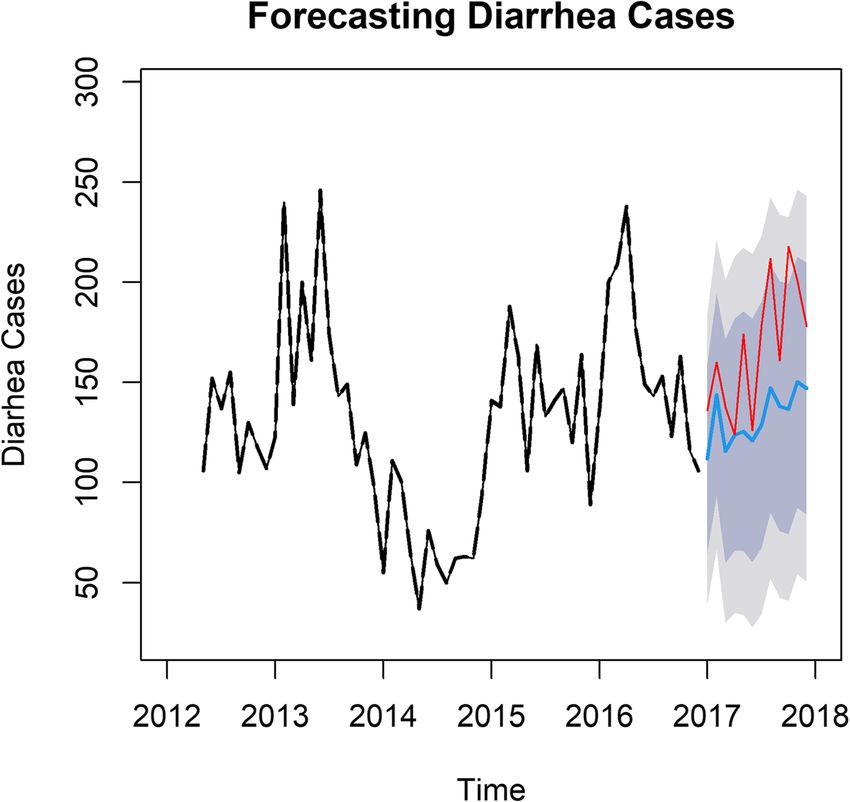
Avoka et al. BMC Pediatrics (2021) 21:88 Page 4 of 9 Fig. 1 Time Series Plot of Diarrhea Cases from 2012 to 2017 2017 to be 172 cases with a standard deviation of 59. variance to compare the monthly averages gave an F- On the other hand, December recorded the lowest statistic of 0.042 with a corresponding p-value of number of average cases of 99, with a standard devi- 0.064 showing significant differences amongst the ation of 8 cases. However, a one-way analysis of monthly averages. This implies that there are seasonal Fig. 2 ACF and PACF plots of Diarrhea Cases
Avoka et al. BMC Pediatrics       (2021) 21:88                                                                                       Page 5 of 9

Table 1 Seasonal Effect of Diarrhea Cases                                 Table 3 Arimax Coefficients
Month                   n                    mean              Std. Dev   Variable   Coefficient   Std. Error   p-value   RMSE         MAPE
January                 4                    114               40         Yt − 1     0.389         0.131        0.003     28.05849     19.26922
February                4                    172               59         Yt − 2     0.352         0.131        0.007
March                   4                    159               49         Xt − 2     0.359         0.057        0.000
April                   4                    167               74

                                                                               Y^ t ¼0:389Y t − 1 þ0:352Y t − 2 þ0:359X t − 2
May                     5                    118               55
June                    5                    158               61
July                    5                    129               42            The model shows that controlling for the lag values of
August                  5                    128               44
                                                                          diarrhea, a decrease in the previous two month’s Rota2
                                                                          figures is associated with a significant decrease in the
September               5                    117               36
                                                                          currently expected diarrhea cases by approximately 36.
October                 5                    117               36         The model predicts diarrhea cases with an average
November                5                    117               36         standard error of 28 cases with a Mean average error of
December                5                    99                8          prediction to be 19%.
F = 0.042               p-value = 0.064
Source: Field data                                                        Validation of model and predicting diarrhea cases
                                                                          Using the TSAPred package, a plot of the predicted diar-
effects in diarrhea over the different months under                       rhea cases in blue is given in Fig. 3 together with their
study.                                                                    90 and 95% confidence intervals in deep grey and light
                                                                          grey, respectively. The actual values of diarrhea cases
                                                                          plotted in red are juxtaposed on the plot to validate the
Selecting a covariate from ROTA                                           model. It is realized that though the actual values are
From Table 2 above, it is noticed that the correlations                   generally higher than the predicted values of diarrhea,
between each of the Rota2 doses and the lagged cases                      they fall within the 95% confidence intervals of the
are protective of the outcome of rotavirus causing diar-                  corresponding estimates. This implies that the bounds of
rhea among under five, showing lower Rota2 cases a                        the 95% confidence interval, especially the upper bound
month ago (Xt − 1), two months ago (Xt − 2), three                        do not wrongfully predict the actual diarrhea cases. Fig-
months ago (Xt − 3) and four months ago (Xt − 4), are                     ure 3 further suggest that diarrhea case varies within
associated with lower diarrhea cases. The correlation                     years depending on the efficacy and administration of
peaks at lag 2 where it is 0.383 showing that the previous                rota2 vaccine. In general, cases are lower in most years
two months Rota is to be chosen as the covariate in pre-                  between 2012 and 2017. It is predicted to rise steadily in
dicting Diarrhea cases in the district.                                   2018 but likely to fall in subsequent years, subject
                                                                          rota2 vaccine administration. Predicted p-values for
                                                                          2018 indicates that lower diarrhea cases will be
Arimax model for diarrhea                                                 recorded as p-values shows a positive association
Using the auto.arima command in the forecast package                      between rota2 vaccine and childhood diarrhea.
in R with lagged Rota as an exogenous variable, the
ARIMA (2,0,0) is chosen as the best fit model for the                     Discussion
data (see Table 3).                                                       The results of this study reveal that there are seasonal
  From Table 3, the fitted model that estimates current                   changes in the diarrhea cases generated which contra-
diarrhea cases (Yt) is given by                                           dicts the study conducted by [23]. Similar studies, con-
                                                                          ducted in China however, recorded a strong seasonal
Table 2 Correlations between Diarrhea and Lagged Rota2                    pattern with peaks in November–December and in July–
Cases                                                                     August [15], which agrees with the current study. Pos-
            Yt         Xt           Xt − 1          Xt − 2     Xt − 3     sible reasons for the variations reported in the China
Xt          0.225371                                                      study and that of our study are the difference in vaccin-
Xt − 1      0.346840   0.735149
                                                                          ation periods and strict implementation of immunization
                                                                          programs, especially in Ghana, where populations are
Xt − 2      0.383489   0.625716     0.745684
                                                                          more vulnerable compared to China’s situation.
Xt − 3      0.330436   0.652169     0.620834        0.737329                Meanwhile, according to Armah et al. [37], the vaccine
Xt − 4      0.236041   0.625549     0.632542        0.593118   0.723181   efficacy against severe rotavirus gastroenteritis was re-
Source: Field data                                                        ported to be 39.3% in certain parts of Africa but up to
Avoka et al. BMC Pediatrics (2021) 21:88 Page 6 of 9 Fig. 3 Comparing predicted and actual values of diarrhea cases in 2018 98% in the America and Europe [38]. This shows that increase reported cases, healthcare systems are becoming there is a huge percentage gap in the rotavirus disease stronger, and resources are being directed towards the situation in parts of Africa, compared to the America prevention of conditions such as diarhhea. This may ex- and Europe. This could be influencing the varied efficacy plain the difference in reported cases in both studies. of the vaccine from one area to the other. The situation However, the decreasing trend of rotavirus diarhea is re- in Africa or Ghana could be due to certain factors such ported and sustained in several developed countries due as high prevalence of under nutrition, high prevalence of to advanced health care services on maternal and child underweight, and high prevalence of unusual rotavirus care [31]. strains as reported by CDC and antigen diversity [39, The study reveals a correlation between Rota2 cover- 40]. Early development of microbiome in infant guts age, including the lagged cases, positively showing an overlaps with that of the immune response. The initial association with lower diarrhea cases. The implication is stage of microbial and immunological development tim- that, the higher the Rota2 doses given for a month, the eously matches that of the first immunization [19]. The lower the diarrhea cases recorded for that month. In line first effect may affect vaccine oriented immunity. Studies with this finding similar studies conducted in Brazil on show that too much pathogenic load affects the potency diarrhea incidence among rotavirus vaccinated infants, of oral vaccines especially in low and middle income reported a progressive reduction in the proportion of countries [12] which also gives more evidence from diarrhea cases since the introduction of rota vaccine other cohort studies [18]. [27]. Conversely, studies conducted in Yemen on all- Like a study conducted in the United States of cause rotavirus cases, reported a fluctuating incidence of America [34] and other places where there was a hospitalized diarrhea cases due to rotavirus [3] and is decrease in the number of hospital admissions for all- further reported high among Croatian population of cause diarrhea and rotavirus, our study recorded a sig- under-five, following the immediate implementation of nificant decrease in the number of reported cases of all- rota2 vaccine [32]. This finding suggests that the attenu- cause diarrhea in all health facilities within the district ating effect of the vaccine may be responsible for the for six (6) consecutive years, 2012–2017. Conversely, the variations in diarrhea cases. Additionally, cost, vaccine trend of increasing diarrhea cases among under-five has availability, cold chain management and vaccine moni- been reported in several studies after the implementa- toring challenges may also affect the efficacy of vaccin- tion of the rota vaccine [3, 24, 30]. In countries with ation in different countries, especially developing
Avoka et al. BMC Pediatrics   (2021) 21:88                                                                                         Page 7 of 9

countries [5]. Several findings reveal that live oral vac-       Limitations
cines including that of rotavirus have had low perform-          Data were extracted directly from the DHIMS2 platform,
ance in low and middle-income countries including                and therefore, any data inaccuracy or error arising out of
Ghana ([6, 7, 16, 34, 41]. In order to completely eradi-         the system cannot be ascertained. Secondly, the efficacy
cate vaccine preventable diseases like rota virus diarhea        and potency of the vaccines that were given to the chil-
among children in developing countries, strict vaccine           dren in this study could not be authenticated by the
management and monitoring are required throughout                study. Additionally, completeness of reporting, timeli-
the cold-Chain management.                                       ness of reporting, and data inconsistencies or data qual-
   The model in this study shows that controlling for the        ity issues are possible data issues. Data captured in the
lag values of diarrhea, a decrease in the previous two           DHIMS2 system are not disaggregated into the various
month’s Rota2 coverage is associated with a significant de-      age groups, therefore analysis involving the different age
crease in the currently expected diarrhea cases by approxi-      groups was impossible. However, in anticipation of these
mately 36. This is in line with studies conducted among          data entry errors, the data were captured ranging from
young children to assess the seasonal association between        2012 to 2017 and divided into training set from May
diarrhea, Tropheryma whipplei and rota vaccine, which            2012 to December 2016, whereas January 2017 to
reveals decreasing seasonal variations in diarrhea cases be-     December 2017 is used to validate the accuracy of data
tween different months and years [17]. Again, our study          and nullify the effects of outliers. Therefore, data quality
anticipates a decrease in diarrhea cases, just like studies in   issues cannot be attributable to the results shown in this
northwestern Ethiopia, which reported decreasing trends          study.
of diarrhea cases as a result of breastfeeding and rota vac-
                                                                 Abbreviations
cine implementation program [29]. Large multi-site ran-          DHIMS2: District Health Information Management System 2; GHS: Ghana
domized controlled trials in low-income settings such as         Health Service; ACF: Auto-correlation Function; PACF: Partial Autocorrelation;
Ghana, have demonstrated vaccine efficacy against severe         ANOVA: Analysis of variance; ARIMA: Autoregressive Integrated Moving
                                                                 Average; ARIMAX: ARIMA with additional exogenous variable that is not the
rotavirus gastroenteritis in the first year of life [28] and     lagged values of the response variable; RMSE: Root Mean Square Error;
difference in the incidence of diarrhea cases are some-          MAPE: Mean Absolute Percentage Error; CDC: Centers for Disease Control;
times attributed to low health budgets [1].                      WHO: World Health Organization
   The current study predicts diarrhea cases with an             Acknowledgements
average standard error of 28 cases with a Mean average           The authors are grateful to all data managers of the Ghana Health Service.
percentage error of 19%. In other studies, contradictory
findings were reported with an average of 42.9% [3]. It is       Authors’ contributions
                                                                 JAA conceived the study idea. JAA, EJD, and FDD designed implemented
worth noting that poor quality of care and ill-                  the study and conducted the data collection. JAA and IS analyzed the data
preparedness on the part of providers to deliver timely,         and drafted the first manuscript of the study. EJD and FDD proofread and
sensitive care to children with diarrhea can lead to in-         edited the manuscript. ANEA, PT and IOT critically revised the draft for
                                                                 important intellectual content. All authors read and approved the final
creasing trends in diarrhea cases [2]. In respect of the         manuscript.
above findings, it could mean that the type of rotavirus
vaccine used in our part of the world and Fanteakwa              Authors’ information
                                                                 JAA holds a Master of Public Health (MPH) degree from the University of
District, in particular, may be the exact vaccine meant to       Ghana and is currently a researcher with Ghana Health Service. EJD holds a
reduce diarrhea-related hospital admissions. If rotavirus        Master of Public Health degree from the University of Ghana and is currently
is the commonest root cause of severe diarrhea in chil-          a senior research consultant at Research Web Africa, Ghana branch. FDD
                                                                 holds a Master of Philosophy in Community Health and Development from
dren globally, as reported [11], then the substantial de-        the School of Medicine and Health Sciences, University for Development
crease in the number of reported cases of all-cause              Studies in Tamale and is currently a KAAD PhD fellow at the University of
diarrhea [23] in children under five in the health facil-        Heidelberg, Germany. IS holds a Master of Philosophy in Statistics and
                                                                 currently a graduate assistant and a Ph. D fellow at the University of Ghana.
ities within our study area is expected.                         PT is a disease Control Officer with Ghana Health Service. IOT is a health
                                                                 Information Officer with Ghana Health Service. ANEA is a Medical Doctor
Conclusion                                                       with Ghana Health Service.
Seasonal variations do influence the occurrence of diar-         Funding
rhea in children under five years. There is a relationship       The authors funded the study, and no external funding was received.
between episodes of diarrhea in children and Rota2;
                                                                 Availability of data and materials
thus, the more children are vaccinated with Rota2, the
                                                                 For confidentiality reasons, we are unable to share these data publicly, but
less diarrhea episodes will occur among them. Whiles it          the corresponding author can be contacted for further information.
is imperative for health care providers to enhance mater-
nal education on vaccination, ensuring continuous rota2          Ethics approval and consent to participate
                                                                 This was a secondary data, and ethical clearance was obtained from the
vaccination for all eligible children is critical to ending      Ghana Health Service Ethics Committee and the Eastern Regional Health
rotavirus related diarrhea.                                      Directorate.
Avoka et al. BMC Pediatrics (2021) 21:88 Page 8 of 9
Consent for publication Epidemiol Glob Health. 2016;6(3):131–40. https://doi.org/10.1016/j.jegh.2015.
Not applicable. 05.001.
15. Liu L, Qian Y, Zhang Y, Zhao L, Jia L, Dong H. Epidemiological aspects of
rotavirus and adenovirus in hospitalized children with diarrhea : a 5-year
Competing interests survey in Beijing. BMC Infect Dis. 2016;16(507):1–7. https://doi.org/10.1186/
The authors declare that they have no competing interests. s12879-016-1829-z.
16. Madeleine G, Yen C, Cortes J, Arau A, Lopman B, Flannery B, et al. Decline in
Author details diarrhea mortality and admissions after routine childhood rotavirus
1
Ghana Health Service, Birim Central Municipal Health Directorate, Box 429, immunization in Brazil : a time-series analysis. PLoS Med. 2011;8(4):1–11.
Akim Oda, Ghana. 2Department of Population and Health Research, Research https://doi.org/10.1371/journal.pmed.1001024.
Web Africa, Box 233, Sunyani, Ghana. 3Department of Statistics, University of 17. Miramont S, Fenollar F, Minodier P, Boutin A, Laporte R, Br V, et al.
Ghana, P.O.Box LG 115, Legon-Accra, Ghana. 4Institutional Public Health Unit, Tropheryma whipplei associated with diarrhoea in young children. Clin
Eastern Regional Hospital, Koforidua, Ghana. 5Fanteakwa North District Health Microbiol Infect. 2016;22:869–74. https://doi.org/10.1016/j.cmi.2016.07.005.
Directorate, Box 60, Begoro, Eastern Region, Ghana. 6Eastern Regional Health 18. Mohammadkhah AI, Simpson EB, Patterson SG, Ferguson JF. Development
Directorate, Ghana Health Service, Eastern Region, Koforidua, Ghana. 7Disease of the gut microbiome in children, and lifetime implications for obesity and
Control in Disadvantaged Populations, Heidelberg Institute of Global Health, Cardiometabolic disease. Children. 2018;5(12):160. https://doi.org/10.3390/
Medical Faculty, Ruprecht-Karls Universität, Heidelberg, Germany. children5120160.
19. Moore RE, Townsend SD. Temporal development of the infant gut
Received: 3 June 2020 Accepted: 4 February 2021 microbiome. Open Biol. 2019;9(9). https://doi.org/10.1098/rsob190128.
20. Muendo C, Laving A, Kumar R, Osano B, Egondi T, Njuguna P. Prevalence of
rotavirus infection among children with acute diarrhoea after rotavirus
vaccine introduction in Kenya , a hospital cross-sectional study. BMC Pediatr.
References
2018;18(323):1–9.
1. Anwari P, Debellut F, Pecenka C, Parwiz SM, Clark A, Groman D, et al.
21. Nakawesi JS, Wobudeya E, Ndeezi G, Mworozi EA, Tumwine JK. Prevalence
Potential impact and cost-effectiveness of rotavirus vaccination in
and factors associated with rotavirus infection among children admitted
Afghanistan. Vaccine. 2018;36(51):7769–74. https://doi.org/10.1016/j.vaccine.2
with acute diarrhea in Uganda. BMC Pediatr. 2010;10(69).
017.10.058.
2. Atinga RA, Kuganab-lem RB, Aziato L, Srofenyoh E. Strengthening quality of 22. Neuzil KM, Kotloff KL. Community-acquired diarrhoea in a world with
acute care through feedback from patients in Ghana. African J Emerg Med. rotavirus vaccine : a glimpse into the future. Lancet Glob Health. 2015;3(9):
2015;5(1):24–30. https://doi.org/10.1016/j.afjem.2014.10.008. e510–1. https://doi.org/10.1016/S2214-109X(15)00052-2.
3. Banajeh SM, Abu-asba BA. The epidemiology of all-cause and rotavirus 23. Ngabo F, Tate JE, Gatera M, Rugambwa C, Donnen P, Lepage P, et al. Effect
acute gastroenteritis and the characteristics of rotavirus circulating strains of pentavalent rotavirus vaccine introduction on hospital admissions for
before and after rotavirus vaccine introduction in Yemen : analysis of diarrhoea and rotavirus in children in Rwanda : a time-series analysis. Lancet
hospital-based surveillance data. BMC Infect Dis. 2015;15(418):1–10. https:// Glob Health. 2008;4(2):e129–36. https://doi.org/10.1016/S2214-109X(15)002
doi.org/10.1186/s12879-015-1165-8. 70-3.
4. Bucardo F, Mercado J, Reyes Y, González F, Balmaseda A, Nordgren J. Large 24. Ngabo F, Tate JE, Gatera M, Rugambwa C, Donnen P, Lepage P, et al. Eff ect
increase of rotavirus diarrhoea in the hospital setting associated with of pentavalent rotavirus vaccine introduction on hospital admissions for
emergence of G12 genotype in a highly vaccinated population in diarrhoea and rotavirus in children in Rwanda : a time-series analysis. Lancet
Nicaragua. Clin Microbiol Infect. 2015;21(6):603.e1–7. https://doi.org/10.1016/ Glob Health. 2016;4(2):e129–36. https://doi.org/10.1016/S2214-109X(15)002
j.cmi.2015.01.022. 70-3.
5. Coldiron ME, Guindo O, Makarimi R, Soumana I, Matar A, Garba S, et al. 25. Nonvignon J, Atherly D, Pecenka C, Aikins M, Gazley L, Groman D, et al.
Safety of a heat-stable rotavirus vaccine among children in Niger : data Cost-effectiveness of rotavirus vaccination in Ghana : examining impacts
from a phase 3 , randomized , double-blind , placebo-controlled trial. from 2012 to 2031. Vaccine. 2018;36(47):7215–21. https://doi.org/10.1016/j.va
Vaccine. 2018;36(25):3674–80. https://doi.org/10.1016/j.vaccine.2018.05.023. ccine.2017.11.080.
6. Cortes J, Curns AT, Tate JE, Cortese MM, Patel MM, Zhou F, Parashar UD. 26. Path. Rotavirus disease and vaccines in Ghana; 2013.
Rotavirus vaccine and health care utilization for diarrhea in U.S. children. 27. Santos CB, Araújo KCG, Jardim-Botelho A, Santos MB, Rodrigues A, Dolabella
New England J Med. 2011;17(365:1108):10. SS, Gurgel RQ. Diarrhea incidence and intestinal infections among rotavirus
7. Cortese MM, Dahl RM, Curns AT. Protection against gastroenteritis in US vaccinated infants from a poor area in Brazil: A spatial analysis. BMC Public
households with children who received rotavirus vaccine. J Infect Dis. 2015: Health. 2014;14(1). https://doi.org/10.1186/1471-2458-14-399.
211. https://doi.org/10.1093/infdis/jiu503. 28. Schwartz LM, Halloran ME, Rowhani-rahbar A, Neuzil KM, Victor JC. Rotavirus
8. Desselberger U, Gray J. Differences of rotavirus vaccine effectiveness by vaccine effectiveness in low-income settings : an evaluation of the test-
country : likely causes and contributing factors. Pathogens. 2017;(figure 1):1– negative design. Vaccine. 2017;35(1):184–90. https://doi.org/10.1016/j.va
13. https://doi.org/10.3390/pathogens6040065. ccine.2016.10.077.
9. Dhital S, Sherchand JB, Pokhrel BM, Parajuli K, Shah N. Molecular 29. Shumetie G, Gedefaw M, Kebede A, Derso T. Exclusive breastfeeding and
epidemiology of rotavirus causing diarrhea among children less than five rotavirus vaccination are associated with decreased diarrheal morbidity
years of age visiting national level children hospitals , Nepal. BMC Pediatr. among under-five children in Bahir Dar , Northwest Ethiopia. Public Health
2017;17(101):1–7. https://doi.org/10.1186/s12887-017-0858-0. Rev. 2018;39(28):1–10.
10. Enweronu-laryea CC, Sagoe KW, Damanka S, Lartey B, Armah GE. Rotavirus 30. Teran CG, Teran-escalera CN, Villarroel P, Patin SI. Nitazoxanide vs. probiotics
genotypes associated with childhood severe acute diarrhoea in southern for the treatment of acute rotavirus diarrhea in children : a randomized ,
Ghana: a cross-sectional study. Virol J. 2013;10(287):1–6. single-blind , controlled trial in Bolivian children. Int J Infect Dis. 2009;13:
11. Glass RI, Parashar UD, Bresee JS, Turcios R, Fischer TK, Widdowson MA, et al. 518–23. https://doi.org/10.1016/j.ijid.2008.09.014.
Rotavirus vaccines: current prospects and future challenges. Lancet. 2006; 31. Tian Y, Chughtai AA, Gao Z, Yan H, Chen Y, Liu B, et al. Prevalence and genotypes
368(9532):323–32. https://doi.org/10.1016/S0140-6736(06)68815-6. of group a rotavirus among outpatient children under five years old with diarrhea
12. Harris VC, Armah G, Fuentes S, Korpela KE, Parashar U, Victor JC, et al. Signi in Beijing , China, 2011–2016. BMC Infect Dis. 2018;18(497):1–11.
fi cant correlation between the infant gut microbiome and rotavirus vaccine 32. Vrdoljak M, Gu M, Trkulja V, Buti I, Ivi I, Hegedu M, et al. Distribution of rotavirus
response in rural Ghana; 2017. p. 215. https://doi.org/10.1093/infdis/jiw518. genotypes in three Croatian regions among children 5 years of age ( 2012–
13. Kim K, Lee G, Thanh HD, Kim J, Konkit M, Yoon S, et al. Exopolysaccharide 2014 ). Int J Infect Dis. 2019;89:3–9. https://doi.org/10.1016/j.ijid.2019.09.008.
from lactobacillus plantarum LRCC5310 offers protection against rotavirus- 33. Ward RL, Bernstein DI. Rotarix : a rotavirus vaccine for the world. Clin Infect
induced diarrhea and regulates inflammatory response. J Dairy Sci. 2018; Dis. 2009;48(August):222–8. https://doi.org/10.1086/595702.
101(7):5702–12. https://doi.org/10.3168/jds.2017-14151. 34. Yen AC, Tate JE. Diarrhea-associated hospitalizations among US children
14. Kumi-kyereme A, Amo-adjei J. Household wealth , residential status and the over 2 rotavirus seasons after vaccine introduction. 2019;127(1). https://doi.
incidence of diarrhoea among children under-five years in Ghana. J org/10.1542/peds.2010-1393.Avoka et al. BMC Pediatrics (2021) 21:88 Page 9 of 9
35. Gujarati DN. Essentials of Econometrics 4th Edition. McGraw-Hill
Publications; 2009. ISBN: 9780073375847.
36. Hyndman RJ, Khandakar Y. Automatic time series forecasting: the forecast
package for R. J Stat Software. 2008;27(3):22. Retrieved from http://www.jsta
tsoft.org/v27/i03/paper.
37. Armah GE, Sow SO, Breiman RF, Dallas MJ, Tapia MD, Feikin DR, Neuzil KM.
Efficacy of pentavalent rotavirus vaccine against severe rotavirus
gastroenteritis in infants in developing countries in sub-Saharan Africa: a
randomised, double-blind, placebo-controlled trial. Lancet. 2010;376(9741):
606–14. https://doi.org/10.1016/S0140-6736(10)60889-6.
38. CDC. Update_ Measles --- United States, January--July 2008. 2008.
39. Ichihara MYT, Rodrigues LC, Teles Santos CAS, Teixeira M, da GLC, De Jesus
SR, Alvim De Matos SM, Barreto ML. Effectiveness of rotavirus vaccine
against hospitalized rotavirus diarrhea: A case-control study. Vaccine. 2014;
32(23):2740–7. https://doi.org/10.1016/j.vaccine.2014.01.007.
40. World Health Organization. Vaccine-preventable diseases and immunization
programme: programme report and future initiatives 2001-2005. 2005.
41. Hanlon P, et al. Trial of an attenuated bovine rotavirus vaccine (RIT 4237) in
Gambian infants. Lancet. 1987;1:1342-5.
Publisher’s Note
Springer Nature remains neutral with regard to jurisdictional claims in
published maps and institutional affiliations.You can also read


