Social Protection Spotlight - ILO
←
→
Page content transcription
If your browser does not render page correctly, please read the page content below
Social Protection Spotlight                                                                                           1
    Towards Universal Health Coverage: Social Health Protection Principles                                    ILO brief

           Social Protection Spotlight

Date: 23 April 2020

    Social protection responses to the COVID-19 crisis:
    Country responses and policy considerations

 Key points

     The COVID-19 pandemic represents a major                          Countries with strong health and social
     public health challenge and will have serious                     protection systems in place can react quickly by
     economic and social impacts. Governments are                      scaling up existing protection mechanisms and
     facing a double challenge: they have to contain                   by extending and adapting them to cover
     the health pandemic, while at the same time                       previously uncovered populations.
     responding to its economic and social impacts.
                                                                       Countries that do not have sufficiently robust
     Social protection systems are an indispensable                    health and social protection systems in place
     part of a coordinated policy response to the                      should be offered urgent international support
     unfolding crisis, ensuring that people can                        to ensure an adequate immediate response to
     effectively access health care while supporting                   the crisis.
     job and income security for those most affected.
                                                                       Countries should prioritize support for those
     They increase resilience, contribute to preventing
                                                                       who are particularly vulnerable to the crisis,
     poverty, unemployment and informality and are
                                                                       including workers in the informal economy;
     powerful economic and social stabilizers that can
                                                                       ensuring that their immediate needs are met,
     contribute to a swift recovery.
                                                                       including access to health care and income
     Countries that have effective health and social                   support.
     protection systems in place that provide universal
                                                                       The crisis has expedited much-needed reform
     coverage are better prepared to respond to the
                                                                       by compelling numerous governments to tem-
     crisis. A nationally defined social protection floor
                                                                       porarily extend social protection to uncovered
     that guarantees access to health care and at least
                                                                       groups by introducing extraordinary measures
     a basic level of income security throughout the
                                                                       and legislation.
     life course is critical.
                                                                       Governments, together with social partners and
     Social dialogue and consultations with social
                                                                       other stakeholders, should take this opportunity
     partners and other stakeholders are particularly
                                                                       to strengthen their social protection systems,
     important for such coordinated policy responses.
                                                                       including floors, as a cornerstone of national
                                                                       social and economic policy architecture.
Social Protection Spotlight 2
Social protection responses to the COVID-19 crisis
The key role of social protection systems other stakeholders are particularly important for such
in responding to the COVID-19 crisis1 coordinated policy responses.
Evidence from previous crises shows that countries
The COVID-19 pandemic represents a major public that have effective health and social protection
health challenge and will have serious economic and systems in place that provide universal coverage are
social impacts. Global growth is projected to contract better prepared to respond to the COVID-19 crisis and
sharply by -3 per cent 2020 (IMF 2020), global income its socioeconomic impacts. They have the institutional
could be reduced by US$2 trillion (UNCTAD 2020) and capacities to scale these systems up relatively quickly
working hours are estimated to decline by 6.7 per cent in response to the crisis (ILO 2019d, 2017). In this
in the second quarter of 2020, which is equivalent to respect, a nationally defined social protection floor that
195 million full-time workers, resulting in significant guarantees access to health care and at least a basic
losses of jobs and incomes (ILO 2020a). Estimates level of income security throughout the life course is
suggest that this may lead to a significant increase in critical. Likewise, countries that have pursued a
global poverty, potentially wiping out a decade of responsible countercyclical fiscal policy in the past —
poverty reduction (Sumner, Hoy and Ortiz-Juarez, accumulating surpluses when the economy was
2020). As the situation unfolds, the repercussions of buoyant — are likely to be in a far stronger position to
the crisis could be even more distressing. respond to a downturn and provide increased social
Governments are facing a double challenge: they have protection through fiscal stimuli.
to contain the health pandemic, while at the same time However, countries that lack a robust health and social
responding to its economic and social impacts. Beyond protection system will need to develop policies and
the tragic loss of human life caused by the virus itself, interventions in an ad hoc way, building institutional
the crisis is likely to entail tremendous human costs capacity under very difficult circumstances, which is
through other channels and may increase poverty and likely to lead to a limited and delayed response. In such
inequality, with particularly adverse effects for older cases, international support will be critical to
persons, persons with disabilities and chronic diseases, complement countries’ efforts to adopt emergency
migrant workers and forcibly displaced people measures to step up the capacities of the health
(Diwakar 2020). Many children and women will be system, expand fiscal space and build the necessary
adversely affected by the repercussions of the institutional capacities to avoid a dramatic health crisis.
pandemic on societies and economies (United Nations
2020). However, countries are not powerless and have As it unfolds, the COVID-19 crisis threatens to derail
a range of policy options to address and mitigate this many countries’ economic and social progress,
crisis. including their achievement of the Sustainable
Development Goals (SDGs). At the same time, it
Social protection systems are an indispensable part of provides an opportunity and “wake-up call” for
a coordinated policy response to the unfolding crisis, countries to prioritize investments in their health and
ensuring that people can effectively access health care social protection systems in order to help avert or
while supporting job and income security for those mitigate the crisis, and to strengthen their social
most affected. They increase resilience, contribute to protection systems in order to better address future
preventing poverty, unemployment and informality challenges.
and are powerful economic and social stabilizers that
can contribute to a swift recovery (ILO 2020b; SPIAC-B,
2020).2 By combining health interventions with social
protection measures, governments can respond
effectively to the crisis.3 In doing so, especially in
countries with a large informal sector, extending
protection to those not yet covered should be at the
centre of policy efforts (ILO 2020c; FAO, 2020). Social
dialogue and consultations with social partners and
__
1
Disclaimer: Owing to the exceptional circumstances generated by this global health pandemic, there has been intense activity in
terms of the breadth of national responses and therefore not all information contained in this document could be fully confirmed by
utilising official legislation or legal bulletins.
2
Lessons learned from the financial and economic crisis of 2008 demonstrate the key role of social protection in stabilizing household
incomes and aggregate demand and contributing to recovery. For example, the expansion of social protection programmes in the
United States was estimated to have a significant multiplier effect on output, while Australia’s fiscal stimulus package, which included
strong social protection components, was instrumental in preventing a contraction in economic growth of 1.3 per cent between 2008
and 2009 (OECD 2009; ILO 2010, 2014, 2017).
3
Lessons learned from previous epidemic outbreaks, such as the SARS, MERS and Ebola outbreaks, demonstrated that the lack of
social protection measures in the context of health epidemics aggravates poverty, unemployment and informality, leading to a
vicious circle of even greater fragility.Social Protection Spotlight 3
Social protection responses to the COVID-19 crisis
Social protection policy responses to the delivery workers and domestic workers. Many
COVID-19 crisis countries have taken emergency measures to close
protection gaps through various measures, including
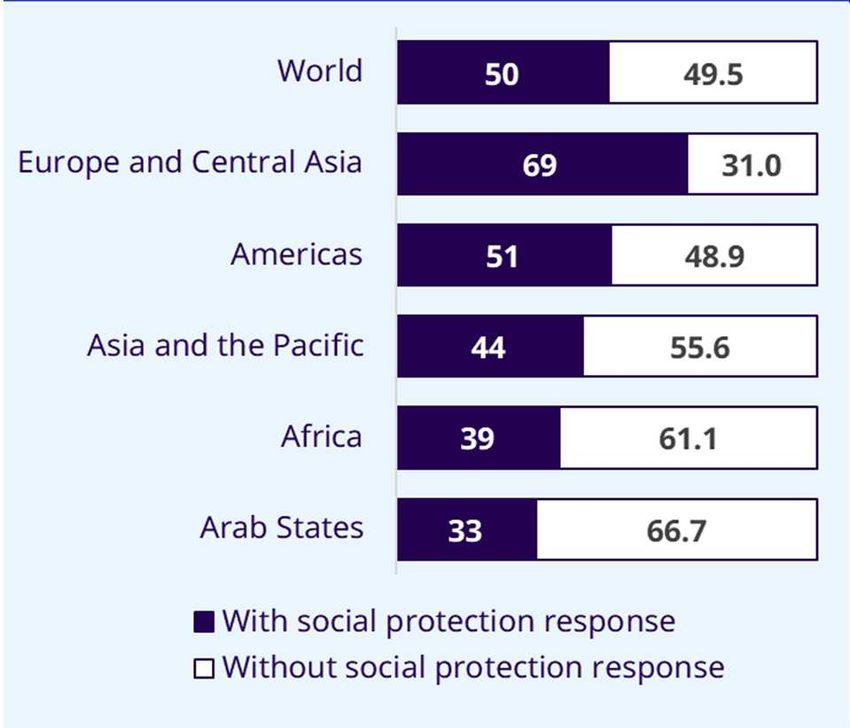
National social protection policy responses to the by:7
COVID-19 crisis address a broad range of areas.4 The extending sickness benefits financed from general
ILO Social Protection Monitor recorded 548 announced taxation to workers who would not otherwise be
social protection measures from 108 countries and entitled (Germany, Ireland, Portugal, United
territories between 1 February and 17 April 2020. Kingdom);
These measures address several areas of social
protection (see figure 1). ensuring the payment of sickness benefits in cases
of quarantine or self-isolation (Austria, France,
The following sections highlight priority policy areas, Germany, United Kingdom, Viet Nam);
including country examples5 and links to more detailed
information. eliminating waiting periods for the payment of
sickness benefits (Australia, Canada, Portugal);
Access to health care waiving the requirement to submit a sickness
certificate (Austria, Japan).
As a response to the COVID-19 crisis, many countries
have taken measures to enhance access to affordable
health care, close gaps in social health protection and Unemployment protection: preventing job losses
extend financial protection, including by: and supporting those who lost their jobs
channelling additional fiscal resources into the Unemployment protection schemes provide a key tool
health system to enhance the availability, for coping with the devastating employment impact of
accessibility, acceptability and quality of health the crisis, which has already threatened millions of jobs
services for all; (ILO 2020a; OECD 2020; ISSA 2020). This includes
measures to support enterprises in retaining workers,
improving coordination in the health system, thereby preventing unemployment, and measures to
including institutional and staff capacity, with a provide income security to unemployed workers, such
central role for public provision, sometimes as by:
complemented by private service providers under
public regulation (Spain, United Kingdom);
integrating prevention, testing and treatment
measures (including telemedicine) within health- Figure 1: Percentage of countries with and without
care benefit packages (China); social protection responses, by region
enhancing financial protection against health-care
expenses, safeguarding and extending coverage of
existing social health protection mechanisms, and
ensuring the universality and continuity6 of such
coverage, such as guaranteeing treatment for
foreign residents (Thailand).
Sickness benefits: ensuring income security
during sick leave
The COVID-19 crisis has exposed critical gaps in
sickness benefit coverage, leaving large numbers of
workers, such as self-employed workers and workers
in non-standard employment, without paid sick leave
(OECD 2020; ILO 2017; ISSA 2020b). This constitutes a
critical challenge for public health and income security,
as workers who cannot rely on sickness benefits and/or
paid sick leave entitlements may be forced to report to
work while sick or may be reluctant to self-isolate,
thereby potentially passing on the virus to colleagues Source: Based on ILO Social Protection Monitor on COVID-19
(18 April 2020).
and clients. This is particularly urgent, as it affects
many workers on the front lines of the COVID-19 crisis,
such as health workers, cleaners, transport and
__
4
A more detailed overview of announced country responses is available in the ILO Social Protection Monitor on COVID-19, see also
Gentilini, Almenfi, and Orton (2020), ISSA (2020a) and OECD (2020).
5
The country examples provided do not represent an exhaustive list.
6
With a view to ensuring, in particular, that those with employer-sponsored schemes will not lose coverage after the loss of a job or
income.
7
For more detail, see ILO (forthcoming (a)).Social Protection Spotlight 4
Social protection responses to the COVID-19 crisis
supporting companies to retain workers through adapting the modalities or conditions of social
short-time work benefits/partial unemployment assistance schemes, such as requirements with
benefits (Denmark, France, Germany, Italy, Japan, regard to job search (Australia), and facilitating
Netherlands, California (United States), Thailand); access to social assistance for new beneficiaries
facilitating access to unemployment benefits for (Ireland, New Zealand);
workers who have lost their jobs and supporting generalized income support to all residents
them in finding new employment, in some cases through one-off payments (Hong Kong (China),
also extending such benefits to self-employed Singapore);
workers (Australia, Ireland, Philippines); providing other cash and in-kind benefits, such as
providing one-off emergency payments to laid-off food items or meals (India, Jamaica) or cash
workers who are not eligible for unemployment transfers to ensure access to food (Federal District
insurance (Australia, Italy, Japan); (Brazil), Indonesia);
coordinating unemployment protection with additional support for particularly vulnerable
measures to facilitate access to employment populations, such as homeless persons (El
services, including job-matching, skills Salvador, France, Spain).
development and active labour market policies to
support jobseekers in finding a new job (Hong Kong Family leave and care policies
(China), Republic of Korea), including through With the closure of schools, universities and childcare
online job counselling and job mediation (Belgium, services in more than 100 countries, impacting more
Estonia). than 800 million children and youth (UNESCO 2020),
family leave policies have moved to the centre of
Old age, survivor and disability benefits attention (UNICEF, ILO, and UN Women 2020). They are
In view of the particular vulnerability of older persons particularly important to support those who cannot
and persons with disabilities, old age, survivor and telework in a situation when many support structures
disability benefits have a particularly important role to are closed. Policies include:
play in ensuring income security for those affected by introducing or expanding special family leave to
the crisis, such as by: support working parents affected by the closure of
advancing the payment of old age and disability schools (France, Italy), subsidizing employers for
benefits and/or increasing their level to guarantee providing paid family leave (Japan) or providing
at least the prevention of poverty (Argentina, Peru, cash transfers or vouchers for babysitting or other
Ukraine); childcare services, especially for health-care
ensuring effective access to health care, adequate workers (Italy, Poland, Portugal, Republic of Korea);
disability and other social protection benefits for maintaining childcare facilities for children of
persons with disabilities (Argentina, Hong Kong health-care workers (Austria, France, Netherlands);
(China), Peru, Singapore); supporting those who provide long-term care for
ensuring continued access to disability benefits, older family members who may be particularly
care and support for persons with disabilities vulnerable to the coronavirus.
(Australia, France);
minimizing the risks of contamination for older Temporarily modifying the payment of social
people when collecting their pension at pension security contributions and tax payments for
paypoints (Peru).8 enterprises
In order to alleviate the liquidity constraints that
Providing income support through social enterprises face, many governments are temporarily
assistance, cash transfers and other support suspending the payment of social security
In view of the rapidly deepening economic contributions and taxes or taking other measures to
consequences of the COVID-19 crisis, many allow greater flexibility in this regard (OECD 2020; ILO
governments have put in place measures to provide 2020c). While such measures can provide much-
income support to the population through social needed short-term relief to affected enterprises, it is
assistance or other tax-financed benefits, including essential that they do not undermine the future fiscal
by:9 sustainability of government budgets and social
security institutions, especially at a time when social
scaling up social assistance for existing
protection systems need to meet increased demands.
beneficiaries by advancing the payment of benefits
and/or increasing their levels (Australia, Brazil, Measures taken include:
China, Malaysia); allowing enterprises to postpone the payment of
relaxing eligibility criteria to increase coverage social insurance contributions and taxes (China,
(Ireland, United Kingdom); France, Hungary, Thailand, Viet Nam)
__
8
For more detail, see SIFAR, University of East Anglia, and Helpage International (2020).
9
For more detail, see ILO (forthcoming (b)) and Gentilini, Almenfi, and Orton (2020).Social Protection Spotlight 5
Social protection responses to the COVID-19 crisis
suspending certain taxes on small enterprises and
waiving enforcement measures and late-payment Box 1: ILO social security standards and their relevance
penalties (Germany, United Kingdom). for the COVID-19 crisis response
ILO social security standards, as well as related
Adapting administrative procedures and delivery
standards, establish basic principles and key parameters
mechanisms
for realizing the human right to social security. They are
COVID-19 also has important implications for how the result of international tripartite consensus and are
benefits and services are administered and delivered. intended to ensure the stability and sound governance
Measures taken include: of national social protection systems, enabling them to
expediting the treatment of requests or the provide adequate medical care and income security
processing of claims and subsequent disbursement throughout people’s lives (ILO 2017, 2019d, 2019a). They
of benefits (Australia, Canada, United Kingdom); are instrumental in guiding response measures and
waiving requirements for in-person visits and ensuring the protection to all those in need. These
encouraging the use of online services (China, standards are based on the recognition of social security
Ireland, United Kingdom), with support offered by as an individual right and the general responsibility of
phone to those who do not have access to online the State to guarantee due provision of adequate
applications; benefits and the sustainability of social protection
systems. Indeed, worldwide, States have stepped in to
adapting payment modalities to avoid crowding
organize the response to the current crisis, seeking to
and higher risks at payment points (South Africa).
protect the people and reduce the social and economic
fallouts of the crisis.
Policy considerations To enable States to effectively discharge this general
responsibility, ILO standards call on them to “take all
The COVID-19 pandemic is a powerful reminder that, measures required for this purpose” in a timely manner.
in our interconnected world, a weakness in one Realizing the universal right to social security demands
nation’s health and social protection system poses a that everyone has access to medical care and income
risk to public health everywhere. Global health security if and when needed, giving priority to those who
inequalities must be addressed as a priority. Thus, the are particularly vulnerable. At the same time, States
crisis has once again called attention to the importance have the responsibility to safeguard and restore the
of ensuring universal access to social protection long-term viability of the social protection system,
systems that provide comprehensive and adequate including, once conditions allow, by paying off former
benefits that meet people’s needs. Countries that in debts contracted by the State and envisaging sufficient
the past decades have invested sufficient resources in budgetary allocations to cover the State’s future
building universal health and social protection systems commitments to social security. The participation of the
are likely to be in a stronger position to respond to the representatives of protected persons and employers in
COVID-19 crisis, while others will be reminded of the these decisions is essential.
importance of doing so in order to better cope with the
current crisis and weather future ones. ILO social Relevant standards include the ILO Social Security
security standards provide important guidance in this (Minimum Standards) Convention, 1952 (No. 102), the
respect (see box 1). Social Protection Floors Recommendation, 2012 (No.
202) and the Employment and Decent Work for Peace
This renewed recognition should lead to increased and Resilience Recommendation, 2017 (No. 205).
global cooperation for the adoption of universal social
protection systems everywhere. Several policy Recommendation 205 calls on Members to undertake
observations and recommendations can be derived the following as quickly as possible in responding to
from this crisis. crisis situations:
seek to ensure basic income security, in particular for
Strengthening social protection as part of persons whose jobs or livelihoods have been
coordinated crisis response policies disrupted by the crisis;
For social protection systems to play their role in develop, restore or enhance comprehensive social
coordinated crisis response policies, the following security schemes and other social protection
considerations are essential: mechanisms, taking into account national legislation
and international agreements; and
Countries with strong health and social protection
systems in place can react quickly by scaling up seek to ensure effective access to essential health
existing protection mechanisms and by extending care and other basic social services, in particular for
and adapting them to cover previously uncovered population groups and individuals who have been
populations. made particularly vulnerable by the crisis.
Countries that do not have sufficiently robust It also provides that in order to prevent crises, enable
health and social protection systems in place recovery and build resilience, Members should
should be offered urgent international support to establish, re-establish or maintain social protection
ensure an adequate immediate response to the floors, as well as seek to close the gaps in their coverage,
crisis (United Nations 2020). taking into account Convention No. 102, Recommen-
dation No. 202 and other relevant international labour
standards.Social Protection Spotlight 6
Social protection responses to the COVID-19 crisis
Countries should prioritize support for those who an immediate crisis response and the necessary
are particularly vulnerable to the crisis, including investments to build their social protection system.
workers in the informal economy; should ensure For some countries, temporary external support
that their immediate needs are met, including may be necessary to safeguard the necessary
access to health care and income support; and investments in health, education and social
should also take practical measures, such as protection and expand their fiscal space to build
providing food and soap or establishing hand- solid health and social protection systems (IMF
washing stations in public spaces (Alfers 2020). 2019).
Social protection is not merely a stopgap response, As governments assemble their fiscal stimulus
with only residual, transitory and fragmented packages, they should strive for a judicious balance
safety nets in addition to market solutions for those in assigning proportionate financial support to
who can afford them: crisis response policies enterprises to retain their workers, as well as
should also contribute to realizing universal health income support and employment services for those
coverage and building universal social protection who have lost their jobs. In addition, there are
systems, including floors, in line with SDG targets additional social protection needs, including for
1.3 and 3.8 (United Nations 2019; USP2030 2019; sickness benefits (particularly for those not covered
ILO 2019d). by statutory paid sick leave), social assistance, and
Effective crisis responses depend on sustained – most importantly – in ensuring effective access to
social dialogue and the meaningful participation of health care.
social partners and other stakeholders in tackling Experience from previous crises shows that the first
the causes and consequences of the crisis, as well signs of recovery are often accompanied by calls for
as ensuring a swift response that leads to recovery austerity and fiscal consolidation that can
and social stability (ILO 2020a): in view of the undermine the progress made. It is imperative that
significant impact of the crisis on workers and their countries sustain their social protection measures
families as well as businesses, joint responsibility and social spending when the immediate health
will contribute to fostering stability (IOE and ITUC crisis subsides in order to ensure that people are
2020). protected against the adverse economic and social
Taking into account that women and girls are consequences that might materialize overtime, as
particularly affected by the crisis, ensuring the well as any future crises. Furthermore, as crisis-
gender-responsiveness of policy responses is response measures have included the temporary
essential. suspension or reduction of social insurance
contributions and taxes, appropriate measures will
Social protection responses to the COVID-19 crisis
need to be taken to ensure the financial
should be coordinated with other economic and
sustainability of social protection systems while
social policies, including labour market and
guaranteeing the adequacy of their benefits.
employment policies, and policies promoting
occupational safety and health.
Preparing for the future
Ensuring the sustainable and equitable The COVID-19 crisis has served as a wake-up call by
financing of social protection in times of crisis exposing serious gaps in social protection systems
and beyond around the world. Governments, together with social
partners and other stakeholders, should take this
Social protection systems play an important role in
opportunity to strengthen their social protection
mobilizing resources to respond to the COVID-19 crisis,
systems, including floors, as a cornerstone of national
yet it is necessary to consider also their sustainability
social and economic policy architecture. In particular:
in the longer run. In particular:
The comparative advantage of a universal social
Robust social protection systems have in place
protection system that reaches everyone is that it is
financial buffers to address the double challenge of
automatically primed to protect all those affected
increased expenditure and reduced revenue, yet a
by a shock. Social protection transfers can be scaled
large-scale crisis may require significant additional
up quickly and with relative administrative ease. In
funding allocations for social protection in order to
complex, fast moving and unpredictable crises like
ensure the provision of adequate and comprehend-
COVID-19, universalism is preferable to targeted
sive benefits and services to all those who need
approaches. This is especially true where targeting
them. After the immediate impact of the crisis has
capacity is more limited and a very high proportion
passed, these financial buffers will need to be
of the population is vulnerable. Universalism makes
refilled through sustainable and equitable finan-
more practical sense than ad hoc efforts to
cing structures, usually drawing on a combination
“effectively” target, the limitations of which are well
of taxation and social insurance contributions, as
documented.
well as an accommodating macroeconomic policy
framework. It is critical that social protection systems are well
prepared to respond to crises, whether these relate
In countries that do not yet have sufficiently solid
to epidemics, climate change or economic shocks.
health and social protection systems in place,
This requires continuous investments in expanding
further efforts will be necessary in order to ensure
the reach and adequacy of universal socialSocial Protection Spotlight 7
Social protection responses to the COVID-19 crisis
protection systems 10 and ensuring that they are References
anchored in national legal and policy frameworks
and financed in an equitable and sustainable Alfers, Laura. 2020. ‘Pandemic: Informal Workers Urgently
Need Income Replacement — and More Protections’.
manner that is based on broad risk-pooling and
Empowering Informal Workers, Securing Informal
solidarity. International social security standards Livelihoods (blog). 23 March 2020.
provide essential guidance in this respect (ILO
Diwakar, Vidya. 2020. ‘From Pandemics to Poverty: The
2019a).
Implications of Coronavirus for the Furthest Behind’. ODI.
The crisis has renewed public and political 3 October 2020.
awareness of the importance of social protection, FAO. 2020. ‘Social Protection and COVID-19 Response in Rural
and that adequate health care and social protection Areas’. Rome: Food and Agriculture Organization of the
should be available to all, ex ante, in order to United Nations.
contend with shocks such as health pandemics. Gentilini, Ugo, Mohamed Almenfi, and Ian Orton. 2020. ‘Social
This calls for reaffirming the principles of social Protection and Jobs Responses to COVID-19: A Real-Time
solidarity that underpin universal social protection Review of Country Measures (Updated 10 April)’.
and its centrality to ensuring socially just societies Global Commission on the Future of Work. 2019. ‘Work for a
(ILO 2019e). Brighter Future’. Geneva: International Labour Office.
The COVID-19 crisis has revealed the worrying ILO. 2010. ‘World Social Security Report 2010/11: Providing
consequences of coverage and adequacy gaps in Coverage in the Time of Crisis and Beyond’. Geneva:
social protection for some categories of workers, International Labour Office.
such as part-time workers, temporary workers and ———. 2014. ‘World Social Protection Report 2014/15:
self-employed workers. It has highlighted the Building Economic Recovery, Inclusive Development and
importance of ensuring adequate social protection Social Justice’. Geneva: International Labour Office.
coverage for workers in all forms of employment ———. 2016. ‘Non-Standard Employment around the World:
that is adapted to their circumstances, in line with Understanding Challenges, Shaping Prospects’. Geneva:
international social security standards and the ILO International Labour Organization.
Centenary Declaration for the Future of Work.11 This ———. 2017. ‘World Social Protection Report 2017-19:
is particularly the case for benefits that have low Universal Social Protection to Achieve the Sustainable
coverage and are often overlooked, such as Development Goals’. Geneva: International Labour
sickness benefits and unemployment protection. Organization.
The crisis has expedited much-needed reform by ———. 2019a. ‘Building Social Protection Systems:
compelling numerous governments to temporarily International Standards and Human Rights Instruments’.
extend social protection to uncovered groups by Geneva: International Labour Organization.
introducing extraordinary measures and ———. 2019b. ‘Extending Social Security Coverage to Workers
legislation. Going forward, stopgap measures in the Informal Economy: Lessons from International
should be transformed into sustainable social Experience’. Geneva: International Labour Organization.
protection mechanisms for these categories of ———. 2019c. ‘Extending Social Security to the Self-Employed:
workers, based on a fair sharing of the cost Lessons from International Experience’. Geneva: Interna-
between employers, workers and governments, tional Labour Organization.
ensuring compliance with labour and social ———. 2019d. ‘Universal Social Protection for Human Dignity,
security legislation (ILO 2016, 2019b; OECD 2018, Social Justice and Sustainable Development: General
2019, 2020a). This is an important step towards Survey Concerning the Social Protection Floors
promoting decent work and supporting transitions Recommendation, 2012 (No. 202)’. Geneva: International
from the informal to the formal economy. Labour Organization.
———. 2019e. ‘Universal Social Protection: Key Concepts and
Social protection must be seen as an investment and
International Framework’. Social Protection for All Issue
not as an additional cost. Previous crises have Brief. Geneva: International Labour Office.
confirmed social protection’s vital role as a social buffer https://www.social-
and economic stabilizer that is integral to the smooth protection.org/gimi/RessourcePDF.action?id=55517.
and successful functioning of society. The positive role ———. 2020a. ‘ILO Monitor 2nd Edition: COVID-19 and the
of social protection as an essential tool to mitigate the World of Work Updated Estimates and Analysis’. Geneva:
negative fallouts from shocks is well established. If International Labour Organization.
adequately supported in this crisis, its value will be ———. 2020b. ‘COVID-19 and World of Work: Impacts and
emphatically underlined once more. Responses’. Geneva: International Labour Organization..
———. 2020c. ‘Social Protection Responses to the COVID-19
Crisis: Country Responses in Asia and the Pacific’. Bangkok
and Geneva: International Labour Organization.
__
10
The Global Partnership for Universal Social Protection (USP2030) supports countries to design and implement universal and
sustainable social protection systems, in line with the 2030 Agenda for Sustainable Development, in particular SDG target 1.3.
11
See also Global Commission on the Future of Work (2019); ILO (2019c).Social Protection Spotlight 8
Social protection responses to the COVID-19 crisis
———. forthcoming (a). ‘COVID 19 Health Crisis: The Need for SIFAR, University of East Anglia, and Helpage International.
Sickness Benefit during Sick Leave and Quarantine’. 2020. ‘Guidelines on Administering Pension Payments in
Geneva: International Labour Organization. the Context of the COVID-19 Pandemic’.
———. forthcoming (b). ‘Non-contributory benefits in the SPIAC-B. 2020. ‘A Joint Statement on the Role of Social
COVID-19 crisis: Country responses and policy Protection in Responding to the COVID-19 Pandemic’.
considerations’. Geneva: International Labour New York: Social Protection Inter-agency Cooperation
Organization. Board.
IMF. 2019. ‘A Strategy for IMF Engagement on Social Sumner, Andy, Chris Hoy, and Eduardo Ortiz-Juarez. 2020.
Spending’. Washington D.C.: International Monetary ‘Estimates Of The Impact Of Covid-19 On Global Poverty,
Fund. WIDER Working Paper 2020/43, Helsinki: UNU-WIDER.
———. 2020. World Economic Outlook (April), Washington UNCTAD. 2020. ‘Coronavirus: Can Policymakers Avert a
D.C.: International Monetary Fund. Trillion-Dollar Crisis?’ Geneva: United Nations Conference
IOE and ITUC. 2020. ‘Joint Statement on COVID-19’. on Trade and Development.
International Organization of Employers and UNESCO. 2020. ‘COVID-19 Educational Disruption and
International Trade Union Confederation. Response’. UNESCO. 18 March 2020.
ISSA. 2020a. ‘Coronavirus – Social Security Responses, UNICEF, ILO, and UN Women. 2020. ‘Family-Friendly Policies
Geneva: International Social Security Association. and Other Good Workplace Practices in the Context of
———. 2020b. ‘COVID-19 Crisis: A Renewed Attention to COVID-19: Key Steps Employers Can Take’. New York and
Sickness Benefits’, International Social Security Geneva: United Nations Children’s Fund, International
Association. Labour Organization, United Nations Entity for Gender
Equality and the Empowerment of Women.
OECD. 2009. ‘Employment Outlook: Tackling the Jobs Crisis.’
Paris. United Nations. 2019. ‘Political Declaration of the High-Level
Meeting on Universal Health Coverage “Universal Health
———. 2018. ‘The Future of Social Protection: What Works for
Coverage: Moving Together to Build a Healthier World
Non-Standard Workers?’ Paris: Organisation for Economic (A/RES/74/2)’. United Nations General Assembly.
Co-operation and Development.
———. 2020. ‘Shared Responsibility, Global Solidarity:
———. 2019. ‘The Future of Work: OECD Employment Outlook
Responding to the Socio-Economic Impacts of COVID-19’.
2019’. Paris: Organisation for Economic Co-operation and New York: United Nations.
Development.
USP2030. 2019. ‘Together to Achieve Universal Social
———. 2020. ‘Supporting People and Companies to Deal with
Protection by 2030 (USP2030) – A Call to Action’. Geneva:
the Covid-19 Virus: Options for an Immediate Employ- Global Partnership for Universal Social Protection.
ment and Social-Policy Response’. Paris: Organisation for
Economic Co-operation and Development.
ILO Social Protection Department Consult our websites for regular updates from the
Contact: socpro@ilo.org world of work response to the COVID-19 crisis.
ILO website: www.ilo.org ilo.org/global/topics/coronavirus
Social Protection Platform: www.social-protection.org/gimi/
www.social-protection.org ShowWiki.action?id=62&lang=ENYou can also read


