Automotive-Grade UFS and e.MMC
Embedded Flash Drives
←
→
Page content transcription
If your browser does not render page correctly, please read the page content below

Automotive-Grade UFS and e.MMC Embedded Flash Drives

The Storage You Can Drive On
                              Designed for the connected and autonomous car market, Western Digital’s automotive-grade
                                iNAND® UFS and e.MMC Embedded Flash Drives (EFDs) deliver high-performance and high-
                             reliability storage for a variety of demanding automotive applications. The devices address the
                             evolving needs of traditional applications such as infotainment and vehicle navigation systems,
                                and next generation applications such as Vehicle-to-Vehicle/Infrastructure communications,
                                            telematics gateways, digital cluster, drive recorders, and autonomous driving.

                               Smart partitioning, a sophisticated read refresh algorithm, power fail immunity, and an LDPC
                                ECC engine are just a few of the features that make these some of the most advanced EFDs
                               on the market. With additional industry-leading features including automotive-optimized 3D
                            technology, iNAND SmartSLC™, and deep diagnostics, Western Digital iNAND automotive-grade
                                                           e.MMC and UFS EFDs empower your data-driven applications.

1   Automotive-Grade UFS and e.MMC Embedded Flash Drives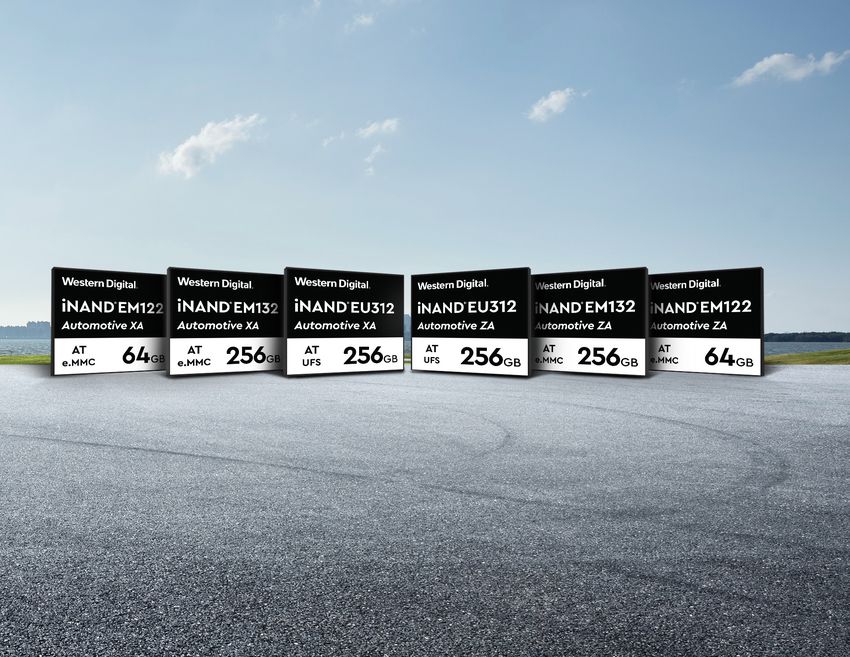
Automotive-Grade UFS and e.MMC Embedded Flash Drives 2

Advanced Features

                        3D Technology *
                        • Higher performance, lower cost and lower power consumption

                        • Larger effective cell size and less cell-to-cell interference

                        • Higher reliability margins when compared to 2D NAND with similar bit density

                        SmartSLCTM*
                        Western Digital’s iNAND automotive-grade e.MMC and UFS products feature industry-leading SmartSLC, designed to boost host
                        write performance and leverage the benefits of SLC to maximize device throughput and endurance.

                        Adaptive mechanisms ensure writes are routed through SLC blocks for superior write speeds and efficiently migrate data to
                        TLC to ensure performance consistency.

                        Advantages:

                        Performance:                                                       Endurance:
                        • Boost sequential and random write performance to SLC level       • Reduce host writes to the TLC area
                        • SLC-grade latency for better write-driven use cases              • Reduces Write Amplification Factor (WAF) to the TLC area
                        • Maintain high performance when media is fragmented               • Increase product endurance and longevity (TBW)
                        • Persistent performance even when media is full
                                                                                           Robustness:
                                                                                           • Leverage SLC’s higher resiliency to data corruption
                                                                                           • TLC/SLC redundancy increases power failure handling

                         * Note:   Applicable for AT EM132 and AT EU312

3   Automotive-Grade UFS and e.MMC Embedded Flash Drives
Advanced Features
Advanced Device Report
iNAND products offer a proprietary device report feature with detailed information and diagnostics on the firmware and device
status at runtime. This information provides a deeper EFD status understanding, on top of the e.MMC and UFS JEDEC specs in an
easy-to-use method including:
• Wear-leveling areas and device health • Lifetime prediction • Error detection and correction
• Voltage droop and occurrences • Firmware release and update • Temperature
• Power diagnostics • Host read and write • Failures and recovery
Smart Partitioning
iNAND automotive-grade e.MMC and UFS Smart Partitioning implementation creates dedicated, physically separated and
individually managed memory areas. This protects specific partitions from the unwanted effects of overuse as well as
preventing any impact to the data integrity caused by activities in other areas, thus helping to maximize endurance, data
retention and separation.
Separate areas may include:
• TLC/MLC based User Area
• SLC based High Data Retention / Read Intensive / Secured area
• SLC based High Endurance area, tailored for write-intensive applications
Auto/Manual Read Refresh
A sophisticated automatic read refresh algorithm is implemented in the iNAND automotive-grade e.MMC and UFS devices to offer
better handling of data retention, read disturb and read refresh. It senses early signs of block degradation and automatically refreshes
the data. The algorithm includes multiple types of scans designed to identify affected pages with high Bit Error Rate (BER).
In addition, the host can initiate Refresh via command, which is proprietary in iNAND automotive-grade e.MMC and according
to JEDEC UFS3.0 in iNAND automotive-grade UFS.
Automotive-Grade UFS and e.MMC Embedded Flash Drives 4Advanced Features
Power Immunity
iNAND automotive-grade e.MMC and UFS devices implement advanced mechanisms for protecting the device and the user data
from data loss, data corruption or device damage due to external power failures. This addresses the occurrence of both write
abort and voltage droop.
100% Content Preloading and Integrity Post IR Reflow
iNAND automotive-grade e.MMC and UFS are designed to support 100% content preloading (via external programmer)
pre-IR reflow and guarantee high data integrity post-IR reflow. This assures that the high temperature experienced during
the IR-reflow process does not affect the data integrity of the preloaded data.
Thermal Management
To prevent the damage to the NAND or controller while operating in high temperatures, the iNAND automotive-grade e.MMC
and UFS implement a robust thermal management mechanism. This mechanism is activated by default and automatically
adjusts the internal power mode to ensure protection from overheating. In addition, the iNAND automotive-grade UFS device
supports Temperature Event Notification-a JEDEC UFS3.0 parameter.
Suited for Automotive Applications
iNAND automotive-grade e.MMC and UFS devices undergo rigorous qualification and production testing, and comply with
automotive standards such as AEC-Q100 and are qualified to meet and exceed the standard requirements.
Fast Boot
iNAND automotive-grade e.MMC and UFS devices enable the host to boot from boot partitions/LUs of the device.
This feature allows the system to be functional at the proper time. For example, the console display and the remaining car
system functionality are needed the moment the driver enters or activates the vehicle. In addition, this feature enables the
replacement of SPI NOR for the inherent capability of the iNAND device, reducing BOM costs and board space.
5 Automotive-Grade UFS and e.MMC Embedded Flash DrivesAutomotive iNAND® Embedded Flash Devices
iNAND AT EU312 iNAND AT EU312 iNAND AT EM132 iNAND AT EM132 iNAND AT EM122 iNAND AT EM122
Grade 3 Grade 2 Grade 3 Grade 2 Grade 3 Grade 2
Capacity (TB) 16GB – 256GB 16GB – 256GB 32GB to 256GB 32GB to 256GB 8GB to 64GB 8GB to 64GB
Interface UFS 2.1 e.MMC 5.1 HS400
Operating Temperature –40°C to 85°C –40°C to 105°C –40°C to 85°C –40°C to 105°C –40°C to 85°C –40°C to 105°C
Sequential R/W (MB/s) Up to 800/550 Up to 310/250 Up to 300/125
Random R/W (MB/s) Up to 35K/40K Up to 20K/12K Up to 22K/12K
Advanced Health Report, Smart Partitioning, Auto and Advanced Health Report, Auto and Manual Refresh, Advanced Health Report, Auto and Manual Refresh,
Enhanced Features
Manual Refresh, UFS 3.0 automotive features included Smart Partitioning, Thermal Management Smart Partitioning, Thermal Management
Package 11.5x13x1.2mm 11.5x13x1.0mm, 11.5x13x1.2mm 11.5x13x0.8mm, 11.5x13x1.0mm, 11.5x13x1.2mm
Ordering Information SDINDDH6-###G-XA SDINDDH6-###G-ZA SDINBDA6-###G-XA1 SDINBDA6-###G-ZA1 SDINBDG4-###G-XA2 SDINBDG4-###G-ZA2
Formerly Known As iNAND® 8250A iNAND® 7550A iNAND® 7250A
Note: One gigabyte (GB) is equal to one billion bytes. Actual user capacity may be less due to operating environment.
Automotive-Grade UFS and e.MMC Embedded Flash Drives 6©2021 Western Digital Corporation or its affiliates. All rights reserved. Western Digital, the Western Digital logo, iNAND, and SmartSLC are registered 5601 Great Oaks Parkway
trademarks or trademarks of Western Digital Corporation or its affiliates in the US and/or other countries. References in this publication to Western Digital San Jose, CA 95119, USA
products, programs, or services do not imply that they will be made available in all countries. Product specifications provided are sample specifications that are www.westerndigital.com
subject to change and do not constitute a warranty. Pictures shown may vary from actual products. All other marks are the property of their respective owners. OEMProducts@wdc.com for any inquiries.
Feburary 2021You can also read


