Avances Conceptuales Mi1gación, Adaptación, y Financiamiento - José Alberto Garibaldi - LEDS LAC
←
→
Page content transcription
If your browser does not render page correctly, please read the page content below
Avances Conceptuales
Mi1gación, Adaptación, y
    Financiamiento

    José Alberto Garibaldi
      San Jose, Octubre 2016.
Recent work –
Mitigation / Adaptation
Tell a story of recent work through papers
• Economics of boldness (climate policy, 2013)
• Low Carbon Resilient Societies (Energeia 2013)
• The middle is beautiful (CDKN/Energeia, 2014)
• Learning by doing (current, ECLAC/Euroclima)Economics of boldness
(climate policy, 2013)
All costs considered, the more ambitious the regime
is, the lesser the costs for most countries
Particularly true for middle and low income countries
Certainly the case for LAC
Major costs for most countries is impacts not
adaptationModelling Approach
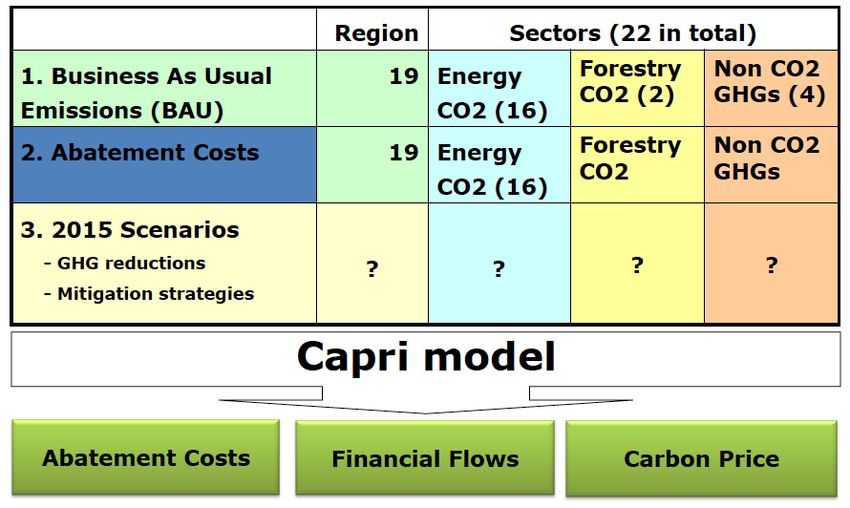
Step 1: model emissions reduction scenario based on publically announced plans from regions
Step 2: Model scenarios for regional impact, abatement, and Step 3: Model financial and carbon flows, prices
adaptation costs in PAGE2009 costs, by region
Select an abatement and adaptation policy
Global and Costs of Costs of
regional abatement adaptation
temperature
Impacts Costs
•Input parameters are uncertain. All results are •Input parameters are certain. Model tries to optimize
probability distributions. results based on MACC curves.
Step 4: compare results from models by regions and on the aggregateIn Middle or Low Income Countries
Seems to be mostly the case:
Scenario 2020
Very Low 15,419
Latin America – holds in all cases Low 14965
Effort 11774
Forestry fungibility, expansion of trading sectors and High -2236
supplementarity restrictions crucial Very High -36952
Costs in US$ Million dollars, 2005.
South East Asia -holds in all cases SE Asia 2020 2030 2040
Low 76207.1 188263 628539
Current 75773 181467 599709
Idem. Impacts reduced by 6 GDP points Effort 74167.2 174509 544640
per year High 72818.2 170290 529927
V. High 69068 169810 472868
Africa -holds up to Effort, and then up to Very
high scenario
Much room to maneuvre, with a financial bridge
allowing taking very high scenarios
All costs in US$ Millions, 2005Imagining Emissions Trajectories
USA goes further down along its INDC; Baseline
China changes growth rates early and
enters plateau;
Other A1 countries avoid backsliding and
Russia makes an effort;
India, Africa and MENA region start
reducing emissions by 2030;
Scenario 1
LAC and Africa & MENA reduce
emissions earlier by 2020 and 2030, and
then more between 2040 and 2050.
16,000
Emissions drop to 0 by 2100 14,000
12,000
10,000 CA CO2
Regional 8,000 IA CO2
South 6,000
4,000 AF CO2
division 2,000
LA CO2
-Does more mitigation lead to lower collective costs? Yes. Base scenario 3.68 degrees - and going up… Scenario 1 – peak at 2,15 degrees…and going down Scenario 1 costs 53 trillion dollars more, but reduces impacts in 60 trillion – a 7 Trillion collective difference
The Impact of Synergies
 Gaining more by doing both Mitigation and Adaptation
Scenario 2:Assumes:
1) The region or country acts addressing mitigation and adaptation
     together, taking advantage of the synergies between these two.
2) These synergies could reduce emissions by 15% more than the
     scenario 1.
Results
A warming of 2.08 degrees by 2100, and the probability of staying
below 2 degrees increases to 51% (from 46% under Scenario 1).
A global reduction of US$ 4.4 trillion in the costs of impacts:
A global and not only a local benefit in advancing these synergies.
all things equal, the effort pays for itself.
Low Carbon Resilient Societies (2013) Four guiding lines: • Links between risk, resilience, adaptation, and security systems in society; • competitive dynamic advantages developed early on; • synergies between mitigation and adaptation linked with finance; • Climate action articulated with sustainable development and international climate negotiation for a regime that supports these lines.
Middle is Beautiful (2014)

• If developing countries advance
  adaptation first and mitigation later, costs
  would grow for them and collectively;
• if they advance mitigation first and
  adaptation later, costs would be reduced
• if they are advance both at the same time,
  they would be reduced further, for them
  and collectively.
Learning by Doing (current)
• Work on financing mitigation and adaptation
• With support from ECLAC and EUROCLIMA
• Identify a portfolio of projects and instruments
• With and agile and participatory methodology
• Consider impacts of risk, maturitym and risk
  diversification – both on mitigation and resilience
• Help share experience / cases
Expandiendo el portafolio de Inversión
Portafolio de Proyectos y Flujos de Financiamiento
                                            La brecha - oferta de fondos
                                               vs proyectos en NDCs

                                             Financial
       Sources         Management                          Project Owners          NDCs
                                           Instruments
    • Carbon and      • Governments      • Debt (at        • Governments       • Mitigation
      general taxes   • Financial          market and      • Public entities   • Adaptation
    • International     Institutions       concessional    • Private           • Capacity
      charges         • Private            rates)            parties             Building
    • Capital           finance          • Capital                             • Cooperation
      inflows         • Corporations       Investment
    • Domestic        • Private equity   • Grants
      Income                             • Guarantees /
                                           risk
                                           management

                                           La necesidad de financiamiento
                                                    y proyectos

   Hay más fuentes, fondos y compromisos; hay menos proyectos
efec>vos e instrumentos para facilitar la colocación de esos fondos en
                            proyectos.
Figura 3 Hacia un mayor portafolio
Riesgo y Maduración de Proyectos
Financiera No financiera
Riesgo Garan9as secundarias / bajas en carbono Definición de propiedad de bienes y
Fianzas por ?po de proyectos acervos
Seguros de inversión / por perdida de Regulación predecible de apoyo a
acervos metas
Mi?gación de riesgo si no ocurren resultados Mecanismos efec?vos de arbitraje y
de mi?gación resolución de controversias
Portafolios estándar de contratos (de Centros para validación, aprobación
desempeño, llave en mano, etc.) y monitoreo de proyectos
Maduración Fondos revolventes para la estructuración de Metas efec?vas de largo plazo
proyectos / NAMAs Polí?cas de impulso a desarrollo de
Subsidios temporales / fondos de transición proveedores de servicios
Esquemas de coordinación con proveedores Elegibilidad como proyectos Bajos
financieros / Banca de segundo piso en carbono / resilientes
Contratos estándar que integran a diversas Coordinación gubernamental
fuentes En?dades que facilitan agregación
Líneas de crédito con varios proveedores de proyectos bajos en carbono /
(mul?laterales y privados) resilientes
Programas de apoyo por ?po de
proyecto / por sectoresAn Agile Methodology
Year 1 Year 1- 2 Year 2 - 3
Founda1on - Planning Collec1ve Work
Planeaci Planeaci Planeaci
ón ón ón
Agarre
Entrega
Agarre Agarre
Plan/
Retrosp Retrosp del Retrosp
del ecKva del
ecKva tema tema ecKva tema
Vision Agreemts
Team Evaluaci
ón
Elaborac
iòn de
priorida
Evaluaci
ón
Elaborac
iòn de
priorida
Evaluaci
ón
Elaborac
iòn de
priorida
des des des
PorOolio PorOolio CollecKve
- Products - Products refining
Method & Preliminar CollecKve
Regula
Plan Doc. Full project IntegraKon
r
Products Full
Countr
project
y
Product
sUna propuesta de trabajo
• Trabajo avanzando desde hace 4 meses sobre vínculos entre
mitigacion y adaptación con financiamiento con la CEPAL y
EUROCLIMA
• Desarrollo de instrumentos y portafolios de proyectos que
combinan reducción de emisiones con incremento de resiliencia
• Con un espiritú cooperativo y en enfásis en la creación de
capacidades
• Con ejemplos tomados del sector energía de México y Perú, y de
este más Economía en Uruguay
• Estaría su país interesado en cooperar?
• Intercambio de ejemplos, hallazgos, y opciones de solución.Información
josealbertogaribaldi@yahoo.com
T.+442085440976
M.+447511674371
S. Jose_Alberto_GaribaldiYou can also read


