Basketball Sport Rules - BASKETBALL SPORT RULES - Special Olympics
←
→
Page content transcription
If your browser does not render page correctly, please read the page content below
BASKETBALL SPORT RULES

    Basketball
    Sport Rules

1                                   VERSION: June 2016
                             © Special Olympics, Inc., 2016
                                         All rights reserved
BASKETBALL SPORT RULES

TABLE OF CONTENTS

1.   GOVERNING RULES ................................................................................................................................................................ 3
2.   OFFICIAL EVENTS ................................................................................................................................................................... 3
3.   SPEED DRIBBLE RULES .......................................................................................................................................................... 3
           Equipment .................................................................................................................................. 3
           Set-up: Mark a circle with a 1.5 meter (4 ft 11 in) diam................................................................... 4
           Rules .......................................................................................................................................... 4
           Scoring ....................................................................................................................................... 4
4.   INDIVIDUAL SKILLS RULES ................................................................................................................................................... 4
           Level I: ........................................................................................................................................ 4
           Level II ........................................................................................................................................ 7
5.   TEAM SKILLS BASKETBALL RULES ................................................................................................................................... 10
           Equipment ................................................................................................................................ 10
           Set-up ....................................................................................................................................... 10
           Rules ........................................................................................................................................ 10
           Scoring ..................................................................................................................................... 11
6.   TEAM COMPETITION ........................................................................................................................................................... 11
           Divisioning ................................................................................................................................ 11
           Competition Adaptations .......................................................................................................... 12
           Team and Players ...................................................................................................................... 12
           Point of emphasis. ..................................................................................................................... 12
           Uniform/Apparel ....................................................................................................................... 12
7.   HALF-COURT BASKETBALL: 3-ON-3 COMPETITION .................................................................................................... 13
           Divisioning ................................................................................................................................ 13
           The Goal ................................................................................................................................... 13
           Playing Area and Equipment ...................................................................................................... 13
           Team and Players ...................................................................................................................... 14
           The Game ................................................................................................................................. 14
           Competition.............................................................................................................................. 14
           Fouls and Penalties ................................................................................................................... 15
           Points of Emphasis .................................................................................................................... 15
           Unified Sports® Events ............................................................................................................. 15
8.   BASKETBALL SKILLS ASSESSMENT TESTS (BSAT) ........................................................................................................ 16
           Dribbling .................................................................................................................................. 16
           Perimeter Shooting ................................................................................................................... 17
           Basketballs ............................................................................................................................... 18
           Baskets ..................................................................................................................................... 18

     2                                                                                                                                                  VERSION: June 2016
                                                                                                                                                 © Special Olympics, Inc., 2016
                                                                                                                                                             All rights reserved
BASKETBALL SPORT RULES

1. GOVERNING RULES
   The Official Special Olympics Sports Rules for Basketball shall govern all Special Olympics competitions. As
   an international sports program, Special Olympics has created these rules based upon International
   Basketball Federation (Fédération Internationale de Basketball) (FIBA) rules for basketball found at
   http://www.fiba.com. FIBA or National Governing Body (NGB) rules shall be employed except when they
   are in conflict with the Official Special Olympics Sports Rules for Basketball or Article I. In such cases, the
   Official Special Olympics Sports Rules for Basketball shall apply.

    Refer to Article 1, http://media.specialolympics.org/resources/sports-essentials/general/Sports-Rules-
    Article-1.pdf, for more information pertaining to Codes of Conduct, Training Standards, Medical and Safety
    Requirements, Divisioning, Awards, Criteria for Advancement to Higher Levels of Competition, and Unified
    Sports.

2. OFFICIAL EVENTS
   The range of events is intended to offer competition opportunities for athletes of all abilities. Program
   may determine the events offered and, if required, guidelines for the management of those events.
   Coaches are responsible for providing training and event selection appropriate to each athlete’s skill and
   interest.
   The following is a list of official events available in Special Olympics.
       Speed Dribble
       Individual Skills Competition
       Team Skills Competition
       Team Competition (5-on-5)
       Half-Court Competition (3-on-3)
       Unified Sports® Team Competition (5-on-5)
       Unified Sports Half-Court Competition (3-on-3)

3. SPEED DRIBBLE RULES

          Equipment
                Measuring tape
                Floor tape or chalk

     3                                                                                          VERSION: June 2016
                                                                                         © Special Olympics, Inc., 2016
                                                                                                     All rights reserved
BASKETBALL SPORT RULES
One basketball (for women’s and junior division competitions a smaller basketball which is
72.4 centimeter [28 1/2 in] in circumference and between 510–567 gram [18–20 oz] in weight
may be used).
Stopwatch
Counter
Whistle
Set-up: Mark a circle with a 1.5 meter (4 ft 11 in) diam.
Rules
Athlete may use only one hand to dribble.
Athlete must either be standing or be sitting in a wheelchair or another type of chair with
similar dimensions while competing.
Athlete starts and stops dribbling at the sound of the whistle.
There is a 60-second time limit imposed. The objective is to dribble the ball as many times as
possible during this period.
Athlete must stay in the designated circle while dribbling.
If the basketball rolls out of the circle, it may be handed back to the athlete, who continues
to dribble.
Scoring
Athlete receives one point per legal dribble within the 60 seconds.
Counting stops and the event ends when the basketball rolls out of the circle for the third
time.
4. INDIVIDUAL SKILLS RULES
There are 2 levels of Individual Skills Competition
Level I:
Three events make up Level 1 Individual Skills Competition: Target Pass, 10 Meter Dribble and Spot
Shot. The athlete’s final score is determined by adding together the scores achieved in each of these
three events. Athletes will be pre-divisioned according to their total scores from these three events.
Each event is diagrammed with the suggested number and placement of volunteers who will
administer them. It is also suggested that the same volunteers remain at an event throughout the
competition so that consistency is provided.
Event #1: Target Pass
4 VERSION: June 2016
© Special Olympics, Inc., 2016
All rights reservedBASKETBALL SPORT RULES
Purpose: to measure an athlete’s skill in passing a basketball.
Equipment: Two basketballs (for women’s and junior division competitions, a smaller
basketball of 72.4 centimeters [28 1/2 in] in circumference and between 510–567
grams [18–20 oz] in weight may be used as an alternative), flat wall, chalk or floor
tape, and measuring tape.
Description: A 1 meter (3 ft 3 1/2 in) square is marked on a wall using chalk or tape.
The bottom line of the square shall be 1 meter (3 ft, 3 1/2 in) from the floor. A 3
meter (9 ft, 9 in) square will be marked on the floor 2.4 meter (7 ft) from the wall.
The athlete must stand within the square. The leading wheel axle of an athlete’s
wheelchair may not pass over the line. The athlete is given five passes.
Scoring
The athlete receives three points for hitting the wall inside the square.
The athlete receives two points for hitting the lines of the square.
The athlete receives one point for hitting the wall but not in or on any
part of the square.
The athlete receives one point for catching the ball in the air or after one
or more bounces while standing in the box.
The athlete receives zero points if the ball bounces before hitting the
wall. The athlete’s score will be the sum of the points from all five passes.
Event #2: 10 M Dribble
Conversion Chart
Seconds Points
0–2 30
2.1–3 28
3.1–4 26
4.1–5 24
5.1–6 22
6.1–7 20
7.1–8 18
8.1–9 16
9.1–10 14
10.1–11 12
12.1–14 10
14.1–16 08
16.1–18 06
18.1–20 04
20.1–22 02
22.1andover 01
Purpose: to measure an athlete’s speed and skill in dribbling a
basketball.
Description: The athlete begins from behind the start line and between the cones.
The athlete starts dribbling and moving when the official signals. The athlete
dribbles the ball with one hand for the entire 10 meter (32 ft 9 ¾ in). A wheelchair
athlete must alternate, taking two pushes followed by two dribbles for legal
dribbling. The athlete must cross the finish line between the cones and must pick up
the basketball to stop the dribble. If an athlete loses control of the ball, the clock
continues to run. The athlete can recover the ball. However, if the ball goes outside
the 2 meter lane, the athlete can either pick up the nearest back-up basketball or
recover the errant ball to continue the event.
Scoring:
5 VERSION: June 2016
© Special Olympics, Inc., 2016
All rights reservedBASKETBALL SPORT RULES
The athlete will be timed from the signal “Go” to when he/she crosses
the finish line between the cones and picks up the basketball to stop the
dribble.
A one-second penalty will be added every time the athlete illegally
dribbles (e.g., two-hand dribbles, carries the ball, etc.).
The athlete will receive two trials. Each trial is scored by adding penalty
points to the time elapsed and converting the total to points based on
the Conversion Chart.
The athlete’s score for the event is his/her best of the two trials
converted into points. (In case of a tie, the actual time will be used to
differentiate place).
Event #3: Spot Shot
x x x x x x x x
8 7 6 5 4 3 2 1
Division Seated in Chairs
Purpose: To measure an athlete’s skill in shooting a basketball.
Equipment: Two basketballs (for women’s and junior divisions competitions, a
smaller basketball of 72.4 centimeter [28 1/2 in] in circumference and between 510-
567 gram [18-20 oz] in weight may be used as an alternative), floor tape or chalk,
measuring tape and a 3.05 meter (10 ft) regulation goal with backboard (for junior
division competitions, a 2.44 meter [8 ft] goal may be used as an alternative).
Six spots are marked on the floor. Start each measurement from a spot on the floor
under the front of the rim. The athlete attempts two field goals from each of six
spots. The attempts are taken at spots #2, #4 and #6, and then at spots #1, #3 and
#5. The spots are marked as follows:
#1 & #2 =1.5 meter (4 ft, 11 in) to the left and right plus 1 meter (3 ft, 3
1/2 in) out.
#3 & #4 =1.5 meter (4 ft, 11 in) to the left and right plus 1.5 meter (4 ft,
11 in) out.
#5 & #6 = 1.5 meter (4 ft, 11 in) to the left and right plus 2 meter (6 ft, 6
3/4 in) out.
Scoring
For every field goal made at spots #1 and #2, two points are awarded.
For every field goal made at spots # 3 and #4, three points are awarded.
For every field goal made at spots # 5 and #6, four points are awarded.
6 VERSION: June 2016
© Special Olympics, Inc., 2016
All rights reservedBASKETBALL SPORT RULES
For any field goal attempt that does not pass through the basket but
does hit either the backboard and/or the ring, one point is awarded.
The athlete’s score will be the sum of the points from all 12 shots.
The athlete’s final score for the Individual Skills Contest is determined by
adding together the scores achieved in each of the three events.
Level II
Three events make up the Level 2 Individual Skills Competition: 12 Meter Dribble, Catch &
Pass and Perimeter Shooting. The athlete’s final individual score is determined by adding
together the scores achieved in each of these three events. Athletes will be pre-divisioned
according to their total scores from these three events. Each event is diagrammed with the
suggested number and placement of volunteers who will administer them. It is also
suggested that the same volunteers remain at an event throughout the competition so that
consistency is provided.
Event #1: 12 Meter Dribble
Purpose: to measure an athlete’s speed and skill in dribbling a basketball.
Equipment: A goal, the official NGB free throw lane, floor tape and two basketballs,
one that the athlete is provided initially, another that is for back-up in case the
basketball bounces away.
Description:
A player is instructed to dribble the ball while passing alternately to the
right and to the left of six obstacles placed in a line, two meters apart, on
a 12-meter course.
The player may start to the right or to the left of the first obstacle but
must pass each obstacle alternately thereafter.
When the last obstacle is passed (the final cone), the player will dribble
around the cone and back through the slalom passing each obstacle
alternately to the right and left. This process is repeated until time is
called. A point is received for every midpoint that the athlete crosses.
The second and remaining balls are all placed on the ground for the
returning athlete to retrieve and continue.
The player continues until 60 seconds have elapsed. If a player loses
control of the ball, the clock continues to run.
7 VERSION: June 2016
© Special Olympics, Inc., 2016
All rights reservedBASKETBALL SPORT RULES
The player recovers the ball or picks up the nearest back-up ball and may
re-enter at any point along the course.
Timing: 60 seconds for one trial.
Scoring: One point is awarded for every midpoint that the athlete crosses. The
player must use legal dribbles and must have control of the ball in order to get
credit for the midpoint of the cones being successfully passed. The player’s score is
how many cone midpoints that he/she successfully passes in 60 seconds.
Staging
Volunteers administer the test and are not to interfere with any player
who is performing the test. Volunteer A will instruct the group doing this
particular test while Volunteer 8 demonstrates the actual test. Volunteer
A will give a basketball to the player who will take the test, ask him/her if
ready, will then say, "Ready", "Go" and will count how many cones the
player passes in 60 seconds.
Volunteers B and C, who are standing behind the extra balls, will retrieve
and replace the basketball whenever it goes out of play. Volunteer D will
time and record the athlete's score. Each volunteer is to administer the
test and manage the area only.
Event #2: Perimeter Shooting
Purpose: to measure an athlete’s skill in shooting a basketball.
Equipment: A goal, the official NGB free throw lane, floor tape and two basketballs,
one that the athlete is provided initially, another that is for back-up in case the
basketball bounces away.
Description
A player stands anywhere along the free-throw line within the free throw
circle.
The player dribbles toward the goal and attempts a field goal of his/her
choice outside the 2.75 meter arc (9 ft). This attempt must be taken
anywhere outside the 2.75 meter arc marked off by a dotted line. [This
arc intersects with the free-throw restraining circle].
The player then rebounds the basketball (made or missed shot) and
dribbles anywhere outside the arc before attempting another field goal.
8 VERSION: June 2016
© Special Olympics, Inc., 2016
All rights reservedBASKETBALL SPORT RULES
The player shall make as many field goals as described above in one one-
minute trial.
Timing: 60 seconds for one trial.
Scoring: Two points are awarded for each field goal made within the one-minute
trial.
Staging
Volunteers administer the test and are not to interfere with any player
who is performing the test. Volunteer A will instruct the group doing this
particular test while Volunteer B demonstrates the actual test.
Volunteer A will give a basketball to the player who will take the test, ask
him/her if ready, will then say, “Ready, Go,” and will count how many field
goals the player makes in one minute.
Volunteer B, who is standing behind the extra ball, will retrieve and
replace the basketball whenever it goes out of play. Volunteer C will time
and record the athlete’s score.
Each volunteer is to administer the test and manage the area only.
Event #3: Catch and Pass
Purpose: to measure an athlete’s skill in passing and catching a basketball.
Equipment
3 Cones, 2 Basketballs, Floor Tape, Airhorn/Whistle, Score Bench and
Clock.
Two strips of tape 600 millimeter (2 ft) long are laid across the court
sideline three meters apart (9 ft 10 in) at Cones A & B. Cone C is laid out
three meter from each end of the sideline forming a triangle.
A small cross made of tape is laid in the middle of Cones A and B where
the athlete stands holding the basketball ready to begin the exercise.
The ball feeder stands behind Cone C.
A spare ball is placed near Cone C.
9 VERSION: June 2016
© Special Olympics, Inc., 2016
All rights reservedBASKETBALL SPORT RULES
Description
On go, the athlete passes the ball to the feeder and moves quickly to
either cone A or B.
As the player approaches or reaches the end line the feeder passes the
ball to the athlete to catch.
The player MUST have at least ONE foot over the end line at the point of
catching the ball.
The player must catch the ball, then pass it back to the feeder from
behind the end line. One or both feet can be grounded but both must be
behind the line at the moment of passing the ball back to the feeder.
When athlete has passed the ball, they move quickly to the opposite cone
to receive the next pass.
The player continues passing, moving along the line and catching the ball
for 60 seconds.
A bounce pass maybe used with lower ability/less able athletes.
Timing: 60 seconds for one trial.
Scoring
One point is scored for each good pass made to the feeder (the pass
must be catchable).
One point is scored for each good catch made by the athlete (i.e. no
fumbles).
The athletes must have the ball under control or no point can be scored.
5. TEAM SKILLS BASKETBALL RULES
Equipment
Two basketballs (for women’s and junior division competitions, a smaller basketball which is
72.4 centimeter [28 1/2 in] in circumference and between 510–567 gram [18–20 oz] in weight
may be used as an alternative).
Metric tape measure
Floor tape or chalk
Regulation basketball goal (a shorter goal which has its ring 2.44 meter [8 ft] above the floor
may be used for junior division competition).
Score sheets
Scoreboard
Set-up
Mark five spots around the floor, similar to a 2–1–2 zone defense with players positioned 4
meters (13 ft 1 1/2 in) apart from each other (see diagram).
Mark position #5 2 meters (6 ft 6 3/4 in) from a spot under the front of the goal’s ring.
Teams should submit a roster prior to the start of the game.
Teams should wear numbered uniforms or shirts.
Rules
The Event Director shall determine how many games should be played. Two five-member
teams are positioned on opposite ends of the playing court. Only one team shall conduct a
round at a time.
10 VERSION: June 2016
© Special Olympics, Inc., 2016
All rights reservedBASKETBALL SPORT RULES
The game is made up of two halves consisting of five rounds each. Players will be given one
opportunity at each of the five positions during the half.
Each player on the first five-member team attempts to catch the ball and then throw it
accurately to the player stationed at the next position.
The official shall hand the ball to the player in position #1 to begin each round.
The player in position #1 throws the ball to the player at position #2. The player at position
#2 throws the ball to the player at position #3. This sequential throwing rotation continues
until the ball reaches the player at position #5.
Athletes may pass the ball in any manner, but each player must pass in numerical sequence. A
bounce pass is allowed provided that there is only one bounce.
If the ball is thrown past an athlete, the athlete or official may retrieve the ball. However, the
athlete must return to his/her position before throwing the ball to the next player. A correct
pass is defined as a ball that is thrown within reach of the receiving player.
When the ball reaches the player in position #5, he/she then attempts a field goal.
Slam dunks are not permitted. The athlete shall not receive any points if a slam dunk is taken.
Athletes stationed in position #5 shall only be given one attempt at scoring.
After the field goal attempt by the player in position #5, the round ends.
Following the completion of the round by the first team, the second team will conduct their
initial round.
Players shall rotate in numerical sequence to the next position after each round.
Play alternates between each team following the completion of each round. Once each team
has completed five rounds, the first half ends.
A five-minute halftime intermission follows.
Teams shall exchange ends of the court following the first half and then complete a set of
five rounds at the other goal for the second half.
Substitutes are allowed into the game only after a round has been completed.
Coaches shall remain on the sideline which is at least 4 meters (13 ft 11/2 in) to the side of
position #2 and #4. Coaches may give verbal or signed instructions to players. Deaf athletes
may receive assistance in positioning.
Scoring
Team receives one point for each correct pass.
Team receives one point for each successful catch.
Team receives two points for each successful field goal.
A bonus of one point is awarded for each complete successful round of passing, catching and
made field goal.
The maximum number of points that can be accumulated by a single team during one half is
55.
The final team score is determined by adding the scores from each of the 10 rounds.
The team with the highest score is the winner.
If the teams are tied at the end of regulation play, additional rounds are conducted. The first
team to score more points in a round than its opponent is the winner.
6. TEAM COMPETITION
Divisioning
11 VERSION: June 2016
© Special Olympics, Inc., 2016
All rights reservedBASKETBALL SPORT RULES
The Head Coach must submit the scores from the two Basketball Skills Assessment Tests
(BSAT), e.g., dribbling and perimeter shooting, for each player on his/her roster prior to
competition.
These tests are for player/team assessment only and are not competition events for medals
and ribbons. Information regarding the BSAT follows in Section D).
The Head Coach also must identify his/her five best players in terms of their on-court playing
ability by placing a star next to their names on the roster.
The “team score” shall be determined by adding the top seven players’ scores and then
dividing that total by seven.
Teams are initially grouped in divisions according to their BSAT team score.
A classification round (or rounds) of games shall then be conducted as a means of finalizing
the divisioning process.
In the classification round, teams will play one or more games with each game lasting at least
six minutes.
Teams may be moved from any pool throughout the pool play process in order to
maintain competitive balance. The Divisioning Committee reserves the right to
adjust the divisioning prior to medal round.
Every effort will be made to guarantee the integrity of the games and divisioning
process. The ultimate goal of the Committee is to select divisions with teams of
similar ability. The decision of the Committee is final and may not be
appealed/protested.
Each team will be required to play all team members.
Competition Adaptations
Following are adaptations of FIBA rules which may be used when conducting Special Olympics
basketball team competitions. These adaptations are optional, and it remains the responsibility of
each individual Special Olympics Program to determine whether they will be employed.
Length of game may be adjusted at the discretion of the competition manager.
The 24-second or 30-second shot clock may be used at the discretion of the competition
management team.
A player may take two steps beyond what is permitted by NGB rules. However, if the player
scores, is deemed to have “traveled” or escapes the defense as a result of these additional
steps, an advantage has been gained. A violation is called immediately.
The free throw shooter shall release the ball within 10 seconds from the time it is placed at
the shooter’s disposal by one of the officials.
During frontcourt throw-in, ball can be thrown directly into backcourt.
Five second closely guarded count only in the front court.
Two free throws awarded beginning with the seventh team foul in each half.
If medical device is worn, it must be approved prior to competition. Includes any device worn
that covers the face, lower arm (from the elbow to the wrist), knee, or lower leg. A document
from a Doctor indicating the purpose and composition of the device will assist in addressing
any risk management issues.
Team and Players
A team shall consist of five players.
The composition of a team, including substitutes, may not exceed 10 players.
Point of emphasis: It is a violation for a player to double dribble.
Uniform/Apparel
12 VERSION: June 2016
© Special Olympics, Inc., 2016
All rights reservedBASKETBALL SPORT RULES
All players must wear basketball attire with identifying numbers and flat rubber sole athletic
shoes.
Team uniform shirts and shorts must be identical in trim color and style.
Undershirts, if worn, must match the color of the body of the uniform (not the trim) and must
be identical in color. Undershirts may be worn by some or all of the players, and may be short
sleeve or tank top (no cut or ragged edges are allowed).
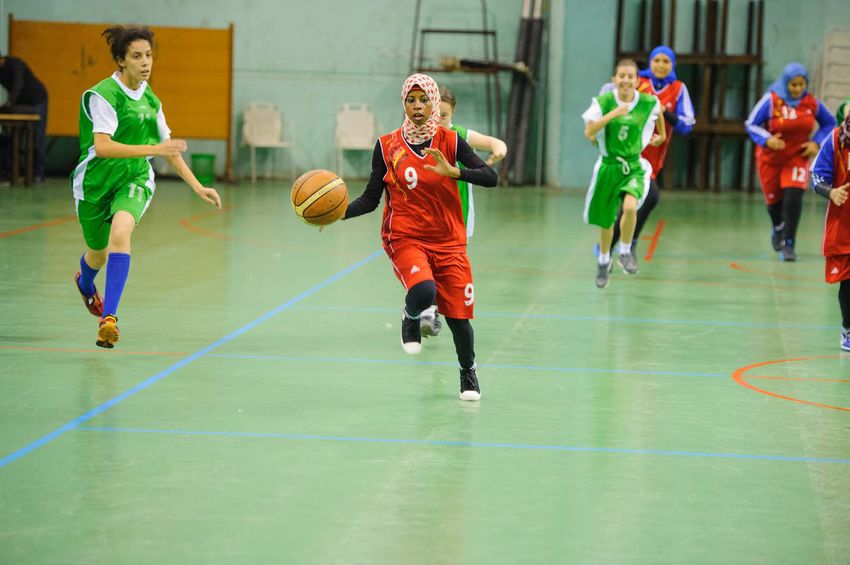
Head Coverings: Head coverings for religious reasons must be documented with prior to
tournament play and meet the same safety standards as for a medical head covering. Head
covering must be of a single, solid color unadorned. This includes, but not limited to, sequins,
trimmings, or any other forms of decorations. The only exception is an athlete may wear a
head band no wider than two in and made of nonabrasive, unadorned single colored cloth,
elastic, fiber, soft leather or rubber. Rubber/cloth (elastic) bands may be used to control hair.
They do not need to match uniform color. Sweatbands are also allowed. In the event an
athlete is required by a licensed medical physician to cover his or her head with a covering or
wrap, the physician’s statement must be on file before it can approve a covering or wrap,
which is not abrasive, hard, or dangerous to any other player and which is attached in such a
way that is highly unlikely to come off during play.
Individuals who do not adhere to uniform regulations will not be allowed to enter a game.
7. HALF-COURT BASKETBALL: 3-ON-3 COMPETITION
Divisioning
The Head Coach must submit the scores from both of the Basketball Skills Assessment Tests
(BSAT), e.g., dribbling and perimeter shooting, for each player on his/her roster prior to
competition.
The Head Coach must also identify his/her three best players in terms of their on-court
playing ability by placing a star next to their names on the roster.
The team score shall be determined by adding the top four players’ scores and then dividing
that total by four.
Teams are initially grouped in divisions according to their BSAT team score.
A classification round of games shall then be conducted as a means of finalizing the
divisioning process.
In the classification round, teams will play one or more games with each game
lasting no longer than six minutes.
Teams may be moved from any pool throughout the pool play process in
order to maintain competitive balance. The Divisioning Committee
reserves the right to adjust the divisioning prior to the medal round.
Every effort will be made to guarantee the integrity of the games and
divisioning process. The ultimate goal of the Committee is to select
divisions with teams of similar ability. The decision of the Committee is
final and may not be appealed/protested.
Each team will be required to play all team members.
The Goal
Half-court basketball may be used as a means of increasing the number of teams for Special
Olympics basketball competition.
It is also a means of assisting athletes with lower ability levels to progress to full court play.
However, efforts must be made to play regulation team basketball whenever possible.
Playing Area and Equipment
13 VERSION: June 2016
© Special Olympics, Inc., 2016
All rights reservedBASKETBALL SPORT RULES
Any half-court section of a basketball court may be used. The court will be bounded by the
end line under the basket, two sidelines and the half-court line.
Each team must wear a uniform shirt. Team shirts shall be of the same solid color, front and
back. Each player shall be numbered on the front and back of the shirt with plain Arabic
numbers of at least 20 centimeters (6-8 in) high on the back and 10 centimeters (4 in) high on
the front and not less than 2 centimeters (3/4 in) in width. All numbers are to be per NGB
specifications.
Team and Players
A team may have up to five players, which includes three starters and two substitutes.
Half-court basketball is a game of three-on-three. Each team must start the game with three
players. A team may drop below three after the start of the game due to player injury or
illness but must have three to start the game. For Unified 3 vs. 3, the ratio will be one athlete
and one partner. A team may not drop below a minimum of two athletes or will have to
forfeit the game.
The Game
The game will be played for 20 minutes or until one team scores 20 points. A made field goal
counts two points, unless attempted from the three-point field goal area, when it counts
three points.
There will be a running clock applied until the final minute of regulation play. During
this time, the clock will stop for all dead ball situations (e.g., fouls, violations, field
goals, and timeouts).
The game will start with a flip of a coin for possession. There is no jump ball. All jump
balls will be administered by alternate possession, starting with the team that wins
the flip of the coin.
The winning team is the first team to score 20 points or the team with the highest
score after the 20-minute game.
If overtime is required due to a tie at the end of regulation play, it will begin with a
flip of a coin for possession. A one-minute intermission will follow regulation play
and each overtime period. The amount of time for an overtime period is three
minutes. The clock will stop during the last minute of overtime for all dead ball
situations.
Competition
The referee will handle the ball on all out-of-bounds plays.
The ball is dead after a foul or violation is called, a field goal is made or any other time the
referee blows his/her whistle.
Teams change possession of the ball after made field goals. However, if a player is fouled in
the act of shooting and makes the basket, the field goal is credited, and the offended against
team retains possession of the ball.
The in-bound spot in all cases (fouls, violations, out-of-bounds, made field goals, timeouts)
will be behind the foul line extended at a designated spot within the restraining circle at the
top of the key marked with an “X”. This procedure is used for all fouls, violations, time-outs,
out-of-bounds and made field goals. The in-bounder will be at the designated spot; all other
players are permitted to have players continue to play defense on any offensive player that
moves in those directions.
On any change of possession, the team which just gained possession of the ball must take the
ball back behind the foul line extended before shooting. In taking the ball back, either the
14 VERSION: June 2016
© Special Olympics, Inc., 2016
All rights reservedBASKETBALL SPORT RULES
ball or the foot of the player in possession must touch the foul line extended or the area
behind it.
A violation has occurred when the defense who has just gained possession of the ball
attempts a field goal without taking it back behind the foul line extended. If a shot is
attempted by the defense after a gained possession without taking it back to the free-throw
line extended, the possession returns to the offense as a dead ball and will need to be
inbounded from the “X”.
Substitutions may be made on a dead ball. When one team makes a substitution, the other
team must be given an opportunity to substitute as well. Players entering the game must
report to the scorer’s table and be beckoned into the game by the referee.
Two 60-second timeouts are allowed per team. When a timeout is called, the clock will be
stopped. A player injury timeout may be called by the referee. The referee may stop the clock
at his/her discretion and is advised to do so at any time. For example, allowing the clock to
run when the ball bounces well out of play gives one team an unfair advantage.
Consequently, the clock should be stopped.
A held ball is called when opposing players have one or both hands so firmly on the ball that
possession can be gained only by force. The ball is awarded on the basis of alternate
possession.
On those courts where the basket support is on the playing court, a player whose body
touches the support is not considered out-of-bounds unless he/she has control of the ball. If
the ball touches the support, it is considered out-of-bounds. No player may use the support
to gain advantage or put an opposing player at a disadvantage.
Officials will grant a player or a coach’s oral or hand signal request for a timeout.
Fouls and Penalties
A foul is an infraction of the rules involving personal contact with an opponent or
unsportsmanlike behavior. It is charged against the offender.
On all fouls (personal, common, technical), the offended against team will get possession of
the ball at the designated spot behind the foul line extended and within the restraining circle
at the top of the key. If a player is fouled in the act of shooting and makes the basket, the
field goal is credited. The offended against team also retains possession of the ball. In all
cases, no free throws will be awarded or attempted. (See diagram below).
There are no individual or team foul limits in 3-on-3 half-court competition. However,
misconduct will result in a warning to the player and coach. Continual misconduct or flagrant
and intentional fouling will result in player dismissal.
An offensive player, including the shooter, may remain in the free throw lane for only three
seconds. The penalty for this infraction is loss of possession.
A player making a throw-in shall have five seconds to release the ball. The penalty for taking
more than five seconds shall be loss of possession.
Points of Emphasis
It is a violation for player to “double dribble.”
Concerning optional adaptations:
A player may take two steps beyond what is allowable. However, if the player scores,
“travels,” or escapes the defense as a result of these extra steps, an advantage has been
gained. A violation is called immediately.
Unified Sports® Events
Unified Sports Team Competition (including 3-on-3)
The roster shall contain a proportionate number of athletes and partners.
15 VERSION: June 2016
© Special Olympics, Inc., 2016
All rights reservedBASKETBALL SPORT RULES
Team 3-on-3: A team may drop below three after the start of the game due to player
injury or illness but must have three to start the game. The minimum allowable ratio
will be one athlete and one partner. Failure to adhere to the required ratio results in
a forfeit.
Team 5-on 5: Five players are required to start a game. FIBA rules allow a team to
continue to play with a lineup with as few as two players before a game is forfeited.
After a game begins and during competition, only the following lineup ratios are
allowed: 3 athletes and 2 partners, 2 athletes and 2 partners, 2 athletes and 1
partner, 1 athlete and 1 partners. Failure to adhere to the required ratio results in a
forfeit.
Each team shall have an adult non-playing coach responsible for the lineup and
conduct of the team during competition.
8. BASKETBALL SKILLS ASSESSMENT TESTS (BSAT)
Dribbling
Set-up: An area of the basketball court (preferably along a sideline or down the center line),
six cones, floor tape and four basketballs one that the athlete is provided initially, two others
that are for back-up in case the basketball bounces away, and one more to continue the test.
Time: 60 seconds for one trial.
Test
A player is instructed to dribble the ball while passing alternately to the right and to
the left of six obstacles placed in a line, 2 meters (6 ft 6 3/4 in) apart, on a 12 meter
course.
The player may start to the right or to the left of the first obstacle but must pass
each obstacle alternately thereafter.
When the last obstacle is passed and the finish line reached, the player puts the ball
down, sprints back to the start for the next ball, and repeats the slalom.
The player continues until 60 seconds have elapsed.
If a player loses control of the ball, the clock continues to run.
The player recovers the ball or picks up the nearest back-up ball and may re-enter at
any point along the course.
Scoring
One point is awarded each time a cone is passed. (For example, if the player
successfully dribbles the ball from the starting line, weaves in and out through the
16 VERSION: June 2016
© Special Olympics, Inc., 2016
All rights reservedBASKETBALL SPORT RULES
entire obstacle course one time, and places the ball down at the finish line, a score
of five has been achieved.
The player must use legal dribbles and must have control of the ball during a
midpoint-to-next-midpoint space in order to get credit for that cone successfully
passed).
The player’s score is how many cones (midpoints) he/she successfully passes in 60
seconds.
Staging
Volunteers administer the test and are not to interfere with any player who is
performing the test.
Volunteer A will instruct the group doing this particular test while Volunteer B
demonstrates the actual test.
Volunteer A will give a basketball to the player who will take the test, ask him/her if
ready, will then say, “Ready”, “Go” and will count how many cones the player passes
in 60 seconds.
Volunteers B and C, who are standing behind the extra balls, will retrieve and
replace the basketball whenever it goes out of play.
Volunteer D will time and record the athlete’s score.
Each volunteer is to administer the test and manage the area only.
Perimeter Shooting
Set-up: A goal, the official NGB free throw lane, floor tape and two basketballs, one that the
athlete is provided initially, another that is for back-up in case the basketball bounces away.
Time: one trial of one minute.
Test
A player stands at the juncture of the free-throw line and lane, either to the left or
right. The player dribbles toward the goal and attempts a field goal of his/her choice
outside the 2.75 meter (9 ft) arc.
This attempt must be taken anywhere outside the 2.75 meter arc marked off by a
dotted line. [This arc intersects with the free-throw restraining circle].
The player then rebounds the basketball (made or missed shot) and dribbles
anywhere outside the arc before attempting another field goal.
The player shall make as many field goals as described above in one one-minute trial.
Scoring
Two points are awarded for each field goal made within the one-minute trial.
Staging
Volunteers administer the test and are not to interfere with any player who is
performing the test.
Volunteer A will instruct the group doing this particular test while Volunteer B
demonstrates the actual test.
Volunteer A will give a basketball to the player who will take the test, ask him/her if
ready, will then say, “Ready, Go,” and will count how many field goals the player
makes in one minute.
Volunteer B, who is standing behind the extra ball, will retrieve and replace the
basketball whenever it goes out of play.
Volunteer C will time and record the athlete’s score.
Each volunteer is to administer the test and manage the area only.
17 VERSION: June 2016
© Special Olympics, Inc., 2016
All rights reservedBASKETBALL SPORT RULES
9. COURT AND EQUIPMENT
Basketballs
Male competition for athletes 12 years and over should use a size 7 basketball.
Circumference: between 749 millimeters [29.5 in] and 780 millimeters [30.7 in]
Weight: between 567 grams [20 oz] and 650 grams [23 oz]
Female competition for athletes 12 years and over should use a smaller size 6 basketball.
Circumference: between 724 millimeters [28.5 in] and 737 millimeters [29 in]
Weight: between 510 grams [18 oz] and 567 grams [20 oz]
Competition for all athletes (male and female) under 12 years of age should use a smaller
size 5 basketball.
Circumference: between 686 millimeters [27 in] and 724 millimeters [28.5 in]
Weight: between 397 grams [14 oz] and 454 grams [16 oz])
Baskets
The baskets shall comprise the backboard, rings and nets.
For competition, the basket ring is normally 3.05 meters (10 ft) above the floor.
A shorter basket which has its ring 2.44 meters (8 ft) above the floor may be used for junior
division competition.
18 VERSION: June 2016
© Special Olympics, Inc., 2016
All rights reservedYou can also read


