BBSRC Research in Food, Nutrition and Health - Strategic Framework: 2015 2020
←
→
Page content transcription
If your browser does not render page correctly, please read the page content below
BBSRC Research in
                          Food, Nutrition and Health
                          Strategic Framework:
                          2015 – 2020
iStock Copyright Thinkstock
BBSRC Research in Food, Nutrition
and Health – Strategic Framework: 2015 – 2020
Food, Nutrition and Health is a complex and interdisciplinary research                                                            Key goals
area with key public health and economic relevance. This document                                                                 • T
                                                                                                                                     o foster a more co-ordinated
aims to provide the academic and wider stakeholder communities                                                                      approach to research in food, nutrition
with a clear roadmap for BBSRC’s strategic support for the area over                                                                and health through better integration
                                                                                                                                    of nutrition science, production and
the next five years, complementing the joint vision of BBSRC, MRC
                                                                                                                                    food processing research - including
and ESRC for integrative research across Council remits. It focuses on                                                              fundamental plant and animal studies
those aspects which form part of BBSRC’s Strategic Research Priority
in Bioscience for Health, but clearly recognises and seeks to foster                                                              • T
                                                                                                                                     o understand diet-mediated
synergies with the Agriculture and Food Security priority in supporting                                                             physiological changes on the
                                                                                                                                    transition between healthy and
research to inform the sustainable provision of safe and nutritious food.                                                           unhealthy or dysregulated states

BBSRC’s Vision for research in                   By harnessing expertise across the BBSRC                                         • T
                                                                                                                                     o understand how relationships
                                                 research space from crop and livestock science                                     between food and health change over
Food, Nutrition and Health                                                                                                          the lifecourse, and how these changes
                                                 to food science and human physiology, BBSRC
It is only by fully understanding the            aims to foster multidisciplinary and integrative                                   may be influenced by genotype, epi-
interactions between food, nutrition and         research which will address complex questions                                      genotype and microbiome
physiological systems that they can be           around the production, processing and
preserved or enhanced to promote long-term       consumption of healthy foods. This research                                      • T
                                                                                                                                     o advance understanding of the
health. BBSRC’s vision is therefore to support   will underpin a stronger and more coherent                                         mechanistic basis of a healthy gut, its
world-class research which will make use         evidence base to inform nutritional policy                                         relationship with wider physiological
of emerging techniques and technologies          decisions and develop new or reformulated                                          function and potential for
to advance understanding of how foods,           foods which will enhance health. The                                               manipulation to positively influence
nutrients and whole diets influence cellular     knowledge gained will be crucial to addressing                                     health
processes, how these influences affect overall   the growing social and economic challenges
health outcomes, and how these responses         posed by modern lifestyles and dietary habits,                                   • T
                                                                                                                                     o understand the health implications
vary between population groups, individuals      and driving innovation in a key manufacturing                                      of modern lifestyles and food
and across the lifecourse.                       sector for the UK economy.                                                         processing techniques

                                                                                                                                  • T
                                                                                                                                     o understand the biological and
                                                                                                                                    behavioural determinants of food
                                                                                                                                    intake, including sensory qualities and
                                                                                                                                    satiety

                                                                                                                                  • T
                                                                                                                                     o actively collaborate with the food
                                                                                                                                    industry to drive innovation in healthy
                                                                                                                                    food products

                                                                                                                                  • T
                                                                                                                                     o generate a robust evidence base
                                                                                                                                    which will underpin policy to influence
                                                                                                                                    food behaviour
                                                                                                    iStock Copyright Thinkstock

                                                                                                                                                                   1
The strategic importance of research and
innovation in Food, Nutrition and Health
Changing diets and dietary                        is vast at around £16bn per annum, rising to     CASE STUDY: Dietary
                                                  £50bn by 2050 if new strategies to address       cholesterol and cardiovascular
habits are placing an                             the consequences of modern lifestyles are        disease risk: the public health
unsustainable burden on                           not developed9.                                  and economic consequences
healthcare systems, individuals,                                                                   of (mis)understanding
families and societies                            As costs escalate, the need for products and     correlations
                                                  interventions to prevent or manage the wide
Adequate nutritional status and appropriate       range of chronic diseases with strong dietary    Reducing the burden of cardiovascular
energy balance are fundamental                    influences is becoming ever more pressing.       disease, which claims over two million
requirements for continued health, yet            The potential benefits are significant:          life-years annually in the UK11, is a major
more than half of the UK population are           reducing cardiovascular events by just 1%        aim of public health policy. Whilst the link
obese or overweight1, consumption of fruit        would result in savings to the National Health   between increased plasma cholesterol
and vegetables is falling2 and the calorie        Service of at least £30M per year10.             and cardiovascular disease is well
density of the average shopping basket is
                                                                                                   established, heart-health policy to limit
increasing3. Around three million people in
the UK are malnourished, including 25% of
                                                  Many of the mechanisms                           consumption of cholesterol-rich foods was
those in hospital 42% in long-term care4.         underpinning the effects                         based on the unfounded assumption that
                                                                                                   dietary cholesterol is a key determinant
Consequences of malnourishment include            of food and nutrition on                         of plasma cholesterol12. Subsequent basic
impaired growth and development and               long-term health are under-                      research and epidemiological studies have
compromised immune function, making
improved nutritional care one of the largest
                                                  investigated                                     clearly demonstrated that there is, in fact,
                                                                                                   no direct relationship between dietary
potential cost-savings for the NHS5.              Despite the clear influence of diet on health,
                                                                                                   and plasma cholesterol13.
                                                  many of the fundamental mechanisms
Poor or inappropriate nutrition is also           which link nutritional intake to physiological
                                                                                                   By dispelling a misguided assumption,
associated with increased cardiovascular risk,    consequences remain undetermined.
                                                                                                   this advance in understanding of the
cancer and serious chronic conditions such as     Epidemiological analysis is valuable in
                                                                                                   relationship between nutritional intake
Type 2 diabetes and hypertension, placing a       identifying correlations between foods or
                                                                                                   and physiological outcome has driven
large proportion of individuals at increased      diets and health outcomes, but without a
                                                                                                   revision of dietary policy in Europe
disease risk. The widespread tendency             firm mechanistic basis such evidence can
                                                                                                   and beyond, leading to the removal of
towards consumption of excess energy and          be uninformative or misleading (see case
                                                                                                   restrictions on cholesterol-containing
consequent rise in obesity-related disease        study Dietary cholesterol and cardiovascular
                                                                                                   foods, including eggs, in 200614. Its
is therefore a pressing challenge for the         disease risk below). The robust and
                                                                                                   impacts have gone beyond nutritional
developed and, increasingly, the developing       authoritative evidence base which can only
                                                                                                   guidelines to influence public perception,
world6. High body mass index is one of the        be delivered through basic research is crucial
                                                                                                   with a significant shift in public perception
leading risk factors for chronic disease in the   to development of healthier food products,
                                                                                                   of the risks and benefits associated with
UK, accounting for 8.6% of the burden of          optimisation of nutritional guidelines and
                                                                                                   egg consumption15 following a media
all disease7 and 9% (£5.1bn per annum) of         determination of effective intervention
                                                                                                   campaign. Consumer egg sales, having
NHS spend8. The cost to the wider economy         strategies.
                                                                                                   been previously stagnant, increased by
                                                                                                   6.1% year-on-year between 2009 and
                                                                                                   201116, providing an important source of
                                                                                                   nutrients (including vitamin D, vitamin
                                                                                                   K and selenium)17 and generating
                                                                                                   additional revenue for poultry farmers.

       2
There is therefore an urgent need to
answer fundamental questions about                 CASE STUDY: Fat, fat, fat or sugar? A key outstanding question
the ways in which nutrients, foods and
whole diets interact with biological and
                                                   Largely on the basis of epidemiological evidence linking total cholesterol levels to
behavioural systems to influence health.
                                                   cardiovascular disease (CVD) and cancer risk, dietary guidelines over the past decade
For example, the gut is the primary point
                                                   have consistently recommended reducing total, and particularly saturated, fat intake. As a
of interaction between foods and the body,
                                                   consequence, many products have been reformulated to substitute carbohydrate for fat,
yet understanding of its healthy function,
                                                   or unsaturated for saturated fats. However, evidence is emerging that the relationships
including relationships to immunity, allergy
                                                   between fats (saturated, monounsaturated and polyunsaturated), carbohydrates and
and intolerance, is far from complete. More
                                                   disease risk is complex and, in the absence of a full understanding, policy and reformulation
widely, determining the precise effects of
                                                   may be doing harm as well as good.
nutrients and bioactive compounds on
cell function will be key to understanding
                                                   Some evidence suggests that substituting carbohydrates for fat can have adverse health
how whole diets influence physiological
                                                   consequences by raising triglyceride levels and reducing beneficial HDL cholesterol19, with
processes such as resilience, metabolic
                                                   associated increases in Type 2 diabetes and CVD risk20. In contrast, substituting unsaturated
stress and ageing. Research to uncover the
                                                   for saturated fat may be actively beneficial for CVD risk, possibly by reducing levels of
influences of genotype and microbiota will
                                                   damaging LDL cholesterol without affecting HDL cholesterol21. The evidence for dairy
aid understanding of individual differences
                                                   products - a major source of saturated fatty acids in UK diets – is complex, with recent
in dietary responses, whilst elucidation of
                                                   large-scale analyses suggesting that milk consumption is associated with a reduction in CVD
the behavioural determinants of food intake
                                                   disease risk22. The picture is complicated further by evidence from animal studies that high
will be crucial to understanding consumer
                                                   levels of some polyunsaturated fats, including omega-6, may promote tumour growth23 and
responses to new products or guidelines.
                                                   inflammation.

Effective nutritional advice                       It is not clear whether these effects are present in humans and at what levels they may
requires accurate definition                       become apparent. What is clear is that our understanding of what constitutes a “healthy
of nutritional needs between                       diet” is far from complete, and policy decisions made on the basis of incomplete evidence
                                                   may have unintended consequences for public health. Fundamental research into these
individuals, population groups                     relationships is urgently needed in order to inform the guidelines, reformulation and
and across the lifecourse                          consumer information which will be most beneficial to public.
Appropriate nutritional advice and effective
public health messaging depend upon
reliable evidence to determine diets            hypersensitivities will underpin development      properties of existing products. Recent
which will benefit health. Whilst there is      of stratified public health advice and            reductions in the salt, trans- and saturated-
much advice and policy based on valid           improved health outcomes. For example,            fat content of foods available to the UK
existing knowledge, in many cases the           a full understanding of the consequences          consumer, and consequent reduction in
lack of robust underpinning evidence base       of diet for processes such as cognitive           consumption amongst the UK population25,
leaves key questions unanswered and             decline could make a major contribution to        is testament to the potential for industrial
recommendations uncertain. Incomplete           extending health and independence in line         innovation to improve diets independent
understanding of the basic relationships        with increasing life expectancies.                of behaviour change (see case study Salt
between food and health means that advice                                                         reduction in UK diets below).
around what constitutes a “healthy diet” is     Innovation in the food industry
subject to revision and reassessment (see       depends upon underpinning
case study Fat, fat, fat or sugar above),
                                                research
leading to confusion and often cynicism
towards dietary advice18.                       Food and drink industries are of critical
                                                importance to the UK economy. They
Provision of effective nutritional advice is    constitute the largest manufacturing sector,
further complicated by largely unexplored       contributing £24.7bn per annum to the
differences in requirements between             UK economy and employing 16% of the
                                                                                                                                                   iStock Copyright Thinkstock

individuals, population groups and across the   manufacturing work force24. They are also key
lifecourse. Understanding the interactions      players in addressing the challenges posed
between food and physiology at critical         by modern diets. Food innovation is crucial
stages of the lifecourse, including pregnancy   to developing the healthier products which
and early life, in the context of differing     will widen consumer choice, and to achieving
genetic profiles and amongst those with food    effective reformulation to improve the health

                                                                                                                                        3
CASE STUDY: Salt reduction in UK diets: the benefits of establishing
a robust causal association between intake and disease

The link between increased sodium consumption - through dietary salt - and raised blood
pressure, with consequent effects on cardiovascular disease risk, is now well known and an
important determinant of dietary policy across the world. However, it has not always been
apparent. The association was established through a robust combination of mechanistic
studies and epidemiological analysis, identifying the adverse effects of sodium on fluid
homeostasis26 and demonstrating an association between salt intake and hypertension27.

The consequences of confidently establishing this link have been significant. Following
recommendations made by the Scientific Advisory Committee on Nutrition in 200328, the
Department of Health and Food Standards Agency set a target to reduce average adult salt
consumption to 6g per day. Their policy approaches have been varied, encompassing public
awareness campaigns, clear front-of-pack labelling and, crucially, collaboration with the food

                                                                                                                                                                                  iStock Copyright Thinkstock
industry to reformulate the processed foods which contribute 75-80% salt in UK diets29.

Between 2003 and 2011, average UK adult salt intake has fallen by 15% (from 9.5 to 8.1g
per day)30 – a reduction which has removed more than 11 million kg salt from UK plates and
is estimated to have prevented at least 9,000 deaths from stroke and heart attack31. Targets
set in 2006 and 2010 have been largely met by UK retailers, achieving a 30% reduction in
the salt content of pre-packaged bread and 49% in branded breakfast cereals32. A new set
of targets was agreed in March 2014, aiming for further significant reductions by 2017.
                                                                                                                                  Policy and consumer pressure to develop
There is clearly progress still to be made in reducing salt intake, and doing so will require                                     healthier products is increasing, presenting
careful consideration of the technical and antimicrobial properties of salt in food production,                                   significant opportunities for businesses
as well as consumer palates. However, significant improvements over the past ten years de                                         able to produce innovative health-
demonstrate the substantial policy and industry impact of collaboration on the basis of a                                         promoting products, including probiotics
robust underpinning evidence base – a model which is now being replicated worldwide33.                                            and nutraceuticals, or to reform existing
                                                                                                                                  products with improved health benefits
                                                                                                                                  and unimpaired palatability. However, the
                                                                                                                                  significant gaps in understanding of the
                                                                                                                                  mechanisms which link food components
                                                                                                                                  to health benefits make it difficult to
                                                                                                                                  substantiate health claims to the approval
                                                                                                                                  of regulatory bodies, stifling innovation and
                                                                                                                                  inhibiting informed consumer choice.

                                                                                                                                  Fully exploiting these opportunities will
                                                                                                                                  require innovation underpinned by a strong
                                                                                                                                  body of research evidence, together with
                                                                                                                                  effective harnessing of industry expertise
                                                                                                                                  to inform academic research. A full
                                                                                                                                  understanding of the relationships between
                                                                                                                                  processing methods and nutritional value,
                                                                                                                                  and between the structures of foods and
                                                                                                                                  neurobiological responses will be critical,
                                                                                                                                  both to drive innovation and to ensure
                                                                                                                                  that developments in production and
                                                                                                                                  manufacturing effectively benefit health
                                                                                                                                  outcomes.

Figure 1: the crucial position of the fundamental research base relative to policy, industry, regulation and public perception.
Robust research will underpin more effective food policy and regulation, industrial innovation and public health messaging

         4
New opportunities for research in Food,
Nutrition and Health
Advances in basic science are                    Improvements in the sensitivity and                                              placed to take advantage of the latest
                                                 resolution of ‘omics technologies, coupled                                       opportunities to drive forward increased
generating new approaches
                                                 with increased data-handling capacity, are                                       understanding of the mechanisms by which
and techniques to address key                    facilitating comprehensive characterisation                                      food and nutrition are linked to biological
questions in food, nutrition                     of biological systems. They offer new                                            outcomes. The UK is also world-leading in its
and health                                       opportunities to determine how foods                                             breadth and depth of cohort studies, many
                                                 and nutrients interact with genes, proteins                                      including nutritional intake, physiological
New techniques and technologies are              and metabolites to influence health, and                                         and genetic data collected over many years,
already generating fresh insight into how        particularly to characterise and analyse the                                     providing a key epidemiological resource
nutrition operates at a molecular and cellular   gut microbiome. ‘Omics technologies are                                          from which hypotheses can be formed and
level, and have the potential to radically       likely to play an important role in identifying                                  mechanistic analyses developed.
advance understanding. New model systems,        and validating biomarkers for health and
including the self-organising mini-guts          nutritional status, and, in the longer term,
derived from BBSRC investment in stem-cell
                                                                                                                                  Computational innovation
                                                 may provide the basis for stratified nutritional
research, will allow researchers to study the    recommendations for optimal health specific
                                                                                                                                  is making complex problems
gut as an organ, rather than a collection of     population groups.                                                               more tractable
individual cells. Developing in-vivo imaging
                                                                                                                                  The relationships between food, nutrition
capability is providing new possibilities to     The UK and BBSRC have world-class science                                        and health are complex, requiring both
study processes such as bacterial colonisation   basis upon which to build. Strength in                                           detailed physiological studies and high-
of the gut in real-time and in complex           molecular biology, biochemistry, genetics                                        throughput multi-scale approaches to unpick
biological settings.                             and epigenetics means that we are well                                           them. However, this complexity is being
                                                                                                                                  rendered increasingly tractable by advances
                                                                                                                                  in analytical capabilities and the increasing
                                                                                                                                  acceptance of data sharing.

                                                                                                                                  Systems-based approaches, made possible
                                                                                                                                  by improvements in computational power
                                                                                                                                  and data-handling capacity, will provide new
                                                                                                                                  opportunities for researchers to tackle the
                                                                                                                                  multiple levels of interaction between food,
                                                                                                                                  nutrition and health. Where research has
                                                                                                                                  often been reductive in assessing the effect
                                                                                                                                  of one nutrient on one phenotypic outcome,
                                                                                                                                  systems analysis will facilitate consideration
                                                                                                                                  of whole diets and complete physiological
                                                                                                                                  systems.

                                                                                                                                  BBSRC’s Exploiting New Ways of Working
                                                                                                                                  research priority offers strong support for the
                                                                                                                                  development of innovative bioinformatics
                                                                                                                                  tools, technologies and approaches.
                                                                                                                                  Researchers in food, nutrition and health
                                                                                                                                  will be supported in making full use of these
                                                                                                                                  opportunities to ensure that the potential
                                                                                                                                  offered by new technologies and modes of
                                                                                                                                  working is fully realised.
                                                                                                    iStock Copyright Thinkstock

                                                                                                                                                                        5
DRINC as a mechanism
                                                                                                                  for fostering integrative
                                                                                                                  research

                                                                                                                  BBSRC, in partnership with MRC and
                                                                                                                  EPSRC, established the Diet and Health

                                                                                    iStock Copyright Thinkstock
                                                                                                                  Research Industry Club34 in 2007. The
                                                                                                                  club involves 15 company members, who
                                                                                                                  contribute to research funds and form
                                                                                                                  part of the grant awarding panel. Through
                                                                                                                  25 projects at 26 research centres, over
                                                                                                                  £15M has been provided to support high
                                                                                                                  quality pre-competitive research into diet
Multidisciplinary and                              •	human and food microbiology; to                             and health within UK universities and
                                                      understand interactions in the GI tract in                  research institutes, helping the food and
integrative research provides                                                                                     drink industry to develop and deliver new
                                                      relation to health and disease
new opportunities to                                                                                              foods of benefit to the consumer (see
understand the relationships                       The importance of integrative research                         case study Vitamin D or Vitamin D? for
between food, nutrition and                        across Research Council remits is reflected                    an example of research funded through
                                                   in a new joint vision for food, nutrition and                  DRINC).
health
                                                   health research between BBSRC, MRC and
Unpicking what is truly meant by healthy           ESRC. By approaching the challenges of food,                   DRINC has brought together over 200
nutrition, and how we can best deliver it, is      nutrition and health research from a joint                     academic and 100 industrial researchers
a multidisciplinary challenge. Insight will        perspective, the Councils will support their                   through regular dissemination events
come from disciplines across crop science,         respective communities in identifying and                      and workshops, forming a community
food science, basic biology, health and            exploiting areas in which integrative research                 which has secured an additional £25M
clinical science, epidemiology, behavioural,       bringing together basic bioscience, health,                    of funding. Following an independent
social and political science – but the complex     medical and social science can address                         evaluation in 201135, DRINC is building
nature of key research questions means that        problems more effectively than individual                      on its success with a second phase of
they are not well served by interrogation          disciplines.                                                   research projects worth approximately
from individual perspectives alone. The                                                                           £10M.
strong impetus for research funders to work        The multifactorial nature of challenges
in effective partnerships, taking advantage        in food, nutrition and health mean that
of differing areas of expertise, will foster new   partnerships must go beyond academic
approaches to complex challenges. It will          research funders to stakeholders in the policy
also address research gaps, avoid overlaps,        and industrial communities (see below).
tackle interface issues and make more              In supporting research, academic funders
efficient use of overall resources.                must draw on their understanding and
                                                   consider their needs as end-users who will be
Particular opportunities for BBSRC exist in        instrumental in deriving economic and social
integrative research between                       impact from fundamental research. Through
                                                   leadership of the Diet and Health Research
•	nutrition and fundamental bioscience;           Industry Club (DRINC; see case study
   to understand the mechanisms which              below), schemes such as LINK and Industrial
   underpin relationships between food,            Partnership Awards and collaborative funding
   nutrition and health                            with Innovate UK as part of the Nutrition
                                                   for Life programme, BBSRC investments are
•	human, plant and animal (livestock)             already demonstrating the benefits of cross-
   biosciences; to understand the                  sector partnerships. BBSRC is committed to
   relationships between nutrient (macro and       working in partnership with other funders
   micro) and bioactive content (including         and stakeholders, and will maintain a
   bioavailability and bioaccessibility) and       prominent role in joint activities to maximise
   health implications, informing agricultural     the impact of knowledge gained from
   research aims                                   fundamental research.

       6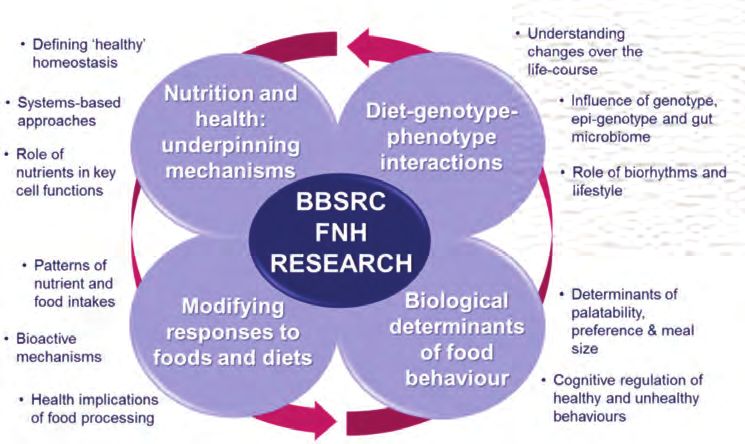
BBSRC’s role in the Food, Nutrition and
Health research landscape
                                                                                                                                      iStock Copyright Thinkstock

Research across the food
system
BBSRC has responsibilities for bioscience
research from basic plant, microbial and
animal science to food science, food safety
and human nutrition – placing it in a unique
position of responsibility for research across
the food system. Addressing the nutritional
challenges facing the UK and the world will
require solutions which encompass the whole
food chain, and BBSRC is well-placed to
integrate human physiological research with
the plant, microbial, animal and food science
within its remit.

Whilst the research challenges in food,
nutrition and health outlined in this
document sit primarily within BBSRC’s
Bioscience for Health strategic priority,        materials – such as alternative types of          BBSRC’s investment in strategically focussed
there are strong links to the Agriculture and    fibre in an identical grain matrix – which will   food, nutrition and health research is built on
Food Security priority – and to the cross-       enhance the ability of nutritional studies to     a large foundation of underpinning world-
Council Global Food Security programme.          determine physiological effects of specific       class bioscience, which supports fundamental
For example, BBSRC is in a strong position to    food components. This information, together       understanding of healthy systems. BBSRC
bring together the crop science community        with consideration of processing and other        is therefore in an excellent position to
with nutritional and food scientists for         factors, can in turn inform the development       build capacity for mechanistic research by
integrative research which considers crop        of crops which will produce healthier foods.      linking nutrition with underpinning work in
characteristics and how they relate to           BBSRC will make full use of its range of          cell biology, immunology, gut physiology
health through processing. Plant and crop        interests in bioscience to foster this type of    and others. It is only through embedding
science can supply fully characterised food      integrative research across its portfolio.        nutrition research in leading-edge basic
                                                                                                   biology that fundamental questions around
                                                 Mechanistic research in food                      precisely how food and nutrients influence
                                                                                                   health can be addressed.
                                                 & nutrition
                                                 The research landscape in food, nutrition and     In line with its research funding, BBSRC has a
                                                 health is complex, with many national and         leadership role in advocating the importance
                                                 international funders across the spectrum         of fundamental research in food, nutrition
                                                 from agricultural research to food behaviour.     and health. It is crucial that other funders
                                                 BBSRC has a crucial role in supporting            and stakeholders recognise the importance
                                                 the fundamental bioscience research               of developing a mechanistic understanding
                                                 which will provide robust, authoritative          of healthy systems, and appreciate the
                                                 evidence on which nutritional policy can be       contribution that bioscience research will
                                                 based and healthier products developed.           make to development of new products
                                                 BBSRC’s responsibility in this area has been      and a strong evidence base for policy and
                                                 heightened by the changing roles of the           regulatory decisions.
                                                 Food Standards Agency and Department of
                                                 Health, which has left a critical gap in public
                                                 funding for nutrition and health research.

                                                                                                                                         7
Food processing and links to Around half of this investment is made
through Institute Strategic Programme
the food industry CASE STUDY: Vitamin D or
Grants, which play a key role in providing
Vitamin D? The science of
Unlike many funders in the food, nutrition sustained and coordinated support for
supplementation
and health research landscape, BBSRC’s research not conducted in HEIs. The Institute
remit includes the basic food science of Food Research (IFR) is a particular focus
Vitamin D is crucial for bone and muscle
which will inform optimal processing and for both fundamental and translational
health and there is concern that many
manufacture. Without careful consideration research, hosting the Food and Health
people do not get enough of it, either
of the consequences of processing, the health and Gut Health and Food Safety Strategic
through their diet or exposure to sunlight.
benefits of “improved” plant materials may be Programme Grants.
As a result, many foods are fortified with
lost, or resultant products may be unpalatable.
vitamin D and it is commonly included in
Food science and processing research will also A proposed new Centre for Food and Health
nutritional supplements.
enable reformulation of existing products with in Norwich aims to build on BBSRC strategic
enhanced health benefits. investments in IFR and across the wider
However, vitamin D comes several
Norwich Research Park, in partnership
forms and new research is suggesting
Food processing and manufacture is of with the University of East Anglia and the
that they may not have equal health
crucial importance to the food industry, North Norfolk University Hospital. Its vision
benefits. Vitamin D3 (cholecalciferol) is
who stand to gain from innovative products is to uniquely integrate multidisciplinary
the type found in animal-derived foods
with enhanced health benefits. BBSRC has bioscience and clinical excellence to deliver
and produced in human skin on exposure
developed strong links to the food industry, new understanding of interactions between
to sunlight, but most fortification and
ensuring that research is informed by food and the gastro-intestinal tract and their
supplementation is in the form of plant-
industrial needs and effectively translated implications for health, production of safe
derived vitamin D2 (ergocalciferoland).
where appropriate (see case study Vitamin and nutritionally enhanced crop-based food
D or Vitamin D? right). These links will be and accelerated innovation and commercial
Research funded by the Diet and Health
developed to ensure that, where processing exploitation by UK industry.
Research Industry Club suggests that
research is directly related to enhanced
vitamin D3 is more effectively converted
health properties, BBSRC continues to be an The remaining half of the research portfolio
than vitamin D2 to the hormone
effective link between underpinning research is shared between Responsive Mode and
responsible for human health benefits36.
and industrial relevance. the Diet and Health Research Industry
This would mean that widely-used vitamin
Club, reflecting the importance of BBSRC’s
D2 supplements may be less beneficial
BBSRC’s existing investments investment in industrially relevant research.
to health than equivalent vitamin D3
Through implementation of this strategic
in food, nutrition and health framework, BBSRC will support researchers in
supplements, a realisation which could
research have significant implications for how
increasing their use of Responsive Mode to
the food industry can most effectively
complement other funding streams.
BBSRC currently invests £10-15M per annum fortify foods. Further studies to compare
on (post farm-gate) research related to supplementation are underway, together
food, nutrition and health – built on a larger with investigation into how gender,
foundation of underpinning world-class ethnicity and genetic make-up play a
bioscience. role in how our bodies use both types of
vitamin D.
iStock Copyright Thinkstock
8
Key Science Challenges
BBSRC will support underpinning science in
food, nutrition and health which addresses
the key health, policy and innovation needs
outlined above. Strategic research will
be framed around the four key research
challenges summarised (figure 2) and outlined
in more detail below, recognising that much
research will address cross-cutting questions.
Current BBSRC investment encompasses
all four of the challenges areas, reflecting
the nature of this strategic framework as a
clarification and focussing, rather than radical
change, of strategic direction.

Key research tools and approaches are
outlined alongside the research challenges.
These should not be taken to be restrictive,
but represent areas which offer potential for
significant advances in the current research
climate. The cross-cutting issues of research      Figure 2: Summary of key research challenges for strategic research in food, nutrition and health. Each challenge is outlined
                                                   in more detail below
infrastructure and capability, skills, deriving
impact and partnership needs are addressed
below.

   1. To establish how food and nutrition can optimise health and reduce disease risk

   •	by defining ‘healthy37‘ and identifying         o	Understanding dietary modulation of                           o	Understanding how maternal nutrition
      early indices of ‘unhealthy38’ states              the healthy mucosal immune system,                               and nutritional modulation during
      that are modifiable by diet                        including its relationship with allergy                          the neonatal period and other critical
                                                         and intolerance                                                  developmental stages influence later life
     o	Understanding the molecular and                                                                                   health outcomes
        cellular signatures of metabolism             o	Determining how nutrition and
        and their dynamics, and responses to             nutritional status contribute to                              o	Conducting mechanistic analysis
        stress39 in a healthy state                      resilience40 at cellular, tissue and whole                       to test hypotheses generated by
                                                         body levels                                                      epidemiological, prospective and other
     o	Using the healthy state as a                                                                                      cohort studies
        comparator to identify and                 •	by defining and understanding how dietary
        characterise early-stage homeostatic          needs and responses to dietary intake                         •	by understanding the biological basis of
        disturbance, particularly in the non-         change across the lifecourse                                     converging pathways shared between cell
        fasted (postprandial) state                                                                                    metabolism and other systems
                                                      o	Understanding and quantifying
     o	Understanding maintenance of gut                 nutritional needs and responses at
        health                                           critical times in the lifecourse and for
                                                         specific population groups

                                                                                                                                                                    9
2. To understand how diet interacts with external and internal factors to 3. To understand the contribution
modulate phenotypic responses that influence health of dietary patterns, individual
nutrients, whole and processed
• by understanding how nutrients regulate o Understanding the role of the gut foods42 and food structures to
key cell functions, including proliferation, microbiome in the metabolism and promoting and maintaining health
recognition, apoptosis, DNA repair and biological activities of food, and
cell-to-cell signalling on immune interactions and tissue
• by using systems biology43, labelling
homeostasis
and imaging approaches to study
o Understanding nutrient sensing at the responses to foods and diets
cellular level, and its consequences for • by understanding the role of biological
cellular and organ messaging, and for rhythms and lifestyle in determining
o Understanding and characterising
behavioural decision-making responses to diet and subsequent
food behaviour in the gut
health outcomes
o Understanding the mechanisms
o Understanding the uptake,
through which energy balance, nutrients o Understanding mechanisms of
processing and storage of dietary
and bioactive compounds modulate metabolic “fine-tuning” by dietary
compounds
physiological responses means
• by understanding functional
• by understanding the contribution of o Understanding the potential for
characteristics of gut receptors,
genotype to individual responses to diet sustained physiological impact of
including interaction with micro and
and consequences for health outcomes small, repeated changes in behaviour,
macro nutrients and effects on satiety
appetite, circulating metabolic
through gut-brain signalling
• by characterisation and mechanistic perturbations or energy expenditure
analysis of the gut microbiome mechanisms
• by providing robust evidence of the
mechanisms of action for bioactive
o Understanding nutritional modulation of o Hypothesis-led study of modern
components within foods44, which can
the gut microbiome and its physiological lifestyle impacts - including shift-
be translated to human models
impact on the host work, sleep deprivation, artificial light
exposure, sedentary behaviour, meal
• by understanding the effects of
o Understanding interactions between the patterning and overconsumption41
processing and modification on health-
host genotype, phenotype and the gut related food properties
microbiome which are influenced by diet
or nutritional status
o Understanding the relationship
between biofortification, food
processing and bioavailability,
including determining optimal
processing methods for maximising
nutrient bioavailability
o Manipulating the physical and
chemical structures of foods
and evaluating metabolic and
neurobiological responses
iStock Copyright Thinkstock
10Key research tools &
approaches
Key research approaches
• Systems biology; recognition that
mechanistic analysis can go beyond the
molecular
• Diet-gene interaction analysis
• Intervention studies45 to integrate
human and molecular analysis
• Human-relevant model systems for
comparative biology and life-history
analysis
• Co-ordination of high-throughput
Copyright iStock
technologies for effective mechanistic
studies
• Human in-vivo physiological studies,
including postprandial challenge
responses
4. To understand the biological determinants of personalised behavioural
responses and attitudes toward food, nutrition and health • Biomarker validation46
• Integration of food science and
• by understanding the determinants of • by understanding determinants of nutrition research
palatability and flavour preference meal size and overconsumption
• Collaboration between physiological
o Understanding the processes by o Understanding how environmental and behavioural science
which flavour preferences are learned cues promote overconsumption and • Gut microbiome modulation
and modified over time how responses can be influenced to
promote desired intake patterns General tools (which, where
o Establishing sensory/textural appropriate, should be applied
determinants of food choice with o Understanding determinants of primarily in hypothesis-driven
a focus on understanding the portion size and dietary decision research)
acceptability of lower-sodium and making, and sustained effects on
• Metabolomics
less energy-dense foods meal size, satiety and energy intake
• Transcriptomics
• by understanding the formation • by understanding “top-down” and/or • Proteomics
of unhealthy dietary habits and cognitive controls of dietary behaviour
behaviours • Genomics
o Understanding barriers to sustained • Cell biology
o Understanding bidirectional behaviour modification
• Cellular and whole-body imaging;
interactions between food and
including liver, pancreas, gut and brain
emotion o Understanding the role of memory
and attentional processes in appetite • Epigenetic analysis
o Evaluating determinants of food control • In-vivo trace-labelling
motivation and reward and
understanding their underlying • Microbiology
neurobiology • Animal models including gnotobiotic
(germ-free) animals
o Understanding how early-life
• Trace element and micronutrient
experience influences behavioural
measurement
responses to foods in adulthood
• Mathematical modelling
11Research capacity and skills
The UK has world-class facilities, resources and
people which underpin its research excellence.
Capitalising on this excellent research base
will require continued support for essential
infrastructure, and the development of young
scientists in the food, nutrition and health
area.
BBSRC will build and broaden the
fundamental research base in food, nutrition
and health through mechanisms such as
responsive mode prioritisation and Strategic
Longer Larger Grants focus areas. Sustainable
research capacity will be safeguarded by
supporting researchers in applying to and
winning funding from responsive mode, in
part by developing Committee expertise and
ensuring that interdisciplinary applications,
including those which cut across Council
iStock Copyright Thinkstock
remits, are assessed in the most appropriate
manner. Through its Exploiting New Ways of
Working enabling theme, BBSRC will ensure
that food, nutrition and health research
benefits fully from the opportunities offered
by new capacities in systems biology and
e-science. BBSRC supports and will continue to framework will be attractive to early-career encourage early-career researchers in food,
support national capacity, particularly through scientists interested in mechanistic studies nutrition and health to take full advantage
the longer term funding available to BBSRC’s of health. Furthermore, emerging interest in of the range of career support mechanisms
institutes. diverse areas - including the gut microbiome available, including David Phillips Fellowships
and gut immunology – will encourage and Doctoral Training Partnership schemes,
The focus on fundamental understanding world-class basic scientists from a range of and support more established researchers in
of gut health and its interactions with food backgrounds to apply their expertise to food, applying their skills to emerging challenges.
and nutrients outlined in this strategic nutrition and health challenges. BBSRC will
BBSRC will also facilitate networking and
collaboration between researchers across
disciplines. Fostering scientific literacy across
the plant and food science, human physiology
and human behaviour communities will be key
to enabling effective interdisciplinary research.
BBSRC will ensure that the mechanisms
available to support interdisciplinary expertise
and approaches, including Strategic Longer
Larger Awards and interchange schemes, are
fully exploited by the full breadth of the food,
nutrition and health community.
12Deriving impact from basic research in
Food, Nutrition and Health
An increased understanding of the basic the research base, food companies and other management through diet. In some cases,
mechanisms underpinning relationships key stakeholders. Effective partnerships with impact will therefore be most effectively
between food, nutrition and health can translational funders such as Innovate UK and derived by connecting fundamental research
generate significant benefits for society and industry groups such as Campden BRI and to more clinically-focused studies. BBSRC
the economy, and it is imperative that this Leatherhead Food Research (see Partnerships will engage with translational research
potential is realised wherever possible. The below) will ensure that industrial needs are funders such as the National Institute for
fundamental research supported by BBSRC communicated to researchers and support Health Research and relevant policy bodies
forms an essential part of the pipeline from effective translation of research outputs to (including the Department of Health) to
research to impact, but other stakeholders are application. support translation into clinical practice where
critical to effective translation. appropriate.
Impact through evidence-
We will continue to engage with industry A mechanistic understanding of the
and policy stakeholders to ensure effective
based policy and practice relationships between food and health will
exchange of knowledge between the research Food and nutrition are major determinants also underpin evidence for robust nutritional
community and end-users, ultimately deriving of health, and an improved understanding guidelines across the lifecourse, particularly
maximum impact from research investment. of the nature of their influence can directly during critical phases of development and
inform health strategies and consumer advice. for vulnerable groups. In the longer term,
Impact through Industrial Fundamental research in food, nutrition and understanding the variability in individual
health can therefore contribute significantly to responses to foods will facilitate more
application personalised nutritional advice. Government
evidence-based policy making, delivering the
Food, nutrition and health research has social and economic benefits that result from bodies involved in food and nutrition policy,
relevance to a wide industrial base, including implementation of more effective policies. such as the Food Standards Agency, Public
farming and food manufacture, representing Health England and the Department of
key components of the UK economy. A more complete understanding of the Health form a crucial interface between basic
The research challenges facing the sector physiological effects of foods and nutrients research and translation into public health
are extensive, with stringent safety and is likely to have implications for optimal practice with whom BBSRC will engage.
health claims frameworks at national and nutritional care and disease prevention or
European levels. However, industrial research
and development investment is relatively
iStock Copyright Thinkstock
low, reflecting the limited margins of food
products and the scale of challenges to be
addressed.
The food industry is therefore in an excellent
position to exploit the basic science that
BBSRC funds, and the skilled biologists which
it trains. Fundamental research elucidating the
mechanisms which link food components to
physiological changes will underpin evidence
for human health effects, crucial for the health
claim approvals which will drive innovation.
The integration of bioscience and food
science will facilitate formulation of healthier
and more palatable foods, stimulating
development of new products.
Building on successful models of collaboration,
BBSRC will facilitate engagement between
13Communication and Partnerships
The issues surrounding food, nutrition and
iStock Copyright Thinkstock
health are complex and multidisciplinary,
extending across organisational
responsibilities. However, there remain
disconnections at many levels: between
funders, between research and policy,
between disparate research disciplines,
between underpinning science and
translational research, between funders and
research communities and between research
outputs and the public.
Effective communication and partnership is
therefore essential to draw on the breadth
of knowledge and capability in multiple
disciplines, organisations and sectors. BBSRC
is committed to working with others to
maximise the outputs of basic research,
and to ensure an effective pipeline from
fundamental research to translation and
impact.
Joint working with other Partnership with other research The food industry and associated bodies
represent key partners in, and users of,
Research Councils funders and key stakeholders
food, nutrition and health research.
Alongside this document, BBSRC, MRC and The research challenges in food, nutrition As well as building relationships with
ESRC have developed a Joint Vision for Food, and health are too great to be tackled by one individual companies, BBSRC will engage
Nutrition and Health which recognises the funder or the UK Research Councils alone. with organisations such as the Food and
importance of integrative research and Other national and international funders have Drink Federation and Institute of Grocery
will form the basis for future cross-Council significant existing and developing interests Distribution to improve awareness of the
working. in relevant areas, with which BBSRC will support provided by the UK research base
engage to prevent duplication and maximise to business, and to encourage academic
BBSRC is also effectively engaged with collaboration. For example, Diet and Health participation in the research challenges facing
other Councils in relevant areas through forms one of seven themes of the Scottish industry. As membership-based food and
the Global Food Security (GFS) and cross- Government’s Rural and Environmental drink research organisations, Campden BRI
Council coordinated ageing research (e.g. Science and Analytical Services (RESAS) and Leatherhead Food Research represent
Life and Lifelong Health & Wellbeing (LLHW) Division’s research agenda, whilst the EU a significant UK capability for translation
Programme) Nutrition, consumer behaviour Joint programming Initiative A healthy diet of fundamental research into industrial
and food choice are key priorities for the for a Healthy Life and other Horizon 2020 application with whom BBSRC will continue to
Global Food Security programme47, and programmes represent significant European work. Their extensive membership provides an
early scoping work around the broader topic investment in relevant research. Partnership effective route to communicate the excellence
of sustainable nutrition has reinforced the with translational funders in industry-focused, of the UK research base to business, whilst
need for a coordinated and multidisciplinary clinical-focused and policy-focused research offering insight into the industrial research
approach. BBSRC, GFS and LLHW will work (including Innovate UK, National Institute for challenges which may be solved through
closely together to ensure our research Health Research and Public Health England fundamental research.
programmes are complementary in these and respectively) will be particularly crucial in
other areas. ensuing that the pipeline from basic research
to impact is effective.
14Communication with the food, Public Engagement The dialogue also highlighted that
participants felt they did not have sufficient
nutrition and health research The relationships between food, nutrition and accurate, clear and objective information
community health arouse significant public interest. This to enable them to make informed dietary
represents both an opportunity for productive choices. BBSRC will continue to work hard
This document underlines BBSRC’s
engagement, and a risk that scepticism to ensure that the results of the work we
commitment to food, nutrition and health
may be aroused by poor or misrepresented fund are effectively and straightforwardly
research and aims to clarify emerging
research. BBSRC must ensure a continued publicised. Routes for communication will
strategic interests. Alongside the new
license to operate by developing an include our own channels (such as Twitter,
responsive mode priority in Food, Nutrition
understanding of areas of public interest and YouTube and the BBSRC website), traditional
and Health48, it serves to demonstrate
concern, and taking steps to maintain public media and increased collaboration with
BBSRC’s intention to support word-class
confidence in the quality and utility of basic organisations – such as the British Nutrition
research in this area.
nutrition research. Foundation – which specialise in interpreting
BBSRC will proactively engage with the and communicating research.
In March 2014, BBSRC held a public
research community to develop and
dialogue around research in food, nutrition BBSRC will continue to actively look for
raise awareness of its strategic interests
and health, with the aim of engaging opportunities where public engagement can
and relevant funding mechanisms – for
in a meaningful conversation about the be used to inform our strategies and we will
example, the research challenges outlined
key research challenges on which BBSRC carry on encouraging the researchers we fund
in this document were informed by an open
should be focussing50. The dialogue clearly to do likewise.
consultation with the research and wider
demonstrated that people have a strong
stakeholder communities49. We will ensure
desire to understand how foods and diets
that applications in food, nutrition and
affect individuals, their families and future
health areas – particularly multidisciplinary
generations - and consequently saw food,
proposals - are reviewed appropriately,
nutrition and health as an important area of
both at peer review and committee stages,
public research. The outputs of the event have
and that researchers are confident in
fed into the research challenges outlined in
review procedures. BBSRC will also foster
this document, and particularly highlighted
the development of multidisciplinary
the relationships between food and mental
collaborations through workshops and
health as a key area for joint working between
networking events, both within BBSRC’s remit
BBSRC and MRC.
(for example connecting plant scientists with
human nutrition researchers) and across
Research Councils.
15Footnotes
1
Department of Health: Reducing obesity 19
Mensink RP et al (2003): Effects of dietary 37
‘healthy’ should be interpreted as a state
and improving diet (2013) fatty acids and carbohydrates on the ratio of of metabolic homeostasis
serum total to HDL cholesterol and on serum
2
DEFRA Food Statistics Pocketbook 2014 lipids and apolipoproteins. Am J Clin Nutr.
38
‘unhealthy’ should be interpreted as a
77(5):1146-55 state of metabolic dysregulation
3
Data from Kantoor World Panel
20
Barclay AW et al (2008): Glycemic index,
39
‘stress’ includes both endogenous (e.g.
4
Russell CA & Elia M (2008): Nutrition metabolic responses) and exogenous (e.g.
Screening Survey in the UK. Available from glycemic load, and chronic disease risk--a meta-
analysis of observational studies. Am J Clin Nutr. chemical stimuli)
http://www.bapen.org.uk/pdfs/nsw/
nsw07_report.pdf 87(3):627-37 40
‘resilience’ refers to homeostatic flexibility
21
Willett WC et al (2013): Current evidence on to adapt to endogenous and exogenous
5
NICE (2006): Nutrition Support in Adults: stress (including ageing), conferring disease
oral nutrition support, enteral tube feeding healthy eating. Ann Rev Public Health 34:77-95
resistance
and parenteral nutrition 22
O. Markey D et al (2014): Dairy and
cardiovascular health: Friend or foe? Nutrition
41
It should be recognised that
6
Overseas Development Institute: Future overconsumption (of energy) and
Diets (2014) Bulletin 39:161–171
undernutrition (of other essential food
7
Murray CJ et al (2013): UK health
23
Welsch CW et al (1992): Relationship between components) are not mutually exclusive
performance: findings of the Global Burden of dietary fat and experimental mammary
tumorigenesis: a review and critique. Cancer Res.
42
Analysis should focus on widely-consumed
Disease Study. Lancet 381: 997-1020 foods rather than niche products
1;52(7 Suppl):2040s-2048
8
DEFRA Food Statistics Pocketbook 2013 43
Emphasis should be placed on systems-
24
DEFRA Food Statistics Pocketbook 2014
9
Foresight report: Tackling Obesities: Future based approaches to move away from
Choices (2013)
25
National Diet and Nutrition Survey reductionist analysis towards interrogation
of complex interactions
10
Barton P et al (2011): Effectiveness and
26
Adrogué HJ et al (2007): Sodium and
cost effectiveness of cardiovascular disease potassium in the pathogenesis of hypertension. 44
Bioactive components should be taken to
prevention in whole populations: modelling N Engl J Med 10;356(19):1966-78. include nutrients, phytochemicals and other
study. British Medical Journal 343: 4044 physiologically relevant compounds found
27
Intersalt Cooperative Research Group (1988): in food
11
Murray CJ et al (2013): UK health Intersalt: an international study of electrolyte
performance: findings of the Global Burden of excretion and blood pressure. British Medical 45
Human intervention studies using a
Disease Study. Lancet 23;381(997-1020) Journal 30;297: 319-28. supplementation approach should maintain
levels of intake realistically achievable
12
Joint WHO/FAO/UNU Expert Consultation
28
Scientific Advisory Committee on Nutrition through normal food consumption
on Protein and amino acid requirements in (2003) Salt and Health. London: The Stationery
Human Nutrition (2002). WHO Technical Office 46
Biomarkers identified in the course
Report Series 935. Cambridge: Royal Society of wider research should be effectively
29
Food Standards Agency (2009) Impact validated
of Chemistry Assessment of the Revised Salt Reduction Targets
13
Gray J & Griffin BA (2009): Eggs and
47
BBSRC, ESRC and MRC are all partners in
30
Department of Health: Assessment of Dietary the Global Food Security programme, which
dietary cholesterol - dispelling the myth. BNF Sodium Levels Among Adults (aged 19-64) in
Nutrition Bulletin 34, 66-70. brings together the major UK public sector
England, 2011. funder of food-related research:
14
Corrigendums to Regulation (EC) No 31
National Institute for Health and Clinical www.foodsecurity.ac.uk/programme/
1924/2006 (2006) Excellence: Guidance on prevention of index.html.
15
Change in public perception on the health cardiovascular disease at the population level 48
http://www.bbsrc.ac.uk/funding/
risks of egg consumption: Collated data 32
Food Standards Agency (2010): Industry priorities/food-nutrition-and-
from 5 surveys undertaken by TNS Omnimas Activity
(2008-2011) health.aspx this responsive mode
33
Wyness LA et al (2012): Reducing the priority incorporates research areas
16
Positive impact on egg sales. Egg sale population’s sodium intake: the UK Food captured in this document with relevant
figures derived from Kantar Worldpanel Standards Agency’s salt reduction programme.
market monitoring data (2009-2011)
interdisciplinary themes, including food
Public Health Nutr. 15(2):254-61
safety and nutritional enhancement
17
Benelam B et al (2012). New data on the 34
http://www.bbsrc.ac.uk/drinc
nutritional composition of UK hens’ eggs. 49
http://www.bbsrc.ac.uk/
BNF Nutrition Bulletin 37, 344-349 organisation/policies/reviews/
18
BBSRC public dialogue on food, nutrition consultations/1308-role-in-food-
and health. Report available at: 36
Tripkovic L et al (2012): Comparison of nutrition-health-research.aspx
http://www.bbsrc.ac.uk/web/FILES/ vitamin D2 and vitamin D3 supplementation in
Reviews/1404-food-nutrition-health-final- raising serum 25-hydroxyvitamin D status: a
50
http://www.bbsrc.ac.uk/society/
report.pdf systematic review and meta-analysis. Am J Clin dialogue/activities/food-nutrition-
Nutr. 95(6):1357-64 health.aspx
16 Produced by RCUK’s internal service providerYou can also read


