Biochemistry at Bristol - 2016 entry
←
→
Page content transcription
If your browser does not render page correctly, please read the page content below
Biochemistry at Bristol
       2016 entry

           1
Contents

                                                                               Page
 Important Information                                                          3
 Introduction                                                                   4
 The City of Bristol and its University                                         5
 Admission to Biochemistry                                                      6
 Studying Biochemistry                                                          8
      The Biochemistry degree programmes                                        8
      Teaching methods                                                          9
      Year 1                                                                   10
      Year 2                                                                   12
      Final Year                                                               14
      Biochemistry with Study in Industry                                      16
      Skills Training                                                          17
      Career Destinations                                                      18
      Research in the School of Biochemistry                                   19
 Accommodation                                                                 20
 Student Views                                                                 21
 Further Information Sources                                                   23

                   Note: We make every effort to ensure the accuracy of the
                    information contained within this booklet. However, the
                   School of Biochemistry cannot be held responsible for any
                    inaccuracies which it may contain, or which arise due to
                              changes subsequent to publication.

                                              2
Important Information

Information on Admission
For information on admission to the undergraduate Biochemistry programmes
contact our Admissions Office:
  Undergraduate Admissions Office
  Senate House
  Tyndall Avenue
  Bristol, BS8 1TH
  UK
  Tel:     +44 (0)117 928 8153
  Fax:     +44 (0)117 925 1424
  E-mail: medsciences-ug-admissions@bristol.ac.uk

Biochemistry UCAS Codes:
 C700      Biochemistry
 C790      Biochemistry with Molecular Biology and Biotechnology
 C720      Biochemistry with Medical Biochemistry

Biochemistry Programme Entry Requirements
Applicants should normally possess A-level Chemistry plus two other A-levels, at
least one being an additional science subject or Maths.
An A or A* grade at GCSE in Mathematics is needed if Maths or Physics is not
offered at A or AS. C grade GSCE English is also required.
All other equivalent qualifications will be considered on merit.
Typical Offer (for all courses):
A-levels: AAA
IB Diploma: 36 overall with 18 at Higher Level (to include Chemistry and at least
one other science or Maths)

Lower offers may be made on the basis of an applicant’s educational context.

                        See our Biochemistry web page:
                    http://www.bristol.ac.uk/biochemistry

                                           3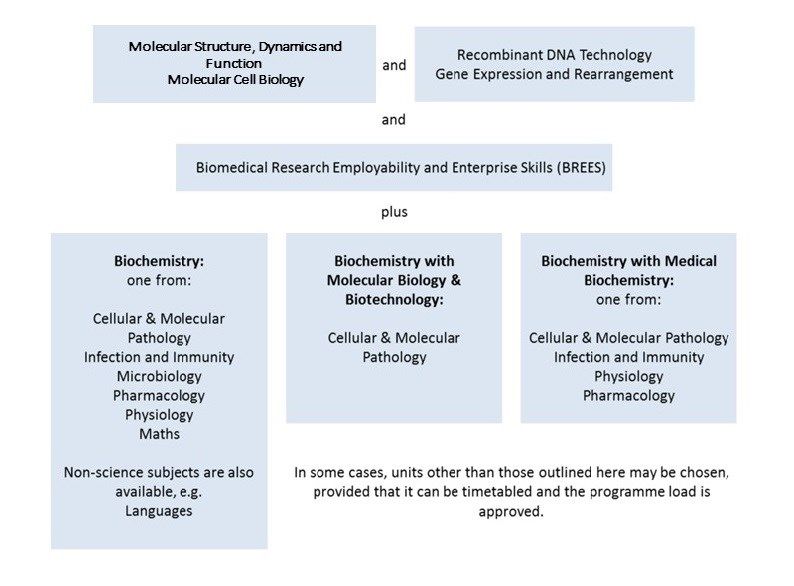
Introduction

Dear Applicant,

Thank you for your interest in the Biochemistry programmes at the University of Bristol. We
hope this booklet answers the majority of your questions.

The School of Biochemistry at Bristol University is one of the best in the country, and we provide
excellent undergraduate teaching in a stimulating research environment. To illustrate this, the
results of the National Student Survey which asks all final year university students across the
country to comment on their chosen degree courses, found that in 2014 99% of the Biochemis-
try students at Bristol agreed with the statement “Overall, I am satisfied with the quality of the
course”.

Year-on-year we produce highly skilled and enthusiastic Biochemistry graduates who embark on
a range of exciting careers in the biomedical industries and beyond. We are able to achieve this
because our staff are dedicated and committed to teaching of the highest quality, because we
have excellent teaching and research facilities, and because we recognise that transferrable
skills training forms an essential part of any modern degree programme. All of this means that
Bristol is an outstanding choice if you are considering studying Biochemistry.

To see if Bristol is the right place for you to study, there are a number of opportunities for you
to visit the School including University Open Days, UCAS Days for UCAS offer holders, and indi-
vidual visits by appointment. If you are not resident in the UK, you are also welcome to visit the
School if you are visiting the country. We are always happy to answer questions by e-mail, tele-
phone, fax or post if you need further information.

We recruit talented students and give them a stimulating environment in which to study Bio-
chemistry. We hope that you will consider joining our School as a step towards an exciting and
worthwhile career as a biochemist.

Best wishes,

  Jon Lane,
  Admissions Tutor

                                                   4
Why Bristol?
The City
Bristol is an exciting multicultural city which successfully blends the traditional with the
modern. It has been named as one of the top 10 cities in the world to visit, and recently
topped the list as the best place to live in Britain*. Bristol is a fantastic place to be a
student.
It has a thriving arts scene with theatres, opera, ballet, art galleries, museums and many
fine examples of architecture from the past and the present. Home to Isambard Kingdom
Brunel in the 1830s, Bristol now boasts many of his masterpieces including the SS
Great Britain and the iconic Clifton Suspension Bridge. There are many music venues
catering for all tastes and a fantastic range of cafes, pubs, bars, clubs and restaurants
throughout the city.
On sunny summer afternoons, you can watch cricket at the County Ground, and in other
seasons there is football (City and Rovers) rugby (Bristol and Clifton), and Bristol also
hosts a National ladies hockey league Premier division team (Clifton Ladies). Less
traditional activities that are accessible in the Bristol area include ballooning, rock
climbing in the Avon Gorge and caving in nearby Cheddar Gorge. The city is surrounded
by beautiful countryside with the Cotswolds, the Mendip Hills and the Forest of Dean all
within easy reach.
* Source: The Independent

The University
Founded over a hundred years ago, the University of Bristol is very much a part of the
City of Bristol with the main precinct situated minutes from the city centre. The University
allows students to experience the excitement of learning in a research intensive
environment where many of our academics are world leaders in their discipline.
Today the University has nearly 13,500 full-time undergraduate students enrolled on a
wide range of courses and approximately 5,500 postgraduate students studying for a
further degree.

The School of Biochemistry
Biochemistry is in the Faculty of Biomedical Sciences and is situated in the Biomedical
Sciences Building in the heart of the University precinct. It was founded in 1964, and
celebrated its 50th anniversary this year. The School has a proud tradition of research in
many important areas of Biochemistry, and our research interests span from single
molecules to the roles of cells in living organisms. This breadth of research means that
Biochemistry is a discipline that underpins scientific research activities across the
University.                                       5
Admission to Biochemistry
Entry Requirements
We usually make offers on three A-levels, but the quality of any AS levels may
affect whether borderline candidates are short-listed. A-level Chemistry is required
together with at least one other science or Maths. Good numeracy is essential for
Biochemistry and AS Mathematics is desirable if Mathematics or Physics is not
offered at A-level. Otherwise we would require a minimum grade A pass at GCSE
in Mathematics.
Our standard offer for the International Baccalaureate is 36 overall (to include 18 at
HL), including Chemistry and at least one other science or Maths.
We welcome applications from candidates holding qualifications other than A-
levels, but look for a knowledge of Chemistry equivalent to an A-level pass at grade
A.
For further information on entry qualifications see:
http://www.bris.ac.uk/prospectus/undergraduate/2014/sections/BIOC/
dept_intro

Choice of Programme
We receive over 700 applications each year for the 92 places available in
Biochemistry to home/EU students. We also have a number of additional places
available to suitable international students. We consider applicants for the C700,
C720 and C790 programmes as a single pool of students for the purpose of
admissions so you should not apply to more than one programme. It is easy to
transfer between them once you are admitted.

Selection
Once your UCAS form is received, it is assessed by our admissions team who look
at predicted and existing qualifications, your referee's comments and your personal
statement. If your application is successful you will be invited to a UCAS day to
see the School and the University, and meet staff and students. These are
normally held on Wednesdays between February and March. We believe that the
UCAS Day enables you to make the most informed choice of programme.

Given the high level of competition for places we would favour shortlisting
candidates whose personal statement shows a commitment to biomedical science.

                                            6
Candidates are not discriminated against on grounds of race, ethnicity, nationality,
gender, sexuality, religion, disability or age.

Our full admissions policy can be found at:
http://www.bristol.ac.uk/biochemistry/admissions/policy.html

Once you have an offer
If you hold Bristol as your firm choice, you will be sent accommodation literature in
May. Insurance candidates will receive information on accommodation after A-
level results are published if they fail to achieve a place with their firm choice.
However, insurance candidates are not guaranteed University accommodation.

Once examination results are published, candidates meeting the terms of our offer
are sent more information about the Biochemistry degree. If you are holding a firm
place and narrowly fail to meet the terms of our offer, please contact us
immediately. We may be able to accept you or suggest places on similar
programmes, if vacancies exist.

Our Students
Our current first year intake is split fairly evenly between men and women and our
students come from a wide range of educational and social backgrounds. We aim
to recruit around 94 UK/EU students each year, with additional places being
available for international students. We have a broad cultural mix of students who
come from the UK and mainland Europe, Asia and the Americas.

International Candidates
We welcome applications from international applicants. The standard offer for
International applicants taking A-levels is the same as for home students. We are
happy to consider alternative qualifications, however, and will make equivalent
offers where appropriate.

An IELTS score of 6.5 is required for candidates who do
not have English as their first language.

                                            7
Studying Biochemistry:
The Biochemistry degree programmes
What is Biochemistry?
Biochemistry is a scientific discipline whose ultimate aim is the understanding of
life’s processes in molecular terms. Biochemists are therefore concerned with
biological problems but recognise that the fundamental events in biology involve
molecular and hence chemical changes.
We have three 3-year BSc programmes:
Biochemistry (C700)
Biochemistry with Molecular Biology & Biotechnology (C790)
Biochemistry with Medical Biochemistry (C720).
We also have a 4-year Biochemistry with Study in Industry BSc. Students may
transfer onto this programme at the end of Year 1 (for further details, see later)
Programme Structure
Each year you will study units to the value of 120 credit points (cp). As can be
seen in the pages that follow, in the first and second years there are some
mandatory units but there is also a wide variety of choice available for the optional
units, particularly in the Biochemistry C700 programme. You may transfer
between programmes providing the right choice of optional units is made.
Tutorial support
When you arrive at Bristol, you will be assigned a personal tutor for the whole 3
(or 4) years of your programme. Your personal tutor will give you academic
tutorials in Biochemistry in the first year in groups of 3-5 students. They will
maintain close contact with you throughout your time in Bristol and are there to
help you with any problems that may affect your studies and to write you a
reference for a job when you graduate.
Student Representation
We have an active student representative system
and a Staff Student Liaison Committee that allows
your voice to be heard within the School. In addition,
you will regularly be asked for feedback on the units
you are studying so we can continue to improve your
educational experience.
8
Teaching Methods

As at most universities, lectures play a major part in our
teaching. Whilst lectures won’t cover every detail of the
subject, they will provide a basic framework of knowledge
which you can then fill out by your own reading. Reading and
thinking for yourself are essential parts of a university
education, and although the lecturers will help by suggesting
useful books and topics to think about, a great deal will
depend on your own efforts.
Lectures are not the only method of teaching; there are also tutorials where you
meet your teachers in small, informal groups. In tutorials a variety of topics may be
discussed, and you can raise difficulties which you may have encountered in the
lectures or in your reading. You will also get the opportunity to practise the type of
questions you will encounter in exams and get feedback on your performance.
Finally, as a scientist, you will spend a good deal of your time in the laboratories,
learning the experimental basis and application of the underlying theory. We have
two modern and well-equipped teaching labs for first and second year students
respectively.
Laboratory work is supported by the innovative eBiolabs online dynamic laboratory
manual system. Before practical sessions, you will access the system and learn in
detail about the experiment you will be doing each week. Information is provided
on the theory behind each practical and the techniques you will be using. We use
animations and videos to guide you through the experiments so that you’ll be well
prepared for the class and be able to make the most of your time in the lab.
You can find out more about our eBiolabs system by
going to:
http://www.bristol.ac.uk/ebiolabs/

You will have around 20 hours of scheduled teaching per week but will be
expected to undertake at least as much independent study over the course of a
typical week. Assessments usually take the form of both unseen exams (which
may include essays, multiple choice questions and calculation questions) and
coursework.

                                            9
Year 1
Biochemistry 1
In your first year you will spend a third of your time studying Biochemistry. The 40 cp
Biochemistry 1 unit is delivered through three lectures per week with practicals and tutorials
usually being held on alternate weeks.
You will be given lectures covering the structure and function of nucleic acids, proteins,
lipids and carbohydrates, the relationships between them and their synthesis and
breakdown. Further topics include the integration of metabolism and hormone signalling and
cell biology.
The unit includes practical classes where you learn techniques such as spectrophotometry,
electrophoresis and protein purification which will allow you to study biochemical systems.
During tutorials you will have set questions marked and returned, discuss any problems you
may have, and give presentations.
Biological Chemistry 1A and 1B
The first year Biological Chemistry units include lectures, practicals, tutorials and
workshops. They are designed to cover all of the fundamental chemistry you will require
throughout your Biochemistry programme, in addition to providing training in other core
skills including writing and mathematics. You will study the following two 20 cp Biological
Chemistry units:
Biological Chemistry 1A: Molecules of Life - this introduces the fundamental
molecular concepts that underpin the study of life and biomedical sciences, presented
within the reference frame of biological and biomedical applications. Key ideas include
coverage of atoms found in organisms and their chemical and physical properties,
how these atoms form bonds to build up biomolecules, chemical reactivity of
biomolecules including mechanisms, and techniques for analysing the molecular and
atomic properties of biomolecules.
Biological Chemistry 1B: Powering Biomolecular Interactions- this unit provides
coverage of the key concepts of biomolecular interactions, including ligand binding
and enzyme catalysis, and the role of energy in driving biomolecular interactions
including redox, photosynthetic and chemiosmotic concepts. In addition, the unit also
provides elementary training in mathematical techniques used in the analysis of
biomolecular interactions, familiarises students with the operation of academic
biomolecular research practice, and introduces elementary scientific writing skills.
Optional Units
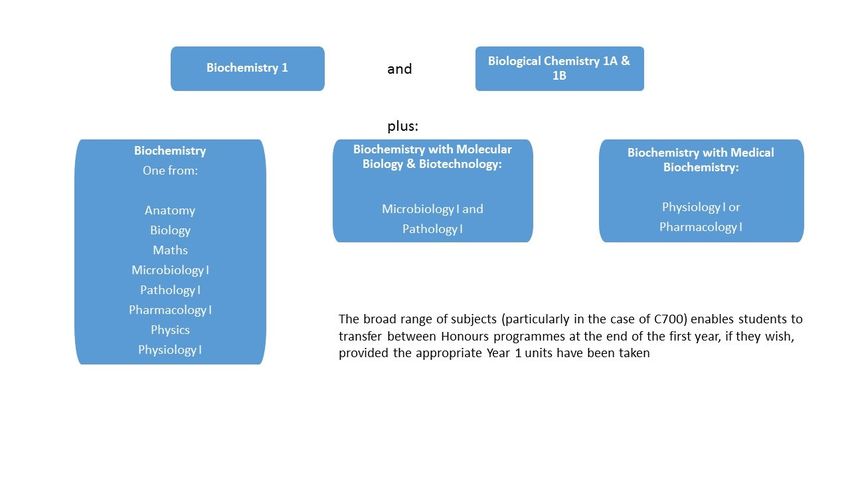
Optional units to a value of 40 cp are selected by students on
the C700 programme from the choices given in the following
table. Most students choose Microbiology, Pathology,
Pharmacology or Physiology options. Students on C790 and
C720 programmes have a more restricted choice.
10First year programme structure
A typical Year 1 timetable
A Biochemistry student studying Biochemistry, Biological Chemistry and Microbiology:
9-10am 10-11am 11-12am 12-1pm Lunch 2-3pm 3-4pm 4-5pm
Lecture Lecture
Monday
Biochemistry Microbiology
Lecture Lecture Practical Class
Tuesday Biochemistry Microbiology Biochemistry or Biological Chemistry
Lecture
Lecture Lecture
Wednesday Biological Free for Sports
Biochemistry Microbiology
Chemistry
Tutorial
Lecture
Biochemistry Practical Class
Thursday Biological
or Microbiology
Chemistry
Biol Chem
Lecture
Tutorial
Friday Biological
Microbiology
Chemistry
11Year 2
Having gained a good understanding of basic Biochemistry in the
first year, you are now ready to build on this knowledge and study
the subject in more depth. You take three mandatory subjects in
the second year, Biochemistry, Molecular Genetics and
Biomedical Research, Employability and Enterprise Skills. As
in the first year, your fourth option may be chosen from a range of
subjects.
Biochemistry 2
Biochemistry 2 is made up of two 20 cp units, each 12 weeks long:
Molecular Structure, Dynamics and Function covers the structural basis of
disease, how cells extract energy from their surroundings, and how cellular energy
is utilised to power molecular motors and the movement of molecules around cells.
Molecular Cell Biology covers how eukaryotic cells are organized at a molecular
level, the intracellular signalling pathways by which cells respond to hormonal
stimulation, and the molecular basis of important eukaryotic cell behaviors including
cell adhesion, regulation of the cytoskeleton, cell migration and cell division.
Molecular Genetics 2
This is again made up of two 20 cp units:
Recombinant DNA Technology studies the methodology surrounding the
cloning, manipulation and analysis of recombinant DNA sequences.
Gene Expression and Rearrangement studies the organization and replication
of genes, genetic analysis, and mechanisms of gene expression in prokaryotic and
eukaryotic systems and their viruses.
Biomedical Research Employability and Enterprise Skills
This 20cp unit will equip you with the skills needed to undertake your final year when
there is an emphasis on research. It will also help to prepare you for life after graduation.
Optional Units
As in the first year, options may be chosen from a range of units. Pathology, Microbiology
and Pharmacology units are popular but some students take subjects outside science
such as languages.
12Second year programme structure
13Final Year
Year 3 Biochemistry
In the final year you will cover a wide range of topics at an advanced level, with the
emphasis on current developments. You will study the following lecture-based
units:
Advanced Cell Biology: material covered will include techniques used to
study cell biology, the cytoskeleton and intracellular trafficking. The
migration of cells and their interactions with the extracellular matrix will also
be covered.
The Dynamic Proteome: covers cutting edge topics in protein
biochemistry.
Cellular Information: you study advanced topics in cellular information
networks and genomic information
Advanced Options in Biochemistry: you will study advanced topics from a
variety of specialist lecture elements. These topics are largely based around
the research specializations of staff within the School. There are seven
elements available and you choose four of these elements. The elements
are:
Synthetic Biology
Protein Science in Therapy and Technology
DNA-Protein Interactions
Molecular Basis of Disease
Neurobiochemistry
Cardiovascular Disease
Cancer
In addition to these four lecture-based units,
you will also study the Core Skills unit for
which you will undertake two pieces of
independent project work.
14The Core Skills Unit
The Core Skills unit is designed to provide you with the skills needed to carry out
biochemical research. You will undertake two pieces of project work for the unit:
The Practical Project: you will spend eight weeks in the research laboratory
of a member of staff where you will carry out a piece of original research, usually
within an area of your special interest. These projects are usually in association
with the on-going research in that laboratory and they give you an excellent
opportunity to work in a research environment as part of a research team. You
will have access to the specialised instrumentation that is an essential part of
biochemical research. Most students find this a valuable experience which helps
them decide whether they wish to proceed further with research or other
laboratory work or else seek a career outside the laboratory after graduation. The
project is written up as an assessed report at the end.
The Literary Project : this is a library-based project where you research a
topic in the current scientific literature and write an in depth review on it.
Your final degree classification
This will take into account your performance in the second year, your final year
project work, comprehension and data handling papers as well as four finals
exams.
15Biochemistry with Study in Industry
What is the structure of the programme?
The programme options are the same as those for the standard 3 year Honours
Biochemistry programmes for the first and second years, with an industrial
placement during the third year of the programme. You resume the final year of the
standard Honours programme for your fourth year.
What are the benefits of taking this programme?
The work experience will look excellent on your cv when you graduate and you’ll get
paid for the work you do!
How do I gain admission to the programme?
You may apply for entry to the programme towards the end of the first year.
Admission will be dependent upon examination results and a satisfactory interview
with the industrial partner.
What happens during the Industrial Placement?
You spend one year as a paid employee of the industrial partner, subject to their
standard working conditions and practices. You will typically spend about 47 weeks
working on a project with appreciable biochemistry content, and will be required to
submit a report which will form part of your final assessment.
Some of our current student placements are at:
AstraZeneca Pharmaceuticals
The Sanger Institute, Cambridge
GlaxoSmithKline
Syntaxin
Vernalis
Reckitt Benckiser
EMBL, Grenoble
In recognition of the excellent research training it
provides to our students, the Biochemistry with
Study in Industry degree is accredited by the
Society of Biology.
16Career Destinations
Biochemistry is a research-based subject and many of our students go on to have
successful careers in biomedical research. Biochemists are in demand in the
biotechnology and pharmaceutical industries and many work in medical, agricultural
or marine research establishments.
Examples of jobs related to Biochemistry include:
Clinical biochemist
Forensic scientist
Research scientist
Clinical trials administrator
School, college of Higher Education teacher
Scientific journalist and medical writer
Patent examiner
It is also possible to progress onto postgraduate Medicine.
Throughout the Biochemistry degree you will also develop a wide range of important
transferable skills which serve as an excellent preparation for a wide range of other
non-scientific careers. These skills include:
Numeracy, analytical and problem solving
Time management and organisation
Data interpretation, statistics and computing skills
Effective written and oral communication
Team working
17Research in the School of Biochemistry
The School of Biochemistry at Bristol was rated very
highly in the Research Assessment Exercise in 2008
making it one of best research Schools in the country.
The research is multi-disciplinary in nature with many
collaborations both with other University Schools and
with other institutions both nationally and
internationally.
Research Areas
We have around 160 researchers and over £8 million
annual research funding for a wide variety of projects.
For simplicity these can be grouped under three headings:
Membrane Biology
The research work encompasses molecular events at and within cell membranes.
Our focus on these hotspots for cellular function ranges from studies of how
proteins are inserted into and across membranes through to research into crucial
membrane channel structure and function.
Enzymes: Dynamic Molecules
We have a strong focus on the fundamental understanding of catalytic
mechanisms and use a wide range of techniques to explore enzymes and their
detailed molecular structure. Insight into these key biomolecules is exploited in
synthetic biology applications and allows us to investigate DNA : protein
interactions.
Dynamic Cell Biology
Many of our studies in this area aim to
understand mechanisms of protein trafficking
and the regulation of dynamic complexes
within and between cells and at membranes.
This includes exploring the role of the
extracellular matrix and the actin
cytoskeleton.
18Accommodation
Introduction
The University guarantees to provide accommodation for all new
unaccompanied full time students who apply for accommodation by
12th July of the year of entry, and who live outside the Bristol area.
Almost all first year students will be placed either in Halls of
Residence or in self-catering flats with a large number of rooms, so
your chances of meeting friends is optimised. Places in University
Residences are restricted and students holding a firm offer at
Bristol will receive preference. Further information on
accommodation can be found at: http://www.bris.ac.uk/accom
Halls of Residence
The majority of rooms are single study bedrooms and all have
phone and internet points. There are two main sites for the Halls of Residence in
Bristol. Clifton Hill House, Manor Hall and Goldney are situated in Clifton, about a
ten minute walk from the main campus. Wills Hall, Churchill, Badock, Durdham,
Hiatt Baker and University Hall are in Stoke Bishop, about 40 minutes walk or 10
minutes by bicycle, and close to the University playing fields. There is an excellent
bus service running from the Stoke Bishop halls to the main precinct. In addition
to the halls, there are a number of Student Houses suitable for first year students.
Private Accommodation
Most students move to private rented accommodation after their first year. The
Accommodation Office offers a comprehensive service for students seeking
private accommodation including a web-based search for accommodation and a
Bulletin Board.
Applying for accommodation
If you hold an firm offer with Bristol you will be sent accommodation literature in
May. When you fill in your accommodation application form, you will be asked to
name five preferred Halls/Student Houses. The accommodation office will strive to
allocate you a room taking into account your preferences.
19Student Views
We think Bristol is a good place to study Biochemistry, but don’t take our word for it,
here’s what our students have to say about us:
Martin Baker
The Biochemistry School at Bristol provides its students with a
high standard of education in both theory and lab based skills.
The modular nature of the course gives students in the first two
years a wide range of units to choose from which are not
necessarily related to biochemistry. Overall I have found that the
course is well structured and the School has a friendly and
welcoming atmosphere. I have also had the opportunity to work
alongside world class research giving me an amazing insight into
the world of science. My experience at Bristol has persuaded me
to pursue a career in science, and more than anything I have
enjoyed my studies so far.
Sinead O’Hara
Bristol is such a great city to live and study in. The city itself is
big enough that you won’t get bored but small enough that you
can feel a part of it. There is such a wide and diverse range of
places, from the harbourside to the large expanse of the Downs
-perfect on a sunny day, and of course the suspension bridge.
The university is well located within the city and close to most
areas for when you move out in second year. Biochemistry is a
difficult degree but is interesting and rewarding as the lecture
material is up to date and engaging. Lecturers and tutors are
always willing to give help and advice.
I would recommend living in halls for the first year as it is a great way to meet lots of
people but also in the first and second year biochemists have lectures with other
related courses so there is plenty of opportunity to meet people outside the course.
There are loads of sports clubs and societies to get involved with at the university,
having been involved with both swimming and hockey I have had a great time
training and socialising. The mix of nightlife suits students well as there is always
something going on for everyone.
20Lavanya Mane
Two years ago, I chose to study Biochemistry at Bristol and
have never once regretted that decision. The city of Bristol is
incredibly diverse – from edgy, street-art filled Stokes Croft
hosting independent shops and restaurants, to beautiful
Clifton, and everything in between!
The School of Biochemistry is one of the friendliest and most
well-organised schools in the university, and the breadth of
the course allows one to engage with a range of aspects of
science. Above all, you will be taught by passionate lecturers
at the forefront of research in their field, who are always
available to provide extra help and advice. The University
itself is brimming with opportunities – I have been a Course Representative, run
peer-assisted study sessions and worked in a research laboratory over the
summer, all besides the great student societies and volunteering options
available!
Student Societies
Students within the School of Biochemistry run a
hugely successful society called Helix. It’s open
to all students who have an interest in
Biochemistry and it organises range of social
events. You can get cheap second hand text
books through their book sales and get to know
your fellow biochemists. There are also a large
number of other societies affiliated to the
Students’ Union covering a wide range of
interests including politics, academic subjects, music and hobbies.
In addition, the Union embraces over 50 affiliated
sports clubs catering for sport at all levels and the
University has fantastic indoor and outdoor sports
facilities for you to use.
Further information on all the Students’ Union
21 activities can be found at http://
www.ubu.org.uk/Further Information Sources
Our Web page
http://www.bristol.ac.uk/biochemistry
The University Web Page
http://www.bristol.ac.uk/
University Prospectus
Available from
The Admissions Office
Senate House
Tyndall Avenue
Clifton
Bristol BS8 1TH
E-mail: ug-admissions@bristol.ac.uk
http://www.bris.ac.uk/prospectusrequest/
More information on studying Biochemistry at the University of Bristol can be found at:
http://www.bris.ac.uk/study/undergraduate/2015/biochemistry/bsc-biochem/
University Open Days
There are three University of Bristol Open Days during the summer. For further
details and future dates please contact the Undergraduate Admissions Office,
Senate House, Tyndall Avenue, Bristol, BS8 1TH or see the University web site.
22www.bristol.ac.uk/biochemistry
23You can also read


