BLUE & GOLD PAGES FACULTY EDITION Emory College of Arts and ...
←
→
Page content transcription
If your browser does not render page correctly, please read the page content below
THE
 BLUE & GOLD
   PAGES
FACULT Y EDITION
   2018-19

Blue & Gold Pages: Faculty Edition 2018-19

 Welcome by Dean Carla Freeman                                                                      3
 PACE Program and Administrators                                                                    4
 Pre-Major Advising                                                                                 5
          Overview
          Expectations for Pre-Major Advisors
          Managing Student Expectations
          Advising Meeting Checklists
          Frequently Asked Questions
 PACE 101 Course Overview                                                                           16
 HLTH 100 Course Overview                                                                           18
 Academic Calendar                                                                                  19
 Program and Policy Changes for 2018-19                                                             20
 Department Contacts                                                                                21
 Academic Requirements, Advising and Support Services                                               25
 Office for Undergraduate Education                                                                 28
          Who’s Who
          Academic Advising
          Academic Support
          ESL
 Student Health, Student Counseling and Accommodations                                              34
 Undergraduate Degrees Outside of ECAS                                                              35
          Dual Degree with Georgia Tech
          Goizueta Business School
          School of Nursing BSN
 Advising for Post-Graduate Programs                                                                36
          Pre-Health
          Pre-Law
 Additional Academic Opportunities and Resources                                                    40
          Atlanta Regional Council for Higher Education (ARCHE)
          Career Center
          Domestic Transient Study
          Emory College Academic Internship
          International Transient Study
          National Scholarships and Fellowships
          Office of International and Summer Programs: Study Abroad, Summer Programs on
          Campus, Maymester, and Emory College Online
          Undergraduate Research

The purpose of this document is to provide resources and advising tips for Pre-Major Faculty Advisors.
Many resources are hyperlinked so that you may review information from direct sources. This guide is also
meant to complement the resources that students received and used over the summer to prepare for
registration, orientation and starting their Emory careers. We expect that you will connect and refer
students with many of the people and resources listed in this document. While you may read it in its
entirety, it is searchable and meant to be used as a means to look-up information you need for, or with
your advisees.

                                                                          Blue & Gold Pages: Faculty Edition 2018-19 | 2
Dear Pre-Major Faculty
Advisors,
As we approach the beginning of a new
academic year, we are excited to welcome the
Class of 2022. Every member of the Emory
College faculty serves an important role as a
pre-major faculty advisor for our first-year
students. This unique advising system allows
you to work with a few first-year students as
they transition from high school to becoming
active and engaged College students and
members of the Emory community.

Whether reviewing a first semester schedule,
asking about academic and extra-curricular
interests, or just being a friendly and familiar
face, the pre-major advising relationship can
set the tone for a positive Emory experience.
While we don’t expect you to know everything,
you are one of the best resources for our new
students, and they are eager to get to know
you.

Thank you for your engagement and
commitment to our undergraduates.

I wish you a wonderful year,
Carla Freeman
Senior Associate Dean for Faculty
College of Arts and Sciences

                   Blue & Gold Pages: Faculty Edition 2018-19 | 3
PACE Programs Overview and Administrators
Pre-major Advising and Connections at Emory (PACE) is the Emory College program that strives to
orient and transition first-year students into the Emory community from matriculation through the
first semester. The PACE program is administered through the Office for Undergraduate Education’s
New Student Programs. We collaborate with faculty in the College, staff from OUE and Campus Life
to determine what students need to know and experience in order to be successful members of the
Emory community.
The three overarching goals of the PACE program are to promote:
Emory Community Development: Students form connections with faculty, staff, and peers
and establish relationships that will support their academic and social goals
Personal Development: Students learn to take ownership of their own learning experience
and begin to develop greater self-understanding
Practical Knowledge: Student will gain the skills to navigate life as a college-level student,
maximizing their personal and Emory community development
Shari Obrentz, PhD
Associate Dean, OUE & Director, PACE
B Jones Center 204
404.727.5110
sobrent@emory.edu
Tina McDowell, M.Ed
Assistant Director, PACE
White Hall 216
404.727.7373
tmcdowne@emory.edu
Michael Toney, M.Ed
Director, Orientation (New Student Programs)
White Hall 215A
404.727.9236
michael.toney@emory.edu
Blaise Bolemon, M.Ed
Assistant Director, New Student Programs
White Hall 216
blaise.bolemon@emory.edu
Blue & Gold Pages: Faculty Edition 2018-19 | 4Pre-Major Advising
Pre-Major Faculty Advisors are advisors of record to all incoming first-year students and, as a result,
act as official ambassadors of Emory College. One of the first responsibilities of a Pre-Major Faculty
Advisor is to show our newest members of the Emory community that we care about them and want
them to succeed at Emory.
Pre-Major Faculty Advisors will be assigned 3-4 new first-year students before the beginning of the
Fall semester. The Faculty Advising Center is updated by the middle of August where Pre-Major
Faculty Advisors will see their new advisees’ names. The PACE administrators try to match students
with faculty based on broad academic interests (arts, humanities, natural sciences or social
sciences). While many faculty are matched with students who have similar academic interests, there
is no perfect match system. Students’ minds and interests change quickly. We also know that many
students have not been previously exposed to all of the academic areas Emory offers, so may not
even know what they will be interested in until they meet faculty and take courses.
Many new Emory students also have professional goals that may not align with faculty members’
expertise. Almost every Emory student has some “pre-professional” interest- and some have
multiple pre-professional goals. We encourage them to explore those in addition to the Liberal Arts,
and believe that Pre-Major Faculty Advisors can develop positive working relationships with
students, no matter their academic interests. We often hear that some of the best relationships
develop because of reasons beyond academic interests.
At the end of the Fall 2017 term, students enrolled in PACE 101 answered survey questions about
their overall Emory experience, including how they felt about relationships they built with their Pre-
Major Faculty Advisors. Students were asked to rate their agreement with the following statements
about their Pre-Major Faculty Advisors as well as the overall usefulness of their advising meetings. In
most cases, students only met with their Pre-Major Faculty Advisor two or three times during the
semester. Even with those brief interactions, first-year students felt welcomed by their Pre-Major
Faculty Advisors and acknowledge that they helped orient them to and connect them with the
Emory community and resources.
Expectations for Pre-Major Faculty Advisors
As an ambassador of Emory College, Pre-Major Faculty Advisors begin to introduce students
to the resources available to them at Emory. As a Pre-Major Faculty Advisor you may be
advising students with interests in a variety of disciplines outside of your own. We do not
expect you to be able to answer every specific question that a student asks about a
department or program, but want you to be an access point for guidance and other
resources to help students obtain the information they need. Additionally, the relationship
that you build with your advisees will help them achieve the three goals outlined by the PACE
program: proficiency, self-knowledge, and connection and engagement.
Pre-Major Faculty Advisors can help meet the PACE program goals (proficiency, self-
knowledge, and connection and engagement) through the conversations they have with
advisees. As a Pre-Major Faculty Advisor, you are expected to:
Initiate connections with first-year students.
Blue & Gold Pages: Faculty Edition 2018-19 | 5 Respond to first-year student inquiries (even if this means referring to another
resource).
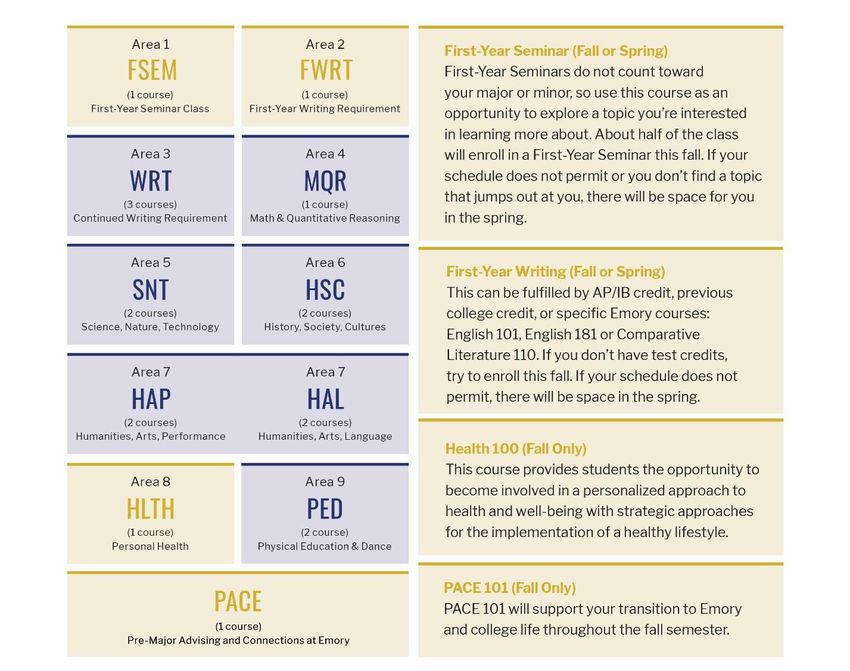
Be familiar with the General Education Requirements (GERs) and First-Year
requirements.
Know what an appropriate course load is and understand how students maintain
fulltime status.
Know when and how to refer advisees to appropriate resources.
Alert the Office for Undergraduate Education (OUE) about any concerns about
advisees.
As a Pre-Major Faculty Advisor, you are one of the members of the Emory community with
whom students can build a connection that will enhance their experience at Emory.
Sometimes you are the first person a student reaches out to for assistance. PACE
administrators and OUE academic advisors rely on information shared by Pre-Major Faculty
Advisors to meet the needs of our first-year students. We encourage you to have your
advisees check in with you. Asking students to report back may encourage additional
communication and a sense of connection. If you don’t hear back from your advisee, it could
be an indication that s/he needs more support.
The PACE Administrators are available to assist Pre-Major Faculty Advisors. If a student
misses his/her first advising appointment, please contact Tina McDowell on the advising day,
August 27.
First-year students are required to meet with you again during the falls semester.
This typically happens during the first two weeks of November, and the student is
asked to reach out to you.
First-year students will remain as your advisee until they declare a major.
If a student declares a major in your department, you may remain as the advisor of
record.
If you are concerned about a first-year student at ANY TIME, please contact the PACE
Administrators, OUE Advising or the appropriate support office(s) listed in the Blue
and Gold Pages: Faculty Edition.
Managing First-Year Student Expectations
On Monday, August 27, all Pre-Major Faculty Advisors will meet with their new advisees. In
order to manage expectations for the first advising session, please note the information we
shared with first-year students over the summer and before their first meeting with you.
This guide also includes optional checklists you may choose to use during your first and
second mandatory advising appointments.
Before they meet with you, first-year students should have completed the following:
Reviewed resources to prepare them for their transition to Emory
Toward Emory Guides: Before You Arrive, Registration, Life at Emory:
http://college.emory.edu/orientation/first-year-students/getting-started.html
Registration 101 Website: http://college.emory.edu/orientation/first-year-
students/registration.html
Blue & Gold Pages: Faculty Edition 2018-19 | 6 Completed Emory Essentials (summer orientation course through Canvas)
Eligible to register for full schedules (up to 19 hours) between August 13-17
Some students may be “disappointed” with closed courses, or their first attempt at
registration
Students may be waiting for placement or AP/IB or other credits to post
Students may be waiting for placement results for some courses
Completed an advisor introduction form as part of Emory Essentials Activities
Students were asked to provide introductory information, including where they are
from, what they are interested in studying and what activities they may like to
pursue.
If you did not receive the form in your Emory email, check your junk mail for an email
from “Wufoo”
Blue & Gold Pages: Faculty Edition 2018-19 | 7First Advising Meeting: Checklist for August 27
CHECKLIST / ACTION ITEM NOTES / RECOMMENDATIONS
1. Welcome student to Emory! • We’re excited to have you join the Emory Community
• This is a short advising meeting to get to know you
and your academic/other interests
• You may review Fall schedule plans/courses for the
year
• You may review the “Contacting your Advisor” form
that they submitted
• Remind advisees that you may refer them other
faculty, departments or advising offices for your
specific questions
2. Ask about academic areas of • Students CANNOT declare a major until Spring
interest. semester
Remind students that NOBODY has • Most declare during the 2nd year, and many change
declared a major. as they explore
• Students do not need to focus on this now
3. Remind students that the first • Encourage students to take a balanced schedule
year is a great time to explore the • Students have 4 years/8 semesters to complete their
Liberal Arts and work on GERs. GERs, they don’t have to complete in their first year
• Many “popular” courses that may be closed are
offered EVERY semester including Econ 101, Econ
112, Math 111, Psyc 110, Psyc 111,QTM 100, Soc 101
4. Remind your advisees that they • This INCLUDES PACE 101 and Health 100.
should enroll in 16-19 credits • 16-19 credits during the first semester allows
during the Fall semester. students to withdraw from a course if needed and
still maintain 12 hours. Some students will have
fewer than 17 hours (depending on courses).
• Do the simple math test: Total credits enrolled minus
the course with the highest number of credits. If this
number is 12 or greater, the student is in good shape
• In order to graduate in 4 years, students will typically
take 15-17 credits every semester after the first
semester which should be 16-19
• First-year students may not enroll in more than 19
credits during the first semester
• For students to be eligible for Phi Eta Sigma at the
end of the first semester, they must complete at least
4 academic courses (3 credits or more) as well as GPA
requirements
• Please check their schedules to make sure they have
these credits by September 5 at 11:59pm
5. Remind advisees that they MUST • For PACE and HEALTH, students may enroll in ANY
enroll in one section of PACE 101 section and may swap sections thru September 5
(begins August 29-31), and one
Blue & Gold Pages: Faculty Edition 2018-19 | 8section of Health 100 begins • PACE: PACE is taken S/U. The first session takes place
(September 4-7) Aug 29, 30 or 31 and attendance is REQUIRED in one
section
• Health: Health 100 is taken for a letter grade.
Passing Health 100 is a graduation requirement
6. Remind advisees that they MUST • Try to enroll in a FSEM during the Fall (a First-year
enroll in a FSEM during the first requirement) if a topic is of interest and the course is
YEAR during Fall OR Spring (First- open
year requirement). • About 50% of First-year students will take in Fall, NOT
EVERYONE WILL!
• If it doesn’t fit the schedule, or they really don’t like
ANY topics, they can wait until Spring. Tentative
FSEMs are listed in SP 2019 Course Atlas
• Encourage exploration! Remember FSEM do not
count for any major
7. Remind advisees that they MUST • Students with AP/IB credits for ENG 101 or 181 CAN
“fulfill” the FWRT requirement use this for the FWRT. These credits need to be
during the first-year with AP/IB posted for credit (not placement) on the transcript to
credits, International Exams, count for the GER.
previous college credit, or course • Students who need a FWRT (Eng 101, Eng 181 or CPLT
enrollment Fall or Spring. 110) should try to enroll in the Fall if it fits the
schedule. There will be spaces in Spring.
• If the student is international and took the EEA, there
is chance s/he was invited and already enrolled in a
special section of English 101 with ESL support. This
is by invitation only.
8. Remind students to check the • FALL ONLY: PACE 101, Health 100, many first
Course Atlas to see when courses sequence language and science courses
are offered for the Fall, Spring or • FALL or SPRING: First-year writing requirements,
both semesters. First-year Seminars
9. Ask student if s/he earned AP/ IB • If student did not earn AP/IB credits, international
credits, international exams or exams, or college courses prior to Emory, no further
completed college coursework at action is needed
another institution. • Check OPUS to see if credits have posted. If credits
NOTE: There is a New AP/IB and have not posted, ask students to check with the
Previous Credit Policy. Students Office of Admission FIRST. Students may still need to
may bring in a total of 18 credits send scores or resend scores/transcripts.
(previous college or transient), of • Refer to the AP/IB charts to see what GERs have been
which only 12 may be from AP/IB or completed. If a student has more than 12 eligible test
International exams. credits, students may need to “swap” the courses
they want for credit vs. placement.
Students will be able to swap credits for • If a student took college courses at another
credit/placement after the first semester institution, they must complete a form and submit to
as long as they are all posted on the the Office of Admission for review to determine if
transcript. credits will be accepted and posted.
Blue & Gold Pages: Faculty Edition 2018-19 | 9• All previous credits (AP/IB, international exam or
college) MUST be submitted to the Office of
Admission by the end of the fall semester.
10. Share that Add/Drop/Swap • First-year student enrollment is open August 27-28
Works! Also, there is no “perfect” (noon)
schedule and that’s normal. • Add/Drop/Swap will open on August 29 (first day of
classes)
• Add/Drop/Swap will close on September 5 at
11:59pm
11. Pre-Professional advising is • Pre-Business has open-hours EVERY day
available: Please REFER and • Pre-Engineering (Dual Degree) has advising available
encourage students to follow up if during the first semester
interested in ANY of these areas. • Pre-Health Advising (PHA) offers pre-health walk-in
hours throughout A/D/S and scheduled
appointments beginning September 6.
• Pre-Law: No set pre-requisites or major, but can be
referred to the Career Center.
12. Share with student when/how • Share how you would like to be addressed (Dr.,
they should contact you and when Professor, First name)- this helps teach proper
they can expect a response. communication etiquette
• Share the phone or email in which students should
use
• Remind students you will meet again in November to
review Spring 2019 schedule
13. Remind students they have a • Students have OLs, RAs and SAs
network of support. • They will meet their PACE Facilitators and PACE Peer
Leaders during the first week of PACE
• OUE academic advisors are also available for
additional academic advising/support
Blue & Gold Pages: Faculty Edition 2018-19 | 10Second Advising Meeting: Checklist for November
First-year students are required to meet with Pre-Major Faculty Advisors before they register for
their Spring 2019 schedules. Students should take the lead and reach out to you, however if you
have specific meeting times or scheduling requirements, you may reach out to yours students. If a
first-year student does not contact you by the end of the pre-registration period, we ask that you
contact Tina McDowell (tmcdowe@emory.edu) so that we may reach out to the student as well.
CHECKLIST / ACTION ITEM NOTES / RECOMMENDATIONS
1. Check-in on first-semester • Ask about extracurricular involvement
• Ask about general fit at Emory
2. Remind students of Registration Times: • Please remind students to check BOTH
November 19-21. Enrollment times are enrollment dates and times.
staggered. • You may ask a student to login to OPUS to
ensure they know where to find these.
3. Check on completion of First-year • If a student did not take a FSEM or
requirements withdrew, they MUST enroll in Spring
(FSEM, FWRT, HEALTH and PACE). • If a student did not bring AP/IB or college
credits for FWRT, or take in Fall, they MUST
enroll in Spring (ENG 101, ENG 181 or CPLT
110)
• If a student does not pass Health 100, they
MUST repeat next Fall (2019)
• If a student does not pass PACE 101, a “U”
will be assigned as the final. No re-take is
allowed.
4. Remind Students to Submit AP/IB, • ALL AP/IB or International exam scores
International Exams, or any previous college MUST be submitted to the Office of
credits to the Office of Admission. Check Admission by last day of Fall 2018 (NO
that they POST IN OPUS. EXCEPTIONS)
• All transcripts from other colleges must be
submitted to the Office of Admission with
Evaluation Form.
• Students are not notified if scores are
received, they MUST CHECK OPUS
• If a test score or college credit has not been
posted, best to email Office of Admission so
it is in writing.
5. Discuss the Fall course selection and • What courses does student enjoy? Any that
balance of schedule. What can stay the they do not?
same or needs to change for Spring? • Over-challenged or under-challenged?
• Need assistance with study or time
management skills? Refer to EPASS and
Academic Coaches
6. Ask about courses in already placed in • What GERs have been completed? What
their shopping carts. remains?
Blue & Gold Pages: Faculty Edition 2018-19 | 11• Have they narrowed an academic area of
focus or still exploring?
7. Promote a BALANCED schedule. Students • First-year students will only be allowed to
should typically enroll in 15-17 credits. enroll in up 19 credits UNTIL their Fall
See notes for enrolling in more than 19 grades post
credits. • If they have a GPA ≥3.0, they may enroll in
up to 22 credits. This will not be an option
until January.
8. Majors/Minors can be declared in Spring • Students may complete the DOM form
but DO NOT HAVE TO BE! online
• Once they do, the department will assign a
major advisor (could still be you)
• The major advisor will be the new advisor
of record
• The student will no longer appear in your
Faculty Advising Center
9. Pre-Professional advising is available. • Pre-Business has open-hours EVERY day
• Pre-Health Advising (PHA) in College
Connect.
• Pre-Engineering (Dual Degree) advising can
be scheduled in College Connect.
• Pre-Law: No set pre-requisites or major, can
be referred to the Career Center.
10. Remind students that Add/Drop/Swap • First-year students may still not get their
Works! perfect schedules, but A/D/S works! A/D/S is
open for 2 months.
• Add/Drop/Swap will open on November 26
• Add/Drop/Swap will close on January 22 @
11:59pm
11. Share with student when/how they • We encourage, but do not require students
should reach you for the remainder of the to meet with you in the Spring before Fall
Fall and Spring. pre-registration.
• Please share when/how often you would
like them to check-in with you after grades
post and during the Spring.
Blue & Gold Pages: Faculty Edition 2018-19 | 12Frequently Asked Questions for Pre-Major Faculty Advisors
While this is not a comprehensive list of questions, these are some of the most frequent questions
pre-major advisors have themselves, or will get from their first year students.
AP/IB or previous credits
How many credits can I bring in? You can bring up to 18 credits total, of which only 12 of
those credits can be from AP/IB or other exams. If you have multiple exams/courses that
are equivalent to the same class at Emory, you will not receive double credit.
If I have more credits than I can bring in, how do I choose which ones to use for credits
vs. placement? Or When should I retake a course that I have AP/IB credit for? This
really depends on many factors- and there is not one right answer. You can use ask these
questions to your advisees.
o You should consider whether you may need a course for a pre-requisite, major or
minor. You may not know at this time- that’s ok!
o You should consider if you have a strong foundation or need a strong foundation to
continue in a department. Things to ask yourself: When did I take this exam? (if
more than a year ago, may be a good idea to take the course). Am I comfortable with
the material? (if not, may be a good idea to take the course) Would I feel better if I
took the College level- or am I ready to keep going?
Did Emory receive my AP/IB Credits? AP/IB Credits are posted in OPUS. Please note: If
submitted electronically, processing can take up to two weeks. If students submitted
material more than two weeks ago, please email Admission
(admission.processing@emory.edu) with more details about the scores, date of submission,
and student name and date of birth.
When will my credits post? If Admission receives scores by July 27, students should see
scores posted in OPUS by August 10. If Admission receives scores between July 27 and
August 10, students should see scores posted in OPUS by August 24. If students submit
scores AFTER August 10- they have until the end of the first semester (December) to have
your official scores submitted. Once received, credits are posted in OPUS. Please note: If
submitted electronically, processing can take up to two weeks. If students submitted
material more than two weeks ago, please email Admission
(admission.processing@emory.edu) with more details about your scores, date of
submission, and your name and date of birth.
How do I swap out my AP/IB credits (if I have more than 12 eligible credits)? The Office
of Admission has a form students can complete to swap out eligible credits. ALL eligible
exams will appear on the transcript, however students may only bring in 12 credits, which
can count for GERs and Graduation requirements.
Academic Support
What support is available? The College has many different academic support services
available.
o Academic Coaching
o ESL Tutoring
o EPASS Peer Tutoring
Blue & Gold Pages: Faculty Edition 2018-19 | 13o EPASS Mentors
o Writing Center
Hardship Concerns
What resources are available for books? There are several resources available for
students. The first is the Lending Library: http://success.emory.edu/resources/library.html.
The OUE also has a small emergency book needs.
Are there any emergency loan funds? The Office of Financial Aid has some emergency
short term loans available. Students should contact their FA advisor for details on applying
and repayment.
What are the resources for food security? http://success.emory.edu/resources/food.html
Disability/Chronic Health/ Mental Health Accommodations and Support
I had academic accommodations in high school/my previous college will I have them
at Emory? Accommodations are uniquely developed for students on an individual basis.
College-level services for students with disabilities are not a continuation of special
education services in high school. Students will meet with a compliance specialist to
determine if they are eligible for accommodations and if so, to determine reasonable
accommodations for college-level work. http://accessibility.emory.edu/students/new-to-
oas/faq.html
How do I register for accommodations? New students have to register with the Office of
Accessibility to detail their disability, past services and needed accommodations from their
own perspective. They will need to provide documentation to the OAS to determine what
accommodations will be appropriate at Emory. Please send students to:
http://accessibility.emory.edu/students/new-to-oas/index.html
What other support is available? The Student Success Programs and Services office has a
number of resources available for students. You can see their resources and programs
here: http://success.emory.edu/index.html
Is counseling available? Counseling and Psychological Services (CAPS)
http://studenthealth.emory.edu/cs/
I am concerned about a student’s well-being, where should I start? Student Intervention
Services (SIS) http://success.emory.edu/SIS/referral.html
Incomplete
When are students eligible for an Incomplete? Incompletes are typically an intervention
for students at the end of the semester who have extenuating circumstances that prevent
them to finish a course by the end of the semester. A faculty member cannot assign an
Incomplete (I) without approval from the Office for Undergraduate Education. To be eligible,
students must have completed at least 50% of the work in the course and be eligible to
“pass” the class. Students should be directed both to their instructor and their OUE
academic advisor.
Transfer
What should I do if a student wants to transfer? There are a number of reasons why new
students may consider transferring to a different institution (financial, social fit, closer to
home, etc.). If a student approaches you with an intention to transfer, we encourage you to
have a conversation with the student to help determine if there are programs, resources or
people that may help make the decision to stay clearer. Many times students are unaware
Blue & Gold Pages: Faculty Edition 2018-19 | 14of opportunities/resources at Emory which may be just what they are looking for. You can
also refer these students to OUE Academic Advisors if there are forms that need to be
completed.
Withdrawals
What is my role with a course withdrawal? Students are allowed to withdraw from
courses without penalty through the 6th week of classes. This means that a “W” will appear
on the transcript, but not affect the GPA. While a "W" will not affect the GPA, students with a
"W" will not be eligible for Phi Eta Sigma. First-year students have the opportunity to
withdraw from one course through the 10th week of classes either in the Fall OR Spring
semester without penalty (same “W” appears on transcript). If a student is interested in
withdrawing from a course, they MUST get a signature from the instructor and an advisor
(you or an OUE Academic Advisor). Students must maintain at least 12 credit hours after the
withdrawal. While your signature is not “approval” for withdrawal, it does offer an
opportunity for discussion and you may ask questions such as:
o Will you still be enrolled in 12 credit hours after withdrawing? (This is required)
o How are you doing in this course?
o Why this course?
o How are your other classes going?
o How will this affect your enrollment next semester?
o Will you have enough credits to promote to the next class after 2 semesters (30, 60
or 90)?
Blue & Gold Pages: Faculty Edition 2018-19 | 15PACE 101 COURSE
All first-year students are required to enroll in PACE 101 during the Fall semester of their first-year.
This course is worth one academic credit and introduces students to important college policies and
procedures as well as academic and extracurricular opportunities on campus.
The Pre-major Advising and Connections at Emory (PACE) program and PACE 101 course support the
continuous transition process for first-year students after they participate in New Student Orientation.
Emory College works with Emory Campus Life to help students transition to college life throughout
the first semester. The program provides resources for students to become proficient in using
learning tools and resources, to identify and reflect on their achievements and to use the resources
to help them to accomplish their academic and personal goals.
PACE Goals:
Emory Community Development: Students form connections with faculty, staff, and peers
and establish relationships that will support their academic and social goals
Personal Development: Students learn to take ownership of their own learning experience
and begin to develop greater self-understanding
Practical Knowledge: Student will gain the skills to navigate life as a college-level student,
maximizing their personal and Emory community development
Below you will find an outline of the requirements students must meet to pass the course, as well as
a schedule for the semester and an outline of the topics covered.
PACE 101 New Course Fall 2018
The PACE 101 course has 78 sections of 19 students. Forty-five facilitators from OUE and Campus
Life along with a student Peer Leaders will lead weekly discussions and activities on various topics
and requirements designed by staff from OUE and Campus Life. During the 50-minute class
sessions, students will receive weekly announcements of current and future events/deadlines and
participate in discussions and activities.
Students are REQUIRED to attend ALL 13 sessions to earn satisfactory credit for PACE 101.
Students are allowed to miss up to two in-class sessions, however they must complete make-up
assignments for the sessions missed to earn credit for the missed sessions. There are three out-of-
class activities in which students must attend an event and complete an activity between September
and December. Students may choose to attend 3 events from a list including Arts at Emory,
Athletics, the Career Center, Civic and Community Engagement (CCE), Study Abroad, Undergraduate
Research, Library, EPASS, and Campus Life. Students will also complete three surveys and attend an
Evidence Week event. The surveys will evaluate Orientation, their place at Emory (mid-term) and the
PACE 101 course. Students will attend a lecture on the nature of evidence from Emory College
faculty. Students completing all requirements for the course will receive a passing grade of “S” and
one academic credit.
Blue & Gold Pages: Faculty Edition 2018-19 | 16PACE 101 Session Topics and Requirements
Students will receive a complete syllabus on the first day of class. All materials will be posted on the
Canvas course. Students MUST sign up for one section by August 29. They must finalize their PACE
101 section by the end of Add/Drop/Swap September 5.
1. Students MUST attend weekly sessions and participate in class sessions and outside
activities
Week of August 27: Welcome to PACE 101
Week of September 3: PACE 101 Goals and Personal Goal Settings
Week of September 10: The Honor Code
Week of September 17: Evidence Week (Credibility of Information)
Week of September 24: Getting Involved and Belonging
Week of October 1: Wellness
Weeks of October 8 and 15: Mid-Semester Check-in
Week of October 22: Choosing a Major
Week of October 29: Advising and Academic Planning
Week of November 5: Academic Planning, a Continuation
Week of November 12: Career Exploration
Week of November 19: Thanksgiving Holidays
Week of November 26: First Semester Celebration-It’s a Wrap/PACE 101 Survey
Week of December 3: End of Classes: NO PACE 101 FINAL
2. Students must attend the required events/complete follow-up activities
Out-Class- Activities (Attend and complete reflection)
They will be able to choose events from the following categories and will complete a brief
reflection after attending.
Arts at Emory
Athletics
Campus Life
Carter Town Hall Meeting ( Attend only, no reflection)
Civic and Community Engagement (Emory Care Day)
Career Center Explorations
EPASS (Skills Building, Mentor, Academic Workshops)
Library
Major
Study Abroad (Going Global and Internship 101 Sessions)
Undergraduate Research
3. Attend two advising meetings with PACE Advisors
Monday, August 27
November 12-16, or the dates you specify or pre-registration
Blue & Gold Pages: Faculty Edition 2018-19 | 17Health 100: It’s Your Health Course Overview
Course Description:
Administered by the Center for the Study of Human Health (CSHH), Health 100 is a required course
for first year students in Emory College. This course is only offered fall semester, and fulfills the
Personal Health (HLTH) General Education Requirement (Area VIII).
Health 100 aims to educate, engage, encourage and empower Emory College first year students in
their own health and well-being. The focus of the course is on discovering health, optimizing
behavior around essential health topics and builds a foundation of positive health practices.
Following the guiding framework of knowledge – translation – application, this course utilizes
experiential, practical application and a peer-facilitated approach to provide students with the tools
to discover their own health and the opportunity to develop the skills to personalize evidence-based
strategies to enhance their health and well-being during college and beyond.
Course Objectives:
Upon completion of this course, students will be able to:
Identify and describe essential concepts and science-based evidence surrounding core
health topics including, but not limited to, (a) time and energy management, (b) vision, goals,
and motivation, (c) stress, (d) sleep, (e) values and strengths, (f) nutrition, (g) physical activity,
and (h) positive mental health.
Develop and discuss personalized strategies for health-enhancing behavior for each core
health topic.
Examine and apply strategies for health-enhancing behavior for each core health topic to the
lived college experience.
Prerequisites: None
Grading: Letter Grade
Credit Units: 1
Canvas website: HLTH100: It’s Your Health-Fall 2017 - https://classes.emory.edu
Blue & Gold Pages: Faculty Edition 2018-19 | 18Academic Calendar
Wednesday, August 29 First Day of Classes
Add/Drop/Swap begins
PACE 101 Sessions Begin
Wednesday, September 5 Add/Drop/Swap ends at 11:59pm
The Office for Undergraduate Education will have
walk-in advising during operating hours
Friday, September 14 Last Day for Grading basis changes (LG/SU)
Monday, October 8 Tuesday, October 9 Fall Break
Friday, October 12 4:00pm: Partial Withdrawal Deadline Without
Academic Penalty
Friday, November 9 4:00pm: One-Time Partial Extended Withdrawal
Deadline
(for new students ONLY)
Monday-Friday, November 12-16 Advising Week: First-year students will schedule a pre-
registration meeting with their faculty advisor
Monday, November 19-Friday, Direct Enrollment: First-Year Registration
November 21 Appointments
Wed, November 21-Fri, November 23 Thanksgiving Holiday
Monday, November 26 Add/Drop/Swap opens at 12:01am, ends Wednesday,
January 22, 2019.
Tuesday, December 11 Last Day of Classes for Emory College
Thurs, December 13-Wed, December 19 Final Exams
Thursday, December 20 Residential Hall Close
Saturday, December 22 AP/IB and transfer credits must be posted by the
Office of Admissions to receive credit, End of Term
Sunday, January 10 Residence Hall Open 10:00am
Tuesday, January 15 First Day of Classes
Monday, January 21 Martin Luther King Holiday-No Classes
Tuesday, January 22 Add/Drop/Swap Ends
Thursday, January 31 Deadline for Letter Grade/Satisfactory-Unsatisfactory
Changes
Friday, March 1 4:00pm: Partial Withdrawal Deadline Without
Academic Penalty
Monday, March 11-Friday, March 15 Spring Break
Friday, March 29 4:00pm: One-Time Partial Extended Withdrawal
Deadline
(for new students ONLY)
Monday, April 1-Friday, March 5 Advising Appointment with Faculty Advisor
Monday, April 8-Wednesday, April 10 Direct Enrollment Appointment: Rising Sophomores
Monday, April 15 Add/Drop/Swap Opens, Closes July 26th Reopens,
August 28th-September 4th.
Monday, April 29 Last Day of Classes for Emory College
Thursday, May 1-Wednesday, May 8 Final Exams
Monday, May 13 Commencement
Blue & Gold Pages: Faculty Edition 2018-19 | 19Program and Policy Changes for 2017-2018
New Major
o Philosophy, Politics, Law: Beginning in Spring 2019, a new major of Philosophy,
Politics, Law will be available through the Philosophy department.
New Minor
o Quantitative Sciences Minor: Starting Fall 2018, a minor in Quantitative Sciences will
be available through Emory College's Institute for Quantitative Theory and Methods.
Changes to Existing Programs
o Mathematics and Computer Science: This year, the department of Mathematics and
Computer Science will reorganize into two separate departments, the department of
Mathematics and the department of Computer Science. This change will not affect
the current curriculum.
Policy Changes
o Readmission Policy: The Readmission Policy has been revised so that students
wishing to return to the College after an absence of five or more years must petition
the Committee on Academic Standards (CAS) for approval. Students readmitted after
a five-year period of absence will be subject to the current degree requirements of
Emory College of Arts and Sciences as well as the current requirements of any major
or minor program that the student has declared.
o AP/IB/Transient Study: For entering first-year students, a combined 18 hours of
credit may be granted for the following types of credit: AP/IB or other test credits
(maximum of 12 credit hours), other college credits earned prior to matriculation
that do not count towards the secondary school diploma, and transient study
credits.
o Makeup Class Policy Due to Inclement Weather Cancellations: When the University is
closed for 1-2 days due to inclement weather, instructors may choose to continue
instruction utilizing an alternative format. When the University is closed for 3+ days
in a semester, the Dean of Emory College will notify students and faculty that the
College Makeup Schedule will take effect, which will include making up classes on
designated weekends, the dates of which will be announced at the beginning of the
semester.
Blue & Gold Pages: Faculty Edition 2018-19 | 20Department Contacts
Your advisees may have questions about specific departments or programs that you cannot answer.
Below is a list of faculty or department administrators who are prepared to answer first-year
advising questions. These contacts will be accessible during Orientation and the Add/Drop/Swap
period.
Department or Program Name Phone
African American Studies Jessi Nalbantyan 404-727-6847
African American Studies Michelle Gordon 404-727-6847
African Studies Kristin Phillips 404-727-9551
American Studies Peter Wakefield 404-727-9659
American Studies Kim Loudermilk 404-727-4227
Ancient Mediterranean Studies Cynthia Patterson 404-727-4465
Anthropology Heather Carpenter 404-727-1448
Anthropology Craig Hadley 404-727-5248
Arabic Rkia Cornell 404-727-8212
Art History Linda Merrill 404-727-0514
Biology Barbara Shannon 404-727-6294
Biology Kathleen Campbell 404-727-2937
Business School Jessica Lowy 404-727-2713
Catholic Studies Judy Raggi-Moore 404-727-4566
Center for the Study of Human Jill Welkley 404-727-4093
Health
Chemistry Matthew Weinschenk 404-727-6522
Chinese Yu Li 404-727-1888
Classics Katrina Dickson 404-727-7939
Comparative Literature Kathy Ly-Nguyen 404-727-7994
Computer Science Steven La Fleur 404-727-0885
Creative Writing Program Paula Vitaris 404-727-4683
Dance Lori Teague 404-727-5339
East Asian Studies Laura Hunt 404-727-6427
Economics Office 404-727-0330
English Mandy Suhr-Sytsma 404-727-6407
English Eric Canosa 404-712-6670
Environmental Sciences Kathy Green 404-727-9504
Film Studies and Media Studies Michele Schreiber 404-727-4452
French Lilia Coropceanu 404-727-7578
German Studies Marianne Lancaster 404-727-1032
Greek Studies Katrina Dickson 404-727-7939
Blue & Gold Pages: Faculty Edition 2018-19 | 21Health and Physical Education John Ridgway 404-727-6527
(Play 4 Life)
Hebrew Pazit Kahlon 404-712-5031
Hindi Brajesh 650-391-3597
History Department Becky E. Herring 404-727-3868
ILA (IDS & AMST Majors) Peter Wakefield 404-727-9659
International Studies Hubert Tworzecki 404-727-2244
Institute for Quantitative Theory & Ann Powers 404-727-6830
Methods
Institute for Quantitative Theory & Zhiyun Gong 404-727-4117
Methods
Italian Studies Simona Muratore 404-727-5898
Japanese Studies Noriko Takeda 404-727-2418
Jewish Studies Catherine Dana 404-727-4649
Korean Bumyong Choi 404-727-6428
Latin Katrina Dickson 404-727-7939
Latin American & Carib. Studies Robert Goddard 404-727-6519
Linguistics Marjorie Pak 404-727-8077
Math Steven La Fleur 404-727-0885
MESAS Ofra Yeglin 404-727-0414
MESAS-Arabic Rkia Cornell 404-727-8212
MESAS-Hebrew Pazit Kahlon 404-712-5031
MESAS-Hindi Brajesh Samarth 650-391-3597
MESAS-Persian Hossein Samei 404-727-5562
MESAS Tibetan Tsepak Rigzin 404-712-2099
Music Melissa Cox 520-370-3593
Neuroscience & Behavioral Leah Roesch 404-727-4589
Biology
Nursing School Office 404-727-7980
Persian Hossein Samei 404-727-5562
Philosophy Michael Sullivan 404-727-7966
Physics Tom Bing 404-727-0767
Political Science Genevieve Reavis 918-533-6549
Political Science Hubert Tworzecki 404-727-2244
Portuguese Ana Catrina Teixeira 404-727-2691
Psychology Lorenza Houser 404-727-7439
REALC Hsu-Te Cheng 404-727-4014
REALC-Chinese Yu Li 404-727-1888
REALC-Japanese Noriko Takeda 404-727-2418
REALC-Korean Bumyong Choi 404-727-6428
REALC-Russian-REES Vera Proskurina 404-712-8727
Religion Ellen Gough 404-727-7996
Blue & Gold Pages: Faculty Edition 2018-19 | 22Religion Eric Reinders 404-727-6186
Sociology Jeff Mullis 404-579-0808
Spanish and Portuguese Jennifer Feldman 404-727-3584
Spanish and Portuguese Robyn Clarke spanishplacement@emory.ed
u
Summer Study Abroad Main Office 404-727-2240
Theatre Studies Aaron Mayer 641-451-0376
Theatre Studies Sara Culpepper swards@emory.edu
Tibetan Tsepak Rigzin 404-712-2099
Women's, Gender, and Sexuality Calvin Warren 404-727-6474
Studies
Blue & Gold Pages: Faculty Edition 2018-19 | 23Academic Requirements, Advising and Support Services
While our first-year students are getting used to Emory policies and requirements, we hope that one
day they will graduate. This section will outline Graduation Requirements, General Education
Requirements (GERs) and First-Year Requirements.
All requirements are listed in the College Catalog under the Academics Tab. In addition, this section
highlights advising and support services that will help students thrive at Emory. We have also
collected advising resources from academic departments, the Office for Undergraduate Education
and Campus Life that you may use with your first-year advisees.
Graduation Requirements
To complete a degree from Emory College, students must manage their academics requirements.
The graduation requirements are also listed in the College Catalog and outline that students must:
Complete a minimum of 127 hours
o 124 Academic Credits
o 2 courses in physical education
o 1 course personal health (HLTH 100)
Complete a minimum of 32 academic courses (3 credits or more)
Complete one major
o May complete two majors OR
o May complete one major and one minor
Maintain a cumulative GPA > 1.9 (2.0 in Senior Year)
Blue & Gold Pages: Faculty Edition 2018-19 | 24General Education Requirements (GERs)
The General Education Requirements may be completed throughout the Emory career. All GERs are
listed in the College Catalog. Courses listed under Departments and Programs include GER tags.
First-Year Requirements and Course Loads
The following courses must be taken within the first year of enrollment at Emory College (some are
required in the first semester, as noted below). Fall and Spring (tentative) courses are listed in the
College Course Atlas. Students may search courses by subject, by department by GER or by View for
First-Year Students
PACE 101: Fall semester only
Health 100: Fall semester only
First-year writing requirements: AP/IB, Fall, Spring, or summer semesters and other credits
First-year Seminars: Fall or Spring semesters
Blue & Gold Pages: Faculty Edition 2018-19 | 25As indicated in the advising checklist, here are some other advising tips for working with first-year
students.
First year students should enroll in 16-19 credits including PACE 101 and Health 100
After the first semester, students should enroll in 15-17 academic credits each semester
Students have 4 years/8 semesters to complete their GERs an do not need to be finished in
their first year
Check the Course Atlas to see when courses are offered for the Fall only, Spring only or both
semester
Course loads will differ by student and plans of study. The following are general guidelines for
course loads.
Normal course load for first semester First-Year students:
16-19 credits (This includes PACE 101 and Health 100)
Eligibility for Phi Eta Sigma (First year honorary) requires enrollment in at least 4 3-credit
courses.
Courses that can count for different GERs
NO OVERLOADS (more than 19 credit hours) allowed
Normal course load for Emory College Students after the first semester:
15-17 per semester for students to finish in eight semesters
Students are permitted to take 12-19 any semester
With a 3.0 GPA, students can take a maximum of 22 hours, plus physical education and
applied music in any one semester
AP, IB, and Other Credit
All Advanced Placement (AP) and International Baccalaureate (IB) credit and any other college credit
must be submitted and recorded on the student’s official transcript no later than the last day of the
Fall 2018 Semester. Here are the policies in brief, which may also be reviewed in the College Catalog
under the Academics Tab. For entering first-year students, a combined 18 hours of credit may be
granted for the following types of credit: AP/IB or other test credits (maximum of 12 credit hours),
other college credits earned prior to matriculation that do not count towards the secondary school
diploma, and transient study credits.
No student will receive both AP and IB credit for the same course.
Emory College will grant acceleration credit for courses beyond the 18 (12 AP/IB or
International Exam) credit hours, but no additional credits will be given and no additional
GERs will be fulfilled.
If student has more than 18 (12 AP/IB or International Exam) eligible credit hours, all courses
will post on the transcript. Students may need help determining which courses to count for
credit versus placement. If a student is using a class for a GER, it must be for credit. Most
courses used for majors/minors should also be used for credit.
Students earning credit in Emory College on the basis of AP or IB examinations should
consult with the appropriate college department regarding the course level at which to
continue their study of those subjects at Emory.
Blue & Gold Pages: Faculty Edition 2018-19 | 26 Students will work with the Office of Admission to “swap” courses in which they would like to
receive credit. Eligible scores beyond the limit may be used for advanced
standing/placement.
All previous credits, AP/IB, International Exams or college credits must be submitted to the
Office of Admission by the last day of their first Fall semester- NO EXCEPTIONS
Students will be allowed to drop or swap previously earned credits AFTER their first
semester.
If a student has questions, email admission.processing@emory.edu
AP/IB Equivalences
View Here
The AP/IB chart is on the NSP website. Tests are listed alphabetically, or you can use the search
function. Each department determines what scores are eligible for Emory credit. Not all AP/IB
courses equate to an Emory course- some just award credit. Some departments may also require a
placement exam/conversation with faculty to determine appropriate starting levels at Emory.
Department Advising Tips
View Here
Each department shared specific information for first year students including appropriate courses
for exploration, starting off or the major or minor and departmental contacts. You may also find
more information about majors/minors or faculty on the departmental websites.
Blue & Gold Pages: Faculty Edition 2018-19 | 27Office for Undergraduate Education (OUE)
The Office for Undergraduate Education (OUE) promotes the academic development of Emory
College students from matriculation to graduation. The OUE handles issues related to:
Registration
Course selection
Academic honor and integrity
Academic advising
Academic support (tutoring and mentoring)
The College’s policies and procedures
Scholarships, research, and distinctive programs
If students need academic support, OUE can suggest some strategies on how and where to study.
Also, students can schedule an appointment with a learning specialist or academic coach.
Appointments for many OUE staff and academic services are available through College Connect.
Contact Information
Main Office: 404-727-6069, 300 White Hall
Website: http://college.emory.edu/oue/
General Advising Questions-Email: oue.advising@emory.edu
Academic advising appointments for students are scheduled online. New system coming Fall
2018.
Academic Concern/Form for faculty: Complete an academic concern form for any students
or advisees:
http://success.emory.edu/SIS/referral.html
Blue & Gold Pages: Faculty Edition 2018-19 | 28Who’s Who in OUE
Joanne Brzinski
Senior Associate Dean for Undergraduate Education
Andrea Lentz
Assistant to Dean Brzinski
Academic Advising & Resources Academic Programs & Faculty
Partnerships
Dean Shari Obrentz Dean Dan Dillard Dean Jason Ciejka* Affiliated Programs
New Student Programs Honor Council
Academic Support
Michael Toney Blaire Wilson Undergraduate
Tammy Kim
Tina McDowell Research
Frank Gaertner Merideth Ray Curriculum/Honors Cora MacBeth
Blaise Bolemon Jane O’Connor Program (interim)
Levin Arnsperger Carlee Beard
Rachel Diamond
Emory Scholars Mandy Suhr-Sytsma ---------- Brenda Nix
Lydia Soleil Ellen Torrence
Dean Cora MacBeth*
Catie Miller
Edmund Goode Writing Program
Academic Advising Science Education &
Abigail Holst Dual Degree Programs (with Dave Fisher)
Elizabeth Morrison Alexis Hackney
Rebecca Rego National Scholarships & Daniel Bosch
Pre-Health Advising
(formerly PHMO) Aileen Taylor Fellowships Dave Morgen
Don Batisky (degree apps) Megan Friddle Heather Julien
Kim Molee Kimber Clark Liz Alexander
Joonna Trapp
Mallory Joynt Alice Rollins Sheila Tefft
Anil Shetty
*Melissa Shoemake,
Susan Pak
Program Coordinator Bobby Jones Program
Vacancy
OUE Operations
Amy Stalzer, Director of Operations
Student Records Office Operations Intake and Referrals
Priscilla Echols Beth Jones, Finance Alethia Snipes
Charrie Collins Margaret Burks, HR Vacancy (Advising)
Gerald Mosley Steve Savage, Communications
Lydia Castle Emily Wolfe, Events
Margaret Burks Vacancy, Data Analysis
Blue & Gold Pages: Faculty Edition 2018-19 | 29Academic Advising
The Office for Undergraduate Education wants to ensure students are on track academically and
available to assist in situations where students have run into unexpected difficulties. Our advising
team will work with students on routine academic matters- including course planning and degree
progress, through to challenges and concerns that could hinder academic progress (including
medical and personal situations). The advising team will work with any student to determine the
best course of action for them in their situation.
To schedule an appointment with one our team, students should use our online online scheduling
tool (new in Fall 2018). Alternatively, students can e-mail us at oue.advising@emory.edu.
Advising Team
International F-1 Students: Frank
Gaertner
A-E: Rebecca Rego
F-N: Kimber Clark
O-W: Alice Rollins
X-Z: Aileen Taylor
Blue & Gold Pages: Faculty Edition 2018-19 | 30Academic Support Services
The OUE offers academic support services to Emory College undergraduate students. The programs
are designed to meet abroad range of immediate and long-term academic needs. Some Emory
College students have never needed or used academic support services before. Recommendations
to these resources can help normalize asking for help. Many of our strongest students use support
services.
The OUE Academic Support Services Include:
Academic Coaches: The Academic Coaches Program is a peer-led academic support resource
designed to facilitate the development of a wide array of study skills in the undergraduate
population. During an appointment with an Academic Coach, students can anticipate
working on time management, test-taking, and note-taking skills while being reintroduced to
other student development resources available across campus. Appointments can be
scheduled through ASST.
Academic Fellows: The Academic Fellows Program provides upper-class student mentors to
first-year international students. The mentors provide links to the wide array of resources on
campus and also help international students understand the culture of Emory College.
Learning Specialist: Consultations address issues of time management, study and
organization skills, and a variety of special needs.
Tutoring: EPASS Tutoring is designed to provide content specific support while fostering the
development of the independent learner. Any students enrolled in Emory College courses
that are supported by EPASS is eligible for 2 hours of peer tutoring per week.
Weekly Group Sessions: EPASS Peer Mentors offer weekly group sessions for
BIOL141/142/336, CHEM150/202/202z/203/203z/204, PHYS116/141/142/151/152 and
QTM100.
The Writing Center: The Writing Center offers support for writers with varying skills and
abilities (struggling and experienced). Students may schedule appointments or visit during
walk-in hours.
Contact Information
EPASS (Tutors and Mentors): Tammy Kim, Senior Associate Director,
tammy.j.kim@emory.edu
o Main Office: E301 Math & Science Bldg
o Appointments: http://emory.edu/asst/
o Website: http://college.emory.edu/oue/student-support/epass
Learning Specialist and Academic Coaches: Merideth Ray, Associate Director,
merideth.ray@emory.edu
o Main Office: E301 Math & Science Bldg
o Appointments: http://emory.edu/asst/
o Website: http://college.emory.edu/oue/student-support/epass
The Writing Center
o Mandy Suhr-Sytsma, Director, writingcenter@emory.edu
o Main Office: 212 Callaway North
o Website: http://writingcenter.emory.edu/
Blue & Gold Pages: Faculty Edition 2018-19 | 31You can also read


