WORLD LANGUAGES Grades Pre-Kindergarten to 12 - Massachusetts Curriculum Framework 2021
←
→
Page content transcription
If your browser does not render page correctly, please read the page content below
Massachusetts
    WORLD                       Curriculum
                                Framework –
 LANGUAGES                      2021

Grades Pre-Kindergarten to 12
Contents Acknowledgments ......................................................................................................................................................3 Vision ..........................................................................................................................................................................6 What the World Languages Framework Does and Does Not Do ...............................................................................9 Guiding Principles for Effective World Language Education ................................................................................... 11 Standards for World Language Practice Pre-Kindergarten through Grade12......................................................... 15 World Languages Content Standards ...................................................................................................................... 20 Organization of the Standards............................................................................................................................. 20 Applying the Standards to Varied Languages and Program Types...................................................................... 23 Course Outcomes ................................................................................................................................................ 25 Novice Low World Languages Standards ............................................................................................................ 26 Novice Mid World Languages Standards............................................................................................................. 28 Novice High World Languages Standards ............................................................................................................ 30 Intermediate Low World Languages Standards .................................................................................................. 32 Intermediate Mid World Languages Standards .................................................................................................. 34 Intermediate High World Languages Standards.................................................................................................. 36 Advanced Low World Languages Standards........................................................................................................ 38 Advanced Mid World Languages Standards ........................................................................................................ 40 Advanced High World Languages Standards ....................................................................................................... 42 Superior World Languages Standards ................................................................................................................. 45 Massachusetts Curriculum Framework for World Languages 2
Acknowledgments

Massachusetts World                                      Sharon Charbonnier, Cultures, Westford Public
Languages Framework Review                               Schools
                                                         Dr. Jessica Clifford, Cultures, Saugus Public Schools
Panel Facilitators, 2019-2020
                                                         Kelly Cooney, Communities, Nantucket Public
Carlos-Luis Brown, Cultures Facilitator, Wilmington
                                                         Schools
Public Schools
                                                         Marilia (Mia) Correia, Communities, Global
Grace Lytle, Connections Facilitator, Barnstable
                                                         Learning Charter Public School (New Bedford)
Public Schools
                                                         Dana Curran, Comparisons, Bedford Public Schools
Sarah Moghtader, Communication Facilitator,
                                                         Justine DeOliveira, Cultures, Martha’s Vineyard
Needham Public Schools
                                                         Public Schools
Jessica Nollet, Comparisons Facilitator, Chelmsford
                                                         Lauren Downey, Comparisons, Needham Public
Public Schools
                                                         Schools
Marieangie Ocasio-Varela, Ph.D., Communication
                                                         Timothy Eagan, Communication, Wellesley Public
Facilitator, Medway Public Schools
                                                         Schools
Terresa Pietro, Communities Facilitator, Wilmington
                                                         Jennifer Faulkner, Communication, East
Public Schools
                                                         Longmeadow Public Schools
Karin Portocarrero-Heisler, Cultures Facilitator,
                                                         Ann Ferriter, Communities, Springfield Public
Sudbury Public Schools, Boston College
                                                         Schools
Amy St. Arnaud, Communities Facilitator, North
                                                         Linda Hackett, Communities, Pentucket Regional
Reading Public Schools
                                                         School District
Anna Barinelli Tirone, Comparisons Facilitator,
                                                         Nicole Haghdoust, Comparisons, Wayland Public
Winchester Public Schools
                                                         Schools
Dominique Trotin, Connections Facilitator, Holliston
                                                         Karena Hansen, Connections, Lincoln Public Schools
Public Schools
                                                         Sam Harb, Communication, Lenox Public Schools
                                                         Buffy Hines, Cultures, Silver Lake Regional School
Massachusetts World                                      District
Languages Framework Review                               Michelle Huaman, Communication, Worcester
Panelists, 2019-2020                                     Public Schools
Jeremiah Ames, Connections, Lee Public Schools           Jessica Kaplan, Cultures, Norwood Public Schools
Beckie Bray Rankin, Communication, Lexington             Sean Kinney, Comparisons, Middleborough Public
Public Schools                                           Schools
Maura Bulman, Communication, Marshfield Public           Nancy Kundl, Connections, Agawam Public Schools
Schools                                                  Shan-Lee Liu, Ed.D., Cultures, Boston Public Schools
Julie Caldarone, Communities, Boston Public              Emily Loughlin, Cultures, Wachusett Regional
Schools                                                  School District
Katie Cardamone, Connections, Mendon-Upton               Na Lu-Hogan, Communication, Arlington Public
Regional School District                                 Schools
Christmas Carroll, Communities, North Andover            Lisa Machnik, Communication, Somerville Public
Public Schools                                           Schools
Amy L. Chacharone, Cultures, Worcester Public            Diane Mehegan, Cultures, Duxbury Public Schools
Schools                                                  Amy Moran, Comparisons, Lexington Public Schools
Massachusetts Curriculum Framework for World Languages                                              3
Catherine Moss, Communication, Methuen Public Jasmine Carbone, Ipswich Public Schools
Schools Xi Chen, Hamilton-Wenham Regional School District
Susan Olsen, Communication, Somerville Public Pei-Chi Chuang, Lexington Public Schools
Schools Michael Cowett, Duxbury Public Schools
Heidi Olson, Communities, Canton Public Schools Julianna Fernandez, King Philip Regional School
Lindsay Perry, Comparisons, Danvers Public Schools District
Ana Pimentel, Connections, Hudson Public Schools Kelly Gilbert, North Reading Public School District
Erica D. Pollard, Cultures, Hingham Public Schools Kimberlee Kasanov, Weston Public Schools
Catherine Ritz, Connections, Boston University Christine Kelley, Boston Public Schools
Wheelock College of Education & Human Elizabeth Kelley, Littleton Public Schools
Development Valeriya Kozlovskaya, Brandeis University
Amy Roberts, Ph.D., Communities, Nauset Public Lisa Machnik, Somerville Public Schools
Schools Danja Mahoney, Reading Public Schools
Vula Roumis, Communication, Brockton Public Erin Manzi, Wakefield Public Schools
Schools Fabiane Noronha, Cambridge Public Schools
Jessica Sapp, Comparisons, Swampscott Public Jennifer O’Brien, Boston Public Schools
Schools Adria Osborne, Millis Public Schools
Kate Shah, Communication, Hopedale Public Sara Peters, Monomoy Regional School District
Schools Katherine Quackenbush, Boston Public Schools
Kelly Shamgochian, Communication, Ware Public Saviz Safizadeh, Pembroke Public Schools
Schools Mary Simmons, Boston Public Schools
Nicole Sherf, Comparisons, Salem State University Karen Soto, Andover Public Schools
Gale Stafford, Connections, Innovation Academy Adriana Thomas, Salem Public Schools
Charter School Arlene Vellman, Waltham Public Schools
Katie Tomten, Comparisons, KIPP Academy Lynn Iolanda Volpe, Concord Public Schools
Collegiate
Madelyn Gonnerman Torchin, Cultures, Tufts Massachusetts Executive Office
University (retired)
of Education
Ellen Toubman, Communication, Medfield Public
James Peyser, Secretary of Education
Schools
Tom Moreau, Assistant Secretary of Education
Michael Travers, Communities, Wellesley Public
Schools
Mellissia Walles, Connections, Idioma Education & Massachusetts Department of
Consulting Elementary and Secondary
Ronie R. Webster, Cultures, Monson Public Schools Education
(retired) Jeffrey C. Riley, Commissioner
Courtney Sullivan, Program Coordinator
Massachusetts World
Languages Framework Content Center for Educational Options
Advisors, 2020 Kristen McKinnon, Assistant Director, Office of
Tanya Alvarado, Public Schools of Brookline Student and Family Support
Nancy Antonellis, Brockton Public Schools
Nancy Braga, Cambridge Public Schools
Massachusetts Curriculum Framework for World Languages 4Center for Instructional Support Paul Aguiar, Director, Office of Language Acquisition Dawn Benski, Arts Content Support Lead Diana Gentile, Management Analyst Maria Hernandez, Instructional Policy Lead Sibel Hughes, Assistant Director, Office of Language Acquisition Zhaneta Liti, Language Acquisition Support Lead Judith Magloire, Language Acquisition Support Specialist D. Andrew McDonie, Language Acquisition Support Specialist, Lead Writer Heather Peske, Senior Associate Commissioner Grace Wang, Instructional Support Lead Craig Waterman, Assistant Director, Instructional Policy State Student Advisory Council Dina Gorelik, Newton Public Schools Andrew K. Horton, Needham Public Schools Katherine Nessel, Pioneer Valley Chinese Immersion Charter School Massachusetts Curriculum Framework for World Languages 5
Vision
All Massachusetts students will acquire a high level of linguistic and cultural proficiency in at least one world
language. Proficiency in one or more world languages will empower students to use languages other than
English to tell their own stories, understand the stories of others, and engage with their communities.

Vision of the World-Ready Student
World-ready students fully participate in their local, national, and global communities by proficiently using
multiple languages and demonstrating competency in multiple cultures. Having acquired linguistic and cultural
proficiency, they are aware of and responsive to the world around them. They are empathetic listeners/viewers,
understanding how challenging it can be to communicate in new languages. They demonstrate insight into the
nature of culture, language, and communication, having compared their own experiences to the culture of the
target language. They examine many disciplines from diverse 1 perspectives, having used multiple languages and
cultural competencies to research and discuss other content areas. They have a critical understanding of their
own identities and their role in the world, having explored their identities within a new language and culture.
Having used their language and cultural skills to invest in their local communities, they are equipped to be
engaged citizens.

To that end, all students of all ages and at all levels of proficiency will use the target language to:

    ●   communicate with speakers/signers of the target language, especially those in their schools and
        communities;
    ●   explore and celebrate the products, practices, and perspectives of multiple cultures;
    ●   compare their own languages and cultures with those of the target communities;
    ●   expand their academic knowledge of other disciplines;
    ●   serve and lead in their academic, local, and global communities;
    ●   become lifelong beneficiaries of the opportunities that proficiency in multiple languages can offer them;
        and
    ●   become agents of change that promote equity, global awareness, and multicultural understanding.

The Massachusetts State Seal of Biliteracy 2
Although proficiency in multiple languages is an end in itself, world-ready students reap additional benefits from
their linguistic skills when those skills are formally recognized. The Massachusetts State Seal of Biliteracy
provides such recognition. Many institutions of higher education across the Commonwealth and across the
country award credits for prior learning to students who have earned the Seal of Biliteracy. Students who earn
the Seal may also have access to higher-paying career opportunities. Because of the additional benefits available
to students who have earned official recognition of their multilingual skills, the Massachusetts State Seal of
Biliteracy advances the vision of the world-ready student.

1
  Merriam Webster defines diversity as “the condition of having or being composed of differing elements, especially the
inclusion of different types of people (such as people of different races or cultures) in a group or organization.” This
framework uses the terms diverse and diversity in their broadest senses to include all members of a language group or
culture and accounting for the various peoples and perspectives that exist within said culture or language group.
2
  See M.G.L. c. 69, §1Q; 603 CMR 31.07.
Massachusetts Curriculum Framework for World Languages                                                                6
World Languages are Essential for Success in the 21st Century Our lives are enriched by world languages. The experience of acquiring a new language facilitates greater access to multiple cultures. Proficiency in multiple languages permits increased access to the history, products, practices, and collective wisdom of multiple cultures. Languages facilitate forming relationships with people who would have otherwise remained strangers. World languages introduce students to the wealth of human creativity, knowledge, and interaction from around the globe. In addition to the personal and cultural benefits of language acquisition, those who speak or sign multiple languages also benefit from cognitive advantages that multilingualism provides. For example, multilingual individuals have been shown to demonstrate higher levels of empathy and sharper interpretive skills 3 than their monolingual peers. Thus, proficiency in multiple languages and cultures enriches the experience of being human. A well-rounded pre-K to grade 12 world language education prepares students to contribute to an increasingly interconnected and complex world. Massachusetts boasts a culturally and linguistically diverse population. Proficiency in world languages and cultures empowers students to engage with, advocate for, and be transformed by diverse perspectives locally and throughout the world. Students with proficiency in world languages bridge the divide between linguistically and culturally isolated populations and promote the intrinsic value of all languages and cultures. This expanded view of the world challenges students to think more broadly as they choose careers, select where they will live, engage in service and leadership, and participate in the civic life of their society. The urgency of world language education has been on the national education agenda for many years. From the Nation at Risk report of 1983 to the No Child Left Behind Act of 2001 to the Every Student Succeeds Act of 2015, the United States government consistently reports that proficiency in world languages is essential for the nation’s domestic and international success. Diplomatic, military, and intelligence services rely on individuals with multilingual skills to provide for national security. Proficiency in world languages and cultures supports economic success, as it maintains and advances the nation’s ability to trade and compete internationally as well as its ability to sustain and expand Under Massachusetts domestic markets. The ability to read, write, and collaborate with others in General Laws, the study of multiple languages facilitates complex and dynamic research for academic, world languages (previously scientific, technological, and health sectors, among others. Multilingual called Foreign Languages) is proficiency among public servants is necessary to ensure that everyone has a core subject. access to critical legal and social services. It is therefore in the nation’s M.G.L. c. 69, § 1D. interest to promote and expand world language education for all. 2021 Massachusetts World Languages Framework: History and Review Process The 2021 Massachusetts World Languages Curriculum Framework is the third publication of World Language standards for Massachusetts since the Massachusetts Education Reform Act of 1993 authorized the Board of Education “to direct the commissioner to institute a process to develop academic standards for the core 3 Javor, R. (2016). Bilingualism, theory of mind and perspective-taking: The effect of early bilingual exposure. psychology and behavioral sciences, 5(6), 143–148. Massachusetts Curriculum Framework for World Languages 7
subjects of mathematics, science and technology, history and social science, English, foreign languages, and the
arts.” 4 The Board adopted the first set of world language standards, known as the Foreign Languages Curriculum
Framework, in 1996. In 1999, the framework was revised to reflect advancement of world language resources at
the national level, including Standards for Foreign Language Learning: Preparing for the 21st Century (1996) and
the American Council on the Teaching of Foreign Languages (ACTFL) Performance Guidelines for K-12 Learners
(1998).

The latest Massachusetts review process began in early 2019, when the Massachusetts Department of
Elementary and Secondary Education (DESE) contracted the Center for Applied Linguistics (CAL) to conduct a
study of the 1999 framework compared to current research, the various practices of Massachusetts language
educators, and other states’ standards. In June of 2019, CAL recommended that the Department build an
updated framework to be informed by the 2015 World-Readiness Standards for Learning Languages 5–
commonly known as the ACTFL standards – which were already in use by many world language educators across
the state. From 2019-2020, K-12 World Language educators throughout the state volunteered to lead or
participate in review panels to build a new framework. The standards produced by the review panels were then
sent to teams of specialized content advisors to evaluate the work for inclusivity and impact in the world
language fields of education for students with diverse abilities, elementary education, classical languages,
heritage languages, languages with diverse written representations, and American Sign Language. These
specialized content advisors provided recommendations to ensure that all students and programs benefit from
this framework.

The 2021 Massachusetts World Languages Framework presents a unique framework, based upon and inclusive
of the World-Readiness Standards (National Standards Collaborative Board, 2015), aligned to the structure of
the other Massachusetts Curriculum Frameworks, and including a focus on social emotional skills and social
justice inherent in the teaching and acquisition of World Languages.

A Note on Terminology
The 2021 Massachusetts World Languages Framework declines to use the term foreign in reference to
languages or cultures. This is in response to advice from Massachusetts educators. The term foreign is neither an
inclusive nor an accurate description of the various languages and cultures spoken, lived, and learned in
Massachusetts. For example, the languages of America’s First Nations are in no way foreign to the United States.
Many states and regions boast historically diverse languages and identities such as French in Louisiana and
Spanish in the Southwest. American Sign Language is a uniquely American language. Languages and cultures
belong simultaneously to the individual, to diverse communities, and to the world. Thus, we have chosen to use
the term world languages and cultures in this Framework and its supporting materials to refer to any language
other than English 6.

4
  M.G.L. c. 69, §1D.
5
  The National Standards Collaborative Board. (2015). World-readiness standards for learning languages. 4th ed. Alexandria,
VA: ACTFL.
6
  For more information on the term world language, see ACTFL’s statement, What is a World Language?.(2017). Retrieved
April 14, 2021 from https://www.actfl.org/advocacy/actfl-position-statements/what-world-language
Massachusetts Curriculum Framework for World Languages                                                           8
What the World Languages Framework Does and
Does Not Do
The standards define what all students should know and be able to do. While the Framework provides an overall
structure, it purposefully leaves the details of topics to the discretion of educators. Educators are best equipped
to implement programs that are most appropriate in promoting excellence in their classrooms and schools.

Framework Structure
The Curriculum Framework provides a structure, standards, and practices intended to guide the selection,
development, and evaluation of world languages curriculum and programming that builds students’ linguistic
and cultural proficiency. It primarily does this through the Standards for World Language Practices, specifically
the development of world language proficiency to:
    • understand, interpret, and analyze what is heard, read, or viewed,
    • interact and negotiate meaning in spontaneous signed, spoken, or written conversations,
    • present information, concepts, and ideas,
    • interact appropriately with others in and from another culture,
    • gain cultural competence and understanding,
    • develop insight into the nature of language and culture,
    • connect with other disciplines and acquire information and diverse perspectives,
    • engage and responsibly collaborate with a variety of multilingual communities,
    • develop and employ social and emotional skills,
    • serve and lead in the community.

District Decisions about Topical Content
The Curriculum Framework provides an overall structure for developing multimodal linguistic and cultural
proficiency in world languages while remaining open-ended enough to allow districts to select their own topics
to facilitate student proficiency. Educators should select content and topics that are connected to students’
interests and background knowledge. Such meaningful content supports students to sustain listening/viewing
and meaning-making interactions 7 and thus will support students toward linguistic and cultural proficiency.
When selecting content and topics, teachers should also consider the age, maturity, and linguistic experience of
their students. The standards themselves provide general guidance as to the type of content that teachers may
choose. Table 1 describes what kind of topics are best suited for students at varying levels of proficiency.

Table 1: Topics by Proficiency Level
 Proficiency Level Description of Most Suitable Topics
 Novice              Topics that are personally connected to the student
 Intermediate        Topics that are connected to the student or their familiar environment
 Advanced            Topics of general, social, academic, or professional interest
 Superior            Topics that are abstract, hypothetical, and or specialized

7
 Glisan, E., Donato, R. (2017). Enacting the work of language instruction: High-leverage teaching practices. Alexandria, VA:
ACTFL.
Massachusetts Curriculum Framework for World Languages                                                             9
Supporting the Massachusetts State Seal of Biliteracy
This framework supports districts to design programs in which all students meet or exceed the world language
criterion for the Massachusetts State Seal of Biliteracy. The Department of Elementary and Secondary Education
has established the ACTFL proficiency level of Intermediate High (IH) as the minimum criterion for the world
language component of the Seal of Biliteracy. IH is also the earliest proficiency level which ACTFL identifies as
beneficial to students in a variety of multilingual college and career contexts. 8 The goal of this framework to
prepare students for success in their multilingual college and career endeavors and the goal of the
Massachusetts State Seal of Biliteracy to recognize students with high levels of proficiency join together at the IH
proficiency level. At this level, students begin to receive significant, tangible benefits from their language skills;
therefore, districts should consider IH to be the minimum programmatic goal for all students.
While Intermediate High ought to be considered the minimum outcome, it is nonetheless a rigorous goal.
Districts should plan for students to engage in six or more consecutive years of well-articulated 9 world language
courses to achieve the IH level of proficiency in most languages and program types. 10 The Department will offer
additional resources to assist districts in determining the optimal length of sequences for students to attain IH
outcomes in various languages and program types.
Supporting High-Leverage Teaching Practices
While this framework does not aim to prescribe teaching strategies, educators may best understand the
practices and content standards through the lens of high-leverage teaching practices (Glisan & Donato, 2017),
also commonly referred to as the Core Practices 11. These practices include:
• facilitating target language comprehensibility,
• guiding learners through interpreting authentic resources,
• designing oral interpersonal communication tasks
• planning with the backward design model
• teaching grammar as a concept and using it in context
• providing appropriate oral feedback
This framework is designed to align with and support these practices. The Department will offer additional
resources to assist districts in understanding high-leverage teaching practices.
Supporting All Students
All students must have the opportunity to meet the same high standards if they are to access the knowledge and
skills that will be necessary and rewarding in their post-high-school lives. No set of standards can reflect the
great variety of abilities, pace of acquisition, and achievement levels in any given classroom. Educators are best
positioned to identify and provide a range of supporting practices and materials for their students. The
Department provides Quick Reference Guides to support educators in supporting all students.
8
See ACTFL’s Oral Proficiency Levels in the Workplace (n.d.) Retrieved April 14, 2021 from
https://www.actfl.org/sites/default/files/guidelines/OralProficiencyWorkplacePoster.pdf
9
See Articulated Sequences in Language Learning.(n.d.). Retrieved April 12, 2021 from
https://www.actfl.org/resources/guiding-principles-language-learning/articulated-sequences-language-learning;
10
See ACTFL’s Oral Proficiency Levels in the Workplace (n.d.) Retrieved April 14, 2021 from
https://www.actfl.org/sites/default/files/guidelines/OralProficiencyWorkplacePoster.pdf
11
Guiding Principles for Language Learners. (n.d.). Retrieved February 26, 2021, from https://www.actfl.org/guiding-
principles
Massachusetts Curriculum Framework for World Languages 10Guiding Principles for Effective World Language
Education
The following principles are philosophical statements that underlie the standards and resources in this
curriculum framework. They should guide the design and implementation of world language programs in
schools. Programs guided by these principles will prepare students for success in college, career, and their lives
as productive, global citizens.
Guiding Principle 1
Effective world language programs invite,
include, support, and benefit all students.
World language education is for all students, regardless of
age, linguistic background, or ability. Since proficiency in
more than one language and culture is vital to success in
the 21st Century, effective programs provide all pre-K-12
students with access to extended, well-articulated
sequences of world language instruction. Effective world
language programs invite and support all students,
including students who already demonstrate proficiency in
a language or languages other than English and those who
are novices to the world language, as well as students with
diverse abilities.
Guiding Principle 2
Effective world language programs lift up all students and empower them to act with
cultural competence and critical consciousness.
Effective world language programs center students, so that all students see their lives and their experiences
reflected in the course topics, curricular materials, and language offerings. In effective programs, students use
the target language to tell their own stories and to examine their own identities.
Effective programs uphold the value of all cultures and languages. They disrupt stereotypes that misrepresent
members of any culture by providing accurate and affirming representations of their histories, identities,
expressions, values, beliefs, products, and practices 12. They embrace the varied vocabularies, syntaxes, and
accents of all languages as they are signed, spoken, and written around the world, including English and all its
rich dialects. They value those linguistic assets in students who are speakers/signers of languages and dialects
other than Standard American English. In so doing, effective programs emphasize the inherent worth and dignity
of all students, cultures, and languages.
Effective world language programs also foster students’ sense of agency. They invite students to apply their
multicultural competences and critical perspectives to contribute to classroom, school, and community
environments that benefit all.
Glynn, C., Wesely, P., Wassell, B. (2014). Words and actions: Teaching languages through the lens of social justice.
12 12
Alexandria, VA: ACTFL.
Massachusetts Curriculum Framework for World Languages 11Guiding Principle 3
Effective world language programs produce high levels of linguistic and cultural
proficiency in one or more world languages in their students.
Proficiency in a world language is the ability to speak or sign, write (for written languages) and understand while
reading, listening, and/or viewing and to behave in culturally appropriate ways 13. Proficiency is skill-based; it
measures what students can do spontaneously with the language and culture across a variety of contexts.
Students acquire proficiency over extended periods of time, often taking
Well-articulated world
six or more years to attain levels of proficiency high enough to be
language programs should
effective in professional environments and to earn the Massachusetts
begin in pre-kindergarten and
State Seal of Biliteracy. To promote high levels of proficiency, well-
continue beyond grade 12.
articulated world language programs should begin in pre-kindergarten
and continue beyond grade 12.
Guiding Principle 4
Effective world language programs are communicative and support meaningful,
authentic, and affirming interactions in the target language.
Students become proficient in a language by using it. This requires a large quantity of comprehensible input 14 in
the target language. For most students, their school’s world language program will be the single greatest source
of target language input throughout their daily life. World language education should be conducted almost
exclusively (90% or more) in the target language in
all language programs and levels by students and
teachers alike, with English being used judiciously
and sparingly 15,16. Language instruction should be
communicative 17 - used to accomplish a purpose
such as exchanging information and ideas,
interpreting relevant authentic resources, meeting
needs, expressing and supporting opinions, and building positive relationships with teachers, peers, and
community members 18.
13
The National Standards Collaborative Board. (2015). World-readiness standards for learning languages. 4th ed.
Alexandria, VA: ACTFL.
14
Grahn, L, & McAlpine, D. (2017). Keys To strategies for language instruction: engagement, relevance, critical thinking,
collaboration. Alexandria, VA: ACTFL.
15
ACTFL recommends 90% target language. The 10% English language use should be reserved for metacognitive tasks and
reflection, as well as potential classroom emergencies.
16
Classical languages may have difficulty achieving 90% Target Language as the interpretive mode tends to be the most
highly prioritized mode of communication in Classical Language courses. Although 90% may be too lofty a goal at this time,
research indicates that comprehensible input in the interpersonal mode assists in the development of interpretive skills.
Thus, the principle of sparing and judicious use of English should still apply to Classical Language programs, although the
target language may be present more frequently than “almost exclusively.”
17
Guiding Principles for Language Learners. (n.d.). Retrieved March 30, 2020, from https://www.actfl.org/guiding-principles
18
See Guiding Principle #10.
Massachusetts Curriculum Framework for World Languages 12Guiding Principle 5
Effective world language programs measure linguistic proficiency.
Communicative language proficiency can be measured with a high degree of consistency and fidelity. ACTFL’s
proficiency benchmarks and performance indicators, upon which this Framework is based, describe what
learners can do with the language. They can be applied to all languages, age groups, program types, and learning
environments. Importantly, proficiency measurement presupposes that the student work being evaluated is
communicative and demonstrative of what students can do with the language rather than what they know
about the language. Effective programs should thus provide students many opportunities to use the language in
a variety of contexts to properly measure performance.
Guiding Principle 6
Effective world language programs foster risk-taking and mistake-making toward growth
in linguistic and cultural proficiency.
Very young children make a variety of mistakes when they acquire their first language. Responsible caretakers
accept their child’s communications, imperfect as they may be, and they applaud their efforts. Since the child
knows that they are safe in their environment, they continue to cultivate their language.
Similarly, effective world language programs seek to reward students’ efforts and focus on what they can do,
rather than focusing on perceived errors or what the students cannot do. Such programs invite and encourage
students to take risks with the language and to attempt communication, even if it is likely to contain mistakes.
Effective programs teach and model that mistakes are indispensable when acquiring language, and they
encourage students to be bold in their communicative attempts.
Guiding Principle 7
Effective world language programs deliver meaningful, relevant, and cross-disciplinary
content to motivate students to acquire the language and build proficiency.
Research indicates that language
acquisition is a byproduct of seeking to
make meaning during
communication 19. Students acquire
language most effectively when the
content of the communication is both
accessible and of high interest to
students. Effective programs select
topics with regard to their students
and use those topics to advance
students to the next level of
proficiency. When decisions about
+content are a result of a collaborative effort among educators across disciplines, there is an opportunity for
students to use the target language to reinforce knowledge gained in other disciplines and use their language
skills in an immediate and practical way.
19
VanPatten, B. (2017). While we’re on the topic. Alexandria, VA: ACTFL
Massachusetts Curriculum Framework for World Languages 13Guiding Principle 8 Effective world language programs differentiate instruction and content, so that they are accessible, rigorous, and appropriate for all students. Differentiation is imperative in world language programs because students often enter courses at varying levels of proficiency and acquire proficiency at different rates. Effective world language programs provide instruction and materials at a level of proficiency at and slightly above the proficiency level of the students. Since growth in language proficiency is measurable, effective language programs understand exactly what their students can do with language and what students will need next. They design to meet their students at the proficiency level they demonstrate and to advance them to higher levels of proficiency. In effective programs, educators select content that is meaningful to students. They elevate student choice and voices so that the content reflects the students, their families, and the communities the district serves. Guiding Principle 9 Effective world language programs connect students to their peers in the classroom, their community, and speakers/signers of the target language throughout the world. The role of languages in connecting people to others is at the heart of the human experience. Language is our primary tool for relationships, civic engagement, and global impact. Effective world language programs invite students to form a community with their classmates as they strive to communicate in the target language. Effective programs also ask and support students to apply those language skills to practical uses outside of the classroom and promote multilingualism. Beyond their own communities, effective programs leverage technology and, when possible, travel to provide for students to use their language and critical thinking skills throughout the world. Guiding Principle 10 Effective world language programs promote social and emotional growth. While all courses promote students’ social and emotional progress, world language programs have a unique opportunity to focus on how students communicate and how they manage themselves. Effective programs encourage students to examine not only the words they are producing, but also the unspoken communications and contexts that accompany the language. These programs encourage positive relationship-building as they promote communicative activities inside and outside of the classroom that allow students to learn about themselves, their peers, and their community. They promote perseverance as they expect students to sustain target language. They ask students to think critically about their own cultural context as they participate in new cultures. Effective programs understand that acquiring proficiency in a new language and culture is a deep and important form of social and emotional growth, and they support the students as they engage in that development. Massachusetts Curriculum Framework for World Languages 14
Standards for World Language Practice Pre-
Kindergarten through Grade 12

Introduction
The Standards for World Language Practice describe the processes and skills students acquire as
speakers/signers of world languages throughout the elementary, middle, and high school years to proficiently
navigate a linguistically and culturally diverse world. Five of these practices - communications, cultures,
comparisons, connections, and communities - appear explicitly in the content standards. The two final practices
- social-emotional well-being and social justice - are implicit; they are
woven through all the standards. These practices are based on the                  The practices from the
standards presented in the 2015 World-Readiness Standards for Learning             individual domains do not
Languages, the 2017 CASEL Social and Emotional Learning Competencies,
                                                                                   develop in isolation from one
and research into the interconnectedness of language acquisition and
social justice.                                                                    another. Students should
                                                                                   develop them concurrently and
  The practices listed below are grouped by the role they fulfill in allowing      not focus upon one to the
    students to demonstrate proficiency in the language. Domain 1 - the
                                                                                   exclusion of the others.
     communication practices - speaks to how students communicate in
 languages other than English. Domain 2 - the linguistic cultures practices-
      describes what students must know about various cultures to effectively communicate. Domain 3 - the
 connections, communities, social emotional, and social justice practices - expresses why students communicate
      in languages other than English. The practices, by necessity, appear simultaneously as students acquire
   language. The practices from the individual domains do not develop in isolation from one another. Students
             should develop them concurrently, and not focus upon one to the exclusion of the others.

Massachusetts Curriculum Framework for World Languages                                                15
The Practices
Domain 1: Communication Practices- How Students Use the Target Language to
Acquire Linguistic Proficiency
Domain 1: Communication
Practice 1 Practice 2 Practice 3 Practice 4
Interpretive Interpersonal Presentational Intercultural
Communication Communication Communication Communication
Practice 1: Interpretive Communication - Understand, interpret, and analyze what is heard, read, or viewed on
a variety of topics. In the interpretive mode of communication, students exercise age and development-
appropriate reading, viewing, and listening skills across a variety of genres as they engage with a text. Text, in
these standards, can be any authentic conveyor of information from target-language cultures. This includes both
fiction and nonfiction, books, poems, songs, dramatic performances, emails, posts on social media, photographs,
paintings, dances, or any other cultural artifact that transmits meaning. To successfully execute this practice,
students must have an understanding of language, culture, the social and emotional context behind the
message, and the medium in which the message is transmitted. In this mode, students:
• Students demonstrate understanding of the characteristics and viewpoints of multiple cultures and
communities.
• Students demonstrate understanding of messages, main ideas, supporting details in written, spoken, or
signed texts on a variety of topics in the target language.
Practice 2: Interpersonal Communication - Interact and negotiate meaning in spontaneous spoken, signed, or
written conversations to share information, reactions, ideas, feelings, opinions, and perspectives. In the
interpersonal communication mode, students exercise reading, viewing, listening, writing, signing, and speaking
skills to seek, convey, and/or exchange information and negotiate the meaning of messages in synchronous
conversations. Students exercise cultural understanding and social skills to effectively exchange information
with their interlocutor(s) 20. In the interpersonal mode:
• Students use the target language in conversations to engage with others and build connections through
empathy, respect, and understanding.
• Students use the target language to participate and negotiate meaning in conversations to share
information.
Practice 3: Presentational Communication - Present information, concepts, ideas, feelings, opinions, and
perspectives to inform, explain, persuade and narrate on a variety of topics using appropriate media21 and
adapting to various audiences of listeners, readers, or viewers. In the presentational mode of communication,
students employ writing, signing, and/or speaking skills to plan and prepare communications for a specific
audience. Students employ their knowledge of culture and their audience to communicate messages that will be
well-received by their listeners, readers, or viewers. In the presentational mode:
• Students use the target language to present information, concepts, and ideas to inform, explain,
persuade, and narrate on a variety of topics.
• Students use the target language to build empathy, express respect, and build connections and adapt
their presentations to account for the diversity of their audience.
20
This framework uses the term interlocutor to refer to participants in a conversation (written, spoken, or signed).
21
See Massachusetts Digital Literacy and Computer Science Curriculum Framework for guidance in effectively incorporating
appropriate media.
Massachusetts Curriculum Framework for World Languages 16Practice 4: Intercultural Communication - Interact appropriately with others in and from another culture.
Without understanding of cultural topics or appropriate behaviors, students are likely to misunderstand or be
misunderstood in their communicative attempts. In the intercultural mode of communication, students read,
listen, and view through the lens that the message’s originator intended. When transmitting information,
students select language and topics that will be comprehensible to their audience or interlocutor(s). Students
also employ culturally appropriate nonverbal behaviors to set at ease or not offend their audience or
interlocutor(s). In the intercultural mode:
• Students use their knowledge of target-language cultures’ products, practices, and beliefs to understand
content and make the content of their target language conversations and presentations familiar and
comprehensible to their interlocutors or audience.
• Students employ culturally appropriate non-verbal communicative features when interacting in the
target language.
Domain 2: Linguistic Cultures Practices- What New Concepts Students
Communicate About
Domain 2: Linguistic Cultures
Practice 5 Practice 6
Cultures Comparisons
Practice 5: Cultures - Gain cultural competence and understanding. Students acquire knowledge about the
products, practices, and perspectives of many cultures, including target-language cultures and their own, as well
as how those products, practices, and perspectives create and interact with identity. When supported by
appropriate linguistic scaffolding based on proficiency level, student age, and grade level:
• Students use the target language to investigate, explain, and reflect on the relationships among the
products that cultures produce, the practices that cultures manifest, and the perspectives that underlie
those products and practices.
• Students use the target language to investigate, explain, and reflect on their own complex identities and
the role cultures play in developing those identities.
• Students use the target language to investigate, explain, and reflect on how cultures influence and
interact with each other over time.
Practice 6: Comparisons - Develop insight into the nature of language and culture to interact with cultural
competence. Students recognize and analyze similarities, differences, interconnectedness, and interactions in
target-language cultures and the language itself. When supported by appropriate linguistic scaffolding based on
proficiency level, student age, and grade level:
• Students use the target language to investigate, explain, and reflect on the concept of culture through
comparisons of the cultures studied and their own.
• Students use the target language to investigate, explain, and reflect on the nature of language through
comparisons of the language studied and their own.
Domain 3: Lifelong Learning Practices- Why Students Communicate in the Target
Language
Domain 3: Lifelong Learning
Practice 7 Practice 8 Practice 9 Practice 10
Connections Communities Social and Emotional Social Justice
Well-being
Massachusetts Curriculum Framework for World Languages 17Practice 7: Connections - Connect with other disciplines and acquire information and diverse perspectives to
use the language to function in academic and career-related situations. Students build, reinforce, and expand
interdisciplinary knowledge. They develop skills that are necessary for success in a globalized, diverse 21st
Century society. They employ creativity, innovation, flexibility, and adaptability to engage in critical-thinking,
inquiry, and problem-solving in all disciplines. When supported by appropriate linguistic scaffolding based on
proficiency level, student age, and grade level:
• Students use the target language to acquire information from target-language resources.
• Students use the target language to explore diverse perspectives.
Practice 8: Communities - Interact and communicate with intercultural competence and confidence to engage
and responsibly collaborate with a variety of multilingual communities at home and around the world.
Proficiency in multiple languages becomes a lifelong skill when students maintain engagement in the target-
language community. Whether using the language for enjoyment or enrichment of other interests, maintaining
friendships and relationships with diverse speakers/signers of the language, or making a local or global impact,
community engagement motivates students to cultivate their language skills over the course of their lives. To
engage in World Language communities, when supported by appropriate linguistic scaffolding based on
proficiency level, student age, and grade level:
• Students use the target language both within and beyond the classroom to consider diverse
perspectives, build empathy, and act collectively to contribute to strong communities.
• Students use the target language to recognize strengths, set goals for growth, and reflect upon progress
in using languages for enjoyment, enrichment, career advancement, and building diverse relationships.
Practice 9: Social and Emotional Well-being - Develop and employ social and emotional skills that are
inextricably linked to language and culture acquisition. Language affects students’ social and emotional well-
being, and their social and emotional context determines how students receive and transmit messages.
Language and culture acquisition are thus inseparably linked to students’ social and emotional development.
Students use the target language and skills developed from acquiring linguistic and cultural proficiency to
promote social and emotional well-being in themselves and others. When communicating in the target
language, and when supported by appropriate linguistic scaffolding based on proficiency level, student age, and
grade level:
• Students demonstrate self-awareness by knowing the limits of their communicative abilities and cultural
understanding, and respectfully adapting their message to their abilities.
• Students demonstrate self-management by persisting in adapting their communicative and cultural skills
in contexts that they have not practiced or foreseen. They take risks with the target language, clarify the
meaning of their attempts, and acquire language in the process.
• Students demonstrate social awareness by producing language that demonstrates empathy and an
understanding of the diversity of their audience or interlocutor(s). They demonstrate cultural and social
behaviors that are appropriate for their context.
• Students use the language in a way that enhances their relationship skills, such as close and active
listening, reading, or viewing when receiving target language messages and respectful and empathetic
negotiation when producing messages.
• Students make responsible decisions when choosing the messages and the verbal and nonverbal means
of transmitting those messages in the target language.
Practice 10: Social Justice – Empower students to think and act with critical consciousness. The act of acquiring
a new language and culture is a practice in empathy, critical thinking, and prejudice reduction, for in accessing
another language and culture(s), students experience new products, practices, perspectives, and communities.
To exercise these benefits, students will use the target language and skills developed from acquiring linguistic
and cultural proficiency to understand and participate in the life of their communities in an informed manner.
Massachusetts Curriculum Framework for World Languages 18When making decisions and in interactions with peers, teachers, family, and community members, using the
target language in a manner appropriate to age, proficiency-level, and situational need:
• Students demonstrate understanding of the impact that language and culture have upon their own and
others’ complex identities.
• Students respond with respectful curiosity and empathy to the history and lived experience of
speakers/signers of world languages and members of many cultures.
• Students recognize and seek to correct stereotypes, systems, and privileges that harm speakers/signers
of many languages and members of many cultures.
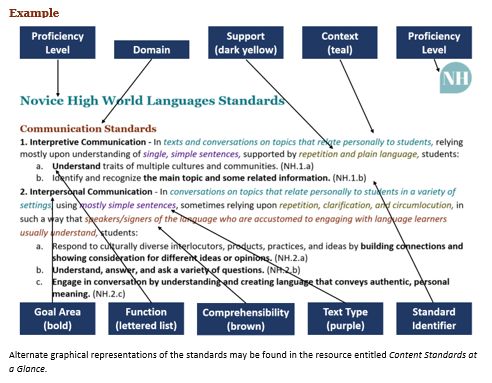
Massachusetts Curriculum Framework for World Languages 19World Languages Content Standards Organization of the Standards Proficiency Levels This framework divides standards not by grade level, but by level of linguistic proficiency. This is to account for the wide variety of programming that exists in schools across the Commonwealth. Organizing the standards by proficiency level allows educators to understand the type of language that is appropriate for their students without regard to age or grade level. Educators should ensure that the topics and materials they present are appropriate for the ages and developmental stages of the students in their classes. It is important to note that individual students will demonstrate varying levels of proficiency across different standards and across different communicative modes. For example, some students may demonstrate Intermediate High proficiency in interpretive reading, but they may demonstrate Intermediate Low proficiency in presentational writing. Similarly, students may have deep or even personal understanding of one or more target-language cultures, but they may be restrained by lower-level communication skills when they attempt to express their cultural knowledge. In each case, educators should identify their students’ current levels of proficiency in each standard and scaffold them to advance them toward the skills reflected in the next proficiency level. Domains Like the practices, the standards are divided into three domains: communication, linguistic cultures, and lifelong learning. The communication standards correspond to ACTFL’s communication goal area and inform how students listen, view, read, speak, sign, and/or write in the target language. The linguistic cultures standards correspond to ACTFL’s cultures and comparisons goal areas and reflect the new knowledge that students gain about target-language cultures and the language itself through the target language. The lifelong learning standards correspond to ACTFL’s connections and communities goal areas and describe how students personalize the language and intercultural knowledge. All three domains are interdependent and should be taught and expressed concurrently. Social Justice and Social and Emotional Practices The skills described in the social and emotional development practices and the social justice practices do not explicitly translate into standards. Rather, they are woven through all standards in all domains. The Department offers a Quick Reference Guide for Social and Emotional Learning in World Languages to social, emotional, and critical consciousness in the content standards. Standards The standards describe the skills that students demonstrate at each level of proficiency. Students demonstrate their proficiency in these standards through the target language. Likewise, teachers should rely almost exclusively upon the target language to deliver the content of the standards and foster classroom environments that facilitate exclusive or near-exclusive student use of the target language. Standards which describe linguistic proficiency are necessarily complex. To clarify such complex standards, this Framework divides each standard into up to five linguistic components (see Table 1). Each linguistic component is color-coded and consistently placed within the standard to facilitate vertical and horizontal alignment across languages and programs. Massachusetts Curriculum Framework for World Languages 20
Table 2: Linguistic Components 22
 Function              Context                    Text Type               Supports                Comprehensibility
 The simplest          The topics and             The length and          What students may       The degree of
 expression of the     settings in which          complexity of the       need to accomplish      success a student
 standard,             students can use           language students       the function            experiences in
 describing what       the language to            produce or                                      communicating a
 students can do       accomplish a               understand to                                   message
 with the language     function                   accomplish a
                                                  function
 E.g. Understand,      E.g. Settings that         E.g. isolated words,
                                                                 E.g. Visual aids,      E.g. In such a way
 list, describe,       students would find        phrases, sentences,
                                                                 repetition, gestures that speakers or
 create, ask           familiar, on topics        paragraphs                            signers will often
                       of immediate                                                     understand
                       interest to students
 Formula for the Content Standards
 In Context, producing/relying upon Text Type supported by Supports in such a way that Comprehensibility,
 students:
     • Function 1
     • Function 2, …

     •   Function
            o The function is the simplest and most straightforward expression of the standard, describing
                what students can do with the language across a variety of topics.
            o For example, in the interpersonal mode, novice students respond to questions by providing basic
                information, while intermediate students understand, answer, and ask a variety of questions.
            o Bolded text within the function descriptor indicates a brand-new function that emerges at a
                higher proficiency level or a new, more rigorous feature of a previously acquired function.
            o The functions appear in unitalicized black print in a lettered list following the introductory
                sentence.

                                  Why are some functions repeated from level to level?
             New linguistic functions emerge slowly over the course of language acquisition. It often
             takes several years for some functions to evolve or emerge. While functions themselves
                   do not often change from level to level, the context, text type, support, and
               comprehensibility around the function evolve as the students’ proficiency increases.

     •   Context
            o      Context describes both the settings in which students demonstrate their ability to use the
                   language to accomplish a function, as well as the topics that students are asked to examine.
            o      The context prioritizes students and their lived experiences.
            o      For example, novice learners function best in settings that the student would find familiar and
                   predictable, while intermediate learners can demonstrate skills in a variety of settings. Novice
                   learners best demonstrate their skills while treating topics of high familiarity and interest, while
                   advanced learners show proficiency while examining more generalized topics.
            o      The context appears in the standard’s opening sentence which introduces the functions. The
                   context appears in the standards italicized in teal.

22
  See resource entitled Linguistic Components Summary for a complete list of contexts, text types, supports, and
comprehensibility descriptors named in the Content Standards.
Massachusetts Curriculum Framework for World Languages                                                       21
You can also read


