BMZ African-German Leadership Academy 2022 - Deutsches ...
←
→
Page content transcription
If your browser does not render page correctly, please read the page content below

Photo y
      b Anders Jildén on Unsplash

                                    BMZ African-German
                                    Leadership Academy
                                                  2022
Background
                        Addressing significant global challenges, such as climate change
                        and economic disparity, are key to the global common good. Our
                         societies’ complex interconnectedness and interdependencies
                        necessitate developing joint and collective sustainable solutions.

                         The visions for achieving global sustainability as formulated by
                        the 2030 Agenda depends on development successes in all world
                         regions, including the steadfast implementation of the African
                                                  Agenda 2063.

Sine Saloum Delta, Senegal
Photo yb Anton Lecock on Unsplash
What is the African Academy?
                                    The BMZ African-German Leadership
                                    Academy (African Academy) is a dialogue
                                    and training programme targeted at
                                    early to mid-career professionals. It is a
                                    space for joint learning and discussion
                                    on sustainability, governance and
                                    leadership.

                                    With diversity at the core of its programme,
                                    the African Academy welcomes
                                    participants from a variety of sectors
                                    (civil society, academia and think tanks,
                                    public administration, business and media)
                                    to encourage transdisciplinarity and to
                                    promote networking and knowledge
                                    exchange among African and European
                                    actors.

                                    Bringing together different perspectives
                                    and expertise, the African Academy offers
                                    the scope to exchange viewpoints and
                                    experiences, as well as advance leadership
                                    skills, through peer learning.

                                    Furthermore, the African Academy
                                    allows for the collaborative creation
                                    of new knowledge, fosters mutual
                                    understanding and establishes trustful
                                    cooperation.

                                    The Academy thus lays the foundation for
                                    long-term collaboration and partnership
                                    between institutions and champions of
                                    change across sectors working towards
                                    sustainable development.

o
R ad in Ethiopia
 Photo by Klay Knight on Unsplash
The African Academy is hosted by the German
                    Development Institute/ Deutsches Institut für
                    Entwicklungspolitik (DIE) and funded by the German
                    Federal Ministry for Economic Cooperation and
                    Development (BMZ).

                    The programme is conducted in English.

                    The African Academy is targeted at early to mid-
                    career professionals from Germany and African partner
                    countries, namely Côte d’Ivoire, Ethiopia, Ghana,
                    Morocco, Senegal, Togo and Tunisia.

Partner countries
The 2022 edition of the African Academy will take place
from April to June.

The full schedule comprises a 10-week in-person phase in
Germany - spent in Bonn and Berlin –, preceded by a two-
week part-time online preparatory phase.

The joint work is followed-up in online exchanges.
Format and content

  The African Academy is grounded on three essential elements that contribute to capacity
                   development: knowledge, leadership and action.

Knowledge elements               The action component            Leadership modules focus
offer participants the space     is an open, creative and        on developing individual
to exchange knowledge            innovative learning space       and collective competencies,
and jointly learn about the      in which participants put       including strengthening
themes of governance and         their knowledge and skills      dialogue skills, problem
sustainability, on both a        into practice. Working          solving, exchanging
global and local level. In       independently in small          perspectives, teamwork,
our academic modules,            groups, participants develop    reflecting on one’s values,
participants strengthen          a hands-on solution and         and building strong and
their analytical capabilities    prototype for a self-selected   trustful relationships,
through engagement               challenge by following the      which will also benefit
with different concepts          design thinking method.         the participants’ home
and the direct interaction                                       institutions. Individual
with diverse scientific                                          coaching for participants
and practice-oriented                                            further complements the
stakeholders. This includes                                      leadership modules.
encounters in discussions,
workshops and site-visits to
selected institutions. A study
trip to Brussels adds first-                                     The training format is based on
hand practical insights into                                     the concept model of the MGG
                                                                 Academy
policy-making.
The programme utilizes a range of
training methods used to cultivate
learning, such as facilitated sessions,
workshops, open space and bar camp
formats, presentations, discussion,
excursions, expert interviews and role-
play.

The African Academy works under the
premise that knowledge acquisition
is not passive, but requires open and
active engagement by the learners.

Through collaborative peer learning,
participants benefit from an exchange
of different perspectives, hone their
critical thinking skills and develop
shared values.

Participants and their home institutions
will form part of a network and jointly
engage in knowledge cooperation.

Network activities are driven by the
network members themselves, and can
include collaborative organisation and
hosting of high-level policy dialogues,
joint publications, or other formats.
Who is the programme for?
The BMZ African-German Leadership Academy is aimed at early to mid-career professionals
from Germany and its African partner countries: Côte d’Ivoire, Ethiopia, Ghana, Morocco,
Senegal, Tunisia and Togo.

Potential participants of the African
Academy should:

 be a national or permanent resident of
 one of the participating countries
 be 25 – 40 years old*
 work on issues relevant for sustainable
 development
 have at least three years’ work experience
 (non-remunerated experience is also
 recognised)
 have the support of their employer
 (written support required as part of
 application)
 have a very good command of the English
 language (equivalent to B2 level of the
 CEFR)
 be respectful of other cultures
 be open to teamwork, reflection and a
 broad variety of working methods

*older applicants, who have taken longer
periods of parental leave, may be considered.

The African-German Leadership Academy
is committed to diversity and inclusion.
We therefore invite all elegible candidates,
irrespective of their gender, ethnic and
religious backgrounds, including persons
with disabilities, to apply.

                                                Photo y
                                                      b Windows on Unsplash
Participant support

                                             In order to facilitate participation,
                                             successful applicants to the African
                                             Academy will be awarded financial
                                             support, covering the following:

                                              Subsidised travel to and from
                                              Germany
                                              Accommodation for the duration
                                              of their stay in Germany
                                              A monthly living allowance to
                                              cover living costs in Germany
                                              Health, accident and personal
                                              liability insurance for the duration
                                              of their stay in Germany
                                              Subsidy to help meet technical
                                              requirements of the programme

                                             Please note that the financial
                                             support provided is not sufficient to
                                             cover participants’ families.

Berlin
Photo yb Moises Gonzalez on Unsplash
Benefits

                 Participants                 Sending Institutions
Participation in an innovative academic      Capacity development of staff in the
and practice-oriented international          areas of leadership, governance and
dialogue format                              sustainability. The knowledge and skills
                                             acquired can be directly applied within the
Capacity development on governance and       participants‘ home-institutions.
sustainable development
                                             Opportunity to propose real-life challenges
Strengthened leadership skills through       from within your working environment to
collective peer learning, complemented by    serve as case-studies for which participants
individual coaching                          find a solution as part of the innovation
                                             projects
Opportunity to become part of an
international network of like-minded         Become part of a growing cross-
professionals                                sectoral network of institutions working
                                             towards sustainable development in the
Exchange and development of new ideas        seven partner countries and Germany/
with peers from partner countries            Europe, opening up new and continued
                                             opportunities for cooperation in the future
Work on innovative solutions for real-life
sustainability challenges                    Opportunity to directly contribute to the
                                             implementation of the 2030 Agenda and
Engagement in different learning formats     the African Agenda 2063

Opportunity to directly contribute to the
implementation of the 2030 Agenda and
the African Agenda 2063

Park in Bonn, Germany
Photo yb Nathalia Esquivel
How to apply? 1 2 Check that you meet all the requirements Read: for participation as listed in the Who is the programme for? section. Conditions for Participation. 3 Compile your application documents: Application Form Part I: Applicant’s statement - to be completed and signed by you. Application Form Part II: Employer‘s statement of support - to be completed, signed and stamped by your employer. Diploma - A copy of your diploma or certificate (in English, French or English, or as a translation) of the highest professional qualification and/or university degree. Passport - A copy of the main pages of your passport. Language Certificate - Proof of English language proficiency (if available). 4 5 Submit your application documents via For any questions, contact the African the application portal. Academy Coordinator: Julia Osada. Deadline for application: 26 November For more information, visit the African 2021. Academy webpage.
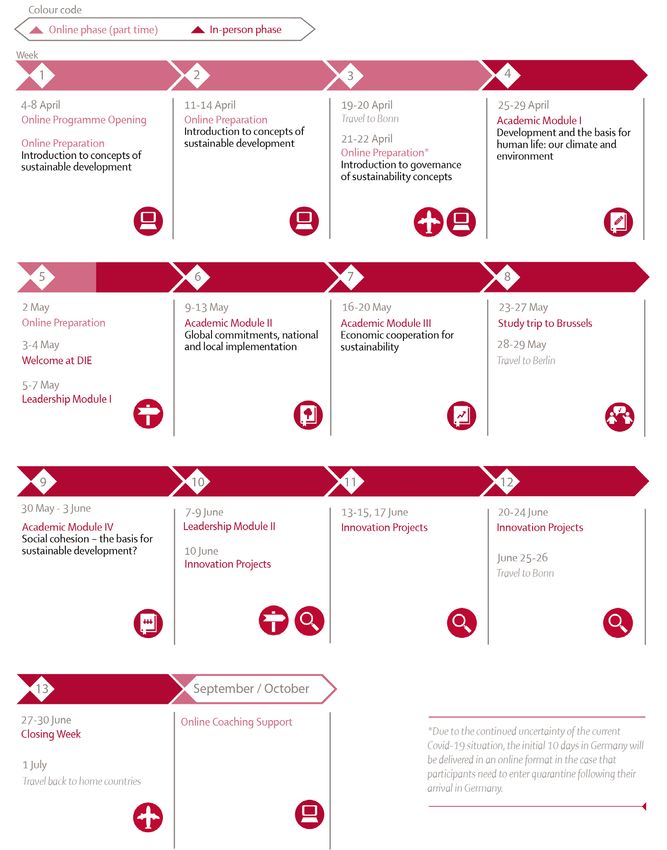
2022 Schedule Overview

                                               *

               This is a draft schedule and it is subject to change.
Contact German Development Institute /
Dr. Sven Grimm Deutsches Institut für
Head of Programme Entwicklungspolitik (DIE)
“Inter- and Transnational Cooperation“ www.die-gdi.de
Sven.Grimm@die-gdi.de Tulpenfeld 6
BMZ-African German Leadership Academy 53113 Bonn
GermanyYou can also read


