Briefing: NIB Priority Domains
←
→
Page content transcription
If your browser does not render page correctly, please read the page content below
Briefing: NIB Priority Domains
Update on the Roadmaps – June 2015

Following the publication of the Five Year Forward View and the Framework Personalised
Health and Care 2020, the National Information Board (NIB) have published a series of work
streams and associated ‘roadmaps’ which set out evidence-based plans for how proposals
for service transformation though data and technology will be delivered and their expected
benefits. These work streams have now been formed into six priority domains for delivery.

These six core priority domains for delivery are intended to become programmes that will
help transform health and care services through data and technology.

Initial modelling by the NIB indicates that technology could contribute to potential savings
opportunities of £8.3-£13.7 billion a year by 2020/21, of which £1.8-£3.4 billion could be
achieved through enabling citizens to make the right health and care choices.

This briefing:
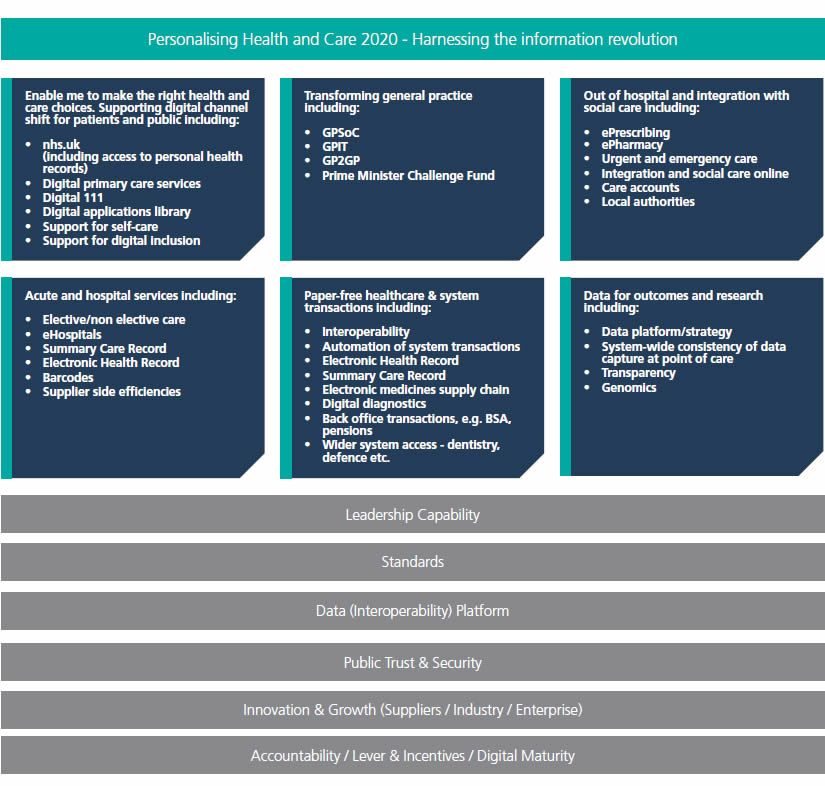
   •   Summarises the six key priority NIB domains:
          1. Enable me to make the right health and care choices
          2. Transforming general practice
          3. Out of hospital care and integration with social care
          4. Acute and hospital services
          5. Paper-free healthcare and system transactions
          6. Data for outcomes and research
   •   Provides a timetable of national requirements for local action and implementation
   •   Includes an overview table of the six priorities

NHS South, Central and West Commissioning Support Unit                               Page | 1
Domain one: Enable me to make the right health and care choices
This domain contributes to the efficiency/productivity challenge and transforms the
patient’s digital experience of and access to health and care services and transactions.
Programmes will include:
• nhs.uk, including access to personal health records (PHR)
• Digital primary care services
• Digital 111
• Digital applications library
• Support for self-care
• Support for digital inclusion
nhs.uk will be developed into a new integrated health and care digital platform. Citizens will
be able to:
• Communicate with clinicians/practices via email, secure video links and complete
pre-consultation questionnaire;
• Include data from their personal applications and wearable devices in their personal
record
• Access a set of (NHS assessed and approved) health and care digital applications
Digital transactions will be offered: ordering/paying for prescriptions, registering with GPs,
claiming funds for treatment abroad, registering as an organ/blood donor and reporting the
side effects of drugs.
nhs.uk will also enable citizens to create their own PHR from information stored in the
electronic health records in primary and secondary care. Where appropriate, PHRs will be
linked to care accounts to help people manage their personal budgets.
The MyNHS data service on nhs.uk will be expanded to include new scorecards, expanded
coverage of patient experience.
NHS South, Central and West Commissioning Support Unit Page | 2Domain two: Transforming general practice
This will include:
General Practice Systems of Choice (GPSoC)
• GPIT
• GP2GP
• Prime Minister’s Challenge Fund (PMCF)
Further procurement under the GPSoC will be used to stimulate the supply of new systems
and the GPSoC framework will be reviewed as a vehicle for change before it ends in April
2018.
To support 7-day services citizens will be able to communicate with their GP via online
communications, including the ability to register securely or change their primary care
provider online.
Domain three: Out of hospital care and integration with social care
Programmes in this domain will cover:
• ePrescribing
• ePharmacy
• Urgent and emergency care
• Integration with social care online
• Care Accounts
• Local Authorities
Patients and carers will able to:
• choose how/where they get their prescriptions, without the need for paper
• check information about their medicines, through simple barcodes
Connecting data to other digital applications will also remind people when to take their
medicines.
111 and 111 digital (part of nhs.uk) will deliver an online triage and consultation service for
patients with urgent needs, fully integrated with local services. The personal use of digital
applications to record their health and care preferences in advance of them needing urgent
and emergency care will be actively encouraged.
NHS South, Central and West Commissioning Support Unit Page | 3There will be a programme to improve self-care and the use of telehealth, to enable citizens to plan and manage their care and finances and to connect to carers and peers. The programme will support the work of local government, and also involve the independent and voluntary sectors, and carers. Domain four: Acute and hospital services Programmes in this domain will cover: • Elective/non-elective care • eHospitals • Summary Care Record • Electronic Health Record • Barcodes • Supplier-side efficiencies Digital initiatives like: providing a single source of information on referrals and bookings; supporting national standards of integration and interoperability; and exploring the use of digital channels for pre and post-operative assessments, will all contribute to driving greater efficiency in hospital settings. For example, asset tracking is an effective way of addressing inefficiencies. It enables a hospital’s wireless infrastructure to actively track assets through the use of Radio Frequency Identification (RFID) tags and can reduce the financial impact of inefficiencies in equipment utilisation; patient care and safety, and staff productivity. NIB is proposing a set of common digital and information standards including the use of the NHS Number as primary identifier of patients, adoption of the GS1 barcoding standard and SNOMED- CT. NHS South, Central and West Commissioning Support Unit Page | 4
Domain five: Paper-free healthcare and system transactions
This domain will include programmes that will support interoperability around common
digital and information standards including:
    • Automation of system transactions
    • Electronic Health Record
    • Summary Care Record
    • Electronic medicines supply chain
    • Digital diagnostics
    • Back office transactions, e.g. BSA, pensions
    • Wider system access – dentistry, defence etc

By April 2016, local health and care economies will publish local digital roadmaps for
delivery against the paper-free targets for 2018 and 2020.

By March 2016, it will be a core requirement for all providers to have enabled access to SCRs
and the information available to clinicians in the SCR will be extended to include whether a
patient has learning disabilities or suffers from dementia.

Work will also begin on the commitment to have 100% of pharmacies with access to the SCR
by March 2017.

By 2018 clinicians in primary, urgent and emergency care will be working without paper
records, and by 2020 all patient and care records will be digital, real time and interoperable.

To ensure transparency a Digital Maturity Index (DMI) is being co-produced with the health
and care sector to enable individual providers and health and care economies to baseline
and benchmark their current position and mark progress. It will assist local organisations
and economies identify solutions to address the gap between their current reality and what
making best use of digital technology delivers. The first DMI will be published in the autumn
of 2015. Core content of the DMI can be found NIB Work Stream roadmap 2.1 Appendix B.

NHS South, Central and West Commissioning Support Unit                                Page | 5
Domain six: Data for outcomes and research
The programmes will seek to address the issues of fragmented, incomplete and inaccessible
health and care data:
• Data platform/strategy
• System-wide consistency of data capture at point of care
• Transparency
• Genomics
Subject to patient consent, high quality standardised data will be extracted from all parts of
the NHS and care services. A standardised record will be generated at the end of every
episode of care with a copy being made available to a patient’s GP.
Major national genomics projects such as the 100,000 genomes programme, laboratory
reconfiguration and wider National Institute for Health Research (NIHR) are already
underway. A National Genome Informatics Network will be created to align and create a
detailed assessment of how NHS genomic and pathology services can share genome or
molecular data for the benefit of patients and research.
The NIB plan on the delivery programme for Personalised Healthcare 2020 can be found
here:
www.gov.uk/government/uploads/system/uploads/attachment_data/file/437067/nib-delivering.pdf
Next steps
• The NIB is currently consulting on the draft roadmaps/content of the programmes within the
domains, before publishing final roadmaps in September 2015
• The NIB is seeking wider views on the proposals and four regional events aimed at local
commissioners, managers, NHS chief information officers, social services, local government
and voluntary/community are being held in Reading, Bristol Sheffield and Manchester
between 15-18 July. Register to attend: www.eventbrite.co.uk/e/nib-regional-events-
reading-tickets-17652515148?access=NIB28715
• NIB is due to publish guidance for CCGs outlining the core content to be included in their
local digital roadmaps
• Co-created tools and resources on developing digital roadmaps as part of a package of
learning and support will be made available from September 2015
NHS South, Central and West Commissioning Support Unit Page | 6Timetable for implementation and local action
Project/element Description Deadline Local Action and Impact
E-discharge All NHS providers must send 1 October 2015 • Ensure that local providers
discharge summaries to GPs are equipped to provide e-
electronically – only email and discharge summaries
e-messaging will be acceptable • Ensure that all GPs are aware
under standard NHS contract that discharge summaries
should not be accepted via
post or fax. If they continue
to receive alternative
discharge summaries this
should be escalated
appropriately.
• Communicate changes to
patients
Community Roll out due to start in Autumn March 2017 • Locally identify which
Pharmacy Access 2015 pharmacies are involved and
to SCR their local practices
• Training for local
pharmacists
• Communication with,
pharmacies, practices and
patients
Electronic Roll out EPS to community March 2016 • Communication to patients
Prescription pharmacy
Service
SCR updated data All GP practices must ensure March 2016 • Ensure all practices are
and all providers that SCRs include information aware of the deadline and
enabled access to on whether patient has SCRs updated accordingly
SCRs dementia or learning disability • Communicate changes to
patients to ensure they are
aware of changes to data
recorded and shared
SCR All GP practices must provide April 2016 • Communication with
Comprehensive access to a comprehensive patients
Record record • Training for GPs
NHS South, Central and West Commissioning Support Unit Page | 7Publication of Local commissioners will create April 2016 • Comply with standards
local roadmaps and publish local roadmaps to published by NIB (Appendix
for delivery of support introduction of fully A work stream 2.1)
interoperable interoperable digital health • Comply with core content
health records records, including specialized guidance (due for
care. publication July 2015)
The roadmaps will describe the • CCGs will coordinate
current digital capabilities of roadmap development in
local areas and outline plans for conjunction with providers,
progress towards paper-free local authorities, and the
over the next five years. They voluntary and community
will be supported by self- sectors. Given the
assessment and peer review; significance of the Better
plans refreshed annually in line Care Fund, Health and
with the NHS Planning Wellbeing Boards will have a
Framework. central role in local sign-off.
NIB will assure the content of
local digital roadmaps to check
that individual and health and
care economy proposals are
harmonised and realistic.
Replacement of Read codes replaced with End of 2016 • All GP systems, QoF and
Read codes Snomed CT pathology reporting systems
compliant with Snomed CT
and records not affected
• Training for GPs
Secondary Care All secondary care outpatient September 2017 • Training in use of e-referrals
Outpatient referrals will use e-referrals system
e-referrals service • Communication to patients
Emergency Emergency services End 2018 • Compliant with plans laid out
services real time (ambulance, 111 and OOH) will in published local roadmap
access to full have access to fully • Communications to patients
digital health interoperable comprehensive alerting them to who will
record patient records have access to their records
Fully All healthcare providers have End 2020 • Communication to patients
interoperable access to fully interoperable, • Training for all healthcare
comprehensive comprehensive patient records. providers and users of
patient records, including IG
NHS South, Central and West Commissioning Support Unit Page | 8Overview of the six NIB priority domains NHS South, Central and West Commissioning Support Unit Page | 9
You can also read


