Brunswick Rail Limited Management Presentation - 15 April 2016
←
→
Page content transcription
If your browser does not render page correctly, please read the page content below
Brunswick Rail Limited
Management Presentation
15 April 2016
Disclaimer
Information contained in this presentation concerning Brunswick Rail Limited, an exempted company under the laws of Bermuda (“Brunswick Rail” or the “Company”, and
together with its consolidated subsidiaries, the “Group”), is for general information purposes only. The opinions of the Company presented herein are based on general
information gathered at the time of writing and are subject to change without notice. The Company relies on information obtained from sources believed to be reliable but does
not guarantee its accuracy or completeness.

These materials may contain forward-looking statements regarding future events or the future financial performance of the Company. You can identify forward looking
statements by terms such as “expect”, “believe”, “estimate”, “anticipate”, “intend”, “will”, “could”, “may”, or “might”, the negative of such terms or other similar expressions.

These forward-looking statements include matters that are not historical facts and statements regarding the Company’s intentions, beliefs or current expectations concerning,
among other things, the Company’s results of operations, financial condition, liquidity, prospects, growth, strategies, and the industry in which the Company operates. By their
nature, forward-looking statements involve risks and uncertainties, because they relate to events and depend on circumstances that may or may not occur in the future. The
Company cautions you that forward-looking statements are not guarantees of future performance and that the Company’s actual results of operations, financial condition,
liquidity, prospects, growth, strategies and the development of the industry in which the Company operates may differ materially from those described in or suggested by the
forward-looking statements contained in these materials. In addition, even if the Company’s results of operations, financial condition, liquidity, prospects, growth, strategies and
the development of the industry in which the Company operates are consistent with the forward-looking statements contained in these materials, those results or developments
may not be indicative of results or developments in future periods. The Company does not intend to update these statements to reflect events and circumstances occurring after
the date hereof or to reflect the occurrence of unanticipated events. Many factors could cause the actual results to differ materially from those contained in forward-looking
statements of the Company, including, among others, general economic conditions, the competitive environment, risks associated with operating in Russia, market change in the
Russian freight rail market, as well as many other risks specifically related to the Company and its operations. No reliance may be placed for any purposes whatsoever on the
information contained in this presentation or on its completeness, accuracy or fairness.

This presentation includes statistics, data, forecasts and other information relating to the Company’s industry and the markets in which it operates that the Company has
obtained from industry publications and surveys, broker research and other third-party sources. None of the sources cited themselves form a part of this presentation. Industry
publications and surveys, brokers research and other third-party sources generally state that the information contained therein has been obtained from sources believed to be
reliable, but there can be no assurance as to the accuracy or completeness of included information. Moreover, such data will often be based on sampling and subjective
judgments by the relevant third-party source and/or inherently predictive and speculative. The Company has not independently verified any of the third-party information
included in this presentation nor has it ascertained the underlying assumptions relied upon therein. Accordingly, the third-party information included in this presentation should
be viewed with caution.

The information in this presentation is subject to verification, completion and change. Accordingly, no representation or warranty, express or implied, is made or given by or on
behalf of the Company or any of its shareholders, directors, officers or employees or any other person as to the accuracy, completeness or fairness of the information or opinions
contained in these materials. None of the Company nor any of its shareholders, directors, officers or any other person accepts any liability whatsoever for any loss howsoever
arising from any use of the contents of this presentation or otherwise arising in connection therewith. This presentation is not an offer to buy or solicitation of an offer to buy or
sell any security or instrument or participate in any trading strategy. No part of this presentation may be construed as constituting investment advice or recommendation to enter
into any transaction.

      Management Presentation 15 April 2016
2
Table of Contents
1. Company Overview 6
2. Market Context & Industry in Turmoil 18
3. Business Model Under Threat 29
4. Market Projections 33
5. Market Projections 37
Management Presentation 15 April 2016
3Glossary of Sources – 3rd Party
Bloomberg Industrial Cargoes New Forwarding Company
• Macroeconomic Shocks – Russian Economy • Market Overview • Industry Shocks – Railcar Transportation Volumes
• Macroeconomic Shocks – Exchange Rate • Industry Shocks – Railcar Oversupply
• Historical Broker and Institution Overestimation – • Industry Shocks – Railcar Production Rail Soviet
Russian GDP • Industry Shocks – Regulatory Changes • Industry Shocks – Railcar Oversupply
• End Result: Industry Wide Decline in Railcar Lease
Central Bank of Russia (CBR) Rates Rosstat
• Macroeconomic Shocks – Russian Economy • Historical & Projected Lease Rates (Market • Market Overview
• Industry Shocks – Regulatory Changes Projections) • Industry Shocks – Railcar Transportation Volumes
• Historical & Projected Lease Rates (Business Case
Focus Economics Website and Conservative Case) RZD Rail Volume Press Releases
• Macroeconomic Shocks – Exchange Rate • Market Overview
Infoline
IMF October 2015 Outlook Database • Market Overview UVZ Company Website
• Macroeconomic Shocks – Russian Economy • Industry Shocks – Russian Railcar Production • Industry Shocks – Railcar Production
• Industry Shocks – Railcar Transportation Volumes • Industry Shocks – Regulatory Changes
• Historical Broker and Institution Overestimation – • Industry Shocks – Next Generation Railcars World Bank
Russian GDP • Industry Shocks – Gondola Surplus Forecast • Macroeconomic Shocks – Russian Economy
• Historical & Projected Lease Rates (Market
IMF January 2016 Outlook Update Projections)
• Macroeconomic Shocks – Russian Economy • Historical & Projected Lease Rates (Business Case
• Industry Shocks – Railcar Transportation Volumes and Conservative Case)
• Historical Broker and Institution Overestimation –
Russian GDP
Management Presentation 15 April 2016
4Glossary of Sources – Company
2012 Annual Report January 2014 Investor Presentation
• Company Highlights “Bringing Railcar Operating Leasing to Russia”
• Company Highlights
2013 Annual Report
• Company Highlights Quarterly Financials
• Historical Financial Summary • Historical Financial Summary
• Historical Performance Summary
“Russia’s New Generation Railcars” Research
2014 Annual Report • Industry Shocks – Next Generation Railcars
• Company Highlights
• Historical Financial Summary
• Historical Performance Summary
2015 Annual Report
• Company Highlights
• Historical Financial Summary
• Historical Performance Summary
Apr 2012 Management Presentation
• Historical Growth of Brunswick Rail
Management Presentation 15 April 2016
5Section 1 Company Overview
Brunswick Rail is a private railcar operating lessor in Russia and the CIS, with a client base heavily concentrated in coal and oil

Company Highlights
                                                  Overview                                                                       Financial Snapshot

                   •   Established in 2004, Brunswick Rail Ltd (referred to sometimes                350                                                                            8.5x
                       herein, with its various related entities, as Brunswick) is a                        5.9x
                                                                                                                                                       306
                                                                                                     300                4.5x     3.8x      4.5x                            4.5x
                       private railcar operating lessor providing freight railcars to                                                                          3.8x
                                                                                                                                                         257   255
                       corporate clients in Russia and the CIS                                       250                                               2.9x
                                                                                                                                                                           204
                   •   Following the acquisition of ZAO ProfTrans Group (“Proftrans”)                200                                   184                       195
                       in 2011, the Company also provides fleet management and                                                                                               153
                                                                                                     150                                         140                               134
                       freight forwarding services within Russia
                                                                                                     100    81         85        92
                                                                                                                                                                                         80
                   •   From its peak in 2012, the Company’s financial performance has                            61         67        71

                       declined from EBITDA of $257m to $80m in 2015                                  50

                       Leasing Operations                                                              -
                                                                                                            2008        2009     2010      2011        2012    2013        2014     2015
                   •   Leasing comprised 85% of 2015 revenue. Brunswick provides
                                                                                                                 Gross Revenue (US$m)      Adjusted EBITDA (US$m)          Net Debt / EBITDA
                       railcars under long term contracts in a mix of Full Service
                       Operating Lease (62% Revenue), Triple Net Operating Lease
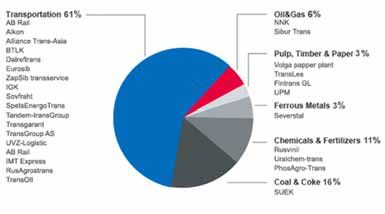
                       (21% Revenue) and Finance Lease (1% Revenue)(1)                                       Leasing Fleet structure by Industry (Jun-15)
                   •   Brunswick Rail’s leasing customer operations span
                       transportation (61%), coal and coke (16%), chemicals and
                       fertilisers (11%), oil and gas (6%) and other industries (6%)
                       Transportation Services
                   •   The transportation division (Proftrans) comprises $20.5m or
                       15% of 2015 revenue. It provides transportation services to third
                       party customers under short term agreements

     Management Presentation 15 April 2016
7    Sources: January 2014 Presentation “Bringing Railcar Operating Leasing to Russia”, BRL 2012-15 Annual Reports, Company data
     (1) Components do not sum to 85% due to rounding
…operating in a regulated and state-dominated sector that has historically been highly correlated with macroeconomic and commodity cycles
Market Overview
Overview Market Size
Mln Tonnes
1,600
• In 2001 the Russian government began a process of
1,344
liberalising the railway sector. Since that time government 1,400
1,273
1,311 1,304
1,206 1,242
1,272 1,237
1,227 1,214
1,161 1,221
reforms have transformed the formerly vertically 1,200
1,043 1,058
1,084 1,107
integrated government railway organisation into a 1,000
regulated state owned enterprise (“RZD”), and hundreds 800
of private supply companies and rail operators 600
400
• RZD retains a monopoly in the provision of rail 200
infrastructure, and is the major player in the provision -
'00 '02 '04 '06 '08 '10 '12 '14
of locomotive services. However, the regulatory Coal & coke Oil & oil products
framework provides third-party operators access to Construction materials & cement Other commodities
Ores Steel & scrap
infrastructure on a non-discriminatory basis alongside RZD Chemicals & fertilizers Timber, lumber
Grain & grain products
and its subsidiaries
Old Generation Daily Gondola Spot Lease Rates(1)
• Operating lease penetration remains low by international Rate, RUB / day Rate, USD / day
standards at c.10%. However, in recent times the large 2500 50
railcar producers have been actively growing their captive 45
$48 $45
leasing fleet
2000 40
35
• Brunswick is currently the largest operating lessor, R 1446
R 1439 $29
however, its fleet only represents 2% of the total railcar 1500 30
market, which is dominated by two major players – Freight $21 25
$19
One (“PGK”) and Federal Freight (“FGK”) – which were 1000 Trough: R 350 20
R 890
established out of the wagon operations of RZD $13
15
R 698 R 406 R 400 R 500
500 R 632 10
• Daily lease rates in the market have decreased from a R 431
$7 $7 $7 5
peak of c.RUB 1,446 in January 2012 to RUB 500 today,
-
having reached a low of c.RUB 350 in March 2015 Jan-12 Dec-12 Dec-13 Dec-14 Dec-15
Gondola spot rate, RUB / day Gondola spot rate, USD / day
Management Presentation 15 April 2016
8 (1) Current gondola market rates are RUB 500, and the Company is expecting rates for 2016 to be around RUB 550
Sources: RZD, Rosstat, Infoline, Industrial Cargoes, Company dataBrunswick Rail’s business model had historically allowed Brunswick Rail to deliver attractive returns
Brunswick Business Model - Historical
INDUSTRY STRUCTURE & DYNAMICS
• Underinvestment in the railcar fleet created
• Liberalisation of the rail industry created
opportunities for private railcar operators • Multi-year commodities bull market drove
significant level of end user demand supply constrained environment where
customers focused on security of supply
BOARD MANAGEMENT
• Best-in-class corporate governance policies • Strong, long-serving, management team
• All directors have significant experience in rail • Western expertise supported by good governance
infrastructure and financial services industry policies and transparency enabled a competitive
• Extensive knowledge of Russian market advantage in cost of capital
SHAREHOLDERS Ability to extract
SUPPLIERS
• Diversified and high-quality international • Strong relationships with railcar producers
shareholder base
premium to spot • Brunswick widely recognised as the “most reliable”
• Demanded good governance and transparency market price partner
CAPITAL MARKETS FLEET
• Ability to access western capital markets and • Historically maintained a young and well invested
importantly obtain lower cost of funding fleet, necessitating lower maintenance costs
• At the time of bond issuance, 81% of fleet was
CONTRACTS below 6 years of age
• Long term, mainly USD denominated, and fixed rate
• Upward contract indexation & termination penalties
• Dollar contracts provided “natural hedge” for the
Company’s borrowings
Management Presentation 15 April 2016
9…enabling rapid growth in the late 2000s and early 2010s
Historical Growth of Brunswick Rail
Deliver
Market Alfa Bank
Implant the concept Build scale Demonstrate resilience sustainable
Decline Refinancing
growth
$600m inaugural
4 M&A Deals Eurobond, rated
Founded $200m MRIF Completed BB- by S&P and
Syndicated Loan(2) $385m $172.5m Private RUB 8 bln credit
Syndicated Loan(2) Ba3 by Moody’s
Placement facility(2)
2004 2005 2006 2007 2008 2009 2010 2011 2012 2013-2015 2016
$50m Sale lease-back
New New $156m Acquisition $250m with Alfa for
Shareholder Rights $300m A/B Loan(2) $150m Preferred
Shareholder Facility(2) & $133m IFC A/B Loan(2) c.RUB 4bn
Issue (upsized to $420m in 2011) Equity Shares
Finance Lease
Equity Financing Debt Financing M&A
25.6 25.8
24.0
21.8 22.2
Fleet size
(ths railcars)(1) 12.6
10.4 10.7
7.4
3.1 3.7
2005 2006 2007 2008 2009 2010 2011 2012 2013 2014 2015
Management Presentation 15 April 2016
10 Source: Company data, Apr 2012 Management Presentation
(1) End of period data
(2) Repaid in fullBrunswick Rail’s founders continue to provide strategic guidance and cornerstone relationships
Business Founders
Martin Andersson Founding Shareholder / Chairman
• Martin Andersson was re-appointed Chairman of Board of Directors of Brunswick Rail in September 2015, and has been a
member of the Board of Directors since 2005. He was a co-founder of the Company in 2004
• Martin is currently also a board member of the Board of Directors of Cabo Delgado Investments and the Interface Financial
Group. He manages an active investment portfolio with interests predominantly in real estate, financial services and
information technology
• Previously Mr. Andersson was a shareholder and Board member at SUEK, Brunswick’s key client, as well as MDM Bank
• Martin co-founded Brunswick Group in August 1993, and was appointed CEO of Brunswick Brokerage in November 1993
He became Chairman of Brunswick UBS Warburg in 1999, and has also previously chaired the Board of Directors of
Brunswick Rail Leasing (2005-2007) and Brunswick Capital Limited (2002-2007)
• From 1992 to 1993 he was an advisor to the Russian Government’s Privatisation Committee, and before that worked as a
consultant at Booz Allen Hamilton specialising in Mergers & Acquisitions
• Martin Andersson graduated from the Stockholm School of Economics in 1989 and HEC Paris in 1990
Gerard de Geer Founding Shareholder / Director
• Joined the Board of Directors of Brunswick Rail (2006) and was a co-founder of the company (2004)
• Co-founded and chaired the Brunswick Group with investments predominantly in emerging markets (1993-2007)
• Founding Partner and Executive Chairman of White Peak Real Estate
• Chairman of China Projects Holding Ltd
• Former Chief Executive Officer of the Enskilda Group
• Former Chairman of Banque Scandinave En Suisse
• Former Director of Hambros Bank London (1975 – 1982)
• Graduated from the Stockholm School of Economics with a B.Sc. in Economics
Management Presentation 15 April 2016
11 Source: Company dataSenior management has significant experience both at Brunswick and in the Russian market
Senior Management
Paul Ostling • Paul Ostling was named CEO of Brunswick Rail in October 2015. Prior to that he was Chairman of the Group’s Board of Directors since
Group CEO 2012
• Before Brunswick Rail, from 2010-2011, Mr Ostling was a board member at Kungur Oilfield Equipment and Services, where he also
served as CEO and General Director from 2007 to 2009
• From 1977 to 2007 he held various senior management positions at Ernst & Young, including Global Chief Operating Officer (2003-2007),
Global Executive Partner (1994-2003), and Vice Chair and National Director for Human Resources (1985-1994). From 1997 to 2007 he was
a member of Ernst & Young’s Global Executive Council
• Paul Ostling has also held Board positions at a number of leading Russian corporates, including MTS, PromSvyazBank and UralChem
• Mr Ostling remains a member of the Board of Directors of Uralkali, which he joined in 2011. He is also a member of the Business Council
for International Understanding, and Executive Vice President for Finance and a member of the Board of Directors at The Boy Scouts of
America Transatlantic Council. In addition to being a member of the New York State Bar Association, Paul Ostling is a certified financial
advisor under SEC and LSE Regulations
• Mr Ostling holds a Law Degree from Fordham University School of Law and a B.S. in Mathematics and Philosophy from Fordham
University
Nicolas Pascault • Nicolas Pascault joined the Group in 2004 as Managing Partner and CFO
First Deputy CEO • In January 2015 Mr. Pascault assumed the position of Deputy CEO, reporting directly to the Chairman, and was asked by the Board to
support a bond restructuring
• After the departure of the previous management team in October 2015, Mr. Pascault became First Deputy CEO
• Prior to joining the Group Mr. Pascault served for six years as CFO of Danone Group in Russia
• Prior to this, he worked for eight years at Ernst & Young in Moscow, St. Petersburg and Paris in the Audit and Corporate Finance
Department
• Mr. Pascault graduated from the Institut d’Etudes Politiques of Paris and has a Master of Finance from the University of Paris II
Vladimir Khoroshilov
Business Development • Vladimir Khoroshilov joined Brunswick Rail in November 2010 and oversees new business development and the Group’s commercial and
Adviser technical activities and transportation services
• From 1997 to 2010 he worked at PhosAgro, where he held various positions including Director for Transport and Logistics. Vladimir
started his career as a programmer at Moscow Institute of Electromechanics and Programming
• Vladimir Khoroshilov graduated from Moscow State University with a degree in Mathematics
• Vladimir left BR in November 2014, and was hired back into BR in September 2015, after the departure of the previous management
team
Management Presentation 15 April 2016
12 Source: Company dataSenior Management (cont.)
Alexey Mashchenkov
• Alexey Mashchenkov joined Brunswick Rail in January 2016
CFO
• Before joining the company he served as Group Chief Financial Officer of Russian Standard Corporation, a holding company with
interests in banking, insurance and alcohol production and distribution. From 2008 to 2012 he was Country Manager at Alpcot Capital
Management, an emerging markets focused asset manager, and served as CFO of Alpcot’s portfolio company Agrokultura (2008-2010).
He has also worked as a consultant at Bain & Co and PricewaterhouseCoopers, as well as Regional Controller at Russian telecoms major
Megafon
• Alexey Mashchenkov graduated from St Petersburg State University, he holds an MBA from INSEAD. He is a member of the Association
of Chartered Certified Accountants and holds the CFA Institute’s Investment Management Certificate. He speaks fluent English
Elena Naumova
Managing Director /
General Counsel • Elena Naumova joined the Group in January 2006 and is in charge of providing general legal support for the Company. Prior to joining
she was a lawyer with Raiffeisen Leasing in 2005-2006 and was Legal Department Head at Interrosleasing from 2002 to 2005. From 1996
to 2001 Elena worked as an attorney and was a member of St. Petersburg Bar Association
• Elena Naumova graduated from St. Petersburg law school in 1996. She is fluent in English
• Elena left BR in October 2014 and was hired back into BR in September 2015, after the departure of the previous management team
Victor Koshkin • Victor Koshkin joined the Group in 2010 and was in charge of M&A and equity transactions until January 2015 when he was asked to
Managing Director / work with Nicolas Pascault to support a Bond restructuring
Capital Markets, IR and
• In October 2015 Mr. Koshkin assumed the position of Managing Director – Capital Markets, IR and Marketing
Marketing
• In 2003-2010 Mr. Koshkin worked in Moscow as CFO at Integrated Energy Technologies, Deputy Head of Business Development at SUAL,
and adviser to shareholders of MDM Group
• In 1996-2001 Mr. Koshkin worked as an investment banker at JP Morgan and Lehman Brothers in New York
• Mr. Koshkin holds an MBA degree from Harvard Business School and a BA degree in Economics from Wabash College
Management Presentation 15 April 2016
13 Source: Company dataDespite recent changes, Brunswick Rail’s management and staff have provided stability and continuity
Business Continuity
Board of Directors
Chairman – Currently Recruiting
Martin Andersson for This Position
Internal Auditor
Since 2004
Paul Ostling
Chief Executive Officer
CEO
Since 2012
Nicolas Pascault
First Deputy CEO
Since 2004
Deputy CEO &
Managing Directors
Avg Tenor: 6.8 yrs
Alexey Mashchenkov Vladimir Khoroshilov Elena Naumova
Advisor to the General Victor Koshkin
CFO Managing Director, General Managing Director, Capital
Director and Group,
Counsel Markets, IR & Marketing
Business Development
Since 2016 Since 2006 Since 2010
Since 2010
Ekaterina Kozyreva Irina Zvereva Pavel Gordievskiy Alexandra Korneeva Yuliya Karpenchuk Nikolay Danilov Richard Sultanov
Director of Strategic
Directors Deputy CFO Director of Commercial Head of Technical Director of Legal Director, HR & IT Director Marketing, Development
Department Department Department Business Support
Avg Tenor: 6.3 yrs & Communications.
Assistant to CEO
Since 2007 Since 2012 Since 2012 Since 2010 Since 2007 Since 2007 Since 2014
Finance International Commercial Maintenance & Legal HR / Information Marketing /
Department Operations Department Repairs Department Administrative Technology Communications
Department Department Department Department
Departments
17 members 2 members 15 members 10 members 2 members 13 members 3 members 1 member
Avg Tenor: 4.4 yrs 9.2 yrs 3.8 yrs 4.3 yrs 5.2 yrs 5.6 yrs 7.2 yrs 3.2 yrs
Management Presentation 15 April 2016
14 Source: Company data….which enabled the Company to deal effectively with legacy management challenges
Legacy Management Challenges
• The previous Brunswick Rail management team left the business with a number of legacy issues. While separate from the wider
industry and business environment, these issues have placed a considerable burden on the Company and current management
Issue Actions Taken
During late spring and early summer 2015, it came to the attention of the Chairman and the Board that the
payment discipline of certain clients had deteriorated
Concerns were raised at the Board level over the failure by incumbent management to reclaim railcars under
Business
defaulted contracts with the view that management had failed to act “tough enough and fast enough” to
Management
prevent further loss
It also became apparent that management had entered into contracts with poor credit quality clients and that
a significant number of railcars had been placed into contracts where, from a logistics perspective, they would
be difficult to recover in the event of an issue
On 15 September, the Board commissioned an independent investigation into managements actions
As a result of this investigation it became apparent that:
― Contracts were entered into that breached the Group’s credit policy
Independent
― Contracts were entered into under which wagons would be used in the Crimea and Sevastopol region
Review
resulting in a breach of certain representations and warranties under the Company’s Secured Financing
Agreement (“SFA”)
As a result of this investigation, the Board decided to terminate the employment contract of the CEO and
suspend additional other staff members
Management Presentation 15 April 2016
15 Source: Company dataActions of previous management resulted in breaches under the Company’s syndicated loan facility that had to be urgently resolved
Secured Facility Lender Negotiations
Issue Commentary
On the 18th September the Company received a waiver from lenders under its Secured Facility (the “Secured Lenders”) in
relation to a breach of its Consolidated Leverage Maintenance Ratio in respect of the period ending 30 June 2015
Subsequent to this date and through the course of its internal review the board learned that a small number of the
Breach of railcars provided as collateral under the SFA were used in Crimea and Sevastopol causing the Company to breach certain
Covenants representations and warranties contained in the SFA
The Company therefore sought a waiver in relation to this matter as announced to the market on 12th October. Without
this waiver the auditors review report could not be issued necessitating a further waiver in relation to late delivery of the
accounts
Failure to secure a further waiver, could have led to a mandatory prepayment notice being issued by he SFA lenders and
Negotiations a cross-default under the bond documentation. An acceleration or threat of acceleration of the bonds under the cross-
with Secured default could have resulted in a Russian insolvency process
Lenders During the ensuing period the Company continued to negotiate with the SFA lenders however a further waiver was not
agreed
The Company continued to work with its lenders under the syndicated facility to address these issues however as the
syndicated facility matured in July 2016, and having reference to the Company’s cashflow forecasts, the Company
determined it was in the best interests of all of its stakeholders to pursue a refinancing option
In December 2015, the Company and Alfa-Leasing LLC signed a term sheet for the provision of up to RUB 4 billion of
financing pursuant to two new sale and leaseback facilities (for 3,398 and 2,700 railcars, respectively)
On 18th of January the Company entered into the first agreement with Alfa-Leasing LLC for the provision of approximately
Alfa RUB 2.3 billion of financing under a sale and leaseback facility in relation to 3,398 railcars which were previously subject
Refinancing to pledge under the syndicated facility. The Company used the proceeds of this facility, together with its own cash to
effect a full repayment of the existing syndicated facility immediately upon the completion of the transaction
On 26th January the Company announced that it had drawn down on the second Alfa tranche in an amount of RUB
1.6billion. All fees associated with the Alfa facility were paid at the drawdown of the first agreement and both tranches
are able to repaid at anytime
In doing so the Company created a stable platform from which it could negotiate a comprehensive restructuring of its
capital structure without the threat of precipitous action from its secured lenders
Management Presentation 15 April 2016
16 Source: Company dataIn parallel, current management has worked hard to resolve legacy challenges it inherited
Current Management Responses to Challenges
• Subsequent to termination of previous CEO’s employment contract, new management was put in place and Paul Ostling,
previously Chairman, became CEO
• Since that time, Management has taken a number of actions to deal with legacy issues and to create a framework of controls to
ensure compliance with the Company’s policies and all applicable laws and regulations
Issue Actions Taken Result
CEO and Chairman worked to re-establish long term client relationships
Certain legacy contracts were put on watch list and new strategies were developed for each, including
rate increases where appropriate
Business
Management
Crimea and Sevastopol region specific sanction policies were enforced to prevent fleet utilisation of
railcars pledged in favour of the Secured Finance Facility lenders in this region
The Company worked diligently to remove the railcars from Crimea and Sevastopol region
Company implemented a railcar monitoring system to more effectively manage the logistics between
the operating leasing and Proftrans businesses
Clear communication channels established across management, local and Board credit committee
levels
Transparency Local credit minutes immediately made available to the Board credit committee
Local credit committee meeting frequency increased to twice per month
Board credit committee meeting frequency increased to once per month
Management Presentation 15 April 2016
17 Source: Company dataSection 2 Market Context & Industry in Turmoil
Russian railcar sector has been severely hit by a series of game-changing shocks

Macroeconomic & Industry Shocks – An Industry Derailed

        1                                                                                                  Macro
                                      a             Prolonged GDP & Commodities Price Contraction
                                                                                                    Demand
            Macroeconomic
               Shocks
                                      b                  RUB / USD Exchange Rate Weakness               Macro

        2                             a                Deteriorating Rail Transportation Volumes       Demand

                                      b                       Recent Railcar Oversupply                 Supply

                                      c                     Railcar Production and Capacity             Supply
                Industry
                 Shocks
                                      d                          Regulatory Changes                   Regulation

                                                                                                            Supply
                                      e                        Next Generation Railcars
                                                                                                    Regulation

                                      f                     Expectations for Railcar Surplus            Supply

                                                                      Reduced Railcar Lease Rates

     Management Presentation 15 April 2016
19
Russian economy has deteriorated significantly and its future remains highly uncertain
1a Macroeconomic Shocks – Russian Economy
Commentary GDP Outlook and CBR forecast range(1)
RUBtrn Growth (%)
• The Russian economy is officially in recession and expected to 50 6%
43 43 c.42 - 43
contract c.(3.7%) for 2015. The future of the economy is unclear 45 44
42 c.42 c.42 4%
40 41
however CBR forecasts negative GDP growth in 2016 of c.(0.5%) 40 38
to (1.0%) with c.0% - 1% in 2017(1) 2%
35
30 -
• The economy has been impacted by: 25 (2%)
20 (4%)
— Over 63% fall in Brent crude oil price between 1 Jan 2014 15
and 7 March 2016, reaching a trough of $27.90. Oil (6%)
10
production rents(2) account for 13.7% of Russian GDP (8%)
5
- (10%)
— Western sanctions on goods and financial services starting in 2009 2012 2015E 2018E
March 2014, with reciprocal import bans by the Russian Real GDP (RUBtrn) Real GDP (RUBtrn) growth (%)
government
Russian Exports / Imports
— Consumer price inflation of 15.8% coupled with high US$bn % Change
benchmark rate (11.0% as of March 2015) reducing real 900
incomes 800
20%
564 551
700 617 -
— Capital outflows and severe reduction in available financing 600 573 590 593 570
592
for small and medium-sized businesses, especially from 470 (20%)
500 442 445
western institutions 410 429
400 343 349 (40%)
247 321 295 294 320
300
— Continuing political tensions and uncertainty on the back of (60%)
Ukraine and Syrian conflicts 200
(80%)
100
- (100%)
2009 2010 2011 2012 2013 2014 2015E 2016E 2017E 2018E
Export value (US$bn) Import value (US$bn)
Management Presentation 15 April 2016
20 Sources: IMF World Economic Outlook & January Update, World Bank, Bloomberg, CBR
(1) Based on CBR base scenario range of projections assuming average oil price at USD 50 per barrel over the whole period
(2) Oil rents are the difference between the value of crude oil production at market prices and total costs of productionRouble depreciated by over 50% against the Dollar between the Nov 2012 bond issue and now
1b Macroeconomic Shocks – Exchange Rate
USD/RUB Historical Performance and Broker Outlook
Since the Russian Central Bank announced a shift to
USD / RUB Exchange Rate Dec 2014 Dec 2014 $/bbl
a free-floating exchange rate regime in the second
Brent prices fall 15.8% Central Bank 160
during December 1st - intervention(1) half of 2014, the value of the Russian rouble has
120 15th on 15 Dec been closely correlated to oil prices
July 2014 - Focus Economics
140
110 US and EU expand
sanctions to new firms
and individuals
120
100 Today Maturity
90 86.0 100
March 2014
80 Annexation of Crimea &
1st sanctions round 3m Avg: 77.0 78.3 80
75.4
1m Avg: 76.0
68.9
6m Avg: 70.0 67.0
70 Nov 2013
71.3
Start of 60
Euromaidan(2) 65.0
60 64.0
40
50
20
40
30 0
Dec'12 Dec'13 Dec'14 Dec'15 Dec'16 Dec'17
(3)
Bloomberg Broker Average Historical FX Broker 1 Broker 2 Broker 3 Broker 4 Broker 5 Brent Spot ($/bbl) Forward Curve
Management Presentation 15 April 2016 (1) On 16 December 14, the Central Bank of Russia raised the benchmark rate
21 Source: Bloomberg Broker Research (7 March 2016), Focus from 10.5% to 17%
Economics (2) Widespread protests in Ukraine culminating in February 2014
(3) Represents average of brokerage forecasts compiled by BloombergRussian rail traffic volumes are correlated with GDP and have also been impacted by the recent downturn
2a Industry Shocks – Railcar Transportation Volumes
Commentary Relationship Between Rail Traffic and Macroeconomy
Growth (%)
• Rail car transportation volumes tend to track overall 15%
economic conditions. Russia’s railways carry a dominant 10%
share of all freight and therefore the relationship
between economic output and rail traffic is particularly 5%
(1.1%)
strong -
• Russian railway industry volumes lost (1.1%) in 2015, the (5%)
(3.4%)
fourth consecutive year of decline. This is an acceleration (3.7%)
(10%)
from the (0.8%) decrease a year ago, reflecting a
deteriorating trend in the country’s economic activity: (15%)
industrial production contracted (3.4%) in 2015 vs. the (20%)
1.7% growth in 2014 '00 '01 '02 '03 '04 '05 '06 '07 '08 '09 '10 '11 '12 '13 '14 '15E
Real GDP Industrial Production Rail Tonnes Transported
• Construction materials led the decline and contracted
(7.9%) in 2015. This was partially offset by an increase in Russian Rail Traffic Dynamics
coal & coke volumes of 2.3% Annual Growth
20%
• Real volumes have continued to decline in 2016 with 3.8%
10%
January rail volumes down 2.9% against January 2015 2.0%
mainly due to a (7.8%) decline in oil & oil products -
• Whilst overall volume declines have been limited thus far, (10%)
(5.3%)
the overall effect on operator profitability has been
(7.8%)
severe when viewed in conjunction with the falling lease (20%)
rates (30%)
• Despite Russian Railways’ focus on returning cargos from (40%)
automotive transport back to rail, the monopoly expects '01 '02 '03 '04 '05 '06 '07 '08 '09 '10 '11 '12 '13 '14 '15 Jan
'16
almost zero growth for the industry in 2016 (0.1% for Coal & coke Oil & oil products Construction materials & cement Other
freight volumes)(1)
Management Presentation 15 April 2016
22 Source: IMF, Rosstat, Broker Research, New Forwarding CompanyRussian railcar market is structurally oversupplied
2b Industry Shocks – Railcar Oversupply
Commentary Railcar Supply Surplus in Russia, ‘000 units
Over the summer period, surplus
Units, '000s tends to reduce on the back of
• The current oversupply is the result of production boom during
140 increased transportation volumes
2010 - 2014 125
117 117 117 117
120 110 110 110 113
• According to Rail Soviet (Rail Operator Association) the current 107
101
surplus of railcars on the Russian Railways network is c.76k as of 96 94
100 91
Nov 2015 76
80
75 76
80 68 71 68 70
64
• In an attempt to reduce the oversupply regulators have 60
introduced regulation to ban extensions of the life of railcars
and fees for parking cars on the government rail network. These 40
incentives have caused some companies to begin scrapping 20
their old fleet
-
• Although the scrapping is likely to narrow the over-supply and Jan-14 Jul-14 Jan-15 Jul-15
provide some upward pressure on rates, the effect is expected
to be limited, given the general level of demand and idle Railcar Production in CIS, ‘000 units
productive capacity in the market
Units, '000s
• CIS plants manufactured c.30k railcars (of which c.16k were 140
gondolas) during 2015 compared to c.122k in 2012. Much of 122
115
the recent overproduction was not driven by economic 120
fundamentals. For example two of the largest wagon producers 100 91 88
- UWC and UVZ - have captive leasing arms (Rail 1520 & UVZ
80 73
Logistics), to which they direct much of their production. These 72
65
companies enjoy a level of implicit & explicit political support 60 50
58 58
52
38
• Industrial Cargoes estimates that there is currently c.22k 40 30
gondolas per year of unused capacity at the top 3 railcar 20
20 9
production plants and it is unclear what the intentions of these 6
producers are and when / if equilibrium between demand and -
supply will be reached '00 '01 '02 '03 '04 '05 '06 '07 '08 '09 '10 '11 '12 '13 '14 '15
Management Presentation 15 April 2016
23 Sources: Company data, Rail Soviet, Industrial CargoesDriven by state subsidies, major railcar manufacturers had significantly expanded capacity – and currently over 58% lies idle
2c Industry Shocks – Russian Railcar Production
Top 3 Gondola Producers in Russia
Producer / 2015 Total & Unused
Gondola Production Commentary
Ownership Capacity
• Most modern railcar plant in Russia with an estimated
construction cost of over $1bn financed by state banks
12,000
— c.$250m was spent on social infrastructure and
relocation of workers
11,525 • Sells to sub (Rail 1520) at a discount to market price
7,656 4%
2,744 • UWC owner is IST Group which has close ties to Russian
1,119 Government through Board members
2012 2013 2014 2015 96% • UWC is the key beneficiary of the reduced rail tariff for
Tikhvin (TVSZ) /United next-gen rail cars; UVZ’s discount is only 60%
Wagon Company • Will be key recipient of the government’s anti-crisis
funding plan for next generation railcars in the amount of
RUB 3bn
• Key defense enterprise producing famous, new “Armada”
18,000 tanks, and other military equipment
• UVZ- Logistics is the group’s captive railcar lessor
21,495 11% • Leasing fleet of 38.6k cars of which 28.4k are gondolas
13,705 15,338
1,941 • However it is rumoured that the fleet will be sold to
Federal Freight
Uralvagonzavod (UVZ) / 2012 2013 2014 2015 89% • Production dropped 87% in 2015, but plant closure is
Russian Government unlikely due to state support and strategic importance of
UVZ for defence
7,200 Controlled by the SDS-Holding, with primary focus on coal
•
2,921 mining
1,975 1,915 Manufacturer is actively getting into the next generation
1,400 •
27%
railcar business
Altayvagon / Siberian 73% • Captive operator is Novotrans
2012 2013 2014 2015
Business Union (SDS)
Unused Capacity Utilized Capacity
Management Presentation 15 April 2016
24 Source: Company data, Infoline, Industrial Cargoes, UVZ Company WebsiteIndustry regulation has been in flux and predominantly driven by government politics and full-employment imperatives
2d Industry Shocks – Regulatory Changes
Large Players Use Connections to Drive Agenda Political Considerations Drive Industry Trends
• Russia’s transition to next generation railcars (“NGRs”) has • The widely expected wave of impending railcar
been dominated by production at UWC and UVZ scrappings is based on the “Service Life Extension Ban” –
a measure to support Russian railcar manufacturers as
• UWC has received substantial economic support
production drops to critically low levels
attributable to its close government connections
• Market expects a rapid increase in NGRs share of the
• For instance, RZD provides the large manufacturers with
Russian fleet to replace the scrapped railcars
distinct tariff reductions although their NGR products are
technically very similar: • However questions remain about the construction of new
• UWC / Tikhvin – highest possible RZD tariff discount infrastructure to take advantage of the improved load
• UVZ – 60% of Tikhvin’s discount capacity of NGRs
• Altaivagonzavod – no tariff discount • As the Russian government continues to guide railcar
industry dynamics, the prospects for old-generation
• UWC / Tikhvin maintains close political connections and
railcars remain highly uncertain due to political
lobbying power, for instance, the spouse of Vice Premier
relationships and government employment objectives
Dvorkovich is on the company’s board
Timeline of Key Regulatory Events
Service life extensions Partial restrictions on life Impending mass railcar
Total ban on life extensions
permitted extensions are introduced scrappings
Prior to Aug 2014 Aug 2014 Jan 2016 2016+
• Service life easily extendable at a • A number of market players • Following a 54% decline in • c. 27% of the fleet is expected to
moderate cost prior to Aug 14 personally address Vladimir Putin CIS railcar production be scrapped between 2015-17
and Dmitry Medvedev with an volume in 2015, the due to the historical
• Rostekhnadzor introduces new rules to
initiative to ban life extensions of old Russian government bans overproduction and recent ban
fight a ‘non-transparent’ market
railcars and replace them with NGRs service life extensions on life extensions
Management Presentation 15 April 2016
25 Source: Industrial Cargoes, Company data and analysis, Infoline, CBRNext generation railcars pose a substitution threat to old generation fleets (like Brunswick Rail’s)
2e Industry Shocks – Next Generation Railcars
Overview Gondola Side-by-Side Analysis
Metrics Old Generation Next Generation
• Next generation railcars (“NGR’s”) were introduced to the
Operational
Russian market in 2013, and have a number of advantages Useful Life (years) 22 32
over existing older generation cars (“OGR’s”), namely Cargo Volume (tonnes) 69 75
payload, useful life and repair costs Volume (m )
3
88 98
Repairs & Maintenance Intervals (years)
• In addition NGR’s enjoy a number of regulatory advantages Capital Repair 11 18
as follows: Depot Repair 3 6
Wheelset Replacement 5-7 10-12
Tariff
Performance
— In 2013, Federal Tariffs Service of Russia introduced lower Efficiency (t-km/m) 241 446
empty run tariffs on certain gondola and hopper NGR’s Rent Rate (RUB/day) 540 1,191
due to their reduced impact on railroad infrastructure. Lifetime Costs
Purchase (RUB'000) 1,750 2,100
The empty run tariff discount is c.10% - 30% Depot Repair (RUB'000) 650 520
Purchase Subsidy Capital Repair (RUB'000) 100 200
Wheelset Replacement (RUB'000) 660 1,248
— The Russian Government provides a subsidy for Current Repair (RUB'000) 330 220
purchasing NGR’s via compensating the interest on loans Bearings Replacement (RUB'000) 160 1,176
taken out to purchase NGR’s amounting to 90% of
refinancing rate. These subsidies amount to c.RUB 200k Route(1) OGR vs NGR Comparison
• From the client’s perspective the illustrative RUB/t cost of
1,131 is identical for OGR and NGR, however, the operator OGR NGR
profits from additional income of RUB 651 per day, as Rent rate (RUB/d) 540 1,191
compared with the OGR x Turnover days (d) 20 18
(2)
• In North America railcars with technical specifications = Total rent (RUB) 10,808 21,438
exceeding those of Russian NGR’s have been the industry
standard for many years + RZD loaded run tariff (RUB) 45,565 46,701
• In Russia the trend is clear – major shippers/best clients + RZD empty run tariff (RUB) 21,636 16,653
(such as SUEK, KuzbassRazrezUgol, En+) are actively = Total transportation cost (RUB) 78,009 84,792
switching to NGR’s
Cargo volume (tonnes) 69 75
Transportation cost (RUB/t) 1,131 1,131
Management Presentation 15 April 2016
26 Source: Company data, Brunswick “Russia’s New Generation Railcars” Research, Infoline
(1) Infoline: route taken as an example: Chelutay-Vanino-Eksp (3,556 km)
(2) NGR turnover days are lower due to their increased efficiency and cargo volumeBased on Infoline estimates the gondola surplus will continue to exert downward pressure on lease rates for old generation railcars
2f Industry Shocks – Gondolas Surplus Forecast
Commentary Gondola Fleet Composition & Surplus Forecast
Railcars ('000s)
• Based on current legislation, expected gondola write-offs will
700 27.1%
amount to c.143k railcars between 2015 and 2017 19.3%
23.3%
600 14.7%
9.4%
• Infoline forecasts indicate that the total gondola surplus will 513 530
496 488 497
reduce from 72k railcars in 2015 to below 40k in 2017 as a 500
45 35 41 52 62
result of gondola write-offs 400
• Production during this period will be comprised almost 300 341
368 353
exclusively of NGRs and is expected to remain relatively 408 386
stable ranging between 21k and 26k gondolas per annum 200
over the next 5 years 100
108 127
88
• NGR’s are expected to comprise close to 100% of gondola -
43 67
production by the end of 2016 and their share of the active 2016E 2017E 2018E 2019E 2020E
Average Railcars - New Generation Average Railcars - Old Generation
fleet is expected to grow to 27% by 2020. As the NGR share
Avg. Surplus (1) NGRs % of Active Fleet
of the fleet increases it is expected that there will be a
bifurcation of the market whereby: Projected Fleet Dynamics
— Top tier clients with most profitable routes will be Railcars ('000s)
dominated by NGRs; and 50 517 490 504 521 538
485
— Old generation cars will be relegated to less profitable 30
routes and second tier clients 10 25 26 24 22 21
14 2 1 1 1 - 2
• Because the surplus comprises largely old generation railcars (10) (5) (5)
(10)
and is expected to gradually increase from 2017, the surplus (30) (21)
will reflect an increasing proportion of the old generation
(50)
fleet
(70) (64) (58)
• This dynamic is expected to create further disproportionate
(90)
downward pressure on lease rates for old generation railcars 2015E 2016E 2017E 2018E 2019E 2020E
as they move down the merit order and their average Production - Old Generation Production - New Generation
Write Offs Year End Fleet
utilisation declines
Management Presentation 15 April 2016
27 Source: Infoline
(1) Surplus calculated on the basis of freight turnover per railcar and total freight turnover, consisting of: (i) Commercially viable parked
gondolas, (ii) gondolas under or on their way to repairs, and, (iii) gondolas in transit in other countries (minimal)Outlined macro and industry shocks have caused gondola RUB lease rates to plummet c.65% with few signs of meaningful recovery in sight
End Result: Industry-wide Decline in Railcar Lease Rates
Commentary
• Historically, gondola spot rates reached a peak of RUB 1,500/day (c.$50) in May 2012, this level of pricing was a result of a
continuing shortage of railcars in Russia that had arisen from underinvestment in the Russian fleet during the 1990’s &
early 2000’s. As a consequence, some companies put additional value on “security of supply” which resulted in favourable
pricing dynamics for railcar operators
• As a result of subsequent capacity expansion and overproduction on the part of producers, combined with exogenous
macroeconomic shocks, the market lease rate fell to a low of RUB 350 in 2015 and has since recovered to RUB 500
• The future direction of rates remains unclear and whilst some market participants expect lease rates to rise on the back of
railcar write offs and gondola fleet consolidation, idle capacity on the part of the producers and the impact of next
generation railcars are expected to exert downward pressure on lease rates for the foreseeable future
(1)
Gondola Lease Rates
Rate, RUB / day Rate, USD / day
R 3000 50
$48 45
R 2500
40
35
R 2000
$29 30
R 1,446
R 1500 25
$19
20
Trough: R 350
R 1000
R 890 15
R 632 $7 R 500
10
R 500
5
R 406 $7
R -
Jan'12 Dec'12 Dec'13 Dec'14 Dec'15
Gondola spot rate, '000 RUB / day Gondola spot rate, USD / day
Management Presentation 15 April 2016
28 (1) Current gondola market rates are RUB 500, and the Company is expecting rates for 2016 to be around RUB 550
Source: Industrial Cargoes, Company dataSection 3 Business Model Under Threat
Fundamental macro and structural changes have permanently eroded Brunswick Rail’s business model
Brunswick Business Model - Current
INDUSTRY STRUCTURE & DYNAMICS
• Russian state reluctant to disturb status quo
• Significant deterioration in macroeconomic
environment since 2012 levels due to employment and financial stability • Persistent oversupply due to falling barriers to
entry and large fleets available for purchase
imperatives
BUSINESS MODEL
BOARD MANAGEMENT
• Best-in-class corporate governance policies • Strong, long-serving, management team
• All directors have significant experience in rail • Western expertise supports good governance
infrastructure and financial services industry policies and transparency
• Extensive knowledge of Russian market
SHAREHOLDERS
SUPPLIERS
• Emergence of captive operating lessors
• Diversified and high-quality international Only spot market • Implicit / explicit state support for producers
shareholder base rates achievable resulting in uneconomic production levels
• Demands good governance and transparency • Scrappage rates likley insufficient to balance
oversupply
CAPITAL MARKETS FLEET
• Shift to RUB denominated contracts has impacted • Ageing of Company’s fleet and high level of Russian
Company’s ability to maintain USD debt fleet renewal has eroded advantage
• Local cost of funding has increased materially • Emergence of next generation cars
•
CONTRACTS
Rouble contracts renegotiated to spot rates
• No rate floor & two-way rate indexation on new contracts
• This change in FX materially eroded the Company’s “natural hedge”
• Precarious financial position of the Company has impacted its ability
to negotiate with clients
Management Presentation 15 April 2016
30…as evidenced by rapidly deteriorating financials
Historical Financial Summary
Historical Financials ($m)
Financial Year Ended 31 December
2012 2013 2014 2015
Gross Revenues 306.2 255.3 204.2 133.5
% Growth 66.5% (16.6%) (20.0%) (34.6%)
Hedging with Non-Der. (2.3) (5.8) (23.0) -
Net Revenues 303.9 249.4 181.2 133.5
% Growth 65.2% (17.9%) (27.4%) (26.3%)
Cost of Services (23.1) (27.4) (24.6) (22.1)
Gross Profit 280.8 222.0 156.6 111.5
% Margin 91.7% 87.0% 76.7% 83.5%
Other Op. Inc. / Exp. (42.2) (46.3) (27.7) (32.3)
Adjustments (1) 18.7 19.1 24.6 1.3
Adj. EBITDA 257.3 194.7 153.4 80.4
% Margin 84.0% 76.3% 75.1% 60.2%
Change in NWC 1.4 (2.9) 6.7 (5.7)
Maintenance Capex - (5.6) (5.1) (3.3)
Growth Capex (160.4) (100.2) (89.3) -
Cash Taxes (3.6) (0.9) (0.6) (0.6)
Unlevered FCF 94.8 85.2 65.1 70.8
% Conversion 36.8% 43.7% 42.4% 88.0%
Total Debt 808.2 793.0 762.2 753.4
Less: EoP Cash (72.0) (62.6) (72.9) (67.3)
Net Debt 736.2 730.3 689.3 686.1
Adj. EBITDA / Interest Paid (2) 3.5x 3.0x 2.2x 1.2x
Net Debt / Adj. EBITDA(3) 2.9x 3.8x 4.5x 8.5x
Divisional Breakdown ($m)
Revenue, USDm
100 74 77 78
77 66 70
80 60 58 56
52 53
44
60
28 27 29 29 19 21 34 37
40 23 23 15 11 31 31
15 10
7 8
20 37 38 38 39 41 39 35 37 7 7
32 29 33 30 22 25 19 17
-
Q1 12 Q2 12 Q3 12 Q4 12 Q1 13 Q2 13 Q3 13 Q4 13 Q1 14 Q2 14 Q3 14 Q4 14 Q1 15 Q2 15 Q3 15 Q4 15
Full service operating leases Triple-net operating leases Transportation services income Finance leases
Management Presentation 15 April 2016
31 Source: 2013-15 BRL Annual Reports, Company quarterly financials
(1) Incl. property tax in ‘12 – ‘14 (none paid in 2014), exploratory IPO process and corporate reorganization, (2) Ratio between Adj. EBITDA and cash finance costs
professional services for forensic review and sanctions matters, non-derivative hedging (3) Includes mezzanine debt…and KPI’s as indicated by the combination of declining revenues and relatively steady costs
Historical Performance Summary
(all figures in $m)
Revenues EBITDA Capex
306 84%
76% 75% 160
255
257 60%
204
106 95
195 6
134 153 5
160
80 100 89
22 23 25 26 0
3
2012 2013 2014 2015 2012 2013 2014 2015 2012 2013 2014 2015
Revenue Avg No. of Railcars EBITDA EBITDA margin Expansion Capex Maintenance
Cost of Services Other Operating Income & Expenses Operating Cash Flows
46
27 42
23 25 242
5 22 13
16 28 32 183
2 6
4 0 8 167
1 9 15
10 3 0 12
0 0 13 9
1 2 257 82
0 17 15 0 9 11 195 153
4 9
9 10 1 (8) 7 80 8
9 (0) 9 (0) 7 (3) 7 (1)
(13) (3) 7 (6)
2012 2013 2014 2015 (4) (1) (1) (1)
Depot Repairs Railcar Insurance 2012 2013 2014 2015 2012 2013 2014 2015
Other Railcar Exp Trans. Services Subcontracted Other Op. Inc. Other Expenses (2)
Other Trans. Service Exp. Bad Debt Expense Staff Compensation Other Change in WC Cash Taxes EBITDA
Property Tax (1)
Management Presentation 15 April 2016
32 Source: BRL 2013 – 15 Annual Reports
(1) Other items include adjustments to EBITDA for property tax, write-off of capitalized professional services associated with preparation to a potential IPO process, railcar re-registration costs,
as well as additional adjustments for repair costs claimed from suppliers, loss/(profit) on disposal of assets, gain from sale of doubtful debt, and provision for bad debts
(2) Property tax is adjusted out of EBITDA between 2012 – 2014 (no property tax paid in 2014)Section 4 Market Projections
Different industry participants forecast varying degrees of market recovery, with brokers being the most bullish

Historical & Projected Lease Rates (Market Projections)
                                                                    Gondola Lease Pricing(1)

                             Historical Rates (RUB)                                               Lease Rate Projections (RUB)

         Lease Rate (RUB/day)
          1400

          1200

          1000

                                                                                                                        900
                                                                                                       775
            800    890                                                                                                  836
                                                                                                       727                                           730
                                                                                      650                                                     720
                                                                                            633                        680
            600
                                    632                           500                                     600
                                                                                           540
                                                       406
            400

            200
               2012                2013               2014          2015            2016           2017              2018              2019         2020
                                    Broker 1 Projected Spot Market Rate                                    Observed Spot Market Rate

                                    Broker 2 Projected Spot Market Rate                                    Infoline Projected Spot Market Rate

     Management Presentation 15 April 2016
34   Source: Broker Research, Industrial Cargoes
     (1) Forecast lease rates are nominal and reflect inflation
Nevertheless, brokers have a consistent track record of over-estimating future EBITDAs by 25-35% on a currency-adjusted basis
Historical Broker Overestimation – Globaltrans (“GLTR”)
On a gross Historical Broker Consensus vs. Actual EBITDA (US$m)(1)
basis, brokers
have on EBITDA ($m)
average 900
historically 800 750
685 703
overestimated 700
600 655 567 574 599
GLTR’s 2-year
forward EBITDA 500 454
by c.62% 400
300 272 280 287
266 247
200
100
2013 2014 2015E 2016E 2017E
After adjusting
Historical Broker Consensus vs. Actual EBITDA (RUBbn) (1)
for exogenous
FX movements,
EBITDA (RUBbn)
sell side 30
analysts have
overestimated 25 23.9
GLTR’s 2-year 21.4
22.2
forward EBITDA 20.8
20 20.8 20.1
by c.34% and 19.7
16.2 16.8 17.4
c.23% in 2013 17.6
16.0
15 15.7
and 2014,
respectively
10
2013 2014 2015E 2016E 2017E
Key: Company actuals & latest forecast as of Mar ’16 4
2013 2014 2015
Broker forecasts by vintage
4 4 4
Management Presentation 15 April 2016
35 Source: Broker Research
(1) Applies RUB / USD rates of 31.8 and 38.7 to 2013 and 2014 EBITDA, respectively, and applies broker FX to 2015 forecasts
(2) All forecasts are broker forecasts for GLTR EBITDAYou can also read


