Business Plan 2019-2020 - Childline Gauteng
←
→
Page content transcription
If your browser does not render page correctly, please read the page content below
Business Plan 2019-2020
DEPARTMENT OF SOCIAL DEVELOPMENT - NOT FOR PROFIT REGISTRATION NUMBER - 040-010-NPO
& A REGISTERED CHILD PROTECTION ORGANISATION
NOT FOR PROFIT COMPANY REGISTRATION NUMBER – 2015/173593/08
SARS PBO NUMBER – 9300 495 78
Email: infogauteng@childline.org.za
www.childlinegauteng.co.za
http://www.facebook.com/pages/Childline-Gauteng/103521926426018
Twitter: @Childline GP
Tel: 011 645 2000
Fax: 011 645 2020
Toll Free Number: 08000 55 555
P.O. Box 32453, Braamfontein, 2017
Childline Community Based Centres
Childline Inner-City, 305 Children’s Memorial Institute, Hillside Street, Parktown – 011 645 2000
Childline Soweto, Chris Hani / Baragwanath Hospital, Old Potchefstroom Road, Soweto – 011 938 8745
Childline Sebokeng, Emfuleni Municipality, 3 Moshoeshoe Street, Sebokeng – 016 592 5327
Childline Orange Farm, Arekopaneng Youth centre, 14356 Extension B, Ward 4, Orange Farm - 072 597 9096
Childline Tembisa, Rabasotho Community Centre, No.2 Qaqa Street, Andrew Mapheto Drive, Tembisa – 011 926 1282/1983
060 756 9018
Childline Katorus, Resource Centre, 824 Ramokunopi West, Katlehong - 011 905 0920
Childline Diepsloot, Afrika Tikkun, Winds of Life Community Centre, No. 6 Peach St, Extension 6, Diepsloot – 072 537 8685
Patrons:
The Most Reverend Desmond M Tutu, O.M.S.G. D.D. F.K.C. Anglican Archbishop Emeritus of Cape Town and Ms Leah Tutu
Childline Gauteng Board of Directors:
Tshebo Mokeona (Chairman), Oscar Lockwood (Vice-Chairman), Nick Dennis, Olivier Barbeau (Treasurer), Clive Fletcher, Anne Letsebe
(Secretary), Sandi Mbatsha, Sipho Mdluli, Prelene Schmidt, Andile Stofile, Disebo Moephuli, Melanie Vogh-Theron, Neo Mosebo,
Vivienne Davidoff (Help Line Volunteer Rep.), Thandi Xaba (Sunlight Safe House Rep.) and Lynne Cawood (Managing Director).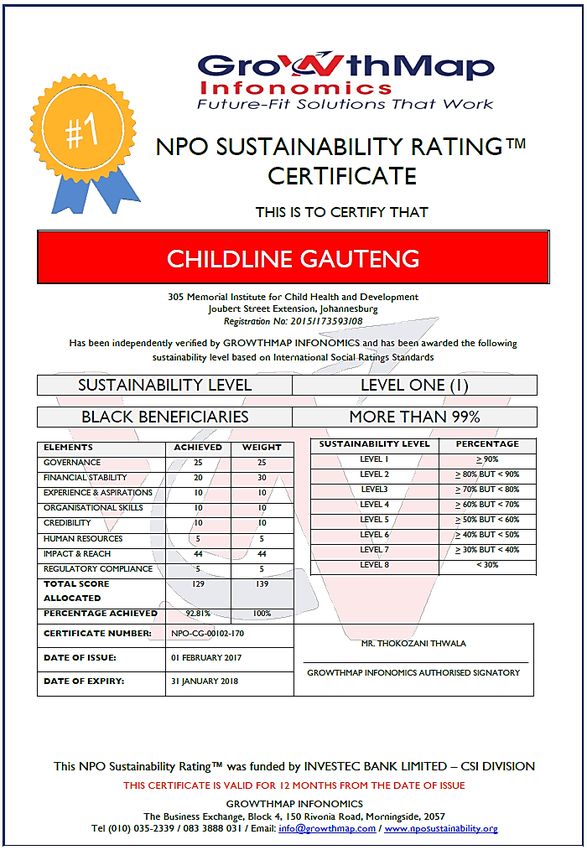
Table of Contents

1. Message from the Director’s Desk ......................................................................................................................... 2
2. Childline’s Vision Statement ................................................................................................................................... 2
3. Childline’s Mission Statement ............................................................................................................................... 2
4. Childline’s Values ................................................................................................................................................... 2
5. Introduction – Summary of Services....................................................................................................................... 3
6. Geographic Footprint.............................................................................................................................................. 4
7. Key Projects and Funding Focus Areas for 2019 - 2020 .......................................................................................... 4
       7.1 Help Line....................................................................................................................................................... 4
       7.2 Sunlight Safe House...................................................................................................................................... 5
       7.3 Counselling and Support Services ................................................................................................................ 6
       7.4 Child Development Programme .................................................................................................................. 7
       7.5 The Information / Innovation Hub ............................................................................................................... 8
             7.5.1 Community Awareness and Prevention Programme (CAPP)............................................................... 8
             7.5.2 Training Department ........................................................................................................................... 9
             7.5.3 Communications – Online and Social Media ..................................................................................... 10
             7.5.4 Monitoring, Evaluation and Reporting .............................................................................................. 11
8. Childline Community-Based Centres (CCBCs) ...................................................................................................... 11
       8.1 Inner City..................................................................................................................................................... 12
       8.2 Tembisa....................................................................................................................................................... 13
       8.3 Soweto ........................................................................................................................................................ 14
       8.4 Sebokeng .................................................................................................................................................... 14
       8.5 Katlehong .................................................................................................................................................... 15
       8.6 Orange Farm ............................................................................................................................................... 16
       8.7 Diepsloot ..................................................................................................................................................... 17
9. Partnerships in Service Delivery ........................................................................................................................... 17
10. Sustainability ...................................................................................................................................................... 18
11. Administration and Finance ................................................................................................................................ 18
12. Marketing ........................................................................................................................................................... 19
13. Organisational Structure ..................................................................................................................................... 19
Annexure A. Budget .................................................................................................................................................. 20
Annexure B. Resources Required ............................................................................................................................. 21
Annexure C. GrowthMap Infonomics– Sustainability Audit .................................................................................... 22

1|P a g e
1. Message from the Director’s Desk
Childline Gauteng takes pride in outlining our Business Plan for the forthcoming financial year, 1 April 2019 to 31 March 2020 and
we thank you for your interest in improving the world for our children.
We especially value your consideration of supporting vulnerable young people and their families given their enormous challenges
of our time with: 50% living below the poverty line; SAPS stats indicating 2.2 million reported crimes; the Optimus
Study (2016) indicating 35.6% sexual abuse, 34.8% physical abuse, 26.1 emotional abuse and 42% exposed to violence. The annual
cost of violence against children, as estimated by Save the Children (2016) in their research report, Violence Unwrapped, is
estimated at R238 billion.
This psycho-socio-economic fragmentation has a profoundly negative cost and long term impact on children. It is essential that
they have access to services that promote family strengthening, emotional health, safety and social cohesion. These are the key
foci of the Childline services. It is both morally and economically imperative to promote programmes that ensure the positive
emotional health for youth.
The Childline team have great experience and skill in healing the wounds that are inflicted by the challenges of our time, through
our services including: the 24/7 toll free Help Line, Childline Community Based Counselling Centres (CCBCs), Community
Awareness and Prevention Programmes (CAPP), Training and the Sunlight Safe House assisting approximately 500 000 people.
As funders shift their focus to strengthen the education, economic and environmental sectors at the cost of family services,
children’s organisations are unable to meet the needs of the most important sector of our society. We invite you to participate
in the creation of a caring society that encourages our children to take every opportunity to grow and develop and take our
country into a stable and dynamic future.
We thank our partners, board of directors, staff and volunteers for your long term dedication to Childline and our collective vision
of implementing the SA Bill of Rights (1996) generally and specifically to: “Heal the divisions of our past and establish a society
based on democratic values, social justice and fundamental human rights” (SA Bill of Rights 1996).
Lynne Cawood
Managing Director
2. Childline’s Vision Statement
Caring for Children.
3. Childline’s Mission Statement
Service excellence to children and families facilitating: equality; human dignity; life; a name and nationality; family or alternative
care; nutrition; shelter; education; health and social services; protection from maltreatment, neglect, abuse, degradation and
exploitative labour practices; freedom from detention and armed conflict for every child as enshrined in the SA Bill of Rights (Act
108 of 1996).
4. Childline’s Values
Childline subscribes to the following values:
The best interest of the child - this principal governs all our work
Child-Centeredness - provide child-centred services that take cognisance of the rights of children and young people and
preserve the family unit where possible
Child Participation - ensure children’s voices are heard in all of our projects
Accountability - remain accountable to the children we serve, the social work profession, our partners and to Childline
Transparency - remain transparent in all aspects
Respect - demonstrate respect for persons of all class, race, language, religious, cultural and sexual orientations
Communication - maintain open and direct communication
Representation - reflect all South African cultures in our management team, staff and volunteers
Development and Empowerment - efficient and effective staff, volunteers, organisational structures, policies and
procedures that will enhance service delivery to children
Confidentiality - work within a development model of social service delivery that respects the client’s right to confidentiality
within the limitations of the child protection system
These values enable us to deliver efficient, effective, specialised, culturally sensitive, accessible and supportive social services.
2|P a g e5. Introduction – Summary of Services
Childline Gauteng offers the following core Services:
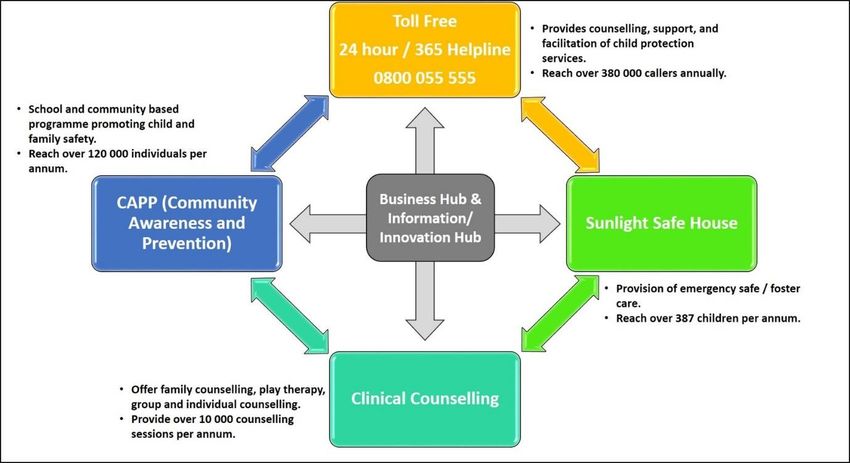
24 Hour Help Line - a toll-free telephone service offering counselling and support services to 380 000 children and their
families for all issues including the facilitation of child protection services
Sunlight Safe House - provides a night time place of safety for over 280 children whose home circumstances are not
conducive to their safety and wellbeing and long-term foster care for 90 children in volunteer community homes and 17
youth in the Independent Living programme
Counselling and Support Services in our Childline Community Based Centres (CCBCs) in the Inner City, Soweto, Sebokeng,
Orange Farm, Katorus, Diepsloot and Tembisa – our social workers provide 10 000 counselling and support services to
abused and traumatised children and in so doing, strengthen the child protection system
Community Awareness and Prevention Programme (CAPP) - Empowers 80 000 children and adults, thereby preventing
child abuse and ensuring early intervention in cases of child abuse and neglect
Community Development – working with the local Child Protection Committees led by DSD we reach approximately 30 000
community members with events focusing on child and substance abuse, child safety, poverty alleviation and access to IDs
and SASSA, TB, health issues and HIV/Aids prevention and treatments, gender based violence, trafficking, human rights and
appropriate community responses to ensure child development
Child Development Leadership Programme - each CCBC implements “LEADers” - a junior Leadership programme for young
people in 12 schools (180 children) with the overall aim of developing Leadership skills in order that they become confident,
positive role models in their communities. Each school will engage in an environmentally focused community project
Training and Development - for all employees, interns, volunteers, professionals and community members, including: social
workers, Help Line counsellors, educators, parents / caregivers, lawyers and police officers who work in the field of Child
Protection and Children’s Rights, reaching 1 000 trainees. We have training modules with CPD points for: Children with
Behaviour Disorders; Childhood Depression; Grief and Loss; Positive Parenting; Positive Discipline; Basic and Advanced
Counselling Skills, Play Therapy; Early Childhood Development; Foster and Temporary Safe Care.
INTERGRATED SERVICES – PROCESS FLOW CHART
3|P a g e6. Geographic Footprint Childline Gauteng operates in the Gauteng province. We have seven Community Based Centres (CCBCs) in the province, namely: Johannesburg’s Inner City, Soweto, Tembisa, Katlehong, Sebokeng, Diepsloot and Orange Farm. Within these seven areas, each office operates as a full time, walk-in centre and offers professional support services (Counselling and Community Awareness and Prevention) developed to meet the needs of vulnerable children and families in a comprehensive manner. The Help Line Call Centre, Training and Development Department and the Sunlight Safe House are all housed at the home office or Inner City Community Based Centre in Parktown. 7. Key Projects and Funding Focus Areas for 2019 - 2020 Childline Gauteng is in the business of safety and positive development for children and families delivered through an integrated, professional service delivery model. Our vision is to provide services to every child in need in Gauteng. However, given the economic challenges facing civil society our focus is to sustain our programmes to children and families whilst seeking new opportunities and partners to assist in extending our services. 7.1 Help Line Strategic Objective Working collectively to protect and care for every child and family through preventative and supportive telephone counselling services and referrals for child protection services from statutory bodies. Demographics of Beneficiaries Age: Children and families are the primary target group and anyone, irrespective of age, race, gender and/or socioeconomic status can call Childline Gauteng Gender: Male and female Race: Callers reflect the demographics of South Africa Project Description The Childline Gauteng Help Line is toll-free (from Telkom, MTN, Cell C and Vodacom) and accessible to all children, families and community members in Gauteng. We are linked to Childline services throughout South Africa. We operate 24 / 7 and 365 days a year in the preferred language of the caller, including French. The Call Centre service facilitates a child rights and responsibilities culture, through counselling regarding any child-related issue. This allows for the early identification of and practical intervention in children’s problems, which averts the exacerbation of problematic situations and serves as a preventative measure. The Help Line focuses on four specific areas of intervention: crisis intervention, facilitation of child protection, a referral and advisory service and counselling. Trained counsellors provide support, information and appropriate intervention including risk assessment on issues such as: the physical, sexual and emotional abuse and neglect of children; adult survivors of abuse; perpetrators of abuse and sexual offenders; trafficking, abduction and prostitution of young boys and girls; exposure and witness to domestic and criminal violence; internet pornography; sexuality, teen pregnancy, HIV/Aids and health issues; gender discrimination; poverty, homelessness, begging and referrals for social grants; behavioural problems; family relationships and parenting skills; legal issues, maintenance, divorce, corporal punishment; bullying and school-related problems e.g. bursaries and school fees; disabled children at risk; physical health e.g. anorexia and emotional health e.g. depression and suicide; substance abuse; child-headed households and bereavement; foreign nationals and refugee children. Approximately 380 000 calls were handled in the financial year April 2018 - March 2019. The Majestic data capturing system facilitates evidence-based reporting, improved monitoring, evaluation and management systems, detailed reports as well as quality assessment of services. The system will enable us to be paperless and allows for the consolidation of all statistical tools. Special functions include research into children’s challenges, data collection and analysis enabling an in depth understanding and early warning signals of the challenges and trends children face. 4|P a g e
Planned Activities
The Help Line provides counselling, support, referrals and information to callers in an ethical and professional manner.
Facilitation of child protection interventions through referrals to our partner organisations is available
Counsellors respond sensitively to the needs of children who test the lines. We recognize that any form of disclosure is
difficult to verbalise. Research conducted in Canada has shown that children will phone up to twenty times before they have
enough courage to talk to the counsellor about the problem troubling them
We recruit, select and train new counsellors in order to ensure that the lines are covered adequately at all times and to
minimise abandoned calls
We continue to contribute to youth development in training and mentoring students and interns from the Foundation for
Professional Development, Afrika Tikkun and HWSETA
Supervisors and counsellors receive on-going training in the form of case discussions, group supervision and monthly
workshops. Specific focus is given to statutory processes and the implementation of the Children’s Act
In order to increase our social service delivery and to maintain the standards set by the SA Council for Social Service
Professions, on-going supervision and support will be provided to our counsellors and Social Auxiliary Workers
Outputs
380 000 calls expected per annum, which are classified and captured on the database system
Approximately 4000 cases to be opened for child protection interventions and 12 000 counselling sessions
Approximately 14000 follow-ups to be made for case referrals
120 individual and 20 group supervision sessions to be held with staff & volunteers
10 training sessions for staff & volunteers
10 new telephone volunteers and 3 interns selected, screened, trained and supervised
20 networking sessions the Criminal Justice System, NGO’s and Child Protection Services
500 email counselling contacts
7.2 Sunlight Safe House
Strategic Objective
To ensure child safety by the provision of emergency overnight safe care for abandoned, abused, orphaned, neglected and
exploited children who have to be removed by SAPS as well as foster care in loving family homes within the community
Target Beneficiaries
Age: 0-18 year old children and 18 – 25 young adults (Independent Living Programme)
Gender: Male and female
Socio-Economic Profile: Most of the children we provide services for are from marginalised families
Project Description
The Sunlight Safe House (SSH) started in 1997 as an after-hours service for abused and abandoned children. With traditional
organisations closed at night and during weekends, many traumatised children were in the unfortunate position of having to stay
at police stations until the welfare agencies opened their doors during office hours. This constituted secondary traumatisation
for the child. Childline Gauteng set up the SSH at the request of the Child Protection Unit (CPU) in conjunction with the local
Child Welfare Societies and Department of Social Development (DSD), whose function it is to provide statutory child protection
services.
Thus, the SSH provides emergency after hour care at our Sunlight Reception Centre. The South African Police Service (SAPS) bring
the child/ren into overnight care and they are referred to statutory services for further investigation and suitable placement.
They are welcomed by our child and youth care workers and the team is able to assess each child’s needs immediately.
The project was extended in 2002 to provide foster care for HIV+ children and young people who are ‘difficult’ to place. To date
we have provided care for approximately 7 480 children.
We also offer training and capacity building to mothers, partner organisations in child and foster care.
Planned Activities
Provision of overnight care for approximately 280 children removed under extreme circumstances at night or over weekends
and referral to statutory services
Professional foster care for 90 children who have been abandoned, abused, lost, neglected or in need of care
5|P a g e 300 Counselling services for the children in our care and 300 home visits to monitor the families
Children will be referred to the relevant statutory organisations for court orders with extension of foster care order reports
for Children’s Court and Social Development
Supervision services for children placed in foster care
Reunification services for children in foster care and their biological families
Provision of financial and material support to children in care and their caregivers
Provision of group counselling focusing on psychosocial/educational issues for children in our care
Assisting children to obtain identification documents, access government grants and provide support for court proceedings
Independent Living Programme for 17 youth who graduated from our foster care services, provision of financial and material
support and assisting them to get sponsorship for their tertiary education requirements for job placement
Outputs
300 Individual support & counselling sessions and 300 home visits for our foster children, Independent Living
youth and parents
Placement, debriefing and referral to statutory services for 280 overnight children
90 Individual Development/Care Plans for each child in foster care to be done by Head of Departments, Social
Workers, children mothers and statutory social workers
Group Support Sessions: 30 group work sessions for pre-teens, teens and independent living groups to encourage
life skills, HIV Free generation and resilience
Community meetings with mothers and children to build the SSH community. The themes for this year are
celebrating: positive parenting skills; HIV/AIDS prevention and adherence to ARVs; our proudly SA cultural heritage;
Madiba Day; and child participation regarding rights and responsibilities
Math classes for all children with educational difficulties
Mother’s mentor programme will include: 10 supervision and training sessions, support groups and individual
sessions with foster mothers
Mandatory monthly supervision and training services – all foster parents are required to attend 6 training meetings.
Topics include: development and revision of a care plan for each child; behavioural problems; indigenous child
rearing practices; and, self-care
Monthly support group for all foster parents according to the children’s different age groups
Monthly supervision and training for all staff members (social workers and child care workers)
Statutory reports - Section 159/186 or Transfer reports
Team building to prevent burnout amongst staff
7.3 Counselling and Support Services
Strategic Objective
Resilient children and families achieved by the provision of psychosocial services in a supportive, protective and culturally
sensitive manner, assisting in the healing process and enabling their development to reach their full potential and prevent further
violations of their rights.
Target Beneficiaries
Age: 3-21 year old children, as well as adult care-givers
Gender: Male and female
Socio-Economic Profile: Marginalised community members
Area Demographics: Majority of our clients are Black, while the minority are Coloured, Asian and White
Project Description
Social work services are offered at the Inner-City, Soweto, Tembisa, Katlehong, Sebokeng, Diepsloot and Orange Farm,
Community Based Centres.
The therapeutic team offers a broad range of counselling services, including family counselling, play therapy, group and individual
counselling, child development leadership groups as well as criminal justice system and other advocacy services for children and
their families. The main aim of counselling is to promote healing and prevent further violation of those rights. Referrals are
received from the Help Line, the Community Awareness & Prevention Programme, schools, health facilities, churches, community
members, professionals, other NGOs, and self-referrals.
6|P a g eThe social work team offers services to children and their families who experience; sexual abuse; adult survivors of sexual abuse;
survivors of neglect, emotional and physical abuse; children who present with behaviour challenges and bullying; those who are
affected or infected by HIV and AIDS often requiring bereavement counselling; trauma; domestic violence; poverty related and
family issues; those with school related difficulties and parents requiring support and guidance as well as parenting skills.
Planned Activities
Provision of counselling services for child survivors and their families, including child headed household, through play
therapy, family / marital counselling, group counselling and individual counselling
Provision of therapeutic group therapy depending on the needs of the case-loads
Child leadership development groups for 18 sessions
Community Prevention and Awareness Activities. Child Protection Week is celebrated at end of May culminating on the 1 st
of June which is National Children’s Day. Sixteen Days of Activism for No Violence against Women and Children takes place
in November each year culminating on the 1st of December which is World AIDS Day. Together with local child protection
partners we will create and implement a programme of activities to raise awareness of child protection issues and services
offered in each community
Outputs
Please refer to Childline Community-Based Centres in Section 8
7.4 Child Development Leadership Programme
Strategic Objective
To facilitate positive leadership skill development of children through including green youth empowerment through
environmental community work projects.
Target Beneficiaries
Age: 12 – 14 year old children
Gender: Male and female
Socio-Economic Profile: Most of the children we provide services for are from low-income families
Project Description
Child Development Leadership Programmes are run in all Gauteng offices with the aim of promoting children’s leadership
potential and to enhance their sensitivity to environmental challenges. Each Community-Based Centre has conducted a needs
assessment in the various communities to ensure that the programme is relevant for their beneficiaries. The programm offers a
variety of extra-mural activities, which ensure positive peer role models and increased resilience of vulnerable children. The
custom-made junior leadership project enhances relationships, self-care, communication skills, problem solving, conflict
resolution, positive values and life skills in general.
Planned Activities
“LEADers” Project: Leading by Example, Acting on our Dreams. The project encourages children to be positive role models in
their communities. Educators nominate 15 primary school learners in Grade 6 that exhibit positive or negative leadership
potential, to take part in the year-long project. This project is facilitated at our Inner City, Soweto, Sebokeng, Tembisa and
Katlehong and Orange Farm Community-Based Centres
Holiday Programmes: Many children are without adult supervision during the school holidays. While many children go to
rural areas to stay with family during the holidays, there are many children who stay in the townships and are left to their
own devices. This leaves them extremely vulnerable and they frequently experience child abuse, neglect and exploitation
during the holidays. The holiday programme involves a five day programme of creative activities designed to keep children
off the streets as well as build resilience, self-esteem and life skills (team work, independence, mastery and creativity)
Christmas Parties: Community-Based Centres in partnership with sponsors host Christmas parties to give clients and young
leaders an opportunity to end the year on a positive note. For many clients, the Christmas party is a highlight in their year.
Children will be given presents, refreshments, fun- filled activities while socialising with peers. Approximately 80 beneficiaries
attend these parties in each centre
Outputs
Please refer to Childline Community-Based Centres in Section 8
7|P a g e7.5 The Information / Innovation Hub
Strategic Objective
Empowering communities with information and skills regarding children’s issues and child protection
Project Description
The focus of the Information / Innovation Hub is on the transfer of knowledge of all psycho-social issues impacting on families to
promote the positive management of these challenges. This transfer of information is done through social media, the Childline
Gauteng website, training, the School Talks Programme, and community events.
We empower both children and adults with the information, knowledge, and skills required for creating safer and more nurturing
communities for children. Information is constantly updated with new ideas, methodologies and research findings being made
available through a variety of modes.
The Information / Innovation Hub seeks to:
Ensure that we at Childline Gauteng stays abreast of new developments in the field of child protection
Tap into the vast bank of knowledge and experience within the organisation
Utilise a variety of channels to disseminate information and teach skills, both internally and externally, thereby expanding
our reach to include our staff, our clients and their families, the communities in which we work and the ever-growing online
community
Four elements comprise the Information / Innovation Hub: The Community Awareness and Prevention Programme, the Training
Department, Social Media and Monitoring and Evaluation.
7.5.1 Community Awareness and Prevention Programme (CAPP)
Strategic Objective
To create awareness regarding children’s rights and responsibilities in school communities, so that children are able to grow and
develop in a brighter, safer and more nurturing environment.
Target Beneficiaries
Age: 4 – 18 year old children as well as educators and caregivers
Gender: Male and female
Socio-Economic Profile: Most of the children we provide services for are from low-income families
Programme Description
This programme embraces the principle of human rights, by encouraging a sense of responsibility towards children’s rights. It
aims to educate children on their rights and responsibilities and equip educators and other adults working with children with the
skills necessary to identify and handle disclosures of abuse and neglect appropriately and sensitively. The programme is
implemented in Tembisa, Katlehong, Sebokeng, Soweto and the Johannesburg Inner City, supporting the Department of
Education’s curriculum on Life Orientation.
Children cannot be completely responsible for ensuring their own safety, as they are disadvantaged in terms of their age,
intellectual capacity and lack of physical strength, as well as in terms of power relations with adults and abusers. However,
making them aware of their rights, helps them to identify when they feel uncomfortable, choose a caring adult that they can trust
or call the Help Line which is available 24 / 7 and 365 days a year.
The CAPP has schools-based activities at its core and targets mainly primary school children. The School Talks Programme involves
giving class-by-class talks to primary school and ECDs children, educating them on their rights and responsibilities and the
importance of help seeking if they experience any problem. The Childline toll-free Help Line number is taught to all participants
in a child-friendly interactive programme. In addition, children are invited to disclose any problems experienced to the facilitators
on a one-on-one basis, if needed and they are provided with containment, a risk assessment and referrals as required. Educators
and school staff are also offered a voluntary presentation on identifying and responding to abuse and neglect.
In addition, the CAPP teams conduct awareness talks at ECDs, drop-in centres, and child and youth care centres.
8|P a g eCAPP aims to share information and empower educators, parents and all those who work with children about children’s needs
and related issues, equipping them with skills to handle disclosures of any child rights violations appropriately and sensitively.
Educators and parents receive presentations and workshops, which provide detailed information on children’s issues. Whilst
rights exist to protect the child they also carry certain responsibilities to ensure their safety, support their family and develop
their humanity.
Without this service, children would remain uninformed and therefore vulnerable. Adults, including parents, caregivers,
educators and child protection workers would be less able to identify and assist children who are being abused.
Planned Activities
Facilitate talks with children in grades R-7 classes in selected schools about children's rights, responsibilities and abuse
Educate children in a class room setting about services for abused children, i.e. Childline toll-free Help Line number
Handle disclosures from children after the talks, conduct brief counselling sessions and refer them to the appropriate
services
Follow up on referrals made
Facilitate presentations to educators on Child Abuse and Handling a Disclosure
Facilitate parent talks and workshops on child rights issues and Positive Parenting Skills for parents at clinics and schools on
request
Events: Child Protection Week is celebrated at end May culminating on the 1st of June which is National Children’s Day.
Sixteen Days of Activism for No Violence against Women and Children takes place in November each year culminating on
the 10th of December which is International Human Rights Day. Together with local child protection partners we create and
implement a programme of activities to raise awareness on child protection issues and services offered in each community
Outputs
Please refer to Community-Based Centres Targets for CAPP outputs in Section 8
7.5.2 Training Department
Strategic Objective
Training and development of professional (including graduate interns) and lay persons working with children.
Target Beneficiaries
Age: Adults
Gender: Male and female
Socio-Economic Profile: Varied.
Project Description
We recognise that on-going professional skills development is necessary to ensure quality services and building confidence in all
persons working with children, including young graduates, our employees and volunteers. Our ability to reach our goal of creating
a safe and nurturing environment for children depends on the skills, knowledge, attitudes and values of the adults in their lives.
Child protection is a specialised field that requires people who are passionate and competent in their field in order to meet the
complex needs of the beneficiaries. This is enhanced by the training and development department.
We are able to customise training modules to meet the specific needs of our partners. We current have the following training
packages, some of which have accredited Continued Professional Development (CPD) points: Counselling Skills, Therapeutic
Work with Children, Court Preparation, Common Behavioural Disorders in Childhood, Childhood Grief and Loss, Childhood
Depression, Children with Behavioural Problems, Grief and Loss, Positive Parenting, Positive Discipline, Foster Care Training, Child
Development and Individual Development Plans for youth.
Our training and development department has both an internal and external component:
Internal Training - addresses the training needs for staff and volunteers. Staff members require on-going skills development and
CPD points. New volunteers are recruited each year for the Help Line and they require in-depth training before they can begin
their work, as well as on-going training based on the needs of the clients. Having a team who is able to provide this internally,
saves on expenses and ensures that valuable intellectual property is kept and shared within the organisation.
In addition, Childline sources donations of training as well as discretionary grants from the Health and Welfare SETA, which
reduces the training-related expenses of the organisation.
9|P a g eOur graduate development project ensures that young social workers and auxiliary social workers who are placed at Childline as
interns, with support by the Health and Welfare SETA, receive the best possible training to equip them to deal with all child
related issues.
External Training - Many of the adults working with children have little or no training on issues related to children. Adult
caregivers in ECDs, CYCCs and drop-in centres, as well as professionals working within the child protection field frequently have
no specialised training in child development, management of behaviour, child abuse and how to handle disclosures. Such training
of workers – both professional and non-professional - is essential in preventing the primary and secondary abuse of children in
these settings.
Some of our training generates income and thus contributes to the sustainability of the organisation.
Planned Activities
Continue to train and develop Childline staff, youth interns and volunteers
Source experts from other organisations to provide presentations and workshops for staff on relevant topics
Develop and present short talks, courses and workshops at the request of NGOs, CBOs, Government Departments and other
stakeholders
Submit selected workshops and presentations for accreditation with the Social Work Council and SACE for CPD points and
offer these workshops to both staff members and outside professionals as a source of income
Submission of Workplace Skills Plan (WSP) and Annual Training Report (ATR) for the HWSETA
Outputs
Staff, volunteer and external training:
1 five day Help Line Course for volunteer counsellors
Ongoing CPD point training for staff, volunteers and external participants
Implement any staff training for which we receive a discretionary grant
Workplace Skills Plan (WSP) and Annual Training Report (ATR) submitted to HWSETA
Topical presentations by guest speakers will be arranged monthly at staff meetings, to meet the needs of staff, interns and
volunteers. External training will be provided on request.
7.5.3 Communications – Online and Social Media
Strategic Objective
To share information and resources with our online community that enlightens and empowers children and adults in order to
create a safer and more nurturing environment for children.
Target Beneficiaries
Age: Children and Adults
Gender: Male and female
Socio-Economic Profile: Varied
Project Description
The internet provides an opportunity for us to drive awareness and advocacy, share our stories and cultivate donor relationships
in ways never before possible.
Social media is used to reach many more people and to extend our footprint. Childline utilises Facebook, Twitter and Instagram
to share information on all child related issues, focussing on positive parenting, and informing our online community about our
achievements and about our financial and other resource needs.
In addition, our new and improved website provides extensive information on our services, various options for fundraising and
donations, as well as on various topics related to the reasons children and adults come to us for help.
10 | P a g eWe also utilise Majestic and email communications with an extensive database of Childline’s Big Friends of Children, the media and donors. Planned Activities Maintain and update the new website Integrate and align social media plan with our strategic goals and target audiences Daily posts on Facebook, Twitter and Instagram Explore social media tools for maximising the use and benefits of social media Outputs Live website Communication / Social media strategy Daily posts on all social media platforms we use Increase in number of followers on social media 7.5.4 Monitoring, Evaluation and Reporting Strategic Objective To assess and improve performance, outcomes and impact of our work, in order to provide high-quality reporting and to make results-based decisions. Project Description Monitoring, Evaluation and Reporting (MER) is a very important part of programme development and is of special importance to donors and beneficiaries. MER allows programme leaders to assess the progress and achievements made against programme aims and objectives, as well as allowing reflective, results-based changes to be made for the betterment of the programmes. Both quantitative and qualitative data is collected on all aspects of the work conducted in each department, in order to track progress, ensure accountability and measure outcomes. This enables us to generate comprehensive reports for all donors, and also to provide detailed information to prospective donors. The Department of Social Development as well as other partners regularly request the opportunity to monitor and evaluate the work that they are funding, and our rigorous MER system enables us to comply with those requests with ease. Planned Activities Review MER plans for each department Update logical frameworks for each project as related to the 2030 sustainable development goals Review / develop MER tools for each project Implementation of updated MER systems Monthly, quarterly and annual reporting Utilise evaluation results to inform decision-making and business planning Outputs Updated MER plans for each department Updated logical frameworks for each project Monthly, quarterly and annual reports A results-based business plan for 2019-20 8. Childline Community-Based Centres (CCBCs) Inner City, Soweto, Tembisa, Katlehong, Sebokeng, Diepsloot and Orange Farm Childline Gauteng operates from Community-Based Walk-in Centres within townships and the Inner City. These centres house the Help Line (Inner City only), Training and Development (Inner City only), Clinical and Counselling support, CAPP and the Child 11 | P a g e
Development Programme. Each centre is managed by a Centre Coordinator, who is supported by a team consisting of Social
Workers, Social Auxiliary Workers and an Administrator.

Outputs: Each of our seven centres has developed activities for 2019-20 according to the capacity in each centre and the needs
of their communities, as shown below:

8.1 Inner City

 Programme             Output                         Comments
 Clinical and          1200 individual counselling    These sessions are for children who have suffered trauma or abuse in
 Counselling           sessions (2 part time social   any environment including in schools and present behavioural
 Support               workers)                       challenges, are infected or affected by HIV/AIDS, or have suffered
                                                      bereavement; and are also for parents who need guidance and for
                                                      adult survivors of abuse
                       8 sessions of group            Therapeutic group sessions for children who have suffered different
                       therapy for children           kinds of trauma.
                       10 Networking meetings         Stakeholders include the SAPS, Child Protection Forums, the
                                                      Department of Social Development, health professionals and the
                                                      Criminal Justice System
                       1 supervision session per      The HOD provides support and empowers social workers with
                       Social Worker per month        therapeutic skills.
                       6 Case conferences             The HOD offers case conferences to the team to help with difficult
                                                      cases.
                       Events: Child Protection       Together with local child protection partners we will create and
                       Week & 16 Days of              implement activities to raise awareness on child protection issues.
                       Activism
                       * The Inner City office also offers court preparation and support for all survivors of physical and
                       sexual abuse on request.
 CAPP -                9 School Talks                  Class-by-class talks will be facilitated to all classes from Gr R to Gr 7.
 Community             9 Teachers Workshops            Workshops or presentations will be facilitated for educators on Child
 Awareness and                                         Abuse and Handling a Disclosure.
 Prevention            7 ECD Programmes                Awareness and Prevention talks with Children and teachers.
 Programme             4 Parent Talks/Workshops        Positive parenting sessions to encourage supportive parenting.
                       Events: Child Protection        Together with local child protection partners we will create and
                       Week & 16 Days of               implement activities to raise awareness on child protection issues.
                       Activism
                       *Workshops and presentations will be facilitated, on request, for NGOs, CBOs, SAPS, Government
                       Departments and other stakeholders.
                       1 Supervision session per
                       social worker per month.
                       1 Supervision session per
                       Social Auxiliary Worker per
                       month.
 Child Leadership      18 Sessions for the             15 children from 1 school in the Inner City are chosen for the LEADers
 Development           LEADers Programme x 2           Programme. The sessions cover communication skills, creativity and
 Programme             groups                          problem solving, leadership skills and a community project.
                       4 Positive Parenting            Parents/caregivers will develop positive parenting skills, and will be
                       Sessions with Parents of        more encouraging and supportive of their children.
                       LEADers
                       1 Holiday Programme             15 Children will be selected to participate in a 5-day holiday
                       (5 days)                        programme which focusses on creative activities designed to build
                                                       resilience.
                       1 Christmas Party for 80        The Christmas party is a wonderful opportunity for clients to celebrate
                       children                        the end of the year and have a fun filled day.

12 | P a g e
8.2 Tembisa
Programme Output Comments
Clinical and 1800 individual counselling These sessions are for children who have suffered trauma or abuse,
Counselling sessions – 2 social workers present behavioural challenges, are infected or affected by HIV/AIDS,
Support or have suffered bereavement; and are also for parents who need
guidance and for adult survivors of abuse.
8 sessions of group Therapeutic group sessions for children who have suffered different
therapy for children kinds of trauma
10 networking and Stakeholders include the SAPS, the Social Services Forum, the
stakeholder sessions Department of Social Development, health professionals and the
Criminal Justice System.
1 supervision session per The HOD provides support and empowers social workers with
Social Worker per month therapeutic skills.
6 Case conferences per The HOD offers case conferences to help with difficult cases.
annum
Events: Child Protection Together with local child protection partners we will create and
Week & 16 Days of implement activities to raise awareness on child protection issues.
Activism
* The Tembisa office also offers court preparation and support for all survivors of physical and
sexual abuse on request
CAPP - 14 School Talks Class-by-class talks will be facilitated to all classes from Grade R to
Community Grade 7.
Awareness and 14 Teachers Workshops Workshops or presentations will be facilitated for educators on Child
Prevention Abuse and Handling a Disclosure.
Programme 15 ECD Programmes Awareness and Prevention talks with Children and teachers.
4 Parent Talks/ Workshops Positive parenting sessions to encourage supportive parenting.
Events: Child Protection Together with local child protection partners we will create and
Week & 16 Days of implement activities to raise awareness on child protection issues.
Activism
1 Supervision session per
social worker per month.
1 Supervision session per
Social Auxiliary Worker per
month.
*Workshops and presentations will be facilitated, on request, for NGO’s, CBO’s, SAPS, Government
Departments and other stakeholders.
Child Leadership 18 Sessions on the LEADers 15 children from one school in Tembisa are chosen for the LEADers
Development Programme x 2 groups Programme. The sessions cover communication skills, creativity and
Programme problem solving, Leadership skills and a community project.
4 Positive Parenting Parents/caregivers will develop positive parenting skills, and will be
Sessions with Parents of more encouraging and supportive of their children.
LEADers
1 Holiday Programme 15 Children will be selected to participate in a 5-day holiday
(5 days) programme which focusses on creative activities designed to build
resilience.
20 Creative art sessions 15-20 Children from a local schools and Childline clients, who are
orphaned, vulnerable or have experienced trauma will be given an
opportunity to have fun while acquiring skills using creative arts
trough the following mediums, play, art, drama and music.
1 Christmas Party for 80 The Christmas party is a wonderful opportunity for clients to celebrate
children the end of the year and have a fun filled day.
13 | P a g e8.3 Soweto
Programme Output Comments
Clinical and 1800 individual These sessions are for children who have suffered trauma or abuse,
Counselling counselling sessions – 2 present behavioural challenges, are infected or affected by
Support social workers HIV/AIDS, or have suffered bereavement; and are also for parents
who need guidance and for adult survivors of abuse.
8 sessions of group Therapeutic group sessions for children who have suffered different
therapy for children kinds of trauma
10 Networking sessions Stakeholders include the SAPS, the Social Services Forum, the
Department of Social Development, health professionals and the
Criminal Justice System.
1 supervision sessions per The HOD provides support and empowers social workers with
Social Worker per month therapeutic skills.
6 Case conferences per The HOD offers case conferences to help with difficult cases.
annum
Events: Child Protection Together with local child protection partners we will create and
Week & 16 Days of implement activities to raise awareness on child protection issues.
Activism
* The Soweto Office also offers court preparation and support for all survivors of physical and
sexual abuse on demand request
CAPP - 20 School Talks Class-by-class talks will be facilitated to all classes from Grade R to
Community Grade 7.
Awareness and 20 Teachers Workshops Workshops or presentations will be facilitated for educators on Child
Prevention Abuse and Handling a Disclosure.
Programme 15 ECD Programmes Awareness and Prevention talks with Children and teachers.
15 Parent Talks/ Positive parenting sessions to encourage supportive parenting.
Workshops
Events: Child Protection Together with local child protection partners we will create and
Week & 16 Days of implement activities to raise awareness on child protection issues.
Activism
1 Supervision session per
social worker per month.
1 Supervision session per
Social Auxiliary Worker
per month.
*Workshops and presentations will be facilitated, on request, for NGO’s, CBO’s, SAPS,
Government Departments and other stakeholders.
Child Leadership 18 Sessions on the 15 children from one school in Soweto are chosen for the LEADers
Development LEADers Programme x 2 Programme. The sessions cover communication skills, creativity and
Programme groups problem solving, leadership skills and a community project.
4 Positive Parenting Parents/caregivers will develop positive parenting skills, and will be
Sessions with Parents of more encouraging and supportive of their children.
LEADers
1 Holiday Programme 15 Children will be selected to participate in a 5-day holiday
(5 days) programme which focusses on creative activities designed to build
resilience.
1 Christmas Party for 80 The Christmas party is a wonderful opportunity for clients to
children celebrate the end of the year and have a fun filled day.
8.4 Sebokeng
Programme Output Comments
Clinical and 1800 individual These sessions are for children who have suffered trauma or abuse,
Counselling counselling sessions x 2 present behavioural challenges, are infected or affected by
Support social workers
14 | P a g eHIV/AIDS, or have suffered bereavement; and are also for parents
who need guidance and for adult survivors of abuse.
8 sessions of group Therapeutic group sessions for children who have suffered different
therapy for children kinds of trauma.
10 Networking sessions Stakeholders include the SAPS, the Social Services Forum, the
Department of Social Development, health professionals and the
Criminal Justice System.
1 supervision session per The HOD provides support and empowers social workers with
Social Worker per month therapeutic skills.
6 Case conferences per The HOD offers case conferences to help with difficult cases.
annum
Events: Child Protection Together with local child protection partners we will create and
Week & 16 Days of implement activities to raise awareness on child protection issues.
Activism
* The Sebokeng office also offers court preparation and support for all survivors of physical and
sexual abuse on request
CAPP - 18 School Talks Class-by-class talks will be facilitated to all classes from Gr R to Gr 7.
Community 18 Teachers Workshops Workshops or presentations will be facilitated for educators on Child
Awareness and Abuse and Handling a Disclosure
Prevention 15 ECD Programmes Awareness and Prevention talks with Children and teachers.
Programme 4 Parent Talks/ Workshops Positive parenting sessions to encourage supportive parenting.
Events: Child Protection Together with local child protection partners we will create and
Week & 16 Days of implement activities to raise awareness on child protection issues.
Activism
1 Supervision session per
social worker per month.
1 Supervision session per
Social Auxiliary Worker
per month.
*Workshops and presentations will be facilitated, on request, for NGO’s, CBO’s, SAPS,
Government Departments and other stakeholders.
Child Leadership 18 Sessions on the 15 children from one school in Orange Farm/Sebokeng are chosen
Development LEADers Programme x 2 for the LEADers Programme. The sessions cover communication
Programme groups skills, creativity and problem solving, leadership skills and a
community project.
4 Positive Parenting Parents/caregivers will develop positive parenting skills, and will be
Sessions with Parents of more encouraging and supportive of their children.
LEADers
1 Holiday Programme 15 Children will be selected to participate in a 5-day holiday
(5 days) programme which focusses on creative activities designed to build
resilience.
20 Creative art sessions 15-20 Children from a local schools and Childline clients, who are
orphaned, vulnerable or have experienced trauma will be given an
opportunity to have fun while acquiring skills using creative arts
trough the following mediums, play, art, drama and music.
1 Christmas Party for 80 The Christmas party is a wonderful opportunity for clients to
children celebrate the end of the year and have a fun filled day.
8.5 Katlehong
Programme Output Comments
Clinical and 909 individual counselling These sessions are for children who have suffered trauma or abuse,
Counselling sessions present behavioural challenges, are infected or affected by
Support HIV/AIDS, or have suffered bereavement; and are also for parents
who need guidance and for adult survivors of abuse.
15 | P a g eYou can also read


