REPORT TO CANADIANS 2019 - House of Commons
←
→
Page content transcription
If your browser does not render page correctly, please read the page content below
REPORT TO CANADIANS 2019

The Report to Canadians presents highlights of the work
undertaken by Canada’s Members of Parliament and
the efforts of the House of Commons Administration in
supporting Members’ daily activities.

By opening a window into the workings of the House of
Commons and increasing the public understanding of
Canada’s parliamentary system, the Report to Canadians
contributes to the transparent public governance expected by
Canadians from coast to coast to coast.

Period of this report: April 1, 2018–March 31, 2019
Parliamentary session covered in this period: 1st session,
42nd Parliament (December 3, 2015–March 31, 2019)

Total number of sitting days during this period: 116

House of Commons Administration
Parliament of Canada
Ottawa, Ontario
K1A 0A9
info@parl.gc.ca

Toll-free (Canada): 1-866-599-4999
Telephone: 613-992-4793
TTY: 613-995-2266

Catalogue Number: X9-27/2019E-PDF

ISSN: 1716-8570

Photographs © House of Commons
Message from the Speaker
                                                            During the past year, improvements were made to
                                                            the e-petitions system that has allowed hundreds of
                                                            thousands of Canadians to participate more easily in
                                                            their democracy through online petitions; measures
                                                            were also put in place to allow Members to express
                                                            themselves—and be understood—in Indigenous
                                                            languages during House proceedings; and security
                                                            was upgraded in constituency offices as well as on
                                                            Parliament Hill.

                                                            The “Members’ Snapshot” section provides information
                                                            on the work of Members over the past year. “Highlights
                                                            from the Hill” presents an overview of the events
                                                            and activities that were part of the closing of Centre
                                                            Block and the reopening of West Block. The “House
                                                            of Commons Administration” section features the
                                                            work carried out by the administrative body that
As Speaker of the House of Commons and head of              supports Members, and an overview of the House
the House of Commons Administration, I am pleased           Administration’s spending is provided in “Financial
to present the Report to Canadians 2019, covering the       Information” section at the end of this report.
2018–2019 fiscal year. In this annual report, you will
learn more about the work carried out by your Members       On behalf of all Members and the House Administration,
of Parliament in the Chamber, in committees, in caucus,     I want to thank you for taking the time to learn more
in constituencies across Canada, and abroad. The            about Members’ activities and the work that is done to
report also provides information about how the House        support them as they carry out their parliamentary duties.
Administration supports the work of Members.

During the 2018–2019 fiscal year, we reached some
important milestones. Canadians saw the temporary
closing of Centre Block and the reopening of West
Block. These two events are of significance for all
Canadians—we turned an important page in the history
of our country’s heritage. In the House of Commons,
                                                                                       Hon. Geoff Regan, P.C., M.P.
we played an active role in the many stages that led
                                                                                 Speaker of the House of Commons
to the House’s historic move to its interim location in
West Block. As you read this year’s report, you will find
out more about the significant work that went into
this move—a move that was also symbolic for us as
an organization. The transition from Centre Block to
West Block shows not only our commitment to the
preservation of our heritage spaces, but also our desire
to remain current and ready to meet the needs of a
modern parliamentary democracy.

                                                                                 House of Commons | Report to Canadians   3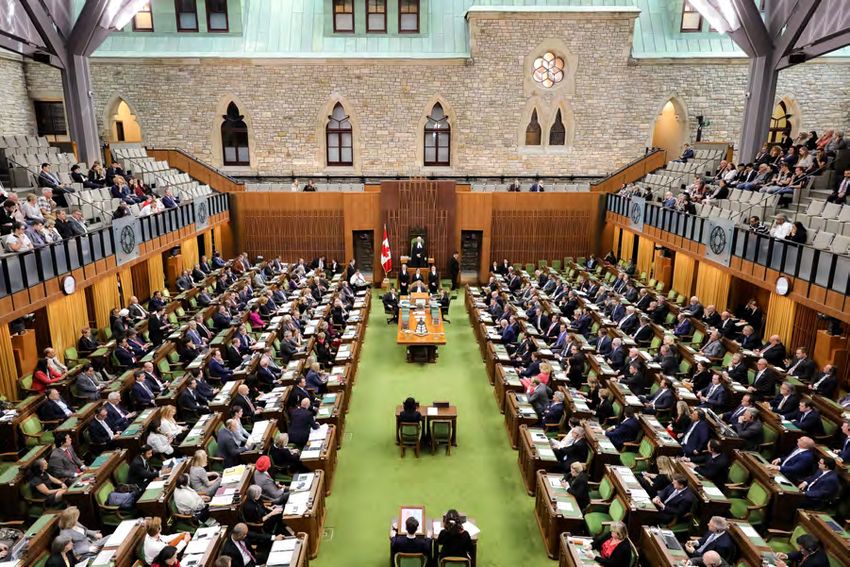
Message from the Clerk
                                                           This report covers a period when Centre Block was
                                                           closed and the rehabilitated West Block was opened.
                                                           The House’s historic move to its interim location
                                                           involved a full range of activities and projects, including
                                                           dry-run exercises in the new West Block Chamber.
                                                           In January 2019, more than 600 employees gathered
                                                           to test various components in the Chamber relating to
                                                           broadcasting, lighting and acoustics to ensure that the
                                                           space dedicated to the exercise of our parliamentary
                                                           democracy was move-in ready. In 2018, the House
                                                           Administration conducted an Employee Engagement
                                                           Survey, which had a response rate of 71%. The results
                                                           revealed that employees are highly engaged and
                                                           enabled and that they are proud to work for the
                                                           House Administration.

                                                           March 31, 2019, marked the end of a strategic
                                                           planning cycle. We have been busy in recent months
In my role as Clerk of the House of Commons, I am          developing a new plan and putting together a renewed
responsible for the sound management of the House          mission, vision and values statement. To set the stage
Administration, whose role is to serve Members so          for innovation and creativity, we have committed to
they can more easily and effectively do their work.        adopting new practices that will allow us to, among
In the following pages, you will see that employees of     other things, encourage risk taking and develop leaders
the House Administration have carried out numerous         at all levels.
projects to support Members in their daily activities.
                                                           The coming year is full of promise. I hope you will come
In November 2018, the House Administration was             back in twelve months to find out what is new within
recognized as one of Canada’s Top 100 Employers            our organization. In the meantime, I encourage you to
for 2019. We had previously received awards as a           learn more about what we have already accomplished
Top Employer for Young People in Canada and a Top          to provide Canada’s Members of Parliament with the
Employer in the National Capital Region—awards we          services, infrastructure and advice they need to fulfill
won again in 2019—and this year, for the first time, the   their roles as legislators and representatives.
Administration was recognized as one of the Top 100
Employers in the country.

                                                                                                     Charles Robert
                                                                                    Clerk of the House of Commons

                                                                                 House of Commons | Report to Canadians   4
Table of Contents

6		Members’ Snapshot

10     Members’ Activities

22		Highlights from the Hill

29     House of Commons Administration

31
   Reporting on Results
Members’ Snapshot 6

Constituencies by province

                                                                                                                              Members’ Snapshot
Each of Canada’s 338 constituencies (also called ridings or electoral districts) has a representative in the
House of Commons. Each Member of Parliament keeps an office and employs staff in the constituency to
connect with their constituents to discuss issues of concern, attend certain community events, and help them
access federal programs and services.

   Look up the address for your Member’s constituency office                       428
                                                                                   Constituency offices

   Learn about current constituencies                                              2,013
                                                                                   Members’ employees

                                    1
                                    Northwest
                                    Territories
                                                                         1
             1                                                           Nunavut
        Yukon

                                                                                    78
                                                                                    Quebec

                                                              14
                                                              Manitoba                               7
                                                                                                     Newfoundland
                                                                                                     and Labrador

     42
   British
Columbia

                   34
                 Alberta                                                                             4
                                                                                                     Prince Edward Island
                                                  121
                             14                   Ontario
                     Saskatchewan

                                                                     10
                                                            New Brunswick

   338                                                                                                11
   Constituencies                                                                                     Nova Scotia

                                                                                     House of Commons | Report to Canadians            7
About Members
of Parliament

                                                                                                                            Members’ Snapshot
Members debate and vote on legislation in the Chamber, attend committee and caucus meetings, and perform
a wide range of duties in their constituencies. They also represent Canada when travelling abroad on official
business or when hosting foreign parliamentarians and officials.

  Each year, Members of Parliament and their staff handle thousands of
 calls from constituents seeking access to federal government programs
                          and services, including:

    1. Employment insurance        3. Veterans' support          immigration

    2. Disability pensions          4. Passports and             5. Commemorative events
      Employment                Disability           Veterans’         Passports and             Commemorative
       insurance                pensions              support           immigration                 events

For more than 150 years, Members of Parliament have upheld the principles and practices of Canadian democracy by
representing the citizens who elect them. Today’s Parliament is the most diverse in our history, containing more women
as well as more Members born outside Canada.

      73%                                       27%                                             Seats held by Members
      Seats held by men                         Seats held by women                 12%         born outside Canada

 Age of Members

   27                                        53                                       78
   Age of the youngest Member                Average age of Members                   Age of the oldest Member

                                                                                   House of Commons | Report to Canadians            8
137 MP staff members honoured for their long service
   Members of Parliament can count on their dedicated staff, who spare

                                                                                                                               Members’ Snapshot
   no effort in helping them carry out their parliamentary functions on the
   Hill and in their constituency offices.

   In May 2018, 137 MP staff members who achieved a significant
   service milestone were honoured during a ceremony and reception
   hosted by the House of Commons Speaker. The ceremony was
   the first to be held following the revival of the Long Service Awards
   Program. The program recognizes employees as they reach one of
   the following milestones: 5, 10, 15, 20, 25, 30, 35, 40 and 45 years
   of service.

Caucuses
Most Members of Parliament belong to a political party and are members of a caucus. Each caucus meets weekly
when Parliament is in session to discuss policies and parliamentary strategy, to share feedback from their constituents,
and to establish positions on issues being debated in the House of Commons. Held in private, caucus meetings allow
Members to freely express their views.

  Learn more about the role of political parties in
                                                                   View the list of party leaders and House Officers
  Canada’s Parliament

Seats held by each political party in the House of Commons (as of March 31, 2019)

      179                                        97                                          41
      Liberal Party of Canada                    Conservative Party of Canada                New Democratic Party

      10                                         5                                           1
      Bloc Québécois                             Independent Members                         Green Party of Canada

      1                                          1                                           3
      Co-operative Commonwealth                  People’s Party of Canada                    Vacant
      Federation

   A party must have at least 12 seats to be recognized as a party in the House of Commons. Recognition means that
   the party has representation on committees as well as funding for research and staff.

                                                                                      House of Commons | Report to Canadians            9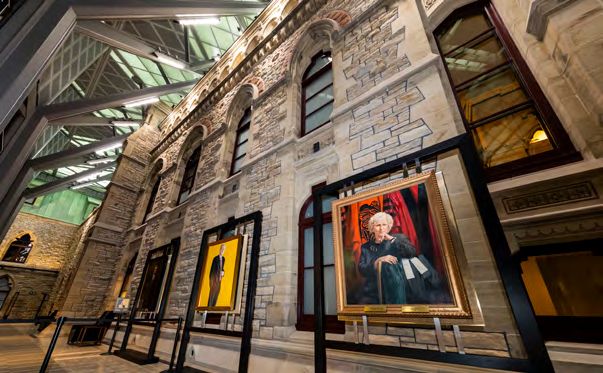
Members’ Activities 10
In the Chamber

                                                                                                                               Members’ Activities
The Chamber is where Members come together to debate issues of local, regional and national importance,
receive documents prepared by government departments and agencies, and debate and vote on potential laws.
All these activities are presided over by the Speaker of the House or one of the Chair occupants.

                                                                           Watch Chamber proceedings online
     A typical week in the House
                                                                           on ParlVU

From April 1, 2018 to March 31, 2019, a total of 60 bills
were introduced, covering a wide range of topics.
Government Bills are introduced by a minister of the Crown and drafted by the Department of Justice on the
instructions of the Cabinet. Private Members’ Bills follow the same legislative process (although time for their
consideration is more restricted) and are introduced by individual Members who are not Cabinet ministers or
parliamentary secretaries.

      22                                                             38
      Governments Bills introduced                                   Private Members’ Bills introduced

TOPICS INCLUDED                                                 TOPICS INCLUDED

 •    Accessibility                                              •   Access to information and privacy
 •    Appropriation                                              •   Compensation, pension and employment insurance
 •    Canadian heritage and multiculturalism                     •   Constitution, official languages and human rights
 •    Democratic institutions                                    •   Criminal Code
 •    Employment, workforce development and labour               •   Elections and Parliament
 •    Families, children and social development                  •   Environment
 •    Finance                                                    •   Federal tax and transfer legislation
 •    Indigenous services                                        •   Health
 •    Intergovernmental and Northern affairs                     •   Labour law
      and internal trade                                         •   Transportation and navigation
 •    International trade diversification                        •   Public finance
 •    Justice
 •    National defence
 •    Public safety and emergency preparedness

                                                                                      House of Commons | Report to Canadians     11
Statistics about the
House of Commons
Members’ Activities
116
Sitting days
725
Written questions submitted
36
Rulings by the Speaker in response
to points of order or questions of
privilege raised in the Chamber
2,591
Sessional papers tabled
Tabling a document is a formal way of providing information
to Members and putting it on the official public record of the House.
Certain documents must be tabled in the House by the government.
Among these are reports on studies conducted by government task
forces and commissions, annual reports for a number of federal
institutions, corporate plans, performance reports, and other papers
concerning matters related to the administrative responsibilities
of the government.
Committees present reports to the House and can request that the
government respond to those reports. Collectively, these documents
are referred to as “sessional papers.”
House of Commons | Report to Canadians 12Petitions
Members’ Activities
The electronic petition application gives millions of
The path of an e-petition
Canadians an opportunity to directly participate in
their democracy. The purpose of a petition is to draw 1. Create a petitioner's account
attention to an issue of public interest or concern and 2. Write and submit a draft
3. Support of five Canadian citizens or residents
to request that action be taken. Two forms of public
of Canada
petitions are accepted: paper petitions and electronic 4. Authorization by a Member of Parliament
petitions. The government is obliged to reply to 5. Preliminary review by the Clerk of Petitions
petitions within 45 days of their presentation. 6. Open for signature on the website for 30, 60,
90 or 120 days
In January 2019, enhancements to the e-petition 7. Certification by the Clerk of Petitions if there
are at least 500 signatures
module were deployed, and a new functionality,
8. Presentation in the House of Commons
currently in development, was identified with a view 9. Tabling of a government response
to making paper petitions also available on the
petitions website.
Find out more about these enhancements
Learn more about petitions
Learn about e-petitions
Number of petitions tabled
875
Paper
122
Electronic
House of Commons | Report to Canadians 13In Committees
View a comprehensive list of studies,
Members’ Activities
In committees, Members conduct in-depth studies, activities and reports
amend proposed legislation, examine government
spending, conduct inquiries and receive input from
experts and citizens. Learn more about committees
Standing committees are established pursuant to
the Standing Orders of the House of Commons and
Browse the list of committee meetings and watch
generally oversee a government department or agency.
or listen to all public meetings on ParlVU
24
Standing committees
• Access to Information, Privacy and Ethics (ETHI) • Industry, Science and Technology (INDU)
• Agriculture and Agri-Food (AGRI) • International Trade (CIIT)
• Canadian Heritage (CHPC) • Justice and Human Rights (JUST)
• Citizenship and Immigration (CIMM) • National Defence (NDDN)
• Environment and Sustainable Development (ENVI) • Natural Resources (RNNR)
• Finance (FINA) • Official Languages (LANG)
• Fisheries and Oceans (FOPO) • Procedure and House Affairs (PROC)
• Foreign Affairs and International Development (FAAE) • Public Accounts (PACP)
• Government Operations and Estimates (OGGO) • Public Safety and National Security (SECU)
• Health (HESA) • Status of Women (FEWO)
• Human Resources, Skills and Social Development • Transport, Infrastructure and Communities (TRAN)
and the Status of Persons with Disabilities (HUMA) • Veterans Affairs (ACVA)
• Indigenous and Northern Affairs (INAN)
Standing joint committees are established pursuant to the Standing Orders of the House of Commons
and the Rules of the Senate, and are composed of members from both the Senate and the House of Commons.
2
Standing joint committees
• Library of Parliament (BILI) • Scrutiny of Regulations (REGS)
House of Commons | Report to Canadians 14Topics Addressed by
Committees
Members’ Activities
Committees provide an opportunity for in-depth
discussions on a variety of topics. In 2018–2019, 10
these topics included: Members on each
standing committee
• Homeless veterans (ACVA)
• Mental health challenges that Canadian farmers,
ranchers, and producers face (AGRI)
1,170
• Impact of tariffs on Canadian businesses, Total number of
companies and workers (CIIT) committee meetings
• Migration challenges and opportunities for Canada
in the 21st century (CIMM)
• Clean growth and climate change in Canada: 1,991
forestry, agriculture and waste (ENVI) Total hours of
• Canada’s sovereignty in the Arctic (FAAE) committee meetings
• System of shelters and transition houses serving
women and children affected by violence against
women and intimate partner violence (FEWO) 5,014
• Impacts of methamphetamine abuse Witness appearances
in Canada (HESA)
• A barrier-free Canada (Bill C-81) (HUMA)
• Northern infrastructure projects 182
and strategies (INAN) Reports presented
• Remediation agreements, the Shawcross doctrine
and the discussions between the Office of the
Attorney General and government colleagues (JUST)
• Use of Indigenous languages in proceedings
of the House of Commons (PROC) Who are the witnesses?
• Economic opportunities for energy efficiency Committees regularly invite citizens, experts,
in Canada (RNNR) representatives of organizations, public servants
• Assessing the impact of aircraft noise in the vicinity and ministers to appear before them to obtain
of major Canadian airports (TRAN) information relevant to a study. These interactions
allow witnesses to share their point of view and
• Sports-related concussions in Canada (SCSC)
present written briefs to the committee.
House of Commons | Report to Canadians 15International and
Interparliamentary
Members’ Activities
Activities
Whether welcoming visiting parliamentarians and dignitaries to the House of Commons
or participating in delegations to foreign legislatures and international conferences,
Members of Parliament play an active role in parliamentary diplomacy.
Through meetings and courtesy calls, the Speakers of the Senate and the House meet
with foreign dignitaries and the diplomatic community.
Learn more about how Members represent Canada to the world
Visit to Canada (June 6–7, 2018) of His Excellency
Emmanuel Macron, President of the French Republic
His Excellency Emmanuel Macron, President of the French Republic,
signing the Distinguished Visitors’ Books at the Parliament of Canada
in the presence of Prime Minister Justin Trudeau; the Senate Speaker,
the Honourable George Furey; and the House of Commons Speaker,
the Honourable Geoff Regan, on June 6, 2018.
House of Commons | Report to Canadians 16Opportunities for parliamentary diplomacy can take various forms:
• Visits by heads of state or government
• Visits by parliamentary delegations
Members’ Activities
• Official delegations led by the Speaker
• Participation in conferences as either hosts or attendees
• Activities here and abroad where members of various associations take part
64th Annual Session of NATO 16th Meeting of the Speakers
Parliamentary Assembly, Halifax, of the Lower Houses of the G7
Nova Scotia, November 2018 The Speaker of the House of Commons, the
During the Annual Session of the NATO Honourable Geoff Regan, hosted the 16th
Parliamentary Assembly, parliamentarians from Meeting of the Speakers of the Lower Houses of
NATO member countries and partner nations met the G7 in Halifax, Nova Scotia from September 6
to study draft reports and hear from government to 8, 2018. The G7 Speakers’ meeting is an annual
representatives, NATO officials, and experts on gathering of presiding officers of parliaments of
a wide range of issues concerning the Alliance. the G7 countries. The 2018 meeting was the third
The 64th Annual Session was hosted by the one attended by current Speaker Geoff Regan or
Parliament of Canada. his delegate. The theme of this year’s gathering
was “Parliamentary Oversight and National
Security.” A number of business sessions,
meetings, and visits occurred, including a visit by
the presiding officers to the prestigious Ocean
Frontier Institute at Dalhousie University.
House of Commons | Report to Canadians 17AMERICAS
SNAPSHOT OF CERTAIN PARLIAMENTARY DIPLOMATIC ACTIVITIES
Members’ Activities
40th Canadian Regional
Parliamentary Seminar
Canadian Branch of the Commonwealth
Parliamentary Association (CCOM)
Iqaluit, Nunavut
Meeting of the Defence
and Security Committee (DSC)
Canadian NATO Parliamentary Association (CANA)
Honolulu, Hawaii
CAN–AM Border Trade Alliance Conference
Canada–United States Inter-Parliamentary Group (CEUS)
Washington, D.C.
Bilateral Visit to Mexico
Canadian Section of ParlAmericas (CPAM)
Mexico City, Mexico
Bilateral Visit to Panama and 3rd Gathering of the
Parliamentary Network on Climate Change
Canadian Section of ParlAmericas (CPAM)
Panama City, Panama
3rd Gathering of the Open Parliament
Network, 45th Board of Directors Meeting of
36
ParlAmericas, and 8th Summit of the Americas
Canadian Section of ParlAmericas (CPAM)
Lima, Peru
Activities
House of Commons | Report to Canadians 18EUROPE
28
Activities
Members’ Activities
Conference of the Parliamentarians of the Arctic Region
Canada–Europe Parliamentary Association (CAEU)
Inari, Finland
Presidential Election
Bilateral Visit Observation Mission
Canada–United Kingdom Inter-Parliamentary Association (RUUK)
Canadian Delegation to the Organization for
London, United Kingdom and Brussels, Belgium Security and Co-operation in Europe Parliamentary
Assembly (SECO)
Kiev, Ukraine
Parliamentary Mission
to France
Canada–France Interparliamentary
Assocation (CAFR)
Paris, France
Meeting of the Steering Committee of the 12+ Group Meeting of the APF Cooperation
Canadian Group of the Inter-Parliamentary Union (UIPU) and Development Committee
Canadian Branch of the Assemblée parlementaire
Horta and Terceira, Portugal
de la Francophonie (CAPF)
Rome, Italy
House of Commons | Report to Canadians 19MIDDLE EAST AND AFRICA
Members’ Activities
Meeting of the APF Political Committee
Canadian Branch of the Assemblée parlementaire
de la Francophonie (CAPF)
Djibouti, Republic of Djibouti
Bilateral Mission to Algeria
Canada–Africa Parliamentary Association (CAAF)
Algiers, Algeria
Bilateral Mission to Ethiopia
Meeting of the APF Education, and Rwanda
Communication and Cultural Affairs Canada–Africa Parliamentary Association (CAAF)
Committee Addis Ababa, Shewa, Ethiopia and Kigali, Rwanda
Canadian Branch of the Assemblée parlementaire
de la Francophonie (CAPF)
Grand-Bassam, Côte d'Ivoire (Ivory Coast)
Meeting of the Parliamentary Network
on HIV/AIDS, Tuberculosis and Malaria
Canadian Branch of the Assemblée parlementaire
de la Francophonie (CAPF)
Lomé, Togo
Bilateral Visit to South Africa and Kenya
Canadian Branch of the Commonwealth Parliamentary Association (CCOM)
Cape Town, South Africa and Nairobi, Kenya
7
Activities
House of Commons | Report to Canadians 20ASIA AND AUSTRALIA
Members’ Activities
Bilateral Visit to Pakistan Co-Chairs’ Annual Visit to Japan
Canada–Japan Inter-Parliamentary Group (CAJP)
Canadian Branch of the Commonwealth
Parliamentary Association (CCOM) Tokyo and Sapporo, Japan
Islamabad, Pakistan
Parliamentary Mission to Shanghai, Shenzhen
and Hong Kong, China
Canada–China Legislative Association (CACN)
Shanghai, Shenzhen and Hong Kong, China
Meeting of the APF Network
of Parliamentarian Women
Canadian Branch of the Assemblée parlementaire
de la Francophonie (CAPF)
Hanoi, Vietnam
10 Bilateral Visit to New Zealand and Samoa
Canadian Branch of the Commonwealth Parliamentary
Association (CCOM)
Activities Auckland and Wellington, New Zealand and Apia, Samoa
House of Commons | Report to Canadians 21Highlights from the Hill 22
Temporary Closing
of Centre Block

                                                              Highlights from the Hill
For almost 100 years, the Parliament Building was the
centre of Canada’s parliamentary democracy, the hub
of important debates and significant decisions, and the
space where much of our country’s history was made.
On December 13, 2018, Members of Parliament rose in
the Centre Block Chamber for the last time for at least
a decade to make way for the start of one of the largest
and most complex heritage rehabilitation projects in
Canadian history.

“   I encourage all Members
    to pause, look around, and
    savour the wonder that is
    the Parliament Building.
    It has taken good care of us
    for almost a hundred years;

                                   ”
    it is now time that
    we return the favour.
    The Honourable Geoff Regan
    December 12, 2018

          Watch party leaders bid goodbye to Centre
          Block in December 2018

                     House of Commons | Report to Canadians      23
In the days and weeks leading up
to and immediately following the
last sitting of Parliament, several
events were held to mark the
Highlights from the Hill
closing of Centre Block.
Thousands of Canadians had the
opportunity to explore the historic
space and its art, artefacts and
architecture before the last official
tour of Centre Block.
The Centre Block rehabilitation
also lives as part of a larger story:
a story about the preservation
of history and the preparations
necessary to support our
Parliament of the future.
The Speaker of the Senate, the Honourable
George J. Furey, and the Speaker of the
House of Commons, the Honourable
Geoff Regan, host a Speakers’ Reception
for dignitaries, current and former
parliamentarians, and media in the Hall of
Honour on November 27, 2018.
House of Commons | Report to Canadians 24West Block Rehabilitation
and Restoration
Highlights from the Hill
The ceremonial handover of the key to West Block by Public Services and
Procurement Canada (PSPC) marked a monumental transition: a shift from
a comprehensive building restoration project to the carefully orchestrated
preparations designed to make West Block move-in ready for Members.
Thousands of Members’ staff and House Administration employees took
part in dry-run exercises to review and perfect the functionality of the interim
The Honourable Carla Qualtrough, Minister of Chamber and other parliamentary spaces and support services in the newly
Public Services and Procurement and Accessibility, restored heritage building.
presents a ceremonial key crafted using copper
from the West Block roof to Speaker Regan during
a handover ceremony on November 8, 2018.
Watch this time-lapse video to get a sense
of the scale of the effort
Every aspect of West Block was tested–from acoustics to security, division
bells and broadcasting and interpretation systems, among numerous other
functionalities–to ensure that Parliament resumed, uninterrupted, in time for
its sitting in January 2019.
In all, 52 new parliamentary office spaces–including those of the Speaker,
the Prime Minister, and House Officers–in addition to four committee rooms,
the Parliamentary Dining Room, and all physical spaces that make up the
building were designed, furnished, and readied for Members.
The symbolism of the Chamber’s open design and glass ceiling reflects
In the last of the four dry runs, 600 Members’ the openness and transparency of a 21st-century democratic parliament.
staff and House Administration employees play
various roles to test the legislative functionality of Various design elements and natural materials used throughout the Chamber
West Block.
evoke Canadian imagery. The wood panelling and tracery in the Chamber
and courtyard are reminiscent of sheaves of wheat, canoes, fish bones, and
hockey sticks.
The core of the rehabilitated building is the permanent courtyard infill that
now accommodates the interim House of Commons Chamber while Centre
Block undergoes its own rehabilitation.
Members and their staff take part in one of
several tours during West Block’s transformation.
House of Commons | Report to Canadians 25Finishing touches
The restored space integrates Canada’s parliamentary history with contemporary
design and technology to meet the needs of Parliament.
Highlights from the Hill
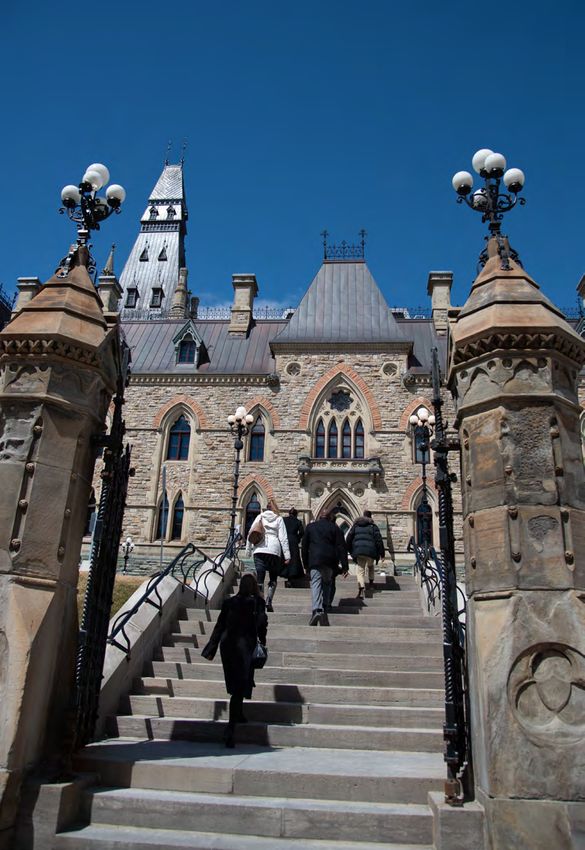
West Block opened its doors as a government building over 150 years ago and
later transitioned into a parliamentary space. Now, the oldest building in the
Precinct is the interim seat of Canada's parliamentary democracy.
Portraits of Canada’s Prime Ministers were relocated to the new
antechamber and foyer in West Block.
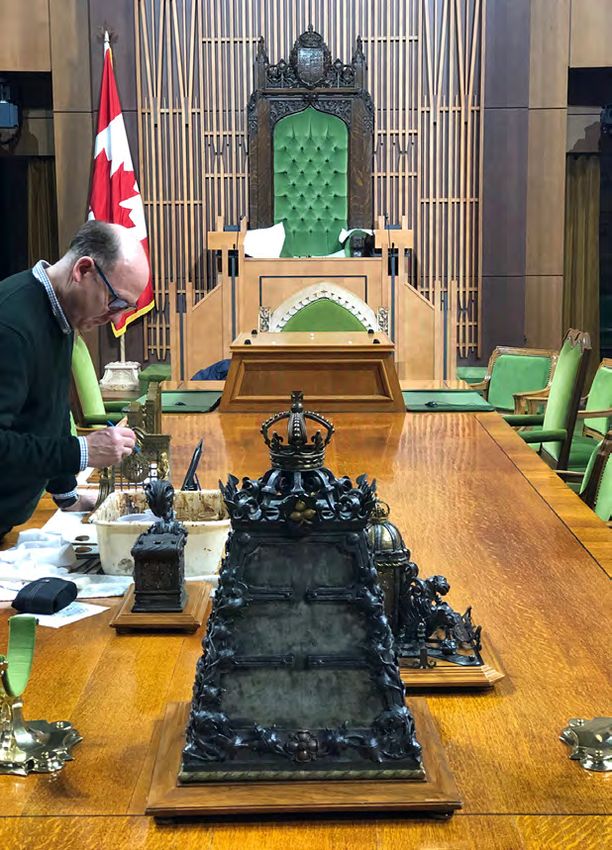
The Speakers’ portraits find a new home in West Block. The Clerk’s Table, a central fixture of the Chamber, moved to West
Block. A conservator worked on several artefacts displayed on the
table to preserve their integrity.
House of Commons | Report to Canadians 26The Opening of West Block
Highlights from the Hill
“ This space is a unique marriage of tradition
and modernity, of the familiar and the
new .... On behalf of the exceptional team
that made this restored West Block a reality,
”
welcome to the new House.
The Honourable Geoff Regan
January 28, 2019
A seashell, sacred plants, fire and cleansing smoke: on January 28, 2019,
these four elements came together as part of a solemn Indigenous smudging
ceremony. Algonquin Elder Claudette Commanda led the ceremony that
blessed the interim Chamber and marked its official use for the first time.
Smudging ceremony
27The opening of West Block was a day of many firsts,
including the inaugural Speaker’s Parade.
Watch the first Speaker’s Parade
Highlights from the Hill
in West Block
Orientation sessions and packages were distributed,
and staff was stationed throughout the building to
troubleshoot and ensure that the new House became
Members’ home away from home.
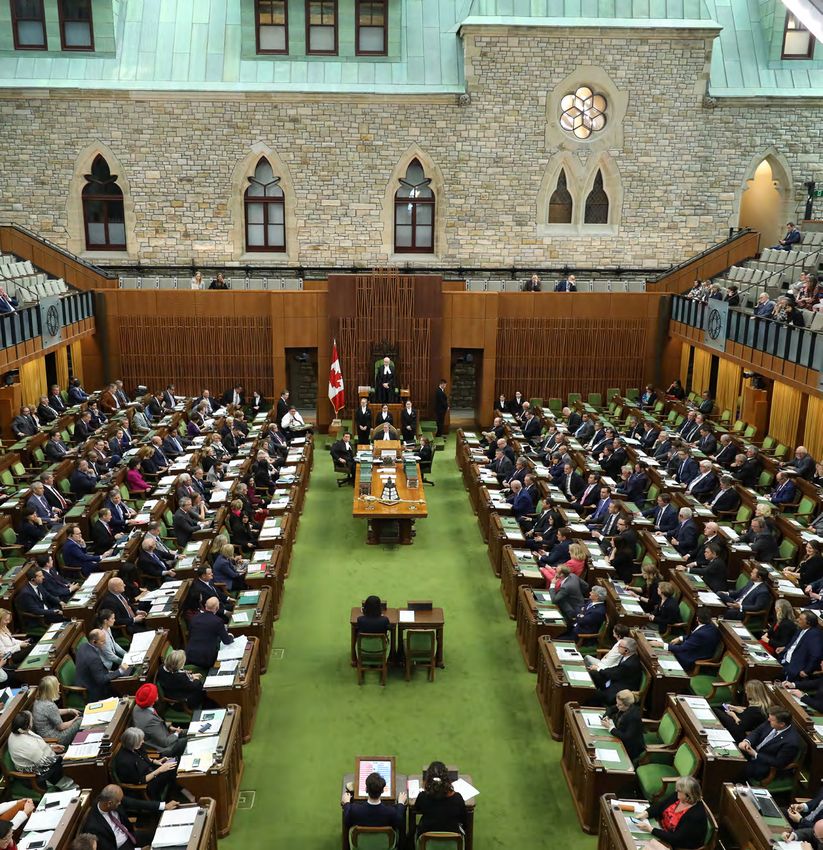
Group photo of Members in Centre Block Chamber
The move to West Block also included the construction
of a Visitor Welcome Centre and the relocation of the
Books of Remembrance from their home in the Peace
Tower’s Memorial Chamber. Located within the Visitor
Welcome Centre, the Room of Remembrance houses
eight altars on which the books containing the names of
Canada’s war dead are presented. Begun in 1942,
the Turning of the Page Ceremony continues each day
at 11 a.m., ensuring that throughout the year, every
name will be visible, in solemn tribute to those who gave
their lives in service to our country.
Group photo of Members in West Block Interim Chamber
Though the ceremonies to mark the opening of West
Block and the new interim Chamber have ended, West
Block’s history remains inextricably linked to that of Centre
Block, and to the living history that is made every day in the
House of Commons.
The ongoing transformation of the buildings that
make up the Parliamentary Precinct will ensure the
preservation of our history, as well as the spaces
where our parliamentary democracy is conducted,
for future generations.
On February 5, 2019, a ceremony was held to mark the placement
of the Books of Remembrance in a new interim space.
The Room of Remembrance is illuminated by soft, speckled
light and was designed to preserve the Neo-Gothic design of the
Memorial Chamber. It remains open to all Canadians who wish to
visit this solemn space.
House of Commons | Report to Canadians 28House of Commons 29 Administration
Our Organization

                                                                                                                                House of Commons Administration
The House of Commons Administration proudly supports its Members and the institution of
Parliament. It strives to provide the services, infrastructure and advice that the Members need
to carry out their work as legislators and as representatives in the Chamber, in committees,
in caucus, and in their offices on Parliament Hill and their constituencies.

      6. Board of Internal Economy               Board of Internal Economy

      7. Speaker of the House of Commons

      8. Clerk of the House of Commons
                                             Speaker of the House of Commons
             8.1 Corporate Communications

             8.2 Internal Audit and Continuous Improvement

             8.3 Curatorial Services          Clerk of the House of Commons
                                                   Corporate Communications
                                           Internal Audit and Continuous Improvement
             8.4 Deputy Clerk, Procedure               Curatorial Services

                  8.4.1   International and Interparliamentary Affairs

                  8.4.2   Committees and Legislative Services

                  8.4.3 House Proceedings
             Deputy Clerk,                           Law Clerk and                                 Deputy Clerk,
              Procedure                              Parliamentary                                Administration
                  8.4.4   Parliamentary Information Directorate
                                                        Counsel
             8.5 Law Clerk and Parliamentary Counsel

                  8.5.1   Legal Services

                  8.5.2   Legislation Services
  International and      Committees              Legal              Legislation        Digital Services        Human
 Interparliamentary    and
               8.6 Deputy  Legislative
                          Clerk, Administration Services             Services                and              Resources
       Affairs            Services                                                      Real Property          Services
                  8.6.1   Digital Services and Real Property

                  8.6.2   Human Resources Services

      House       8.6.3Parliamentary
                         Parliamentary Precinct Operations                             Parliamentary          Corporate
   Proceedings          Information                                                      Precinct           Security Office
                  8.6.4 Directorate
                          Corporate Security Office                                     Operations

                  8.6.5   Press Gallery Secretariat

                  8.6.6   Finance Services
                                                                                        Press Gallery          Finance
                                                                                         Secretariat           Services

* See Appendix A for more details.

                                                                                       House of Commons | Report to Canadians       30
Reporting on Results 31
2018-2019 Results Highlights

                                                                                                                                   Reporting on Results
                                               The House Administration’s priority is to support Members in their work as
            Operational
                                               parliamentarians. Our strong culture of service will continue to be fostered,
            Excellence
                                               with an ongoing focus on improvement.

 Use of Indigenous languages                                          Modernization of householders
The House adopted the 66th Report of the Standing                   New householder formats provide Members with
Committee on Procedure and House Affairs, setting                   a more dynamic and modern look for their printed
out a process for the use of Indigenous languages                   communications with constituents. The new
in the House of Commons. In collaboration with the                  householder formats also offer more choice
Translation Bureau and PSPC, the House worked to                    at a reduced cost.
ensure that Members’ interventions in Indigenous
languages could be interpreted when possible and
published in that language, in addition to English
and French.

                  Inuinnaqtun
        North Slavey             Gwich’in
       Inuvialuktun
    South Slavey             Tłıchǫ Yatıı Inuktitut
         Chipewyan Cree

   Greener commute
   This past year, the House installed:

    •   9 electric vehicle charging stations
    •   2 bike repair stations
    •   Many additional indoor and covered bicycle stations

   Providing greener alternatives to get to work is a step
   towards creating an environmentally friendly workplace.

                                                                                          House of Commons | Report to Canadians     32
Family-friendly environment
The House of Commons is responsive to the needs of Additional family-friendly services are provided
Members, modifying the way it conducts business so throughout the Parliamentary Precinct, such as:
that it increasingly becomes a more family-friendly and
Reporting on Results
• Full-time private child care offered at the Children
inclusive institution. It offers a wide range of services
on the Hill Daycare as well as short-term, on-call
to help Members fulfill their responsibilities while
child care services as needed
also caring for their families. The design of the newly
renovated West Block building includes a Family Room • Parking spaces reserved for pregnant Members
for the exclusive use of Members and their spouses and Members with babies
with infants and young children. This space provides • Shuttles that can accommodate most strollers
numerous amenities, such as a crib, bottle warmer, • Several washrooms equipped with baby
high chair and play mat. In addition, a Spouses’ Lounge change stations
includes a breastfeeding area and is available for use as • Cafeterias across the Precinct, including the
a gathering space for Members and their families. Parliamentary Dining Room, that provide high
chairs and serve child-friendly food options
Family-friendly services and resources are continually
evaluated to ensure they reflect the evolving needs of
Members. In May 2018, the Board of Internal Economy
approved changes to travel policies applicable to
Members that improve their ability to reunite with
their families.
On-site service centres for Members and
their staff
As a client-focused organization, the House
Administration is continuously improving services
that allow Members and their employees to fulfill
their parliamentary responsibilities more easily
and effectively.
One recent example is the creation of multidisciplinary
on-site service centres called Sourceplus that provide
Members and their staff with in-person support. A
team of House of Commons employees are on hand to
answer questions related to finance, human resources,
information technology and various operational
services offered by the House Administration.
Members and their staff can take advantage of the
services offered at the four Sourceplus service centres
located throughout the Parliamentary Precinct.
House of Commons | Report to Canadians 33Sound information technology (IT) and robust information management (IM)
Modern are key enablers for any knowledge-based organization.
Technology
and Information
Infrastructure In 2018, the House Administration continued to develop its IM/IT solutions
and processes.
Reporting on Results
Electronic petition enhancement Human Resources Management
Following the adoption of the 75th Report of the Integrated System renewal
Standing Committee on Procedure and House Affairs, The Human Resources Management Integrated System
enhancements to e-petitions were deployed in (HRMIS) encompasses the management of information
January 2019. Petitioners are now able to select the such as leave, employees, employment, and departures.
timeline for which e-petitions are open for signature
The implementation of a new HRMIS is part of a larger
online, choosing between 30, 60, 90 or 120 days.
strategy to modernize our enterprise resource planning
Rules regarding paper petitions were also modified to
infrastructure. The first phase of this strategy was
allow for the use of larger-size paper and to provide
completed in 2017 with the launch of the new Financial
for more flexible formats for signatories’ addresses.
Management System.
Starting in the 43rd Parliament, the text of paper
petitions will also be published online once these The HRMIS was designed to capture, house and report
petitions are tabled in the House. on human resources management information in a
more user-friendly, efficient and integrated fashion.
The international and
interparliamentary activities
website renewal
A newly redesigned parliamentary diplomacy website
was launched in February 2019. The mobile-friendly
website offers regularly updated content—including
information about events, activities, news, conferences
and reports, dedicated Twitter feeds, as well as curated
photo galleries—within a simplified, modern design that
provides improved functionality.
Learn more about the diplomatic work of Members
on the international stage
House of Commons | Report to Canadians 34To preserve and protect the iconic buildings that make up the Parliamentary
Precinct and prepare them to meet the requirements of a working Parliament,
Renewed
the House of Commons together with its parliamentary partners and the
Physical Spaces
and Associated Government of Canada introduced the Long Term Vision and Plan (LTVP) in 2001.
Reporting on Results
Services
This past year, the transition of the House of Commons Chamber to its interim
home in the newly restored West Block and the temporary closure of Centre Block
marked a significant milestone in the life of the LTVP.
The rehabilitation of West Block
The renovation of West Block was a major undertaking.
It required a comprehensive, contemporary design
approach that would not only restore the existing
heritage building to its former glory, but also incorporate
all the modern functionality required to support our
parliamentary democracy.
AT PEAK TIMES DURING
CONSTRUCTION, THERE WERE
OVER 1,200 WORKERS ON
SITE DAILY.
What was done
• Restoration of masonry, sculptural elements and
decorative metalwork
• Replacement of mechanical, electrical and
life-safety building systems
• Replacement of the windows and roof
• Excavation and construction of the courtyard infill
to build the interim Chamber
• Excavation and construction of the North Court
underground facility
• Modernization of information technology and
multimedia capabilities
• Improved security and accessibility
House of Commons | Report to Canadians 35The changing nature of physical and information technology security
Enhanced
Emergency
threats is challenging for any organization. Through awareness programs,
Management and safety audits, threat and risk assessments, and policy development, the
Security Approach
House Administration continued to ensure an open and secure Parliament
Reporting on Results
throughout 2018.
Communications and
emergency preparedness
The House Administration has
revised its crisis communications
strategy and framework to
ensure that it is ready to
communicate timely, accurate,
and relevant information
via appropriate channels to
Members, their staff and House
Administration employees
in situations of emergency
response, crisis management
and business continuity.
Supporting
parliamentarians during
international travel
The House and Senate
administrations worked
together to:
• Ensure that documentation
required when travelling was
available in a safe and
secure manner
• Provide cybersecurity
awareness information for
travelling Members
• Equip Members with secured
mobile technology when they
were travelling
House of Commons | Report to Canadians 36The House Administration is committed to encouraging employees to
Engaged,
Qualified and contribute to the organization and develop their careers at the House by
Productive offering training and development programs and checking in with employees
Workforce
for their feedback, with a view toward constant improvement.
Reporting on Results
The House Administration is one of Canada’s
Top Employers
For the third year in a row, the House Administration was named one of the
National Capital Region’s Top Employers and one of Canada’s Top Employers
for Young People by Mediacorp Canada, the country’s largest publisher of
employment periodicals. This year, the House Administration was designated
as one of Canada’s Top 100 Employers for the first time. Here are some of
the reasons the House Administration was recognized and honoured:
• The organization recruits and retains individuals from a broad range of
backgrounds. The House Administration maintains a dedicated Diversity
Council and a Workplace Inclusion Program.
• The Administration offers a variety of work arrangements to help
employees balance work with their personal lives.
• The organization engages with universities, colleges and cégeps and
offers students temporary and permanent placements in a variety of
disciplines, including information services, finance, procedural services
and human resources.
Employee Engagement Survey
The Employee Engagement Survey is a vital tool that the House of Commons
uses to measure and understand the employee experience and what
motivates employees to succeed. Today’s feedback drives tomorrow’s
actions. This is how we improve.
Following the first Employee Engagement Survey, which was held in
2014, three priority areas were identified: communication effectiveness,
collaboration, and performance expectations. In the 2018 survey, employees
responded that they have seen improvements in each of these areas.
Overall employee engagement and enablement results have improved as
compared with 2014 and were above the public‐sector averages. The vast
majority of employees (93%) are proud to work for the House Administration,
believe the organization prioritizes the quality of service provided to
Members, are treated with respect, and are able to use their official language
of choice. Based on the results of the survey, an action plan will be developed
to continue to improve employee engagement and enablement.
House of Commons | Report to Canadians 37Management
Excellence Program
This six-day training program supports
managers in developing the fundamental
Reporting on Results
skills they need to lead their teams.
Through the program, leaders:
• Develop foundational soft skills needed
to effectively engage and empower
their employees
• Become familiar with new, practical
tools that support them in their
supervisory and managerial roles
• Gain a better understanding
and appreciation of the
leadership/managerial roles
within the House Administration
House of Commons | Report to Canadians 38Financial Information
Supplementary
Planned Versus Actual Spending Main Total Actual Surplus /
Estimates and
2018-2019 (In Thousands of Dollars) Estimates Authorities Spending (Deficit)
Adjustments
Statutory
Members and House Officers 120,174 (15,803) 104,371 104,371 -
Employee Benefit Plans 39,834 (728) 39,106 39,106 -
Total statutory 160,008 (16,531) 143,477 143,477 -
Non-statutory
Members and House Officers 161,659 6,856 168,515 156,999 11,516
Committees, Parliamentary Associations
9,160 - 9,160 7,040 2,120
and Parliamentary Exchanges
House Administration Program
176,185 9,051 185,236 179,897 5,339
House Administration
Total non-statutory 347,004 15,907 362,911 343,936 18,975
TOTAL 507,012 (624) 506,388 487,413 18,975
Actual Spending1
House Administration Actual Spending 2018-2019 (In Thousands of Dollars)
– Salary (including Employee Benefit Plans) and operating expenditures
FTE Budget2
–
Budgeted number of permanent full-time equivalent (FTE) employees
Office of the Clerk 5,288 42
Office of the Law Clerk and Parliamentary Counsel 5,169 31
Procedural Services 31,173 334
Office of the Deputy Clerk, Administration 2,656 19
Parliamentary Precinct Operations 31,989 508
Corporate Security Office 6,899 57
Digital Services and Real Property 75,390 440
Human Resources Services 20,702 134
Finance Services 22,573 200
TOTAL 201,839 1,765
1
Salary (including Employee Benefit Plans) and operating expenditures
2
Budgeted number of permanent full-time equivalent (FTE) employees
Learn more about the House’s financial information
House of Commons | Report to Canadians 39Appendix A - House Administration
Board of Internal Economy
The Board of Internal Economy (BOIE) is the governing body of the House of Commons. Under the Parliament of
Canada Act, the Board has the legal authority to “act on all financial and administrative matters respecting (a) the
House of Commons, its premises, its services and its staff; and (b) the Members of the House of Commons.”
Speaker of the House of Commons
As Chair of the BOIE and head of the House Administration, the Speaker is responsible for the overall
direction and management of the Administration. The Speaker maintains order in Chamber proceedings and
protects the rights and privileges of the House.
Clerk of the House of Commons
The Clerk of the House of Commons is the chief executive of the Administration and is responsible for the
day-to-day management of House operations. The Clerk is at the service of all Members and must act with
impartiality and discretion. The Clerk also authenticates all decisions made by the House, maintains records
of the proceedings, and advises on the interpretation of parliamentary rules, precedents and practices.
In addition, the Clerk oversees the following functions:
Corporate Internal Audit and Curatorial
Communications Continuous Improvement Services
The Corporate Communications As the House’s champion of Curatorial Services provides advice
team provides the BOIE, good management practices, to the institution on heritage
the offices of the Speaker and Internal Audit and Continuous matters and is responsible for the
the Clerk, and all service areas Improvement supports the House House of Commons collection,
with strategic advice, analysis, Administration’s mandate by which is composed of 5,000
products, tools and support related providing objective and objects, including official portraits,
to communications, branding, value-added assurance, historical paintings and other
crisis communications, social risk-management and advisory works of art, as well as ceremonial
media and media relations. services on all strategic and objects and pieces of furniture.
management practices. The Peace Tower Carillon also falls
under its purview.
House of Commons | Report to Canadians 40Law Clerk and Parliamentary Counsel
As the chief legal officer of the House of Commons, the Law Clerk and Parliamentary Counsel provides
comprehensive legal and legislative services to the Speaker, the BOIE, Members, committees, the Clerk
and the House Administration. The Law Clerk is also a Table Officer.
Legal Services Legislation Services
Legal Services offers comprehensive legal advice and Legislation Services assists Members who are not in
services to the House as an institution, to the Speaker, to Cabinet in drafting Private Members’ Bills and motions
the BOIE, to Members, to committees, and to the House to amend Government Bills. This service is also
Administration. Legal advisors specialize in multiple responsible for printing Government Bills and Private
areas of law, including parliamentary law, constitutional Members’ Bills as they progress through the legislative
law, labour law, and contract law. As well, this team may process. It ensures that bills are correctly printed or
intervene in legal proceedings on behalf of the House reprinted with amendments as approved by the House
of Commons and its Members to ensure that their or its committees and when ultimately adopted as acts
parliamentary privileges and immunities are protected. of Parliament.
House of Commons | Report to Canadians 41Deputy Clerk, Procedure
Procedural Services offers a broad range of procedural and legislative advice to the Speaker, Members
and Officers of the House of Commons. Procedural Services also conducts research and offers training
on parliamentary practice and procedure, and coordinates Members’ participation in international and
interparliamentary activities. This service area produces timely and accurate parliamentary information in both
official languages, such as the transcripts of debates in the House or minutes of committee proceedings.
House Proceedings Directorate Committees and Legislative Services
The House Proceedings Directorate is responsible for The Committees and Legislative Services Directorate
supporting the business of the Chamber, including provides procedural and administrative support to all
producing parliamentary publications, managing the standing, special, legislative and joint committees of the
Page Program and coordinating Private Members’ House of Commons. The Directorate is also responsible
Business. It provides research, advice and information for providing procedural advice to the Speaker and
regarding parliamentary procedure. Members with respect to legislation.
International and Interparliamentary Affairs Parliamentary Information Directorate
The International and Interparliamentary Affairs The Parliamentary Information Directorate is in charge
Directorate (IIA), a joint directorate of the Senate and of coordinating and supporting Procedural Services’
the House of Commons, coordinates the Parliament of information technology activities; implementing
Canada’s external relations and activities. IIA supports strategies to effectively manage information assets;
both Speakers’ exchanges with their counterparts; the producing the debates and the proceedings and
activities of parliamentary associations and recognized evidence of both the House and its joint committees;
interparliamentary groups, in Canada and abroad; ensuring the analytical indexing of key House and
official visits by dignitaries and heads of state; and committee publications; and overseeing the strategic
conferences hosted by the Parliament of Canada. direction for the dissemination of digital content.
House of Commons | Report to Canadians 42Deputy Clerk, Administration
The Office of the Deputy Clerk, Administration, provides Members with a broad range of administrative services,
infrastructure, support and advice to help them carry out their parliamentary functions on the Hill and in
constituencies. It oversees the functionality and service delivery of several service areas—namely Digital Services
and Real Property, the Corporate Security Office, Finance Services, Human Resources Services and Parliamentary
Precinct Operations—and ensures their unified plan and vision. It also provides services that support strategic
planning and reporting activities, as well as the technical and administrative infrastructure for the Canadian
Parliamentary Press Gallery.
Digital Services and Real Property Finance Services
Digital Services and Real Property plans, implements Finance Services delivers advisory and operational
and maintains information technology and information support to Members and their staff, as well as to the
management services for Members and the House Administration, in the areas of policy and financial
Administration. In addition, this service area is planning, financial management, and materiel and
responsible for facility renovations as part of the Long contract management.
Term Vision and Plan.
Corporate Security Office Parliamentary Precinct Operations
The Corporate Security Office is responsible for Parliamentary Precinct Operations provides efficient
ensuring security on the floor of the House of Commons and modern operational support to ensure a functional
Chamber, conducting investigations, coordinating work environment for Members and the Administration.
visitor and event access, ensuring security awareness, This includes areas such as trades, tenant operations,
and administrating parking services. It also develops room allocations, catering and restaurants, postal
and implements House-wide administrative security and messenger services, transportation, printing and
policies, standards, and processes aimed at preventing, mailing, as well as maintenance and material handling.
detecting and responding to security risks and threats.
Human Resources Services Press Gallery Secretariat
Human Resources Services offers a range of services The Press Gallery Secretariat is responsible for the
and support to Members and their staff, as well as to technical and administrative infrastructure for the
the Administration, in the areas of talent management, Canadian Parliamentary Press Gallery. The Secretariat
employee relations, pay and benefits, occupational directs the activities of a wide variety of specialized
health and safety, and organizational effectiveness. services, such as management of press conferences,
media accreditation, audio-technical set-ups for scrums,
access control to media lock-ups, and distribution of
press releases.
House of Commons | Report to Canadians 43Highlight from the Hill
You can also read


