Pyalong Primary School Emergency and Critical Incident Management Plan 2020-2021
←
→
Page content transcription
If your browser does not render page correctly, please read the page content below
Pyalong Primary School

       Emergency and Critical Incident
       Management Plan 2020-2021

                      10-14 Bourke Street, Pyalong, VIC, 3521
                      03 5785 1291 / pyalong.ps@education.vic.gov.au

                      Department of Education and Training

                            Date Approved: 3/09/2020

Emergency Management Plan: Pyalong Primary School - 2020-2021
Printed: 14/09/2020
Page 1
Purpose
The purpose of this Emergency and Critical Incident Management Plan (EMP) is to provide a detailed
plan of how this school campus will prepare and respond to emergencies and critical incidents that may
impact on student and/or staff health, safety and well-being and/or school operations.

Context
Schools have the authority to activate their EMPs when an event warrants a response. Schools should
know how to access multiple information sources including the VicEmergency app,
https://www.emergency.vic.gov.au, emergency services and/or the Department of Education and
Training.

All principals and key school staff should download the VicEmergency app on their phone with a watch
zone around their school to receive alerts and information regarding hazards and incidents in their vicinity.

Should the principal or school be made aware of an emergency in the local area, the principal or
nominated person will consult the following sources for information:
   1. Call ‘000’ for life-threatening or time critical emergencies.
   2. Contact the Incident Support and Operations Centre (ISOC) on 1800 126 126.
   3. Seek support from your region/regional Manager, Operations and Emergency Management or
        Emergency Management Support Officer if required.
   4. Check the VicEmergency app or www.emergency.vic.gov.au for up to date information on
        warnings and incidents.
   5. Contact your Senior Education Improvement Leader.
   6. Check the Department of Education and Training web site for incident updates.

Emergency Management Plan: Pyalong Primary School - 2020-2021
Printed: 14/09/2020
Page 2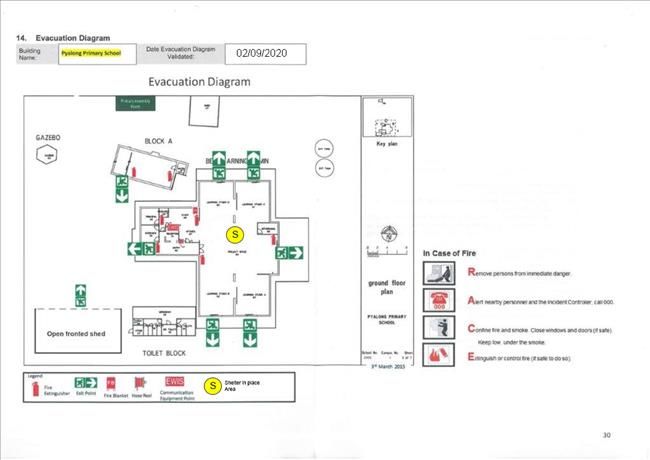
Distribution List
       Name                                        Position Title and Organisation   Communication Date   Email or Postal
                                                   Name                                                   Address

       Vacant                                      Manager Operations and            02/09/2020
                                                   Emergency Management,
                                                   Regional Office, DEECD>

       Brendan Kelly                               CFA - Pyalong                     02/09/2020           c/o Pyalong Post
                                                                                                          Office/General Store

       Pyalong Police Station                      Police - Pyalong                  02/09/2020           c/o Pyalong Post
                                                                                                          Office/General Store

       All school staff                            Pyalong Primary School            02/09/2020           c/o Pyalong Primary
                                                                                                          School

       All visitors to school                      All visitors                      02/09/2020           On display on
                                                                                                          noticeboard in main
                                                                                                          office

       All School parents                          Pyalong Parents                   02/09/2020           On display on
                                                                                                          noticeboard in main
                                                                                                          office, on school
                                                                                                          website

       Emergency Management Plan: Pyalong Primary School - 2020-                                              Printed: 14/09/2020
2021

       Page | 3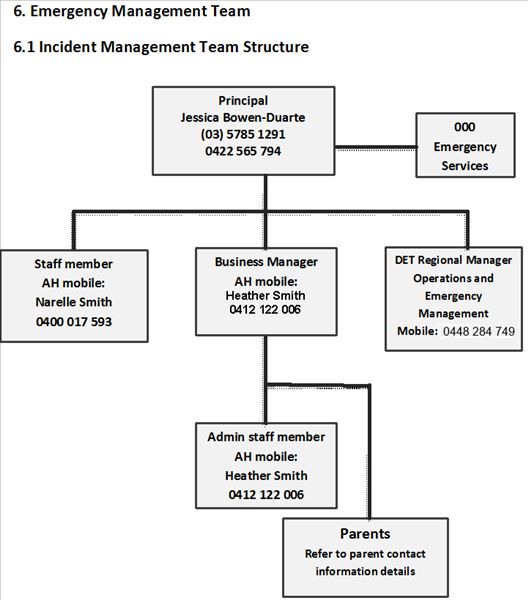
Emergency Management Plan: Pyalong Primary School - 2020-   Printed: 14/09/2020
2021

       Page | 4
Facility Profile
School Name/Campus Name Pyalong Primary School
Address 10-14 Bourke Street, Pyalong, VIC, 3521
Phone 03 5785 1291
Email pyalong.ps@education.vic.gov.au
Fax 03 5785 1249
DET Region NORTH-EASTERN VICTORIA
DET Area Goulburn Area
LGA Mitchell (S)
BOM/Fire District North Central District
Is your school on Bushfire Yes
At- Risk Register?
Bushfire At-Risk Register Category 3
Category
Operating Hours 8:45AM - 3:45PM
Number of Students 73
Number of Staff 13
Number of Buildings 3
Is the School a designated No
Neighborhood Safer Place?
Shelter-In-Place Location Main Building - Open Learning Area
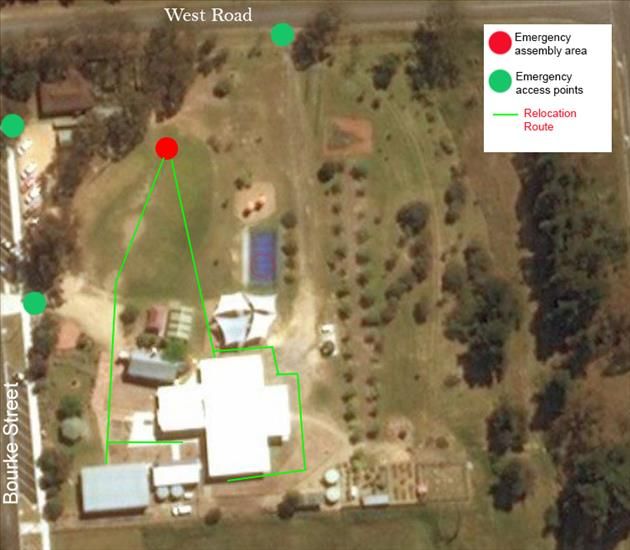
On-site Evacuation Location Main School Oval
Off-site Evacuation Location Pyalong Recreation Reserve
Emergency Management Plan: Pyalong Primary School - 2020- Printed: 14/09/2020
2021
Page | 5Typical method used for SMS, School Newsletter, website
communications to school
community
Is this school has other Yes
services or users of the site?
Other Services/Users of Site
Service/User Location Number of Student Emergency Contact Phone Mobile
Name or Visitor
Pyalong Room 3 Building ID Max 15 students 0700 - 0900 1530 - 5785 1291 0434 492 632
Primary - 61 before school and 15 1800
School Out of students after school
School Hours
Care
Pyalong Room 3 Building ID Max 15 students 0700 - 0900 1530 - 5785 1291 0403 357 962
Primary - 61 before school and 15 1800
School - Out students after school
of School
Hours
Pyalong Stephanie Max 15 participants 0930 - 1130 5785 1291 0400 720 022
Playgroup Alexander Kitchen
Building ID - 61
Building Information Summary
Telephones (landlines)
Location Number
Office (03) 5785 1291
Alarms
Description Location Monitoring Number
Company
Fire fill this in only if required
Emergency Management Plan: Pyalong Primary School - 2020- Printed: 14/09/2020
2021
Page | 6Intrusion Main building DET DET - FOB
required
Other
Utilities
Description Location Service Location of shutoff
Provider Instructions
Gas / Propane LPG - Lower school Elgas Turn off gas bottle at
grounds - Adjacent to the rear of main
old school building building
Water Bourke Street boundary, Goulburn Valley Turn off at Mains,
school water tanks located Water Bourke Street
behind toilet block (Building boundary
ID 20, 21, 22)
Electricity Main Switchboard - AGL (Powercor) Turn off at main power
Administration Building board in administration
area
Sprinkler System
Control Valve Location
Shutoff Instructions Location
Boiler Room
Location
Access
Emergency Power System
Type
Location
Provides power to
Emergency Management Plan: Pyalong Primary School - 2020- Printed: 14/09/2020
2021
Page | 7Shutoff Instructions Location
Building and Site Hazards
Location Number
Additional Profile Information
Additional Info
Emergency Management Plan: Pyalong Primary School - 2020- Printed: 14/09/2020
2021
Page | 8Emergency Kit Checklist
Checklist Yes / No
Student data and parent contact information (contained in EMP) Yes
Student and staff with additional needs list (contained in EMP) Yes
including any student medications
Staff contact information Yes
Student Release Forms/sign out book Yes
List of staff on the IMT Yes
Traffic/emergency safety vests and tabards Yes
Standard portable First Aid Kit. Refer to First Aid Kits Contents Yes
Checklist
Torch with replacement batteries (or wind up torch) Yes
Whistle Yes
Portable battery powered radio Yes
Copy of facility site plan and EMP including evacuation routes Yes
Water Yes
Sunscreen and spare sunhats Yes
Plastic garbage bags and ties Yes
Toiletry supplies Yes
Sanitary products Yes
Review Emergency kit checked date
Date emergency kit checked 28/08/2020
Next check date 28/08/2021
Emergency Management Plan: Pyalong Primary School - 2020- Printed: 14/09/2020
2021
Page | 9Drill Schedule
School Term Drill Type Contact Person Schedule Date Actual Date
Term 1 Incident Management Team Jessica Bowen- 27/01/2021 01/09/2020
Training Duarte
Term 1 Evacuation Procedures and Jessica Bowen- 16/02/2021 07/03/2018
drills (on site) Duarte
Term 2 Lock down procedures Jessica Bowen- 07/06/2021 08/05/2018
Duarte
Term 3 Evacuation Procedures and Jessica Bowen- 09/09/2021 02/08/2018
drills (on site) Duarte
Term 4 Evacuation Procedures and Jessica Bowen- 15/11/2020
drills (off site) Duarte
Emergency Management Plan: Pyalong Primary School - 2020- Printed: 14/09/2020
2021
Page | 10First Aid Training
Staff Member Training Completed Date Qualified To
Jessica Bowen-Duarte Stitches Level 2 First Aid / Asthma / 17/07/2022
Anaphylaxis/ CPR (2019)
Narelle Smith Stitches Level 2 First Aid / Asthma / 17/07/2022
Anaphylaxis/ CPR (2019)
Margaret Dickinson Stitches Level 2 First Aid / Anaphylaxis / 17/07/2022
Asthma / CPR (2019)
Rita Pollock Stitches Level 2 First Aid / Asthma / 17/07/2022
Anaphylaxis/ CPR (2019)
Heather Smith Stitches Level 2 First Aid / Asthma / 17/07/2022
Anaphylaxis/ CPR (2019)
Samantha Briggs Stitches Level 2 First Aid / Asthma / 17/07/2022
Anaphylaxis/ CPR (2019)
Stephen Cadusch Stitches Level 2 First Aid / Asthma / 17/07/2022
Anaphylaxis/ CPR (2019)
Robyn Dwyer Stitches Level 2 First Aid / Anaphylaxis / 17/07/2022
Asthma / CPR (2019)
Andi Ferraro Stitches Level 2 First Aid / Asthma / 17/07/2022
Anaphylaxis/ CPR (2019)
Erica Stute Stitches Level 2 First Aid / Asthma / 17/07/2022
Anaphylaxis/ CPR (2019)
Michelle Gyton-Taylor Stitches Level 2 First Aid / Asthma / 17/07/2022
Anaphylaxis/ CPR (2019)
Jessica Ciampi Stitches Level 2 First Aid / Asthma / 17/07/2022
Anaphylaxis/ CPR (2019)
Other Training Record
Staff Member Training Type Date
Stephen Cadusch 10710NAT Course in Allergy and 18/06/2019
Anaphylaxis Awareness
Stephen Cadusch Trauma Responsive Practice 04/08/2020
Emergency Management Plan: Pyalong Primary School - 2020- Printed: 14/09/2020
2021
Page | 11All staff Mandatory Reporting 01/09/2020
All staff Working Safely in Schools during 01/09/2020
COVID training
Emergency Management Plan: Pyalong Primary School - 2020- Printed: 14/09/2020
2021
Page | 12Students or Staff with Additional Needs
To ensure adherence to the provisions of the Information Privacy Act 2000 you should
not record personal details here.
Add summary of those with additional needs or medical conditions below, without
including personal details.
Category Number of Staff Number of Students
Severe Language Disorder 0 2
Asthma 0 5
Severe behaviour disorder 0 4
Intellectual disability 0 3
Mobility issues 0 1
Epilepsy 1 0
Intellectual disability 0 1
Austism 0 5
Emergency Management Plan: Pyalong Primary School - 2020- Printed: 14/09/2020
2021
Page | 13Risk Assessment
Identified Hazards Description of Risk Existing Controls Effectiveness of Risk Rating Controls to be implemented Revised Risk Rating
existing controls
Building fire Probable Causes: Inappropriate Effective
management of stored chemicals Fire services equipment (fire hose reels, fire Consequence Ensure Emergency Management Plan Consequence
such as cleaning fluids; Incident in extinguishers, fire blankets, hydrants) is tested and is up to date.
Major Major
science laboratory; Exploding gas tagged as per Australian Standards. Ensure all students and staff participate
tank; Faulty electrical wiring; A Workplace Inspection is completed once per term to
Likelihood in emergency drills and know the Likelihood
Faulty electrical equipment check that exit signs and other emergency equipment is Rare evacuation process and points Rare
Probable Consequences: Physical working. Risk Level Ensure that all cleaning fluids are Risk Level
injury to staff or students; Stress or Communication systems (PA system) are tested on a stored appropriately (in the outside,
Medium Medium
psychological injury requiring regular basis. locked cleaning cupboard)
clinical support for multiple A fire blanket (tested and tagged to Australian Standards) Regualr maintenance checks as per
individuals is available in all kitchen areas. OHS schedule
All electrical equipment is tested and tagged as per
Australian Standards and that frayed leads, damaged
equipment and so on. are disposed of in an appropriate
manner.
Bushfire/Grassfire Probable Causes: Lightning strike; Effective
Arson; Spark ignited by machinery; Weekly checks of safety equip are conducted during Consequence Ensure grounds are kept in good Consequence
Power line failure; Escaped bushfire season. condition with grass cut, long grass
Severe Major
planned burn Probable School liaises with local fire services regarding beside buildings whipper snipped -
Consequences: Injury; Serious preparedness prior to start of the Fire Danger Period.
Likelihood fortnightly mowing roster Likelihood
injury from smoke inhalation; WatchZone on VicEmergency App Unlikely Ensure gutters are cleaned twice yearly Unlikely
Stress or psychological injury Evacuation drills are conducted in Terms 1 and 4; Risk Level Enact fire prevention maintenance Risk Level
requiring clinical support for conduct Shelter-In-Place drill in Term 1. measures using School Council
High Medium
multiple individuals, risk of Working bees to clear and clean up school site occur at allocated funds
property damage or property loss. least twice per year. Ensure all parties are aware of the
EMP is reviewed and socialised with staff before fire Emergency Management Plan
season.
Staff and parents are aware of EMP and understand their
role within it.
‘Annual facilities bushfire readiness review checklist’ is
implemented in October to prepare for the bushfire
season
Pre-determined arrangements implemented as fire
danger escalates (in accordance with school’s category
on the Bushfire at Risk Register)
Off-site emergencies Risk of injury to staff and student's Complete Student Activity Locator. Acceptable Ensure all staff have proper documentation with
in the event that an emergency Consequence them on excursions. Consequence
occurs offsite at an excursion, Adhere to the Guidelines for Outdoor Education.
Major Moderate
professional development day,
camp or other offsite activity. Staff should follow DET's Work-related driving procedures. Likelihood Likelihood
Possible Possible
Complete risk assessment for all off site excursions/camps. Risk Level Risk Level
High Medium
Emergency Management Plan: Pyalong Primary School - 2020- Printed: 14/09/2020
2021
Page | 14Intruder Physical or psychological injury Ensure visitors/contractors sign in through the office area Effective Ensure all personnel are vigilant on reporting
could occur to staff, students, when they first arrive on site. Consequence any visitors to office Consequence
visitors or contractors if threatened Ensure contact details for Police and Emergency services
Moderate Moderate
or physically assaulted by an are located at the front office.
intruder. There is a risk that Practice drills Likelihood Likelihood
property could be damaged. Possible Possible
Students witnessing the event may Risk Level Risk Level
also be psychologically harmed.
Medium Medium
Bomb/substance Physical or psychological injury Ensure each phone has a Bomb Threat Checklist available. Effective Ensure checklist available at all phones.
threat could occur to staff, visitors or Consequence Consequence
contractors. Schedule and practice emergency evacuation drills on a
Severe Severe
regular basis.
Likelihood Likelihood
Implement and follow Bomb Threat response procedure Rare Rare
(located in EMP) Risk Level Risk Level
Medium Medium
Severe weather Risk of roof down flooding Risk of Ensure roofs/gutters/drains are clear. Acceptable Hire personnel to clean gutters as part of yearly
event injury Risk of property damage. Consequence maintenance schedule. Consequence
Physical injury to staff or students Liaise with SES/Local Government to identify potential risks.
Moderate Moderate
Stress or psychological injury Visual check roof structure as part of Working
requiring clinical support for Develop contingency for storage of equipment/materials if Likelihood Bee maintenance Likelihood
multiple individuals necessary. Possible Possible
Risk Level Risk Level
Test communications.
Medium Medium
Influenza pandemic Risk of health and possible death Ensure relevant staff are familiar with DET's Pandemic Effective Use newsletter and other technology to advise
(in extreme cases) Incident Response Procedures including the School Consequence parents and the community of risk. Consequence
Influenza Response Plan template.
Severe Severe
Educate parents of necessity of keeping sick
Ensure basic hygiene measures are in place and posters Likelihood children at home. Likelihood
are displayed at the beginning of flu season (April). Unlikely Unlikely
Risk Level Risk Level
Ensure there is convenient access to water and liquid soap
High High
and/or alcohol based sanitiser.
Ensure staff and children are educated about covering their
cough to prevent the spread of germs.
Loss of essential Lack of availability of school Ensure that bottled drinking water is kept on site and Acceptable Tanks to be filled with drinking water when
services resources such as computers encourage students to bring their own bottled water each Consequence empty. Consequence
Lack of availability of fresh drinking day.
Major Moderate
water and water for flushing toilets Tanks are connected to drinking taps (to be used when
town water is unavailable). Likelihood Likelihood
Permission forms to be distributed at the beginning of each Possible Unlikely
school year, allowing us to access the Recreation Reserve Risk Level Risk Level
in instances of emergency ie. no flushing toilets.
High Medium
Contact SEIL and Emergency Services Unit.
Emergency Management Plan: Pyalong Primary School - 2020- Printed: 14/09/2020
2021
Page | 15Child Abuse Probable causes: Domestic Effective Provide support to parents in the form of online
violence; Substance abuse; Recognise indicators of Child Abuse Consequence parenting courses Consequence
Stress/isolation; Mental health Child Safe Standards Ensure all staff are trained in mandatory
Major Major
problems/intellectual disability; PROTECT protocol reporting
Lack of parenting skills Probable Student Critical Incident Advisory Line
Likelihood Seek early intervention and assistance from Likelihood
consequences: Physical and Student Support Services/Student Welfare Coordinator Possible visiting SSSO. Unlikely
psychological Risk Level Risk Level
trauma/distress/injury;
High Medium
Depression/apathy; Inability to
concentrate;
Emotional/behavioural/learning
problems; Eating Disorder
Information Security Probable Causes: Hacking; Effective
Malware virus; Unprotected Privacy (including DET’s Schools’ Privacy Policy) Consequence
systems/passwords; Accidental Privacy, Department provided software
Moderate
Probable consequences: Privacy (requests for Information about Students)
Inconvenience Inability to Acceptable use of ICT Resources
Likelihood
access/use computer system; Staff member manages and reviews school’s privacy Unlikely
Loss/corruption of files/data; practices Risk Level
privacy breach Regular privacy audit to determine what information the
Medium
school collects, how it is used and with whom information
is shared.
Examine data security arrangements
Password protocols for ICT
Medical Emergency Probable causes: Effective Ensure medical alert forms are up to date ad
Accident/misadventure; Staff trained in first aid Consequence easily accessible Consequence
known/unknown illness Probable First Aid Kit Induction program includes information sharing
Major Major
consequences: Ill health, Staff observant to signs of illness about students at risk of anaphylaxis, asthma,
recuperation; hospitalization; Medical history – staff/students
Likelihood diabetes etc Likelihood
impact on continuity of education; First Aid and Infection Control Procedure Possible Ensure first aid supplies are regularly audited Unlikely
Psychological distress for those Medication Authority Form and authority to administer Risk Level and supplies are maintained at an adequate Risk Level
witnessing incident level
High Medium
Mental Stress Probable causes: Exposure to Effective Minimise workload through ensuring face to face
distressing event; Student Support Services Consequence teaching load does not exceed set guidelines Consequence
Anxiety/depression; illness Well-being staff in school Mentoring for new staff
Moderate Moderate
Probable consequences: Student Engagement and Inclusion Guidance Access to EAP 1300 361 008
Psychological trauma/distress; Building Resilience Framework
Likelihood Weekly check-in on staff wellbeing Likelihood
Attempted suicide; Suicidal Victorian Anti-bullying and Mental Heath Initiative Possible Unlikely
ideation/self-harm; Interrupted Respectful Relationships Initiative Risk Level Risk Level
learning
Medium Medium
Missing person - Probable causes; Lost or Effective 1:1 supervision for students at risk
school or school separated whilst on School records attendance Consequence Frequent home - school contact Consequence
camp/excursion camp/excursion; Truancy; Student engagement policy to promote school
Moderate Moderate
Unknown - i.e. distress Probable attendance and address truancy, which is staged
consequences: injury; interrupted Recess and lunchtime supervision. Likelihood Likelihood
education; psychological Behaviour Support Plans to address individual truancy. Possible Unlikely
trauma/distress Student Activity Locator to be completed ahead of all Risk Level Risk Level
camps (which includes outlining all students to attend
Medium Medium
camp)
Emergency Management Plan: Pyalong Primary School - 2020- Printed: 14/09/2020
2021
Page | 16 List of students to attend camp to be held at school site
and by Teacher in Charge on camp.
School excursion/camp risk assessment
Traumatic Probable causes: Effective
Death/Injury/Grief Accident/misadventure; Existing Student Support Services Consequence
illness; Sudden medical Well-being staff in school
Moderate
emergency Probable Managing Trauma Guide
Consequences: Distress/anger; Incident Support and Operations Centre referrals
Likelihood
Disruption to school operations; Employee Assistance Program Possible
Disruption to school operations; Risk Level
Stress, psychological injury,
Medium
impact on well-being requiring
support
Violence, Aggression Probable causes: underlying Site based policies and strategies Effective Staff not to be at school alone in the evenings
and/or harassment abuse or exposure to family Lunchtime and recess supervision Consequence Consequence
violence; developmental factors School based security measures such as dual entry
Major Major
Probable Consequences: physical points
or psychological harm; Disruption Behavioral Code of Conduct
Likelihood Likelihood
to learning/continuity of education Requirement for multiple staff to be present at meetings Possible Unlikely
or incidents involving aggressive parent or student Risk Level Risk Level
School pursues specific interventions or referrals as
High Medium
required/appropriate:
Trespass order
Child Protection referral
Family violence referral
Specific supports for students with challenging behaviors and
interventions:
Referral to Student Support Services (SSS)
School Wide Positive Behaviour Support strategies
(Behaviour Support Plans etc.)
Restraint and Seclusion procedures
Respectful Relationships
Health and Human Services Behaviour Support Services
More advanced supports accessed as appropriate e.g.
Engagement of a Student Support Services visiting
professional
School welfare officer/coordinator engaged
Training
Diffusion strategies and training for staff
Conflict management training
Awareness training and resources – Building Resilience
and Preventing Radicalisation to Violent Extremism
Specific support for teacher/staff in dealing with challenging
behaviours
Employee Assistance Program (EAP) for impacted staff
Principal Mentor Program
Proactive Wellbeing Supervision
Principal Health Checks
Early Intervention Principal Support Service
Refer to additional resources for impacted persons
School breakfast club (where available)
School wide Positive Behaviour Support
Emergency Management Plan: Pyalong Primary School - 2020- Printed: 14/09/2020
2021
Page | 17 Koori inclusive School Wide Positive Behaviour Support
Heat (Extreme) Probable causes: Prolonged Effective
period of excessively hot weather Sun and UV protection policy Consequence Move students into the areas with an Consequence
Probable Consequences: SunSmart program are implemented air conditioner installed
Major Major
hyperthermia: heat and sunlight Playground areas are shaded
overheat human body resulting in Sufficient shelter available for students awaiting pick-up
Likelihood Likelihood
heat cramps, heat exhaustion, by parents Possible Unlikely
heat stress and heat stroke; Sufficient unrestricted water available Risk Level Risk Level
dehydration exacerbating existing Restricted outdoor time during hot days (indoor recess
High Medium
medical conditions; power outages and lunch, sports programs moved to gym/indoor area) or
due to high use of air-con, cancelled in response to the severity of the event
refrigeration; failure of public Staff are trained in identifying early signs of heat
transport (rail); food poisoning due stress/dehydration
to unrefrigerated school lunch
Snakes Probable Causes: Warm, dry Effective
temperatures; Proximity of School grounds are cleared of all refuse and grass is cut Consequence Students educated in safety around Consequence
bushland/grassland to school regularly snakes
Major Moderate
Probable Consequences: Physical Staff with first aid qualifications are trained in responding Ensure snake first aid kit is available in
injury to staff or students; Stress or to a snake bite
Likelihood the First Aid cupboard Likelihood
psychological injury requiring Staff wear protective footwear on yard duty Possible Possible
clinical support for multiple School has a closed shoe policy Risk Level Risk Level
individuals Food in the chicken coup/shed is kept in tight sealed
High Medium
containers to reduce vermin
Phone number of snake handler is on display in office
Smoke Probable Causes: Fire at nearby Effective
factory/premises; Road accident Medical treatment plans for children with pre-existing Consequence Keep students inside the building for Consequence
involving a vehicle transporting a heart or lung conditions are current and accessible i.e. recesses and lunchtimes
Major Major
hazardous substance; asthma
bushfire/grassfire; planned burning Medication is kept accessible
Likelihood Likelihood
Probable Consequences: Physical Air conditioners allow recirculation of air Unlikely Unlikely
injury to staff or students; Stress or Watch Zone on VicEmergency App Risk Level Risk Level
psychological injury requiring EPA AirWatch
Medium Medium
clinical support for multiple Follow precautionary health advice on smoky days – i.e.
individuals limit outside activity, limit physical activity, consider
rescheduling outdoor events
Bus Emergency Probable Causes: Bus incident Effective
While En Route (eg. breakdown, fire or flood or Engage approved Accredited Bus Operators Drivers Consequence
other emergency event) or bus Buses with seat-belts are used for transporting students
Major
accident which occurs: while Controls for bus travel to or from school:
school bus enroute to or from Complies with School Bus Program Emergency Likelihood
school or while bus conveying staff management Operational Guidelines Unlikely
and students for camp excursion School’s EMP consistent with bus operator’s plan. Risk Level
or other school activity Probable Student Transport Emergency management procedures
Medium
Consequences: Risk of socialised with school and bus operator.
death/injury to passengers or Supervision during bus arrival and departure.
pedestrians; Delay/disruption Bus coordinator appointed (bus coordinating schools
only).
Log of bus travel risks.
Emergency Management Plan: Pyalong Primary School - 2020- Printed: 14/09/2020
2021
Page | 18 School maintains a bus roll to determine who is travelling
on the bus each day.
School maintains emergency contact records for all
students travelling on buses.
Controls for bus travel during camp or excursion:
Staff to follow DET’s work-related driving procedure.
Bus driver to maintain log book as required.
Students supervised and monitored while participating in
off-site school activities, including bus transport.
Permission forms for excursions and camps contain
parent/guardian emergency contact details and copy of
these kept on school site, with one copy to be taken on
trip.
Student Activity Locator (SAL) completed.
Contact details of emergency contacts for students on
camp or excursion.
Risk assessment planning has occurred for all off-site
camps and excursions.
First aid kit to accompany excursions and first aid
qualified staff to attend.
Traffic management plan to manage school
access/egress at drop off/pick up times.
Supervision to monitor student compliance with school
road and bike safety policy.
Gas Leak/Chemical Probable causes: Faulty Effective
Spill (on-site) equipment; Gas leak; Non- School Site Safety policy Consequence Chemicals stored in locked cleaners Consequence
compliance with storage and Chemical management procedures outlined in: cupboard outside of main school
Major Moderate
handling procedures; Contractors Managing Chemicals building
completing building works OHSMS Chemical Management policy, covering
Likelihood Likelihood
Probable consequences: Exposure dangerous goods and hazardous substances Unlikely Unlikely
to harmful substance; Poisoning School seeks and follows advice of nominated OHS Risk Level Risk Level
representative
Medium Medium
All dangerous goods and hazardous substances are
identified in school and included in chemical register
maintained by school
School drills evacuation procedures for gas leak/chemical
spill.
Emergency Management Plan: Pyalong Primary School - 2020- Printed: 14/09/2020
2021
Page | 19Core Emergency Response Procedures
Core Procedures Procedure Instructions
On-site evacuation/relocation When it is unsafe for students, staff and visitors to remain inside the school building the Chief
procedure Warden on-site will take charge and activate the Incident Management Team if necessary.
Call 000 for emergency services and seek and follow advice.
Evacuate students, staff and visitors to your main school oval.
Report the emergency and evacuation to Incident Support and Operations Centre (24
hour, 7 days) on 1800 126 126.
Take your emergency kit/first aid kit (including your student and staff attendance lists
and a copy of this EMP).
Once at your primary and/or secondary assembly point/s, check all students, staff and
visitors are accounted for.
Ensure communications with emergency services is maintained.
Wait for emergency services to arrive or provide further information.
Notify your region and seek advice from your regional Manager, Operations and
Emergency Management if required.
Confirm with emergency service personnel that it is safe to return to normal
operations.
Maintain a record of actions/decisions undertaken and times.
Contact parents as required.
Actions after on-site evacuation/relocation procedure
Ensure any students, staff or visitors with medical or other needs are supported.
Advise the Incident Support and Operations Centre and the region (regional Manager,
Operations and Emergency Management) that the evacuation is over.
Determine whether to activate your parent re-unification process.
Determine if there is any specific information students, staff and visitors need to know
(for example, parent reunification process or areas of the facility to avoid).
Contact the SSSO Network Coordinator if required.
Print and issue pre-prepared parent letters and give these to students to take home.
Ensure all staff are made aware of Employee Assistance Program contact details.
Seek support from your region/regional Manager, Operations and Emergency
Management if required.
Undertake operational debrief with staff and Incident Management Team to identify
any on-site evacuation and procedural changes that may be required.
Complete your Post Emergency Record.
Off-site evacuation procedure If it is unsafe for students, staff and visitors to remain on the school grounds the Chief Warden
on-site will take charge and activate the Incident Management Team if necessary.
Call 000 for emergency services and seek and follow advice.
Identify which off-site assembly point you will evacuate staff, students and visitors to.
Evacuate staff, students and visitors to the Pyalong Recreation Reserve, Northern
Highway Pyalong, declared a Safe Bushfire Shelter.
Report the emergency and evacuation to Incident Support and Operations Centre (24
hour, 7 days) on 1800 126 126.
Take your emergency kit/first aid kit (including your student and staff attendance lists
and a copy of this EMP).
Once at primary and/or secondary assembly point/s, check all students, staff and
visitors are accounted for.
Ensure communications with emergency services is maintained.
Emergency Management Plan: Pyalong Primary School - 2020- Printed: 14/09/2020
2021
Page | 20 Wait for emergency services to arrive or provide further information.
Notify your region and seek advice from your regional Manager, Operations and
Emergency Management if required.
Confirm with Emergency Service personnel that it is safe to return to normal
operations.
Maintain a record of actions/decisions undertaken and times.
Contact parents as required.
Actions after off-site evacuation procedure
Ensure any students, staff or visitors with medical or other needs are supported.
Advise the Incident Support and Operations Centre and the region (regional Manager,
Operations and Emergency Management) that the evacuation is over.
Determine whether to activate your parent re-unification process.
Determine if there is any specific information students, staff and visitors need to know
(for example, parent reunification process or areas of the facility to avoid).
Direct all Media enquiries to DET Media Unit on 8688 7776.
Contact the SSSO Network Coordinator if required.
Print and issue pre-prepared parent letters and give these to students to take home.
Ensure all staff are made aware of Employee Assistance Program contact details.
Seek support from your region/regional Manager, Operations and Emergency
Management if required.
Undertake operational debrief with staff and Incident Management Team to identify
any off-site and procedural changes that may be required.
Complete your Post Emergency Record.
Lock-down procedure When an external and immediate danger is identified and it is determined that the students
should be secured inside the building for their own safety the Chief Warden on-site will take
charge and activate the Incident Management Team if necessary.
Call 000 for emergency services and seek and follow advice.
Initiate the lock-down and provide instructions to staff, for example, close internal
doors and windows, remain in classroom, sit below window level or move into
corridors.
Check that all external doors (and windows if appropriate) are locked.
If available, allocate staff to be posted at locked doors to allow students, staff and
visitors to enter if locked out.
Report the emergency and lock-down to the Incident Support and Operations Centre
(24 hour, 7 days) on 1800 126 126.
Divert parents and returning groups from the school if required.
Ensure a telephone line is kept free.
Keep public address system free.
Keep main entrance as the only entry point. It must be constantly monitored and no
unauthorised people allowed access.
If safe to do so, have a staff member wait at the main entry to the school to guide
emergency services personnel.
As appropriate, ascertain that all students, staff and visitors are accounted for.
Notify your region and seek advice from your regional Manager, Operations and
Emergency Management if required.
As appropriate, confirm with emergency services personnel that it is safe to return to
normal operations.
Maintain a record of actions/decisions undertaken and times.
Contact parents as required.
Actions after lock-down procedure
Ensure any students, staff or visitors with medical or other needs are supported.
Emergency Management Plan: Pyalong Primary School - 2020- Printed: 14/09/2020
2021
Page | 21 Advise the Incident Support and Operations Centre and the region (regional Manager,
Operations and Emergency Management) that the lock-down is over.
Determine whether to activate your parent re-unification process.
Determine if there is any specific information students, staff and visitors need to know
(for example, parent reunification process or areas of the facility to avoid).
Direct all Media enquiries to DET Media Unit on 8688 7776.
Print and issue pre-prepared parent letters and give these to students to take home.
Contact the SSSO Network Coordinator if required.
Ensure all staff are made aware of Employee Assistance Program contact details.
Seek support from your region/regional Manager, Operations and Emergency
Management if required.
Undertake operational debrief with staff and Incident Management Team to identify
any lock-down and procedural changes that may be required.
Complete your Post Emergency Record.
Lock-out procedure When an internal immediate danger is identified and it is determined that students should be
excluded from buildings for their safety the Chief Warden on-site will take charge and activate
the Incident Management Team if necessary.
Call 000 for emergency services and seek and follow advice.
Announce lock-out with instructions about what is required. Instructions may include
nominating staff to:
o Lock doors to prevent entry
o Check the premises for anyone left inside
o Obtain Emergency Kit
Go to the designated assembly point/s at the far end of the Pyalong Primary School
Oval (signed).
Check that students, staff and visitors are all accounted for.
Report the emergency and lock-out to the Incident Support and Operations Centre (24
hour, 7 days) on 1800 126 126.
Notify your region and seek advice from your regional Manager, Operations and
Emergency Management if required.
Where appropriate, confirm with emergency services personnel that it is safe to return
to normal operations.
Maintain a record of actions/decisions undertaken and times.
Contact parents as required.
Actions after lock-out procedure
Ensure any students, staff or visitors with medical or other needs are supported.
Advise the Incident Support and Operations Centre and the region (regional Manager,
Operations and Emergency Management) that the lock-out is over.
Determine whether to activate your parent re-unification process.
Determine if there is any specific information students, staff and visitors need to know
(for example, parent reunification process or areas of the facility to avoid).
Print and issue pre-prepared parent letters and give these to students to take home.
Direct all Media enquiries to DET Media Unit on 8688 7776.
Ensure all staff are made aware of Employee Assistance Program contact details.
Contact the SSSO Network Coordinator if required.
Seek support from your region/regional Manager, Operations and Emergency
Management as required.
Undertake operational debrief with staff and Incident Management Team to identify
any lock-out and procedural changes that may be required.
Complete your Post Emergency Record.
Emergency Management Plan: Pyalong Primary School - 2020- Printed: 14/09/2020
2021
Page | 22Shelter-in-place procedure When an incident occurs outside the school and emergency services or the Chief Warden
determines the safest course of action is to keep students and staff inside a designated building
in the school (as evacuation might reasonably expose people to a greater level of danger until
the external event is handled), the Chief Warden on-site will take charge and activate the
Incident Management Team if necessary.
Call 000 for emergency services and seek and follow advice.
Chief Warden activates the Incident Management Team.
Move all students, staff and visitors to the pre-determined shelter-in-place area Main
school building - Central Learning Area.
Take your emergency kit/first aid kit (including your student and staff attendance lists
and a copy of this EMP).
Report the emergency to the Incident Support and Operations Centre (24 hour, 7
days) on 1800 126 126.
Check that all students, staff and visitors are accounted for.
Ensure communications with emergency services is maintained.
Wait for emergency services to arrive or provide further information.
Notify your region and seek advice from your regional Manager, Operations and
Emergency Management if required.
Where appropriate, confirm with emergency service personnel that it is safe to return
to normal operations.
Maintain a record of actions/decisions undertaken and times.
Contact parents as required.
Actions after shelter-in-place procedure
Ensure any students, staff or visitors with medical or other needs are supported.
Advise the Incident Support and Operations Centre that shelter-in- place is over.
Determine whether to activate your parent re-unification process.
Determine if there is any specific information students, staff and visitors need to know
(for example parent reunification process or areas of the facility to avoid).
Direct all Media enquiries to DET Media Unit on 8688 7776.
Print and issue pre-prepared parent letters and give these to students to take home.
Ensure all staff are made aware of Employee Assistance Program contact details.
Contact the SSSO Network Coordinator if required.
Seek support from your region/regional Manager, Operations and Emergency
Management as required.
Undertake operational debrief with staff and Incident Management Team to identify
any shelter-in-place and procedural changes that may be required.
Complete your Post Emergency Record.
Emergency Management Plan: Pyalong Primary School - 2020- Printed: 14/09/2020
2021
Page | 23Specific Emergency Response Procedures
Specific Procedure Instructions
Procedures
Building fire
Call 000 for emergency services and seek and follow advice.
Activate the fire alarm.
If appropriate, follow the procedure for on-site evacuation.
Report the emergency immediately to the Chief Warden who will convene your IMT if necessary.
Extinguish the fire (only if safe to do so).
Evacuate to the onsite evacuation point at the far end of the school oval (signed), closing all doors and windows.
Check that all areas have been cleared and notify the Chief Warden.
Check that all students, staff, visitors and contractors are accounted for.
Report emergency to the Incident Support and Operations Centre (ISOC) on 1800 126 126.
Notify your region and seek advice from your regional Manager, Operations and Emergency Management if required.
Contact parents as required.
Direct all Media enquiries to DET Media Unit on 8688 7776
8688 7776
8688 7776
.
Bushfire/Grassfire If immediate assistance is required phone ‘000’
Contact Vic Emergency 1800 226 226 for information on the fire
Report the emergency immediately to the Chief Warden who will convene your IMT and in consultation with emergency services determine
the appropriate response
Report the emergency to the Incident Support and Operations Centre (24 hour, 7 days) on 1800 126 126.
Notify your region and seek advice from your Regional Manager, Operations and Emergency Management if required
Continue to monitor local conditions (wind changes, size of fire, direction of travel) and emergency warnings and advice messages through
the VicEmergency App, TV, battery powered radio tuned to an emergency broadcaster (local ABC radio)
Ensure staff and students do not hinder emergency services or put themselves at risk by going near damaged buildings or trees
Direct all Media enquiries to DET Media Unit on 8688 7776
Contact parents as required
Staff will remain with children until they are collected by parents or relocated by emergency services.
Off-site Risk assessment template completed for all camps and excursions.
emergencies Ensure that all camps and excursions are listed on the Student Activity Locator.
Contact 000 and follow advice.
Check that all students, staff, parent assistants etc are accounted for.
Report the incident to the Incident Support and Operations Centre on 1800 126 126.
Notify the region and seek advice from the Regional Manager, Operations and Emergency Management if required.
Direct all Media enquiries to the DET Media unit on 8688 7776.
Ensure that all families are contacted as soon as possible.
Child Abuse
In the event of an incident, disclosure, or suspicion of child abuse, the school will:
Follow the Four Critical Actions for Schools about Responding to Incidents, Disclosures and Suspicions of Child
Abuse hyperlinked at
https://www.education.vic.gov.au/Documents/about/programs/health/protect/FourCriticalActions_ChildAbuse.pdf
Report the incident internally to the Incident Support and Operations Centre (ISOC) by calling 1800 126 126. If you require
additional advice and support with managing the incident, ask to consult with the Incident Management and Support Unit (IMSU),
available on the same phone number.
This is an abridged version of schools’ obligations which are outlined in more detail in Identifying and Responding to All
Forms of Abuse in Victorian Schools hyperlinked at
https://www.education.vic.gov.au/Documents/about/programs/health/protect/ChildSafeStandard5_SchoolsGuide.pdf
For suspected student sexual offending, the school will:
Follow the Four Critical Actions for Schools on Responding to Student Sexual Offending hyperlinked at
https://www.education.vic.gov.au/Documents/about/programs/health/protect/FourCriticalActions_SSO.pdf.
Report the incident internally to ISOC by calling 1800 126 126. If you require additional advice and support with managing the
incident, ask to consult with the IMSU, available on the same phone number.
The Four Critical Actions is a summary of schools’ obligations which are outlined in greater detail in Identifying and
Responding to Student Sexual Offending hyperlinked at
https://www.education.vic.gov.au/Documents/about/programs/health/protect/SSO_Policy.pdf
In the event of an incident, disclosure, or suspicion of child abuse, the school will:
Follow the Four Critical Actions for Schools about Responding to Incidents, Disclosures and Suspicions of Child
Abuse hyperlinked at
https://www.education.vic.gov.au/Documents/about/programs/health/protect/FourCriticalActions_ChildAbuse.pdf
Report the incident internally to the Incident Support and Operations Centre (ISOC) by calling 1800 126 126. If you require
additional advice and support with managing the incident, ask to consult with the Incident Management and Support Unit (IMSU),
available on the same phone number.
This is an abridged version of schools’ obligations which are outlined in more detail in Identifying and Responding to All
Forms of Abuse in Victorian Schools hyperlinked at
https://www.education.vic.gov.au/Documents/about/programs/health/protect/ChildSafeStandard5_SchoolsGuide.pdf
For suspected student sexual offending, the school will:
Emergency Management Plan: Pyalong Primary School - 2020- Printed: 14/09/2020
2021
Page | 24 Follow the Four Critical Actions for Schools on Responding to Student Sexual Offending hyperlinked at
https://www.education.vic.gov.au/Documents/about/programs/health/protect/FourCriticalActions_SSO.pdf.
Report the incident internally to ISOC by calling 1800 126 126. If you require additional advice and support with managing the
incident, ask to consult with the IMSU, available on the same phone number.
The Four Critical Actions is a summary of schools’ obligations which are outlined in greater detail in Identifying and
Responding to Student Sexual Offending hyperlinked at
https://www.education.vic.gov.au/Documents/about/programs/health/protect/SSO_Policy.pdf
In the event of an incident, disclosure, or suspicion of child abuse, the school will:
Follow the Four Critical Actions for Schools about Responding to Incidents, Disclosures and Suspicions of Child
Abuse hyperlinked at
https://www.education.vic.gov.au/Documents/about/programs/health/protect/FourCriticalActions_ChildAbuse.pdf
Report the incident internally to the Incident Support and Operations Centre (ISOC) by calling 1800 126 126. If you require
additional advice and support with managing the incident, ask to consult with the Incident Management and Support Unit (IMSU),
available on the same phone number.
This is an abridged version of schools’ obligations which are outlined in more detail in Identifying and Responding to All
Forms of Abuse in Victorian Schools hyperlinked at
https://www.education.vic.gov.au/Documents/about/programs/health/protect/ChildSafeStandard5_SchoolsGuide.pdf
For suspected student sexual offending, the school will:
Follow the Four Critical Actions for Schools on Responding to Student Sexual Offending hyperlinked at
https://www.education.vic.gov.au/Documents/about/programs/health/protect/FourCriticalActions_SSO.pdf.
Report the incident internally to ISOC by calling 1800 126 126. If you require additional advice and support with managing the
incident, ask to consult with the IMSU, available on the same phone number.
The Four Critical Actions is a summary of schools’ obligations which are outlined in greater detail in Identifying and
Responding to Student Sexual Offending hyperlinked at
https://www.education.vic.gov.au/Documents/about/programs/health/protect/SSO_Policy.pdf
Information
Security Contact your IT specialist technician for advice and support
If you require support from IMTD contact the Service Desk through one of the following mechanisms:
o Phone 1800 641 943
o Email servicedesk@edumail.vic.gov.au
o Submit an IT Service Request through the Service Gateway
If the incident involves sensitive and/or personal information that may identify an individual without their consent
Phone the privacy help desk on 8688 7967
Email privacy@edumail.vic.gov.au
Consider notifying the Media Unit on 8688 7776
If the information security breach is considered malicious contact local police
Offer impacted staff option to access EAP (as applicable)
Offer Student Support Services support to impacted students (as applicable)
Intruder Call 000 for emergency services and seek and follow advice.
Report the emergency immediately to the Chief Warden.
Do not do or say anything to the person to encourage irrational behaviour.
Initiate action to restrict entry to the building if possible and confine or isolate the threat from building occupants.
Determine whether evacuation, lock-down or shelter-in-place is required in consultation with police where possible. Evacuation only
should be considered if safe to do so.
Report emergency to the Incident Support and Operations Centre on 1800 126 126
Notify your region and seek advice from your regional Manager, Operations and Emergency Management if required.
Contact parents as required.
Direct all Media enquiries to DET Media Unit on 8688 7776
Bomb/substance If a suspicious object is found (or the threat identifies the location of a bomb)
threat Immediate response
Immediately clear and cordon off the area in the vicinity of the object.
Call 000 for police and seek and follow advice.
Report the threat to the Chief Warden/principal who will coordinate the emergency response until police arrive.
Report the emergency to the Security Services Unit on 1800 126 126.
Do not approach, touch, tilt or tamper with the object.
Evacuation
Evacuate the school and:
o Ensure students and staff are not directed past the object
o Alert any other services co-located at the school site
o Check that all students, staff and visitors are accounted for
o Restrict all access to the site and ensure there are no barriers inhibiting access by police
Communication
Provide police with details of the situation, including actions you have taken and intend to take. Follow any advice provided by
police.
Contact parents when evacuation is complete and it is safe to do so.
Notify your regional emergency management contact and seek advice if necessary.
Direct all Media enquiries to DET Media Unit on 8688 7771.
Await "all clear" advice from police before returning to school buildings to resume normal school activities.
If a bomb/substance threat is received by telephone
DO NOT HANG UP
Keep the person talking for as long as possible and obtain as much information as possible.
Without alerting the caller, signal a co-worker to:
o call 000 for police on a separate phone
o notify the Chief Warden/principal
Emergency Management Plan: Pyalong Primary School - 2020- Printed: 14/09/2020
2021
Page | 25o report emergency to the Security Services Unit on 1800 126 126.
Fill out the Bomb Threat Checklist and record the following details while you are on the phone to the caller (The Bomb Threat
Checklist is provided in the "Related forms" section of your on-line EMP. The checklist should be located with staff who normally
answer in-coming phone calls):
o gender of caller
o age of caller
o accents and speech impediments
o background noises
o key phrases used
o whether the threat is automated/taped/recorded.
Ask the caller:
where exactly is the bomb/substance located?
what time will the bomb explode/the substance be released?
what will make the bomb explode/how will the substance be released?
what does the bomb look like?
what kind of device/substance is it?
who put the bomb/substance there? Why was it put there?
what kind of substance is it (gas, powder, liquid)? How much is there?
where are you? Where do you live?
what is your name? What are your contact details?
Once the call is finished:
o DO NOT HANG UP - it may be possible for police to trace the call if the telephone line is kept open, regardless of
whether the caller hangs up.
o Immediately:
inform the Chief Warden/principal if this has not yet been done
call 000 to report threat to police if this has not yet been done - use a different telephone line or mobile phone
o clear and cordon off the area if the caller identified the location of the object. Do not approach, touch, tilt or
tamper with the object.
o implement evacuation and communication procedures as indicated in section "If a suspicious object is found" above
o report the emergency to the Security Services Unit on 1800 126 126.
o ensure all of the caller information has been written down and provided to police on arrival.
If a bomb/substance threat is received by letter
Place the letter in a clear bag or sleeve and store in a secure place
Avoid any further handling of the letter or envelope
Call 000 for police and seek and follow advice
Notify the Chief Warden/principal
If the letter identifies the location of a device, immediately clear and cordon off the nominated area. Do not approach, touch, tilt or
tamper with the object.
Implement evacuation and communication procedures as indicated in section "If a suspicious object is found" above.
Report emergency to the Security Services Unit on 1800 126 126.
If a bomb/substance threat is received electronically e.g. by email
o DO NOT DELETE THE MESSAGE
o Call 000 for police and seek and follow advice
o Notify the Chief Warden/principal
o If the email identifies the location of a device, immediately clear and cordon off the area. Do not approach, touch, tilt or
tamper with the object.
o Implement evacuation and communication procedures as indicated in section "If a suspicious object is found" above.
o Report emergency to the Incident Support and Operations Centre on 1800 126 126.
If you are at the site of an explosion
o Direct staff to shelter students under sturdy tables or desks if objects are falling around you.
o Implement evacuation and communication procedures as indicated in section "If a suspicious object is found" above.
Do not retrieve personal belongings or make phone calls when evacuating.
o Help others to leave the area. Use stairs instead of elevators.
o Be aware of weakened floors and stairways and watch for falling debris.
o Once out of the affected building:
Move students away from windows and glass doors or other potentially hazardous areas
Use caution to avoid debris that could be hot or sharp
Call 000 for emergency services and seek and follow advice
Report the emergency to the Security Services Unit on 1800 126 126.
Be aware of any potential secondary explosions
Limit use of phones as communications systems may become congested.
Severe weather
event Call 000 if emergency services are needed and seek and follow advice.
Before the storm, store or secure loose items external to the building, such as outdoor furniture and rubbish bins.
Secure windows (close curtains and blinds) and external doors. If necessary, tape windows and glass entrances. Utilise boards
and sandbags if required.
During a severe storm:
o Remain in the building and keep away from windows.
o Restrict the use of telephone landlines to emergency calls only, particularly during a thunderstorm.
Report any matter concerning the safety and wellbeing of students, staff and visitors to the Chief Warden.
Disconnect electrical equipment - cover and/or move this equipment away from windows.
Report emergency to the Incident Support and Operations Centre on 1800 126 126.
Notify your region and seek advice from your regional Manager, Operations and Emergency Management if required.
Listen to local radio or TV on battery-powered sets for weather warnings and advice
After the severe weather event
After storm passes, evaluate the need to evacuate if uncontrolled fires, gas leaks, or structural damage has occurred as a result of
the storm.
Contact parents as required.
Emergency Management Plan: Pyalong Primary School - 2020- Printed: 14/09/2020
2021
Page | 26You can also read


