CAL/OSHA EMERGENCY COVID STANDARDS - By: Rebecca Schach and Rebecca Hause-Schultz - California Citrus Mutual
←
→
Page content transcription
If your browser does not render page correctly, please read the page content below

CAL/OSHA EMERGENCY
    COVID STANDARDS
By: Rebecca Schach and Rebecca Hause-Schultz

    This PowerPoint Presentation was created by The Saqui Law Group, P.C.
                      and is ©2020. All rights reserved.
Cal/OSHA COVID Emergency Standards
Big Picture Overview
• Effective November 30, 2020
• Set to expire October 2, 2021

Key Provisions
• Written COVID Prevention Program
• Communication and Training
• Identifying Hazards and Setting Controls
• Physical Distancing and Face Coverings
• Employer-provided transportation and housing
• Multiple Outbreak and Major Outbreak Protocols
• Recordkeeping and Recording
Add a footer                                        2
Cal/OSHA COVID Emergency Standards

• COVID-19 “case” means a person who:
   (1) Has a positive COVID-19 test,
   (2) (2) Is subject to a COVID-19-related order to isolate issued by a
       local or state health official, or
   (3) (3) Has died due to COVID-19, in the determination of a local
       health department or per inclusion in the COVID-19 statistics of a
       county.

• COVID-19 “exposure” means being within six feet of a COVID-19
  “case” for a cumulative total of 15 minutes or greater in any 24-hour
  period within or overlapping with the “high-risk exposure period”.

  Add a footer                                                              3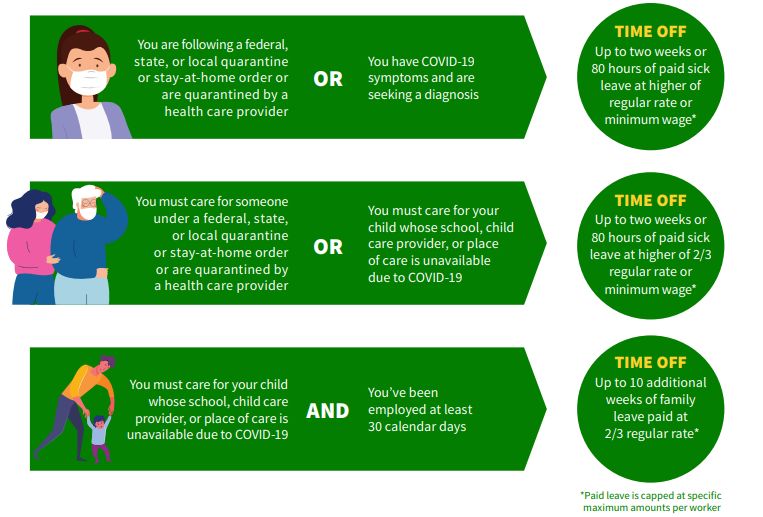
Cal/OSHA COVID Emergency Standards
• “High-risk exposure period” means:
(1) For persons with COVID symptoms, from two days before they first
    develop symptoms until 10 days after symptoms first appeared, and
    24 hours have passed with no fever, without the use of fever-
    reducing medications, and symptoms have improved; or
(2) For persons who test positive but have no symptoms (i.e.
    asymptomatic), from two days before until ten days after the
    specimen for their first positive test for COVID-19 was collected.

• “Exposed workplace” means any work location, working area, or
  common area at work used or accessed by a COVID-19 “case” during
  the high-risk period, including bathrooms, walkways, hallways, aisles,
  break or eating areas, and waiting areas. The exposed workplace does
  not include buildings or facilities not entered by a COVID-19 case.

Add a footer                                                               4
Employer-Provided Transportation
• Prioritize shared transportation assignments
• Ensure employees waiting for transportation shall be separated by 6 feet,
  provided face coverings and ensure they are worn (when indoors or outdoors
  and less than 6 feet apart).
• Ensure that employees inside the vehicle are at least 3 feet of separation in all
  directions between operator and passengers.
• Any passengers and operators are provided and wear a face covering in the
  vehicle.
    • This is a heightened standard requiring the employer provide and require
      face coverings in the vehicle whereas in the housing unit, the employer is
      only mandated to provide face coverings.
• Screen and exclude drivers and riders with COVID symptoms prior to boarding
  shared transportation.

Add a footer                                                                          5
Employer-Provided Transportation

• Already in practice:
    • Disinfect and clean all high contact surfaces before each trip and between
      different drivers and provide sanitizing materials for cleaning such high
      contact surfaces.

       • Provide and maintain an adequate supply of hand sanitizers in each
         vehicle and ensure all drivers and passengers sanitize before entering and
         exiting vehicle. Employers must note hand sanitizers with methyl alcohol
         are prohibited.

Add a footer                                                                      6
Employer-Provided Housing
• Prioritize shared housing unit assignments.
• Ensure at least six feet of distancing in housing and common areas.
• Bunk beds shall not be used.
• Provide face coverings to all residents with information on when they should
be used in accordance with state or local health orders.
• Already in practice:
• Encourage residents to report COVID-19 symptoms;
• Disinfect and clean at least once daily;
• Ensure that dishes and utensils are not shared;
• Isolate COVID exposed residents from others; Isolate COVID cases from all
other non-COVID residents by providing them a separate bathroom,
sleeping area, and eating/cooking facility.
Add a footer 7Multiple Outbreak Protocol
• The Company must activate this Protocol when either:
• The workplace has been identified by a local health department as the
location of a COVID-19 outbreak, or
• Three (3) or more COVID-19 “cases” in an “exposed workplace” occur
within a 14-day period.
• Remember, on those key terms:
• COVID-19 “case” (1) Has a positive COVID-19 test, (2) Is subject to a
COVID-19-related order to isolate issued by a local or state health official,
or (3) Has died due to COVID-19
• “Exposed workplace” includes any work location, working area, or
common area at work used or accessed by a COVID-19 “case” during the
high-risk period, including bathrooms, walkways, hallways, aisles, break
or eating areas, and waiting areas.
Add a footer 8Multiple Outbreak Protocol
If either of the activating events occur, the Company must take the following
Protocol steps:
• Immediately test all employees at the exposed workplace and again after one
week. Employees who remain at the workplace must be provided continuous
testing at least once a week. All testing shall be provided at no cost to
employees during work hours.
• Exclude any and all exposed employees from the workplace.
• Investigate the workplace to determine possible contributing factors to the
outbreak and perform any changes to COVID policies, procedures, and
controls. This investigation shall be updated every thirty days that the
outbreak continues or in response to new information.
• If the second activating event occurs on or after November 30th, the Company
must also contact the local health department within 48 hours and provide
total number of COVID cases with details of each case.
This Protocol applies from the time of the activating event until no new COVID-
19 positive cases arise within a 14-day period.
Add a footer 9Major Outbreak Protocol
• The Company must activate this Protocol when:
• Twenty (20) or more COVID-19 “cases” in an “exposed workplace”
occur within a 30-day period.
Add a footer 10Major Outbreak Protocol
• If the activating event of a Major Outbreak occurs on or after
November 30th, the Company must take the following Protocol steps:
• Exclude positive cases and exposures from workplace.
• Investigate workplace to determine possible contributing factors to
the outbreak and perform any changes to COVID policies,
procedures, and controls.
• Contact the local health department within 48 hours after knowing
of three or more cases and provide total number of COVID cases
with details of each case.
This Protocol applies from the time of the activating event until no new
Add a footer
COVID-19 positive cases arise within a 14-day period. 11Major Outbreak Protocol (Cont’d)
Additional Requirements for Major Outbreaks:
1. Testing
• Provide testing, at least twice a week or more if recommended by the local
health department, to employees present at the exposed workplace during
the relevant 30-day period and who remain at the workplace. All testing shall
be provided e at no cost to the employees.
• This testing requirement is more frequent at twice weekly than the
Multiple Outbreak Protocol (once weekly)
2. Hazard Investigation and Correction
• Ensure that buildings with mechanical ventilation have filtered recirculated air
with Minimum Efficiency Reporting Value (MERV) 13 or higher efficiency
filters if compatible with ventilation system. If incompatible, then the highest
filtering efficiency.
• Determine the need for a respiratory protection program.
• Evaluate whether to halt some or all operations until all COVID hazards have
been corrected. This Protocol applies from the time of the activating event
Adduntil
a footerno new COVID-19 positive cases arise within a 14-day period. 12Exclusion from the Workplace Wages During Exclusion Period • Employees who are excluded from work under the COVID-19 Infections and Outbreaks Protocols must maintain their earnings, seniority, and all other employee rights and benefits, including their right to their former job status. • Put simply, the Regulations mandate that the Company pay for this time when employees are excluded from the worksite and provides no cap on the amount of earnings that must be continued if employees are excluded from work. • While the Company can and should continue to designate and compensate employees under the California COVID Supplemental Paid Sick Leave law, the Company needs to also be compliant with continued earnings and benefits under these Cal/OSHA Emergency COVID-19 Regulations. Add a footer 13
Exclusion from the Workplace (Cont’d)

Wages During Exclusion Period
• This requirement to continue earnings and benefits has two narrow
  exceptions:
    • Where the Employee is unable to work for reasons unrelated to possible
       COVID-19 transmission, or

     • The Company demonstrates that the COVID-19 exposure was not work
       related.

• Given recent enforcement trends, we would urge the Company to consider
  these exceptions on a case-by-case basis only in conjunction with counsel.

Add a footer                                                                   14
Return to Work
Return to Work for COVID cases
• There are two (2) “buckets” of Standards
for infected employees:
• Asymptomatic “bucket” are COVID cases who tested positive but never
developed COVID-19 symptoms.
• Asymptomatic COVID cases can return to work after a minimum of 10
days have passed since the test date of their first positive COVID-19 test.
• Symptomatic “bucket” are COVID cases who test positive and develop
symptoms.
• Symptomatic COVID cases can return to work when:
1. At least 24 hours have passed since the employee suffered a fever
of 100.4 or higher (without using medications),
2. Other COVID symptoms have improved, AND
Add a footer 3. At least 10 days have passed since the test date of their first 15
positive COVID-19 test.Return to Work
Return to Work for COVID exposures
• Employees with COVID-19 exposure may return to the workplace 10 days
after the last known COVID-19 exposure.
• CDPH Guidance (12/14/20): All asymptomatic close contacts (within 6
feet of an infected person for a cumulative total of 15 minutes or more
over a 24-hour period) may discontinue quarantine after Day 10 from the
date of last exposure with or without testing.
• Executive Order N-84-20 (12/14/20): Adopts CDPH Guidance as official
change to Cal/OSHA Emergency Standards.
• Employers may not require a negative COVID-19 test for an employee to
return to work.
Add a footer 16The 3 “R”s – Recordkeeping, FR
Recording and Reporting
• Recordkeeping: The Emergency COVID-19 Regulations require
the Company track all COVID-19 cases with
• The employee’s name, contact information, occupation, location
where the employee worked, the date of the last day at the
workplace, and the date of a positive COVID-19 test.
• Because other overlapping laws require that medical information be
kept separate from the personnel file and confidential, we would
recommend that the Company maintain a separate running log of the
information listed above.
Add a footer 17The 3 “R”s – Recordkeeping, FR
Recording and Reporting
• Recording: The Company must record COVID-19 illness or fatality
on the Log 300 when:
• Fatality or illness – i.e. days away from work, restricted work or
transfer to another job, medical treatment beyond first aid, or
loss of consciousness AND
• Work-related – i.e. event or exposure in the workplace caused
or contributed to fatality or illness.
• Log 300 recording must be done within seven (7) calendar days
after you receive information about a recordable event.
• Log 300A Summary must be posted through April 30 of the
following year.
• Log 300 Records should be kept in-house for three (3) years.
18The 3 “R”s – Recordkeeping, FR
Recording and Reporting
• Reporting: The Company must “immediately” report to Cal/OSHA any
serious injury or illness, or death, of an employee occurring in a place of
employment or in connection with any employment.
• Fatality or “Serious injury or illness” – i.e. requires inpatient
hospitalization, employee suffers an amputation, the loss of an eye, or
permanent disfigurement AND
• “Immediately” reporting means as soon as practically possible but not
longer than 8 hours after the employer knows or with diligent inquiry
would have known of the death or serious injury or illness. Reporting
does not require that the serious injury or illness be work-related.
• Q: Is a COVID-positive case a “serious injury or illness”? Not automatically!
The case must require inpatient hospitalization or other category of injury
to report.
Add a footer 19Navigating the Maze of Applicable Leave In The COVID Pandemic
Families First
Coronavirus
Response Act Americans With
(FFCRA) Disabilities Act (ADA)
State Leave—PSL—
EPSL—State Agency
Interplay
20Families First Coronavirus Response Act (FFCRA)
• Enforced by the USDOL.
• In the private sector—applies to employers with fewer than 500
employees.
• Extra leave through December 31, 2020—will it be continued?? Open
question!
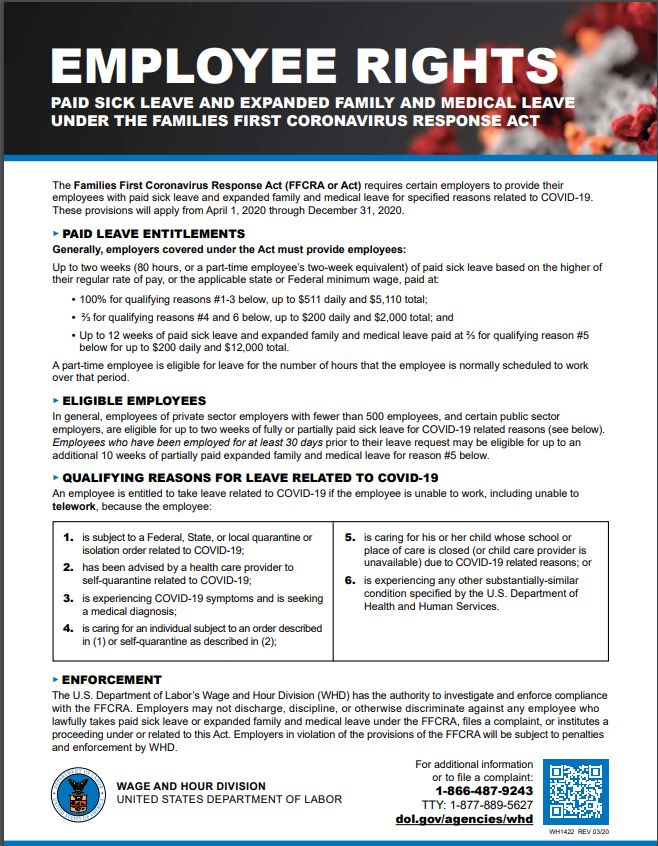
21Families First Coronavirus Response Act (FFCRA)
• Two buckets of leave:
• BUCKET 1: FFCRA Emergency Paid Sick Leave: Two weeks (ESPLA) (up to
80 hours) of paid sick leave at the employee’s regular rate of pay where
the employee is quarantined and/or experiencing COVID-19 symptoms
and seeking a medical diagnosis or caring for a child (for employee, up to
$511/day and $5,110 in total, for family care, 2/3 regular rate, not to
exceed $200/day and $2,000 in total);
• BUCKET 2: FFCRA Emergency Family and Medical Leave Expansion Act
(EFMLEA): Up to an additional TEN weeks of paid expanded family and
medical leave at 2/3 the employee’s regular rate of pay when the
employee is unable to work due to a bona fide need to care for a child
whose school or child care provider is closed or unavailable due to COVID-
19. (if employee has been employed for at least 30 calendar days) (up to
$10,000.00 total.)
22EFMLEA Leave Interaction With FMLA
Emergency Family Paid Family and Medical Leave Expansion Act
(EFMLEA): EFMLEA is a new leave reason under the FMLA—NOT more
leave.
• There is only one qualifying reason for leave under the EFMLEA:
Employee leave to care for his or her child whose school or childcare
provider is closed or unavailable for reasons related to COVID-19.
• An employee who already used 12 weeks of leave under the FMLA is
not eligible to use EFMLA leave.
23Families First Coronavirus Response Act (FFCRA)
24Required Posters:
• Poster must be
“conspicuously
posted”—put it with
your other postings.
• Ideas to post:
• Employer
website;
• Direct mailed to
employees—stuff
in their paycheck;
• E-mail to
employees.
25Does Your State Have Additional COVID-19 Leave?
• California enacted COVID-19 Supplemental Paid Sick Leave for employers
with over 500 employees—filling the gap left by the FFCRA.
• Originally just for food sector workers—now expanded to non-food sector
workers unable to work for any of the following reasons:
(1) They are subject to a Federal, State, or local quarantine or
isolation order related to COVID-19;
(2) They are advised by a health care provider to self-quarantine
or self-isolate due to concerns related to COVID-19; or
(3) They are prohibited from working by the hiring entity due to
health concerns related to the potential transmission of COVID-
19. 26The Americans With Disabilities Act (“ADA”) Can leave be an accommodation for people with a disability under the ADA? • Yes. • The ADA prohibits discrimination against people with disability. • Under the ADA, reasonable accommodations are adjustments or modifications provided by an employer to enable people with disabilities to enjoy equal employment opportunities. • If a reasonable accommodation is needed and requested by an individual with a disability to apply for a job, perform a job, or enjoy benefits and privileges of employment, the employer must provide it unless it would pose an undue hardship, meaning significant difficulty or expense. Add a footer 27
Employer Leave Best Practices Checklist
• How long has the employee been working?
• What is the purpose of the leave?
• Did you document the leave request?
• Did you designate the leave [FMLA/PSL]?
• Do you need to engage in the interactive process before the employee can
  return to work?
• Is it safe within CDC guidelines for the employee to return to work?
• Am I required to communicate information to my other employees about
  testing?
      • Making sure not to communicate an employee’s private medical
        information.
• In my area, am I required to report to the local health department or
  another regulatory agency?
Add a footer                                                                 28
Overlap with AB 685
• Emergency COVID-19 Regulations mandate the Company give notice of
a potential COVID-19 exposure within one business day to all employees
and independent contractors and other employers present at the
workplace.
• In contrast, AB 685 mandates notice to all employees and “employers of
subcontracted employees.”
• Put simply, the Emergency COVID-19 Regulations mandate the Company
disclose a potential exposure to other individuals not included in AB
685.
29California Workers’ Compensation for COVID-19
Timeline
• May 6, 2020: Governor Newsom enacted Executive Order N-62-20,
creating a COVID-19 workers’ compensation coverage.
• July 5, 2020: Executive Order N-62-20 expired.
• September 17, 2020: SB 1159 was enacted into law, taking
immediate effect and is set to expire on January 1, 2023.
30California Workers’ Compensation for COVID-19
Overview:
• SB 1159 creates a rebuttable presumption that an employee who
tested positive for COVID-19 was affect at the workplace. This
presumption implements a complicated outbreak analysis in
determining if an employer is subjected to it.
• If the employer has 100 employee or few – four employees
test positive for COVID-19 within 14 calendar days.
• If the employer has more than 100 employees – 4 percent of
the number of employees test positive for COVID-19 within 14
calendar days.
• The place of employment is ordered closed by public
authorities due to a risk of infection with COVID-19.
31California Workers’ Compensation for COVID-19
Overview Cont.
• SB 1159 also requires employers, who know or reasonably should know that
an employee has tested positive for COVID-19, to report – within three
business days – specific information to their worker’s compensation carrier.
Such information includes:
• An employee who has tested positive.
• The date that the employee tests positive.
• The specific address of the employee’s place of employment during
the 14 days period preceding the positive test.
• The highest number of employees who reported to work in the 45
day period preceding the last day the employee worked at the
place of employment.
32California Workers’ Compensation for COVID-19
Employers’ Obligations:
• Employers should make sure they are properly following state and local
health guidelines regarding COVID-19.
• Employers should make sure to properly record all employee information
in case they need to report it to their workers’ compensation carrier.
• Once an employer is aware that an employee has tested positive for
COVID-19, the employer must report this information to its workers’
compensation carrier.
• Depending on the employers size, the employer should be aware that
they may need to provide workers’ compensation to affected employees.
• In order to rebut the presumption made under SB 1159, employers should
have evidence of any measure they have taken to reduce potential
transmission of COVID-19 in the workplace. 33Questions?
Copyright Notice and Disclaimer: This PowerPoint presentation was created by The Saqui Law Group P.C.,
and is ©2020. All rights reserved. The information contained in this PowerPoint presentation is provided
solely for the general interest of clients and friends of The Saqui Law Group. This information should not
be relied upon or construed as legal advice and is not a substitute for obtaining legal advice from an
attorney licensed in your state. We assume no liability or responsibility for any errors or omissions in the
content of this PowerPoint presentation. The use of our PowerPoint presentation is not intended to and
does not establish an attorney-client relationship. Please do not send us confidential information via e-
mail without first obtaining permission to do so from one of our attorneys.
Questions regarding this Roseville Office:
PowerPoint presentation 1410 Rocky Ridge Drive
may be sent to Suite 330
administrator@ Roseville, CA 95661
laborcounselors.com or
Te l : ( 9 1 6 ) 7 8 2 - 8 5 5 5
Client Services at
(916)782-8555
www.laborcounselors.com Fax: (916) 782-8565You can also read


