Campaign Advertising by Australian Government Departments and Agencies - May 2013
←
→
Page content transcription
If your browser does not render page correctly, please read the page content below
Campaign Advertising by Australian
Government Departments and Agencies
May 2013

Half Year Report
1 July to 31 December 2012

                     GOVERNANCE AND RESOURCE MANAGEMENT GROUP
Campaign Advertising by Australian
Government Departments and Agencies
May 2013
Half Year Report
1 July to 31 December 2012
GOVERNANCE AND RESOURCE MANAGEMENT GROUPDepartment of Finance and Deregulation
Governance and Resource Management Group
ISSN 1838-4501 (Print)
ISSN 1838-451X (Online)
Copyright Notice
Content
This work is copyright and owned by the Commonwealth of Australia.
With the exception of the Commonwealth Coat of Arms, this work is licensed under a Creative Commons Attribution
3.0 Australia licence (CC BY 3.0) (http://creativecommons.org/licenses/by/3.0/au/deed.en)
This work must be attributed as: “Commonwealth of Australia, Department of Finance and Deregulation, Governance
and Resource Management Group, “Campaign Advertising by Australian Government Agencies – Half Year Report 1 July
to 31 December 2012 (May 2013)”.
Use of the Coat of Arms
The terms under which the Coat of Arms can be used are detailed on the following website:
http://www.itsanhonour.gov.au/coat-arms/
Contact us
Inquiries regarding the licence and any use of this work are welcome at:
Governance and Resource Management Group
Department of Finance and Deregulation
John Gorton Building, King Edward Terrace, Parkes ACT 2600
Email: governmentadvertising@finance.gov.au
iiForeword
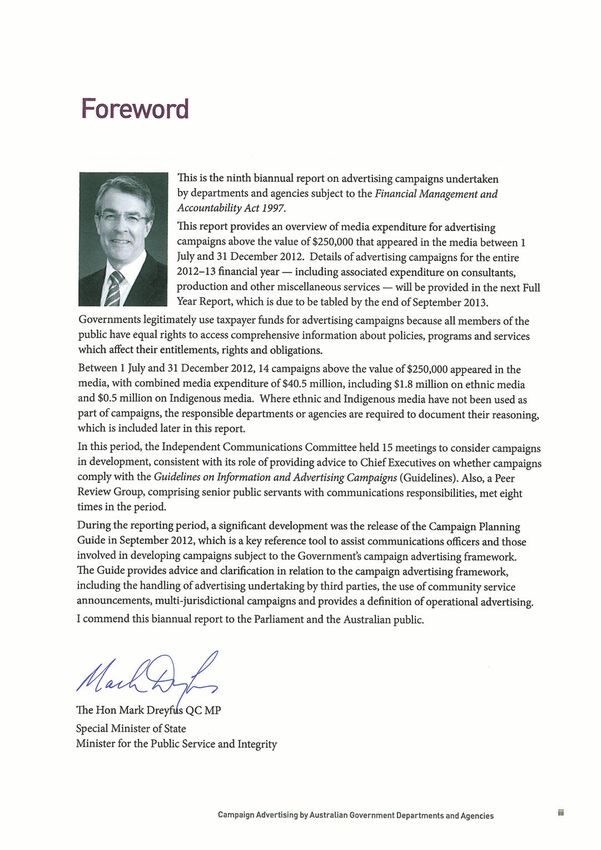
This is the ninth biannual report on advertising campaigns undertaken
by departments and agencies subject to the Financial Management and
Accountability Act 1997.
This report provides an overview of media expenditure for advertising
campaigns above the value of $250,000 that appeared in the media between
1 July and 31 December 2012. Details of advertising campaigns for the entire
2012–13 financial year — including associated expenditure on consultants,
production and other miscellaneous services — will be provided in the next Full
Year Report, which is due to be tabled by the end of September 2013.
Governments legitimately use taxpayer funds for advertising campaigns because all members of the
public have equal rights to access comprehensive information about policies, programs and services
which affect their entitlements, rights and obligations.
Between 1 July and 31 December 2012, 14 campaigns above the value of $250,000 appeared in the
media, with combined media expenditure of $40.5 million, including $1.8 million on ethnic media
and $0.5 million on Indigenous media. Where ethnic and Indigenous media have not been used as
part of campaigns, the responsible departments or agencies are required to document their reasoning,
which is included later in this report.
In this period, the Independent Communications Committee held 15 meetings to consider campaigns
in development, consistent with its role of providing advice to Chief Executives on whether campaigns
comply with the Guidelines on Information and Advertising Campaigns (Guidelines). Also, a Peer
Review Group, comprising senior public servants with communications responsibilities, met eight
times in the period.
During the reporting period, a significant development was the release of the Campaign Planning
Guide in September 2012, which is a key reference tool to assist communications officers and those
involved in developing campaigns subject to the Government’s campaign advertising framework.
The Guide provides advice and clarification in relation to the campaign advertising framework,
including the handling of advertising undertaking by third parties, the use of community service
announcements, multi-jurisdictional campaigns and provides a definition of operational advertising.
I commend this biannual report to the Parliament and the Australian public.
The Hon Mark Dreyfus QC MP
Special Minister of State
Minister for the Public Service and Integrity
iiiContents
Forewordiii
About the Biannual Reports on Campaign Advertising
by Australian Government Departments and Agencies vi
Chapter 1: The Campaign Advertising Framework 2
Guidelines on Information and Advertising Campaigns
by Australian Government Departments and Agencies 2
Roles of Key Stakeholders 2
Ministers2
Agencies Undertaking Advertising Campaigns 3
Department of Finance and Deregulation 3
Independent Communications Committee 4
Peer Review Group 4
Central Advertising System 5
Communications Multi-Use List 5
Process for the Development and Launch of Campaigns 6
Chapter 2: A
ustralian Government Campaign Expenditure
from 1 July to 31 December 2012 8
Advertising Campaign Summaries 10
Australian Customs and Border Protection Service:
Duty Free Tobacco Concessions 10
Australian Electoral Commission: Count Me In 10
Australian National Preventive Health Agency: National Tobacco 10
Australian Securities and Investment Commission: Money Smart 11
Department of Broadband, Communications and the Digital Economy:
Digital Switchover 11
Department of Broadband, Communications and the Digital Economy:
National Broadband Network - Metropolitan 11
Department of Defence: Defence Force Recruiting 12
Department of Families, Housing, Community Services
and Indigenous Affairs: Dad and Partner Pay 12
ivDepartment of Families, Housing, Community Services
and Indigenous Affairs: Household Assistance Package 12
Department of Families, Housing, Community Services
and Indigenous Affairs: Schoolkids Bonus 13
Department of Foreign Affairs and Trade: Smartraveller (Phase 3) 13
Department of Health and Ageing: National Tobacco – More Targeted Approach 13
Department of Health and Ageing: Tobacco Plain Packaging 14
Department of Innovation, Industry, Science, Research
and Tertiary Education: Clean Technology Program 14
Chapter 3: Historical Series of Australian Government
Campaign Advertising Expenditure 16
Appendix A: Guidelines on Information and Advertising Campaigns by Australian
Government Departments and Agencies (March 2010)
Appendix B: Overview of the Campaign Advertising Review
and Approval Process 30
vAbout the Biannual Reports on
Campaign Advertising by Australian
Government Departments and Agencies
The Special Minister of State reports to the Australian Parliament on a biannual basis
on the expenditure of government advertising campaigns. The reports focus on
campaigns undertaken by Financial Management and Accountability Act 1997 (FMA Act)
departments and agencies (agencies) for which expenditure is greater than $250,000.
This Half Year Report covers the period from 1 July to 31 December 2012 and reports on
14 advertising campaigns which ran during the period, based on data sourced from the
Central Advertising System.
For each campaign, a short description and breakdown of expenditure by advertising
medium are provided. Expenditure on ethnic and Indigenous media is also separately
reported. Where campaigns did not use ethnic and/or Indigenous media, the reasons
from the responsible departments and agencies are provided in Chapter 2 of this report.
Under the campaign reporting framework, Full Year Reports are issued annually, which
cover a full financial year and provide data on both direct media placement expenditure
and associated indirect campaign advertising expenditure, such as market research and
advertising production costs. The next Full Year report is scheduled to be tabled by the
end of September 2013.
viChapter 1: The Campaign Advertising Framework
Chapter 1: The Campaign
    Advertising Framework

    Guidelines on Information and Advertising Campaigns by
    Australian Government Departments and Agencies
    The Guidelines on Information and Advertising Campaigns by Australian Government
    Departments and Agencies (Guidelines) are central to the campaign advertising
    framework and were published in March 2010, and subsequently re-issued in March
    2011 to reflect changes in Ministerial responsibilities.
    The Guidelines contain five principles for Government advertising and information
    campaigns, including the need for campaigns to be properly targeted, free from
    political content, relevant to Government responsibilities, and conducted with due
    regard to efficiency, effectiveness and accountability. All agencies subject to the
    FMA Act are required to comply with the Guidelines.
    The Guidelines are available at Appendix A and on the Department of Finance and
    Deregulation website: www.finance.gov.au/advertising.

    Roles of Key Stakeholders

    Ministers
    Ministers of agencies which are undertaking a campaign have responsibility
    for authorising the campaign’s development, consistent with normal financial
    management processes, and for authorising the launch of a campaign. While
    Ministers do not have responsibility for campaign development, they have a
    legitimate interest in the development of campaigns in their portfolios.
    Under the Guidelines, the Special Minister of State has the discretion to exempt
    a campaign from compliance with the Guidelines on the basis of a national
    emergency, extreme urgency or other compelling reason. Where exemptions
    are agreed, the relevant Minister, the Chair of the Independent Communications
    Committee and the Parliament are informed. No exemptions were agreed during
    the reporting period.

2
Agencies Undertaking Advertising Campaigns
Chief Executives are responsible for certifying that any advertising campaigns
developed within their agencies comply with the Guidelines and related
Government policies.
Agencies may also request assistance from the Department of Finance and
Deregulation (Finance) on matters of campaign procurement, including the
development of shortlists of specialist communications consultants (such as market
researchers, advertising and public relations suppliers) and associated tender
processes for consultants.
Agencies must also provide accurate information and documentation to the
Independent Communications Committee (ICC), which provides independent
reviews of compliance with the Guidelines, and the Peer Review Group
(PRG), which provides agencies with advice on their campaign proposals and
documentation, with the objective of maximising the strategic integrity and
effectiveness of campaigns.
Department of Finance and Deregulation
The Communications Advice Branch (CAB) in Finance provides policy advice,
whole-of-government coordination and assistance to agencies conducting
advertising activities. CAB’s functions include, but are not limited to:
• providing policy advice related to the framework for information and advertising
campaigns and associated processes to the Special Minister of State;
• advising on whether information and advertising activities fall within scope of
the Guidelines
• managing the Communications Multi-Use List (CMUL);
• as requested, assisting agencies with advice on formative and evaluative research,
campaign proposals, communications strategies and associated briefs and
shortlists for communications suppliers from the CMUL;
• providing advice on campaign advertising, including indicative costs for
campaign elements;
• providing secretariat services to the PRG and the ICC;
• providing advice to the ICC about campaigns under development;
• assisting with the management of the whole-of-government contracts for media
buying and placement as part of the Central Advertising System (CAS); and
• coordinating the biannual reports on campaign expenditure.
3Independent Communications Committee
The ICC was established in March 2010. During the reporting period, the ICC was
chaired by Dr Allan Hawke AC and its other members were Ms Helen Williams AO
and Ms Anthea Tinney PSM. The ICC provides its independent views and advice
to the Secretary or Chief Executive of agencies conducting or proposing to conduct
advertising campaigns where expenditure is expected to be over $250,000.The ICC
can consider campaigns at any stage of development, although generally considers
them at the following stages:
• when a communications strategy has been developed
• when a creative concept has been selected and refined, but prior to campaign
material going into production, and
• when creative materials have been finalised, but prior to the campaign launching
in the media.
The ICC has a degree of reliance on expert advice, including from Finance as well as
advice from the agencies proposing to conduct campaigns. However, Finance does
not advise the ICC on compliance with the Guidelines. The ICC’s consideration
of compliance draws upon a review of campaign materials, supporting materials
provided by the responsible agency, any associated market research or supporting
evidence, and any other information or independent expert advice available.
The Committee is also responsible for:
• overseeing the operation of the Guidelines to ensure compliance with their
integrity and spirit
• providing a public assessment of proposed campaigns and their compliance with
Principles 1 to 4 of the Guidelines
• reporting to responsible Ministers on activities undertaken under the Guidelines,
as necessary, including any trends and emerging issues, and
• considering and proposing to responsible Ministers any revisions to the
Guidelines as necessary in light of experience.
Review reports issued by the ICC can be found at www.finance.gov.au/advertising.
Peer Review Group
The PRG is chaired by the Department of the Prime Minister and Cabinet and co-
chaired by Finance. The PRG involves a revolving membership of Senior Executive
Service (SES) communications officers from FMA Act agencies with responsibility
for campaign development and/or external communication activities. The PRG
may also seek advice from a range of external experts with experience in marketing,
communications and advertising.
The PRG provides advice to agencies on their campaigns, with the objective of
maximising the strategic integrity and effectiveness of communication activities and,
in doing so, aims to build the professional capability of government communicators.
The PRG is intended to be the means by which the proposed communications
activities of FMA Act agencies can be tested against the experience, knowledge and
insights of other SES level communications officers across government.
4Agencies are required to submit campaigns to the PRG when they have developed
their communications strategy and may return to the PRG at later stages of
campaign development or implementation. The PRG does not consider whether
proposed campaigns comply, or are likely to comply, with the Guidelines. This role
is performed by the ICC.
Central Advertising System
All campaign and non-campaign advertising by FMA Act agencies must be placed
through the Central Advertising System (CAS), which consolidates government
advertising expenditure and optimises media discounts through whole-of-
government negotiated media rates.
Finance operates the CAS and manages the contracts of two media agencies which
assist in media planning, placement and rates negotiations with media outlets.
Universal McCann handles all campaign media planning and placement, and
Adcorp Australia places all non-campaign advertisements, such as job vacancies,
tenders and public notices.
In addition to FMA Act agencies, certain other bodies may use the CAS and access
the rates, terms and conditions that the Commonwealth has negotiated. These
organisations are:
• agencies covered by the Commonwealth Authorities and Companies Act 1997
(CAC Act)
• the Northern Territory and Australian Capital Territory governments
• Commonwealth statutory authorities and government business enterprises, and
• organisations provided with Australian Government funding for advertising or
communications purposes.
Communications Multi-Use List
The Communications Multi-Use List (CMUL) is a continuously open, whole-of-
government list of specialist communications suppliers interested in tendering
for work associated with Australian Government advertising and information
campaigns.
5FMA Act agencies must use the CMUL when developing and implementing
advertising and information campaigns valued at $250,000 or more. The CMUL
began operating on 31 March 2009 and contains five categories of communications
expertise:
• advertising;
• market and social research;
• public relations;
• communicating with Indigenous Australians; and
• communicating with people from non-English speaking backgrounds.
The names of the potential suppliers that have been assessed as satisfying the
conditions for inclusion on the CMUL are available on AusTender (www.tenders.
gov.au/cmul).
Process for the Development and Launch of Campaigns
The basic steps involved in the development and launch of advertising campaigns
with expenditure of $250,000 or more are:
• the Minister of the relevant agency agrees to the development of a campaign,
subject to funds being available;
• the agency informs Finance of their intention to develop a campaign;
• Finance can, if requested, assist the agency in the selection of specialist
communications suppliers (such as advertising or market and social research
agencies);
• the agency develops the campaign, which is reviewed at different stages by the
ICC and the PRG;
• once a proposed campaign is at the final stage, the ICC provides a report on the
campaign’s compliance with Principles 1 to 4 of the Guidelines to the responsible
Chief Executive;
• agency Chief Executives are responsible for certifying that the campaign fully
complies with the Guidelines, taking into account the advice from the ICC
and advice from their agency in respect to Principle 5 (legal and procurement
matters); and
• the responsible Minister may launch or approve the launch of the campaign after
receiving the Chief Executive’s certification of compliance with the Guidelines.
Finance, the ICC and the PRG interact with the responsible agency throughout the
development of campaigns. In addition, relevant Ministers are usually briefed by
their portfolio agency throughout the campaign development process.
An overview diagram of the typical campaign activity review and approval process is
provided at Appendix B.
6Chapter 2: Australian Government
Campaign Expenditure from
1 July to 31 December 2012Chapter 2: Australian Government
Campaign Expenditure from 1 July to
31 December 2012
This chapter provides a range of information on individual advertising campaigns
above the value of $250,000. For each campaign, a short description and breakdown
of expenditure by medium are provided.
Table 1 provides information on campaign media expenditure, broken down by
media types (i.e. television, press, radio, etc). Total expenditure on Indigenous and
ethnic media placement is reported separately.
As set out in Table 1, during the reporting period, a total of $40.5 million was spent
on all campaign advertising media, including $1.8 million on ethnic media and
$0.5 million on Indigenous media.
8Table 1: Advertising campaigns from 1 July to 31 December 2012
Expenditure
Campaign Advertising Media Expenditure
($ million)
Agency Campaign
Out of
TV Press Radio Magazines Digital Other TOTAL Ethnic Indigenous
Home
Australian Customs and Border Duty Free Tobacco Concessions — 0.4 — 0.3 0.1 0.1 — 0.9 0.1 —
Protection Service
Australian Electoral Count Me In — — 0.0 — 0.2 — — 0.2 0.0 0.0
Commission
Australian National Preventive National Tobacco 3.0 0.3 0.4 0.1 0.9 0.5 — 5.3 — —
Health Agency
Australian Securities and MoneySmart — — — — 0.4 — — 0.4 — —
Investment Commission
Broadband, Communications Digital Switchover 0.7 0.4 0.1 — 0.1 — — 1.2 0.0 0.0
and the Digital Economy
National Broadband Network - 4.8 0.9 0.9 0.0 1.6 — 0.8 9.0 0.3 0.0
Metropolitan
Defence Defence Force Recruiting 4.2 0.1 1.6 0.2 1.9 — 0.4 8.5 — —
Families, Housing, Dad and Partner Pay — 0.0 — — 0.1 — — 0.1 0.0 —
Community Services and Household Assistance Package 4.2 1.2 1.2 0.3 1.0 — 0.2 8.2 0.6 0.2
Indigenous Affairs Schoolkids Bonus — — — — 0.6 — — 0.6 — —
Foreign Affairs and Trade Smartraveller (Phase 3) 0.8 0.0 0.0 0.1 0.3 0.3 — 1.5 0.1 —
Health and Ageing National Tobacco - More 0.9 0.8 0.4 0.1 0.5 0.2 0.0 2.9 0.5 0.1
Targeted Approach
Tobacco Plain Packaging — 0.6 — — 0.1 — — 0.7 0.0 —
Innovation, Industry, Science, Clean Technology Program — — — 0.0 0.0 — — 0.0 — —
Research and Tertiary
Education
– Other media expenditure 0.0 0.3 0.2 0.1 0.4 0.0 0.0 1.1 0.1 0.1
including activity less than
$250,000
TOTAL 18.6 4.9 4.9 1.2 8.3 1.1 1.5 40.5 1.8 0.5
Source: Central Advertising System Notes: Figures are rounded to one decimal place. Discrepancies in tables between totals and sums of components are due to rounding.
All figures are gross media spend (exclusive of GST).
‘—’ indicates no media was placed in this medium.
‘0.0’ denotes media was placed in this medium, though less than $50,000 was spent.
9
.Advertising Campaign Summaries
Australian Customs and Border Protection Service: Duty Free Tobacco Concessions
Customs and Border Protection commenced an awareness campaign in June 2012
to educate international travellers about the reduced tobacco duty-free limit that was
announced in the 2012-13 Budget.
The campaign objectives were to inform travellers and crew about the reduced
incoming tobacco duty-free threshold; generate compliance with the new duty-free
threshold for tobacco products; and educate travellers and crew about the procedures
in place for managing the duty payable on excess duty-free tobacco. During the
period, $0.9 million was spent on media placement
Agency exception reporting: Customs and Border Protection had a limited budget
($1.5m) allocated for advertising the changes to the tobacco duty-free concession for
travellers arriving in Australia. Indigenous Australians were not identified as a key
target audience arriving in Australia with tobacco products. Customs and Border
Protection relied on advertising advice from Universal McCann to maximise reach
with the recommended advertising media channels. As Indigenous Australians were
not a key target audience, Indigenous advertising was not suggested in the media plan.
All travellers departing Australia, regardless of nationality, were provided with a flyer
in English outlining the reduced tobacco duty-free concession for arrival in Australia.
Australian Electoral Commission: Count Me In
The Count Me In campaign used a postcard mailed to every household. The purpose
was to reach all Australians – including those that may have been missed in other
AEC mailings – to encourage people to enrol or update their enrolment details. The
mail out was supported by an online advertising campaign, public relations activities
and social media. This campaign was exempt from review by the Independent
Communications Committee. During the period, $0.2 million was spent on media
placement
Australian National Preventive Health Agency: National Tobacco
The National Partnership Agreement on Preventive Health National Tobacco
Campaign aims to contribute to a reduction in the prevalence of the adult daily
smoking by promoting quit attempts among smokers and motivation and support to
avoid relapse among recent quitters. During the period, $5.3 million was spent on
media placement.
10Agency exception reporting: The Australian Government funds two complementary
national tobacco cessation campaigns to contribute to a reduction in the prevalence
of the adult daily smoking to 10 per cent or less by 2018. The Australian National
Preventive Health Agency (ANPHA) is responsible for the mainstream National
Tobacco Campaign, which did not use ethnic media in this period. A campaign that
specifically targets this audience was conducted by the Department of Health and
Ageing. ANPHA continuously monitors campaign activity and works collaboratively
with the Department to plan and adjust for national audience needs.
Australian Securities and Investment Commission: Money Smart
The campaign’s over-riding objective was to drive traffic to the Australian Securities
and Investment Commission’s MoneySmart website, which was launched in March
2011. Specifically, the campaign seeks to achieve stronger MoneySmart brand
awareness and motivate consumers and investors to visit the MoneySmart website.
During the period, $0.4 million was spent on media placement
Agency exception reporting: ASIC didn’t use Indigenous or ethnic media as part
of the campaign during the reporting period. This aspect of the campaign will be
conducted in the period January to June 2013.
Department of Broadband, Communications and the Digital Economy:
Digital Switchover
The Australian Government has announced a region-by-region switchover from
analog to digital television in Australia which is expected to be completed by
10 December 2013. In support of this policy a long-term, phased communication
campaign launched in April 2009. The aim of the Digital Switchover campaign is to
ensure a smooth transition to digital free-to-air television by informing Australians
about digital switchover, necessary preparations and sources for further information.
During the period, $1.2 million was spent on media placement.
Department of Broadband, Communications and the Digital Economy:
National Broadband Network - Metropolitan
The Australian Government established NBN Co to build and operate a National
Broadband Network (NBN) to provide access to affordable, high-speed broadband
to 100 per cent of Australian homes and businesses. To support this policy, a
communication campaign aimed at metropolitan Australia was launched in
November 2012. The aim of the campaign was to inform the public about the NBN
initiative, to aid in understanding the cost, type and quality of service of the NBN and
to provide information on the value of broadband to individual Australians, society
and the economy. During the period, $9 million was spent on media placement.
11Department of Defence: Defence Force Recruiting
This is an ongoing campaign to correct common misperceptions about the Service
brands and generate enquiries to fill almost 7,400 Officer and General Entry
positions in the Navy, Army and Air Force. While the advertising aims to reach
older candidates and influencers, the key target audience is 16–24 year old males and
females nationally. During the period, $8.5 million was spent on media placement.
Agency exception reporting: Defence Force Recruiting (DFR) is a national
advertiser with reach into regional and local communities through local radio,
newspapers, social media and other channels. While Defence actively encourages
diversity in its workforce, good English written and oral skills are essential. Our
primary target audience is 16–24 year old Australians, and the media consumption
habits of multicultural and Indigenous youths mirror those of mainstream. Should
DFR develop a campaign specifically targeting parents and family members,
multicultural media will be included in the media mix. Defence maintains a very
strong presence on the ground in Indigenous communities, specifically enlisting
young Indigenous people in courses that may prepare them for the Defence
recruiting process or other employment opportunities.
Department of Families, Housing, Community Services and Indigenous Affairs:
Dad and Partner Pay
The Dad and Partner Pay (DaPP) campaign was developed to support the
introduction of the new entitlement for working fathers and partners. Eligible
working dads and partners who are caring for a child born or adopted after
1 January 2013 will be entitled to two weeks of DaPP at the National Minimum
Wage. The campaign aims to increase awareness and understanding of DaPP as a
new entitlement under the existing Paid Parental Leave (PPL) scheme, including the
rights and responsibilities of target audiences. During the period, $0.1 million was
spent on media placement.
Agency exception reporting: An initial small burst of advertising (mainstream
online and print only) commenced from 30 September 2012 to support first claims
(1 October 2012). The remaining, larger advertising boost – including radio, print,
online, Culturally and Linguistically Diverse (CALD) and Indigenous commenced
from 6 January 2013 to support the implementation start date of DAPP (1 January
2013). CALD and Indigenous public relations activity (including stakeholder
re-engagement and editorial) commenced from 1 October 2012.
Department of Families, Housing, Community Services and Indigenous Affairs:
Household Assistance Package
The Household Assistance Package (HAP) campaign is driven from the Clean Energy
Future Plan. Low to middle income households will receive assistance through the
HAP. The objective of the campaign is to increase awareness and understanding of
the payments, tax cuts and entitlements amongst those who will benefit. During the
period, $8.2 million was spent on media placement.
12Department of Families, Housing, Community Services and Indigenous Affairs:
Schoolkids Bonus
The Schoolkids Bonus is a new payment to assist families and individuals with
primary and secondary education expenses. It commenced in 2012-13 and replaced
the Education Tax Refund, which was previously claimed though an individual’s tax
return. The aim of the campaign is to increase awareness that the Schoolkids Bonus
has replaced the Education Tax Refund and to inform the target audiences of their
rights and responsibilities. During the period, $0.6 million was spent on media
placement.
Agency exception reporting: Informational online advertising commenced on
25 November 2012 to alert parents to check with Centrelink that their and their
children’s education details were correct in order to receive the Schoolkids Bonus.
This included search engine optimisation, which appropriately targeted Indigenous
and Culturally and Linguistically Diverse (CALD) audiences. The remaining, larger
boost – including television, radio, print, online, CALD and Indigenous advertising
– commenced 6 January 2013 to coincide with the delivery of the first payment.
Department of Foreign Affairs and Trade: Smartraveller (Phase 3)
The Smartraveller campaign is a key policy instrument for the Australian
Government to promote the security and welfare of Australians travelling overseas.
The campaign aims to assist Australians to make well informed decisions about
travelling overseas by encouraging them to register their travel plans with the
Department of Foreign Affairs and Trade (DFAT), to read and subscribe to DFAT’s
travel advice, and to take out appropriate travel insurance. During the period,
$1.5 million was spent on media placement.
Agency exception reporting: Smartraveller campaign advertising is aimed at all
Australians aged 18 and over who travel overseas. Smartraveller Phase II evaluation
and Phase III exploratory research did not identify the need for specific Indigenous
communications. Tracking research is also showing the current campaign is
effectively reaching Indigenous audiences. However, the need for specific targeting
of Indigenous media is kept under review.
Department of Health and Ageing: National Tobacco – More Targeted Approach
The National Tobacco – More Targeted Approach campaign complements the
mainstream tobacco campaign by engaging with high-need and hard to reach
audiences, including highly socially disadvantaged groups such as people in low
socio-economic areas, people from culturally and linguistically diverse communities,
and pregnant women and their partners. Aboriginal and Torres Strait Islander
audiences were targeted through the use of national Indigenous-specific media,
including television, press and radio. During the period, $2.9 million was spent on
media placement.
13Department of Health and Ageing: Tobacco Plain Packaging
The Tobacco Plain Packaging campaign aimed to inform manufacturers, retailers
and wholesalers of tobacco products, including importers of tobacco products, of
their responsibilities and obligations under the Tobacco Plain Packaging Act 2011
and related regulations, and that non-compliance may result in significant criminal
or civil penalties. During the period, $0.7 million was spent on media placement.
Exception reporting: The campaign did not specifically target Aboriginal and
Torres Strait Islander people, or utilise Indigenous media because retailers and other
suppliers of tobacco products are predominantly non-Indigenous. However retailers
and suppliers of tobacco products from Aboriginal and Torres Strait Islander
backgrounds received information through mainstream channels.
Department of Innovation, Industry, Science, Research and Tertiary Education:
Clean Technology Program
The $1.2 billion Clean Technology Program provides incentives for business
to reduce emissions and invest in clean energy, as well as develop new clean
technologies and services. Campaign advertising aims to raise awareness of
the program among eligible businesses within the Australian industry and
manufacturing communities. During the period, $0.0 million was spent on
media placement.
Agency exception reporting: Campaign advertising for the Clean Technology
Innovation Program was postponed on 30 August 2012 pending the outcome of a
Government-wide review on grants programs. During September 2012, advertising
ran in five industry magazines that had gone to print prior to the postponement of
the campaign. Campaign advertising was resumed in February 2013 and included
a component of advertising in culturally and linguistically diverse press. Campaign
materials were provided to the Enterprise Connect Remote Enterprise Centre in
Alice Springs and the Indigenous Engagement Adviser and Resources Technology
Innovation Centre in Mackay.
14Chapter 3: Historical Series of Campaign Advertising Expenditure
Chapter 3: Historical Series of
     Australian Government Campaign
     Advertising Expenditure

     The table below details campaign advertising media expenditure by FMA Act
     agencies from January 2004 to December 2012 on half year, calendar year and
     financial year bases. This information is only available from January 2004, as dif-
     ferent information was recorded prior to that time.

     Table 2: Campaign Advertising Media Expenditure
     —January 2004 to December 2012

      Period                          Biannual        Calendar Year        Financial Year
                                     ($ million)         ($ million)           ($ million)
                     2012                                      111.9
      Jul-Dec 2012                         40.5
                  2011-12                                                           139.7
      Jan-Jun 2012                         71.4
                     2011                                      148.7
      Jul–Dec 2011                         68.4
                  2010–11                                                           116.9
      Jan–Jun 2011                         80.3
                     2010                                      112.8
      Jul–Dec 2010                         36.6
                  2009–10                                                           114.7
      Jan–Jun 2010                         76.2
                     2009                                      115.3
      Jul–Dec 2009                         38.5
                  2008–09                                                           130.1
      Jan–Jun 2009                         76.9
                     2008                                       86.6

16
Period Biannual Calendar Year Financial Year
($ million) ($ million) ($ million)
Jul–Dec 2008 53.2
2007–08 185.3
Jan–Jun 2008 33.4
2007 254.0
Jul–Dec 2007 151.9
2006–07 170.1
Jan–Jun 2007 102.1
2006 116.5
Jul–Dec 2006 68.0
2005–06 120.5
Jan–Jun 2006 48.5
2005 116.5
Jul–Dec 2005 72.0
2004–05 70.6
Jan–Jun 2005 44.5
2004 78.8
Jul–Dec 2004 26.1
Jan–Jun 2004 52.7
Notes: Figures are rounded to one decimal place. Discrepancies are due to rounding.
Expenditure for the 2004 calendar year differs between Table 2, which only includes expenditure by FMA Act
agencies, and Table 3, which also includes expenditure by bodies subject to the Commonwealth Authorities and
Companies Act 1997 and Territory Governments.
Source: Central Advertising System
17The two figures below depict campaign advertising media expenditure by FMA Act
agencies from January 2004 to December 2012 on calendar year and financial year
bases. This information is only available from January 2004, as different information
was recorded prior to that time.
Figure 1: Campaign advertising media expenditure by FMA Act agencies
by calendar year: 2004 to 2012 ($m)
Notes: Figures are rounded to one decimal place.
Source: Central Advertising System
Figure 2: Campaign advertising media expenditure by FMA Act agencies by financial
year: 2004–05 to 2011–12 ($m)
Notes: Figures are rounded to one decimal place.
Source: Central Advertising System
18The table below provides contains aggregate expenditure through the CAS between
1994 and 2004. Information on expenditure before 2004 available is only available
at an aggregated level, encompassing expenditure by FMA Act agencies, CAC Act
bodies and Territory Governments. The data is available on calendar and financial
year bases.
Table 3: Central Advertising System Campaign Advertising Media Expenditure
—July 1994 to December 2004
Calendar Year Financial Year
($ million) ($ million)
2004 94.4 2003–04 97.8
2003 63.9 2002–03 51.8
2002 60.4 2001–02 83.9
2001 117.3 2000–01 133.2
2000 177.6 1999–00 186.8
1999 91.4 1998–99 54.0
1998 57.6 1997–98 55.1
1997 50.3 1996–97 29.4
1996 36.1 1995–96 47.6
1995 54.9 1994–95 43.1
Notes: Figures are rounded to one decimal place.
Expenditure for the 2004 calendar year differs between Table 2, which only includes expenditure by FMA Act
agencies, and Table 3, which also includes expenditure by bodies subject to the Commonwealth Authorities and
Companies Act 1997 and Territory Governments.
Source: Central Advertising System
1920
Appendix A: Guidelines on Information
and Advertising Campaigns by Australian
 Government Departments and Agencies
                          (March 2010)
Appendix A: Guidelines on Information
and Advertising Campaigns by
Australian Government Departments
and Agencies (March 2010)
The Guidelines were amended in March 2011 to reflect changes in
Ministerial responsibilities.
Introduction
1. This document in its entirety forms the Guidelines on Information and Advertising
Campaigns by Australian Government Departments and Agencies (Guidelines).
2. These Guidelines set out the principles applying to information and advertising
campaigns undertaken in Australia.
3. Agencies subject to the Financial Management and Accountability Act 1997 (FMA
Act) must comply with these Guidelines.
4. Agencies conducting information and advertising campaigns must comply with
all relevant policies and processes issued and amended from time to time by the
Special Minister of State or the Minister for Finance and Deregulation or the
agency responsible for such policies, currently the Department of Finance and
Deregulation (Finance).
5. The Special Minister of State can exempt a campaign from compliance with
these Guidelines on the basis of a national emergency, extreme urgency or
other compelling reason. Where an exemption is approved, the Independent
Communications Committee will be informed of the exemption, and the decision
will be formally recorded and reported to the Parliament.
6. The Independent Communications Committee considers campaigns and
provides advice to Chief Executives on all advertising campaigns valued at more
than $250,000 or where requested to do so by the Chief Executive.
22Underlying Principles
7. In general terms, a campaign is a planned series of communication activities that
share common objectives, target the same audience and have specific timelines
and a dedicated budget. An advertising campaign includes paid media placement
and an information campaign does not.
8. The underlying principles governing the use of public funds for all government
information and advertising campaigns are that:
a. members of the public have equal rights to access comprehensive information
about government policies, programs and services which affect their entitlements,
rights and obligations;
b. governments may legitimately use public funds to explain government policies,
programs or services, to inform members of the public of their obligations, rights
and entitlements, to encourage informed consideration of issues or to change
behaviour; and
c. government campaigns must not be conducted for party political purposes.
Definition of Advertising Campaigns
9. For the purposes of these Guidelines, an advertising campaign involves paid
media placement and is designed to inform, educate, motivate or change
behaviour. Large-scale recruitment advertising not related to specific job
vacancies and with a degree of creative content may be considered an advertising
campaign. Agencies should seek advice from Finance if they are unsure whether
an activity is an advertising campaign.
10. Simple, informative advertising that generally appears only once or twice,
contains factual statements and typically has a low creative content is not an
advertising campaign. This category of advertising is non-campaign advertising
and includes, but is not limited to:
• recruitment for specific job vacancies;
• auction and tender notices;
• invitations to make submissions or apply for grants;
• notification of date and/or location specific information (for example,
notification of a public meeting at a particular time and place); and
• other public notices.
23Campaign Review and Certification
11. The requirements for review and certification of campaigns are determined by the
value of the campaign and whether advertising will be undertaken. The value of
a campaign is the budget for all campaign elements across all financial years and
includes:
• market or social research consultants, public relations consultants,
advertising agencies and/or other specialist consultants commissioned in
the development of advertising material;
• production and placement of advertising in print, radio, digital, cinema,
television or out-of-home media; and
• production and dissemination of other campaign materials.
12. The value of a campaign does not include departmental staff and associated costs.
13. For campaigns below $250,000, the Chief Executive has the discretion to seek
consideration of campaigns by the Independent Communications Committee.
14. For advertising campaigns of $250,000 or more:
• The Independent Communications Committee will consider the proposed
campaign and provide a report to the Chief Executive on compliance with
Principles 1, 2, 3 and 4 of the Guidelines. Agencies will be responsible for
providing a report to their Chief Executive on campaign compliance with
Principle 5 of the Guidelines.
• Following consideration of the reports on campaign compliance, the Chief
Executive will certify that the campaign complies with the Guidelines and
relevant government policies.
• The Chief Executive will give the certification to the relevant Minister who
may launch the campaign or approve its launch.
• The Chief Executive’s certification will be published on the relevant
department’s web site when the campaign is launched.
• The conclusions of the Independent Communications Committee will be
published on Finance’s web site after the campaign is launched.
15. Information campaigns of $250,000 or more are not subject to review by the
Independent Communications Committee or certification by the Chief Executive
but must comply with these Guidelines and other relevant policies and processes
as outlined in clause 4.
16. The Government will provide reports to the Parliament that detail expenditure on
all advertising campaigns with expenditure in excess of $250,000 commissioned
by FMA Act agencies.
2417. Chief Executives will ensure that:
• research reports for advertising campaigns with expenditure of $250,000
or more are published on their agency’s web site following the launch of a
campaign where it is appropriate to do so; and
• details of advertising campaigns undertaken will be published in agency
annual reports.
Information and Advertising Campaign Principles
The following five principles set out the context in which Australian Government
campaigns should be conducted. They relate to when campaigns can be conducted,
how campaign materials should be presented, and the legal and procurement
responsibilities that need to be considered.
Principle 1: Campaigns should be relevant to
government responsibilities
18. The subject matter of campaigns should be directly related to the Government’s
responsibilities. As such, only policies or programs underpinned by:
• legislative authority; or
• appropriation of the Parliament; or
• a Cabinet Decision which is intended to be implemented during the
current Parliament should be the subject of a campaign.
19. Examples of suitable uses for government campaigns include to:
• inform the public of new, existing or proposed government policies, or
policy revisions;
• provide information on government programs or services or revisions to
programs or services to which the public are entitled;
• inform consideration of issues;
• disseminate scientific, medical or health and safety information; or
• provide information on the performance of government to facilitate
accountability to the public.
25Principle 2: Campaign materials should be presented in an
objective, fair and accessible manner and be designed to meet the
objectives of the campaign
20. Campaign materials should enable the recipients of the information to distinguish
between facts, comment, opinion and analysis.
21. Where information is presented as a fact, it should be accurate and verifiable.
When making a factual comparison, the material should not attempt to mislead
the recipient about the situation with which the comparison is made and it should
state explicitly the basis for the comparison.
22. Pre-existing policies, products, services and activities should not be presented as
new.
23. Special attention should be paid to communicating with any disadvantaged
individuals or groups identified as being within the target audience. Particular
attention should be paid to the communication needs of young people, the rural
community and those for whom English is not a convenient language in which to
receive information.
24. Imagery used in campaign materials should reflect the diverse range of
Australians. There should be recognition of the full participation of women,
Indigenous and culturally and linguistically diverse communities by realistically
portraying their interests, lifestyles and contributions to Australian society.
25. Campaign materials should be tested with target audiences to indicate they are
engaging and perform well against the objectives of the campaign.
Principle 3: Campaign materials should be objective and not
directed at promoting party political interests
26. Campaign materials must be presented in objective language and be free of
political argument.
27. Campaign materials must not try to foster a positive impression of a particular
political party or promote party political interests.
2628. Campaign materials must not:
a. mention the party in Government by name;
b. directly attack or scorn the views, policies or actions of others such as the policies
and opinions of opposition parties or groups;
c. include party political slogans or images;
d. be designed to influence public support for a political party, a candidate for
election, a Minister or a Member of Parliament; or
e. refer or link to the web sites of politicians or political parties.
Principle 4: Campaigns should be justified and undertaken in an
efficient, effective and relevant manner
29. Campaigns should only be instigated where a need is demonstrated, target
recipients are clearly identified and the campaign is informed by appropriate
research or evidence.
30. Campaign information should clearly and directly affect the interests of recipients.
31. The medium and volume of the advertising activities should be cost effective and
justifiable within the budget allocated to the campaign.
32. Distribution of unsolicited material should be carefully controlled.
33. Campaigns should be evaluated to determine effectiveness.
Principle 5: Campaigns must comply with legal requirements and
procurement policies and procedures
34. The manner of presentation and the delivery of campaigns must comply with all
relevant laws including:
a. laws with respect to broadcasting and media;
b. privacy laws;
c. intellectual property laws;
d. electoral laws;
e. trade practices and consumer protection laws; and
f. workplace relations laws.
35. Procurement policies and procedures for the tendering and commissioning of
services and the employment of consultants should be followed and there should
be a clear audit trail regarding decision making.
2728
Appendix B: Overview of the Campaign
 Activity Approval and Review Process
        for Departments and Agencies
Appendix B: Overview of the Campaign
Advertising Review and Approval Process
New campaign Strategy Consultant
Research
proposed development procurement
Funds are available Agency drafts Agency prepares Agency selects lists
for the campaign research brief campaign media brief of communications
activity and policy for master media suppliers from the
authority exists Agency selects list agency CMUL and conducts
of suppliers from the tender processes
Minister has given CMUL and conducts Master media agency (e.g. advertising,
approval tender process prepares media strategy PR and specialist
and plan NESB/Indigenous
Finance informed of Researcher appointed
proposed campaign and market research communications
Agency drafts
conducted consultants)
communication
strategy (informed by Tender process for
developmental research selection of market
and master media research supplier to
agency media strategy) undertake campaign
evaluation can also be
Agency drafts briefs
undertaken at this time
Notes: for communications
• This flowchart represents the key points of developing suppliers Agency evaluates
a typical advertising campaign, to the point of approval proposals and select
and launch. Some steps may occur concurrently or be consultants (advertising
repeated. All advertising campaigns undertaken by PRG reviews evaluation is informed
FMA Act Agencies above the value of $250,000 should communications by independent testing
go through the process. strategy and associated of creative concepts
• Campaign advertising activity above the value of research (usually before with the target
$250,000 is subject to review by the Independent ICC consideration) audience/s)
Communications Committee (ICC) and certification
by the relevant Chief Executive.
• The ICC reviews campaigns for compliance with the ICC reviews
Guidelines on Information and Advertising Campaigns by communications
Australian Government Departments and Agencies. strategy and associated
• The Peer Review Group (PRG) provides agencies with research/evidence,
advice on their campaign proposals and documentation, draft media plan and
with the objective of maximising the strategic integrity media strategy
and effectiveness of campaigns.
• Finance is responsible for the administration of the
Central Advertising System and the management of the
master media planning and placement agency contract
for campaign advertising. Finance provides advice and
a secretariat function to the ICC and is the secretariat
to the PRG.
• Agencies must use the Communications Multi-Use List
to source specialist communications suppliers to work
on campaigns with total budgets above $250,000.
30Advertising Campaign Campaign approval
refinement finalised and launch
Advertising materials Agency finalises Agency provides a report
refined and further campaign materials and to Chief Executive on
research undertaken media plan Principle 5
Agency, creative agency Pre-campaign Chief Executive considers
and master media benchmark research will ICC report on compliance,
agency - may review usually be undertaken Agency advice on
and refine media plan compliance with the
Guidelines, and considers
ICC considers final whether to certify the
PRG may consider campaign materials campaign
campaign at and provides a report Minister briefed, and may
pre-production stage to the Chief Executive launch or approve launch
(usually before ICC on compliance with of the campaign
consideration) Principles 1–4 of the
Guidelines Chief Executive certification
of compliance with the
ICC reviews campaign Guidelines posted on
advertising materials, Agency website when
including concept campaign launches in the
testing reports, before media
production begins
ICC review letter posted
on Finance website when
campaign is launched in
the media
31You can also read


