Canada Goose Nesting Season - Frequently Asked Questions March 2021 - Wildlife Rescue Association ...
←
→
Page content transcription
If your browser does not render page correctly, please read the page content below
Canada Goose
Nesting Season
Frequently Asked Questions
March 2021
Canada Geese nested on my building last
    year. Will they be back?
    Canada Geese mate for life and will return to the same location to
    nest year after year.
    Any approach to controlling geese nesting ideally should be in place
    before the nest building starts—or quickly thereafter—as it is much
    more difficult to discourage geese after they have become attached to
    a site. After nesting has started, moving or scaring geese off a nest is
    against the law. Canada Geese are protected under the Migratory Bird
    Convention Act and it is illegal to tamper with a nest, eggs or birds
    without a permit.

    Should I deter Canada Geese from nesting on
    my building?
    There is much to consider. The lack of available natural nesting sites
    means these birds have limited spaces to raise their young. Deterring
    them from your building may mean they choose an even less desirable
    location. However, in some cases, the rooftop may be dangerous for the
    goslings or it may be impossible to safely remove the family once the
    babies have hatched. If this is the case encouraging the family to choose
    another nesting site may be the best option.

WILDLIFE REHABILITATION AND PUBLIC EDUCATION                                    WILDLIFERESCUE.CA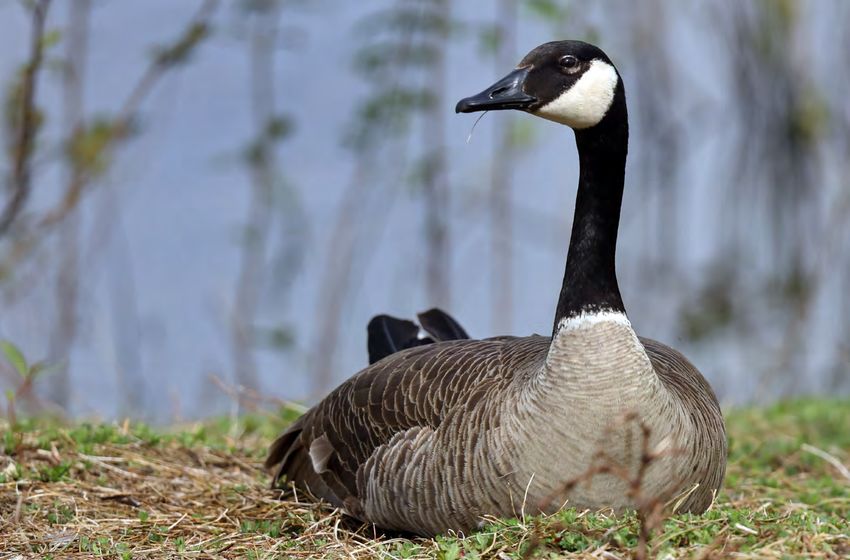
My rooftop is not an appropriate nesting site.
    How can I deter Canada Geese from nesting
    on my condo building/in my water feature
    before they lay eggs?
    Below is a list of deterrents that may help in diverting a goose pair to a
    more appropriate nest site. Please note that a combination of deterrents
    will typically be required to have success in diverting them to another
    nest site.

       • Shrubs and trees to change the levels of the landscape -
         geese prefer open areas for nesting so they can see predators
         approaching. A varied landscape does not give them this visual
         advantage.
       • Scare balloons/kites – mounted so they move in the wind. Give
         eyespots to emulate a predator. Place them in multiple locations
         and move them around from time to time.
       • Flagging/mylar tape/garbage bags attached to stakes, placed so
         they also move in the wind. The less predictable it is the more
         uncomfortable it makes nesting geese.
       • Ultrasonics - sounds that are uncomfortable for birds but do not
         impact humans/pets.
       • Lights that annoy geese, e.g. Away With Geese Roof Unit
       • Motion-activated sprinkler system, e.g. Contech ScareCrow
         Animal Deterrent
       • Inflatable scarecrows, e.g. AirCrow Blackbird Inflatable Scarecrow

WILDLIFE REHABILITATION AND PUBLIC EDUCATION                                     WILDLIFERESCUE.CA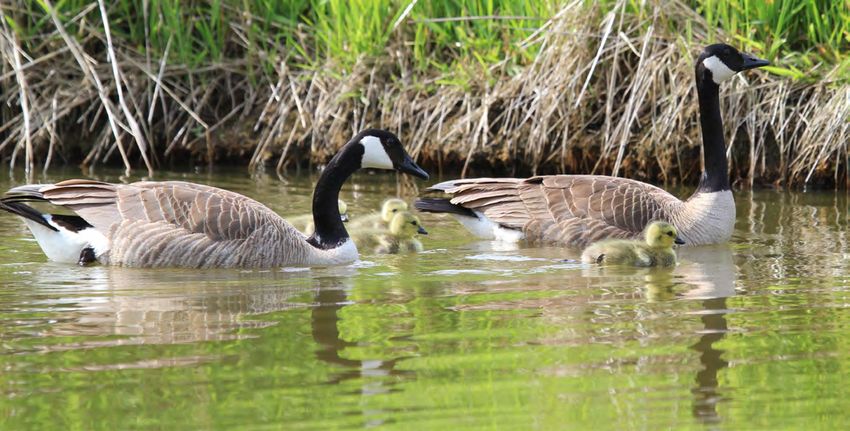
Why are Canada Geese nesting on my
    building?
    Human encroachment has led to a significant reduction in natural
    habitat for Canada Geese. These birds naturally nest on a slightly
    elevated area near water. They prefer sites where they have an
    unobstructed view so they can easily see approaching predators.
    The lack of available natural nesting sites has resulted in Canada Geese
    nesting on rooftops, even in busy urban environments. They typically
    still nest in the vicinity of water, though families may have to cross busy
    streets to get there. Green roofs have become particularly attractive to
    nesting Canada Geese.

WILDLIFE REHABILITATION AND PUBLIC EDUCATION                                      WILDLIFERESCUE.CA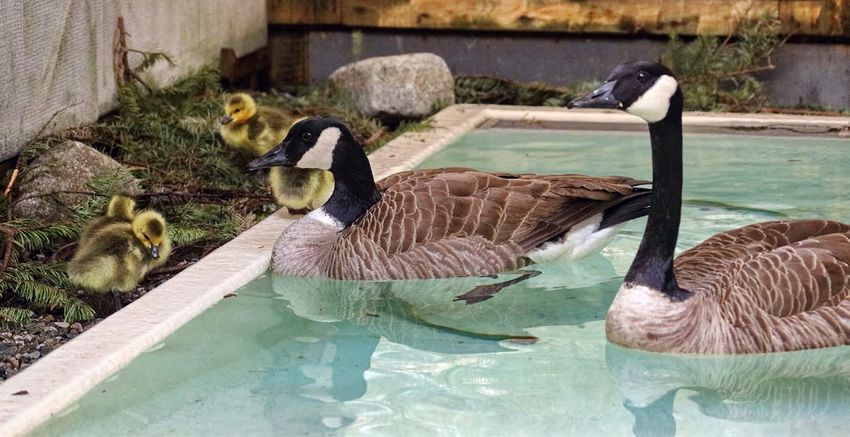
Where will the goslings go once they have
    hatched on my building?
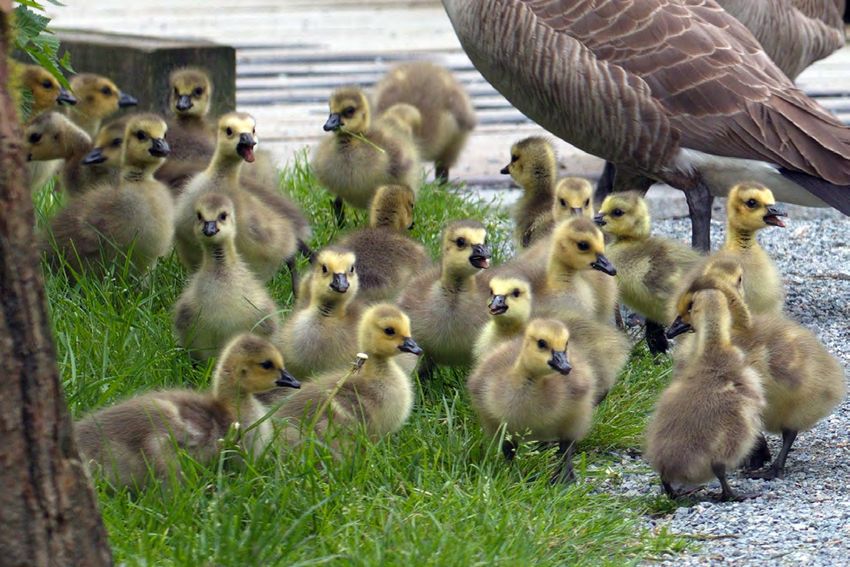
    Once all the eggs have hatched, the parents will attempt to lead the
    babies to water. This means the goslings may start jumping off the
    building to follow the parents. Goslings can usually safely jump as many
    as two storeys onto the pavement without injuring themselves and up
    to four storeys onto grass. They will then follow the parents to water.
    Along the way, they may need assistance to find a safe pathway. Never
    put yourself in danger, but if you are able to safely help them cross
    roadways by pushing pedestrian lights, etc this may assist them in safely
    reaching their destination.

    Why don’t the parents carry them down?
    Even if they wanted to, adult geese are unable to carry their goslings.
    Their beaks are not adapted to hold onto large, squirmy goslings.
    Instead, goslings instinctively follow their parents wherever they go.

WILDLIFE REHABILITATION AND PUBLIC EDUCATION                                    WILDLIFERESCUE.CA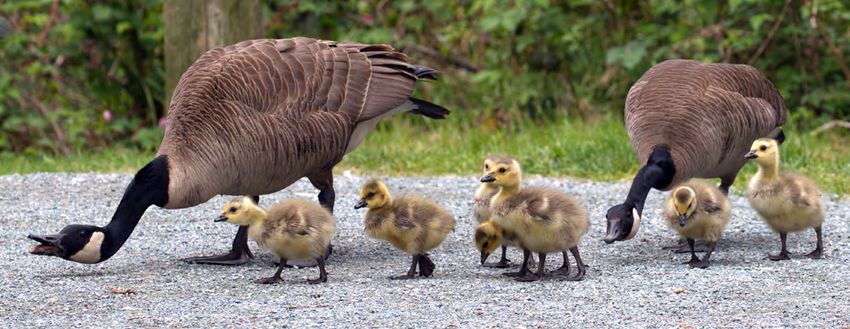
I have noticed goslings with no parents.
    What should I do?
    If there are no adult geese, that you can see or hear:
       1. Grab a box and gather the goslings one by one containing them in
          a deep enough box so they cannot jump out/escape.
       2. Wait in the area for as long as possible to see if mom or dad
          returns. Keep them peeping!
           a. If adults do not return, call our Helpline at 604-526-7275.
           b. If an adult goose returns (or both), let the goslings out of the
               box near the water, stand back and observe to make sure the
               parent(s) reunite.

WILDLIFE REHABILITATION AND PUBLIC EDUCATION                                     WILDLIFERESCUE.CA
There is a lone adult goose that doesn’t seem
to leave a particular area/intersection.
Can you put it with some other geese?
This is likely a gander that is standing by while its mate incubates its
eggs. Unless it is injured it is best to leave it where it is. Attempts to
capture an uninjured adult goose will be stressful for the goose and
unsuccessful for the rescuer! Uninjured geese will typically fly away to
escape capture.
Can I remove the Canada goose nest or eggs?
Canada Geese are protected under the migratory bird act. It is illegal
to disturb or remove a nest without a permit.
“Environment and Climate Change Canada-Canadian Wildlife Service
(EC-CWS)’s primary responsibility is the conservation of migratory
birds, which includes Canada Geese...
No migratory birds, their eggs or nests may be harmed without a permit.”
- Government of Canada
WILDLIFE REHABILITATION AND PUBLIC EDUCATION WILDLIFERESCUE.CANeed more help?
Call your local wildlife rehabilitator for assistance.
Wildlife Rescue Association of British Columbia
5216 Glencarin Drive, Burnaby, BC V5B 3C1
Support Centre: (604) 526-7275
info@wildliferescue.ca
If you are not located in the Lower Mainland, please contact your
nearest wildlife rehabilitator.
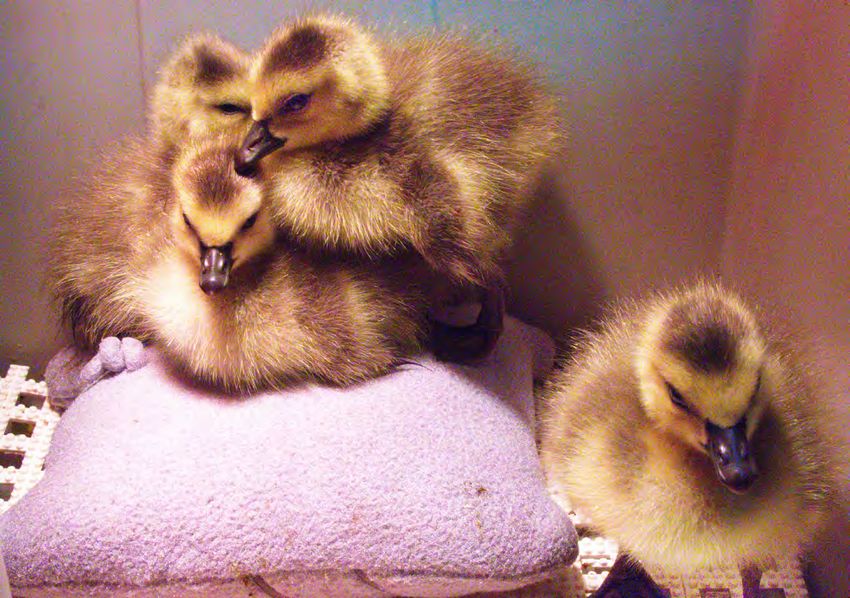
Goslings in care at Wildlife Rescue.
Follow along on social media:
wildliferescue wildliferescuebc WRAofBC
WILDLIFE REHABILITATION AND PUBLIC EDUCATION WILDLIFERESCUE.CAYou can also read


