Cellular Landscape and Network Evolution - Marco Stracuzzi Product Marketing - Telit
←
→
Page content transcription
If your browser does not render page correctly, please read the page content below
Telit IoT Roadshow 2019

Cellular Landscape and
Network Evolution
Marco Stracuzzi
Product Marketing
Cellular IoT around the world
Telit IoT Roadshow 2019

Global cellular IoT connections hit 1 billion in 2018
Source: Berg Insight, 2019

• The global number of cellular IoT subscribers increased by 70%
   during 2018 to reach 1.2 billion.

• Until 2023, it is forecasted to grow at a CAGR of 49.4%
   to reach 9 billion IoT devices connected to cellular networks.

• Growth was driven by exceptional adoption in China, 63% of the
global installed base.

       Confidential & Proprietary
       © 2019 Telit. All Rights Reserved.                                           3
Telit IoT Roadshow 2019
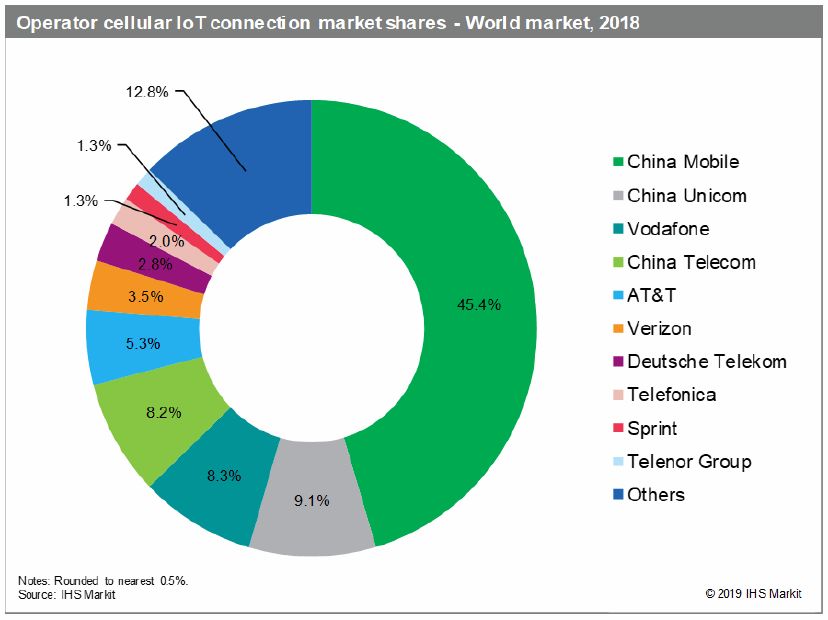
Mobile Operators cellular IoT connections market share
CHINA 60%+
Top 10 MNOs of WW
~ 90% connections
market share
AT&T 1st US
51M
connections
VF 1st EU
81M
connections
Confidential & Proprietary
© 2019 Telit. All Rights Reserved. 4Telit IoT Roadshow 2019
IoT connections for Mobile Operators
The number of IoT connections as a percentage of the total number of mobile connections
AT&T
from 1/4 to 1/3
during 2018
Source: Analysys Mason, 2019
Confidential & Proprietary
© 2019 Telit. All Rights Reserved. 5Legacy Networks Sunset and Technology Trends
Telit IoT Roadshow 2019

Europe
• Overall strategy:
  •   Maintain 2G – until 2025 *
  •   Shutdown 3G – e.g. Netherlands, UK, Norway, Sweden
  •   Evolve 4G
  •   Launch 5G

• * Exceptions (public information):
  • Swisscom: 2G sunset 2020, 3G sunset planned 2024
  • T-Mobile Netherlands: 2G sunset 2020

      Confidential & Proprietary
      © 2019 Telit. All Rights Reserved.                               7
Telit IoT Roadshow 2019
North America
• 2G (almost) over – only T-Mobile US left
• 3G sunsetting– Verizon: CDMA/EVDO 2020, AT&T: 2-2-22
Since 2G there have been 6 different cellular technologies
2G CDMA 3G LTE Cat 3 LTE Cat 1 LTE Cat M1 LTE NB IoT
GE910 CE910 HE910 LE910 LE910 ME910 NE910
Confidential & Proprietary
© 2019 Telit. All Rights Reserved. 8Telit IoT Roadshow 2019
Asia-Pacific
• Korea, Japan, Australia:
• Shutdown 2G
• Maintain 3G
• Evolve 4G
• Launch 5G
• China:
• Maintain 2G – big istalled base
• Deploy NB-IoT – government push
Confidential & Proprietary
© 2019 Telit. All Rights Reserved. 9Telit IoT Roadshow 2019
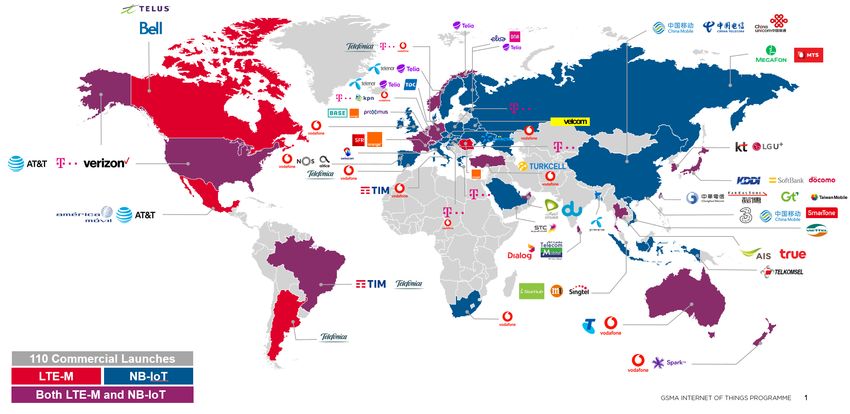
Mobile IoT global coverage
Source: GSMA Internet of Things Programme, April 2019
Confidential & Proprietary
© 2019 Telit. All Rights Reserved. 10Telit IoT Roadshow 2019
IoT Technology Trend
2G ~40%
2019 of tot. IoT 2020 2021 2022 2023 2024
(Counterpoint)
GSM|GPRS|EDGE 3G ~20% Europe and China only
of tot. IoT Full USA 2G Shutdown (TMUS)
(Counterpoint) Swisscom 2G Shutdown
3G|HSPA+ 3G / HSPA+
AT&T Netherlands AT&T / VF UK Scandinavia
No new 3G activations 3G Sunset 3G Sunset 3G Sunset
LTE Cat3/4 LTE-M &
NB-IoT
LTE Cat1 45% of tot.
IoT
LTE CatM1 (Ericsson)
VoLTE
NB-IoT
LTE Cat 18/20
5G eMBB
USA Big cities National coverage
EU
Confidential & Proprietary
© 2019 Telit. All Rights Reserved. 113GPP standards evolution
Telit IoT Roadshow 2019

        Technology evolution towards 5G MBB and pervasive IoT

              MOBILE BROADBAND

                                                                                     Rel 15 trials & launches     Rel 15 Nationwide rollouts

                                                                                        Rel 14
                                                                  Rel 13 launches
                                                                                      launches

3GPP
STANDARDS   Rel 12          Rel 13                   Rel 14                 Rel 15       Rel 16                   Rel 17 & onwards

              LICENSED LPWA
                                                          eMTC               FeMTC       eFeMTC                 Further eMTC enhancements
              Evolution to
               Mobile IoT
                                                          NBIoT             eNBIoT      FeNBIoT                 Further eMTC ehancements

                     Confidential & Proprietary
                     © 2019 Telit. All Rights Reserved.                                                                                                           13
Telit IoT Roadshow 2019
3GPP target was to provide 15 dB of coverage gain for LTE-
M with UE @ 23 dBm, compared to LTE Cat 1, and 20 dB for
Summary for LTE Cat 1, LTE-M and NB-IoT NBIoT.
Coverage is increased by simply operating in 180kHz
(NBIoT) or 1.08MHz (LTE-M) compared to 20MHz LTE
carrier bandwidth, yielding 20dB and 11.5dB improvement
respectively.
Cat 1 LTE-M NB-IoT
Rel 8 Rel 13 Rel 14 Rel 13 Rel 14
Deployment LTE bands LTE bands In-band & Guard-band LTE, standalone (GSM)
(in-band)
Coverage, MCL 140.7 dB MCL (2Rx) 155.7 dB MCL(a) 164 dB MCL for standalone (d)
160.7 dB MCL (b)
DL access scheme OFDMA, 15 kHz tone OFDMA, 15 KHz tone spacing OFDMA, 15 KHz tone spacing
spacing
DL modulations QPSK, 16 QAM, 2 Rx QPSK, 16QAM, 1 Rx QPSK, 1 Rx
UL access scheme SC-FDMA, 15 KHz tone SC-FDMA, 15 KHz tone spacing SC-FDMA, 15 KHz or 3,75 KHz tone spacing
spacing
UL modulations QPSK, 16QAM QPSK, 16 QAM Single Tone: π/4-QPSK, π/2-BPSK
Multi Tone: QPSK
Channel bandwidth 1.4-20 MHz 1.4 MHz 5 MHz 180 Khz (1 PRB)
(1.08MHz = 6 PRB)
Coverage N/A Mode A: zero-to-small rep. (0 to 5 dB) CE level 0,1,2
Enhancements Mode B: large rep. (10 to 15 dB) (level 2 correponds to 164dB MCL)
(a) CE Mode B, this is the simulation achieved using conservative receiver Noise Figures and 20 dBm Power Class UE (3GPP TR36.888)
(b) CE Mode B, this is the simulation achieved using less conservative receiver Noise Figures and 23 dBm Power Class UE (3GPP TR45.820)
(c) The common perception that NB-IoT offers 20 dB symmetrical link budget enhancement is not without a compromise. Max coupling loss (MCL) for in-band and guard-band modes is not symmetrical and much below the target 164dB.
Confidential & Proprietary
© 2019 Telit. All Rights Reserved. 14Telit IoT Roadshow 2019
Summary for LTE Cat 1, LTE-M and NB-IoT – cont’d
Cat 1 LTE-M NB-IoT
Rel 8 Rel 13 Rel 14 Rel 13 Rel 14
Duplex Mode FD-FDD & TDD FD & HD (type B), FDD & TDD HD (type B), FDD
DL antennas 2 1 1
Peak data rate (DL/UL) DL: 10 Mbps DL: 300 Kbps DL: 300 Kbps DL: 20 Kbps DL: 127 Kbps (2 HARQs)
UL: 5 Mbps UL: 375 Kbps in HD- UL: 1 Mbps (d) HD-FDD UL: 60 Kbps for multi- UL: 158.5 for multi-tone
FDD Cat M1 tone Cat NB2
(by spec: 1 Mbps / 1 Mbps if FD- Cat NB1
FDD)
DL 2.4 Mbps;
UL 2.5 Mbps (e) HD-
FDD Cat M2
Power saving I-DRX, C-DRX PSM, extended I-DRX, C-DRX PSM, extended I-DRX, C-DRX (longer timers)
Power class Class 3, 23 dBm Class 3, 23 dBm Class 3, 23 dBm Class 3, 23 dBm
Class 5, 20 dBm Class 5, 20 dBm Class 5, 20 dBm
Class 6, 14 dBm
Voice support Yes, VoLTE Yes, VoLTE No
Mobility Full mobility Limited to full mobility Enhanced mobility Cell reselection only
Latency Low-mid, due to higher Low-mid, due to higher bandwidth Mid-high
bandwidth (field perfomance: 80ms to 4s in CE Mode (field perfomance: 100ms to 10s in CE Mode)
(d) Half-duplex, increase UL TBS to 2984b from 1000b, HARQ’s from 8 to 10, & ACK bundling – max theoretical speed;
(e) Peak rate based on 4008b UL/DL TBS, 10 HARQ’s & ACK bundling – max theoretical speed
Confidential & Proprietary
© 2019 Telit. All Rights Reserved. 15Telit IoT Roadshow 2019
IoT Device Categorization with Sample Use Cases
Throughput
Cat-4
Video Surveillance
DL:~150Mbps UL:~50Mbps
VoLTE IoT Gateways
Full mobility & roaming
Cat-1 Low
DL:~10Mbps UL:~5Mbps Connected Alarm Panels To
Elevators Mid
VoLTE Telematics Latency
Full mobility & roaming
Cat-M1 Smart Watches
DL:~300Kbps UL:~375Kbps Connected Activity Trackers
Fleet Management Health Care
VoLTE* Personal/Pet
Full mobility, Partial roaming Trackers
Mid
Cat-NB1 Industrial To
Smart Meters Bicycle Sharing
DL:~20Kbps UL:~60Kbps Monitoring Smart Lighting High
No Voice Industrial Sensors Asset Tracking Latency
Static/Nomadic, Partial roaming Smart Parking
Up to 2/day Up to 1/hr; Up to 4/hr; Up to 10/hr; >240/day Transactions
Battery life: >10 24/day Battery 96/day Battery 240/day Battery Battery life: Up Battery life
years life: 3-5 years life: Months life: Days to 1 day
*Under development
Confidential & Proprietary
© 2019 Telit. All Rights Reserved. 16Market News
Telit IoT Roadshow 2019

AT&T, KPN, Orange and Swisscom activate LTE-M roaming
June 5, 2019
• AT&T, Orange, Swisscom and KPN activated LTE-M roaming across their
respective IoT networks, enabling connected devices to operate more
efficiently across Europe and North America.

• Swisscom deployed the technology across Switzerland, while Orange’s
LTE-M offering is available in France and Romania. KPN launched it in the
Netherlands and AT&T operates its network across the US and Mexico.

• By the end of 2020, industry body GSMA believes LTE-M will fully cover
Europe, and the companies said they expect to add more operators to the
roaming agreement “in the coming months”.

       Confidential & Proprietary
       © 2019 Telit. All Rights Reserved.                                              18
Telit IoT Roadshow 2019
AT&T and Vodafone NB-IoT Roaming across U.S. and Europe
October 23, 2019
• AT&T and Vodafone Business will open up access to their respective NB-
IoT networks to make it easier for customers to create massive IoT
deployments that work across the U.S. and parts of Europe.
• The inter-carrier roaming arrangement will include the country-wide NB-
IoT network for AT&T in the U.S. and the Vodafone networks in Spain,
Germany, Italy, UK and the Netherlands.
• It will be available to customers by the end of 2019.
Confidential & Proprietary
© 2019 Telit. All Rights Reserved. 19Telit IoT Roadshow 2019
Key takeways
• IoT continues to be a reliable source of growth over the next 5 years
• Hard to let 2G go in Europe, while 3G might disappear first
• North America and Asia-Pacific have already taken the move to 4G and 5G
• LTE Cat.1 is the lowest-tier, mature technology supporting Voice over LTE
• 3GPP standards are evolving in two directions: MBB and LPWA
• LTE-M and NB-IoT are an integral part of long-term 5G Massive IoT strategy
Confidential & Proprietary
© 2019 Telit. All Rights Reserved. 20Thank You! Marco Stracuzzi, Product Marketing Marco.Stracuzzi@telit.com Telit reserves all rights to this document and the information contained herein. Products, names, logos and designs described herein may in whole or in part be subject to intellectual property rights. The information contained herein is provided “as is.” No warranty of any kind, either express or implied, is made in relation to the accuracy, reliability, fitness for a particular purpose or content of this document. This document may be revised by Telit at any time. For most recent documents, please visit www.telit.com © 2019 Telit. All Rights Reserved.
You can also read


