CHARTER 2018 Combined Deaf Education Centres - Kelston Deaf Education Centre
←
→
Page content transcription
If your browser does not render page correctly, please read the page content below
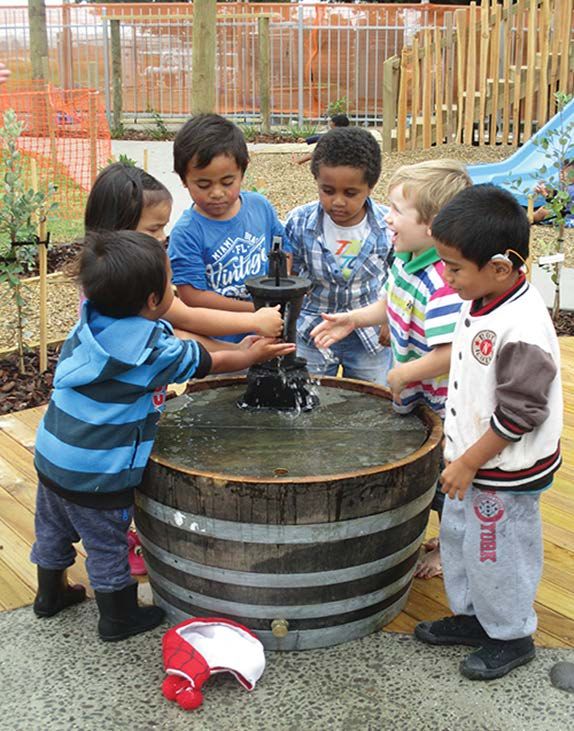
Combined Deaf Education Centres
       CHARTER 2018
Contents
Introductory Section ............................................................................................................................................... 1

Our Mission – Our Vision ........................................................................................................................................ 2

Resourcing .............................................................................................................................................................. 4

Our Services ............................................................................................................................................................ 5
  School ................................................................................................................................................................. 5
  Residential .......................................................................................................................................................... 6
  Regional Services ................................................................................................................................................ 7
  Resource and Technical ...................................................................................................................................... 8
  Early Childhood ................................................................................................................................................... 9
  Habilitation ....................................................................................................................................................... 10
  Priority Learners ............................................................................................................................................... 11

Strategic Plan 2018-2021 ...................................................................................................................................... 13

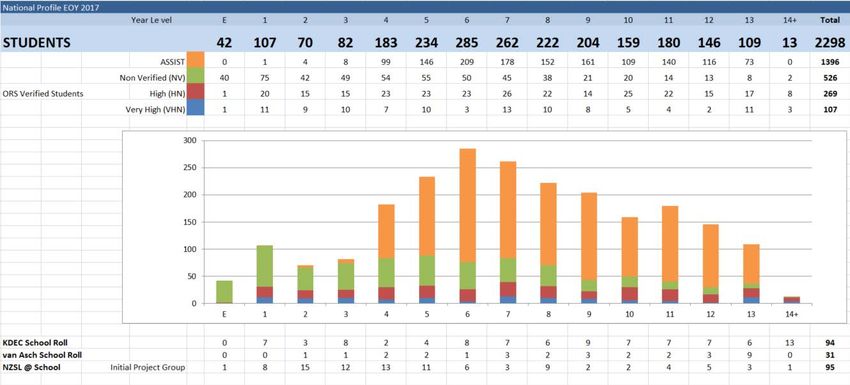
National Learner Profile........................................................................................................................................ 25
  KDEC Regional and School ................................................................................................................................ 27
  van Asch Regional and School .......................................................................................................................... 28

Annual Section ...................................................................................................................................................... 29
  Operating Context: ........................................................................................................................................... 29
  van Asch and Kelston Deaf Education Centres – Curriculum Annual Plan ....................................................... 30

Sector Co-operation ............................................................................................................................................. 31

Guiding Documents .............................................................................................................................................. 32

Appendix 1 – Exit Achievement Level and Destination – van Asch Deaf Education Centre ................................. 35

Appendix 1 – Exit Achievement Level and Destination – Kelston Deaf Education Centre ................................... 36

Appendix 2 – Analysis of Variance 2017 – van Asch Deaf Education Centre ........................................................ 39

Appendix 2 – Analysis of Variance 2017 – Kelston Deaf Education Centre .......................................................... 45

Glossary – Technical Terms .................................................................................................................................. 57

Learners ................................................................................................................................................................ 60
Introductory Section

Who are we?

A Community of learning around the child
                                             The provision of services for Deaf and hard of hearing (DHH)
                                             children in New Zealand is the responsibility of just two Centres.

                                             Kelston Deaf Education Centre (KDEC) provides services across the
                                             upper North Island including metropolitan Auckland while van Asch
                                             Deaf Education Centre (van Asch), covers the South Island and
                                             lower part of the North Island. Over 2000 DHH children throughout
                                             New Zealand are enrolled at or receive services from the Deaf
                                             Education Centres. Together we employ nearly 400 staff who are
                                             employed by the Combined Board of Trustees.

Both Centres were established as special schools and operate a core/day school and residential facility and
provide Early Childhood Services. They also offer a range of courses and services for parents/caregivers,
schools and other professionals.

Specialist outreach roles include

•   New Zealand Sign Language, (NZSL) Tutors

•   Specialist Resource Teachers

•   Habilitationists

Specialist service provisions including

•   Resource Teachers of the Deaf (RTDs)

•   Hearing Aid Technician/Audiology/ASSIST staff

•   Communicators/Educational Interpreters

•   Specialist Services Team KDEC Day School

Equal rights to primary and secondary education

Under the Education Act 1989, all children have the right to enrol at their local school:

“… people who have special educational needs (whether because of disability or otherwise) have the same
rights to enrol and receive education at State schools as people who do not”

Education Act 1989 s(8) (1)

Combined Board Charter 2018                                                                                 Page 1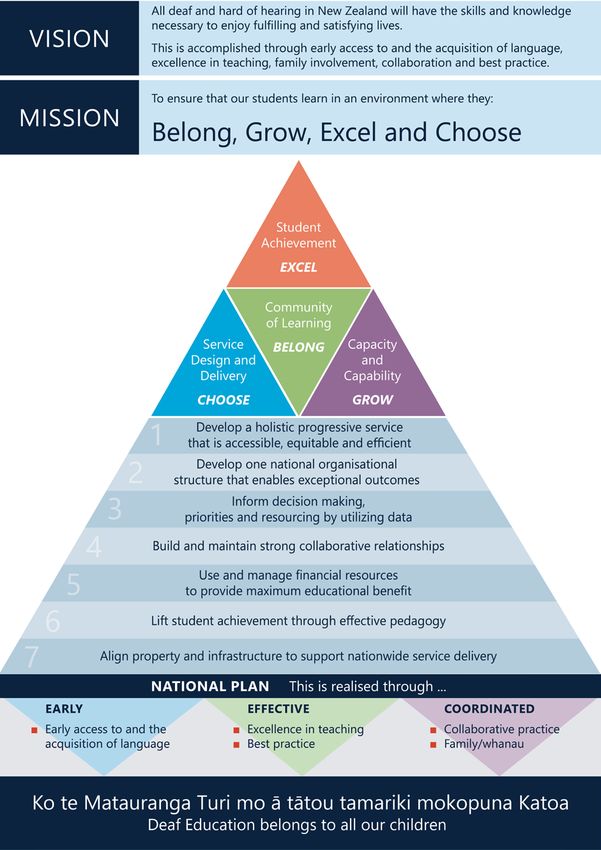
Our Mission – Our Vision

Strategic Goals full version see page 12.

Combined Board Charter 2018                 Page 2

Strategic Goals full version see page 12.

Combined Board Charter 2018                 Page 3
Resourcing

                                                  Investing in the right support early on will help raise the
                                                  achievements of our learners and improve their emotional
                                                  and social wellbeing. Our work is underpinned by the
                                                  National Plan Government’s Learning Support guiding
                                                  principles which aim to:

                                                  •   Remove barriers to learning

                                                  •   Become involved earlier

                                                  •   Provide quality services

                                                  •   Monitor and evaluate our work and build a strong
                                                      evidence base to improve what we do

• Build and sustain productive partnerships with parents, whanau, schools and other professionals.

As a result, “Every day, children will learn and succeed because of the work we do.”

Each year the Ministry of Education provides funding to the Combined Board so that each Centre can offer a
range of services to support DHH and hard of hearing learners. The schools are funded in line with the
principles that resource all schools. The additional early involvement, regional, specialist, resource centre and
technical support services are funded on a yearly contract within the Resourcing Notice.

Working closely with the Ministry of Education, the Board strives to make the best use of its available
resources to meet an ever-increasing demand on our services and the expectation of high achievement.

Data on Learner Demographics Needs, Achievement and
the outcomes of specific programmes will inform resourcing
decisions.

Combined Board Charter 2018                                                                                 Page 4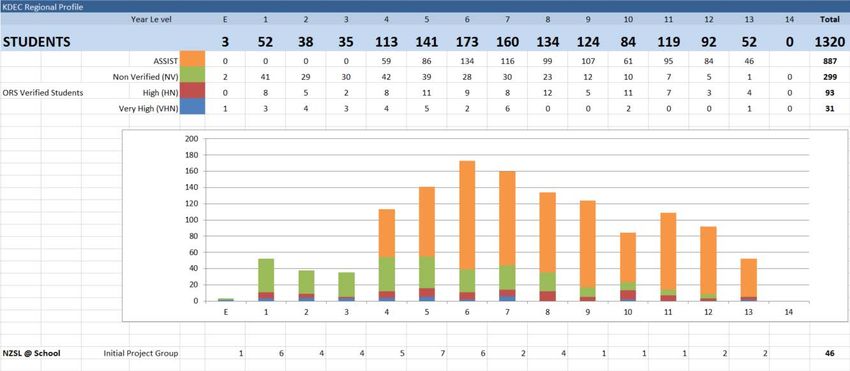
Our Services

School
The DHH learners enrolled at the Schools of van Asch and Kelston range in age from 5 -21 years.

Both Schools are the Specialist Service Provider for the ORS verified learners enrolled in the Schools. This
designation enables the Board to provide specialist and paraprofessional staff to serve the needs of learners
enrolled in the school.

                                                          Kelston Deaf Education Centre
 van Asch Deaf Education Centre
                                                          Te Kura Maatua o Kerehana mo nga Tamariki Turi

                                                          The KDEC School operates as a network of
 Satellite classes operate at Hagley Community
                                                          provisions in partnership with regular schools
 College, Hillmorton High School and Wharenui
                                                          across the city of Auckland. The last of these
 Primary School in Christchurch. Core school
                                                          provisions was opened on 7 February 2017.
 enrolments come from throughout the region served
 by the Centre.                                           Learners in the KDEC School, partake fully in the
                                                          New Zealand Curriculum. The teaching focus is on
 Some school subjects are provided in the Satellite
                                                          access and adaptation of the curriculum.
 Unit by van Asch Teachers and in partnership with Te
 Kura. Some school subjects are accessed via the Host     The rebuild of the Archibald Road complex, which
 School class programmes where the Teacher of the         includes the Residential Hostel is now complete.
 DHH and support staff provide access and adaption
                                                          A linked campus approach operates with partner
 support.
                                                          schools in West Auckland: Kelston Boys High,
 All satellite and High School transition programmes      Kelston Girls College, Kelston Intermediate and
 integrate our Local Curriculum: Language, Literacy       Kelston Primary.
 and Deaf Culture within the New Zealand Curriculum.
                                                          Likewise, a parallel campus approach exists in
 The van Asch Deaf Education Centre School
                                                          Auckland’s South East at Ormiston Primary School,
 Curriculum January 2013 outlines the programmes
                                                          Ormiston Junior College and Ormiston Senior
 provided.
                                                          College.
 Every learner has unique needs so parents,
                                                          Oteha Valley School provides a partner Primary
 caregivers, teachers, the learner, and specialists,
                                                          school on the North Shore of Auckland.
 where appropriate, meet biannually to review and
 develop goals for Individual Education Plans (IEPs).     Tu Kokiri provides a transitional programme for
                                                          senior learners preparing for further study or
 We are an Accredited provider for NZSL NCEA
                                                          employment.
 standards. Teachers of the Deaf based at the satellite
 units teach the standards to enrolled learners and       KDEC is NZQA accredited to teach and guide
 hearing learners within the partnership agreement        learners in the High School programmes at Kelston
 parameters.                                              Boys, Kelston Girls, Ormiston Senior and Tu Kokiri
                                                          successfully partake in NZQA learning pathways.
 The Transition programme offers flexible
 programmes to meet learners specific educational
 and vocational needs while fostering independence
 and self-advocacy.

Combined Board Charter 2018                                                                                Page 5
Residential
Each Centre has residential facilities to cater for those learners whose overall personal, social and educational
needs cannot be met in their home area/local school.

Residential programmes enable up to 43 DHH learners to live in a safe and challenging environment that
promotes their learning, development and independence through an integrated educational and residential
programme.

At all times both Centres comply with the Education (Hostels) Regulations 2005.

                                                            Kelston Deaf Education Centre
 van Asch Deaf Education Centre
                                                            Te Kura Maatua o Kerehana mo nga Tamariki Turi

 The hostel license allows for up to 20 learners to be      The KDEC hostel license allows for up to 23 learners
 enrolled.                                                  to be enrolled.
 Residential homes are also used for assessment visits      The opening of the new Residential hostel has
 of regional learners and in-service and training           enabled KDEC to re-establish short term residential
 programmes for parents/caregivers and associated           courses during 2017.
 support persons.
                                                            The admission criteria for full time enrolment are
 Regional learners use the residential facilities when      that the learner’s IEP identifies that their education
 attending short-term Immersion courses.                    needs will best be met by residential placement,
                                                            and that a suitable placement is available. Specific
 When not required for the Centre’s own use, the
                                                            obligations are outlined in the KDEC Resourcing
 facilities are used, on a cost recovery basis, for other
                                                            Notice.
 education in-service or family programmes.

Combined Board Charter 2018                                                                                  Page 6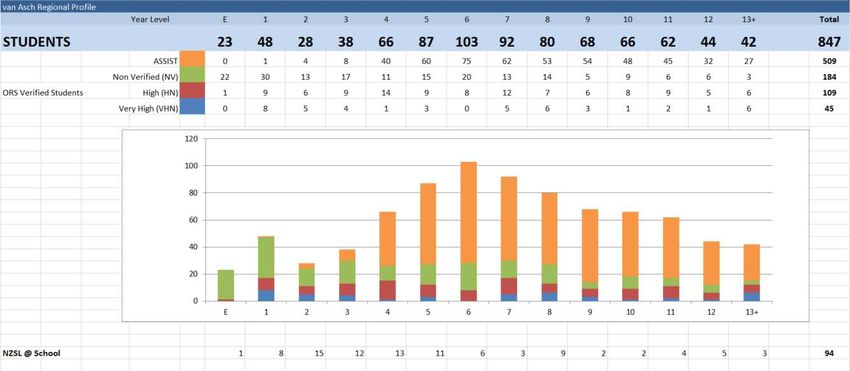
Regional Services
Specialist Teaching\Advice and Guidance

The Centres’ Regional Services are subject to special education policy and are available to DHH learners with
moderate needs and those verified under the Ongoing Resource Scheme (ORS).

ORS specialist teacher components previously with the mainstream schools, are now incorporated into the
regional specialist teaching services. This resource is reviewed and allocated on an annual basis.

A range of specialist support is provided via the RTD and Assist services:

RTD:
• Direct RTD Specialist inclusive teaching support
• Advice and guidance
• Regular monitoring to check progress is being maintained

ASSIST:
• Advice and guidance
• Regular monitoring to check progress is being maintained

Between 2013-2015 a sector shift was agreed to enable the Advisor on Deaf Children to focus on the Early
Years for DHH and Hard of Hearing children and agreement for extended service provision by the two DECs.
Progressively since 2013 the Assessment and Involvement of a Specialist Teacher (ASSIST) has been the DECs
responsibility from year 4 onwards for non-verified learners, year 1 onwards for verified learners.

                                                            Kelston Deaf Education Centre
 van Asch Deaf Education Centre
                                                            Te Kura Maatua o Kerehana mo nga Tamariki Turi

 The Regional Services are funded to provide                The Centre will deliver the specified range of advice
 Specialist Teaching and Advice and Guidance to DHH         and service options to eligible learners enrolled in
 learners enrolled in a mainstream, attached satellite      state funded mainstream settings, to
 Unit or Special School across the South Island and         family/whanau, and the schools they attend.
 lower half of the North Island.
 Specialist Teaching service is allocated to learners       The Centre provides administrative and operational
 meeting the criteria for literacy, language support in     support for staff working regionally.
 an inclusive setting. This service is provided either by
                                                            Staff delivering the services, provide data to profile
 a Resource Teacher of the Deaf or qualified teacher
                                                            learner needs and to demonstrate service
 based in the learner’s local area. Both RTDs and
                                                            effectiveness.
 staffing transfer teachers receive
 outreach/professional support from the Specialist          Staff liaise with other providers of services to
 Resource Teachers of Literacy, Sign Language and           eligible learners, and provide training and
 Speech-Language. NZSL tutors provide Sign Language         professional development to regional services staff
 tuition and awareness of Deaf Culture.                     involved in the provision of services to learners,
                                                            their families, caregivers, whanau and schools.
 All regional learners who receive services from the
 Centre are eligible for Assist Services that provide
 advice and guidance in relation to IEPs, transition,
 and hearing aid management and classroom
 strategies.

Combined Board Charter 2018                                                                                  Page 7
Resource and Technical

                                                        Kelston Deaf Education Centre
 van Asch Deaf Education Centre
                                                        Te Kura Maatua o Kerehana mo nga Tamariki Turi

 van Asch’s resource and technical services provide     Resource and technical services are provided to
 services for DHH pre-schoolers and learners from the   DHH pre-schoolers and learners enrolled in the
 time of diagnosis to the end of their compulsory       compulsory education sector. These include:
 education. These services are available to the
                                                        •   On-going access to assistive listening services
 families and whanau of DHH children and the staff in
                                                            (including hearing aids and FM systems), plus
 regular schools.
                                                            the related fitting, repair and maintenance and
 •   The Centre maintains a media centre and library        technical support.
     that provides curriculum support, extension
                                                        •   Curriculum support and extension resources
     resources, virtual learning and in-service
                                                            for learners, their families and whanau as well
     training.
                                                            as the staff in regular schools.
 •   van Asch provides Audiological assessment for
                                                        •   Residential and in-service training for the
     learners enrolled in the school and learners
                                                            families and whanau of DHH children and staff
     attending assessment in residential
                                                            in regular schools.
     programmes. Outreach paediatrics Audiological
     support to local audiologists is also offered.     KDEC is funded to provide audiology services for
     Ongoing access to assistive listening services     learners enrolled in the day school and to maintain
     (including hearing aids and FM systems, plus the   a resource centre and library. Both these facilities
     related fitting, repair and maintenance). The      are available to families and whanau of DHH and
     Audiologist works alongside the EIC and            hard of hearing children as well as the staff of
     Specialist Resource teachers. Outreach support     regular schools throughout New Zealand.
     is provided to DHB Audiologists working with
     pre-schoolers and learners.

Combined Board Charter 2018                                                                             Page 8
Early Childhood
van Asch Deaf Education Centre Kelston Deaf Education Centre
Te Kura Maatua o Kerehana mo nga Tamariki Turi
An Early Intervention Centre on-campus programme Pre-school
is provided for local families. The E.I.C. has a
The pre-school programme supports the
sessional license for up to 21 children per session
development of spoken language and New Zealand
and provides group parent and child sessions.
Sign Language (NZSL) in a bilingual and inclusive
Weekly individual parent-child communication
setting.
sessions are also offered. The Centre follows the Te
Whaariki Curriculum with an emphasis on Those enrolled are children who are DHH their
communication development. hearing siblings, Children of DHH Adults (CODAs),
those with a connection to the adult DHH
The E.I.C. is also accessed by families from across the
Community and children living in the local
region through Preschool Residential Courses that
community.
are provided throughout the school year. Ten
courses per year are offered. Up to three families The curriculum draws on the individual experiences
can attend each course. of each child and their family to deliver a diverse
cultural and linguistic programme consistent with
The E.I.C. staff work closely with the AoDC, CI
the national Early Childhood Education (ECE)
Habilitationists and First Signs Facilitator to provide a
curriculum – Te Whariki. The programme is
collaborative service for families.
supported by adults who are fluent in English and
New Zealand Sign Language, who work alongside
children to promote confidence and competence in
all languages.
Combined Board Charter 2018 Page 9Habilitation
Kelston Deaf Education Centre
van Asch Deaf Education Centre
Te Kura Maatua o Kerehana mo nga Tamariki Turi
Van Asch is funded to employ Habilitationists. Under a joint venture agreement through the
Habilitation services for children with cochlear Northern Cochlear Implant Trust, The Hearing
implants are provided through a contract with the House and KDEC are funded for habilitation staff to
Southern Hearing Charitable Trust. contribute to the delivery of ongoing monitoring,
advice and guidance for cochlear implant
Habilitationists are based at the Southern Cochlear
recipients, between the ages of 5 – 18 years old.
Implant Programme in Christchurch and Wellington.
They also provide an outreach service to children’s While the joint venture has been in place for 10
home areas and professional support to Teachers of years the contract for service is renewable annually.
the DHH and associated professionals who provide
weekly habilitation.
Combined Board Charter 2018 Page 10Priority Learners
Te Rautaki Matauranga Maori – Maori Achievement Strategy
The Treaty of Waitangi is a founding document of New Zealand. As such, the Treaty is a crucial driver for the
way the Board delivers services and engages with Tangata Whenua, Learners, Whanau and Iwi. The Board
acknowledges that Iwi and Hapu have a constitutional interest in the effectiveness of service delivery to DHH
learners. In order to meet its obligations and responsibilities under the Treaty of Waitangi, the Board has
developed, adopted and implemented Te Rautaki Matauranga Maori.
van Asch Deaf Education Centre Kelston Deaf Education Centre
Te Kura o van Asch mo nga Tamariki Turi Te Kura Maatua o Kerehana mo nga Tamariki Turi
In recognizing the unique position of Maori culture Te Rautaki Maori provides the overview, initiatives,
and language in New Zealand, van Asch Deaf steps, and actions through which the Chief
Education Centre continues to enhance procedures Executive and his Senior Management Team
and practices within all aspects of the Centre to raise continue to identify and implement culturally
achievement for Maori learners. responsive outputs that support Maori learners
enjoying educational success and access to the rich
Through professional leadership and training,
cultural heritage of Aotearoa.
teaching and residential staff are reflecting on
culturally responsive practices to engage the Maori Ruaumoko Marae provides a cultural focal point
Learner. for the delivery of Te Rautaki Matauranga Maori.
All Core School learners including Maori will be
provided with opportunities to take part in Maori
Tikanga, Te Reo and Maori Art activities.
A Specialist Resource Teacher, Maori/Kaitakawaenga
supports learning opportunities in the Core School
and supports engagement and consultation with
Maori families of enrolled learners and those
receiving services from across the van Asch Region.
Combined Board Charter 2018 Page 11STRATEGIC PLAN
At the end of 2017, after extensive consultation with parents, staff and students, the Combined Board agreed on 7 strategic goals to direct our work. These
new Strategic Goals represent an exciting new phase in developing Deaf Education Services throughout New Zealand. The Board’s 7 Strategic Goals are:
1. Develop a holistic progressive service for Deaf and hard of hearing learners that maximises educational, social and emotional outcomes and is
accessible, equitable and efficient in its delivery.
2. Develop one new national organisational structure that enables excellent educational outcomes for Deaf and hard of hearing learners New Zealand
wide.
3. Inform decisions, priorities, and resourcing by utilising data, evidence based best practice and research that underpin child centred values of Excel,
Choose, Grow and Belong.
4. Build and maintain strong, collaborative relationships with the Deaf community, including external stakeholders.
5. Use and manage financial resources to provide the maximum educational benefit for our learners within budget and contractual frameworks.
6. Lift student achievement through effective pedagogy for all of our Deaf and hard of hearing learners.
7. Align property and infrastructure to support a nationwide service delivery model.
Combined Board Charter 2018 Page 12Strategic Plan 2018-2021
Goal Time Current 2017 EOY
Strategic Goal Target 2018 Actions Who Outcomes
No. frame Status Comments
3. Inform decisions, a. Board, i. Provide access of Identified database Term 1 KAMAR national Agreed to KAMAR
priorities and Management and KAMAR to teaching administrators student database is hosting
resourcing by teaching staff use staff. developed so it is fit July 2017
utilising data, the data to DECs Curriculum for purpose
ii. Implement full
evidence based inform decisions, Leaders Joint Assessment
training of KAMAR
best practice and priorities and SAFs Policy agreed to
according to user
research that resourcing. July 2017,
protocols
underpin child Board expense
centred values of Align Annual National Principals additional cost to
Excel, Choose, b. Contribute to dataset and DECs fields host in the cloud
Grow and Belong development an Kamar joint training
c. first pull in April 2018
Annual National Oct
and Board reporting
Data set Further training
2018
planned for staff
2018
2017 Goal
Deaf student’s
achievement levels,
targets and
progress are
measured
consistently and
reported
transparently.
Combined Board Charter 2018 Page 13Goal Time Current 2017 EOY
Strategic Goal Target 2018 Actions Who Outcomes
No. frame Status Comments
3.. Inform decisions, Implement a National i. An agreed language For those enrolled Terms 2 - DHH language Working group
priorities and Assessment Policy assessment at & receiving 4. progress and summarised
resourcing by framework is ratified services from achievement is able current status
utilising data, by Board Curriculum Leaders to be recorded in - Aug
evidence based ii. Draft and trial DECs database - SAF meeting Oct 30
best practice and assessment SAFs Trends and patterns future framework
research that schedules across the Teachers are reported on and recommendations
underpin child DECs to line up with inform type of presented.
centred values of Board reporting service needed Nov 27 – SAF
Excel, Choose, meeting progress
Grow and Belong recommendations.
b. Outcomes for Trial OMT tool with some DECs Curriculum Term 2 Understand the Maori Deaf
Maori & Pasifika Māori/ Pasifika cohorts leaders patterns and trends Learners BOT
are described and report this to the around Māori Deaf Curriculum reports
Board Maori & Pasifika and Pasifika Deaf Oct 2018
Cultural Advisers achievement levels
Provide achievement SAFs to inform a
levels/ information for Principals nationwide Strategic
Maori and Pasifika as part Plan for lifting the
of curriculum reporting to cultural
the Board. responsiveness and
capabilities for all
teachers
c. Student’s Identify key groups of DECs Curriculum Term 2-3 Engagement patterns Explore OMT
engagement patterns DHH students to report Leaders and trends are assessment tool
are described Presence, Participation identified to inform
and Learning (OMT). Principals resourcing and
DECS - Enrolled service delivery
students and RTDs
students
Combined Board Charter 2018 Page 14Goal Time Current 2017 EOY
Strategic Goal Target 2018 Actions Who Outcomes
No. frame Status Comments
6. To lift student a. for Deaf Learners i. NZSL@Schools VA Senior Leaders Term 1-4 Practises and NZSL student
achievement whose primary pilot studies J Townshend HOSS philosophies across assessment
through effective language is NZSL a continued regional and Deaf
pedagogy for NZSL Deaf Bilingual Otago, Wgtn, school settings are NZSL Pilot studies
users philosophy and Southland HOSs VA F Gordon established to ensure progress Oct
practises are agreed ii. Core Schools Defining KDEC M Carr successful NZSL Curriculum report
to across Bi-bi the role of the tutor progress.
settings across school settings
iii. Training is provided Krista Clifford
for the NZSL Student
assessment kit
c. Students have “Turi Whare Rama” Senior Leaders Students have provide summary
opportunity to curriculum document J Townshend, opportunity to of work in 2017
develop their deaf shared and considered S de Heer, develop their deaf Annual report
identity, culture and Nationally. KDEC L Guy; M Carr identity, culture and
sign language SRTs sign language Trial curriculum
alongside fluent role Continue Trial Curriculum Teachers alongside fluent role 2018
models and peers. within van Asch region for NZSL tutors models and peers. Draft shared VA
NZSL Immersion weeks/ Middle Leaders
days and K.I.T days. T3
A plan to develop i. Set NZSL standards Residential and Staff develop their Goal ongoing since
Educational and ii. Educational and Core School fluency in NZSL so 2016 Inconsistent
Residential staff residential staff NZSL Leaders Heads of students language, practice with this –
proficiency in NZSL is skills are assessed School/Curriculum identity and culture needs
made. and specific action SLPI trainers are fostered in all strengthening in
plans for personal appropriate settings. 2018
development in NZSL Educational staff.
are made.
iii. Carry out internal Non-teaching staff
PLD including
Personal
Development plans in
NZSL.
Combined Board Charter 2018 Page 15Goal Time Current 2017 EOY
Strategic Goal Target 2018 Actions Who Outcomes
No. frame Status Comments
6. To lift student Develop and share DECs working group is DECs – Core Ed The wellbeing and Centrally funded
achievement knowledge of convened to prepare and sense of belonging PLD C Butler
through effective effective Social implement a team inquiry Sarah de Heer for DHH students is facilitator Core Ed.
pedagogy Emotional Learning as a pilot to inform future understood across a SEL Report
strategies social and emotional SEL Project Group range of learners Submitted to Board
wellbeing strategies for all July 28
DHH students nationally. Project group met
Nov 15 - SAFs and
Curriculum leaders
attended.
Build teacher i. Introduce a national SAFs and Consistent practices
capability to team-based inquiry curriculum leaders are established
accelerate student approach.
learning through ii. Introduce the new Establish an inquiry
inquiry based foci Code of Professional Principals, Senior focused appraisal
Responsibility to all and Middle Leaders approach
teaching staff.
iii. Strengthen Consistent overall
moderation practices Curriculum leaders teacher judgement
that support a team practices are
based inquiry established.
approach across the
two centres.
Provide specific tutor Mentoring programme DECs – MoE TOD graduates are Applications for
training opportunities provided by DECs competent to carry 2018 are open. 10
to ensure Teachers of nationally Joy Creet - Mentor on teacher practice study awards.
the Deaf graduate independently Changed to 6 year
with adequate level one study awards
of technical skill Nov 7
8 study awards
provided Nov 13
Combined Board Charter 2018 Page 16Goal Time Current 2017 EOY
Strategic Goal Target 2018 Actions Who Outcomes
No. frame Status Comments
6. To lift student Negotiate 2019 new Work with MOE to ensure DECs/MoE/Unis Ensure the Contract renewal
achievement Specialist teaching that a NZ Teachers of the preservation and 2020.
through effective contracts Deaf training programme Principals improvement of a Make case to MoE
pedagogy is sustained beyond 2019. dedicated training for more focus on
programme for NZ Specialisation and
Teachers of the Deaf. technical skills.
Oct 1 MoE mtg
Sensory schools
flagged training a
work matter as
priority in 2018.
MoE agreed to
include DECs in
contract
discussions.
1. Create a Holistic Understand how MoE Regional Leaders engage PrincipalsRegional DECs Service delivery
progressive Service Learning Support with Regional Directors to Leaders Linkages are
for DHH learners Delivery plan impacts share VA Services and described for
that maximises on DECs services to understand impact of schools, Regional
educational, social schools. local LS Delivery plan MoE and whanau
and emotional
outcomes and is COLs concept to be Sensory School Sensory Schools are
accessible, further explored by the Principals able to work
equitable and Sensory Schools collaboratively on
efficient in its student outcomes at
delivery a National level.
Understand how MoE MoE to share 10-year Board Term 1 DEC work priorities
NZSL Action Plan Action Plan re NZSL Work Chair/Delegate and NZSL funding are
impacts on DECs programme at SAG Principals clarified
services to schools. meeting
Combined Board Charter 2018 Page 17Goal Time Current 2017 EOY
Strategic Goal Target 2018 Actions Who Outcomes
No. frame Status Comments
1. Create a Holistic ASSIST scope of i. Set up approach to Senior Leaders – The ASSIST service is 2017 Goal
progressive Service practice is agreed prioritise Advice and Assist available to all DHH Consolidate the
for DHH learners within MoE formula. Guidance service for students nationally at sector shift to the
that maximises students receiving Assist staff equitable levels AODC focus on
educational, social services from the based on agreed MoE Early years and
and emotional DECs Principals formula DEC agreed service
outcomes and is ii. Maintain and extend provision for years
accessible, current ASSIST staff 4 onwards.
equitable and skill set (ASSIST
efficient in its programme).
delivery
5. Use and manage Work with MoE to Resourcing notice funding Principals The Assist service is Assist –AODC
financial resources resource ASSIST to for Assist staffing and Board available to all DHH Governance
to provide the meet needs as costs are reviewed based students nationally at meetings
maximum demonstrated on on MoE formula. equitable levels Resourcing notice
educational annual dataset. negotiations Oct
benefit Term 1 - 2018 2017
7. To align property a) Property: Master planning to B Mulcahy CSR funds released
and infrastructure ChCh Satellite complete in partnership F Gordon for this. HCC Board
to support a Transition HCC & MoE given verbal
nationwide service Programme rebuild at approval.
delivery model Hagley Community HCC send letter to
College DEC Board.
Scoping meeting
held with VA &
MoE Oct.
Combined Board Charter 2018 Page 18Goal Time Current 2017 EOY
Strategic Goal Target 2018 Actions Who Outcomes
No. frame Status Comments
7. To align property Property for ChCh Master planning to B Mulcahy CSR funds released
and infrastructure Satellite High School complete in partnership F Gordon for this. HHS Board
to support a Programmes Yr 7-13 HHS & MoE given verbal
nationwide service rebuilt at Hillmorton approval.
delivery model High School HHS send ltr to DEC
Board.
Scoping mtg held
with VA & MoE Oct.
Sensory Resource May 2017 MoE
Centre upgrades stakeholder mtg.
VA: Agreed to set up
Nelson, Gisborne, national dataset to
Dunedin, Wellington, Scoping N Pouwels inform property
Manawatu On hold M Anderson infrastructure
KDEC: Master planning planning and to
Taupo, Whangarei, Costing consider language
Rotorua Costing L Guy pathways.
Sept 2017 BOT start
reviewing service
pathways
PODs review/set up In partnership with Regional Senior 2018
Nelson, Wellington, Regional MoE office and Leaders
Manawatu, Dunedin Schools set-up or review N Pouwels
Gisborne PODs M Anderson
National Deaf National Service delivery Principals
Campus Network model is explored for
students enrolled at the
DECs
a) IT Infrastructure Set up one IT service E.O.
provider Resource Centre
Combined Board Charter 2018 Page 19Goal Time Current 2017 EOY
Strategic Goal Target 2018 Actions Who Outcomes
No. frame Status Comments
7. To align property IT Infrastructure Set up Office 365 as the Resource Centre
and infrastructure one cloud-based IT
to support a environment and utilise
nationwide service the 365 suite of products
delivery model Redesign a new logo, Resource
website and intranet Centres/Com. Eng.
Officer
Set up one online file Resource
management system Centre/HR/IT
provider
Set up one shared digital Resource Centre
communication system – IT Provider
video, telephone, etc.
b) Financial Set up Credit Card M Koning
Infrastructure Management system E.O.
Set up Invoice Scanning M Koning
software E.O.
Set up Bank Accounts M Koning
E.O.
I.R.D number etc. M Koning
E.O.
Financial team structure LSM
c) Administration Telephone contact M Koning
Infrastructure E.O.
Address contact M Koning
E.O.
Branding - Stationery Resource Centre
Combined Board Charter 2018 Page 20Goal Time Current 2017 EOY
Strategic Goal Target 2018 Actions Who Outcomes
No. frame Status Comments
7. To align property d) HR Infrastructure Appoint CEO LSM
and infrastructure Senior Leadership team
to support a Consider deaf leadership
nationwide service Scope set up of HR HR Senior
delivery model Software systems Leaders/LSM
Policies/Procedures
4. Build and maintain Deaf Community & Create an effective Com. Eng. 2018 Parents will be more Database
strong, stakeholder groups national database of key Officer/Principals informed and incomplete
collaborative stakeholders comprising:- involved. DECs will /not
relationships with Students (school, have greater access current
the Deaf residential, regional, to key stakeholder
community, ASSIST). feedback. Improved
including external Parents/Caregivers/Whan partnership working
stakeholders. au with key
DEC staff stakeholders
Schools/teachers
(mainstream,
satellite/provisions/
campus, EIC/ECE)
Deaf Community
Parent Groups
Other stakeholder
organisations e.g.
SCIP/Hearing House
Combined Board of
Trustees
MoE
Combined Board Charter 2018 Page 21Goal Time Current 2017 EOY
Strategic Goal Target 2018 Actions Who Outcomes
No. frame Status Comments
4. Build and maintain DEC staff Produce one national staff Com. Eng. 2018 Staff across both progressing
strong, information bulletin each Officer/Resource DECs will experience
collaborative fortnight. Centres communication that
relationships with (VADEC - lead is timely and
the Deaf partner) equitable.
community, Staff can access BOT
including external updates as well as
stakeholders. external news
Stakeholder Produce and distribute a Com. Eng. Term 4 Parents receive On hold at
groups/parents/ monthly newsletter for Officer/Board & 2019 current and regular present
whanau parents/stakeholders Secretary information about
comprising a summary of our services as well
the monthly Board as Board
meeting as well as communications.
appropriate information Parents can also find
from the staff monthly contact information
bulletin. for key staff,
providing them with
a regular information
channel.
As a result, parents
are better informed
and can contribute to
the decisions which
affect them/their
kids and will feel
valued.
Combined Board Charter 2018 Page 22Goal Time Current 2017 EOY
Strategic Goal Target 2018 Actions Who Outcomes
No. frame Status Comments
4. Build and maintain Parents/whanau/ Produce one National Com. Eng. Office Terms 3 Enables greater Pre-design
strong, staff Deaf Education Yearbook Resource Centres &4 communication gathering
collaborative (KDEC - lead across both DECs and content
relationships with partner) between staff. Offers
the Deaf the potential for the
community, promotion of joint
including external events/projects.
stakeholders. Promotes the sharing
of best practice.
Reduction in printing
costs.
Establish forum for Com. Eng. Officer, Term 4 Builds relationships
internal/external Board and Promotes
communication Chair/Principals communication with
Parent group key stakeholder
reps./Deaf Group groups. Maximises
Reps. resources and
information sharing
Parents/whanau/ Com. Eng. Officer to Com. Eng. Officer Creates a clear and Starting
staff attend the AGM of NZ regular channel for term 2
Federation for Deaf feedback from
Children. Also, AGMs of groups to the Board
established parent and promotes
groups. (9 parent groups). communication with
Meet with other stakeholders.
stakeholder groups as
appropriate
Combined Board Charter 2018 Page 23Goal Time Current 2017 EOY
Strategic Goal Target 2018 Actions Who Outcomes
No. frame Status Comments
4. Build and maintain Produce a guide for Lead by Com. Eng. Begins Parents have clear On hold
strong, parents to support Officer/Sue Term 2 information to help
collaborative children through Lawless. support them in the
relationships with transitions choices they make
the Deaf Moderated by with their children.
community, L. Guy/M. Carr, S de Parent involvement is
including external Heer/ F Gordon increased. DEC
stakeholders. processes are
improved
Parents/whanau/ Co-ordinate stakeholder Com. Eng. Officer Planning Increased
staff survey every 2 years. Senior leaders Stage opportunities for
Give feedback and term 4 stakeholders to
support Dept. action influence policy and
plans. procedures.
Promotes greater
responsiveness to
Stakeholder
views/comments.
Raised awareness of
Board Strategic
direction.
Carry out consultation Com. Eng. Officer Planning Supports Board and
with stakeholders on the Principals Term 4 managers with
Board’s Strategic Plan evaluation of
Strategic Plan.
Satisfies obligation to
consult on strategic
direction. Promotes
good practice and
collaboration.
Combined Board Charter 2018 Page 24National Learner Profile The Combined Board has prioritized the development of an accurate National Picture of the DHH learner population. The table below shows the distribution of DHH learners enrolled at or receiving services from the Deaf Education Centres by region: The first column - Average % DND 2010-2014 – shows the percentage of DHH children notified to the Deafness Notification Database on average over the past five years. The centre column - Average % DND 2016 – shows the percentage of DHH children notified to the Deafness Notification Database on average over the past five years. The third column - % Pop
The detailed learner profile below records overall learner numbers rather than percentages. The aim of the
table is to provide an overview of learners according to their - Year Level - at School. Coloured bars show how
many learners at each year level are ORS verified and non verified – these learners received regular timetabled
contact from Resource Teachers of the Deaf. The ASSIST category is for those learners that the DECs have
responsibility to provide Advice and Guidance as a result of the agreed sector shift of service provision. The two
Deaf Education Centres provide advice and guidance for DHH learners from Year 4 onwards. This shift has
enabled the Advisors on Deaf Children to a greater focus on the Early Years.

Learners use a wide variety of amplification – Technology – this includes Cochlear Implants (CI); Cochlear Implant
and Hearing Aid (CI/HA) and Hearing Aids (HA).

A cohort of learners have been identified for inclusion in the NZSL @ School Project.

The sector shift to simplify AODC/RTD roles and responsibilities has been introduced systematically over the
past three years. The final phase of the roll-out began in July 2015. A significant number of learners (ASSIST in
the table below) who are now “receiving service from” the DECs. This data clearly reflects the policy decision
that the DECs will take responsibility for all DHH learners from School Year 4 onwards.

The table also indicates the overall national – Ethnicity of Learners - using Ministry of Education Categories: NZ
European; Maori; Pasifika; Asian, and Middle East, Latin America and African (MELAA).

National Profile as at 30/12/17

Combined Board Charter 2018                                                                               Page 26
KDEC Regional and School

Regional Learner Profile

Core School Learner Profile

Combined Board Charter 2018   Page 27
van Asch Regional and School
van Asch Deaf Education Centre, located in Sumner, a suburb of Christchurch and in the Waitahi Iwi, was
established in March 1880 as a fully funded Department of Education special school.

Today, it is both a coeducational composite special school and a national resource centre, having responsibility
for the support of Deaf and Hard of Hearing children and learners throughout the South Island and lower half of
the North Island.

The van Asch Regional Learner Profile notes all children enrolled at or receiving services from van Asch across
all parts of the region.

Regional Learner Profile

Core School Learner Profile

Combined Board Charter 2018                                                                             Page 28
Annual Section

Operating Context:
Annual Management Plans are prepared for each of the Centres. These plans quantify operational goals,
target specific to the requirements of the Resourcing Notice and identify key learner achievement foci.

The plans contain specific references to events and activities that will contribute to advancing the strategic
intentions of the Board – where this can be achieved within the existing operational staffing and funding.

References:
1. 2018 van Asch and Kelston DEC Consolidated Budgets

2. The Centre’s Core School and Regional curriculum

3. The Core School Annual Plans 2018

4. Residential Homes Management Plans 2018

5. The Regional Services Annual Plans 2018

6. Resource and Technical Services Annual Plans for 2018

7. Maori Learner’s Achievement Strategy - Te Rautaki Maori

Combined Board Charter 2018                                                                               Page 29
van Asch and Kelston Deaf Education Centres – Curriculum Annual Plan

The two Deaf Education Centres have developed for the school year 2018 a joint Curriculum Annual Plan. This
national plan incorporates targets and actions that are specified in the Board’s 2018 Strategic Action Plan

- see Strategic Goals 3 and 6:

Strategic Goal 3:
Inform decisions, priorities and resourcing by utilising data, evidence based best practice and research that
underpin chid centre values of Excel, Choose, Grow and Belong

Strategic Goal 6:
To lift student achievement through effective pedagogy

A 3 year Curriculum reporting schedule will provide the Board with evaluations on student achievement for
those learners enrolled at a DEC and those receiving services from. Analysis of Variance will form a key part of
the report for enrolled students and those learners receiving direct teaching services from a DEC. Presence,
Participation and Engagement patterns and trends will also be reported to the Board for these groups.

Achievement Targets are to be develop for Priority groups - NZSL users, Maori and Pasifika Deaf Learners,

The Curriculum Leaders are working closely with the MoE SAFs to develop a national evaluative approach that
is based on a Teacher inquiry model. Professional Learning to implement the new Assessment Policy and Team
based Inquiry model is to be designed.

Combined Board Charter 2018                                                                              Page 30
Sector Co-operation

Combined Board Charter 2018   Page 31
Guiding Documents

 Evidence Based Shifts in Practice to Lift Outcomes

 The annual Resourcing Notice provides the key record of the staffing and operational resources available to the
 Combined Board of Trustees. The notice describes the day school and regional specialist staffing and operations
 entitlements as well as the payments made for early involvement, residential, specialist technical services that
 each Centre provides. The notice also outlines the purposes and outcomes for each service.

 Since 1998 Government has agreed that these core functions, and additional services, should continue in
 alignment with the wider “Special Education 2000” initiatives. It was agreed that core school and residential
 functions at each centre should be resourced in accordance with the principles that resource all schools, and
 that the additional early childhood, regional specialist and resource centre functions should be funded
 transparently and separately.

 Current Opportunities

 The Ministry recognizes that the education sector is operating in a state of continuing change as we work
 together to sharpen the focus on lifting the outcomes for Government’s priority learners.
 Work programme matters of particular relevance during 2018 include:
 •   ASSIST - consolidation of the sector shift to the Advisor on DHH Children focus on the Early Years for DHH
     and hard of hearing children and deployment of agreed service provision to the two DHH Education Centres.
     Learner numbers involved in the ASSIST programme have increased significantly since 2015. Current
     resourcing cannot meet this demand. The Ministry advise they are using the 2017-2018 budget process to
     address staffing and funding resourcing challenges. The regional teacher staffing formula has not been
     updated since 1998 and this is an agreed area of work for 2018.
 •   NZSL@School – Implementation of this service approach is now embedded in DEC operational practices. It
     is one of Government’s NZSL responses to the 2013 Human Rights Commission report, A New Era in the
     Right to Sign, on Government implementation of the New Zealand Sign Language Act 2006.
Strengthening the NZSL@School initiative to become an integral part of service delivery in line with the Human
  Rights Commission report, A new era in the right to sign in the following ways;
     •    NZSL Regional Hubs/Campus sites have been explored by each Centre. The Ministry wrote a business
          paper to support this strategy for learners using NZSL in 2016. In 2017 the Ministry instead focused on
          gathering data on DHH learners via a National Dataset Snapshot. The DECs will contribute to this
          snapshot. Trends and patterns are expected to be summarised in 2018. This data and Service delivery
          redesign will inform Property Master Planning at a national level
     •    consideration of NZSL competency assessment, bilingual pedagogies, and approaches for online and
          remote services.
     •    supporting DHH learners to interact and learn together via a range of immersion activities.
     •    provision of NZSL tutoring and interpreting.
 •   Interpreter funding for DHH staff –The MoE investment is consistent with sector guidance through the
     position statement, New Zealand Sign Language in Education. In 2018 Board will continue to work with MoE
     and MSD to identify actual costs for each Centre. These two funding sources will then clarify the interpreter
     activities they have responsibility for. Resourcing will then be reviewed based on actual costs.
 •   Following the 2016 ERO joint review of the Deaf Education Centre, the Board will work with ERO and the
     Ministry to strengthen its governance role in relation to Learner achievement of all DHH learners enrolled
     at and receiving services from the two Centres. An improvement plan will be developed.
 •   continued strengthening of the national network of services, including Regional Teaching Services and early
     childhood outreach, to:
      •   support sector relationships, including with regular schools, the Advisors on Deaf Children, cochlear
          implant programmes, Deaf Aotearoa and Deaf Children New Zealand.

 Combined Board Charter 2018                                                                              Page 32
• align learner need, workforce capability and capacity, and service design and delivery.
• develop an agreed framework for: data collection; resource development, storage and access;
pedagogy and assessment; IT systems and Human Resource and Payroll management; and technical
service provision
Investing in Outcomes
This Resourcing Notice further records each Centre’s resourcing for the 2018 school year. It outlines the basis of
the resourcing received, sets the purposes for which it can be used and explains the payment cycle and
processes.
1. The Ministry and Combined Board will meet twice yearly to discuss progress and performance, new
directions, emerging opportunities, alternative use of resources and proposals which have the potential to
improve the responsiveness and targeting of services to students, their families and their schools, including
where such proposals may require review of resourcing approaches, processes or quanta within available
resourcing.
2. The Centres are expected to operate within available funding and deliver services as specified in this
contract for a six month period, 1 January to 30 June 2018.
3. The student outcomes the Ministry of Education (the Ministry) expects are:
· Presence: Children and young people with additional learning needs are present and
welcome in early learning and Kāhui Ako/kura/school settings.
· Participation: Children and young people with additional learning needs participate
and engage in early learning and Kāhui Ako/kura/school settings.
· Wellbeing: Children and young people with additional learning needs feel supported,
have good emotional and social skills and a sense of belonging in early learning and
Kāhui Ako/kura/school settings.
· Progress and achievement: Children and young people with additional learning
needs progress and achieve in early learning and Kāhui Ako/kura/school settings.
4. The Ministry seeks to understand the value gained from its investment. This funding is to support the
Centres to lift education outcomes for all students they support. The Centres’ annual planning and reporting will
be the basis for addressing the accountabilities relating to this resourcing.
5. The DEC Board will report, using an agreed template, approximately one month prior to each of the Ministry
and Board twice yearly strategic planning meetings - in its Annual Report and in an interim milestone report.
The Ministry of Education will work with the Centres in late 2017 to test and refine the required reporting,
including the template to be used.
6. Reporting will address matters related to this Resourcing Notice, including narrative and quantitative data
on:
· Student outcomes: Presence, Participation, Progress and Achievement and Wellbeing.
· Direct and indirect service provision (students ‘enrolled at’ or ‘receiving a service from’).
· Operational matters.
· Progress on strengthening the national networks of sensory services.
· Use of existing infrastructure, including property, transport and technology.
7. Further information on reporting is provided in Annexure 1 to this Notice.
8. Kelston Deaf Education Centre (KDEC) and van Asch Deaf Education Centre (VADEC) (the Centres) are
established under Section 98 of the Education Act 1964 as special schools. The Centres have day school and
residential functions, early involvement, and a range of national services including regional teaching, specialist
services, resource centre and technical service roles, professional learning and development, and separate early
childhood services.
9. The Governments’ policy under the Education Act is that all students, regardless of any disabilities they may
have, are entitled to enrol at their local, regular school. All New Zealand children and young people are entitled
Combined Board Charter 2018 Page 33to a rich and balanced education. Whatever their circumstances, they should have the same opportunities to learn, make progress, and achieve their full potential. 10. The national network of deaf education services needs to support educational outcomes for the full range of students who are Deaf and Hard of Hearing Deaf, including opportunities to work together where this supports their learning. The Centres’ purpose is to support students to access the curriculum, with a focus on ensuring learning for those students enrolled at or receiving a service from them. Some of these students may also have additional learning support or accessibility needs. Additional References The Combined Board of Kelston Deaf Education Centre and van Asch Deaf Education Centre acknowledges these guiding documents of the New Zealand Education system’s principles, values and desirable achievements with particular emphasis on DHH learners. • the National Education Guidelines, • the National Plan for DHH Education, • the New Zealand Disability Strategy and • UN Conventions on the Rights of Disabled People and the Rights of Children • Human Rights Commission Report New Era for NZSL in Aotearoa (2012) • Better Public Service – Goals • Ministry of Education Investing in Education Success - Focus on priority learners (2014) Wilson Report – Role of the Advisor on Deaf Children (2010) Combined Board Charter 2018 Page 34
Appendix 1 – Exit Achievement Level and Destination
– van Asch Deaf Education Centre

NCEA Achievement 2017 van Asch Enrolled Students
van Asch DEC students join mainstream classes at their Partner Schools for NCEA subjects. The
students are taught by Partner School Teachers, and supported by van Asch DEC staff in mainstream
classes. When back in the satellite classroom van Asch DEC teachers provide pre and post teaching
of the same mainstream class material.

NZSL NCEA Level 1 and 3 is taught by van Asch DEC teachers in the satellite classroom.

NCEA Subjects at Partner Schools

Level 1: Maths, English Literature, Wood Technology, Visual Arts, NZSL.
Level 2: Chemistry, Classics, English, Geography, Photography, Design, Maths, Food and Nutrition,
Hospitality, Future Directions

Year 11 (2 students)
   • One student achieved 38 Level 1 credits
   • One student achieved 44 Level 1 credits

Year 12 (3 students)
   • One student completed NCEA Level 1, gained 14 Level 2 credits
   • One student completed NCEA Level 1with merit endorsement for Visual Arts
   • One student completed NCEA Level 1, completed NCEA Level 2 with merit endorsement for
        Chemistry and Classics

Year 13 (1 students)
   • One student achieved 20 Level 1 credits

Year 13+ (3 students)
   • One student completed NCEA Level 2 with excellence endorsement for Photography
   • One student achieved 42 Level 3 credits and 39 credits towards Service Industries Vocational
       Pathway
   • One student achieved 16 Level 1 credits with merit endorsement for Design

School leavers Exit Achievement Level, Destination and Focus:

 Student           Year            Achievement                             Destination
 A                 Y13+            NCEA Level 1 and 2                      Otago Polytechnic, Arts and
                                                                           Design study

 B                 Y13+            NCEA Level 1 and 2                      Seeking employment in their
                                   Hagley Certificate in Dance             home town

 C                 Y13+            Trades Academy                          To begin employment as a
                                   Certificate in Carpentry Stage 2 & 3    carpentry apprentice

Combined Board Charter 2018                                                                  Page 35
You can also read


