Course Handbook 2021 - WSMVET clu ter - Stawell Secondary College
←
→
Page content transcription
If your browser does not render page correctly, please read the page content below
WSM

VET
  clu ter

  Course Handbook
             2021
            1
2
Contents

What is VET Delivered to Secondary Schools?....................................................................................................................................4
VET Program Information & Application Process..............................................................................................................................5
Structured Workplace Learning, Qualification Levels......................................................................................................................7
SWL Portal - Finding Work Placement...................................................................................................................................................8
USI Number.....................................................................................................................................................................................................9
State School Relief - Work Boots........................................................................................................................................................... 10
Certificate II in Agriculture ..................................................................................................................................................................... 11
Certificate II in Automotive Vocational Preparation...................................................................................................................... 12
Certificate II in Building & Construction............................................................................................................................................. 13
Certificate III in Community Services.................................................................................................................................................. 14
Certificate II in Dance................................................................................................................................................................................ 15
Certificate II in Electrotechnology (Career Start)............................................................................................................................ 16
Certificate II in Engineering Studies.................................................................................................................................................... 17
Certificate II in Furniture Making Pathways...................................................................................................................................... 18
Certificate II in Health Support Services (Client Support)........................................................................................................... 19
Certificate II in Kitchen Operations...................................................................................................................................................... 20
Certificate II in Music Industry............................................................................................................................................................... 21
Certificate II in Plumbing (Pre-apprenticeship)............................................................................................................................... 22
Ready for Work Program.......................................................................................................................................................................... 23
Certificate II in Salon Assistant............................................................................................................................................................... 24
Certificate III in Screen & Media............................................................................................................................................................ 25
Certificate III in Sport & Recreation...................................................................................................................................................... 26
Bus Travel....................................................................................................................................................................................................... 27
Application Form........................................................................................................................................................................................ 31
Code of Conduct......................................................................................................................................................................................... 32
Enrolment Consent.................................................................................................................................................................................... 33
Parent VET Permission Notice................................................................................................................................................................ 34
Parent VET Permission Notice................................................................................................................................................................ 35
Scored Assessment.................................................................................................................................................................................... 36

This Handbook has been compiled by the Wimmera Southern Mallee VET Cluster Coordinator.
VET Cluster coordination services are provided by Wimmera Southern Mallee LLEN (www.llen.com.au)
Information contained in this document has been sourced from The Department of Education and Training, the Victorian
Curriculum and Assessment Authority , Federation University, Longerenong College, Skillinvest, Horsham College and Centre
for Participation. Information was correct at the time of publishing.

                                                                                                           3
What is VET Delivered to Secondary Students?

Vocational Educational and Training (VET) programs can be             Entry Level
undertaken as part of secondary school studies. VET programs          VET programs are available to Year 10, 11 & 12 students, but
offer students nationally or state recognised vocational              students must have their school’s approval to enrol.
certificates, which are endorsed for recognition in both the          Is there much reading, writing or maths involved in VET?
Victorian Certificate of Education (VCE) and the Victorian            Some VET courses require a high level of literacy and/or
Certificate of Applied Learning (VCAL) from the Victorian             numeracy. While VET programs incorporate hands-on training,
Curriculum and Assessment Authority (VCAA).                           they also include theory based training designed to support
Students enrolled in VET may also combine study and                   practical skills. Students who have low levels of literacy and/or
employment through School Based Apprenticeships and                   numeracy may find it difficult to successfully complete certain
Traineeships which allow students to do an apprenticeship or          VET courses. If a student is eligible for funding to provide
traineeship while they undertake their VCE or VCAL.                   education support at their school, the school must ensure
Wimmera Southern Mallee (WSM) VET Cluster                             the ES also accompanies the student when they attend VET
The WSM VET Cluster is a partnership between 18 senior                classes.
secondary education providers (member schools) within the             VET increases students’ learning potential by:
region and the Wimmera Southern Mallee Local Learning and             •  Broadening VCE/VCAL options
Employment Network (WSMLLEN). Participating members                   •  Assisting in transition from school to work
are from all education sectors; government, catholic and              •  Multiplying post-school opportunities and employment
independent. We also have participation from students in                 prospects
non-cluster member schools from other regions where space             •  Providing the opportunity to trial a career and helping
permits.                                                                 students explore possible areas of interest which promote
Training is delivered by Federation University (Horsham                  further study and work choices
Campus), Longerenong College, Skillinvest, Centre for                 •  Allowing students to develop strong links with industry
Participation and Horsham College.                                       and local community employers, i.e. students may be
Participating Member Schools:                                            offered part-time/casual work
                                                                      •  Developing students’ capacity to cooperate, work in
•   Ararat College
                                                                         a team, make decisions, problem solve and develop
•   Balmoral Community College
                                                                         leadership skills
•   Birchip P-12 School
                                                                      •  Helping students to gain confidence, communication,
•   Dimboola Memorial Secondary College                                  skills and knowledge of employers’ expectations in a real
•   Edenhope College                                                     adult working environment
•   Goroke P-12 College                                               •  Fostering positive feedback by enabling students to
•   Holy Trinity Lutheran College, Horsham                               demonstrate specific skills and competency
•   Hopetoun P-12 College
                                                                      VET gives national or state qualification and skills
•   Horsham College                                                   Upon successful completion of the program, students are
•   Horsham Special School                                            awarded a nationally or state accredited vocational training
•   Kaniva College                                                    Certificate or Statement of Attainment.
•   Marian College                                                    VET qualifications may articulate directly into further
•   Murtoa College                                                    education and training at TAFE through documented pathway
•   Nhill College                                                     agreements.
•   Rainbow P-12 College                                              VET provides access to a range of different technologies
•   Stawell Secondary College                                         related to the type and place of work.
•   St Brigid’s College, Horsham
•   Warracknabeal Secondary College

The WSM VET Cluster is coordinated by Wimmera Southern
Mallee LLEN. (WSMLLEN)

A VET Delivered to Secondary Students Program is usually
made up of VET units of competency delivered by a registered
training organisation (e.g. TAFE), the students’ home school or
other schools within the Wimmera Southern Mallee region.

                                                                  4
Program Information & Application Process

How does VET fit in with my school certificate?                        VET Application Process
                                                                       There are six steps in applying for a VET course
VCAL – VET programs contribute by providing credit towards
the Work Related Skills and Industry Specific strands within the       Step 1
VCAL. One credit towards a VCAL learning program is awarded            Explore the course requirements of your chosen VET course
on successful completion of 90 nominal hours of accredited             carefully via WSM VET Cluster website. Read the course
VET curriculum.                                                        handbook (available on the website).
                                                                       Step 2
VCE – some VET programs are approved by the Victorian                  If unsure about the options, students should consult with their
Curriculum and Assessment Authority (VCAA) and can provide             VET Coordinator, Careers Advisor or MIPS Coordinator at their
credit towards the student’s ATAR via either scored assessment         school.
or a 10% increment (see below).
                                                                       Step 3
Scored Assessment – courses that offer scored assessment               Obtain your Unique Student Identifier (USI) number “USI
will contribute directly to the student’s ATAR either as one of        Number” on page 9)
the primary four studies, or as a fifth or sixth study. Students
                                                                       Step 4
undertaking scored assessment as part of their VET course
                                                                       Complete your online application for your chosen VET course
will be assessed via school-assessed coursework and an
                                                                       via the WSMVET Cluster Website.
end-of-year examination set by the VCAA. Students must be
registered for scored assessment with their RTO.                       Your school will issue a consent form for your parent/guardian
                                                                       to sign. (This can also be downloaded from the WSM VET
10% Increment – where a VCAA approved course does
                                                                       Website). You must have parent/guardian consent to enrol in
not offer scored assessment but does include a Units 3 & 4
                                                                       a VET Course and you will be required to upload a copy of this
sequence, the student is eligible to receive an increment of
                                                                       signed form with your online application.
10% of their average primary four ATAR subject scores if they
successfully complete the Units 3 & 4 sequence.                        When you lodge your online application, your school VET
                                                                       coordinator will receive a copy of your application and will
Block Credit Recognition – For VET courses not approved by
                                                                       give final approval for you to enrol in your chosen course.
the VCAA, students will be eligible for credit towards their VCE
for successful completion of units of competency/modules               Step 5
within their VET subject. For every 90 nominal hours of study          Students will be notified by their VET coordinator if they have
completed, students will be eligible for a unit of credit at:          been successful in gaining a place in the VET program.
•    VCE Units 1 and 2 level for modules completed at                  Step6
     Certificate II level                                              Students will be required to attend an Induction Day. Your VET
•    VCE Units 3 and 4 level for modules completed at                  Coordinator will be advised of the date of the Induction Day.
     Certificate III level.                                            On this day, additional information will be provided regarding
Details of the credit provided by each course towards VCAL             your chosen program. Some Registered Training organisations
and VCE is included in the course information on the course            will conduct pre-training reviews and language, literacy and
pages.                                                                 numeracy assessments.
This handbook outlines a selection of VET programs available
to students at member schools for 2021.
Read the requirements of your selected program carefully.
Please note the printed arrangements regarding times,
venues and course outlines are subject to change and will be
confirmed before the commencement of the course.

                                                                   5
Program Information & Application Process
VET Course Requirements 6. Reports
Students enrolling in a VET program through the WSM VET All students undertaking a VET program will receive official
Cluster will be required to complete a Code of Conduct and written progress reports. These reports are issued by the
Medical Forms. Further to this, additional course require- respective training providers for each program and supplied
ments set out by the WSM VET Cluster must be adhered to. It to the students’ home school. Parents will receive a copy of
is important that parents and students take time to read the these reports in term two and four. Completed certificates
following course requirements before submitting an enrol- or statements of attainment will be sent directly to students’
ment form. home school at the completion of the program.
1. Absences 7. Student behaviour
Students are required to notify their school VET Coordinator of Currently, there are approximately 300 students undertaking
their absence in advance. VET programs through the WSM VET Cluster. To ensure the
2. Punctuality success, continuity and availability of VET programs to all
All students are expected to arrive on time to class. Non-adher- students, it is imperative that students abide by the program
ence to set class times will be reported to the student’s home teachers’ rules and the policies and procedures of the host
school. school or registered training organisation whenever they are
on site. This includes meeting Occupational Health and Safety
3. Work Requirements requirements in and out of the classroom. Attitude and behav-
All tasks as assigned by the program teacher are to be com- iour are to be at a high standard.
pleted by the due date. Refer to the Registered Training Organ-
isation’s policies in relation to resitting of assessments. 8. Withdrawal from a VET program
VET programs are successful because students are able to ac-
4. Unique Student Identifier (USI) cess programs offered by member schools. It should be noted
All students doing nationally recognised training need to have by students and parents that failure to abide by the above
a Unique Student Identifier (USI). This includes students doing course requirements may result in a student being withdrawn
Vocational Education Training (VET) in schools. from a program.
A USI is a reference number made up of numbers and letters.
Creating a USI is free. It creates a secure online record of your 9. Course changes
nationally recognised training that you can access anytime Please note: All course details and delivery arrangements con-
and anywhere, and it’s yours for life. tained in this booklet are subject to change.
The USI is linked to the National Vocational Education and All courses require minimum student numbers to proceed. For
Training (VET) Data Collection, and this means an individual’s further information on VET programs, please refer to the
nationally recognised training and qualifications gained any- Victorian Curriculum and Assessment Authority website:
where in Australia, from different training organisations, will www.vcaa.vic.edu.au/vet
be kept all together. 10. Victorian Training Guarantee
The USI will: If you are enrolled at a school, you will not be able to receive
• link a student’s VET achievements, regardless of where in a government-subsidised training place for a course through
Australia they did the course the Victorian Training Guarantee, unless you are undertak-
• let students easily access secure digital transcripts of their ing the course as part of a School-Based Apprenticeship or
achievements (transcripts will be available from January Traineeship. The Government supports schools in other ways
2016) to offer vocational training to their students, so you should
• give students more control over their VET information. discuss all your options with your school.
• Application for a USI is done online, by going to 11. Access & Equity
www.usi.gov.au. WSM VET Cluster is committed to the goals of access and
5. Program Costs equity and aims to provide opportunities for VET students, VET
Courses may attract fees for materials, books and equipment. program and WSM VET Cluster staff that foster fairness, equity,
Costs will vary according to the materials required by and respect for social and cultural diversity that is free from
students. discrimination, harassment and vilification.
* Please Note: program costs in this handbook are subject
to change.
6Structured Workplace Learning, Qualification Levels
Structured Workplace Learning
Structured Workplace Learning is a key feature of VET
programs. Although it may not be a requirement in order
National Qualification Levels
to complete every course, all students are encouraged to
complete a minimum of one week (40 hours) work placement
in a related industry. This will enhance their learning and Entry level programs
prospects of attaining an apprenticeship or entry into further Certificate I &
training. tester programs
Structured Workplace Learning may involve an employer
accepting a student on a one day a week basis or a one-week
block.
Many VET and pre-apprenticeship programs are at
Structured Workplace Learning enables the student to this level
demonstrate acquired skills and knowledge in an industry Certificate II
setting. During the work placement, a student will undertake
tasks to build on their skills and knowledge and complete a
log book of tasks undertaken.
If a student is having difficulties finding a structured work
Many apprenticeships and traineeships are at this
placement, WSMLLEN will offer assistance, through the VET level
Cluster, to source a suitable placement. SWL placements are Certificate III
listed online via the SWL portal. See “SWL Portal - Finding Work
Placement” on page 8 for more information.
It is the responsibility of the student however, to ensure that
all paperwork associated with structured work placements Available through TAFE and Registered Training
are completed and returned in a timely fashion. Students will Organisations
need to meet the work placement requirements of the course Certificate IV
to the best of their abilities.
Benefits of workplace learning
• Practical skill development
• Builds employer contacts Available through TAFE and Registered Training
Organisations
• Improves confidence in the workplace
• Development of personal skills and maturity Diploma
• Preparation for entering the workforce
• Adds relevant work experience to resume
• Opportunity to obtain an industry based reference
• Exposure to workplace dynamics May obtain credit for TAFE programs undertaken
• Opportunity to learn about industry practices and
procedures University
• Allows skills and knowledge obtained in the classroom to
be applied in the work environment
SWL recognition is available for students who undertake SWL Birchip -
in an industry aligned to the VCE VET program in which they
are enrolled. SWL recognition is also available for students
undertaking a school-based apprenticeship or traineeship
(SBAT). In order to receive VCE or VCAL credit, students need
to maintain and complete their Workplace Learning Record
(WLR). WLRs are available for download on the relevant VCE
VET programs page.
7SWL Portal - Finding Work Placement
Structured Workplace Learning is a key feature of VET programs. All students are encouraged to complete a minimum of one
week (40 hours) work placement in a related industry, however, the number of hours will vary depending on the course. This will
enhance their learning and prospects of attaining an apprenticeship or entry into further training.
Structured Workplace Learning may involve an employer accepting a student on a one-day-a-week basis or a one-week block.
Structured Workplace Learning enables the student to demonstrate acquired skills and knowledge in an industry setting. During
the work placement, a student will undertake tasks to build on their skills and knowledge and complete a log book of tasks
undertaken.
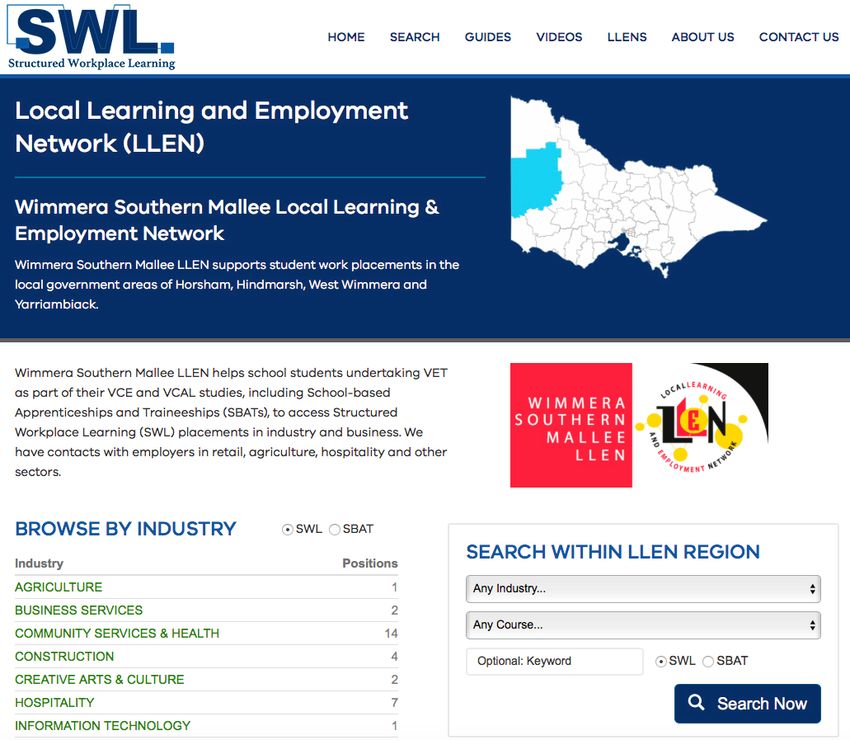
The SWL online portal lists local and state-wide work placement opportunities. Students can search the portal by region, indus-
try or course to find an appropriate work placement.
For local Wimmera and Southern Mallee opportunities please visit http://workplacements.education.vic.gov.au/llens/wsmllen/.
Select ‘share with your teacher’ when you find an appropriate opportunity and your teacher can match you to the position
before you arrange to attend an interview.
http://www.workplacements.education.vic.gov.au/llens/wsmllen/
wo r k
h fo r a line
Searcement o-nwide
plac nd state ble
a ila
Local nities ava
rtu
oppo
8Parents of VET students!
Does your child have a USI Number
Every VET student must have a Unique Student Identifier
Important (USI) Number to enrol in a course and to obtain their
qualification or certificate.
• A USI number is kept for life and you cannot create another one.
• Make sure you write down, print or take a screen shot of your USI.
• It is not easy to retrieve your lost USI so we recommend keeping a backup
copy in a safe place at home.
ID required
Your child will need at least 1 or Get that
preferably 2 forms of identification
USI number!
Please make sure your
child has their USI with
them on the first day of
their VET course.
• Your child must have a USI to enrol on the first day of VET classes
• A USI is free and easy to create online
• To create a USI, your child should go online to www.usi.gov.au and follow the
steps outlined.
9Boots shown for illustrative
purposes only
State Schools’ Relief now
providing VET in Schools
Work Boots
State Schools’ Relief now provide leather safety work boots to students enrolled
in VET in Schools (VETis) programs.
Without the right footwear disadvantaged Boots are made to Australian Standard
students are unable to participate in their VETis (AS2210.3 class 1), comprising of a composite
studies. State Schools’ Relief now provide safety toe and a sole resistant to most oils, acids
these work boots to assist student to remain in and chemicals. Available in black or camel.
school.
Applications can be made now by your welfare
Contact your school VET Coordinator to find out if you
This opportunity is available to any student team through our online application portal
are eligible to receive these work boots.
based on the normal assessment of student www.ssr.net.au/schools
need conducted in your school. Boots are
provided directly from State Schools’ Relief at
no cost to students, parents or schools.
1/8 Johnston Court Dandenong, VIC, 3175
Phone: (03) 8769 8400
Web: www. stateschoolsrelief.org.au/
www.ssr.net.au
State Schools’ Relief acknowledges the
support of the Victorian Government
10Certificate II in Agriculture
Program structure
Delivered over two years
Agriculture Location
Longerenong College
Contact Days/Hours
Every second Wednesday 9.30am to 3.00pm
Course code: AHC20116 RTO
The Certificate II in Agriculture aims to equip students with experience, knowledge and skills that will Skillinvest
enhance employment prospects in a range of rural industries including intensive animal production,
broad-acre cropping, grazing and agribusiness. Furthermore, the course provides a foundation for RTO Code
further study in agriculture through several pathways including apprenticeships, full time, part time and 4192
online options. Participants will develop skills in a range of areas including safety, machinery operation,
RTO Contact
fencing, welding, agronomy, farm chemicals and livestock husbandry.
Nick Wachsmann (03) 53622260
Contribution towards VCAL Possible study pathways Materials Fee
One credit towards a VCAL learning program is Potential Study Options/Career Paths (General or To be paid by the student:
awarded on successful completion of 90 nominal in specialised fields): $125.00 (first year)
hours of accredited VET curriculum. You will be • Certificate III/IV (apprenticeship or full time $110.00 (second year)
eligible at Foundation, Intermediate or Senior study)
Structured Workplace Learning
levels. • Diploma of Agronomy (full or part time or
A minimum of 200 hours work placement is
online)
Contribution towards VCE required, normally completed on alternate
• Diploma of Agribusiness
Students will be eligible for two or more units at Wednesdays when attendance at Longerenong
• Advanced Diploma of Agribusiness
Units 1 and 2 level and a Units 3 and 4 sequence. College is not required.
management
ATAR Contribution • Degree and post graduate study Scored Assessment Available
Students who receive a Units 3 and 4 sequence Potential Career Paths (Further study likely to be No
will be eligible for an increment towards their required)
ATAR (10 per cent of the lowest study score of the • Farm overseer/manager
National or State Accreditation
primary four studies). National
• Agronomist or Livestock agent
• Precision Agriculture consultant
Clothing/Equipment/OH&S
• Agribusiness professional, Rural merchandiser
Closed boots and appropriate clothing for weather
or marketing specialist
required.
• Agricultural research assistant or Scientist
Potential career paths
Potential Career Paths (With or without further
study)
• Farm hand or Feedlot assistant Nationally Recognised
Training
• Shearing shed hand or rouseabout
• Farm machinery operator/contractor
• Fencing contractor
Units may include:
Unit code First Year Unit code Second Year
AHCOHS201 Participate in OHS processes AHCWRK204 Work effectively in the industry
AHCBAC202 Assist agricultural crop maintenance AHCWRK209 Participate in environmentally sustainable work
AHCINF202 Install, maintain and repair fencing practices
AHCLSK205 Handle livestock using basic techniques AHCCHM201 Apply chemicals under supervision
AHCINF204 Fabricate & repair metal or plastic structures AHCBAC201 Assist agricultural crop establishment
AHCLSK209 Monitor water supplies AHCBAC204 Prepare grain storages
AHCMOM204 Undertake operational maintenance of machinery AHCLSK211 Provide feed for livestock
AHCPRK203 Move and handle pigs AHCMOM202 Operate tractors
AHCWOL201 Pen sheep AHCMOM212 Operate quad bikes
HLTFA201B Provide basic emergency life support AHCPCM201 Recognise Plants
AHCWOL203 Carry out wool pressing
AHCWRK201 Observe and report on weather
WIMMERA LO
CA
L LEARNI
NG
WSM
VET
SOUTHERN
MALLEE
AN
K
D
OR
LLEN
EM
PL
OY E TW
11
MENT N
clu terCertificate II in Automotive Vocational Preparation
Contribution towards VCAL
One credit towards a VCAL learning program
Automotive is awarded on successful completion
of 90 nominal hours of accredited VET
curriculum. You will be eligible at Foundation,
Intermediate or Senior levels.
Contribution towards VCE
Course code: AUR20716 Students will be eligible for two or more units
The Certificate II in Automotive Vocational Preparation is a work-ready pre-employment program at Units 1 and 2 level and a Units 3 and 4
designed to meet the needs of students wishing to pursue a career in the automotive industry. This sequence.
program aims to enable students to develop a defined range of skills appropriate to entry-level
positions in the automotive industry and to apply known solutions to a limited range of predictable
ATAR Contribution
Students who receive a Units 3 and 4 sequence
problems associated with an understanding of basic automotive technologies.
for VCE VET Automotive will be eligible for an
increment towards their ATAR (10 per cent
Contribution towards VCAL Possible study pathways
of the fourth study score of the primary four
One credit towards a VCAL learning program is • Certificate III (apprenticeship)
studies).
awarded on successful completion of 90 nominal • Certificate IV (post trade)
hours of accredited VET curriculum. You will be • Diploma RTO
eligible at Foundation, Intermediate or Senior Skilllinvest
Potential career paths
levels.
• Light Vehicle Mechanic RTO Code
Contribution towards VCE • Heavy Vehicle Mechanic 4192
Students will be eligible for two or more units at • Earthmoving and Mobile Plant
Units 1 and 2 level and a Units 3 and 4 sequence. • Automotive Electrician RTO Contact
• Motorcycle Mechanic Ian Westhead (03) 5381 6200
ATAR Contribution
Students who receive a Units 3 and 4 sequence Materials Fee
for VCE VET Automotive will be eligible for an To be paid by the student:
increment towards their ATAR (10 per cent of the $200
fourth study score of the primary four studies). Structured Workplace Learning
Clothing/Equipment/OH&S A minimum of 40 hours work placement is
Safety boots required recommended.
No singlets
Scored Assessment Available
No
National or State Accreditation
National
Nationally Recognised
Training
Units may include:
Unit code First Year Unit code Second Year
AURAEA002 Follow environmental and sustainability best practice in an AURAFA003 Communicate effectively in an automotive workplace
automotive workplace AURAFA004 Resolve routine problems in an automotive workplace
AURASA002 Follow safe working practice in an automotive workplace AUMAFA001 Apply for jobs and undertake job interviews
AURETR003 Identify automotive electrical systems and components AURAFA009 Carry out research into automotive industry
AURLTA001 Identify automotive mechanical systems and components AURETK001 Identify, select and use low voltage electrical test
AURTTK002 Use and maintain tools and equipment in an automotive equipment
workplace AURETR046 Remove and refit vehicle batteries
AURTTA027 Carry out basic vehicle servicing AURETR047 Recharge vehicle batteries
AURTTB007 Remove and replace brake assemblies AURETR048 Construct and test basic electronic circuits
AURTTJ003 Remove and replace wheel and tyre assembly AURTTE007 Dismantle and assemble single cylinder four-stroke
petrol engines
AURTTA004 Inspect and service engines
WIMMERA LO
CA
L LEARNI
NG
WSM
VET
SOUTHERN
MALLEE
AN
K
D
OR
LLEN
EM
PL
OY E TW
12
MENT N
clu terCertificate II in Building and Construction
Program structure
Delivered over two years
Building and Construction Location
Building Training Workshop
Longerenong College
Contact Days/Hours
Course code: 22338VIC Wednesdays 9.30am to 3.20pm
The outcomes of the qualification will enable the participant to develop skills in the following areas:
RTO
• safe handling of selected hand and power tools
Skillinvest
• interpreting workplace documents and plans
• performing building related calculations RTO Code
• communicating effectively in the workplace 4192
• researching pathways and job opportunities in the construction industry
RTO Contact
• safety requirements on a work site
Ian Westhead (03) 5381 6200
• components of building structures
• basic quality principles in the construction industry Materials Fee
• awareness of building codes and standards. To be paid by the student:
$250
Contribution towards VCAL Possible study pathways
One credit towards a VCAL learning program is • Carpentry Apprenticeship
Structured Workplace Learning
A minimum of 40 hours work placement is
awarded on successful completion of 90 nominal • Architecture
recommended.
hours of accredited VET curriculum. You will be • Building Engineering
eligible at Foundation, Intermediate or Senior • Interior Design Scored Assessment Available
levels. No
Potential career paths
Contribution towards VCE • Builder National or State Accreditation
Students will be eligible for two or more units at • Building Site Manager National
Units 1 and 2 level and a Units 3 and 4 sequence. • Building Inspector
• Landscaper
ATAR Contribution
Students who receive a units 3 and 4 sequence for
VCE VET Building will be eligible for an increment
towards their ATAR (10 per cent of the lowest study
score of the primary four studies).
Clothing/Equipment/OH&S
Safety boots required
No singlets
Nationally Recognised
Training
Units may include:
Unit code Core Units Unit code Elective Units
CPCCOHS2001A Apply OHS requirements, policies and procedures in the VU22022 Identify and handle carpentry tools and equipment
construction industry VU22023 Perform basic setting out
HLTAID002 Provide basic emergency life support VU22016 Erect and safely use working platforms
CPCCWHS1001 Prepare to work safely in the construction industry
VU22030 Carry out basic demolition for timber structures
VU22014 Prepare for work in the building and construction industry
VU22024 Construct basic sub-floor
VU22015 Interpret and apply basic plans and drawings
VU22031 Construct basic formwork for concreting
CPCCCM1015A Carry out measurements and calculations
VU22025 Construct basic wall frames
CPCCCM2006 Apply basic levelling procedures
VU22026 Construct a basic roof frame
CPCCCM1012A Work effectively and sustainably in the construction industry
VU22027 Install basic external cladding
CPCCCM1014A Conduct workplace communication
VU22028 Install basic windows and door frames
WIMMERA LO
CA
L LEARNI
NG
WSM
VET
SOUTHERN
MALLEE
AN
K
D
OR
LLEN
EM
PL
OY E TW
13
MENT N
clu terCertificate III in Community Services
Program structure
Delivered over two years
Location
Community Services Centre for Participation
39 Urquhart St, Horsham
Days/Hours
Course Code CHC32015 Wednesdays 9.30am to 3.20pm
(Including Units from CHC22015, Certificate II in Community Services)
RTO
The VET Community Services program gives students the opportunity to gain both theoretical
iVET Institute Pty Ltd
knowledge and practical skills. It allows them to demonstrate competency in a range of areas and
www.ivetinstitute.com.au
prepares them to work in various settings within the Community Services industry. The knowledge and
RTO Provider 40548
skills gained will help students to decide on future pathways and study options.
Delivered by
Program structure Students who are able to undertake further Centre for Participation
Units 1 and 2 comprises 9 units of competency: training to complete CHC32015 Certificate III in
RTO Contact
five compulsory units and four elective units. On Community Services may be eligible for further
Centre for Participation
successful competition of Units 1 and 2, students credit at Units 3 and 4 level.
Kylie Zanker (03) 5381 6701
will be eligible for the award of CHC22015
ATAR Contribution
Certificate II in Community Services.
Yes Structured Workplace Learning
It is recommended that students complete Units A minimum of 60 hours work placement per year
This score is calculated through the coursework
1 and 2 with a minimum of 9 units of competency is required.
assessment completed throughout the year as
(five core and four electives) prior to undertaking
well as a final year examination. Coursework is Materials Fee
Units 3 and 4.
made up of three tasks as selected and assessed To be paid by the student:
Units 3 and 4 comprises three core units selected
by their teacher. $120 (first year)
from CHC32015 Certificate III in Community
Possible Study Pathways $120 (Second year)
Services.
On successful complete of Units 3 and 4, students • Certificate III & IV in Child Care Scored Assessment Available
will be eligible for: • Certificate III & IV in Aged Care Yes
• a statement of attainment towards the • Certificate III & IV in Disability
completion of CHC32015 Certificate III in • Diploma of Early Childhood Education National or State Accreditation
Community Services National
Potential Career paths
• a VCE Units 3 and 4 sequence. • Personal Care Assistant
VCE VET Unit entitlement • Support Worker
Students who complete Units 1 and 2 of • Customer Service
Nationally Recognised
CHC32015 Certificate III in Community Services • Child Care Worker Training
(incorporating CHC22015 Certificate II in • Aged Care Worker
Community Services) will be eligible for up the • Disability Support Worker
three units of credit towards their VCE at Units 1
and 2 level.
Students who complete the scored compulsory
units in Units 3 and 4 of CHC32015 Certificate III in
Community Services will be eligible for a Units 3
and 4 sequence.
Units may include:
Unit code First Year Unit code Second Year
HLTWHS001 Participate in workplace health and safety CHCCCS016 Participate in workplace health and safety
CHCCOM001 Provide first point of contact CHCCDE003 Work within a community development framework
CHCDIV001 Work with diverse people CHCCDE004 Implement participation and engagement strategies
CHCCOM005 Communicate and work in health or community services
BSBWOR202 Organise and complete daily work activities
HLTAID003 Provide first aid
FSKWTG09 Write routine workplace texts
FSKRDG10 Read and respond to routine workplace information
FSKLRG09 Use strategies to respond to routine workplace problems
WIMMERA LO
CA
L LEARNI
NG
WSM
VET
SOUTHERN
MALLEE
AN
K
D
OR
LLEN
EM
PL
OY E TW
14
MENT N
clu terCertificate II in Dance
Program structure
Delivered over two years
Dance Location
Horsham College Dance Studio
Contact Hours
Wednesdays 9.30am to 3.20pm
Course Code CUA20113 RTO
(With selected units from CUA30113 Certificate III in Dance) Go tafe
The VCE VET Dance programs aim to enhance employment prospects in the live performance and
entertainment industry and enable participants to gain a recognised credential and make an informed RTO Code
choice of vocation or career path. 3094
Delivered by
Contribution towards VCAL Possible study pathways Horsham College
One credit towards VCAL Learning Program is There is a comprehensive range of certificate,
awarded on successful completion of 90 nominal advanced certificate, diploma, degree/bachelor, RTO Contact
hours of accredited VET curriculum graduate certificate and graduate diploma course Campbell Pallot (03) 5381 7712
offerings from many and diverse providers around
Contribution towards VCE Materials Fee
Australia.
Students will be eligible for up to 2 units at Units 1 To be paid by the student:
and 2 level and a Unit 3 and 4 sequence. Potential career paths (To be confirmed)
Performance in a variety of dance styles and at a
ATAR Contribution Structured Workplace Learning
range of levels, including:
Students wishing to receive an ATAR contribution A minimum of 20 days work placement is
• Elite performance
must undertake scored assessment. This study recommended.
• Choreography
score can contribute directly to the ATAR, either as
one of the student’s best four studies (the primary
• Community dance, theatre and events Scored Assessment Available
(performers and administrators) Yes
four) or as a fifth or sixth study.
• Community cultural development and
Clothing/Equipment/OH&S maintenance (performers and managers/
National or State Accreditation
Appropriate loose, comfortable clothing for dance National
administrators)
instruction • Musical theatre (performers and cabaret
performers/producers)
• Dance teaching and management
Nationally Recognised
Training
Units may include:
Unit code First Year Unit code Second Year
BSBWOR203B Work effectively with others CUAPRF201 Prepare self for performances
CUADAN201 Develop basic dance techniques CUAIND201 Develop and apply creative arts industry knowledge
CUAWHS101 Follow basic safe dance practices CUAPRF304 Develop audition techniques
CUADAN209 Perform basic cultural dance technique CAUDAN202 Incorporate artistic expression into basic dance
CUADAN208 Perform basic street dance technique performances
CUADAN207 Perform basic tap dance technique CAUDAN305 Increase depth of jazz dance technique
CUADAN206 Perform basic ballet dance technique CAUDAN308 Increase depth of contemporary dance technique
CUADAN203 Perform basic jazz dance technique
* Units may vary to meet the Victorian Curriculum Assessment
CUADAN205 Perform basic contemporary dance technique Authority (VCAA) requirements and trends
CUAWH201 Develop a basic level of physical condition for dance
WIMMERA LO
CA
L LEARNI
NG
WSM
VET
SOUTHERN
MALLEE
AN
K
D
OR
LLEN
EM
PL
OY E TW
15
MENT N
clu terCertificate II in Electrotechnology (Career Start)
Program structure
Delivered over two years
Electrotechnology Location
Federation University
Wimmera Campus (Horsham)
Contact Days/Hours
Course code: UEE22011 Wednesdays 9.20am to 3.20pm
This program will give you the foundation to kick start an electrical apprenticeship; a career that needs RTO
both your brains and your hands-on skills. Qualified electricians are in high demand and are paid a Federation University
higher than average weekly full-time wage.
This VET for Senior Secondary Schools program will develop knowledge and skills that will equip you for RTO Code
entry into the workforce whilst you undertake applied learning in an adult learning environment. 4909
As well as contributing to satisfactory completion of VCE or VCAL, after 2 years of study and, upon
Indicative Materials Fees
successful completion, students will gain a nationally recognised qualification and credits towards a
(To be Confirmed)
Certificate III in Electrotechnology.
You will learn about identifying and selecting components, accessories and materials, solving To be paid by the student:
circuit problems and OH&S requirements in our industry specific electrotechnology classrooms and First Year: $135 plus $68 for the textbook.
workshops, located both at Federation University and the Wimmera Trade Training Centre. Second Year: $135
(Information on purchasing the textbook will be
Contribution towards VCAL Additional Requirements available at Induction Day.)
VCAL - one credit towards a VCAL learning Students need to be at least in Year 10 at the time Structured Workplace Learning
program is awarded upon successful completion of enrolment and have strong maths knowledge It is recommended that students undertake a
of 90 nominal hours of accredited VET curriculum. and must complete a Language, Literacy and minimum of 40 hours SWL or work experience
Numeracy Assessment and Pre-Training Review each year of this program with a qualified
Contribution towards VCE
prior to enrolment. A Unique Student Identifier electrician or large electrical business to enhance
VCE - students who complete this qualification are
(USI) number is required. their learning and job prospects.
eligible for three units at units 1 & 2 level and a
units 3 & 4 sequence. Potential career paths Scored Assessment Available
Career opportunities include:
ATAR Contribution No
• Apprentice Electrician
Students who receive a units 3 and 4 sequence will
After further study: National or State Accreditation
be eligible for an increment towards their ATAR (10
• Qualified Electrician National
per cent of the lowest study score of the primary
• Electrical Engineer
four studies).
• Linesman
Clothing/Equipment/OH&S
Students are required to wear Australian standard
work boots* and long work pants each week.
Other Personal Protective Equipment (PPE)
requirements will be advised at Induction Day.
*Work boots are required to meet AS2210.3 class 1
(i.e. comprising of a safety toe and a sole that is resistant to most oils, acids and chemicals).
Units of competency:
Unit code Delivered over 2 years
UEENEEE179A Identify and Select Components, Accessories & Materials for Energy Sector Work Activities
Nationally Recognised
UEENEEE101A Apply Occupational Health & Safety Regulations, Codes and Practices in the Workplace Training
UEENEEE105A Fix and Secure Electrotechnology Equipment
UEENEEE122A Carry Out Preparatory Energy Sector Work Activities
UEENEEE141A Use of Routine Equipment/Plant/Technologies in an Energy Sector Environment
Commencement of this program will be dependent on
UEENEEE148A Carry out Routine Work Activities in an Energy Sector Environment
adequate student numbers and funding.
UEENEEE102A Fabricate, Assemble and Dismantle Utilities Industry Components
Programs and units may be subject to change prior
UEENEEE104A Solve Problems in d.c. Circuits to commencement, based on training package
UEENEEK142A Apply Environmentally and Sustainable Energy Procedures in the Energy Sector requirements and industry trends. This training
UEENEEP024A Attach Cords and Plugs to Electrical Equipment for Connection to Single Phase 230 is delivered with Victorian and Commonwealth
Volt Supply Government funding to eligible individuals.
WIMMERA LO
CA
L LEARNI
NG
WSM
VET
SOUTHERN
MALLEE
AN
K
D
OR
LLEN
EM
PL
OY E TW
16
MENT N
clu terCertificate II in Engineering Studies
Program structure
Delivered over two years
Engineering Location
Longerenong College
Contact Days/Hours
Wednesdays 9.30am to 3.20pm
Course code: 22470VIC RTO
The aim of this course is to provide pre-employment training and a pathway into the engineering, Skillinvest
manufacturing or related industries. Specifically, a graduate of this course will be eligible to:
• Undertake a work-based traineeship or apprenticeship in a range of engineering, manufacturing or RTO Code
related areas 4192
• Enrol in Certificate III courses in the engineering, manufacturing or related areas
RTO Contact
• Seek entry-level employment in the engineering, manufacturing or related industries.
Ian Westhead (03) 5381 6200
Contribution towards VCAL Possible study pathways Materials Fee
One credit towards a VCAL learning program is • Certificate III Apprenticeship To be paid by the student: $250
awarded on successful completion of 90 nominal • Certificate IV post trade Structured Workplace Learning
hours of accredited VET curriculum. You will be • Diploma A minimum of 40 hours work placement is
eligible at Foundation, Intermediate or Senior recommended.
Potential career paths
levels.
• Engineering Trades-person – Metal Scored Assessment Available
Contribution towards VCE Fabrication Yes. Students wishing to receive an ATAR
Students will be eligible for two or more units at • Forging contribution must undertake scored assessment.
Units 1 and 2 level and a Units 3 and 4 sequence. • Founding
• Structural Steel Erection National or State Accreditation
ATAR Contribution National
• Electroplating
Students who receive a Units 3 and 4 sequence
• Metal Spinning
will be eligible for an increment towards their
• Metal Polishing
ATAR. This study score can contribute directly to
• Sheet Metal Work
the ATAR, either as one of the student’s best four
studies (the primary four) or as a fifth or sixth
study.
Clothing/Equipment/OH&S
Safety boots required
Nationally Recognised
No singlets Training
Units may include:
Unit code Core Units Unit code Elective Units
MEM13014A Apply principles of Occupational Health & Safety in work MEM18002B Use power tools/hand held operations
environment VU22337 Perform basic welding and thermal cutting processes to
MEM18001C Use hand tools fabricate engineering structures
VU22329 Report on a range of sectors in the manufacturing, VU22333 Perform intermediate engineering computations
engineering and related industries VU22334* Produce basic engineering components and products
VU22330 Select and interpret drawings and prepare three using fabrication and machining operations
dimensional (3D) sketches and drawings
VU22331 Perform basic machining processes
VU22332 Apply basic fabrication techniques * Has pre-requisite units - VU22331 VU22332
MEMPE006A Undertake a basic engineering project
WIMMERA LO
CA
L LEARNI
NG
WSM
VET
SOUTHERN
MALLEE
AN
K
D
OR
LLEN
EM
PL
OY E TW
17
MENT N
clu terCertificate II in Furniture Making Pathways
Program structure
Delivered over two years
Furniture Making Location
Wimmera Trade Training Centre,
Horsham College Campus
Contact Days/Hours
Course Code MSF20516 Wednesdays 9.10am to 3.15pm
The VCE VET furnishing program provides students with the knowledge and skills to enhance their
RTO
employment prospects in the furnishing or cabinet making industry. The qualification within this
SuniTAFE
program will help develop students’ knowledge of timber and other furnishing materials plus provide
them with the ability to read plans whilst working on a range of projects. RTO Code
4693
A person working in the furniture trade may be involved in cabinet making, upholstery, polishing,
picture framing and floor finishing and covering while incorporating elements of creativity with Delivered by
functionality and design. Horsham College
Contribution towards VCAL Clothing/Equipment/OH&S RTO Contact
One credit towards a VCAL learning program is Safety boots required Horsham College
awarded on successful completion of 90 nominal Durable work wear—no loose fitting clothing Campbell Pallot (03) 5381 7712
hours of accredited VET curriculum. You will be
Additional Requirements Materials Fee
eligible at Foundation, Intermediate or Senior
Prior to the commencement of this course, To be paid by the student:
levels.
students must undertake a pre-training review (To be confirmed)
Contribution towards VCE and a language, literacy and numeracy evaluation.
Structured Workplace Learning
Recognition of two units at Units 1 and 2, and a
Potential career paths 40 hours spread across the 2 year program is
Units 3 and 4 sequence.
• Furniture Maker recommended.
Note: The Units 3 and 4 sequence of VCE VET
• Cabinet Maker
Furnishing is not designed as a stand-alone Scored Assessment Available
• Picture Framer
study. Students are strongly advised against Yes. Students wishing to receive an ATAR
• Wood Machinist
undertaking the Units 3 and 4 sequence without contribution must undertake scored assessment.
• Production Manager
first completing Units 1 and 2.
• Furniture Designer National or State Accreditation
ATAR Contribution National
Possible study pathways
Students who receive a Units 3 and 4 sequence
• Certificate III (apprenticeship)
will be eligible for an increment towards their
• Diploma of Building Surveying
ATAR. This study score can contribute directly to
• Advanced Diploma of Building Design
the ATAR, either as one of the student’s best four
• Bachelor of Architecture
studies (the primary four) or as a fifth or sixth
study.
Further information can be found on the VTAC website:
www.vtac.edu.au
Where a student elects not to receive a study score for
VCE VET Furnishing, no contribution to the ATAR will be Nationally Recognised
Training
available.
Units may include:
Unit code First Year Unit code Second Year
MSAENV272 Participate in Environmentally Sustainable Work Practices MSFFM2001 Use Furniture Making Sector Hand and Power Tools
MSAPMSUP106 Work in a Team MSFFM2002 Assemble Furnishing Components
MSMPCI103 Demonstrate Care and Apply Safe Work Practices MSFFP2001 Undertake a Basic Furniture Making Project
MSFFP2002 Develop a Career Plan and Apply Safe Work Practices MSFGN2001 Make Measurements and Calculations
MSFFF2003 Prepare Surfaces
MSFFM2005 Join Materials Used in Furnishing * Units may vary to meet the Victorian Curriculum Assessment Authority (VCAA)
requirements and trends
MSFFP2006 Make Simple Timber Joints
MEM16006A Organise and Communicate Information
WIMMERA LO
CA
L LEARNI
NG
WSM
VET
SOUTHERN
MALLEE
AN
K
D
OR
LLEN
EM
PL
OY E TW
18
MENT N
clu terCertificate II in Health Support Services (Client Support)
Program structure
One-year Course
Location
Health Support Services Federation University
Wimmera Campus (Horsham)
Contact Days/Hours
Course code: HLT23215 1 day per week (Wednesdays) 9.20am – 3.20pm
Take the first step into your career in the health industry. from February to October
Certificate II in Health Support Services is a qualification that will provide you with the work-skills and
RTO
knowledge at an entry level standard to enhance your career prospects into the health industry and to
Federation University
provide assistance to health professionals.
This VET for Senior Secondary Students program is an applied learning program taught in an adult RTO Code
learning environment, within our dedicated classrooms and simulated practical workspaces. The 4909
program includes basic training in health topics and includes first aid and nursing related care units.
After one year of study and upon successful completion, you will gain a nationally recognised
Indicative Materials Fees
qualification that also contributes to satisfactory completion of VCE or VCAL. (To Be Confirmed)
To be paid by the student:
$132.95
Contribution towards VCAL Additional Requirements
VCAL – one credit towards a VCAL learning Students need to be at least in Year 10 at the time Structured Workplace Learning
program is awarded upon successful of enrolment and must complete a Language, It is mandated that students undertake a
completion of 90 nominal hours of accredited VET Literacy and Numeracy Assessment and Pre- minimum of 40 hours Structured Workplace
curriculum. Training Review prior to enrolment. A Unique Learning (SWL) for the duration of this program
Student Identifier (USI) number is required. within a health provider workplace, or similar, to
Contribution towards VCE
gain competency and enhance their learning and
VCE –Students who complete this program may be Further study options
job prospects.
eligible for recognition of up to three units at Units • Certificate III in Individual Support
1 and 2 level. • Diploma of Nursing Scored Assessment Available
• Bachelor of Nursing No
ATAR Contribution
No Potential career paths National or State Accreditation
Following further studies, career opportunities National
Clothing/equipment/OH&S
include:
Students are required to wear protective
• Nurse
footwear and other protective items as required
• Paramedic
under OH&S legislation. Specific dress and OHS
• Allied Health Care Professional
requirements will be advised during induction.
Units may include:
Unit code Units of Competency
CHCCOM005 Communicate and Work in Health or Community Services Nationally Recognised
Training
CHCDIV001 Work with Diverse People
HLTINF001 Comply with Infection Prevention and Control Policies and Procedures
HLTWHS001 Participate in Workplace Health and Safety
HLTAID003 Provide First Aid
CHCCCS012 Prepare and Maintain Beds
CHCCCS020 Respond Effectively to Behaviours of Concern
CHCCCS026 Transport individuals
HLTFSE002 Provide Ward or Unit Based Food Preparation and Distribution Services
HLTHSS004 Handle and Move Equipment, Goods and Mail
CHCDIV002 Promote Aboriginal and/or Torres Strait Islander Cultural Safety
HLTHSS003 Perform General Cleaning Tasks in a Clinical Setting
WIMMERA LO
CA
L LEARNI
NG
WSM
VET
SOUTHERN
MALLEE
AN
K
D
OR
LLEN
EM
PL
OY E TW
19
MENT N
clu terYou can also read


