Inquiry Based Instruction on Student's Enhanced Competencies in Science
←
→
Page content transcription
If your browser does not render page correctly, please read the page content below
International Journal of Academic Multidisciplinary Research (IJAMR)
ISSN: 2643-9670
Vol. 5 Issue 2, February - 2021, Pages: 91-130

 Inquiry Based Instruction on Student‘s Enhanced Competencies
                            in Science
                                                Marifie M. Doctora, Ph.D (Cand.)
Abstract: This study examined the effect between the inquiry-based and traditional teaching instruction. A total of 85 respondent
students of Grade 8 participated in the study. Forty student in the control group and forty five students in the experimental group.
This study is a quasi-experimental pretest and posttest design. Quantitative analysis was used to determine any differences
between the pretest and posttest. Based on the findings using the procedures described in this research, the answers to the
problems raised in this study were ascertained and summarized as follows: Before conducting the research, pretests results
showed that the learners registered the highest mean of 14.47 in inquiry based teaching approach which is slightly higher than
traditional teaching approach. Meanwhile, the lowest mean of 13.00 was computed for the pretest for traditional teaching
approach. After the experiments, findings revealed that in the posttests, respondents registered the highest mean of 32.20 when
they were exposed to inquiry based teaching approach. On the other hand, a computed mean of 22.13 was registered for the
traditional method. When the mean scores of the pretests and posttest were compared using the paired samples t-test, results
revealed that highly significant differences existed between the performance of the students in the control and experimental group.
Moreover, significant differences existed between the performances of the students in Science when they were subjected to Inquiry-
based teaching.
Introduction

        Education is a light that shows mankind the right direction to push forward. The purpose of education is not just making
the students to literate but to become rationale thinkers, as well. When there is willingness to change, there is hope of progress in
any field. Education means to go beyond the quality and continue to achieve things by acquiring knowledge. Enduring learning
will enable the learners enhance their ability in every aspect of their life. It may also help people to become more productive
members of the society.

        ―Education is the wise helpful and respectful cultivation of learning undertaken in the belief that all should have the
chance to share in life‖(Smith, 2013). The word education is also used to describe the outcomes of educational process. Ideally,
education should help people develop an appreciation of their cultural heritage and live more satisfying lives. The most common
ways to get education is to attend school. (The World Encyclopedia Vol. 6, 2004).

         Education involves both teaching coupled with learning. Sometimes, people learn by teaching themselves. But they also
learn with the help of other people, such as parent or teachers. Parents are a child‘s first and perhaps most influential and important
teachers. They teach their children holistically in all aspect such as their attitudes, habit and values. Teachers and school
administrators have the topmost responsibility for education. Teaching approach is a set of principles, beliefs or ideas about the
nature of learning which is translated into the classroom. It springs from teacher‘s own philosophy of education, the nature of
education, the role of the teacher and that of the student ( Corpuz & Salandalan, 2013)

         One process cannot succeed without the success or support of the other. A teacher cannot claim she/he has taught if the
learners have not learned substantially. The teaching styles of the teachers should jibe with the learner‘s learning styles. Unless the
two fit, teachers and learners will be existing in two different worlds. Teaching as a process cannot be taken independently in its
entirety. With so many ingredients needed, the most important is still the learner. The learner being the center of the teaching, will
influence to a great extent of teaching. It is therefore important that the knowledge of the learner and his learning styles
considered. The different teaching styles with the support of simple to sophisticated teaching materials are now necessary to effect
good learning (Lucas & Corpuz, 2014)

        Teacher is considered as a guide in the journey of learning because of his experience, knowledge and great interest in the
learning of their students. Teacher possess exceptional knowledge and great interest in the learning of students that is why they are
considered as guide in enduring knowledge. It is in this context that the personal qualities of teachers and their attitude towards
work and teaching profession have significant influence on classroom learning.

          In many cases, it has been observed that teaching is the cause and learning the effect. Learning outcomes can indicate
teaching performance. The quality of teaching is related to the quality of learning. We always attribute the kind of learning to the
kind of teaching. As the direct relationships of teaching and learning become clear, success of both brings out something like, ―
learning and teaching and teaching for learning,‖ This means that while the teacher, teaches, he or she also learns in the process.
On the other hand, as the students learn, they also teaching themselves how to learn. (Bilbao et al, 2008).

                                                       www.ijeais.org/ijamr
                                                                                                                                    91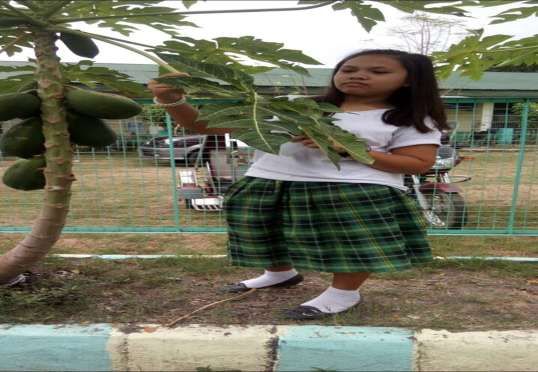
International Journal of Academic Multidisciplinary Research (IJAMR)
ISSN: 2643-9670
Vol. 5 Issue 2, February - 2021, Pages: 91-130
         ‗To teach is to make someone learn.‖ This statement means that the end product of teaching is learning. Learning is a
change as a transportation in an individual‘s behavior caused by experiences or self-activity. It implies that learning can only
happen through the individual‘s activity or his/her own doing. Most learning is intentional, like when a learner acquires knowledge
in the classroom or when one observes a demonstration activity. Intentional learning occurs when activities are purposefully
arranged for the students to participate and experience. Every waking moment all individuals are engaged in learning, however
learning occurs more when the various stimuli are properly arranged for the purposes of learning (Bilbao et al, 2008).

        To make learning effective, teacher must involve learners in organizing and finding relationship in the information they
encounter rather than being empty receptacles in need of a fill-up. The goal is to maximize the learning of all learners and to
increase the mutuality of their relationships with children different from themselves. Thus there is a need to change some teaching
methodologies to a cooperative learning that is centered on having learners become more willing and able to accept responsibility
and control their own learning (Zulueta, 2006).

         At present, in the Philippine Educational System, wherein there is a shortage in classroom throughout the country, there is
no enough funds to provide for instructional materials in every classroom to provide good quality of education for the students.
The main goal of teaching is to provide effective instruction to students. Considering the students that we have today. For the
students‘ learning science is never fun and the process is boring; thus resulting to decreasing of students‘ performance. They
focused on using gadgets and browsing the Internet and other related activities in the computer. Teachers are blame when the
students had lower scores and did not perform well. Therefore the teacher should find ways to create interesting instructional
devices that can provide necessary strategies for them to perform well (Banson, 2012)

           Indirect instruction method is best used when the learning process is inquiry-based, the result is discovery and the
learning context is a problem. The inquiry method may become a problem solving method when the focus of inquiry is a problem
to be solved. In the process of inquiry, students are led to discover something they have not known before. These inquiry and
problem solving may be made as a student project or if given a project, the students will employ a lot of inquiry and may end up
with a lot of discovery.

           Inquiry method approach provide children opportunities to explore, inquire and discover new learnings. The core of
inquiry is spontaneous and a self -directed exploration. Textbook-dictated procedures do not allow an active probe into the
unknown. Curiosity, special interests and instant queries among young demand immediate answers. It puts premium on obtaining
information through direct experiences. They are asking about something, doing something to obtain information and processing
information. As more and more substantiations unravel they compare, classify, analyze and evaluate collected observations.
Depending on the weight and relevance of the evidence, they formulate their own conclusion (Corpuz & Salandalan, 2004)
   Inquiry-based learning is fundamental for the development of higher order thinking skills. According to Bloom‘s Taxonomy,
the ability to analyse, synthesize, and evaluate information or new understandings indicates a high level of thinking. Teachers
should be encouraging divergent thinking and allowing students the freedom to ask their own questions and to learn the effective
strategies for discovering the answers. The higher order thinking skills that students have the opportunity to develop during inquiry
activities will assist in the critical thinking skills that they will be able to transfer to other subjects.
              The inquiry approach is also a search for the solution to a problem through an exploration and evaluation of
alternatives. This approach views a given discipline more as attitude than the body of knowledge or as method. Emphasizing the
affective aspects of learning, it uses both content and processes as means toward the development of the qualities of mind as
curiosity, skepticism, intellectual honesty, and others. Hence the primary aim is the development of a desirable attitude including
proper appreciation and valuing (Acero, 2000).
       Relative to the aforementioned, this research was conducted to find out, the effects of inquiry-based instruction on students‘
competencies in science.

Statement of the Problem

        This study aimed to compare traditional and inquiry based learning in the teaching science to Grade 8 students at
Calawitan National High School.

         Specifically it sought to answer the following questions:

    1.   How may the inquiry-based teaching be described in terms of:
         a. Content
         b. Methods
         c. Assessment?
    2.   What is the performance of Grade 8 students in the pretest?
                                                       www.ijeais.org/ijamr
                                                                                                                                  92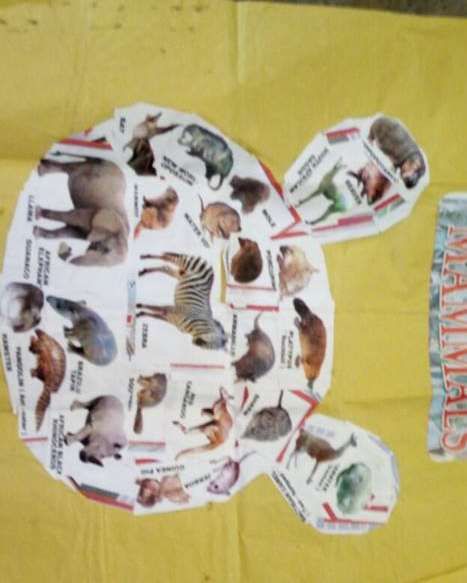
International Journal of Academic Multidisciplinary Research (IJAMR)
ISSN: 2643-9670
Vol. 5 Issue 2, February - 2021, Pages: 91-130
    3.   What is the performance of Grade 8 students in the posttest?
    4.   Is there a significant difference in the performance of Grade 8 students in the pretest and posttest?
    5.   What are the perceptions of the students on inquiry based teaching in science?

Hypotheses

          The study was guided by hypotheses that there is no significant difference in the performance of Grade 8 students in the
pretest and posttest

Conceptual Framework

      The study of science within education had a primary focus on memorizing and organizing facts. Unfortunately, there is still
evidence that some students are still receiving this type of science instruction today.

       Traditional education, also known as back-to-basics, conventional education or customary education, refers to long-
established customs that society traditionally used in schools. Some forms of education reform promote the adoption of
progressive education practices, a more holistic approach which focuses on individual students' needs and self-control. In the eyes
of reformers, traditional teacher-centered methods focused on rote learning and memorization must be abandoned in favor of
student-centered and task-based approaches to learning. However, many parents and conservative citizens are concerned with the
maintenance of objective educational standards based on testing, which favors a more traditional approach (Zulueta, 2006).
       Inquiry guided learning has widespread appeal for a variety of institutions of education throughout the world. As a suite of
teaching strategies that defies a simple prescription for practice, inquiry guided learning challenges practitioners to develop
conceptual framework that describe inquiry as a site of student learning rather than of traditional scholarship (Lee, 2004).

      Inquiry is a dynamic process of being open to wonder and puzzlements and coming to know and understand the world
(Galileo, 2004). There are different approaches of Inquiry-Based Learning/Teaching, such as Guided discovery, the 5E Model and
the 7E Model. Guided discovery model involve the inquisition, acquisition, supposition, implementation, summation and
exhibition. The 5E model approaches include the following engage, exploration, explanation, elaboration and evaluation.
Enhancement of Instructional Models 5E instructional model (1980s) become 7E Model which composed of elicit, engage,
exploration, explanation, elaboration, evaluation and extend. Bases of expanding the 5E Model, eliciting prior knowledge is a
necessary components of learning process to ensure that the concepts they develop are correct and not misconceptions (can be
done by framing a ―what do you think‖ question).Expert learners are much more adept at the transfer of learning than novices,
hence, practice in the transfer of learning is required in good instruction. The goal of 7E learning Model is to emphasize the
increasing importance of eliciting prior understandings and the extending, or transfer of concepts.

         A student-centered classroom, students are very much a part of constructing their own learning in a holistic environment
that capitalizes on student interests. The students are encouraged to reflect on their own learning, share their insights with their
peers, and apply new learning to real life, authentic experiences. When learners are the focus, they become fully engaged in the
process (McCombs and Miller, 2007).

                           Input                 Process                Output                  Outcomes

                   Module                  Inquiry Based                  Project                     Enhanced
                   Lesson                    Learning                   Performance                  Competencies
                   Grades                     Pretest                                                 In Science
                                              Posttest

                                                  Figure 1. Paradigm of the Study

                                                       www.ijeais.org/ijamr
                                                                                                                                 93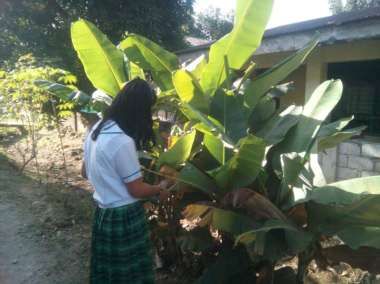
International Journal of Academic Multidisciplinary Research (IJAMR)
ISSN: 2643-9670
Vol. 5 Issue 2, February - 2021, Pages: 91-130
       As shown in Figure 1, the paradigm includes module, lesson and grades that serve as the basis of the study. The second
frame is the process which is the inquiry-based and traditional based instruction, and also include the pretest and the posttest which
served as the independent variables of the study. The third frame served as the output which includes the project and performance
of the students which served as the moderator variables. The last frame is the enhanced competencies in Science which served as
the dependent variable.

Significance of the Study

        The findings of the study will be beneficial to the following:

         Learners. The study will be helpful to the students for they could be informed of what Inquiry-based learning is. Grade 8
students with difficulties in studying science would have less difficulties in their lessons.

          Parents. The findings of the study will increase the participation of the parents in supporting the needs of their child and
their partnership in the school in achieving high scholastic performance of their children.

         Administration. The major provider of instructional material needs of the teacher, they will encourage to upgrade the
information technology resources in the school so that the teacher may find making module tool for instruction.

          Science Teachers. The result of the study may serve as encouragement and inspiration to science teacher as they perform
their duties, it will lessen the everyday task and improve knowledge of their learners. .

         Students. The study may be a great help learners‘ performance, will increase the level of understanding, uplift confidence
resulting to become more independent individual.

         Other Researchers. The result of this study may also enlighten other concern educators towards having another related
research in the future.

Scope and Limitation of the Study

           This research compared the performance of the students in science at Calawitan High School using two different
strategies of teaching the traditional and inquiry-based learning.

          The study was limited only on the performance and achievement in science

lessons of Grade 8 students during the school year 2016-2017. The experiment made use of two strategies encompass to
heterogeneous students of Grade 8 sections 8 Molave with 40 students and Grade 8 Yakal with 45 students in class. A pretest was
administered to test the prior knowledge of the students in Science.
Location of the Study
          This study was conducted at Calawitan High School in San Ildefonso, Bulacan. Calawitan National High School was
formally opened last July 1969 with 73 initial students and 3 pioneer teachers, thru the effort of barangay officials, parents and
concerned citizen in neighboring barangays. Despite the problems encountered by the school, still they progressed. They acquired
their new site, which is almost 10,000 sq. meters. The school caters children coming from Malipampang, Calasag, Telapatio,
Pulong Tamo and Pangclara Candaba Pampanga.
          The school has 29 regular permanent teachers and 595 students for the school curriculum year 2016-2017. Grade 8
students composed of 132 regular students in 3 sections namely Narra, Yakal and Molave. The two sections that served as the
subjects of the study were 8 Yakal with 45 students and 8 Molave with 40 students.

                                                       www.ijeais.org/ijamr
                                                                                                                                   94
International Journal of Academic Multidisciplinary Research (IJAMR)
ISSN: 2643-9670
Vol. 5 Issue 2, February - 2021, Pages: 91-130

                                                        Figure 2. Map of San Ildefonso

Definition of Terms

          To ensure thorough understanding of the terms used in this study, the following terms were defined operationally.
Academic performance. This is the learning outcome of the student respondents using the inquiry-based approaches in teaching
science.
Active learning. This terms refers to the student who actively response to the learning environments that allow students to talk and
listen, read, write, and reflect as they approach course content through problem-solving exercises, informal small groups,
simulations, case studies, role playing, and other activities -- all of which require students to apply what they are learning using the
inquiry-based strategies.
Cooperative learning. This refers to the systematic pedagogical strategy that encourages small groups of students to work together
for the achievement of a common goal. The term will be used when the students perform their group activity.
Grades. It refers to the numerical achievement and progress report of the students
Grade 8 Students. It refers to the students who were the subjects of the study.
HOTS. It means Higher Order Thinking Skills .It uses six levels of thinking such as knowledge, comprehension, application,
analysis, synthesis and evaluation for critical decision making. This will be used in the art of questioning in the inquiry-based
approach.
Inquiry-based learning- this will be the approach used in the study which starts by posing question, problems or scenarios—rather
than simply presenting established facts or portraying a smooth path to knowledge. This approaches was used as the main tool in
this study to enhance the competencies in science. The inquiry-based instruction is principally very closely related to the
development and practice of thinking skills
Lecture. This method is one of instructional strategies in traditional learning approaches. The lecture still remains an important
way to communicate information.
Module. This is the instrument used to conduct the inquiry-based learning approaches in the study. This instructional device served
as the basis on how the students increased their learning and understanding in the field of science.
Posttest. This is an assessment test given to the students‘ respondent after exposing them inquiry-based teaching instruction.
Pretest. This is an assessment test given to the students at the beginning of the study
Project. This is an assign task for the students like poster or collage made by a group of
students‘ to supplement and apply classroom studies.
Traditional method of teaching .This method of teaching and learning lies mainly on the teacher and it‘s believed that the students
will be able to use the knowledge if they are present in the class discussions and listen to the teacher‘s explanation and examples.
The teaching is teacher-centered. This is the teaching strategies used as the control group.

                                                        www.ijeais.org/ijamr
                                                                                                                                     95
International Journal of Academic Multidisciplinary Research (IJAMR)
ISSN: 2643-9670
Vol. 5 Issue 2, February - 2021, Pages: 91-130
METHODOLOGY

          This chapter presents the research design, data gathering techniques, sampling procedure and data analysis scheme of the
study.
Research Design
       This research used mixed methods. The study was experimental and used the pretest and posttest experimental design.
Quantitative analysis was used to determine any differences between the pretest and posttest means. Descriptive statistics was used
in the presentation of analysis and interpretation of data collected.
Data Gathering Techniques
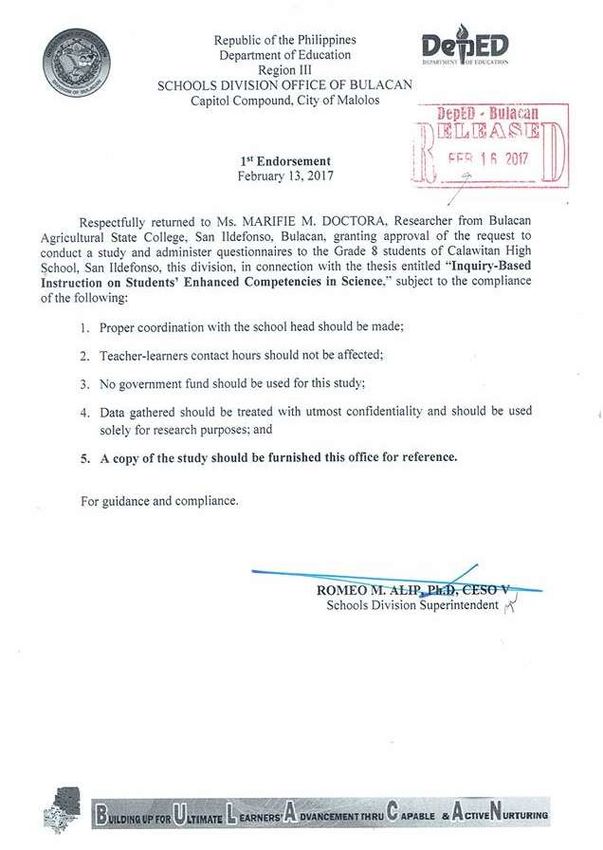
         The researcher sought permission from the Schools Division Superintendent of Bulacan. The researcher personally
handed over the endorsement to the school principal of Calawitan High School in San Ildefonso. After the receipt of the approval,
coordination with the advisers of the two sections schedule was made for the administration of Inquiry-based learning approach to
the students. The researcher personally administered the module for the accuracy of the responses. After gathering the previous
grades of the students in Science a pretest was given to the students before the conduct of the research. After six weeks a posttest
was administered to the students involved in the study. Grade 8 Yakal used the Inquiry based learning modules and will serve as
the experimental variables while Grade 8 Molave will used the Traditional based learning which will serve as the control group.
Project and Performance ratings of the students were gathered to measure the reliability of the results. A corresponding Rubrics
was designed and used to evaluate the Project.

                                                TIMETABLE OF ACTIVITIES
                                                         S.Y. 2016-2017
               JANUARY 30-31, 2017             Day 1    Pretest in Science 8
                                               Day 2    Introduction to Biodiversity
                                               Day 4    ACTIVITY # 1: What's in a Name?
               FEBRUARY 6-9, 2017              Day 1    Archaebacteria and Eubacteria
                                               Day 2    ACTIVITY 2: How do Bacteria in Yogurt
                                                        Look Like?
                                               Day 3    Kingdom Protist
                                               Day 4    Kingdom Fungi
               FEBRUARY 13-16, 2017            Day 1    Plant Kingdom
               MODULE 2                        Day 2    ACTIVITY # 3: Classifying Vascular and
                                                        Non Vascular Plants
                                               Day 3    Gymnosperm, Angiosperm and Harmful Plants
                                               Day 4    ACTIVITY # 4: Monocot and Dicot
               FEBRUARY 20-24, 2017            Day 1    Introduction of Animal Kingdom
                                               Day 2    Cnidarians, Mollusks, Echinoderm
                                                        and Arthropods
                                               Day 3    Flatworm, Roundworm and Segmented Worms
                                               Day 4    ACTIVITY # 5: Classifying Worms
               FEBRUARY 27-28                  Day 1    Vertibrates: Fishes, Amphibians and Reptiles
                                               Day 2    Birds and Mammals
               MARCH 1-2                       Day 3    ACTIVITY # 6: The Importance of Biodiversity
                                                        in Ecosystem
                                               Day 4    INTERACTION: Food Chain and Food Web
               MARCH 6-9, 2017                 Day 1    ACTIVITY # 7: How do you Identify the
                                                        components of a Food Chain in an Ecosystem
                                               Day 2    Biochemical cycles

                                                       www.ijeais.org/ijamr
                                                                                                                                 96
International Journal of Academic Multidisciplinary Research (IJAMR)
ISSN: 2643-9670
Vol. 5 Issue 2, February - 2021, Pages: 91-130

                                                 Day 3    Biodiversity Collage/Poster Making(Project)
                                                 Day 4    Posttest in Science
Sampling Procedures
          Table 1 presents the lessons included in the study two heterogenous section were used. Both sections were exposed to the
same lessons but one section used Inquiry-based learning module while the other section used the Traditional based of learning
approaches. Universal sampling or total enumeration will be utilized in selecting the students. A total of 85 students participated in
the study.
                                         Table 1. Distribution of the Respondents of the Study

                                 Calawitan High Schools Grade 8                    Number of Students
                                            Section

                                                                           Male           Female            Total

               1                 Molave                               23                17             40

               2                 Yakal                                29                16             45

Data Analysis Scheme
         The results of the study were tabulated, analyzed, interpreted and represented in textual and tabular form using the mean,
standard deviation and independent samples t-test.

Results and Discussion

          This chapter presents the analyses and interpretation of all the data gathered in this study in accordance with the problems
stated in Chapter I. It looked into the effects of inquiry-based instruction and traditional teaching strategies on the performance of
Grade 8 learners in Science at Calawitan High School, San Ildefonso, Bulacan during the school year 2016-2017.
Inquiry Based Teaching
       Table 2 presents the mean, standard deviation of the students view on the content, method and assessment of the Grade 8
students towards inquiry based teaching.
        It can be seen from the table that the student respondents strongly agree on the content, method and assessment of the
inquiry based teaching strategies.
        It can be noted from the table that the item ―Present objectives that are easily understood‖ garnered the highest computed
mean of 4.78 with a verbal interpretation of ―strongly agree‖. Meanwhile, item ―Use effective techniques that improves learning of
the students‖ received the lowest computed weighted mean of 4.58 with a verbal interpretation of ―strongly agree‖. The overall
mean was computed at 4.668 which was verbally described as ―strongly agree‖.
         Further, table based on content showed that the highest computed mean of 4.80 with a verbal description of ―strongly
agree‖ has recorded for the item ―Provide different ways of exploring the lesson like games, puzzle, collage making, activities,
reporting, role play and group work. However, the item‖ Use localized materials that can be found inside the school ground‖
received the lowest computed mean of 4.58 with a verbal description
of strongly agree. The overall mean was computed at 4.658 which was verbally described ―strongly agree‖
          However, students assessed the inquiry based teaching strategies based on content, method and assessment was verbally
described as ―strongly agree‖
       These results imply that inquiry approach sometimes termed as ―discovery‖ heuristic‖ and problem solving‖ is defined
simply as a teaching method which is ―modelled after the investigative processes of scientists‖. These results imply that students
can acquire an orderly and logical arrangement that may produce quality education and quality learners (Aquino, 2003).

                                                         www.ijeais.org/ijamr
                                                                                                                                   97
International Journal of Academic Multidisciplinary Research (IJAMR)
ISSN: 2643-9670
Vol. 5 Issue 2, February - 2021, Pages: 91-130

                                                Table 2. Inquiry-based teaching
                                                                                               N=45
                 A. Content
                                                                                      Mean    SD      Description

            1. Present objectives that are easily understood.                         4.78    .420       SA

            2. Use effective techniques that improve learning of the students.        4.58    .554       SA

            3. Use different question such as what, where, when, why and how in       4.67    .522       SA
               guide question and in exploring the lesson
            4. Various ways of presenting the lesson such as concept map, graphic                        SA
               organizer, puzzle (word, picture loop a word, and cryptogram)          4.67    .603

            5. Show organized content of the lesson that enhance the learner          4.64    .529       SA
               knowledge in science.
               Overall Mean                                                           4.668   SA

                 B. Method                                                                     N=45
                    The Teacher;
                                                                                      Mean    SD      Description

            1. Provide different ways of exploring the lesson like games, puzzle,                        SA
               collage making, activities, reporting, role play and group work.       4.80    .405

            2. Use (localized)materials that can be found inside the school ground.   4.58    .543       SA

            3. Show clear and step by step procedure of the activities.               4.62    .614       SA

            4. Use instructional materials like manila paper, cartolina, localized                       SA
               materials, colored paper, charts, powerpoint presentation and video    4.62    .490
               lesson.
            5. Present a detailed outline of the lesson.                              4.67    .477       SA

                Overall Mean                                                          4.658   SA

                 C. Assessment                                                                 N=45
                    The Teacher;
                                                                                      Mean    SD      Description

            1. Help the learners increase their level of understanding.               4.76    .435       SA

            2. Provide different ways in assessing the learners.                      4.60    .495       SA

            3. Increase the knowledge of the learners in scienc.e                     4.80    .405       SA

            4. Provide updated way of evaluating the learner.                         4.56    .503       SA

            5. Show clear instruction in pretest and posttest.                        4.67    .477       SA

               Overall Mean                                                           4.678   SA

              Legend:
                                                      www.ijeais.org/ijamr
                                                                                                                    98
International Journal of Academic Multidisciplinary Research (IJAMR)
ISSN: 2643-9670
Vol. 5 Issue 2, February - 2021, Pages: 91-130
                  Rating Scale                 Description

                  4.21 - 5.00                  Strongly Agree (SA)
                  3.41 - 4.20                  Agree (A)
                  2.61 - 3.40                  Moderately Agree (MA)
                  1.81 - 2.60                  Moderately Disagree (MD)
                  1.00 - 1.80                  Strongly Disagree (SD)

Performance of the students in the pretest and posttest (Control Group)

       Table 3 exhibits the performance of the Grade 8 Molave in the pretest and posttest (50 item test) using the traditional
teaching strategies.

         It can noted from the table that in the pretest for traditional teaching strategy, the scores of the students ranged from 11 to
20 with a computed mean of 13.00 and standard deviation of 2.819. A closer look at the table reveals that the majority of the
students‘ 82.5 percent of the respondents got scores of 11 to 20 and the remaining 17.5 percent obtained scores from 0 to 10.
         Also the same table shows that the score in the posttest for traditional teaching strategy, ranged from 21 to 30 with a
computed mean of 22.125 and standard deviation of 4.931. Furthermore, it can be seen from the table that half or 50 percent of the
respondents had a registered scores from 21 to 30. Meanwhile, 37.5 percent of the respondents got scores of 11 to 20 and the
remaining 12.5 percent obtained scores of 31 to 40.

         Traditional teaching is concerned with the teacher being the controller of the learning environment. Power and
responsibility are held by the teacher and they play the role of instructor (in the form of lectures) and decision maker (as regards to
curriculum content and specific outcomes). They regard students as having 'knowledge holes' that need to be filled with
information. Traditional methods of teaching will not be complete without mentioning lecture. Students focus on memorizing what
they are told. "Experiments" follow cookbook-style procedures to produce the expected results (Salandalan, 2008)

                                       Table 3. The students‘ test scores in the pretest and posttest
                                       Pretest                                              Posttest
                                      (N = 40)                   Verbal                    (N = 40)             Verbal
               Score
                                                              Description                                     Description
                                 f               %                                      f             %
              41 – 50
              31 – 40                                                                 5            12.5            VS
              21 – 30                                                                20            50.0             S
              11 – 20            33             82.5              FS                 15            37.5            FS
               0 – 10            7              17.5              BS
            Range                                17 – 5                                          34 – 12
            Mean                                 13.00                                           22.125
            Std.
                                                 2.819                                            4.931
            Deviation
    Legend:
    VS – Very Satisfactory
    S – Satisfactory
    FS – Fairly Satisfactory
    BS – Below Satisfactory

Performance of the students in the pretest and posttest (Experimental Group)

        Table 4 presents the results of the pretest before and after exposing the students to inquiry-based teaching strategy.
        Examination of the tabulated results shows that in the using inquiry-based teaching strategy, the scores of the students‘
ranged from 11 to 20 . Meanwhile, the mean was computed at 14.47 while the standard deviation which measures the deviation of
scores of the students from the mean was recorded at 3.188. Further examination of the results reveals that majority or 82.2 percent

                                                          www.ijeais.org/ijamr
                                                                                                                                     99
International Journal of Academic Multidisciplinary Research (IJAMR)
ISSN: 2643-9670
Vol. 5 Issue 2, February - 2021, Pages: 91-130
of the respondents got the scores of 11 to 20, 8.9 percent got scores of 21 to 30 and the remaining 8.9 percent obtained scores of 0
to 10.
Further examination of the Table 3 reveals the posttest after exposing of the learners
to inquiry-based teaching strategy, the scores of the respondents in the posttest ranged between 31 and 40 with a computed mean
of 32.20 and standard deviation of 6.170. Majority or 57.8 percent of the respondents obtained scores of 31 to 40; 33.3 percent got
scores of 21 to 30; 6.7 percent got scores of 41 to 50; and the remaining 2.2 percent obtained scores of 11 to 20.
Inquiry-based learning increase the level of performance of the students and inspire them to learn more thoroughly. Inquiry
guided learning also develops sense of independence among learners. It is considered as a self-directed learning wherein it focuses
more on discipline as a framework and not on scholastic. It also serves as the dominant mode of learning and the primary stimulus
for knowledge acquisition (Lee, 2011).
Inquiry based teaching is a teaching that focused on inquiry or question. But effective inquiry is more simply answering
questions and getting the right answer. It spouses investigation, exploration, search, quest, research, pursuit and study. It is
enhanced by involvement with the community of learners, each learning from the other in social interaction (Kuklthan, Maniotes
& Caspari, 2007).
It can be noted from the table that the posttests registered the highest mean of 32.20 when students were exposed to
inquiry based teaching strategies.
In this note it can be said that the fifty item pretest /posttest that covers the different topics using inquiry-based teaching
has increased the competency level of the students in science.
Table 4. The students‘ test scores in the pretest and posttest
Pretest Posttest
(N = 45) Verbal (N = 45) Verbal
Score
Description Description
F % f %
41 – 50 3 6.7 O
31 – 40 26 57.8 VS
21 – 30 4 8.9 S 15 33.3 S
11 – 20 37 82.2 FS 1 2.2 FS
0 – 10 4 8.9 BS
Range 21 – 8 44 – 17
Mean 14.47 32.20
Std.
3.188 6.170
Deviation
Legend:
O – Outstanding
VS – Very Satisfactory
S – Satisfactory
FS – Fairly Satisfactory
Differences among groups in the pretest and posttest
To determine if the scores of the students were significantly different from their scores in the posttest, dependent samples t-
test or paired sample t-test was employed. This statistical tool tells the researcher if the difference between two means is larger
than would be expected by chance (i.e. statistically significant). Results of the analysis are presented in Table 5.
Findings revealed that highly significant differences existed between the pretest and posttest. This highly significant
differences were brought about by the fact that the computed probability values is less than 0.05 significance level.
Table 5 and 6 show that there is a significant difference between the pretest and posttest scores of the students (t = -
13.858, 0.05). This shows that the students had a significant increase of 58.74 percent in their posttest scores as compared with
their pretest scores.
www.ijeais.org/ijamr
100International Journal of Academic Multidisciplinary Research (IJAMR)
ISSN: 2643-9670
Vol. 5 Issue 2, February - 2021, Pages: 91-130
Table 5. Paired samples t-test of the pretest and posttest (Control Group)
Variable N Correlation 2-tail sig. Mean Std. Dev. SE of Mean
Pretest 13.00 2.819 .446
40 .637 .000**
Posttest 22.13 4.931 .780
** highly significant
Table 6. Paired differences between pretest and posttest (Control Group)
95% confidence
Mean Std. Dev. SE of Mean t-value df 2-tailed sig.
interval
-9.125 4.164 .658 -13.858 39 .000** -10.457(L)
** highly significant
A thorough examination of Table 7 shows that before exposing the students to inquiry based approach, the pretest had a
mean score of 14.47 with a computed standard deviation of 14.47. After subjecting to inquiry based approach, posttest was
administered and a computed mean of 32.20 was registered with a standard deviation of 6.170. Based on the t-test analysis, the
difference of 17.733 was found highly significant as shown.
To assess the effectiveness of inquiry-based teaching approach in teaching
Science, paired samples t-test was used in the study. The results showed that there is a highly significant difference in the students
with a computed value of -17.650. This indicated that highly significant differences between the pretest and posttest of the students
in science when they were subjected to inquiry-based teaching strategies.
Results showed that the inquiry-based teaching strategies is effective in teaching Science. This indicated that the students
learned the lesson when the teacher applied these
strategies. Therefore, it helpful enhanced their level of competencies in science.
Table 7. Paired samples t-test of the pretest and posttest (Experimental Group)
Variable N Correlation 2-tail sig. Mean Std. Dev. SE of Mean
Pretest 14.47 3.188 .475
45 .715 .001**
Posttest 32.20 6.170 .920
** highly significant
Table 8. Paired differences between pretest and posttest (Experimental Group)
95% confidence
Mean Std. Dev. SE of Mean t-value df 2-tailed sig.
interval
-17.733 6.740 1.005 -17.650 44 .000** -19.758(L)
** highly significant
Differences between groups in the pretest and posttest
In this part of the study, the performance of the Grade 8 students respondents in the pretest using the inquiry based
teaching strategies were compared using the t-test with a value of 2. 251, with a mean difference of 1.467 a 2-tailed significant of
.056 which is described as not significant. Results of the analysis are shown in Table 9. Findings revealed that there is no
significant differences in the pretest scores of the students.
www.ijeais.org/ijamr
101International Journal of Academic Multidisciplinary Research (IJAMR)
ISSN: 2643-9670
Vol. 5 Issue 2, February - 2021, Pages: 91-130
Student learning is strongly steered by assessment tool (Willis, 2002). Traditional methods of assessment have often used
only ―objective‖ measures such as examinations and test to assess learning. Student perceptions of assessment requirements
directed their approaches to learning and affected their learning outcomes.
Table 9. Independent samples test in the pretest (Control vs. Experimental)
Mean Difference Std. Error Diff t-value df 2-tailed sig. 95% confidence interval
.171(L)
1.467 .652 2.251 82.999 .056ns
2.763(U)
ns - not significant
Table 10 reveals the results of the analyses when paired samples t-test was utilized to determine the differences of the
posttest scores between the control and experimental groups of Grade 8 students.
A closer look of the tabulated results shows that significant differences existed in the pretest scores performance of the
students who were taught the traditional way and the inquiry –based strategies. The mean difference is 10.075 with t-value of
8.355. Findings indicated that two tailed significance is at .027 which is less than the .05.
Table 10. Independent samples test in the posttest (Control vs. Experimental)
Std. Error 95% confidence
Mean Difference t-value df 2-tailed sig.
Diff interval
7.676
10.075 1.206 8.355 82.117 .027*
12.474
*significant
Inquiry based learning promotes the acquisition of new knowledge, abilities and attitudes through students increasingly
independent investigation of questions, problems and issue, for which there often is no single answer (Lee, 2004).Through this
strategy students could utilized and develop HOTS which a great help in increasing the level of knowledge among the respondents.
Qualitative Analysis
To determine the perception of the students on inquiry based approach, qualitative data were collected by means of a
questionnaire. It identified students‘ view on inquiry-based teaching instruction by giving the respondents a seven item
questionnaire on their perceptions when they were exposed to inquiry-based teaching approach.
Qualitative researchers are concerned with making inference based on perspective, so it is extremely important to get as
much data as possible for later analysis. Researchers spend a considerable amount of time designing interview questions.
Interviews are designed to generate participant perspectives about ideas, opinions, and experiences.
A repertory grid was used by the researcher to further describe the students‘ perspectives. The Repertory Grid is an
instrument designed to capture the dimensions and structure of personal meaning. Its aim is to describe the ways in which people give
meaning to their experience in their own terms. It is not so much a test in the conventional sense of the word as a structured interview
designed to make those constructs with which persons organized their world more explicit. The way in which we get to know and
interpret our milieu, our understanding of ourselves and others, is guided by an implicit theory which is the result of conclusions drawn
from our experiences. The repertory grid, in its many forms, is a method used to explore the structure and content of these implicit
theories/personal meanings through which we perceive and act in our day-to-day existence.
Students’ perception on Inquiry-based Teaching in Science
The students participated when sharing their perception about the inquiry based
teaching instruction. They gave their insights and comments on the teaching strategies used in this research. This showed that the
students of Grade 8 Yakal in Calawitan High School were very appreciative and eager to learn the new method of teaching.
Repertory Grid 1. Students‘ insight on Applying Inquiry based teaching approach
www.ijeais.org/ijamr
102International Journal of Academic Multidisciplinary Research (IJAMR)
ISSN: 2643-9670
Vol. 5 Issue 2, February - 2021, Pages: 91-130
Theme Subtheme Significant Statement
Knowledge and
The students want To know how students will handle their works and what
awareness about
to know more about are the different strategies in way of teaching
inquiry based
the inquiry-based
teaching I need to know the different instructional way of
strategy teaching like problem solving etc.
Inquiry based strategy
is a different method To have an idea about the different method and if it is
of learning effective
Effects of the inquiry To know more ways of learning
based in learners It is about student centered problem solving group
activities and discovery approach
To make our activities easier and to know about the
teaching method, we want to know it is effective
To know what inquiry based learning approach is
I need to know about how will they enlighten the
students through this strategies
Main Theme 1. The students are interested to know more about the inquiry-based teaching strategy.
Insight and perception about the content of inquiry-based teaching instruction
Students gave their points of view on what are their perceptions were on the content of the Inquiry-based teaching
instruction. They were given the ideas needed for them to learn more about the new teaching method introduced to them.
An old adage states: "Tell me and I forget, show me and I remember, involve me and I understand." The last part of this
statement is the essence of inquiry-based learning, says the workshop author. Inquiry implies involvement that leads to
understanding. Furthermore, involvement in learning implies possessing skills and attitudes that permit you to seek resolutions to
questions and issues while you construct new knowledge (Exline, 2004)
Repertory Grid 2. Students need to learn about inquiry-based learning approach
Theme Subtheme Significant Statement
The students want Inquiry-based is discovery I learn about problem solving, group activities and
to learn more approach discovery approach
about inquiry Inquiry based is more on I learned how to cooperate with my groupmates and
based teaching students centred how to solve problems
approach Inquiry based gained I learn more when the teacher use different ways of
Is more comfortable for teaching in science
the learners I learned the lesson in easily using this teaching
Inquiry based is effective method
teaching approach I learn how to be a good leader and a better follower
and also helped me build my self confidence in
doing different activities in the classroom
I learned that the leader only leads not to do all the
activities
Yes it is effective in our learning we do the
activities by ourselves
Main Theme 2: Students want to learn more about inquiry-based teaching
Perception of the students about the method used in inquiry based teaching
The students shared their idea on the method used in inquiry-based teaching instruction. They perceived that these
teaching strategies make them independent and interested with what they are doing. Students performed the varied tasks in this
approach through learning by doing. Like what Aristotle said that ―For the things we have to learn before we can do them, we
learn by doing them‖. Learning by doing means learning from experiences resulting directly from one‘s action (Reese, 2011).
Repertory grid 3. Activities and techniques of inquiry-based teaching approach
www.ijeais.org/ijamr
103International Journal of Academic Multidisciplinary Research (IJAMR)
ISSN: 2643-9670
Vol. 5 Issue 2, February - 2021, Pages: 91-130
Theme Subtheme Significant Statement
Students do the different Inquiry-based approach It became easier for us to learn the lesson
task and activities using made the learners more It helped us the to be active in our classroom
varied techniques of active and independent discussions
inquiry- based teaching Inquiry-based approach Group activities, were and focused on the
approached helped the students do the students
various learning activities
It helped us in our learning
Inquiry-based is a multi-
We enjoyed the lessons because we were
tasking technique
solving puzzles
We were aware of other ways of other ways
of learning of science.
Main Theme 3: The students become aware of other teaching techniques through inquiry-based teaching strategy.
Perception of the students on how inquiry based teaching instruction enhanced learning in science
Students perceived that using the inquiry based teaching enhanced their learning in science. This made the students involve
in the activities and the tasks needed in the lesson.
Repertory grid 4: Students insights on how inquiry based enhanced learning in science
Theme Subtheme Significant Statement
The students want to Inquiry-based approach It change us and it enhanced our
enhance their learning enhanced the learning abilities learning in science by means of
competencies in science of the students sharing knowledge
Inquiry-based improve the With collaborative activity we
progress report of the students enhanced our skills and talents to
Inquiry-based made the make an activity easier to perform
students become familiar with It helped me study to improve my
learning by doing grade
In this strategy we were are not just
using 2 senses but all 5 senses which
helped us
Main Theme 4: The students experienced the teaching techniques of inquiry-based strategy.
Perception of the students on the impact of inquiry-based teaching
The students believed that inquiry-based learning approach helped them gain knowledge and skills in doing different
activities using inquiry-based teaching. One of the important outcome of inquiry should be useful knowledge about the natural and
human-designed worlds. These broad concepts contain important issues and questions that individuals will face throughout their
lives. Also, these concepts can help organize the content of the school curriculum to provide a relevant and cumulative framework
for effective learning. An appropriate education should provide individuals with different ways of viewing the world,
communicating about it, and successfully coping with the questions and issues of daily living. Likewise, happened in classroom
situation that this teaching strategies can boost the student performance in activities in science lesson. (paraphrase) ( Exline, 2004)
Repertory grid 5: The inquiry based approach promote efficient techniques that increase the learners knowledge in science
Theme Subtheme Significant Statements
Students want to find out Inquiry based teaching Yes, because students will know about
which serve as more approach is more effective the inquiry based learning
efficient the inquiry based than traditional Yes unlike on traditional way which
approach or traditional Inquiry based teaching more and lectures and discussion
approach in their lesson in approach is easy to follow and Yes this is effective because they help
science understand the lesson the students more active
Inquiry based teaching Yes, its makes all activity easier
instruction enhanced the Yes because the students makes as
students confidence cooperative to the teacher and co-
students
www.ijeais.org/ijamr
104International Journal of Academic Multidisciplinary Research (IJAMR)
ISSN: 2643-9670
Vol. 5 Issue 2, February - 2021, Pages: 91-130
Main theme 5: Students learned that inquiry based learning is an effective technique in teaching science.
Perception of the students on assessment using inquiry-based teaching
Students perceived that using inquiry-based teaching increases their
Learning in science. Through this method students become aware and familiar on the
lessons being taught since they are the one who search and discover it. This strategy gained more knowledge for the students, thus
it enhanced their learning.
Repertory grid 6: Inquiry based approached increased the learning ability of the students in science.
Theme Subtheme Significant Statements
Students want to test how Inquiry based learning used It increase my learning using the
inquiry based teaching different strategies different strategies
instruction increase Inquiry based increase the It helps me to learn well in every
learning. learning experience of the lessons
students I use a lot of my senses to increase my
strategies on how to learn science
Main theme 6: Inquiry based teaching instruction increased the level of learning skills of the students using varied strategies in
science lesson.
Perception of the students on how inquiry based teaching instruction enhanced their competency level in science
Inquiry-based learning uses a central question to frame a curriculum unit or module. Students answer this central question
for themselves, discovering and learning through a series of guided discussions, experiments, and hands-on activities over several
class periods. Teachers find that students are more engaged in what they're learning, and have a wider context for understanding
the material rather than just hearing a lecture or memorizing facts (Lucas, 2017).
Students perceived that when learning in science lessons is inquiry-based, their competency in science will also increase.
Using this strategy, the students were ready to cooperate with others and ready to face the learning tasks in the classroom.
Repertory grid 7: Inquiry-based approached enhance the competency level in science
Theme Subtheme Significant Statements
Students want to know if the Inquiry-based teaching
inquiry based teaching instruction enhanced the It enhanced the competency
instruction will increase the competency in science level by making the students
competency in science Inquiry-based made the lesson study
more understandable for the Yes, it made me understood the
student lesson
Yes, compared with the
traditional way of teaching
Main theme 7: Inquiry based teaching instruction enhanced the students‘ level of competency in science.
FINDINGS, CONCLUSIONS AND RECOMMENDATION
This chapter presents the summary of the major findings, the conclusions drawn based on the findings, and the
recommendations given in accordance with the conclusions.
Findings
This study compared the traditional and inquiry based teaching approach in Grade 8 students of Calawitan National High
School.
Using the procedures described in the preceding chapters, the answers to the problems raised in this study were ascertained
and summarized as follows: Before conducting the research, pretests results showed that the learners registered the highest mean
of 14.47 in inquiry based teaching approach which is slightly higher than traditional teaching approach. Meanwhile, the lowest
mean of 13.00 was computed for the pretest for traditional teaching approach.
www.ijeais.org/ijamr
105International Journal of Academic Multidisciplinary Research (IJAMR)
ISSN: 2643-9670
Vol. 5 Issue 2, February - 2021, Pages: 91-130
After the experiments, findings revealed that in the posttests, respondents registered the highest mean of 32.20 when they
were exposed to inquiry based teaching approach. On the other hand, a computed mean of 22.13 was registered for the traditional
method.
When the mean scores of the pretests and posttest were compared using the paired samples t-test, results revealed that
highly significant differences existed between the performance of the students in the control and experimental group.
Moreover, significant differences existed between the performances of the students in Science when they were
subjected to Inquiry-based teaching.
Conclusions
Based on the findings of the study, it is therefore concluded that there is a significant difference between the students‘
performance in Grade 8 science when they were subjected to Inquiry-based teaching.
Henceforth, the inquiry-based teaching enhanced the competency levels of the students in Science.
Recommendation
In the light of the findings of the study, the following recommendations were drawn.
1. Teachers should find time to have an enhance their teaching strategies for the benefit of the students by attending school
learning action cell (SLAC) sessions and other in-service seminars.
2. School Administrators provide training and seminar for the teacher that promote critical and logical thinking .This will be
of great help for the students to become more independent learners and acquire lifelong practical skills.
3. In the future studies, it is suggested that an investigation whether inquiry-based teaching has a similar effect when the
students are group in large numbers.
LITERATURE CITED
Acero. V. etal. (2000). Principles of and Strategies of Teaching. Manila: Rex Publishing Company Incorporation.
Arao, R. R. etal. (2011) Statistics (Based on CMO 03 Series 2007). Rex Bookstore Inc.
Aquino, G. V. 2003 Models, Strategies and skills: A Guide to Efficient and Effective Teaching. Quezon City. National Book Store.
Aquino G. V. (2000) Educational Management, Principles, Functions, Concepts. Manila: Rex Publishing Company Incorporation.
Aquino, M. D. et al. (2013) Worktext in Science and Technology Science Links,
First Edition. Rex Publishing Company Incorporation.
Aquino, G. V. (2004) Effective Teaching Third Edition. Manila: Rex Publishing Company Incorporation.
.
Bailey, R. (2013). Three domain system. Retrieved from http://biology.aout.com/od/evolution/a/99041708a.html on December 10,
2016.
Banson, Precillano T. (2012) Handbook and Legal Bases of Education 2 nd Edition.
Bilbao,Purita et al. (2008) Curriculum Development. Lorimar Publishing Inc.
Carpora, J.M. & Blessinger P. Inquiry Based Learning for Science, Technology, Engineering and Mathematics (STEM) Programs.
A Conceptual Resource for Educators.
https://books.google.com.ph/books?id=tuvvAAAAMAAJ&q=inauthor:%22Joan+A.+Gallagher-
Bolos%22&dq=inauthor:%22Joan+A.+GallagherBolos%22&hl=en&sa=X&ved=0ahUKEwiEtKPgvYPTAhXIvrwKHXbVDMA
Q6AEIGjAA: Retrieved on February 10, 2017.
Corpuz, Brenda B. etal. (2006) Principles of Teaching 1. Lorimar Publishing Inc.
Corpuz, Brenda B. etal. (2006) Principles of Teaching 2. Lorimar Publishing Inc.
www.ijeais.org/ijamr
106International Journal of Academic Multidisciplinary Research (IJAMR)
ISSN: 2643-9670
Vol. 5 Issue 2, February - 2021, Pages: 91-130
Corpuz, Brenda. B. & Salandalan Gloria G, (2015) Principles of Teaching with TLE. Lorimar Publishing Inc.
Curriculum Guide for Science .K-12 Curriculum. Pasig City. DepEd. 2012.
Dantes, Jennifer P.( 2015). Simulation, Inquiry and Collaboration in Teaching. Thesis. Bulacan Agricultural State College.
Exline, Joe (2004) Inquiry- based learning retrieved from http://www.thirteen.org/edonline/concept2class/inquiry/on March 31,
2017
Garcia Sy, M. (2015). Social Networking Sites and Virtual Learning Environments for climate Change Education. Dissertation.
Bulacan Agricultural State College.
Handbook in Science: 2002 Basic Education Curriculum in Secondary Level. Pasig City
DepEd. 2002
Garcia Sy, M. (2016).Handbook in Science: Inquiry-Based learning handbook
Inquiry based approach:© 2004 Educational Broadcasting Corporation. Retrieved from
http://www.thirteen.org/edonline/concept2class/inquiry/ on March 24, 2017
Karser, G.E (2011). Classification: The three domain system. Retrieved from
http;//faculty.ccbcmd.edu/courses/bio141/lecguide/unit1/3domain/3domain.html.
Kuklthan, C. C.; Maniotes L.K., and Caspairi, A. K. (2007). Guided Inquiry: Learning in the 21 st Century. Santa Barbara, CA:
Libraries Unlimited
Lee, Virginia S. 2011. ―The Power of Inquiry as a Way of Teaching‖ Innovation Higher Education 2011 .36(3) 149-160. Retrieved
on March 31, 2017.
Lee. (2004) Traditional Scholarship retrieved from
http://www.teachhub.com/traditional scholarship. Retrieved on December 5, 2016
Lucas, Rita D. et al (2014) Facilitating Learning. Lorimar Publishing Inc.
Lucas, George. (2017) Educational Foundation. Retrieved from https://www.edutopia.org/practice/inquiry-based-learning-science-
classroom on May 22, 2017
Martinez, Joyce Marie V. (2007) SciLinks TIMSS-Based Learning Materials for Secondary Level, Module 10.
McCombs, B. L. (2009). Learner-centered Learning Classroom Practices and
Assessment: Maximizing Student Motivation, Learning Achievement. Research paper
Reese, Hayne W. (2011). Behavioral Development Bulletin Volume 11.Retrieved
fromhttp://psycnet.apa.org/journals/bdb/17/1/1.pdf on May 28, 2017.
Repertory Grid: Retrieved fromhttp://www.terapiacognitiva.net/record/pag/man1.htm on March 25, 2017.
Philippines, Department of Education. (2013)Science and Technology. Reprint Edition
Qualitative Research: Retrieved from http://atlasti.com/qualitative-research/ on March 21,
2017
Qualitative Research Design: Retrieved fromhttps://researchrundowns.com/qual/
qualitative-research-design/on March 30, 2017.
Ramos, Arnold (2010) Research and Statistics
www.ijeais.org/ijamr
107You can also read


