Climate change adaptation and cocoa farm rehabilitation behaviour in Ahafo Ano North District of Ashanti region, Ghana
←
→
Page content transcription
If your browser does not render page correctly, please read the page content below
Open Agriculture 2021; 6: 263–275
Research Article
Abayomi Samuel Oyekale*
Climate change adaptation and cocoa farm
rehabilitation behaviour in Ahafo Ano North
District of Ashanti region, Ghana
https://doi.org/10.1515/opag-2020-0191 sharecropping. The implications of the results were that
received July 20, 2020; accepted September 3, 2020 promotion of climate change perception would facilitate
Abstract: Sustainable cocoa production is the hub of adaptation, and the form of cocoa farmland ownership as
economic development and growth in Ghana. Climate well as climate change adaptation indicator influenced
change has been implicated in the dwindling produc- farmers’ involvement in cocoa farm rehabilitation.
tivity of the Ghanaian cocoa sub-sector, although defor- Keywords: climate change adaptation, cocoa farm reno-
estation for cocoa farmland expansion poses significant vation, cocoa farm rehabilitation, land tenure, Ghana
long-term risks to ecosystem stability and environmental
conservation. This study assessed farmers’ perception of
climate change, their adaptation methods and the factors
explaining involvement in the renovation/rehabilitation 1 Introduction
of old cocoa farms. The data were collected from 378
cocoa farmers in Ahafo Ano North District in the Ashanti Over the past few decades, cocoa production has under-
region. The data were analysed with Principal Component gone significant transformations, although low produc-
Analysis (PCA), Ordinary Least Square regression, Negative tivity prevails partly due to changes in some weather
Binomial regression and Two-stage Probit regression. The parameters. A projected future decline in cocoa produc-
results showed that the majority of the farmers were older tivity portends some economic concerns to the fate and
than 50 years and attained primary education. High tem- fortune of several stakeholders along its value chains
perature (64.29%), too stormy rainfall (64.29%) and too much (Abbott et al. 2005). More specifically, companies that
rainfall (61.90%) were largely perceived by cocoa farmers utilise cocoa as a major raw material in the production
in 2015. The farmers were adapting to climate change of chocolates and other candy sweets are at risk of down-
through diversification into other crops (70.63%), planting sizing with a consequential decline in their profit levels.
of hybrid varieties (71.69%), commitment to spray cocoa Although it had been projected that the global chocolate
pods regularly (74.87%) and initiation of some changes market will grow to about USD 161.56 billion in revenue
in the planting and harvesting times (71.96%). The adapta- by 2024 from its value of USD 103.28 billion in 2017 (Zion
tion was significantly influenced (p < 0.05) by cocoa Market Research 2018), this is only achievable if global
farming experience, number of children under the age of cocoa production is sustained.
5 years, perception of extremely high temperature, percep- Climate change is one of the major challenges con-
tion too low rainfall, perception of delay in commencement fronting the sustainable productivity of cocoa in the
of rainfall, cultivation of cocoa as the primary crop, percep- world today (Gateau-Rey et al. 2018). Future projected
tion of delay in rainfall stop and delay in regular farm declines in cocoa production calls for some climate-smart
clearing and rented farm. Cocoa rehabilitation decision initiatives to closely monitor the sustainability of outputs
was influenced by climate change adaptation indicator, in the two top producing countries (Cote D’Ivoire and
monthly income, perception of extreme temperature and Ghana), which jointly account for approximately 60%
of global outputs. The antecedents of drought, rainfall
instability and extremely high temperature in some cocoa
growing agro-ecological zones in the world have under-
* Corresponding author: Abayomi Samuel Oyekale, Department of
Agricultural Economics and Extension, North-West University
mined cocoa productivity, with some residual impacts
Mafikeng Campus, Mmabatho 2735, South Africa, sometimes transferred to subsequent years (Wood and
e-mail: asoyekale@gmail.com Lass 1987; de Mejía et al. 2003; Jacobi et al. 2015). In
Open Access. © 2021 Abayomi Samuel Oyekale, published by De Gruyter. This work is licensed under the Creative Commons Attribution 4.0
International License.264 Abayomi Samuel Oyekale
absence of cognitive adaptation capability and institu- result of uncertainties in securing future contracts beyond
tional risk-sharing mechanisms, cocoa production is the fruit yielding time of newly planted cocoa trees.
critically influenced by persistent sensitivity to unprece- The ageing of Ghanaian cocoa trees also fundamen-
dented changes in some weather parameters (Hutchins tally reflects the dominance of old stocks of cocoa breeds
et al. 2015). Policymakers in some cocoa-growing African that were planted several years ago (Vekau 2013). Many
countries are particularly worried about the inherent low of these trees are susceptible to cocoa swollen shoot virus
capability of the majority of the farmers to withstand disease, which affects 17% of the cocoa land areas in
some climatic shocks (Läderach et al. 2013), given their Ghana (Andres et al. 2018). In absence of production
low access to farm insurance and lack of other essential insurance to cater for crop failures and given the preva-
adaptation skills. To develop cocoa agriculture as a way lence of climatic variability, understanding the behaviour
of sustaining agricultural foreign exchange earnings in of farmers in replanting and rehabilitating old cocoa
cocoa-producing African countries, there is a call for a farms is of critical relevance for promoting cocoa produc-
clear understanding of the drivers of climate change tivity in a much more sustainable manner (Vekau 2013).
adaptation and its impacts on some essential farm invest- Cocoa replanting and rehabilitation efforts are of vital
ment decisions (Anim-Kwapong and Frimpong 2008). importance along the trail of redefining a paradigm shift
In addition to climate change, cocoa production is from extensive to an intensive production system. From
being affected by some agronomic and socio-economic the sustainability point of view, intensive cocoa produc-
issues (Asare et al. 2014). Specifically, the ageing of cocoa tion would reduce pressure on deforestation and facili-
farmers and their farms have come under serious scrutiny tate the speedy restoration of some degraded farmlands
(Wessel and Quist-Wessel 2015; Ruf 2007; KPMG 2012; (Gockowski and Sonwa 2011). This promises to reduce the
Mejia 2011). In Ghana, although cocoa is of significant rate of deforestation, which is currently one of the major
importance to economic growth and development, con- environmental concerns in Ghana. Specifically, about
tributing about 9% of the gross domestic products (GDPs) 11% of Ghanaian forestland had been lost since 2000. It
(Kroeger et al. 2017), its productivity has declined over has also been projected that given the current climatic
the past few years. The population of cocoa farmers is scenarios, some regions where cocoa is currently grown
ageing, and about 23% of the cocoa land areas seem to in Ghana would fail some basic agronomic suitability
have outlived their productive time, having been planted tests by 2050 (Kroeger et al. 2017).
for more than 30 years (Kroeger et al. 2017). The generally The initiative for promoting climate-smart cocoa pro-
ageing population of cocoa farmers and their farms is a duction is a move in the right direction, given its strategic
reflection of low entry by youths, who are now priori- emphases on forestland protection, increase in cocoa
tising involvement in other farm and non-farm activities productivity and improvement in farmers’ livelihoods
to devolve a stable livelihood in cocoa agriculture (Asare (Kroeger et al. 2017). Understanding the adaptation stra-
et al. 2014). This ‘generation gap’ in cocoa agriculture is tegies of cocoa farmers against climate change, and how
a bequest that is commonly observed in the farming such decisions would influence involvement in the
sector, mainly as a result of young people’s perception replanting of old cocoa trees would assist policymakers in
of farming as a job that is very tedious and full of drud- understanding the prescriptive pathways to take in order to
gery (Fick 2015). This is alarming, given a high rate of promote environmental sustainability in cocoa production.
unemployment among Ghanaian youths and the govern- This study is unique from some previous studies such as
ment’s deficiencies in the creation of much-desired secular Vekau (2013) and Chery (2013) because it analyses the
job opportunities. simultaneous relationship between climate change adapta-
More importantly, the practice of cocoa agroforestry tion indicator and cocoa farm rehabilitation decision using
presents a more sustainable system in terms of environ- some proven econometric procedures.
mental conservation and cocoa productivity (Gyau et al.
2014). This practice had been replaced with cocoa mono-
cropping, under which the majority of existing trees were
removed. Although some newly introduced cocoa hybrids
2 Materials and methods
were high yielding, their productive lifespan seems to be
short and often requiring replanting (Vekua 2013). In the 2.1 The study area
context of some cultural norms surrounding cocoa farm-
land lease arrangements, under which some cocoa farmers The data for this study were collected among cocoa
operate, replanting old farms becomes a risky venture as a farmers in Ahafo Ano North District of the Ashanti region.Climate change adaptation and cocoa farm rehabilitation behaviour in Ghana 265
The district is located in the northwestern part of the withdraw from participating at any time during the inter-
region with Tepa as its capital. It was created in view, should they for any reason decide to do so. We also
1988 by LI 1402 Legislative Instrument through an Act informed them about the confidential treatment to which
of Parliament. The total landmass of the district is the information being supplied would be given. The
573.9 km square, and the district is located between lati- questionnaire sought to obtain information on farmers’
tude 60 47′N and 70 02′N and longitude 20 26′W and demographic characteristics, cocoa production and input
20 04′W. With a total population of 94,285, 74.0 percent use, perception of climate change and coping methods,
of the households are engaged in agriculture, although sources of income, stress and exposure to occupational
rural dwellers engage more in agriculture with 84.0% health hazards.
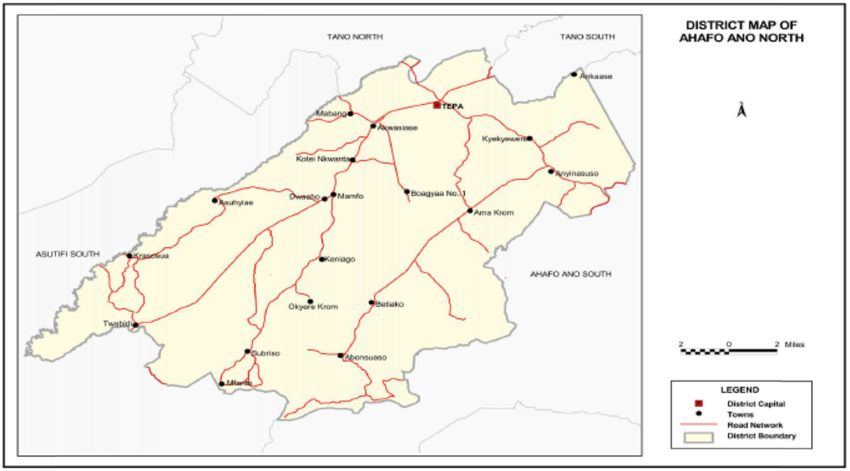
(Ghana Statistical Services 2014). Figure 1 shows the
map of the district.
2.3 Analytical methods
2.2 Sampling and data collection methods 2.3.1 Principal component analysis (PCA)
Respondents for this survey were cocoa farmers in Ahafo To compute the index of climate change adaptation from
Ano North District. A multi-stage sampling method was some adaptation options that were being used by cocoa
used for selecting the farmers. The first stage involved a farmers, PCA was employed. In this case, a composite
random selection of Ahafo Ano North district among indicator that denotes farmer’s adaptive index against
those where cocoa is grown in the region. The second climate change was computed from indicated responses
stage involved the compilation of the list of prominent to adaptive measures of investing in a cocoa drying
cocoa-growing villages in the district. Among these, we machine, diversifying into other crops, diversifying into
selected 21 villages with the help of the resident extension non-farm activities, monitoring weather change by indi-
agent, after which 378 cocoa farmers were sampled in genous knowledge, re-spraying of cocoa pods, reduc-
those selected villages. The survey followed the conven- ing the time interval for spraying, irrigating the farm,
tional ethical procedures for primary data collection. monitoring weather change through media, planting of
First, respondents were informed about the purpose of hybrid seeds, regular cocoa spraying and changing in the
the survey. They were also briefed about their right to planting and harvesting time. The PCA as a statistical
Figure 1: Map of Ahafo Ano North District (Source: Ghana statistical service 2014).266 Abayomi Samuel Oyekale
method helps to extract some unique linear combinations equality of variance and mean. Specifically, the specifica-
that can be found in the eleven (11) defined set data cli- tion of the Negative Binomial model begins with a
mate adaptation variables. The analyses were carried out Poisson specification:
with STATA 13 software with an indicator of adaptation e−μμy
computed by invoking the generate command (gen) after Pr[Y = y] = y = 0, 1, 2, 3,…, (2)
y!
invoking the conventional (pca) command.
y denotes the number of climate change adaptation
methods that a farmer uses. The basic assumption of
2.3.2 Ordinary least square (OLS) regression Poisson distribution is the equality of both mean (μ) and
variance. After running the data with Poisson regression in
In order to determine the socioeconomic factors influen- STATA 13 software, the goodness of fit test rejects the
cing adaptation indices that were computed with PCA, hypothesis of Poisson distribution. Therefore, Negative
the Ordinary Least Square (OLS) Regression model was Binomial distribution was used. The conventional specifica-
applied. This is a multiple regression model of the form: tion of the Negative Binomial regression model is in line
20 4 with the Poisson–gamma mixture distribution, with a
Yi = α1 + βk ∑ xik + πs ∑ Vis + ui (1) mean of 1 and scalar parameter v (Cameron and Trivedim
k=1 s=1 2013; Hilbe 2014). This is as specified as follows:
In equation (1), Yi is the PCA climate change adaptation y
index, α1, βk and πs are the parameters to be estimated Pr Y = i , α
μi
and ui is the stochastic error term. xik and Vis are the (3)
α−1 y
included explanatory variables presented in Table 1. Multi- Γ(yi − α−1) α−1 μi i
= −1
collinearity among the independent variables was evalu- Γ(yi + 1)Γ(α−1) α−1 + μi α + μi
ated with variance inflation factor (VIF). High VIF is a 1
reflection of substantial increase in the variances of esti- where μi = ti μ and α = v .
mated parameters as a result of existing collinearity The estimated model is of the form:
among them, when compared with situation where there 24
is no correlation (Murray et al. 2012). Heteroscedasticity μi = exp ln(ti) + ϖk ∑ xik + ui (4)
k=1
was tested with Breusch–Pagan/Cook–Weisberg test. This
was meant to validate the use of OLS on the assumption where xik are as defined in Table 1.
that the variance of the dependent variable is constant.
Statistical insignificance of the estimated statistics is an
indication of homoscedasticity. Should the test show sta- 2.3.4 Instrumental variable Probit regression
tistical significance, the parameters are to be estimated
with robust standard errors. The need to model the influence of climate change adap-
tation on the decision to rehabilitate cocoa farms compels
some econometric procedures in the form of Two-Stage
2.3.3 Negative binomial regression model Probit regression due to the potential endogeneity of the
climate change adaptation index. It should be noted that
In order to determine the factors influencing the number the conventional Probit model only produces unbiased
of adaptation methods that cocoa farmers were using estimators when endogeneity is not a problem within
against climate change, the Negative Binomial Regression the specified model. In this study, Two-Stage Probit
model was estimated. This model is different from the model was estimated as follows:
popular multiple regression in the fact that the depen- 20
dent variable is a count outcome that is assumed to Ri = γ + εi ∑ xik + ζYi + ei (5)
follow a negative binomial distribution. In this case, the k=1
determinants of the number of adaptation measures that 20 4
cocoa farmers were using, which is nonnegative integers: Yi = α1 + βk ∑ xik + πs ∑ Vik + ui (6)
k=1 s=1
0, 1, 2, 3, 4, 5,… was modelled. Negative binomial regres-
sion was chosen because the distribution rejects the under- Equation (5) presents the Probit regression model for
lying assumptions of Poisson regression that emphasise the the decision to rehabilitate cocoa farms with Ri being theClimate change adaptation and cocoa farm rehabilitation behaviour in Ghana 267 dependent variable coded as 1 for those that rehabilitated 3 Results and discussion and 0 for those who did not rehabilitate. Yi is the endo- genous independent variable that represent indicators Table 2 shows the demographic characteristics of the of adaptation to climate change. In this analysis, the cocoa farmers. It shows that in line with previous studies, two forms of indicators that were used in estimating equa- the majority (70.11%) of the farmers were male (Asamoah tions (1) and (2) were utilised. The major issue in estimating et al. 2013); Cocoa Research Institute of Ghana (CRIG) and Two Stage Probit model is identification of instrumental The World Cocoa Foundation (WCF 2017). Male dominance variables, which must be correlated with Yi but not corre- in cocoa agriculture is a reflection of the tediousness of lated with Ri . Equation (5) was estimated with instrumental several agronomic practices that are involved and relatively variables defined as perception of too much rainfall in the low access to production resources by women. Educational previous year, delay in rainfall commencement in the pre- attainments were also very low with the majority only vious year, delay in rainfall stopping in the previous year having primary education, while 20.63% did not have any and cocoa being grown as primary crop. The description of form of formal education. The role of education in pro- the independent variables in equations (5) and (6) is pre- moting receptiveness of farmers to new production technol- sented in Table 1. Estimation of equation (5) in STATA 13 ogies has been highlighted in the literature Cocoa Research generated the Wald test of exogeneity (athrho = 0), which if Institute of Ghana (CRIG) and The World Cocoa Foundation statistically significant indicates that climate change adap- (WCF 2017). Cocoa farmers’ household sizes were also high tation indicator is truly endogenous, and estimation of a with an average of eight members per household. In some standard Probit regression would have produced inefficient instances, cocoa farmers would see large family size as a and biased estimators. way of promoting their farming activities due to the Table 1: Description of explanatory variables Symbol Variable name Description x1 Monthly income Monthly income in Ghanaian Cedes x2 Formal education Formally educated = 1, 0 otherwise x3 Cocoa farming experience Number of years farming experience x4 Adult number Number of adult members x5 Under 5 number Number of children under the age of 5 years x6 Extreme high temperature Noticed extremely high temperature last year = 1, 0 otherwise x7 Extreme low temperature Noticed extremely low temperature last year = 1, 0 otherwise x8 Delay in rainfall start Noticed delay in rainfall commencement last year = 1, 0 otherwise x9 Delay in rainfall stop Noticed delay in rainfall stopping last year = 1, 0 otherwise x10 Member sick in cocoa season Yes = 1, 0 otherwise x11 Missed regular cocoa spraying Yes = 1, 0 otherwise x12 Missed regular farm clearing Yes = 1, 0 otherwise Mode of farm ownership x13 Rented farm Yes = 1, 0 otherwise x14 Lease farm Yes = 1, 0 otherwise x15 Sharecropping Yes = 1, 0 otherwise x16 Others Yes = 1, 0 otherwise x17 Number of cocoa farms Number of separate cocoa farms managed by farmers x18 Cocoa land area Acres of cocoa farm cultivated x19 Number of time head sick Number of times head was sick during cocoa season x20 Farming as primary occupation Yes = 1, 0 otherwise V1 Too much rainfall Noticed too much rainfall last year = 1, 0 otherwise V2 Storming rainfall Noticed storming rainfall last year = 1, 0 otherwise V3 Too low rainfall Noticed too low rainfall last year = 1, 0 otherwise V4 Cocoa as primary crop Cocoa is the main crop grown = 1, 0 otherwise
268 Abayomi Samuel Oyekale
Table 2: Socioeconomic characteristics of cocoa farmers in Ahafo greener means of livelihood. The future of the Ghanaian
Ano North district cocoa industry is therefore being seriously threatened as
a result of the ageing of the majority of cocoa farmers.
Freq. Percent While the average age of the farmers was 52 years, it has
Gender been noted that life expectancy in Ghana is just 62 years
Male 265 70.11 (Löwe 2017).
Female 113 29.89 The results in Table 2 further show that majority of
Per capita income
the farmers (78.84%) were earning less than GhC 200 (USClimate change adaptation and cocoa farm rehabilitation behaviour in Ghana 269
Table 3: Perceived trends of changes in some weather parameters
Trend
Observed weather parameters 2014 2015 Upward Downward Same Do not know
Extremely high temperature 72.75 64.29 30.95 10.85 24.60 33.60
Extremely low temperature 47.88 46.03 32.54 8.73 21.43 37.30
Too much rainfall 54.50 61.90 27.78 13.49 23.02 35.71
Too low rainfall 53.70 47.62 23.28 13.23 26.72 36.77
Delay in rainfall commencement 60.85 52.12 25.66 1.06 26.98 46.30
Delay in rainfall stopping 45.50 43.12 22.49 8.47 30.69 38.36
Too stormy rainfall 58.99 64.29 26.98 9.79 29.89 33.33
Thicker cloud covers 56.61 53.44 22.49 8.99 33.86 34.66
exploring some alternative means of livelihood in the self-supplementary cocoa spraying (Naminse et al. 2012;
event of pertinent income risks. Codjoe et al. (2013) noted Akosa 2001; Abankwa et al. 2010).
that crop diversification implies farmers’ engagements Table 4 also shows that 71.69% were planting hybrid
with the planting of crops that have shown commendable cocoa varieties to cope with weather vagaries. Hybrid
resistance to drought which also serves as a form of cocoa plants take a shorter time to reach maturity, while
insurance against rainfall instability and its associated the productivity is also higher than those of old cocoa
variability. More specifically, however, farmers had to stocks. Some farmers were also changing the time of
resort to devoting more time in cultivating food crops at planting cocoa (71.96%). Planting time becomes very cri-
the expense of climate-risk prone cocoa. tical when the pattern of rainfall changes. In a situation
Many of the adaptation methods are related to farm- where rainfalls become unstable, the inability to change
ing activities and include re-spray of cocoa pods in cases planting time would result in planting crops’ exposure
where there were rains after application of pesticides to severe environmental and water stressors. Several
(50.79%), deliberate wetting of young cocoa plants during authors have raised concerns over expected negative
the dry season (43.92%) and commitment to regularly impacts of high temperature and reduction in the volume
spray cocoa pods (74.87%). Timeliness of spraying cocoa of rainfall on cocoa productivity and expansion of its land
is a major issue for government agencies those imple- areas in Ghana (Okoffo et al. 2017; Laux et al. 2010). The
ment Ghanaian mass spraying project However, there general agronomic rule of thumb is that in absence of
have been some delays in cocoa agrochemical spraying, functioning irrigation, variability in spatial and/or tem-
thereby compelling affected farmers to be engaged in poral rainfall portends significant negative consequences
for crop productivity (Intergovernmental Panel on Cli-
Table 4: Adaptation measures employed by cocoa farmers against mate Change 2014).
climate change
Methods of adaptation Freq %
3.2 Determinants of climate change
Diversification
adaptation
Diversify into other crops 267 70.63
Diversify into non-farm activities 167 44.18
Farming practices/operation enhancement Table 5 shows the results of OLS and Negative Binomial
Invest in cocoa drying machine 148 39.15 Regression as presented in equations (1) and (2), respec-
Re-spray of cocoa 192 50.79 tively. It should be reemphasised that the OLS was car-
Reduce time interval for spraying 177 46.83 ried out with index of adaptation that was computed with
Irrigation of young plants 166 43.92
PCA as the dependent variable. The Negative Binomial
Planting hybrid seeds 271 71.69
Regular cocoa spraying 283 74.87 regression was carried out with the count of the number
Change planting and harvesting time 272 71.96 of adaptation methods of each farmer as the dependent
Weather monitoring variable. The results from the two models show that
Monitor weather change by indigenous 224 59.26 the data were properly fitted by the models, going by
knowledge
statistical significance of the Likelihood Ratio Chi Square
Monitor weather change through Media 226 59.79
(p < 0.01). In the two models, the parameters of cocoa270 Abayomi Samuel Oyekale
farming experience, number of children under 5, percep- the expectation that accumulated experiences can facili-
tion of extremely high temperature, perception of too tate substantial effectiveness and diversity of implemented
low rainfall, perception of delay in commencement of adaptive measures (Maddison 2006; Nhemachena and
rainfall and cultivation of cocoa as primary crop are sta- Hassan 2007; Denkyirah et al. 2017). The results are con-
tistically significant (p < 0.05). However, in the OLS trary to those reported by Denkyirah et al. (2017). In the
regression model, perception of delay in rainfall stop context of climate change adaptation, understanding the
and delay in regular farm clearing schedules showed sta- influence of farming experience is very critical. Well-
tistical significance (p < 0.05), while the parameter of experienced farmers are expected to be aged, and this
rented farm is significant in the Negative Binomial regres- may influence their ability to take some proactive deci-
sion model (p < 0.05). sions against climate change.
The results show that farming experience is with a The results further show that as the number of chil-
negative sign in the two models and statistically signifi- dren below the age of 5 years increases in a farming
cant (p < 0.05). This implies as the number of years of household, climate change adaptation indices increase.
cultivating cocoa increases, the indicators of climate The need to understand the impact of child dependency
change adaptation decrease. In some previous studies, within cocoa farming households motivated the separa-
the farming experience had been hypothesised to have tion of the number of children from that of adults. More
a positive influence on climate change adaptation given importantly, some previous studies had found a negative
Table 5: Determinants of adaptation to climate change
Ordinary least square Negative binomial
No. of adaptation methods/indicator of adaptation Coef. Z stat Coef. Z stat
−6 −6
Monthly income −8.28 × 10 −0.28 −4.34 × 10 −0.50
Formal education −0.0337653 −0.08 0.0406557 0.32
Cocoa farming experience −0.0174054** −2.20 −0.0057635 −2.48**
Adult number 0.0330895 1.14 0.0086331 1.05
Under 5 number 0.0947507** 2.38 0.0272935** 2.39
Extreme high temperature 0.4452777** 1.97 0.1340115** 1.96
Extreme low temperature 0.1112304 0.49 0.0231334 0.34
Too much rainfall 0.0906391 0.41 0.0156434 0.24
Storming rainfall 0.0415459 0.55 0.0098236 0.47
Too low rainfall 0.9400425*** 4.21 0.2558276*** 3.86
Delay in rainfall start 0.5163758** 2.43 0.129692** 2.03
Delay in rainfall stop 0.4510006** 2.03 0.0898556 1.37
Member sick −0.0650131 −0.29 0.011186 0.17
Missed regular cocoa spraying −0.0400568 −0.15 −0.0101448 −0.12
Missed regular farm clearing 0.6310387** 2.41 0.1504692* 1.88
Mode of farm ownership
Rented farm 0.5932407 1.53 0.2260377 2.01
Lease farm −0.3842001 −0.62 0.0283378 0.16
Sharecropping 0.1817199 0.70 0.0087742 0.12
Others 0.2871855 0.61 0.036067 0.26
Number of cocoa farms −0.0451512 −0.52 0.0046695 0.18
Cocoa land area 0.0042248 0.61 0.0005515 0.28
Number of time head sick 0.0149878 0.27 −0.0069385 −0.43
Farming as primary occupation −0.1604202 −0.57 −0.0193252 −0.24
Cocoa as primary crop 0.7863547*** 2.89 0.1981916*** 2.56
Constant −1.845527** −2.23 1.336523*** 5.50
ln alpha −2.434359
alpha 0.0876539
Number of observations 378 378
LR chi2 (26) 7.26*** 120.05***
Pseudo R2/Adj. R2 0.3017 0.0575
Breusch–Pagan/Cook–Weisberg test 0.76
***Statistically significant at 1%, **Statistically significant at 5%, *Statistically significant at 10%.Climate change adaptation and cocoa farm rehabilitation behaviour in Ghana 271
relationship between household size and the ability to 3.3 Determinants of farmers’ decision to
adopt innovative farming (Denkyirah et al. 2017). The rehabilitate cocoa farms
result of this study shows that farmers with more children
under the age of 5 years had higher indicators of climate Table 6 presents the results of instrumental variable
change adaptation. Probit regression. It reveals the results in Panels A and
The results also show that perception of higher tem- B for cases where adaptation indicators were the PCA
perature, too low rainfall and delays in commencement indices and number of adaptation methods, respectively.
of rainfall are with a positive sign and showed statistical The results are quite similar except for few cases where
significance (p < 0.05) in the two estimated models. the levels of significance vary. The results show that
However, in the OLS model, delay in rainfall stopping adaptation indicators increase the probability of the
is a positive sign and statistically significant (p < 0.05). farmers choosing to rehabilitate cocoa farms (p < 0.01).
These results are attesting to the notion that perception of This is expected because the farmers who are utilising
climate changes can facilitate positive actions towards many adaptation methods may not give too much
mitigation of its impacts. The ability to properly under- thought on climate change issues that are affecting cocoa
stand the prevailing trends in weather by farmers is productivity.
a prerequisite for timely adaptation (Neil Adger et al. The results in Table 6 also indicate that as the
2005; Tesso et al. 2012). The changes that are needed to monthly incomes of cocoa farmers increased, the prob-
mitigate adverse impacts of climate change are only ability of rehabilitating cocoa farms significantly decreased
going to be effectively undertaken when the farmers are (p < 0.05). These results are also emphasising the role of
equipped with accurate perceptions (Oluwatusin 2014; income in cocoa farm rehabilitation.
Nhemachena and Hassan 2007; Maddison 2006). Ehiakpor The results show that the parameters of rented land
et al. (2016) found that perception of climate variability and sharecropping variables were statistically significant
positively influenced adaptation among cocoa farmers in at 10 and 5%, respectively. The results indicate that
Ghana. In another study, Jiri et al. (2015) also reported a farmers who were cultivating rented cocoa farmland
positive correlation between climate change perceptions had a higher probability of rehabilitating cocoa farms
and adaptation. when compared with those who own their cocoa farms.
The result also showed that in the two models pre- However, the farmers who were on sharecropping arrange-
sented in Table 5, the farmers who were growing cocoa as ments had a lower probability of rehabilitating cocoa
a primary crop had significantly higher indicators of cli- farms. Peyton (2018) also reported that sharecroppers
mate change adaptation (p < 0.05). This gives some indi- were very reluctant to make investments in rehabilitating
cations that those farmers who concentrated on cocoa old farms. Therefore, this result indicates that sharecrop-
cultivation had more drive to undertake several adapta- ping discourages cocoa farm investment via rehabilitation
tion methods. It also reveals that farmers who depended (Roth et al. 2017).
on cocoa as a major source of livelihood cannot trivialise Table 6 further reveals that as the number of adult
the need to take some adaptive measures against climate members in farming households increases, the prob-
change. It had been emphasised that cocoa is among the ability of rehabilitating cocoa farmland increases. This
most sensitive crops to changes in temperature and pre- may have resulted from labour intensiveness of rehabili-
cipitation (Schroth et al. 2016; Läderach et al. 2013). tation processes, which in most cases requires uprooting
Table 5 also shows that in the results for the OLS of old cocoa trees and cutting down the old stock. This
model, the farmers who rented land had significantly result buttresses that of Roth et al. (2017) who reported
higher climate change adaptation indicators. This under- that rehabilitation of cocoa farms was being delayed due
scores the role of the land tenure system in climate to the ageing of cocoa farmers, high cost of uprooting
change adaptation. Cocoa farmers on rented land would cocoa trees, inadequate finance and inadequate knowl-
have made some upfront payment on the rented land edge of modern agroforestry technologies
or a bidding agreement exists on the amount of money The results also show that the farmers who perceived
expected to be paid at the end of the season. This implies high and low temperature had a lower probability of
they must be able to circumvent all climatic obstacles to accepting to rehabilitate their cocoa farms. It should be
achieve maximum yields from their rented cocoa farms. noted that cocoa farming is highly susceptible to varia-
In a previous study, Fagariba et al. (2018) found that the tions in temperature. These results are therefore in line
land tenure system was one of the major constraints to with expectations. In addition, as the number of times,
climate change adaptation among cocoa farmers. the farmers who were sick during cocoa season increase,272 Abayomi Samuel Oyekale
Table 6: Determinants of farmers’ decision to rehabilitate cocoa farms
A B
Coef. Std. Err. Coef. z
Adaptation indicator 0.467905*** 6.45 0.296191*** 6.39
Monthly income −0.0001069** −2.34 −0.0001081** −2.16
Formal education 0.245382 1.38 0.228552 1.20
Cocoa farming experience −0.0007513 −0.11 0.0013451 0.19
Adult number 0.0459103* 1.71 0.0498021* 1.74
Under 5 number −0.0144866 −0.47 −0.0210437 −0.64
Extreme high temperature −0.5739904*** −3.25 −0.6252772*** −3.33
Extreme low temperature −0.286911* −1.69 −0.3238359* −1.78
Too much rainfall −0.1591519 −1.00 −0.1722028 −1.02
Storming rainfall −0.0326303 −0.49 −0.0358055 −0.49
Member sick −0.0070566 −0.04 −0.0381148 −0.21
Missed regular cocoa spraying 0.1753195 0.83 0.1931315 0.86
Missed regular farm clearing −0.1813694 −0.87 −0.1570291 −0.72
Number of cocoa farms 0.0344356 0.51 0.0141598 0.20
Mode of farm ownership
Rented farm 0.6187055* 1.80 0.6348572* 1.71
Lease farm 0.4141236 0.92 0.3849979 0.80
Sharecropping −0.4807** −2.46 −0.4619218** −2.20
Others −0.3015251 −0.85 −0.255462 −0.69
Cocoa land area −0.0076545 −1.36 −0.007382 −1.23
Number of time head sick −0.0792829* −1.81 −0.080738* −1.70
Farming as primary occupation −0.0091849 −0.05 −0.0377428 −0.19
Constant 0.6808467** 2.02 −1.241423*** −3.59
Athrho −0.4929058*** −2.63 −0.3947375* −1.66
ln sigma 0.4867126*** 13.37 1.154758*** 31.72
Rho −0.4565197*** −3.08 −0.3754372*** −6.08
Sigma 1.626959*** 27.46 3.173255*** 30.46
Number of obs 378 378
Wald chi2 (21) 100.05 103.03
Prob > chi2 0.0000 0.0000
Wald test of exogeneity (/athrho = 0) 6.94*** 2.75*
***Statistically significant at 1%, **Statistically significant at 5%, *Statistically significant at 10%.
the probability of rehabilitating cocoa farms decreases. implications of climatic changes on the adoption of envir-
This is expected given the labour intensiveness of cocoa onmentally benign production system through rehabili-
rehabilitation. This also underscores the fact that it will tation and renovation of old cocoa farms are properly
take a healthy farmer to undertake many of the farming factored into the equation. This study provides a vital
activities in cocoa production. contribution to knowledge by econometrically linking
some essential climate change adaptation indicators of
cocoa farmers to their ultimate decision to rehabilitate
their old cocoa farms. The results have highlighted
4 Conclusion some fundamental issues in respect of climate change
adaptation and the possibility of engaging in climate-
Understanding the drivers of climate-smart cocoa pro- smart cocoa farming through old farm rehabilitation.
duction is essential for devolving some policies to ensure Specifically, there are some policy implications arising
the sustainability of cocoa agriculture in Ghana. Given from this study. First, the enhancement of cocoa farmers’
on-going agitations on the impact of climate change on climate change adaptation will promote involvement in
cocoa productivity, the future seems very bleak when the cocoa farm rehabilitation. This implies that farmers’Climate change adaptation and cocoa farm rehabilitation behaviour in Ghana 273
ability to adapt to changes in climate will foster their [2] Abbott P, Wilcox M, Muir WA. Corporate social responsibility in
willingness to invest in old cocoa farms through rehabi- international cocoa trade. West Lafayette, IN, USA: Purdue
litation. Therefore, there is a need to facilitate climate University; 2005.
[3] Akosa KS. Ghana sprays for bumper cocoa crop. United
change adaptation among old cocoa farmers by under-
Kingdom: BBC; 2001. Available from: http://news.bbc.co.uk/
taking some comprehensive assessment of their resource 2/hi/africa/1595428.stm
endowment and receptibility to changes. The findings [4] Andres C, Hoerler R, Home R, Joerin J, Dzahini-Obiatey HK,
have also indicated that adequate perception of climate Ameyaw GA, et al. Social network to inform and prevent the
change would facilitate adaptation and engagement spread of cocoa swollen shoot virus disease in Ghana. Agron
Sustain Dev. 2018;38(53):1–11. doi: 10.1007/s13593-018-0538-y.
with cocoa farm rehabilitation. The policy implications
[5] Anim-Kwapong GJ, Frimpong EB. Climate change on cocoa
of promoting awareness and ability of cocoa farmers production. In: Agyeman-Bonsu W, ed., Ghana climate change
to adequately perceive climatic changes cannot be impacts, vulnerability and adaptation assessments under the
overemphasised. Such efforts would facilitate the reha- Netherlands climate assistance programme (NCAP). New Tafo
bilitation of cocoa farms because the farmers are well Akim, Ghana: Environmental Protection Agency; 2008.
p. 263–98.
able to understand changes in climatic parameters.
[6] Asamoah M, Ansah FOwusu, Anchirinah V, Aneani F,
In addition, the findings have underlined the role of
Agyapong D. Insight into the standard of living of Ghanaian
the land tenure system in promoting climate change cocoa farmers. Greener J Agric Sci. 2013;3(5):363–70.
adaptation and farm rehabilitation decisions among [7] Asare R, Afari-Sefa V, Osei-Owusu Y, Opoku P. Cocoa agro-
cocoa farmers. Specifically, the proper definition of forestry for increasing forest connectivity in a fragmented
land ownership rights would enhance sustainable cocoa landscape in Ghana. Agrofor Syst. 2014;88:1143–56.
[8] Barry Callebaut. Organic cocoa farming expanding opportu-
production with cocoa farm renting arrangements holding
nities for cocoa farmers. Switzerland: Barry Callebaut; 2008.
a higher potential. Available from: https://www.barry-callebaut.com/sites/
default/files/publications/gzd_e_bc_ar08_cabosse_ii.pdf
Acknowledgments: The author acknowledges the efforts [9] Cameron AC, Trivedi PK. Regression analysis of count data.
of the enumerators, most especially those who assisted in Econometric society monograph no. 53. 2nd edn. Cambridge:
providing necessary linkages to the cocoa farmers. The Cambridge University Press; 2013.
[10] Chery W. Factors influencing sustainable cocoa production in
efforts of the farmers’ group leaders in motivating many
Northern Haiti. LSU Master’s Theses 3083; 2013. Available
cocoa farmers to participate in the survey are also grate- from: https://digitalcommons.lsu.edu/gradschool_th-
fully acknowledged. eses/3083
[11] Cocoa Research Institute of Ghana. Cocoa manual. A source
Funding information: The data collection activities were book for sustainable cocoa production. Ghana Cocoa Board,
2010, 41st annual report and financial statement for the year
funded by the North-West University, Mafikeng Campus,
ended September; 2010. p. 19. www.cocobod.gh
through my Institutional Research Excellence Awards [12] Cocoa Research Institute of Ghana (CRIG) and The World Cocoa
(IREAs). Foundation (WCF). Report on land tenure and cocoa production
in Ghana, a CRIG/WCF collaborative survey; 2017. Available
Author contribution: ASO conceptualised the study, ana- from: http://www.worldcocoafoundation.org/wp-content/
lysed the data and wrote the report. uploads/files_mf/
1492612620CRIGLandTenureSurveyFinal41217.pdf
[13] Codjoe FNY, Ocansey, CK, Boateng DO, Ofori J. Climate change
Conflict of interest: The authors state no conflict of awareness and coping strategies of cocoa farmers in rural
interest. Ghana francis nana yaw. J Biol Agric Healthc.
2013;3(11):19–29.
Data availability statement: The datasets generated during [14] Denkyirah EK, Okoffo ED, Adu DT, Bosompem OA. What are the
drivers of cocoa farmers’ choice of climate change adaptation
and/or analysed during the current study are available
strategies in Ghana? Cogent Food Agric. 2017;3:1334296.
from the corresponding author on reasonable request. [15] Ehiakpor DS, Danso-Abbeam G, Baah JE. Cocoa farmer’s per-
ception on climate variability and its effects on adaptation
strategies in the Suaman district of western region, Ghana.
Cogent Food Agric. 2016;2:1210557. doi: 10.1080/
23311932.2016.1210557.
References [16] Fagariba CJ, Song S, Baoro SKGS. Climate change adaptation
strategies and constraints in Northern Ghana: evidence of
[1] Abankwa V, Aidoo R, Osei RK. Socio- economic impact of farmers in Sissala West District. Sustainability. 2018;10:1484.
government spraying programme on cocoa farmers in Ghana. [17] Fick M. Ageing cocoa farmers pose risk for Ghana industry –
J Sustain Dev Afr. 2010;12(4):116–26. Generation gap threatens future production. United Kingdom:274 Abayomi Samuel Oyekale
Financial Times; 2015. Available from: https://www.ft.com/ and Ghana, aligning stakeholders to support smallholders in
content/d9cb0d1c-26e7-11e5-bd83-71cb60e8f08c deforestation-free cocoa. Washington, DC: World Bank; 2017.
[18] Gateau-Rey L, Tanner EVJ, Rapidel B, Marelli J-P, Royaert S. Available from: https://doi.org/10.1596/29014
Climate change could threaten cocoa production: effects of [31] Läderach P, Martínez-Valle A, Schroth G, Castro N. Predicting
2015-16 El Niño-related drought on cocoa agroforests in Bahia, the future climate suitability for cocoa farming of the world’s
Brazil. PLoS One. 2018;13(7):e0200454. leading producer countries. Ghana Côte d’Ivoire Clim Chang.
[19] Ghana Statistical Services. 2010 Population and housing 2013;119:841–54.
census – district analytical report – Ahafo Ano North District; [32] Laux P, Jäckel G, Tingem RM, Kunstmann H. Impact of climate
2014. Available from: https://new-ndpc-static1.s3.amazo- change on agricultural productivity under rainfed conditions in
naws.com/CACHES/PUBLICATIONS/2016/06/06/Ahafo+Ano Cameroon-A method to improve attainable crop yields by
+North+2010PHC.pdf planting date adaptations. Agric For Meteorol.
[20] Gockowski J, Sonwa DJ. Cocoa intensification scenarios and 2010;150:1258–71.
their predicted impact on CO2 emissions, biodiversity con- [33] Löwe A. Creating opportunities for young people in Ghana’s
servation, and rural livelihoods in the Guinea rainforest of cocoa sector. Working Paper 511. Overseas Development
West Africa. Environ Manag. 2011;48:307–21. doi: 10.1007/ Institute; 2017. Available from: https://www.odi.org/sites/
s00267-010-9602-3. odi.org.uk/files/resource-documents/11635.pdf
[21] González de Mejía E, Martínez-Resendiz V, Castaño-Tostado E, [34] Luckstead J, Tsiboe F, Nalley LL. Estimating the economic
Loarca-Piña G. Effect of drought on polyamine metabolism, incentives necessary for eliminating child labor in Ghanaian
yield, protein content and in vitro protein digestibility cocoa production. PLoS One. 2019;14(6):e0217230.
in tepary (Phaseolus acutifolius) and common doi: 10.1371/journal.pone.0217230.
(Phaseolus vulgaris) bean seeds. J Sci Food Agric. [35] Maddison D. The perception of and adaptation to climate
2003;83(10):1022–30. change in Africa (centre for environmental economics and
[22] Gyau A, Smoot K, Kouame C, Diby L, Kahia J, Ofori D. Farmer policy in Africa CEEPA, discussion paper no. 10). Pretoria:
attitudes and intentions towards trees in cocoa (Theobroma University of Pretoria; 2006.
cacao L.) farms in Côte d’Ivoire. Agrofor Syst. [36] Mejia R. Increasing productivity of cocoa in Côte d’Ivoire,
2014;88:1035–45. Ghana, Indonesia and Colombia. Master’s Thesis. West
[23] Hilbe J. Modeling count data. Cambridge: Cambridge Lafayette, IN, USA: Purdue University; 2011.
University Press; 2014. [37] Murray L, Nguyen H, Lee Y-F, Remmenga MD, Smith DW.
[24] Hutchins A, Tamargo A, Bailey C, Kim Y. Assessment of climate Variance inflation factors in regression models with dummy
change impacts on cocoa production and approaches to variables. Conference on applied statistics in agriculture;
adaptation and mitigation: a contextual view of Ghana and 2012. Available from: https://doi.org/10.4148/2475-
Costa Rica; 2015. p. 1–24. Available from: https://elliott.g- 7772.1034
wu.edu/sites/g/files/zaxdzs2141/f/World%20Cocoa% [38] Naminse EY, Fosu M, Nongyenge Y. The impact of mass
20Foundation.pdf spraying programme on cocoa production in Ghana; 2012.
[25] Intergovernmental Panel on Climate Change. Climate change https://www.ifama.org/resources/files/2012-Conference/
2014–impacts, adaptation and vulnerability: regional aspects. 556_Paper.pdf
Working group II contribution to the fifth assessment [39] Neil Adger W, Arnell NW, Tompkins EL. Successful adaptation
report of the intergovernmental panel on climate change to climate change across scales. Glob Environ Change.
(technical report). Cambridge: Cambridge University 2005;15:77–86. doi: 10.1016/j.gloenvcha.2004.12.005.
Press; 2014. [40] Nhemachena C, Hassan R. Micro-level analysis of farmers’
[26] International Cocoa Initiative (ICI). Cocoa farmers in Ghana adaptation to climate change in Southern Africa IFPRI discus-
experience poverty and economic vulnerability; 2017. sion paper 00714. Washington, DC: International Food Policy
Available from: https://cocoainitiative.org/news-media-post/ Research Institute; 2007.
cocoa-farmers-in-ghana-experience-poverty-and-economic- [41] Okoffo ED, Denkyirah EK, Adu DT, Fosu-Mensah BY. A double-
vulnerability/ hurdle model estimation of cocoa farmers’ willingness
[27] Jacobi J, Schneider M, Bottazzi P, Pillco M, Calizaya P, Rist S. to pay for crop insurance in Ghana. SpringerPlus.
Agroecosystem resilience and farmers’ perceptions of climate 2016;5:873.
change impacts on cocoa farms in Alto Beni, Bolivia. Agric [42] Oluwatusin FM. The perception of and adaptation to climate
Food Syst. 2015;30(2):170–83. change among cocoa farm households in Ondo State. Nigeria.
[28] Jiri O, Mafongoya P, Chivenge P. Smallholder farmer percep- Acad J Interdiscip Stud. 2014;3:147–56. doi: 10.5901/
tions on climate change and variability: a predisposition for ajis.2014.v3n1p147.
their subsequent adaptation strategies. J Earth Sci Clim [43] Peyton N. Can land rights for farmers save Ghana’s cocoa
Change. 2015;6:277. doi: 10.4172/2157-7617.1000277. sector? 2018. Available from: https://www.reuters.com/
[29] KPMG. Cocoa certification a study on the costs, advantages article/us-ghana-cocoa-landrights/can-land-rights-for-
and disadvantages of cocoa certification. Den Haag, The farmers-save-ghanas-cocoa-sector-idUSKCN1LF16X
Netherlands: The International Cocoa Organization (ICCO); [44] Roth M, Antwi Y, O’Sullivan R. Land and natural resource
2012. p. 99. governance and tenure for enabling sustainable cocoa culti-
[30] Kroeger A, Koenig S, Thomson A, Streck C, Weiner P-H, vation in Ghana. Washington, DC: USAID Tenure and Global
Bakhtary H. Forest- and climate-smart cocoa in Côte d’Ivoire Climate Change Program; 2017.Climate change adaptation and cocoa farm rehabilitation behaviour in Ghana 275
[45] Ruf F. The cocoa sector. Expansion, or green and double green Degree of Master in Agricultural Production Chain
revolutions. ODI: London, UK; 2007. p. 3. Management; 2013 Sept.
[46] Schroth G, Läderach P, Martinez-Valle A, Bunn C, Jassogne L. [49] Wessel M, Quist-Wessel PMF. Review: cocoa production in
Vulnerability to climate change of cocoa in West Africa: pat- West Africa, a review and analysis of recent developments.
terns, opportunities and limits to adaptation. Sci Total NJAS Wagen J Life Sci. 2015;74–5:1–7.
Environ. 2016;556:231–41. [50] Wood GAR, Lass RA. Cocoa. London, New York: Longman
[47] Tesso G, Emana B, Ketema M. Econometric analysis of local Scientific & Technical, Wiley; 1987. Available from: http://
level perception, adaptation and coping strategies to climate site.ebrary.com/id/10297531
change induced shocks in North Shewa, Ethiopia. Int Res J [51] Zion Market Research. Chocolate market by type of chocolate
Agric Sci Soil Sci. 2012;2:347–63. (dark, milk, and white) and by sales category (everyday cho-
[48] Vekua K. Analyzing constraints for replanting aged cocoa trees colate, premium chocolate, and seasonal chocolate). Global
with hybrid cocoa varieties among smallholder farmers in industry perspective, comprehensive analysis, and forecast,
Asamankese District of Eastern Ghana. Dissertation submitted 2017–2024 report; 2018. Available from: https://www.zion-
to Van Hall Larenstein University of Applied Science for the marketresearch.com/report/chocolate-marketYou can also read


