Clinical Evaluation of Acrochordons and its Association in Systemic Diseases
←
→
Page content transcription
If your browser does not render page correctly, please read the page content below
Annals of R.S.C.B., ISSN:1583-6258, Vol. 25, Issue 2, 2021, Pages. 1429 - 1441
Received 20 January 2021; Accepted 08 February 2021.

               Clinical Evaluation of Acrochordons and its Association in Systemic Diseases
                                         E. Malarmangai1, K. Harsha Vardhan2, K. Manoharan3
                  1,2,3
                          Department of Dermatology, Venereology & Leprosy, Sri Lakshmi Narayana Institute of Medical Sciences
                              Affiliated to Bharath Institute of Higher Education and Research, Chennai, Tamil Nadu, India.
                                                               3
                                                                 manoharan.k@bharathuni.ac.in

                                                                       ABSTRACT
                    Acrochordons (known as skin tags) are benign skin tumors. An Acrochordon is a small, soft, benign
                    pedunculated growth that is found primarily in persons who have higher body mass index. It is the
                    hyperpigmented elevation of the skin which appears above the skin surface as nodules or papilloma in healthy
                    individuals. The common locations of Acrochordons are in the areas of skin folds in and around neck, eyes, and
                    chest wall. The prevalence of Acrochordons is relatively high, found among 46% of the general population. The
                    prevalence of acrochordons showed in our study was 21(14.0%). The clinical presentation of skin tags showed
                    that majority of the skin tags presented as multiple lesions (57.1%) and was present in the neck and chest region
                    (38.1%). Majority of the skin tags (61.9%) presented as small lesions measuring 2 mm in length. All the skin
                    tags were hyperpigmented. The aim of this study is to clinically evaluate the pattern and presentation of
                    acrochordons. This study was carried out as a cross sectional study among 150 participants visiting the
                    outpatient clinic of the Department of Dermatology of our tertiary care hospital for a period of 7 months. A
                    structured interview schedule was used to elicit data regarding the medical history. Clinical examination of skin
                    tags was associated factors of acrochordons along with the prevalence of systemic diseases.

                    Keywords:
                    Acrochordons, Hyperpigmented, Nodules, Hyperpigmented, Benign Pedunculated.

                                                                     1.Introduction

              Acrochordons or skin tags, also referred to as soft fibromas is a commonly occurring benign skin
              lesion which consists of a small portion of the skin projecting from the surrounding skin. [1] The
              out pouches of the skin extend freely from the skin surface and are connected by a stalk. Skin
              tags present in a roughly 25% of the adults and is said to be familial. Skin tags are caused by
              friction between skin folds and or between skin and clothing. Skin tags are commonly seen in
              axilla, upper chest and beneath the breasts, neck, eye lids and groin folds. Skin tags are
              acrochordons are benign painless lesions, but manifest with symptoms when there is an abrasion
              or necrosis. Presence of red or black color in the skin tags could be a consequence of torsion in
              the base which results in cutting off of the blood supply. In such scenario excision may be the
              preferred treatment followed by cryosurgery with liquid nitrogen or electro-desiccation. [2]
              There are several systemic infectious diseases and syndromes associated with skin tags. Skin tags
              are associated with conditions like pregnancy, intestinal polyps, growth disorders, metabolic
              syndromes, atherosclerosis and various other syndromes including polycystic ovarian
              syndrome, Birt–Hogg–Dubé syndrome, and Cowden syndrome. Some of the infections which
              correlate with skin tags include human papilloma virus, which is said to occur in 88% of the
              acrochordons lesions. Certain variations in the estrogen levels and hormones such as IGF-1,
              Insulin and Transforming Growth Factor (TGF) and Epidermal Growth Factor (EGF)are also
              implicated in the incidence of skin tags. [3]
              The size of acrochordons varies between 2 to 5 millimeters in diameter and sometimes very big
              acrochordons can be up to 5 centimeters in diameter. Sometimes groin may also be affected. The
              clinical presentation of Acrochordons resembles the appearance of small, elevated, pedunculated
              skin colored or hyperpigmented painless papules that develop either as single or multiple lesions
              in the same site. [7] They are usually asymptomatic but sometimes due to fibrosis, necrosis or

             http://annalsofrscb.ro                                                                                            1429
Annals of R.S.C.B., ISSN:1583-6258, Vol. 25, Issue 2, 2021, Pages. 1429 - 1441
Received 20 January 2021; Accepted 08 February 2021.
secondary infections it can cause irritation and pain when exposed to mechanical trauma. In rare
cases following skin rubbing or scratching, the skin tags may cause abrasion, hemorrhage and
crust formation.
2. Materials and Methods
Study design
This study was carried out as a cross sectional study in a Teaching hospital. This study was
undertaken in the outpatient Department of Dermatology in our Teaching hospital. This study
was carried out for a period of seven months between October 2017 and April 2018. The study
population consisted of all the patients who visited the outpatient department during the study
period.
Sample size and sampling technique
Based on intensive literature review a report by Melissa. C Stoppler reported that 25% of the
adults have skin tags. [35] Based on this the sample size was calculated at 95% confidence limits
and a 7.5% absolute precision as 128. Allowing 10% for non-response the final sample size was
calculated as 140.8 and was rounded off to 150. The participants were selected using purposive
sampling amongst the patients who visited the outpatient clinic of our Dermatology Department.
Ethical approval and informed consent
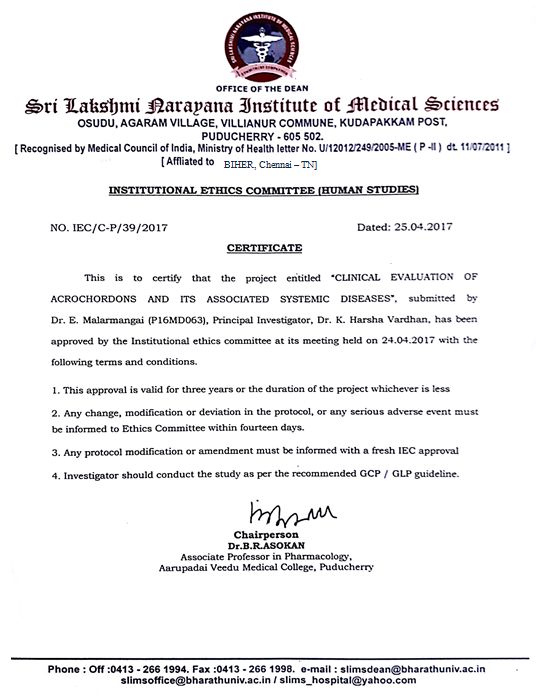
Approval was obtained from the Institutional Ethics Committee prior to the commencement of
the study. Each participant was explained in detail about the study and informed consent was
obtained prior to the data collection.
Data collection tools
Selection criteria is based on inclusion criteria and exclusion criteria. A structured interview
schedule was used to collect information regarding the Background characteristics and skin
lesions. The interview schedule was divided into Demographic history, Medical History, Clinical
examination. Acrochordons were clinically examined and identified as small, hyperpigmented,
pedunculated soft tissue extensions from the skin. [7]. Body mass index was classified as per
WHO classification for Asians [36].
Data Analysis
Data was entered and analyzed using SPSS version 15 software. Percentages were used to
describe the prevalence of skin tags and systemic diseases. Chi – square was used to document
the association between skin tags and systemic diseases. A p value less than 0.05 was considered
to be statistically significant.
3.Results and Discussion
This cross-sectional study was carried out among 150 participants visiting the outpatient clinic of
our department. The consent form was given to the patients prior to the interview. A
structured interview schedule was used to elicit history regarding the medical conditions. Each
participant was clinically examined for skin tags. Random blood sugar was estimated to assess
the status of diabetic control.
http://annalsofrscb.ro 1430Annals of R.S.C.B., ISSN:1583-6258, Vol. 25, Issue 2, 2021, Pages. 1429 - 1441
Received 20 January 2021; Accepted 08 February 2021.
Majority of the participants belonged to the age group of >40 years (75.3%). Males were about
104 (69.33%) while females were 46 (30.67%). The body mass index of the participants showed
that majority of the participants were overweight (23.7%). (Figure1). The
Random blood sugar levels were evaluated and it was observed that 66 (44.0%) of the
participants had uncontrolled diabetes mellitus.
Figure-1: Distribution of the body mass index of the study participants:
number of number of
Percentage of participants
participants participants
obese underweight
8.7 4
9% 4%
number of underweight
participants
overweight normal
27.3 number of overweight
27% participants
obese
normal
60
60%
The medical history of the study participants were elicited. It was observed that 26 (17.3%) of the
participants had type 2 diabetes mellitus. Among these participants, majority (92.3%) of the
participants had the disease for 3-5 years. Moreover, 27 (18.0%) of the participants had a history
of hypertension of which 55.6% were known hypertensives for 3-5 years. History of
hypercholesterolemia was present in 9 (6.0%) participants while history of endocrine disorders
was present in 2 (1.3%) participants. (Table 1)
S. No Characteristics Frequency (N=150) Percentage (%)
1 History of Type 2 Diabetes Mellitus
Present 26 17.3
Absent 124 82.7
2 If present, duration (in years) (n=26)
≤2 2 7.7
3-5 18 69.2
>5 6 23.1
3 History of hypertension
Present 27 18.0
Absent 123 82.0
4 If present, duration (in years) (n=27)
≤2 6 22.2
3-5 15 55.6
http://annalsofrscb.ro 1431Annals of R.S.C.B., ISSN:1583-6258, Vol. 25, Issue 2, 2021, Pages. 1429 - 1441
Received 20 January 2021; Accepted 08 February 2021.
>5 6 22.2
5 History of hypercholesterolemia
Present 9 6.0
Absent 141 94.0
6 If present duration (in years) (n=9)
≤2 1 11.1
3-5 7 77.8
>5 1 11.1
7 History of cardiovascular diseases
Present 4 2.7
Absent 146 97.3
8 if present duration (in years) (n=4)
≤2 0 0.0
3-5 4 100.0
>5 0 0.0
9 History of cerebrovascular diseases
Present 0 0.0
Absent 150 100.0
10 History of endocrine disorders
Present 2 1.3
Absent 148 98.7
11 If present duration (in years) (n=2)
≤2 0 0.0
3-5 1 50.0
>5 1 50.0
Clinical presentation of acrochordons
The prevalence of acrochordons showed in our study was 14.0% [95% CI: 8.4 to 19.5].
Acrochordons was absent in 129 (86.0%) participants. (Table 1).
Table -2 Prevalence of acrochordons among the study participants
S. No Acrochordon Frequency Percentage (%) 95% CI
(N=150)
1 Present 21 14.0 8.4-19.5
2 Absent 129 86.0 80.44-91.55
The clinical presentation of skin tags showed that majority of the skin tags presented as multiple
lesions (57.1%) and was present in the neck region (38.1%). Majority of the skin tags (61.9%)
presented as small lesions measuring 2 mm in length. All the skin tags were hyperpigmented.
(Table 2)
http://annalsofrscb.ro 1432Annals of R.S.C.B., ISSN:1583-6258, Vol. 25, Issue 2, 2021, Pages. 1429 - 1441
Received 20 January 2021; Accepted 08 February 2021.
Table 3: Clinical presentation of acrochordons
S. No Parameters Frequency (N=21) Percentage (%)
1 Number of skin tags
Multiple 12 57.1
Single 9 42.9
2 Location
Axillae (arm) 1 4.8
Chest 8 38.1
Elbow 1 4.8
Eyes 3 14.2
Neck 8 38.1
3 Size (mm)
1 0 0.0
2 13 61.9
3 6 28.6
4 2 9.5
4 Color
Hyperpigmented 21 100
I. Association between acrochordons and risk factors
The association between background risk factors and acrochordons show that males are at
increased risk for acrochordons (16.3%). However, the observed difference was statistically not
significant. Participants with overweight and obesity were at an increased risk for acrochordons
(16.7% and 14.4% respectively) compared to participants with normal BMI. However, the
observed difference was statistically not significant. Our study also showed that uncontrolled
diabetes mellitus (RBS>200 mg/dl) was not significantly associated with acrochordons
(p30 1 (16.7) 5 (83.3) 6
24-29.9 13 (14.4) 77 (85.6) 90 4.6 0.203
18.5-24 3 (7.3) 38 (92.7) 41
http://annalsofrscb.ro 1433Annals of R.S.C.B., ISSN:1583-6258, Vol. 25, Issue 2, 2021, Pages. 1429 - 1441
Received 20 January 2021; Accepted 08 February 2021.
200 20 (13.7) 126 (86.3) 146 0.4 0.520Annals of R.S.C.B., ISSN:1583-6258, Vol. 25, Issue 2, 2021, Pages. 1429 - 1441
Received 20 January 2021; Accepted 08 February 2021.
participants in the study were females (68.63%) and the mean age of the participants was 38.6
years which is similar to our study.[38]
Our study assessed the Body Mass Index of the participants. Majority of the participants were
found to be normal weight (60.0%) obesity was present in 8.7%. In the study done by Tameka et
al obesity and overweight were significant findings in the study with a median Body Mass Index
31.1kg/m2 among the cases and 26.1 kg/m2 among controls which is similar to our study.[4] In
an another study Maluki et al the mean Body Mass Index was the 32.5 kg/m 2 among the cases
and 27.1 kg/m2 among the controls which is also similar to our study.[38]
Our study evaluated the presence of systemic risk factors among the study participants. It was
observed that 26(17.3%) of the participants had type 2 diabetes mellitus. Among these
participants, majority (92.3%) of the participants had the disease for 3-5 years. Moreover, 27
(18.0%) of the participants had a history of hypertension of which 55.6% were known
hypertensives for 3-5 years. History of hypercholesterolemia was present in 9 (6.0%) participants
while history of endocrine disorders was present in 2(1.3%) participants. The prevalence of
uncontrolled diabetes mellitus was 15.3 % of the participants. In a study done by Tameka et al
history of diabetes mellitus was present in 22.4% of the participants while family history of
diabetes mellitus was present in 45.9% of the participants. The results were similar to the above
study. [4] Hypercholesterolemia was present in 46.9% of the participants and mean the blood
glucose level among the study participants was found to a 105.4mgs/dl.[4] In a study done by a
Bhargava et al 20% of the participants had over diabetes mellitus while 8% of the participants
had impaired glucose tolerance. Moreover 26% participants were found to be obese in the study.
[24] In a comparative study done by Maluki et al the mean blood pressure among the mean
systolic blood pressure among the cases was found to be 136.3 mmHg while family history of
diabetes was a positive in about 98% of the cases and 8% of the controls. The mean fasting blood
sugar level among the patients was ranging between 106.1 to 112.9 mmHg/ dl. [38]
The prevalence of acrochordons in our study was 14.0%. Multiple skin tags were present in
57.1% of the participants and majority of the skin tags were located in the neck and chest region
(38.1%). All the skin tags were hyperpigmented (100%). The size of the skin tags varied from 1
to 4 mm and it was observed that majority of the participants had a size of 2 mm (61.9%). A
study done by EL Safouri et al the prevalence of skin tags of 59.3% which was higher than our
study. In 21.1% of the participants with skin tags the color of the skin tags was
hyperpigmented.[20] In a study done by Zawahry et al the site of presentation of skin tags reveal
that the majority of the skin tags were present in the neck region (60%) followed by axilla and
chest which is similar to our study results.[39] In a study done by Mustafa et al majority of the
lesions were present beyond one site, which is similar to our study. In this study it was observed
that majority of the participants had skin tags in the neck region (15%) followed by on the face
(15%) majority of the patients (65%) of the skin tags were very small in size, which was similar
to our study. Majority of the participants had a hyper pigmented skin tag (63.3%) which was
similar to our study. [40]
In our study one of the objectives was to evaluate the association of acrochordons and the risk
factors. The association between demographic risk factors and the skin tags was carried out and it
was observed that male participants were at an increase the risk of having skin tags compared to
female participants. However, the association was statistically non-significant. We also analyzed
the evaluated the risk of Body Mass Index as a risk factor for acrochordon. It was observed that
participants with overweight and obesity were at increased risk for developing skin tags
compared to participant with normal Body Mass Index. However, the observed association was
statistically non-significant. It was observed that fasting blood sugar levels > 200mg/dl was a
http://annalsofrscb.ro 1435Annals of R.S.C.B., ISSN:1583-6258, Vol. 25, Issue 2, 2021, Pages. 1429 - 1441
Received 20 January 2021; Accepted 08 February 2021.
significant risk factor for the development of skin tags the association was not statistically
significant (P > 0.005) we also evaluated the association between skin tags and the presences of
known history of diabetes mellitus or hypertension or cardiovascular diseases. It was observed
that known history of cardiovascular diseases was a risk factor and it increased with prevalence
of skin tags (75.0%) compared to patients without with, no history of cardiovascular diseases
(12.3%). The observed difference was statistically significant (p< 0.001). Known history of
hypertension was significantly associated with the occurrence of skin tags. Participants with
known history of hypertension had increased the prevalence of skin tags (29.6%) compared to
participants with no history of hypertension (10.6%) The association was found to be statistically
significant (p< 0.001)
In a study done by El Safouri et al BMI was found to be a significant risk factor for skin tags (p<
0.05).[20] In other study done by El Zawahry et al diabetic status was significant risk factor for
appearance of skin tags ( p< 0.001), similar to the findings of our study.[39] In a study done by
Maluki et al BMI, Blood Pressure, and Metabolic Syndrome correlated significantly in the
presence of skin tags (pAnnals of R.S.C.B., ISSN:1583-6258, Vol. 25, Issue 2, 2021, Pages. 1429 - 1441
Received 20 January 2021; Accepted 08 February 2021.
References
[1] Millington GW, Graham-Brown RA. “Obesity and skin disease” in Skin and skin
disease throughout life. In: Burns A, Breathnach S, Cox N, Griffiths CE, editors.
Rook's textbook of dermatology. 8th ed. Oxford: Blackwell publishing; 2010.
[2] Duff M, Demidova O, Blackburn S, Shubrook J. Cutaneous manifestations of Diabetes
Mellitus. Clin Diabetes 2015;33(1):40-48.
[3] Usatine RP, Smith MA, Chumley HS, Mayeaux Jr. EJ. Color Atlas of Family
Medicine. 2nd edition. Access Medicine. Skin tag. Chapter 157. The McGraw-Hill
Companies.
[4] Tamega AA, Aranha AMP, Guiotoku MM, Miot LDB, Miot HA. Association between
skin tags and insulin resistance. An Bras Dermatol 2010;85(1):25-31.
[5] Banik R, Lubach D. Skin tags: localization and frequencies according to sex and age.
Dermatologica. 1987;174:180-3.
[6] Pennys NS. Skin tags do not contain cutaneous nerves. Arch Dermatol. 1990 Dec;
126(12):1654-5.
[7] Schwartz RA. Acrochordon. Available from
[8] Lipoff JB. StatPearls. Acrochordon. [Internet] Available from [9] Symptoma.
Acrochordon.
[9] Wilson PW, D'Agostino RB, Parise H, Sullivan L, Meigs JB. CMetabolic syndrome as
a precursor of cardiovascular disease and type 2 diabetes mellitus. Circulation. 2005
Nov 15; 112(20):3066-72
[10] Third Report of the National Cholesterol Education Program (NCEP) Expert Panel on
Detection, Evaluation, and Treatment of High Blood Cholesterol in Adults (Adult
Treatment Panel III) final report. National Cholesterol Education Program (NCEP)
Expert Panel on Detection, Evaluation, and Treatment of High Blood Cholesterol in
Adults (Adult Treatment Panel III). Circulation. 2002 Dec 17; 106(25):3143-421
[11] Davidovici BB, Sattar N, Prinz J, Puig L, Emery P, Barker JN, van de Kerkhof P,
Ståhle M, Nestle FO, Girolomoni G, Krueger JG. Psoriasis and systemic inflammatory
diseases: potential mechanistic links between skin disease and co-morbid conditions. J
Invest Dermatol. 2010 Jul; 130(7):1785-96.
[12] Rasouli N, Kern PA Adipocytokines and the metabolic complications of obesity. J Clin
Endocrinol Metab. 2008 Nov; 93(11 Suppl 1):S64-73
[13] Zaba LC, Cardinale I, Gilleaudeau P, Sullivan-Whalen M, Suárez-Fariñas M, Fuentes-
Duculan J, Novitskaya I, Khatcherian A, Bluth MJ, Lowes MA, Krueger JG.
Amelioration of epidermal hyperplasia by TNF inhibition is associated with reduced
Th17 responses. J Exp Med. 2007 Dec 24; 204(13):3183-94.
[14] Zech LA, Gross EG, Peck GL, Brewer HB. Changes in plasma cholesterol and
triglyceride levels after treatment with oral isotretinoin. A prospective study. Arch
Dermatol. 1983 Dec; 119(12):987-93.
[15] Woodhouse PR, Khaw KT, Plummer M. Seasonal variation of serum lipids in an
http://annalsofrscb.ro 1437Annals of R.S.C.B., ISSN:1583-6258, Vol. 25, Issue 2, 2021, Pages. 1429 - 1441
Received 20 January 2021; Accepted 08 February 2021.
elderly population. Age Ageing. 1993 Jul; 22(4):273-8.
[16] Hulthe J, Hultén LM, Fagerberg B. Low adipocyte-derived plasma protein adiponectin
concentrations are associated with the metabolic syndrome and small dense low-
density lipoprotein particles: atherosclerosis and insulin resistance study. Metabolism.
2003 Dec; 52(12):1612-4
[17] Finucane FM, Luan J, Wareham NJ, Sharp SJ, O'Rahilly S, Balkau B, Flyvbjerg A,
Walker M, Højlund K, Nolan JJ, (on behalf of the European Group for the Study of
Insulin Resistance: Relationship between Insulin Sensitivity and Cardiovascular
Disease Risk Study Group)., Savage DB. Correlation of the leptin : adiponectin ratio
with measures of insulin resistance in non-diabetic individuals. Diabetologia. 2009
Nov; 52(11):2345-2349.
[18] Matilainen V, Koskela P, Keinänen-Kiukaanniemi S. Early androgenetic alopecia as a
marker of insulin resistance. Lancet. 2000 Sep 30; 356(9236):1165-6.
[19] ElSafoury O, Fawzi M, Abdel Hay RM, Hassan AS, El Maadawi Z, Rashed L.
Increased tissue leptin hormone level and mast cell count in skin tags: a possible role
of adipoimmune in the growth of benign skin growths. Indian J Dermatol
VenereolLeprol. 2010 Sep-Oct; 76(5):538-42
[20] Gorpelioglu C, Erdal E, Ardicoglu Y, Adam B, Sarifakioglu E. Serum leptin,
atherogenic lipids and glucose levels in patients with skin tags. Indian J Dermatol.
2009; 54(1):20-2
[21] Barbato M, Criado P, Pamplona R, Vasconcelos V. Association between multiple skin
tags and insulin resistance. Journal of the American Academy of Dermatology,
Volume 66, Issue 4, AB127
[22] Narahari P, Rao PNS, Sharma N, Navukkarasu S, Navaneeth A, Om Prakash M.
Predictors of overweight and obesity among medical students. International Journal of
Scientific and Research Publications 2014;4(12):1-5.
[23] Bargava P, Mathur D. Acrochordon diabetes and associations. Indian Journal of
Dermatology Venereology and Leprology. 1996;62(4):226-228.
[24] Garcia-Hidalgo L, Orozco-Topete R, Gonzalez-Barranco J, Villa AR, Dalman JJ,
Ortiz-Pedroza G. Dermatoses in 156 obese adults. Obes Res. 1999;7:299–302.
[25] Salem SAM, Attia EAS, Osman WM, El GendyMA.Skin Tags: A link between
lesional mast cell count/tryptase expression and obesity and dyslipidemia. Indian J
Dermatol 2013;58(3):240.
[26] Phiske MM. An approach to acanthosis nigricans. Indian Dermatol Online J
2014;5(3):239-249.
[27] Thappa DM (1995) Skin tags as markers of diabetes mellitus: an epidemiological study
in India. J Dermatol 22: 729-731.
[28] Elwood, H. Fibroepithelial polyp. PathologyOutlines.com website.
[29] Urschitz J, Urban Z, Granda C, Souza KA, Lupp C, Csiszar K et al. A serial analysis of
gene expression in sun damaged human skin. Journal of Investigative Dermatology
2002;119(1):3-13.
http://annalsofrscb.ro 1438Annals of R.S.C.B., ISSN:1583-6258, Vol. 25, Issue 2, 2021, Pages. 1429 - 1441
Received 20 January 2021; Accepted 08 February 2021.
[30] Stoppler MC, Williams CS.Skintags.eMedicine Health 2009;1081:1–53
[31] Chizuru Nishida. Appropriate body mass index for Asian populations and its
implications for policy and intervention strategies. Lancet 2004;363:157-63.
[32] Shrestha P, Poudyal Y, Rajbhandari SL. Acrochordons and diabetes mellitus: a case
control study.NJDVL 2015;13(1):32-37
[33] Maluki AH, Abdullah AA. Metabolic association of skin tags. Int J Dermatol Clin Res
2016;2(1):3-11.
[34] El Zawahry, Abdallah MAR, Elmahdy HE. Study of possible relationship between skin
tags and obesity in Egypt. The Egyptian Journal of Dermatology and Venereology
2013;33(1):18-21
[35] Mustafa NAO, Ramadan ARMA, Alfarouk KO, Aljarbou A, Elhassan GO, Muddathir
AK et al. Skin tags and atherogenic lipid profile in diabetes mellitus type 2 in Jabir
Abu Eliz Diabetic Center. American Journal of Dermatology and Venereology 2017;
6(3):41-50.
[36] Austin MA, King MC, Vranizan KM, Krauss RM (1990) Atherogenic lipoprotein
phenotype. A proposed genetic marker for coronary heart disease risk. Circulation 82:
495-506
ANNEXURES
ANNEXURE I
SAMPLE SIZE CALCULATION
Sample size was calculated using formula
n = (1.96)2pq
d2
n =3.84 ×25 × 75
56.25
n = 128
Where, n = number of sample required
p = prevalence = 25
q = 100 – p , 100 – 25 = 75
d = allowable error (7.5%)
Expecting a non response rate of 10% the total sample size was calculated
N =140.8 Final sample size = 150
http://annalsofrscb.ro 1439Annals of R.S.C.B., ISSN:1583-6258, Vol. 25, Issue 2, 2021, Pages. 1429 - 1441
Received 20 January 2021; Accepted 08 February 2021.
ANNEXURE II
BIHER, Chennai – TN]
http://annalsofrscb.ro 1440Annals of R.S.C.B., ISSN:1583-6258, Vol. 25, Issue 2, 2021, Pages. 1429 - 1441
Received 20 January 2021; Accepted 08 February 2021.
ANNEXURE III
CONSENT FORM
I am aware of the research work being conducted in Sri Lakshmi Narayana Medical College
about ACROCHORDONS using minimally invasive technique by Dr. E. Malarmangai. I am
ready to participate in this study whole-heartedly. I am not being compelled in any way to be part
of this study. I have been assured that by being part of this research I don’t have to bear the
excess expenses other than what is absolutely needed for diagnosing and treating my disease.
I have been given complete liberty to quit from this study at any point of time. I have been
assured by the doctor that even if I quit from her study, I am entitled for complete treatment of
my primary disease. Doctor has also promised me that my personal details will never be
published without my permission.
I have read and understood the above things carefully and I am ready to be a part of this study
whole-heartedly. I have been explained about the study in vernacular language.
Name of the investigator: Dr. E. Malarmangai
Designation of the investigator: Post graduate in Dermatology
Signature of the investigator:
Patient’s sign:
http://annalsofrscb.ro 1441You can also read


