Code of Practice on the Identification of Staff and Selection of Outputs for - REF2021 Research & Impact September 2019 - REF 2021
←
→
Page content transcription
If your browser does not render page correctly, please read the page content below
Code of Practice on the
       Identification of Staff and
       Selection of Outputs for
       REF2021

Research & Impact
September 2019
Table of Contents ................................................................................................. 2

Foreword............................................................................................................... 5

Executive Summary ............................................................................................. 6

PART 1: INTRODUCTION ........................................................................................ 8

Background .................................................................................................................... 8
1.1 Ulster University and REF........................................................................................ 8
1.2 Development of the Code of Practice ...................................................................... 8
1.3 Purpose of the Code of Practice .............................................................................. 8
Equality, Diversity and Inclusion................................................................................... 9
1.4 Equality, Diversity and Inclusion ............................................................................. 9
1.5 Equality, Diversity and Inclusion in REF2014 ........................................................ 10
1.6 Equality, Diversity and Inclusion in REF2021 ........................................................ 11
1.7 Equality, Diversity and Inclusion Training.............................................................. 11
1.8 Equality Impact Assessment (EIA) ........................................................................ 12
Principles of the Code of Practice ............................................................................... 13
1.9 Principles .............................................................................................................. 13
1.10 Transparency........................................................................................................ 13
1.11 Consistency .......................................................................................................... 14
1.12 Accountability ....................................................................................................... 14
1.13 Inclusivity .............................................................................................................. 14
Communication ............................................................................................................ 15
1.14 Ulster University's REF2021 Communication Process .......................................... 15
1.15 Communication of the Code of Practice ................................................................ 15
Complaints and Appeals .............................................................................................. 16
1.16 Complaints and Appeals ........................................................................................ 16

PART 2: IDENTIFYING STAFF WITH SRR ................................................................... 17

2.1      Guiding Principles of the Process for the identification of Staff with SRR .............. 17
2.2      Development of the Process for Identifying Staff with SRR .................................. 17
2.3      Process for Identifying Staff with SRR .................................................................. 17
          2.3.1 Stage 1................................................................................................... 18
          2.3.2 Stage 2................................................................................................... 18
          2.3.3 Default Status......................................................................................... 19
2.4      Categories of SRR Staff ....................................................................................... 19
          2.4.1 SRR ....................................................................................................... 20
          2.4.2 SRR Pending ......................................................................................... 20
                  2.4.2.1 Review Meeting for Staff Recorded as SRR Pending .............. 20
          2.4.3 Non-SRR ................................................................................................ 20

                                                                                                                                2
Staff and Committees .................................................................................................... 20
2.5 The Operational and Strategic Management of REF ............................................... 21
2.6 Staff       .................................................................................................................... 22
2.7 Committees............................................................................................................... 22
Training ........................................................................................................................... 22
2.8 Training for Staff in Decision-Making Roles............................................................... 22
Appeals ........................................................................................................................... 23
2.9 Reasons for Appeal .................................................................................................. 23
      2.9.1 Academic Staff.............................................................................................. 23
      2.9.2 Research Only Staff ...................................................................................... 23
2.10 Appeals Process ...................................................................................................... 23
Equality Impact Assessment ......................................................................................... 24
2.11 EIA on the Identification of Staff with SRR .............................................................. 24

PART 3: DETERMINING RESEARCH INDEPENDENCE ............................................ 25

Policies and Procedures ................................................................................................ 25
3.1 Process for Determining Research Independence .................................................. 25
3.2 Staff, Committees and Training ............................................................................... 25
3.3 Appeals................................................................................................................... 25
Equality Impact Assessment ......................................................................................... 26
3.4 EIA on the Identification of Independent Researchers.............................................. 26

PART 4: SELECTION OF OUTPUTS ........................................................................ 27

Policies and Procedures ................................................................................................ 27
4.1 Selection of Outputs for REF2021 ........................................................................... 27
4.2 Process for the Identification of Research Outputs of Cat A Staff ............................ 27
4.3 Process for the Identification of Research Outputs of Former Staff ......................... 28
4.4 Process for the Final Selection of Research Outputs for Inclusion in REF2021 ....... 29
Staff, Committees and Training ..................................................................................... 30
4.5 Staff, Committees and Training ............................................................................... 30
Equality Impact Assessment ......................................................................................... 30
4.6 EIA on the Selection of Outputs ............................................................................... 30

PART 5: STAFF CIRCUMSTANCES .................................................................... 31

5.1     Ulster University's Commitment to Supporting Equality, Diversity and Inclusion ...... 31
5.2     Process for Declaring Individual Staff Circumstances (ISC) ..................................... 31
5.3     Consideration of Declared ISC ................................................................................. 32
5.4     Decisions on Declared ISC ...................................................................................... 32
5.5     Data on ISC ............................................................................................................. 32
5.6     Part-time Staff .......................................................................................................... 33
5.7     Fixed-term Staff ....................................................................................................... 33
5.8     Contract Research Staff (CRS) ................................................................................ 33
        5.8.1 Selection of Members of CRS for Inclusion in REF2021 ............................. 34

                                                                                                                                     3
5.9.   Early Career Researchers........................................................................................ 34
5.10   Support for Staff with Circumstances ...................................................................... 34
5.11   Equality Impact Assessment ................................................................................... 34
5.12   Appeals................................................................................................................... 34

Part 6: Appendices .............................................................................................. 36

Appendix 1:          Ulster University's REF2021 Consultation Process .................................. 37
Appendix 2:          Definition of Category A Eligible and Category A Submitted ..................... 39
Appendix 3:          Category A Eligible and Category A Submitted Pro-Formae ..................... 40
Appendix 4:          Roles and Responsibliites of REF Decision Makers .................................. 47
Appendix 5:          REF-related Committees: Terms of Reference and Membership ............. 48
Appendix 6:          Briefing Document on Research Independence ........................................ 59
Appendix 7:          Individual Staff Circumstances Disclosure Process .................................. 64
Appendix 8:          Guidance on Removing the 'minimum of one' requirement ....................... 68
Appendix 9:          Research Support Services ...................................................................... 70
Appendix 10:         Glossary of Abbreviations ........................................................................ 81

                                                                                                                                  4
FOREWORD BY THE PRO-VICE-CHANCELLOR (RESEARCH & IMPACT)

This Code of Practice aims to ensure that all members of Ulster University staff are aware of
the processes that have been put in place in preparation for our submission to the Research
Excellence Framework (REF) 2021. Thank you to everyone who has contributed to the
development of our Code of Practice, by actively responding to our various consultations over
the last year particularly and by sharing feedback with us from across the university and its
staff representative groups. We are very grateful for your continuing engagement.

In our Research and Impact Strategy 2017-2022 we made a commitment to empowering our
people to undertake interdisciplinary research in a supportive environment to produce
internationally excellent and world leading outputs with transformative impact. We have placed
our research community at the centre of our strategy and we wish to create a culture in which
our researchers can grow and flourish in a supportive environment to enable our people to
achieve and exceed their own aspirations and the ambitions in our strategy.

Our Code of Practice sets out the positive steps we are taking to ensure the identification of
staff and the selection of outputs for inclusion in our REF return is completed in a transparent,
consistent, accountable and inclusive manner. We have placed people at the centre of this
Code of Practice and aim to ensure that our staff feel supported through the procedures.

I am deeply committed to our university’s values and I am proud to be Pro-Vice-Chancellor of
a university that not only produces world class research which makes a hugely positive
contribution to society – both globally and locally, but one that also champions these values
as part of its approach to every aspect of our work.

                                                                                               5
EXECUTIVE SUMMARY
Ulster University’s Research & Impact Strategy 2017-22 defines our ambitions for our research
activities and outcomes. It provides direction and sets out a plan for our research and its impact
over a five-year period and builds upon our core strategies to develop our people, our research
outputs and our impact. We are extremely proud of Ulster’s achievements in REF2014 and our
current research and impact strategy seeks to build upon these successes further, by
demonstrating the global significance of our work and how it translates into real value and
public good through our economic, social, cultural, health care, public policy or services, and
environment impacts.
Equality, Diversity and Inclusion is at the core of our DNA at Ulster University and has
underpinned all of our REF and RAE submissions over the last 12 years. We strive to support
the career aspirations of all of our staff and we wish to ensure ‘barrier free’ processes, which
help maximise inclusivity and participation in REF. In designing the processes within our
REF2021 Code of Practice we have been mindful of the needs of all staff and in particular
needs related to protected characteristics. We have aimed to ensure that all of our processes
are ‘equality proofed’ to prevent unjustifiable and discriminatory barriers.
We aim to be a ‘value-led’ and ‘people-centric’ University and this has informed the
development of our REF2021 Code of Practice. We wish to create a research environment
which supports the continuous development and improvement of our research community. Our
strategic plan, known as the five and fifty plan, recognises that “….creating the right conditions
to let people flourish and ensuring that every member of staff is recognised as playing a central
role in achieving our ambitions”. We aim to build a culture in which values-led behaviour is
encouraged and modelled by leaders and colleagues alike.
Our REF2021 Code of Practice and the processes therein have been developed through an
iterative consultative process. We have aimed to secure the engagement of our entire
research community and staff representative bodies in the development of the code through a
series of consultations on the code. We have also consulted with members of our REF2021
Steering Committee which has overseen the development of the code and includes
representation from every REF2021 Unit of Assessment.
6Our Code of Practice covers:
• the fair and transparent identification of staff with significant responsibility for research;
• determining who is an independent researcher; and
• the selection of outputs.
7PART 1: INTRODUCTION
Background
1.1 Ulster University and REF
Ulster University’s Research & Impact Strategy 2017-22 defines our ambitions for our research
activities and outcomes. It provides direction and sets out a plan for our research and its impact
over a five-year period and builds upon our core strategies to develop our people, our research
outputs and our impact. We are extremely proud of Ulster’s achievements in REF2014 and our
current research and impact strategy seeks to build upon these successes further, by
demonstrating the global significance of our work and how it translates into real value and
public good through our economic, social, cultural, health care, public policy or services, and
environment impacts.
We wish to create a research environment which supports the continuous development
and improvement of our research community. Our strategic plan, known as the five and
fifty plan, recognises that “….creating the right conditions to let people flourish and
ensuring that every member of staff is recognised as playing a central role in achieving
our ambitions”.
1.2 Development of the Code of Practice
Ulster University’s Code of Practice and the processes therein have been developed
through an iterative consultative process1. We have strived to include the entire research
community in the development of the code through a series of consultations on key
sections of the Code of Practice. We have also consulted with members of our REF2021
Steering Committee which has overseen the development of the Code and includes
representation from every REF2021 Unit of Assessment. A REF2021 Code of Practice
Working Group2, chaired by the Deputy Director of People and Culture - Partnerships and
Services, was established to develop and review the Code of Practice and ensure
adherence to the processes therein. The membership of the Working Group comprises
representation from each Faculty, the People & Culture Directorate (P&C) and the
Department for Research & Impact.
1.3 Purpose of the Code of Practice
The purpose of the Code of Practice is to ensure that the processes for identifying staff
1 See Appendix 1 for full details of the University’s consultation process
2 See Appendix 5 for Terms of Reference & Membership
8and selecting outputs for REF2021 adhere to the principles of Transparency, Consistency,
Accountability, and Inclusivity. The overarching principle of the Code of Practice is that
each member of staff who is identified as either ‘Category A Eligible’ or ‘Category A
Submitted’ 3 be treated fairly and in accordance with the principles of Equality, Diversity
and Inclusion.
Equality, Diversity and Inclusion
1.4 Equality, Diversity and Inclusion
Equality, Diversity and Inclusion is at the core of our DNA at Ulster University. We aim to
embed and mainstream Equality Diversity and Inclusion considerations into our REF2021
Code of Practice.
Ulster University is committed to embedding Equality, Diversity and Inclusion in our
institutional REF processes and, as such, our Code of Practice ensures adherence to the
University’s policies, and to good practice on Equality, Diversity and Inclusion matters
more broadly. In developing the Code of Practice and identifying ‘Category A Eligible’
and ‘Category A Submitted‘ staff, the University has had due regard to all relevant
equality legislation. Additionally, it should be noted that Section 75 of the Northern Ireland
Act 1998 places a statutory obligation on the University to promote equality of opportunity:
• between persons of different religious belief, political opinion, racial group,
age, marital status or sexual orientation;
• between men and women generally;
• between persons with a disability and persons without; and
• between persons with dependents and persons without.
The University’s commitment to equality is articulated in its Equality Scheme and Equal
Opportunities Policy. Ulster University is highly committed to the principles that underpin
the Athena SWAN Charter, which recognises and celebrates good employment practice
for supporting the development and inclusion of women working in higher education,
research, and all aspects of University life. All departments are committed to achieving
Bronze Awards and subsequent progression to Silver Awards. The University continues
to fund staff to participate in the Aurora Leadership Development Programme, a
programme specifically designed to encourage women to think of themselves as future
3 See Appendix 2 for definitions of Category A Eligible and Category A Submitted staff
9leaders and actively engage in developing their leadership potential.
The University supports the career development of our contract research staff. In 2012
we were awarded the HR Excellence in Research Award which recognises and supports
the implementation of the Research Concordat on the career development of research
staff. We successfully retained the award in 2014 and 2017. Our current HR Excellence
in Research implementation plan includes a range of measures to support the career
development of contract research staff.
1.5 Equality, Diversity and Inclusion in REF2014
Equality, Diversity and Inclusion is at the core of all of our REF and RAE submissions
over the last 12 years. In addition to Equality Impact Assessments (EIAs), known in the
Northern Ireland legislation as Equality Screening) we also conducted a full EQIA on the
outcome from REF 2014. It should be noted that the requirements of an EQIA within the
Northern Ireland legislation far exceed the requirements of an EIA within the GB
legislation. The EQIA within Northern Ireland legislation includes a requirement for
widespread consultation with a broad range of stakeholders and places a range of
equality related duties on all public sector employers (Universities are treated as though
they are public authorities for the purposes of Section 75 of the Northern Ireland Act).
We have been mindful of the outcome from the 2014 EQIA in developing this Code of
Practice and measures taken include:
• diversity and inclusivity continue to be valued, actively promoted and embedded in
all research processes and policies;
• progression of the Athena SWAN agenda to encourage and support the
involvement and promotion of women in research via the University’s 2017 action
plan which commits to:
• developing maternity/parental leave/adoption guidance for line managers to
structure support before, during and after leave to raise awareness of
paternity and shared parental leave, and Keeping in Touch (KIT) days;
• the establishment of the Returning Carers’ Scheme to offer grants (up to the
value of £2.5k) to assist those returning from leave due to caring
responsibilities to establish their research profiles and career development.
There are two rounds calling for applications per year;
• in addition to providing financial support through the Returning Carers’
Scheme, an adjusted workload is assigned where possible to returning
members of staff following leave due to caring responsibilities;
10• monitor the equality profile throughout the REF process;
• monitor and encourage gender balance of staff taking Sabbatical Leave;
• hold annual “Preparing for Promotions” workshops, focussing on both the
research and academic promotions process within the University;
• promote gender equality of PhD researchers within individual Schools and
Depts. reviewing PhD gender balance as part of their Athena SWAN
engagement and devising actions to address where relevant;
• the newly formed Ulster University Women’s Network provides a supportive
and collegial space for women to focus primarily on specific issues of interest
to them, to encourage them in their careers and well-being and to enable
them to be their best selves.
• communication to eligible staff of information on the reduction of the REF outputs
requirement without penalty and the arrangements for the confidential disclosure of
information submitted about individual staff circumstances; and
• developing research potential by putting in place appropriate support for staff
members starting their research career or resuming research activities on return
from long periods away (e.g. for maternity/adoption leave, secondment, prolonged
illness or caring roles).
1.6 Equality, Diversity and Inclusion in REF2021
The Code of Practice actively promotes equality of opportunity in the University’s
submission to REF and the processes therein ensure that ALL eligible members of staff
are given the opportunity to participate in REF2021. We wish to ensure that equality of
opportunity is at the core of everything we do throughout the REF2021 cycle. The
processes detailed in this code have been designed to ensure inclusivity and to
maximise participation.
Where decision have to be made, we aim to ensure that they are fair and capable of
objective non-discriminatory justification. All ‘decision makers’ receive comprehensive
equality, diversity and inclusion training.
Where an applicant wishes to appeal a key decision, we ensure that the appeal process
is independent of the original decision and the appeal panel includes women and men
who have received appropriate training.
111.7 Equality, Diversity and Inclusion Training
We wish to ensure that all of the key ‘decision makers’ in the REF have the necessary
‘people skills’ and receive comprehensive training on equality diversity and inclusion
skills.
One of the training needs that we identified in regard to ‘people skills’ is the ability of
managers to deal with sensitive people issues. Our People and Culture Department
designed and delivered bespoke training to address this particular training need and, to
ensure transparency and consistency of approach across the board and the training was
accompanied by a guidance document for Research Directors and Heads of School on
how to conduct research trilateral meetings.
Further training is being delivered in 2019 to cover the requirements of relevant equality
legislation and will use case studies to explore equality issues in the explicit context of the
selection of staff and outputs for the REF. The University has engaged AdvanceHE to
deliver a number of practitioner workshops on Equality, Diversity & Inclusion and
REF2021 for those staff involved in the REF2021 decision-making processes. These
workshops will be delivered in September 2019 and will be mandatory for all REF2021
decision-makers. The AdvanceHE workshops will enable participants to:
• understand the legislative and policy drivers and context for embedding
consideration of Equality, Diversity and Inclusion in all aspects of decision-making
in REF2021;
• ensure that equality is appropriately considered and embedded in all decisions on
REF2021, at the level of individuals, UoAs, and institutionally, including in:
o the selection of staff
o the selection of outputs
o the institutional and UoA environment statements;
• understand the concepts of conscious and unconscious bias and how these can
play out in any decision-making around REF 2021;
• create a culture and process in which individuals are able, but not compelled, to
disclose circumstances that may entitle them to a reduction in research outputs;
• manage at unit level the effects of individual circumstances on the total output pool;
• begin to develop individual and institutional actions and strategies to minimise the
potential for bias in REF decision-making.
Equality training materials will also be made available online for all REF decision-
makers.
121.8 Equality Impact Assessment (EIA)
We wish to conduct EIAs not because we are required to but, because we want to. We
believe that EIAs will make our processes better and ensure that we protect the need and
rights of our diverse community of researchers. As issues emerge from the EIAs we are
committed to acting on the findings and, where necessary, adapting or changing our
processes to ensure equality of opportunity. At the commencement of our preparations
for REF we developed a base template for the EIA on our code of practice. As we progress
through the REF cycle we will conduct EIAs at key ‘check points’ (detailed below). We
view an EIA as an iterative process rather than a ‘one-off’ event. We will take the learning
points from the EIAs and make our processes better.
The University will establish a REF2021 Equality Working Group (REF2021 EWG)4 to
monitor the implementation of the Code of Practice through regular EIAs and to determine
the extent of any impact upon the Section 75 categories.
The REF2021 EWG will draw up a timetable of EIAs on the identification of staff with
SRR, the identification of staff with independence and the selection of outputs up until the
final submission. The findings and recommendations from the ongoing EIAs will be used
to develop the research profile of any group or groups shown to be underrepresented in
the REF submission.
A full EQIA will be conducted on the final submission and the REF2021 EWG will agree
the format and parameters of this.
Principles of the Code of Practice
1.9 Principles
Ulster is a ‘values-led’ university. We aim to build a culture in which we can all flourish,
and where values-led behaviour is encouraged and modelled by leaders and
colleagues alike.
Our values-led approach has informed the development of our REF2021 Code of Practice
and the following principles underpin our Code of Practice:
4 See Appendix 5 for Terms of Reference & Membership
13• Transparency
• Consistency
• Accountability
• Inclusivity
1.10 Transparency
All processes for identifying Category A Eligible staff, determining Category A Submitted
staff (ie: those with Significant Responsibility for Research (SRR)), determining research
independence, and selecting outputs for inclusion have been developed as the result of
a broad and iterative consultation process5. Therefore, the research community has full
ownership of the agreed processes within the code.
As part of our process all decisions regarding staff eligibility or SRR status are
documented. This provides transparency on the evolution of the final submission.
Furthermore, each member of staff signs off any changes to their SRR status6.
1.11 Consistency
The process for identifying Category A Eligible and Category A Submitted is consistently
applied throughout the University. To ensure consistency of approach all Research
Directors and Heads of School attended training and were provided with a guidance
document on how to conduct research trilateral meetings with potential Category A
Eligible and Category A Submitted staff. In determining research independence, all
Research Only staff are provided with a briefing document on both REF2021 and the
definition of independence.
1.12 Accountability
The code defines clearly the roles and responsibilities of those staff and groups involved
in identifying Category A Eligible staff, Category A Submitted staff, determining research
independence and selecting outputs for REF2021. Details of the roles and responsibilities
of the decision makers are detailed in Appendix 4 and the Terms of Reference and
Membership of all REF-related committees/groups are detailed in Appendix 5.
1.13 Inclusivity
We strive to support the career aspirations of all of our staff and we wish to ensure
5 See Appendix 1 for details of the Consultation Process
6 See Appendix 3 for Category A Eligible and Category A Submitted Pro-Formae
14‘barrier free’ processes which help maximise inclusivity and participation. In designing
the processes within our code we have been mindful of the needs of all staff and in
particular needs related to protected characteristics. We aim to ensure that all of our
processes are ‘equality proofed’ to prevent unjustifiable and discriminatory barriers.
The SRR status or non-inclusion of an individual will have NO impact on any decisions
relating to their future support, promotion, extension of contract or progression within the
institution. Commitment is given to support staff who do not have SRR at any stage in
the exercise through a number of measures and resources including training, sabbaticals,
mentoring and peer-review. Details of these support processes and resources are
available to all staff both online and in a Research Support Handbook7 which details all
the support and resources available for researchers.
Communication
1.14 Ulster University’s REF2021 Communication Process
All REF2021 related updates and communications are disseminated via ALL staff emails,
the staff intranet, INSIGHT (the University’s online magazine) and, in the case of staff who
are absent from the University, Line Managers are asked to draw these communications
to their attention. As part of the communication process the University has developed a
timeline for REF2021 detailing the national REF timetable and an internal University
timetable. The timeline is available as a poster to all Associate Deans for Research and
Impact (ADRIs) and Research Directors (RDs) and it is also available online and in a
printable poster format. Any additional updates to the timetable will be communicated to
all staff via ALL staff emails, the staff intranet and, additionally, at local level updates will
be provided through appropriate Faculty, School and UoA meetings or briefings.
Final decisions on any individual’s REF status are recorded centrally and clearly
communicated and signed off by the individual. It is also made clear to all individuals that
final decisions in relation to REF2021 will NOT be taken into account in relation to any
promotion, progress, extension of contract or performance management procedures.
The final selection of outputs, and the basis on which the final selection is made, will be
clearly communicated to all staff in the relevant Unit of Assessment by the Research
Director.
7 See Appendix 10
151.15 Communication of the Code of Practice
The University’s Code of Practice has been developed as the result of a university-wide
iterative consultation8 process ensuring both ownership and awareness of the final Code
of Practice by both the research community and the staff representative bodies. There will
be a programme of activity to ensure the effective dissemination of the code. It will be
made available centrally to all staff via INSIGHT, the University’s internal REF2021
webpages and an email to all staff and locally via fora such as Faculty School and
Research meetings/Away Days. In the case of staff who are absent from the University
a physical copy of the Code of Practice will be posted to their home address. Furthermore,
if a member of staff requires the code in an alternative format, for example in Braille, staff
will be directed to the Research Performance team.
Complaints and Appeals
1.16 Complaints and Appeals
The University is committed to having sound governance of the Code of Practice and
robust complaints and appeals procedures.
In Sections 2.9 to 2.10 we have detailed our appeal process in relation to the
identification of staff with SRR, in Section 3.3 we have detailed our appeal process in
relation to determining Independence and in Section 5.12 we have detailed our appeal
procedure in relation to ‘Staff Circumstances’.
We have also put in place a procedure for complaints in relation to non-adherence with
the code generally. All such complaints should be sent to the Pro-Vice-Chancellor
(Education). The PVC (Education) is not involved in either the development or
implementation of the code and is therefore deemed to be independent of the process.
The PVC (Education) will establish a complaints panel to hear the complaint and the
Complaints Panel will include two senior members of staff who have no role in the REF
process and will have due regard to gender balance.
8 See Appendix 1
16PART 2: IDENTIFYING STAFF WITH SIGNIFICANT RESPONSIBILITY FOR RESEARCH (SRR)
2.1 Guiding Principles of the Process for the Identification of Staff with SRR
The guiding principles of the University’s REF process for the identification of staff with SRR
are that:
• no one individual can decide on whether a person is SRR or non-SRR;
• the Research Director (RD) and Head of School (HoS) will ensure clear communication
with each individual in relation to their REF status and any changes in status will always
be documented and signed off by the individual.
2.2 Development of the Process for Identifying Staff with SRR
The University’s process for identifying staff with SRR resulted from an iterative university-wide
consultation9. Consultation commenced while the code was at a formative stage and continued
throughout its development.
In addition to the various consultations the Pro-Vice-Chancellor for Research & Impact (PVC
(R&I)) and the Director of People and Culture met with staff representative bodies (ie: University
and UCU representatives and Research Directors) to consult with, and seek agreement with
them on the proposed processes for making decisions in relation to the identification of staff who
have SRR. The Director for People and Culture also accompanied the PVC (R&I) to a number
of the UCU meetings. Following each of these meetings UCU issued an update to their
members.
2.3 Process for Identifying Staff with SRR
Taking account of feedback from a number of University-wide consultations with staff and staff
representative bodies the University agreed and implemented a two-stage process for
identifying staff with SRR. The process for identifying staff with SRR commenced in 2018.
In implementing the process individual meetings (known as trilaterals because they involved
the Research Director, the Head of School and the member of staff) were held with ALL
academic/research staff to ensure all were aware of the process and of the requirements for
Category A Eligible and Category A Submitted status. In the case of areas with high numbers
of contract research staff, group meetings rather than individual meetings are held. Staff were
asked to complete and sign a pro-forma where an outcome was agreed. Where staff were
absent at the time of the meetings (eg: on sick leave, maternity leave, etc.) this is followed up
9 See Appendix 1
17by the Research Performance team within the Department for Research & Impact who maintain
a master list of absentees together with details of their return date. The Research Performance
team also monitors new starts to ensure that no member of staff is overlooked in the SRR
process.
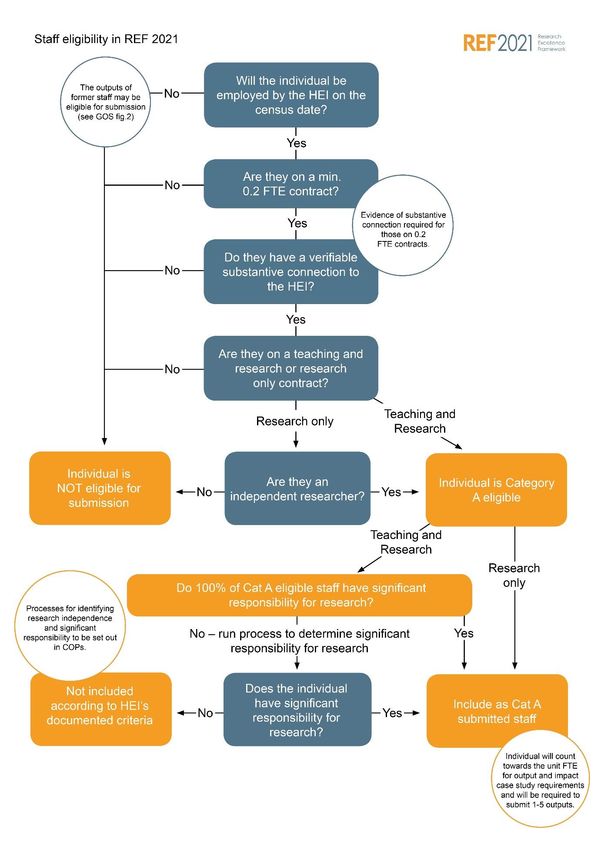
2.3.1 SRR Identification Stage 1 involved individual meetings with ALL academic/research
staff to identify all those who are Category A Eligible, ie: on an academic function of
Teaching & Research or Research Only (excluding Research Assistants). Individual
staff members met with their Research Director (RD) and Head of School (HoS) and were
asked to complete a pro-forma confirming the agreement reached on their academic
function (ie: Teaching & Research, Teaching Only or Research Only) and their REF2021
Unit of Assessment. Additionally, each individual was asked to provide feedback on what
they felt were the most appropriate SRR indicators for their discipline. As a result of the
feedback a draft list of SRR indicators was compiled and submitted for university-wide
consultation10 before being finalized for application in Stage 2 of the process.
2.3.2 SRR Identification Stage 2 involved meeting with ALL Category A Eligible staff (as
identified in Stage 1) and applying the agreed indicators of SRR in order to determine
Category A Submitted staff (ie: those with SRR). At the Stage 2 meetings members of
staff were asked to complete a pro-forma to record their agreed SRR status and indicating
which of the SRR indicators applied to them. Those members of staff who did not have
SRR were asked to clearly articulate the reason for this and sign the pro-forma.
Figure 1 below summarises the process for identifying staff with SRR.
10 See Appendix 1
18Category A Eligible
•Stage 1: Summer 2018 Staff •Spring 2019
•Trilateral research •Population of PURE REF
meetings with ALL Staff to •Stage 2: Winter 2018 Module with details of
determine Cat A Eligibility •Trilateral research Cat A Submitted staff (ie:
and consult on potential meetings with all Cat A SRR Staff)
SRR Indicators Eligible staff to discuss
SRR Status and apply SRR
All indicators
Category A Subitted
Academic/Research
Staff
Staff
Figure 1: Process for Identifying Staff with SRR
2.3.3 Default Status
In the event of a member of staff who does not engage in the SRR process either by not
attending a trilateral meeting or by not completing the SRR paperwork, every possible
means is employed to resolve the situation. If the situation still remains unresolved the
default status for staff on academic contracts is recorded as non-SRR and this is
communicated to the member of staff concerned, along with a copy of the Code of
Practice outlining the Appeals Process.
2.4 Categories of SRR Staff
Sections 2.4.1 to 2.4.3 below detail the three categories of SRR status (ie: SRR, SRR Pending
and non-SRR) and how these are recorded and monitored following the SRR trilateral meetings.
Upon receipt of a pro-forma signed by the relevant individual and co-signed by their HoS/RD
and/or Line Manager, SRR status is immediately recorded on CoreHR11 .
The SRR, SRR Pending or Non-SRR status of an individual will have NO impact on any
decisions relating to their future support, promotion, extension of contract or progression within
the institution.
11 The University’s Human Resource Database
192.4.1 SRR
SRR status for all individuals is entered in CoreHR and the details of all staff designated
as SRR are uploaded to the REF Module in PURE (the University’s central research
information management system) so that the process of identifying eligible REF outputs
can be instigated.
2.4.2 SRR Pending
The University has created an interim status of ‘SRR Pending’ for those staff who do
not meet a range of SRR indicators appropriate to their discipline at their initial SRR
trilateral meeting. For staff identified as SRR Pending the RD and HoS will agree a set
of clear, identifiable, measurable and manageable research expectations with the
individual and discuss the support available to him/her to achieve these expectations.
He/she will also be provided with a copy of the University’s Research Support
handbook12 which outlines the research support available to all researchers to support
them in their REF journey. A review date will be set for all SRR Pending staff following
their initial SRR meeting and this will be recorded by the Research Performance team
who will follow up on any change to status after the review date.
2.4.2.1 Review Meeting for Staff Recorded as SRR Pending
The majority of SRR meetings are expected to take place within the first 6
months of 2019 and all SRR Pending staff should have a review meeting as
early as possible in 2020 to ensure that any changes in status are notified to
the Research Performance team well in advance of the REF census date of 31st
July 2020. It is expected that the majority of SRR Pending review meetings
will take place in early 2020 and, for those whose initial SRR meeting did not
take place in early 2019, a review date of no later than May 2020 will be required
to ensure time for any changes to be made to the REF submission.
Following the SRR Pending review meeting, the member of staff will be
confirmed as one of the following two REF2021 categories: SRR or Non-SRR
in line with the REF Guidance on Submission. It is important to note that for
REF2021 staff can only be designated as SRR or non-SRR.
SRR Pending is a University category rather than a REF status. It is an
interim status which is designed to support those staff to achieve full SRR
status before the REF census date.
12 See Appendix 10
202.4.3 Non-SRR
For staff who are designated as Non-SRR the evidence of their Non-SRR status, which
is documented and signed off by the individual, is recorded and stored securely by the
Research Performance team. If, at any stage during their career, a Non-SRR member of
staff takes on more responsibility for research they will become SRR Pending and will be
provided with appropriate support and resource to help them achieve full SRR status.
Staff and Committees
This section of the code and associated appendices give an overview of Ulster University’s
structures for research and set out the operating criteria and terms of reference for individuals,
committees, advisory groups and any other bodies involved in the REF2021 advisory or
decision-making processes.
2.5 The Operational and Strategic Management of REF
The operational management and co-ordination of the REF submission occur through the
Research Performance Team reporting to the Pro-Vice-Chancellor for Research & Impact (PVC
(R&I)) (see Figure 2).
The Research and Impact Team
Pro-Vice-Chancellor (R&I)
&
Director for R&I
Research Research
Development Research Research Impact & Ethics & Doctoral
Management Performance Innovation Governance College
The strategic management of research activities relating to REF occurs through Research
Directors (RDs) reporting to Associate Deans for Research and Impact (ADRIs) who report in
turn to the PVC (R&I) and their respective Executive Dean (ED).
21Research is managed and led within the four Faculties by an Associate Dean for Research &
Impact (ADRI) and across a number of REF2021 Units of Assessment (UoAs), each led by a
Research Director (RD) who works closely with their respective Head of School (HoS) (see
Figure 3).
The Faculty Structure
Computing,
Arts, Humanities & Life & Health Ulster University
Engineering & the
Social Sciences Sciences Business School
Built Environment
Executive Dean Executive Dean Executive Dean Executive Dean
Associate Dean Associate Dean Associate Dean Associate Dean
(R&I) (R&I) (R&I) (R&I)
Research Research Research Research
Directors (with Directors (with Directors (with Directors (with
HoS) HoS) HoS) HoS)
2.6 Staff
See Appendix 4 for details of the roles and responsibilities of the REF2021 decision-
makers.
2.7 Committees
See Appendix 5 for details of the Terms of Reference and Membership of all REF-related
committees/groups.
Training
2.8 Training for Staff in Decision-Making Roles
(See also Section 1.7: Equality, Diversity and Inclusion Training)
Additionally, monthly forum meetings with ADRIs and RDs are used to focus on various aspects
of the REF Guidance, eg: Outputs, Impact, etc. and the forum meetings are also used to deliver
REF training and to share best practice in relation to REF activities.
22Appeals
2.9 Reasons for Appeal
Appeals can only be made where there is non-agreement of an individual’s Category A Eligible
or Category A Submitted status.
Appeals cannot be made in relation to the final selection of outputs for any individual.
2.9.1 Academic Staff: All academic staff who have a mutually agreed SSR status (ie: SRR,
Non-SRR or SRR Pending) are expected to have completed a pro-forma agreeing to
this designation. Where a member of staff does not agree an SRR status at the
trilateral meeting with his/her Research Director and Head of School, a further meeting
will be arranged to discuss this; if there is still no consensus on SRR status a meeting
will take place with the relevant ADRI and, if required, Executive Dean. If there is still
no agreement following the meetings the member of staff’s default status will be Non-
SRR and, at that stage, the member of staff may instigate the formal appeals process
(see Section 2.10).
2.9.2 Research Only Staff: All Research Only staff are required to meet the ‘independence’
criterion in order to be Category A Eligible. If a member of Research Only staff is
deemed to be an independent researcher and is Category A Eligible then he/she is
automatically SRR as their Research Only academic function denotes significant
research activity. Where there is a dispute over independence a meeting will be
arranged with the RD/HoS and if there is still no agreement an additional meeting will
be arranged with the relevant ADRI and, if required, the Executive Dean. If there is
still no agreement following the meetings, the member of staff’s default status will be
Ineligible and, at that stage, the member of staff may instigate the formal appeals
process (see Section 2.10).
2.10 Appeals Process
The appeals process is intended to be the means by which:
• academic staff can seek a review of the University’s decision to default their status to
Non-SRR as a result of non-agreement on their status; and
• research only staff can seek a review of the University’s decision to default their status
to Category A Ineligible as a result of non-agreement of their independent status.
23Appeals should be made in writing to the Pro-Vice-Chancellor (Education) by the individual
clearly stating the grounds on which they wish to make the appeal. The Pro-Vice-Chancellor
(Education) will convene an Appeals Panel comprising representation from P&C, R&I and a
Research Director from a Faculty other than that of the appellant. In setting up the panel due
regard will be paid to gender balance. Members of the Appeals Panel will be independent of
the REF decision-making processes and will be trained in equality legislation.
All appeals should normally be lodged within two weeks of the default designation. The Appeals
Panel will be convened and the individual will be informed of the decision of the Appeals Panel
by letter no later than two weeks from the date of the lodgement of the Appeal. A meeting will
also be offered should the individual wish to discuss the matter further with the Appeals Panel.
The decision of the Appeals Panel will be final.
Equality Impact Assessment
2.11 EIA on Identification of Staff with SRR
This section should be read in conjunction with section 1.8 which details our overall approach
and ethos in relation to EIAs.
The EIA on staff identified as having SRR will be informed by an analysis of data in respect of
all the protected characteristics of staff considered to meet the criteria for having SRR in the
context of all staff who are eligible for submission, and all academic/research staff.
As issues emerge from the EIAs we are committed to acting on the findings of the EIAs and,
where necessary, adapting or changing our processes to ensure equality of opportunity. We
view an EIA as an iterative process rather than a ‘one-off’ event. We will learn from EIAs and
make our processes better processes.
24PART 3: DETERMINING RESEARCH INDEPENDENCE
Policies and Procedures
3.1 Process for Determining Research Independence
All Research Only staff will be made aware of the REF2021 definition of independence and the
requirement for Research Only staff to be ‘independent researchers’ in order to be Category A
Eligible either via an individual research trilateral meeting with their RD and HoS (see Figure
1) or via a research group meeting. To ensure transparency and consistency all Research Only
staff will be provided with a briefing document on both REF2021 and the definition of
independence13. To ensure that all Research Only staff are full briefed, the Research
Performance team will provide RDs and HoS with a list of all Research Only Staff (excluding
Research Assistants) irrespective of contract end date. The Research Performance team will
also monitor all new starts and provide RDs and HoS with details of all new starts on a monthly
basis. As part of their local induction all Research Only new starts will be provided with the
REF2021 briefing document.
The onus will be on each member of Research Only staff to demonstrate, and provide evidence
of, their independence to their RD/HoS and complete a pro-forma14 confirming which of the
independence criteria they meet. If a Research Only member of staff is deemed to be
independent and therefore Category A Eligible then he/she is automatically SRR (ie: Category
A Submitted) as their combined independence and Research Only academic function
demonstrate significant research activity. As per Paragraph 2.4.1 their SRR status is recorded
on University systems (CoreHR and in the REF module in PURE). If a member of Research
Only staff does not provide evidence of independence, they are deemed to be Category A
Ineligible.
3.2 Staff, Committees and Training
Please see Part 2, Sections 2.5 to 2.8 for details of Staff, Committees and Training.
3.3 Appeals
The appeal process and the appeal panel on issues of research independence will be
identical to that for SRR (see section 2.9 to 2.10 above).
13 See Appendix 6
14 See Appendix 6
25Equality Impact Assessment
3.4 EIA on the Identification of Independent Researchers
This section should be read in conjunction with section 1.8 which details our overall approach
and ethos in relation to EIAs.
The EIA on staff who meet the definition of an independent researcher will be informed by an
analysis of data in respect of all the protected characteristics of staff who meet the definition of
an independent researcher in the context of an appropriate comparator pool for all Research
Only staff (excluding Research Assistants).
As issues emerge from the EIAs we are committed to acting on the findings of the EIAs and,
where necessary, adapting or changing our processes to ensure equality of opportunity. We
view an EIA as an iterative process rather than a ‘one-off’ event. We will learn from EIAs and
make our processes better processes.
26PART 4: SELECTION OF OUTPUTS
Policies and Procedures
4.1 Selection of Outputs for REF2021
The following paragraphs detail the University’s process for identifying eligible research
outputs and for ensuring a fair approach to the final selection of outputs for inclusion in
the REF2021 Submission.
The overriding principle in the selection of outputs is that each Category A Submitted member
of staff is submitted with one output and the selection of the remaining outputs is based solely
on the quality of the remaining outputs within the total pool of proposed outputs to maximise the
REF return for the UoA.
The development of each REF submission and the list of outputs to be included is an
incremental process and the final submission evolves through the regular REF Review
meetings chaired by the PVC (R&I) and involving the EDs, ADRIs, RDs and HoS.
Research outputs are evaluated throughout the REF cycle with decisions made about the final
selection of outputs when the actual output profile of the UoA as a whole is clear. Internal peer
review of outputs by RDs and relevant discipline experts is routine and the use of additional
external peer judgements and metrics is recommended where appropriate. A 13 point rating
scale has been implemented in the PURE REF module ranging from -1*, 1*, +1* … -4*, 4*,
+4*) and is used to rate each output. Where there is no distinction in terms of quality between
2 outputs additional metrics will be brought into play where appropriate and these metrics will
be provided by the University’s Research Support Librarian. Reviewers and advisors are
selected on the basis of relevant research expertise and experience in the field. Feedback to
researchers regarding the assessment of individual outputs will be concise and constructive.
The outcomes of the reviews will be used to inform modelling exercises which will help
determine the optimal UoA submission.
4.2 Process for the Identification of Eligible Research Outputs for Category A
Submitted Staff
The PURE15 REF2021 module is used to manage the University’s REF submission including
the identification, selection and rating of research outputs.
15 PURE Is the University’s publication repository and central research information management system.
27In the spirit of openness and transparency all staff who have been defined as SRR (ie: Category
A Submitted) are invited to propose the research outputs they wish to be considered for REF
via the PURE REF Module and each member of SRR staff is provided with a step-by-step guide
on how to do this. When an SRR member of staff logs in to their PURE profile they see an
additional tab called ‘Propose Outputs for REF2021’. This view lists all their REF-eligible
research outputs and is automatically limited to the REF2021 publication period (1 January
2014 – 31 December 2020). The member of staff can propose as many outputs as he/she
wishes and has the option to rank these and provide additional commentary on each of them.
Once the outputs of all SRR staff are proposed the relevant Research Director is able to see
the total pool of outputs proposed for consideration for REF2021. In cases where a member of
SRR staff does not propose an eligible output which the RD feels should be considered then
the RD can request that the additional output be added to the proposed pool. If a SRR member
of staff is absent long-term the Research Performance team can populate the REF module with
his/her eligible outputs so that the RD can have access to these and this will be communicated
to the absent member of staff.
Research
•Spring 2019 - SRR staff propose Directors •2019-20 - all SRR staff are
eligible research outputs for allocated a minimum of one
inclusion in REF2021 through •April/May 2019 - RDs (together output and the selection of the
the REF Module in PURE with ADRIs and HoS) look at remaining outputs is based
the total pool of proposed solely on the quality of the
outputs for each UoA available pool of proposed
outputs.
Final Selection of
All SRR Staff
Outputs agreed
Figure 3: Process for the Identification of Eligible Outputs and the final Selection of REF2021 Outputs
4.3 Process for the Identification of Research Outputs of Former Staff
For REF2021 the guidance allows for outputs in the submitted pool to be attributed to
former staff provided that the output was first made publicly available while the staff
member was employed by the institution as a Category A Eligible member of staff.
28You can also read


